International Journal of Trend in Scientific Research and Development (IJTSRD)
Volume 5 Issue 4, May-June 2021 Available Online: www.ijtsrd.com e-ISSN: 2456 – 6470
@ IJTSRD | Unique Paper ID – IJTSRD42333 | Volume – 5 | Issue – 4 | May-June 2021 Page 465
Impact of GST on Different Classes
Dr. Sumit Trivedi
Assistant Professor, Choithram College of Professional Studies, Madhya Pradesh, India
ABSTRACT
GST came to India as a medicine that would treat taxable diseases at one go. It
was described by economists as the biggest economic reform after
independence. Till the year 2017 indirect tax structure in India wasa complex
mixture of central taxes and state taxes, here different types of taxes were
levied at different stages, which made the tax structure difficult and most of
the taxes were not adjusted for this system tax. Increases effect such as taxes
on taxes that increase the value of products and services. This economic
reform is extremely essential for an emerging economic power like India.
Impact of The last deputy speaker from the government, the government and
the economy will present its influence in both positive and negative forms.
This research of mine will throw light on the study of these two sides.
KEYWORDS: Tax structure, Cascading Effect, Economic Power
How to cite this paper: Dr. Sumit Trivedi
"Impact of GST on Different Classes"
Published in
International Journal
of Trend in Scientific
Research and
Development(ijtsrd),
ISSN: 2456-6470,
Volume-5 | Issue-4,
June 2021, pp.465-
466, URL:
www.ijtsrd.com/papers/ijtsrd42333.pdf
Copyright © 2021 by author (s) and
International Journal ofTrendinScientific
Research and Development Journal. This
is an Open Access article distributed
under the terms of
the Creative
Commons Attribution
License (CC BY 4.0)
(http://creativecommons.org/licenses/by/4.0)
INTRODUCTION
It is a direct tax which is a tax made by combining
various central and state taxes. Introduction this is a
significant economic reform for an emerging economic
power like India and “One Nation One Tax” is the correct
statement for GST, GST. There are a Goods and Services
Tax. It is a tax that the manufacturer has the right to
impose on the fulfillment of the goods and services of the
end consumer. It is a complete tax which is levied on
every price increase on the basis of multiplicity. Payment
will be made on stage.
GST History of:-
GST The biggest change in India's tax system was made in
2005, when sales tax was passed by V.A.T. could not end the
tax imposed system in India. GST in about 165 countries of
the world The GST is applicable at the rate of 15% in New
Zealand, 10% in Australia, 19.6% in France, 19% in
Germany, 19% in Sweden and 25% in Denmark and even in
Pakistan. Is applicable
The foundation of GST was laid 16 years ago in the
government of Atal Bihari Vajpayee. After this, Finance
Minister, Honorable P. Chidambaram implemented GST.
In Budget 2010 during the UPA government in the year
2007 was offered to GST. The responsibility of the
implementation of its design and preparation of the road
map was the responsibility of the State Finance Minister
of the authorized committee. The Empowered Committee
presented the report of model and road map for goods
and services tax in India, which Kendra took GST from
accept. In the introduction of th Constitution
amendments were made. Accordingly, the center was
empowered to levy tax and the state was empowered to
levy tax.
In the category of events, when the government gave the
first draft of the GST model in 2016, commentary
feedback was received across the country. GST
incorporating suggestions The Model Law has been
amended and released in November 2016, in 2017, the
GST. All four bills related to the Lok Sabha were passed
in the Lok Sabha.
Hence GST Implemented across the country from midnight
of 30 June 2017 with this, "One Country One Tax" was
converted into par under which tax rates were fixed at 0%,
5%, 12%, 18% and 28%.
GST in India:-
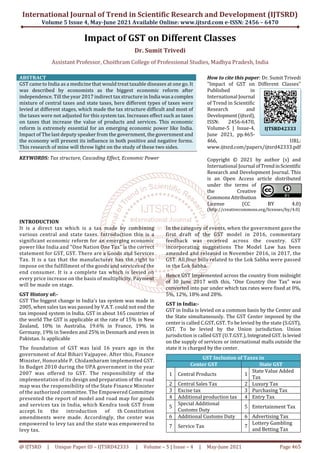
GST in India is levied on a common basis by the Center and
the State simultaneously. The GST Center imposed by the
center is called C.GST, GST. To be levied by the state (S.GST),
GST. To be levied by the Union jurisdiction. Union
jurisdiction is called GST (U.T.GST.),IntegratedGST.Islevied
on the supply of services or international malls outside the
state it is charged by the center.
GST Inclusion of Taxes in
Center GST State GST
1 Central Products 1
State Value Added
Tax
2 Central Sales Tax 2 Luxury Tax
3 Excise tax 3 Purchasing Tax
4 Additional production tax 4 Entry Tax
5
Special Additional
Customs Duty
5 Entertainment Tax
6 Additional Customs Duty 6 Advertising Tax
7 Service Tax 7
Lottery Gambling
and Betting Tax
IJTSRD42333
International Journal of Trend in Scientific Research and Development (IJTSRD) @ www.ijtsrd.com eISSN: 2456-6470
@ IJTSRD | Unique Paper ID – IJTSRD42333 | Volume – 5 | Issue – 4 | May-June 2021 Page 466
Effect of GST:-
GST will make India's economy a country with a tax
economy. Experts are of the opinion that GS in the country
With the implementation of T, GDP growth will increase by2
to 3 percent and around 132 crore people of the country will
pay only one kind of tax on services and goodsandthe entire
structure of tax collection will become very transparent.
In the indirect tax regime, the end consumer has to bear the
tax burden. But the tax is collected by the businessmen. The
businessman collects the tax fromtheconsumeranddeducts
his input credit from it and submits the rest to the
government. GST has been seen to have a mixedandpositive
impact on the whole of India. Which can be understood as
follows?
Positive impact:-
GST this will ensure that indirect tax rates and
structures remain the same throughout the country.
This will increase the certainty and make it easier to
trade.
Industries are yet to file 18 different types of taxes. But
with the implementation of GST, industries will save
time and money.
GST will prove to be very profitable for the technology
industry as it will eliminate many levies, this will leadto
expansion of digital services.
Single and transparent tax system in proportion to the
value of goods and services will be applicable in the
country.
Increased efficiency and ban on malpractices will
reduce the overall tax burden on most consumer goods
which will benefit consumers.
GST Negative effects of:-
GST In another way it has a negative effect, it has
become easier to do business between the states, it is
being specially takenadvantageofbythelargecompany,
due to this, the problems of small industries have
increased, due to the outskirts of the states, they have a
natural away from the big companies established far
away. Protection which has now expired
This experience is also being appliedbytheeconomist.If
applicable, the cost of buying a house will increase by
8% and those who buy a house will decrease by 12%.
About 60% of India's gross domestic product comes
from the service sector. At present, service tax at the
rate of 14.5% in India was considered, which is GST. It
will increase to 18% after implementation.
In the banking and financial sector, the effective tax rate
was 14%, till now, this tax is only charged on the
transaction and there was no tax on interest but GST.
After implementation, thetaxonthissectorwill increase
by 18 to 20%. That is, processing fees,debit/creditcard
fees, charges on insurance premium will increase.
Conclusion:-
The tax system is the backbone of the economic system of
any nation. The stronger the economic structure, the
stronger it will be. In this reflection, GST If we look at the
international experiences related to it, there have been
positive and encouraging results. These economic reforms
are indispensableforanemerging economicpowerlikeIndia
and this reform of the tax system will also help in the
creation of a better competitive environment for trade and
investment at domestic and international level. _
Taking the consent of the Center and the States on the
provisions related to the Goods and Services Tax, it seems
credible to the future by applying it.
Reference:-
[1] https://gshindi.com
[2] www.m.jagranjosh.com
[3] www.hindinotes.org

Impact of GST on Different Classes

  • 1.
    International Journal ofTrend in Scientific Research and Development (IJTSRD) Volume 5 Issue 4, May-June 2021 Available Online: www.ijtsrd.com e-ISSN: 2456 – 6470 @ IJTSRD | Unique Paper ID – IJTSRD42333 | Volume – 5 | Issue – 4 | May-June 2021 Page 465 Impact of GST on Different Classes Dr. Sumit Trivedi Assistant Professor, Choithram College of Professional Studies, Madhya Pradesh, India ABSTRACT GST came to India as a medicine that would treat taxable diseases at one go. It was described by economists as the biggest economic reform after independence. Till the year 2017 indirect tax structure in India wasa complex mixture of central taxes and state taxes, here different types of taxes were levied at different stages, which made the tax structure difficult and most of the taxes were not adjusted for this system tax. Increases effect such as taxes on taxes that increase the value of products and services. This economic reform is extremely essential for an emerging economic power like India. Impact of The last deputy speaker from the government, the government and the economy will present its influence in both positive and negative forms. This research of mine will throw light on the study of these two sides. KEYWORDS: Tax structure, Cascading Effect, Economic Power How to cite this paper: Dr. Sumit Trivedi "Impact of GST on Different Classes" Published in International Journal of Trend in Scientific Research and Development(ijtsrd), ISSN: 2456-6470, Volume-5 | Issue-4, June 2021, pp.465- 466, URL: www.ijtsrd.com/papers/ijtsrd42333.pdf Copyright © 2021 by author (s) and International Journal ofTrendinScientific Research and Development Journal. This is an Open Access article distributed under the terms of the Creative Commons Attribution License (CC BY 4.0) (http://creativecommons.org/licenses/by/4.0) INTRODUCTION It is a direct tax which is a tax made by combining various central and state taxes. Introduction this is a significant economic reform for an emerging economic power like India and “One Nation One Tax” is the correct statement for GST, GST. There are a Goods and Services Tax. It is a tax that the manufacturer has the right to impose on the fulfillment of the goods and services of the end consumer. It is a complete tax which is levied on every price increase on the basis of multiplicity. Payment will be made on stage. GST History of:- GST The biggest change in India's tax system was made in 2005, when sales tax was passed by V.A.T. could not end the tax imposed system in India. GST in about 165 countries of the world The GST is applicable at the rate of 15% in New Zealand, 10% in Australia, 19.6% in France, 19% in Germany, 19% in Sweden and 25% in Denmark and even in Pakistan. Is applicable The foundation of GST was laid 16 years ago in the government of Atal Bihari Vajpayee. After this, Finance Minister, Honorable P. Chidambaram implemented GST. In Budget 2010 during the UPA government in the year 2007 was offered to GST. The responsibility of the implementation of its design and preparation of the road map was the responsibility of the State Finance Minister of the authorized committee. The Empowered Committee presented the report of model and road map for goods and services tax in India, which Kendra took GST from accept. In the introduction of th Constitution amendments were made. Accordingly, the center was empowered to levy tax and the state was empowered to levy tax. In the category of events, when the government gave the first draft of the GST model in 2016, commentary feedback was received across the country. GST incorporating suggestions The Model Law has been amended and released in November 2016, in 2017, the GST. All four bills related to the Lok Sabha were passed in the Lok Sabha. Hence GST Implemented across the country from midnight of 30 June 2017 with this, "One Country One Tax" was converted into par under which tax rates were fixed at 0%, 5%, 12%, 18% and 28%. GST in India:- GST in India is levied on a common basis by the Center and the State simultaneously. The GST Center imposed by the center is called C.GST, GST. To be levied by the state (S.GST), GST. To be levied by the Union jurisdiction. Union jurisdiction is called GST (U.T.GST.),IntegratedGST.Islevied on the supply of services or international malls outside the state it is charged by the center. GST Inclusion of Taxes in Center GST State GST 1 Central Products 1 State Value Added Tax 2 Central Sales Tax 2 Luxury Tax 3 Excise tax 3 Purchasing Tax 4 Additional production tax 4 Entry Tax 5 Special Additional Customs Duty 5 Entertainment Tax 6 Additional Customs Duty 6 Advertising Tax 7 Service Tax 7 Lottery Gambling and Betting Tax IJTSRD42333
  • 2.
    International Journal ofTrend in Scientific Research and Development (IJTSRD) @ www.ijtsrd.com eISSN: 2456-6470 @ IJTSRD | Unique Paper ID – IJTSRD42333 | Volume – 5 | Issue – 4 | May-June 2021 Page 466 Effect of GST:- GST will make India's economy a country with a tax economy. Experts are of the opinion that GS in the country With the implementation of T, GDP growth will increase by2 to 3 percent and around 132 crore people of the country will pay only one kind of tax on services and goodsandthe entire structure of tax collection will become very transparent. In the indirect tax regime, the end consumer has to bear the tax burden. But the tax is collected by the businessmen. The businessman collects the tax fromtheconsumeranddeducts his input credit from it and submits the rest to the government. GST has been seen to have a mixedandpositive impact on the whole of India. Which can be understood as follows? Positive impact:- GST this will ensure that indirect tax rates and structures remain the same throughout the country. This will increase the certainty and make it easier to trade. Industries are yet to file 18 different types of taxes. But with the implementation of GST, industries will save time and money. GST will prove to be very profitable for the technology industry as it will eliminate many levies, this will leadto expansion of digital services. Single and transparent tax system in proportion to the value of goods and services will be applicable in the country. Increased efficiency and ban on malpractices will reduce the overall tax burden on most consumer goods which will benefit consumers. GST Negative effects of:- GST In another way it has a negative effect, it has become easier to do business between the states, it is being specially takenadvantageofbythelargecompany, due to this, the problems of small industries have increased, due to the outskirts of the states, they have a natural away from the big companies established far away. Protection which has now expired This experience is also being appliedbytheeconomist.If applicable, the cost of buying a house will increase by 8% and those who buy a house will decrease by 12%. About 60% of India's gross domestic product comes from the service sector. At present, service tax at the rate of 14.5% in India was considered, which is GST. It will increase to 18% after implementation. In the banking and financial sector, the effective tax rate was 14%, till now, this tax is only charged on the transaction and there was no tax on interest but GST. After implementation, thetaxonthissectorwill increase by 18 to 20%. That is, processing fees,debit/creditcard fees, charges on insurance premium will increase. Conclusion:- The tax system is the backbone of the economic system of any nation. The stronger the economic structure, the stronger it will be. In this reflection, GST If we look at the international experiences related to it, there have been positive and encouraging results. These economic reforms are indispensableforanemerging economicpowerlikeIndia and this reform of the tax system will also help in the creation of a better competitive environment for trade and investment at domestic and international level. _ Taking the consent of the Center and the States on the provisions related to the Goods and Services Tax, it seems credible to the future by applying it. Reference:- [1] https://gshindi.com [2] www.m.jagranjosh.com [3] www.hindinotes.org