MODULE 4
• Convergence between IFRS and US
GAAP
• Benefits of IFRS over the Indian
GAAP
• IFRS in India
• Benefits of IFRS in India
• Challenges in implementation of
IFRS in India
Convergence between IFRS and US GAAP
• The IASB and the US Financial Accounting Standards Board (FASB) have been
working together since 2002 to achieve convergence of IFRSs and US Generally
Accepted Accounting Principles (GAAP).
• In September 2002 the IASB and the FASB agreed to work together, in
consultation with other national and regional bodies, to remove the
differences between international standards and US GAAP. This decision was
embodied in a Memorandum of Understanding (MoU) between the boards
known as the Norwalk Agreement.
• US Securities and Exchange Commission (SEC) removed in 2007 the
requirement for non-US companies registered in the US to reconcile their
financial reports with US GAAP if their accounts complied with IFRSs as issued
by a proposed road map on adoption of IFRSs for domestic US companies.
• The Group of 20 Leaders (G20) called for standard setters to re-double their
efforts to complete convergence in global accounting standards.
• In April 2012 the IASB and FASB published a joint progress report in which they
describe the progress made on financial instruments, including a joint
expected loss impairment (‘provisioning’) approach.
• In February 2013 the IASB and FASB published a high level update on the
status and timeline of the remaining convergence projects.
IFRS in India
• India being one of the global players, migration to IFRS will
enable Indian entities to have access to international capital
markets without having to go through the cumbersome
conversion and filing process.
• It will lower the cost of raising funds, reduce accountants’’
fees and enable faster access to all major capital markets.
Furthermore it will facilitate companies to set targets and
milestones based on a global business environment rather
than an inward perspective.
• It will enable management to bring all components of the
group into a single financial reporting platform. This will
eliminate the need for multiple reports and significant
adjustment for preparing consolidated financial statements
or filing financial statements in different stock exchanges.
Benefits of IFRS over the Indian GAAP
1. Improve transparency in accounting
system.
2. Globally accepted.
3. New opportunity.
4. Allows exercise of professional judgement.
5. IFRS are increasingly being recognised as Global
Reporting Standards for financial statements.
6. Indian GAAP is becoming rare because it has some
limitations in comparison with IFRS.
7. As global capital markets become increasingly
integrated, many countries are adopting IFRs.
8. More than 100 countries already permit the use of
IFRS in their countries.
Benefits of IFRS in India
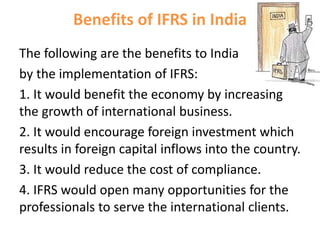
The following are the benefits to India
by the implementation of IFRS:
1. It would benefit the economy by increasing
the growth of international business.
2. It would encourage foreign investment which
results in foreign capital inflows into the country.
3. It would reduce the cost of compliance.
4. IFRS would open many opportunities for the
professionals to serve the international clients.
Challenges in implementation of IFRS
in India
There are certain challenges in implementation of IFRS in India. They
include:
1. Increase in cost initially due to dual reporting requirement, which
entity might have to meet till the full convergence is achieved.
2. Current accounting framework in India is deeply affected by laws
and regulations. It is required to make amendments in various laws
and regulations.
3. All stakeholders, employees, auditors, regulators, tax authorities etc.
would need to aware about IFRS. They need to be trained.
4. Organisations would incur additional costs for modifying their
current accounting procedures for meeting the new disclosures and
reporting requirements.
Indian ifrs

Indian ifrs

  • 1.
    MODULE 4 • Convergencebetween IFRS and US GAAP • Benefits of IFRS over the Indian GAAP • IFRS in India • Benefits of IFRS in India • Challenges in implementation of IFRS in India
  • 2.
    Convergence between IFRSand US GAAP • The IASB and the US Financial Accounting Standards Board (FASB) have been working together since 2002 to achieve convergence of IFRSs and US Generally Accepted Accounting Principles (GAAP). • In September 2002 the IASB and the FASB agreed to work together, in consultation with other national and regional bodies, to remove the differences between international standards and US GAAP. This decision was embodied in a Memorandum of Understanding (MoU) between the boards known as the Norwalk Agreement. • US Securities and Exchange Commission (SEC) removed in 2007 the requirement for non-US companies registered in the US to reconcile their financial reports with US GAAP if their accounts complied with IFRSs as issued by a proposed road map on adoption of IFRSs for domestic US companies. • The Group of 20 Leaders (G20) called for standard setters to re-double their efforts to complete convergence in global accounting standards. • In April 2012 the IASB and FASB published a joint progress report in which they describe the progress made on financial instruments, including a joint expected loss impairment (‘provisioning’) approach. • In February 2013 the IASB and FASB published a high level update on the status and timeline of the remaining convergence projects.
  • 3.
    IFRS in India •India being one of the global players, migration to IFRS will enable Indian entities to have access to international capital markets without having to go through the cumbersome conversion and filing process. • It will lower the cost of raising funds, reduce accountants’’ fees and enable faster access to all major capital markets. Furthermore it will facilitate companies to set targets and milestones based on a global business environment rather than an inward perspective. • It will enable management to bring all components of the group into a single financial reporting platform. This will eliminate the need for multiple reports and significant adjustment for preparing consolidated financial statements or filing financial statements in different stock exchanges.
  • 4.
    Benefits of IFRSover the Indian GAAP 1. Improve transparency in accounting system. 2. Globally accepted. 3. New opportunity. 4. Allows exercise of professional judgement. 5. IFRS are increasingly being recognised as Global Reporting Standards for financial statements. 6. Indian GAAP is becoming rare because it has some limitations in comparison with IFRS. 7. As global capital markets become increasingly integrated, many countries are adopting IFRs. 8. More than 100 countries already permit the use of IFRS in their countries.
  • 5.
    Benefits of IFRSin India The following are the benefits to India by the implementation of IFRS: 1. It would benefit the economy by increasing the growth of international business. 2. It would encourage foreign investment which results in foreign capital inflows into the country. 3. It would reduce the cost of compliance. 4. IFRS would open many opportunities for the professionals to serve the international clients.
  • 6.
    Challenges in implementationof IFRS in India There are certain challenges in implementation of IFRS in India. They include: 1. Increase in cost initially due to dual reporting requirement, which entity might have to meet till the full convergence is achieved. 2. Current accounting framework in India is deeply affected by laws and regulations. It is required to make amendments in various laws and regulations. 3. All stakeholders, employees, auditors, regulators, tax authorities etc. would need to aware about IFRS. They need to be trained. 4. Organisations would incur additional costs for modifying their current accounting procedures for meeting the new disclosures and reporting requirements.