PREPARED BY
DR.R.RUPA
NON PERFORMING ASSETS
(NPA)
Non Performing Asset (NPA)
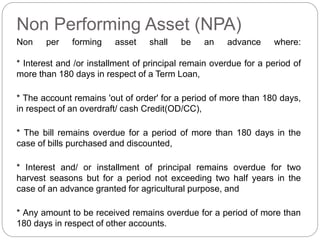
Non per forming asset shall be an advance where:
* Interest and /or installment of principal remain overdue for a period of
more than 180 days in respect of a Term Loan,
* The account remains 'out of order' for a period of more than 180 days,
in respect of an overdraft/ cash Credit(OD/CC),
* The bill remains overdue for a period of more than 180 days in the
case of bills purchased and discounted,
* Interest and/ or installment of principal remains overdue for two
harvest seasons but for a period not exceeding two half years in the
case of an advance granted for agricultural purpose, and
* Any amount to be received remains overdue for a period of more than
180 days in respect of other accounts.
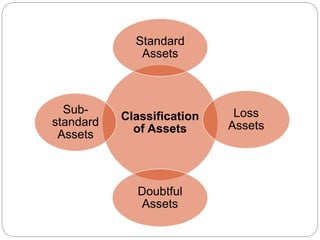
Classification
of Assets
Standard
Assets
Loss
Assets
Doubtful
Assets
Sub-
standard
Assets
Types of NPA
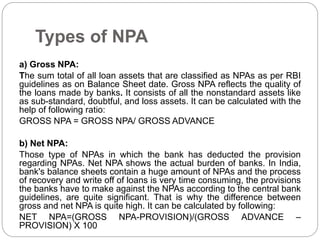
a) Gross NPA:
The sum total of all loan assets that are classified as NPAs as per RBI
guidelines as on Balance Sheet date. Gross NPA reflects the quality of
the loans made by banks. It consists of all the nonstandard assets like
as sub-standard, doubtful, and loss assets. It can be calculated with the
help of following ratio:
GROSS NPA = GROSS NPA/ GROSS ADVANCE
b) Net NPA:
Those type of NPAs in which the bank has deducted the provision
regarding NPAs. Net NPA shows the actual burden of banks. In India,
bank's balance sheets contain a huge amount of NPAs and the process
of recovery and write off of loans is very time consuming, the provisions
the banks have to make against the NPAs according to the central bank
guidelines, are quite significant. That is why the difference between
gross and net NPA is quite high. It can be calculated by following:
NET NPA=(GROSS NPA-PROVISION)/(GROSS ADVANCE –
PROVISION) X 100
Reasons for an account becoming
NPA:
1) Internal Factors:
 Funds borrowed for a particular purpose but not use for the said
purpose.
Project not completed in time.
 Poor recovery of receivables.
 Excess capacities created on non-economic costs.
 In-ability of the corporate to raise capital through the issue of equity
or other debt instrument from capital markets.
 Business failures.
 Diversion of funds for expansionmodernizationsetting up new
projects helping or promoting sister concerns.
 Willful defaults, siphoning of funds, fraud, disputes, management
disputes, misappropriation etc.
 Deficiencies on the part of the banks viz. in credit appraisal,
monitoring and follow-ups, delaying settlement of payments
subsidiaries by government bodies etc.,
2) External Factors:
 Sluggish Legal System i.e. long legal tangles, changes that
had taken place in labour laws & lack of sincere effort.
 Scarcity of raw material, power and other resources.
Industrial Recession.
 Shortage of raw material, raw material / input price
escalation, power shortage, industrial recession, excess
capacity, natural calamities like floods, accidents.
 Failures, nonpayment over dues in other countries,
recession in other countries, externalization problems,
adverse exchange rates etc.
 Government policies like excise duty changes, Import duty
changes etc.
Reasons for Occurrence of
NPAs
These loans can occur due to the following reasons:
 Normal banking operations
 Bad lending practices
 Incremental component (due to internal bank
management, like credit policy, terms of credit, etc...)
 Competition banks are enormously selling unsecured
loans
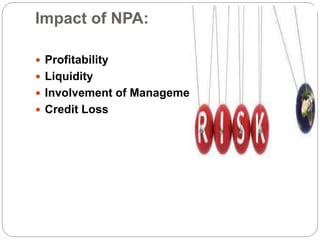
Impact of NPA:
 Profitability
 Liquidity
 Involvement of Management
 Credit Loss
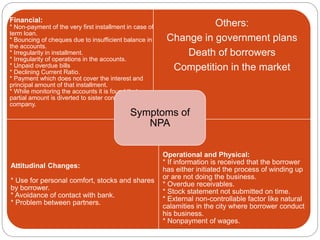
Financial:
* Non-payment of the very first installment in case of
term loan.
* Bouncing of cheques due to insufficient balance in
the accounts.
* Irregularity in installment.
* Irregularity of operations in the accounts.
* Unpaid overdue bills
* Declining Current Ratio.
* Payment which does not cover the interest and
principal amount of that installment.
* While monitoring the accounts it is found that
partial amount is diverted to sister concern or parent
company.
Others:
Change in government plans
Death of borrowers
Competition in the market
Attitudinal Changes:
* Use for personal comfort, stocks and shares
by borrower.
* Avoidance of contact with bank.
* Problem between partners.
Operational and Physical:
* If information is received that the borrower
has either initiated the process of winding up
or are not doing the business.
* Overdue receivables.
* Stock statement not submitted on time.
* External non-controllable factor like natural
calamities in the city where borrower conduct
his business.
* Nonpayment of wages.
Symptoms of
NPA
How to reduce NPA?
Some steps are as follows by which bank can reduce NPA -
1. SARFAESI ACT 2002 - The Securitisation and
Reconstruction of Financial Assets and Enforcement of
Security Interest Act, 2002 (SARFAESI) empowers Banks /
Financial Institutions to recover their non-performing assets
without the intervention of the Court.
2. Lok Adalats: Lok Adalat is for the recovery of small loans.
According to RBI guidelines issued in 2001, they cover NPA up
to Rs. 5 lakhs, both suit filed and non-suit filed are covered.
3. Compromise Settlement: It is a scheme which provides a
simple mechanism for recovery of NPA. It is applied to advances
below Rs. 10 Crores.
4. Credit Information Bureau: A Credit Information Bureau help
banks by maintaining a data of an individual defaulter and
provides this information to all banks so that they may avoid
lending to him/her.
5. Debt Recovery Tribunals: The debt recovery tribunal act was
passed by Indian Parliament in 1993 with the objective of
facilitating the banks and financial institutions for speedy
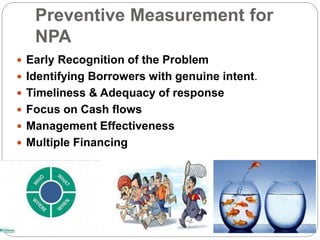
Preventive Measurement for
NPA
 Early Recognition of the Problem
 Identifying Borrowers with genuine intent.
 Timeliness & Adequacy of response
 Focus on Cash flows
 Management Effectiveness
 Multiple Financing
THANK YOU

Non performing assets (npa)

  • 1.
  • 2.
    Non Performing Asset(NPA) Non per forming asset shall be an advance where: * Interest and /or installment of principal remain overdue for a period of more than 180 days in respect of a Term Loan, * The account remains 'out of order' for a period of more than 180 days, in respect of an overdraft/ cash Credit(OD/CC), * The bill remains overdue for a period of more than 180 days in the case of bills purchased and discounted, * Interest and/ or installment of principal remains overdue for two harvest seasons but for a period not exceeding two half years in the case of an advance granted for agricultural purpose, and * Any amount to be received remains overdue for a period of more than 180 days in respect of other accounts.
  • 3.
  • 4.
    Types of NPA a)Gross NPA: The sum total of all loan assets that are classified as NPAs as per RBI guidelines as on Balance Sheet date. Gross NPA reflects the quality of the loans made by banks. It consists of all the nonstandard assets like as sub-standard, doubtful, and loss assets. It can be calculated with the help of following ratio: GROSS NPA = GROSS NPA/ GROSS ADVANCE b) Net NPA: Those type of NPAs in which the bank has deducted the provision regarding NPAs. Net NPA shows the actual burden of banks. In India, bank's balance sheets contain a huge amount of NPAs and the process of recovery and write off of loans is very time consuming, the provisions the banks have to make against the NPAs according to the central bank guidelines, are quite significant. That is why the difference between gross and net NPA is quite high. It can be calculated by following: NET NPA=(GROSS NPA-PROVISION)/(GROSS ADVANCE – PROVISION) X 100
  • 5.
    Reasons for anaccount becoming NPA: 1) Internal Factors:  Funds borrowed for a particular purpose but not use for the said purpose. Project not completed in time.  Poor recovery of receivables.  Excess capacities created on non-economic costs.  In-ability of the corporate to raise capital through the issue of equity or other debt instrument from capital markets.  Business failures.  Diversion of funds for expansionmodernizationsetting up new projects helping or promoting sister concerns.  Willful defaults, siphoning of funds, fraud, disputes, management disputes, misappropriation etc.  Deficiencies on the part of the banks viz. in credit appraisal, monitoring and follow-ups, delaying settlement of payments subsidiaries by government bodies etc.,
  • 6.
    2) External Factors: Sluggish Legal System i.e. long legal tangles, changes that had taken place in labour laws & lack of sincere effort.  Scarcity of raw material, power and other resources. Industrial Recession.  Shortage of raw material, raw material / input price escalation, power shortage, industrial recession, excess capacity, natural calamities like floods, accidents.  Failures, nonpayment over dues in other countries, recession in other countries, externalization problems, adverse exchange rates etc.  Government policies like excise duty changes, Import duty changes etc.
  • 7.
    Reasons for Occurrenceof NPAs These loans can occur due to the following reasons:  Normal banking operations  Bad lending practices  Incremental component (due to internal bank management, like credit policy, terms of credit, etc...)  Competition banks are enormously selling unsecured loans
  • 8.
    Impact of NPA: Profitability  Liquidity  Involvement of Management  Credit Loss
  • 9.
    Financial: * Non-payment ofthe very first installment in case of term loan. * Bouncing of cheques due to insufficient balance in the accounts. * Irregularity in installment. * Irregularity of operations in the accounts. * Unpaid overdue bills * Declining Current Ratio. * Payment which does not cover the interest and principal amount of that installment. * While monitoring the accounts it is found that partial amount is diverted to sister concern or parent company. Others: Change in government plans Death of borrowers Competition in the market Attitudinal Changes: * Use for personal comfort, stocks and shares by borrower. * Avoidance of contact with bank. * Problem between partners. Operational and Physical: * If information is received that the borrower has either initiated the process of winding up or are not doing the business. * Overdue receivables. * Stock statement not submitted on time. * External non-controllable factor like natural calamities in the city where borrower conduct his business. * Nonpayment of wages. Symptoms of NPA
  • 10.
    How to reduceNPA? Some steps are as follows by which bank can reduce NPA - 1. SARFAESI ACT 2002 - The Securitisation and Reconstruction of Financial Assets and Enforcement of Security Interest Act, 2002 (SARFAESI) empowers Banks / Financial Institutions to recover their non-performing assets without the intervention of the Court. 2. Lok Adalats: Lok Adalat is for the recovery of small loans. According to RBI guidelines issued in 2001, they cover NPA up to Rs. 5 lakhs, both suit filed and non-suit filed are covered. 3. Compromise Settlement: It is a scheme which provides a simple mechanism for recovery of NPA. It is applied to advances below Rs. 10 Crores. 4. Credit Information Bureau: A Credit Information Bureau help banks by maintaining a data of an individual defaulter and provides this information to all banks so that they may avoid lending to him/her. 5. Debt Recovery Tribunals: The debt recovery tribunal act was passed by Indian Parliament in 1993 with the objective of facilitating the banks and financial institutions for speedy
  • 11.
    Preventive Measurement for NPA Early Recognition of the Problem  Identifying Borrowers with genuine intent.  Timeliness & Adequacy of response  Focus on Cash flows  Management Effectiveness  Multiple Financing
  • 12.