Goods and Services
Tax
ABHISHEK KUMAR SINGH
 GST is a revolutionary tax reform and it is going to replace indirect taxes applicable in our
country.
 Taxes can be divided into 2 broad categories :
 Direct and indirect taxes
 Direct taxes are imposed on to the person and are paid to the government by the tax payer
himself, example income tax .
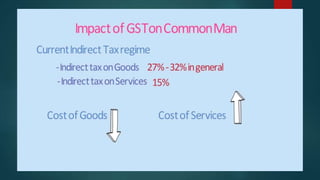
 Indirect taxes on other hand are imposed on goods and services and are indirectly paid to the
government via 3rd party, for example Service tax , you pay service tax which is included in the
bill to the owner of the restraunt , that restraint owner will pay service tax portion to the
government , in this way you pay taxes to the government via 3rd person that’s why its called
indirect tax.
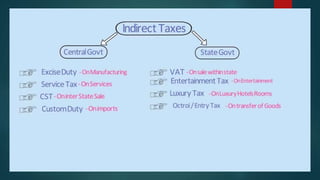
Indirect Taxes
 In our country indirect taxes are levied by the central government as well
as the state government , some major indirect taxes leveid by the central
government are :
Now lets understand WHAT IS GST?
 As the name suggest it is an indirect tax levied on goods and services it is
clear that GST is an indirect tax that is why it is not going to have any
impact on direct taxes that means income tax rates and its structure will
remain the same .
 The reason why everyone believes that GST will be a game changer
because GST will replace major indirect taxes that are levied by center and
state .
 What does it mean : it means taxes such as excise duty , service tax,
entertainment tax etc will be replaced by GST.
Types of GST
 There are 2 kinds of GST :
 Central GST (C GST)
 State GST (S GST)
 All central Government indirect tax except Custom duty will be replaced by
CGST whereas State level indirect tax will be replaced by S GST.
Benefits of GST
 Economist says that it should add atleast 2% to India’s GDP and will keep
India’s economy moving , some benefits of GST are :
It will replace all major indirect taxes
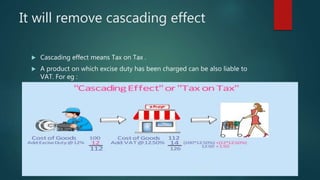
It will remove cascading effect
 Cascading effect means Tax on Tax .
 A product on which excise duty has been charged can be also liable to
VAT. For eg :
It will reduce flow of BLACK Money in
the country
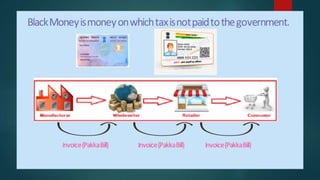
 Black money includes funds on which taxes have not been paid to the
government.
 There are persons who do not report each and every transaction by doing this
they save indirect taxes and more importantly they are able to furnish
underreporting of their incomes.
 GST is the single tax on the supply of goods and services right from
manufacturers to the consumer.
 To get the credit of previously paid taxes everyone will insist upon getting the
invoice for the transaction
 , GST will have a paper trail which can be accessed by the income tax
department , uses of PAN and Adhaar will be required to file GST returns , this
will help income tax departments to track transactions , in my view this is the
beginning of new era where corruption will gradually subside .
One INDIA One Market
 There are dozens of taxes that prevent India from becoming a common
market .
 Under GST single tax will be imposed on production sales and service
turning India into a common market.
Seamless Flow of goods across nation
 On many occasion you must have seen long line of trucks on both sides of states border, these
long line of trucks sometimes running miles have to pay entry tax or octroi , these taxes are
collected by individual states .
 Imagine a situation where trucks has to pass multiple states, according to road ministry study a
typical truck has to spend 16% of its time at check post or at toll plaza’s in queueing up to pay tax
only to pass through a state .
 In addition to this there is CST Centre Sales Tax for interstate movement of goods consignor has to
show various document relating to CST at the state border
 some manufactures donot supply goods to other state because of this CST amount . GST will allow
easier transportation of goods from 1 state to another by removing this CST and Octroi and thus
will reduce transportstion and logistic cost.
Ease of Doing Business
 Apart from having a common market there will be lots ease of doing
business in India at present a business man has to get register with various
tax authorities maintain many papers and file different tax returns to
different tax authorities after implementation of GST there will be single
registration single return and less paperwork .
 The business man can put his time and energy in doing business rather
than complying with various tax laws.
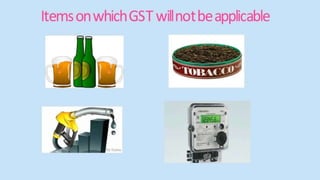
Items on which GST will not be
applicable
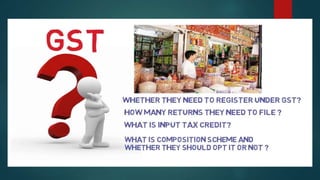
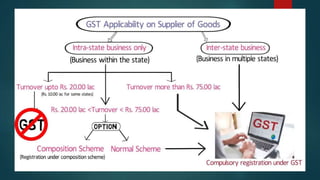
 Under a normal scheme : 37 returns in a year.
 Composition scheme : 5 returns in a year
 But there is a disadvantage in composition scheme and it is that he can
not avail the benefits of Input Tax Credit .
 Non availability of ITC will result in increase in cost of goods which simply
means decrease in profit margins .
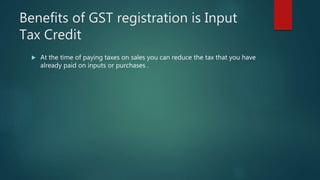
Benefits of GST registration is Input
Tax Credit
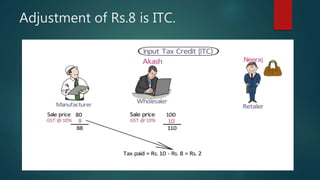
 At the time of paying taxes on sales you can reduce the tax that you have
already paid on inputs or purchases .
Adjustment of Rs.8 is ITC.
THANK YOU

Goods and services tax

  • 1.
  • 2.
     GST isa revolutionary tax reform and it is going to replace indirect taxes applicable in our country.  Taxes can be divided into 2 broad categories :  Direct and indirect taxes  Direct taxes are imposed on to the person and are paid to the government by the tax payer himself, example income tax .  Indirect taxes on other hand are imposed on goods and services and are indirectly paid to the government via 3rd party, for example Service tax , you pay service tax which is included in the bill to the owner of the restraunt , that restraint owner will pay service tax portion to the government , in this way you pay taxes to the government via 3rd person that’s why its called indirect tax.
  • 3.
    Indirect Taxes  Inour country indirect taxes are levied by the central government as well as the state government , some major indirect taxes leveid by the central government are :
  • 5.
    Now lets understandWHAT IS GST?  As the name suggest it is an indirect tax levied on goods and services it is clear that GST is an indirect tax that is why it is not going to have any impact on direct taxes that means income tax rates and its structure will remain the same .  The reason why everyone believes that GST will be a game changer because GST will replace major indirect taxes that are levied by center and state .  What does it mean : it means taxes such as excise duty , service tax, entertainment tax etc will be replaced by GST.
  • 6.
    Types of GST There are 2 kinds of GST :  Central GST (C GST)  State GST (S GST)  All central Government indirect tax except Custom duty will be replaced by CGST whereas State level indirect tax will be replaced by S GST.
  • 7.
    Benefits of GST Economist says that it should add atleast 2% to India’s GDP and will keep India’s economy moving , some benefits of GST are :
  • 8.
    It will replaceall major indirect taxes
  • 9.
    It will removecascading effect  Cascading effect means Tax on Tax .  A product on which excise duty has been charged can be also liable to VAT. For eg :
  • 11.
    It will reduceflow of BLACK Money in the country  Black money includes funds on which taxes have not been paid to the government.  There are persons who do not report each and every transaction by doing this they save indirect taxes and more importantly they are able to furnish underreporting of their incomes.  GST is the single tax on the supply of goods and services right from manufacturers to the consumer.  To get the credit of previously paid taxes everyone will insist upon getting the invoice for the transaction  , GST will have a paper trail which can be accessed by the income tax department , uses of PAN and Adhaar will be required to file GST returns , this will help income tax departments to track transactions , in my view this is the beginning of new era where corruption will gradually subside .
  • 12.
    One INDIA OneMarket  There are dozens of taxes that prevent India from becoming a common market .  Under GST single tax will be imposed on production sales and service turning India into a common market.
  • 13.
    Seamless Flow ofgoods across nation  On many occasion you must have seen long line of trucks on both sides of states border, these long line of trucks sometimes running miles have to pay entry tax or octroi , these taxes are collected by individual states .  Imagine a situation where trucks has to pass multiple states, according to road ministry study a typical truck has to spend 16% of its time at check post or at toll plaza’s in queueing up to pay tax only to pass through a state .  In addition to this there is CST Centre Sales Tax for interstate movement of goods consignor has to show various document relating to CST at the state border  some manufactures donot supply goods to other state because of this CST amount . GST will allow easier transportation of goods from 1 state to another by removing this CST and Octroi and thus will reduce transportstion and logistic cost.
  • 14.
    Ease of DoingBusiness  Apart from having a common market there will be lots ease of doing business in India at present a business man has to get register with various tax authorities maintain many papers and file different tax returns to different tax authorities after implementation of GST there will be single registration single return and less paperwork .  The business man can put his time and energy in doing business rather than complying with various tax laws.
  • 17.
    Items on whichGST will not be applicable
  • 20.
     Under anormal scheme : 37 returns in a year.  Composition scheme : 5 returns in a year  But there is a disadvantage in composition scheme and it is that he can not avail the benefits of Input Tax Credit .  Non availability of ITC will result in increase in cost of goods which simply means decrease in profit margins .
  • 21.
    Benefits of GSTregistration is Input Tax Credit  At the time of paying taxes on sales you can reduce the tax that you have already paid on inputs or purchases .
  • 22.
  • 24.