
BUNDELKHAND INSTITUTE OF ENGINEERING AND 
TECHNOLOGY, JHANSI 
PRESENTATION ON INDUSTRIAL TRAINING( 2014-15) 
At 
ERICSSON INDIA PVT. LTD, LUCKNOW 
STUDY OF GLOBAL SYSTEM FOR 
MOBILE COMMUNICATION (GSM) 
BY-ANIMESH 
LOCHAN 
7th semester 
ECE- 1104331011
COMPANY PROFILE 
Communication is changing the way we live and work. Ericsson plays a key role in 
this evolution, using innovation to empower people, business and society. 
Ericsson provides communications networks, telecom services and support 
solutions, making it easier for people all over the globe to communicate. 
 Approximately 40 percent of the world’s mobile traffic passes through 
network equipment supplied by Ericsson. 
 The networks Ericsson supports for operators serve more than 2.5 billion 
subscribers. 
 Ericsson has over 64,000 services professionals. 
 Ericsson has customers in more than 180 countries. 
 Ericsson has been in the telecoms market for 138 years. 
 Ericsson is the fifth largest software supplier in the world. 
GSM- Animesh Lochan (11) 2
GSM Overview 
•Global System for Mobile (GSM) is a second 
generation cellular standard developed to cater 
voice services and data delivery using digital 
modulation 
• GSM operating frequencies:- 
850 MHz- 1900 MHz- America 
900 MHz- 1800 MHz- Rest of world 
• Uplink frequency – 890MHz- 915 MHz 
Downlink frequency – 935MHz- 960 MHz 
GSM- Animesh Lochan (11) 3
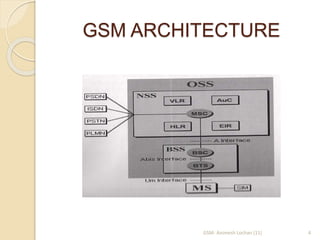
GSM ARCHITECTURE 
GSM- Animesh Lochan (11) 4
Contd… 
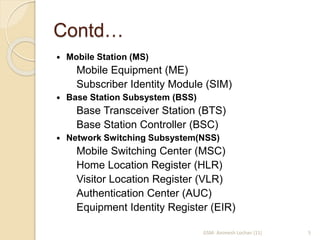
 Mobile Station (MS) 
Mobile Equipment (ME) 
Subscriber Identity Module (SIM) 
 Base Station Subsystem (BSS) 
Base Transceiver Station (BTS) 
Base Station Controller (BSC) 
 Network Switching Subsystem(NSS) 
Mobile Switching Center (MSC) 
Home Location Register (HLR) 
Visitor Location Register (VLR) 
Authentication Center (AUC) 
Equipment Identity Register (EIR) 
GSM- Animesh Lochan (11) 5
Mobile Station (MS) 
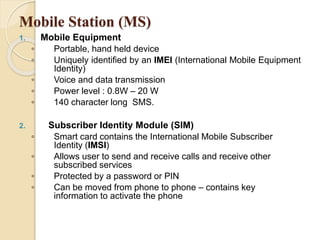
1. Mobile Equipment 
◦ Portable, hand held device 
◦ Uniquely identified by an IMEI (International Mobile Equipment 
Identity) 
◦ Voice and data transmission 
◦ Power level : 0.8W – 20 W 
◦ 140 character long SMS. 
2. Subscriber Identity Module (SIM) 
◦ Smart card contains the International Mobile Subscriber 
Identity (IMSI) 
◦ Allows user to send and receive calls and receive other 
subscribed services 
◦ Protected by a password or PIN 
◦ Can be moved from phone to phone – contains key 
information to activate the phone
Base Station Subsystem (BSS) 
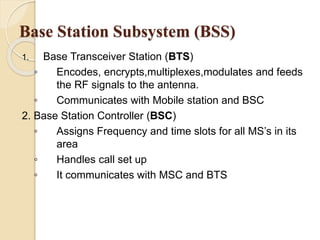
1. Base Transceiver Station (BTS) 
◦ Encodes, encrypts,multiplexes,modulates and feeds 
the RF signals to the antenna. 
◦ Communicates with Mobile station and BSC 
2. Base Station Controller (BSC) 
◦ Assigns Frequency and time slots for all MS’s in its 
area 
◦ Handles call set up 
◦ It communicates with MSC and BTS
Network Switching Subsystem(NSS) 
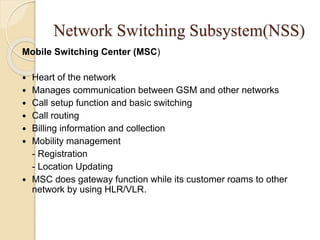
Mobile Switching Center (MSC) 
 Heart of the network 
 Manages communication between GSM and other networks 
 Call setup function and basic switching 
 Call routing 
 Billing information and collection 
 Mobility management 
- Registration 
- Location Updating 
 MSC does gateway function while its customer roams to other 
network by using HLR/VLR.
 Home Location Registers (HLR) 
- permanent database about mobile subscribers in a 
large service area (generally one per GSM network 
operator) 
- database contains IMSI, prepaid/postpaid, roaming 
restrictions, supplementary services. 
 Visitor Location Registers (VLR) 
- Temporary database which updates whenever new 
MS enters its area, by HLR database 
- Controls those mobiles roaming in its area
 Authentication Center (AUC) 
- Protects against intruders in air interface 
- Maintains authentication keys and algorithms and 
provides security. 
- Generally associated with HLR 
 Equipment Identity Register (EIR) 
- Database that is used to track handsets using the 
IMEI (International Mobile Equipment Identity) 
- Only one EIR per PLMN (public land mobile network 
)
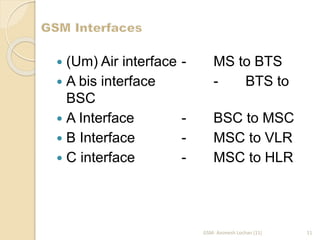
 (Um) Air interface - MS to BTS 
 A bis interface - BTS to 
BSC 
 A Interface - BSC to MSC 
 B Interface - MSC to VLR 
 C interface - MSC to HLR 
GSM- Animesh Lochan (11) 11
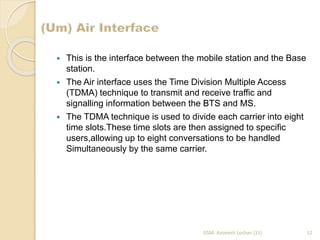
 This is the interface between the mobile station and the Base 
station. 
 The Air interface uses the Time Division Multiple Access 
(TDMA) technique to transmit and receive traffic and 
signalling information between the BTS and MS. 
 The TDMA technique is used to divide each carrier into eight 
time slots.These time slots are then assigned to specific 
users,allowing up to eight conversations to be handled 
Simultaneously by the same carrier. 
GSM- Animesh Lochan (11) 12
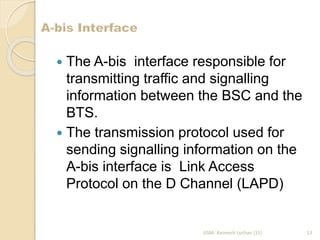
 The A-bis interface responsible for 
transmitting traffic and signalling 
information between the BSC and the 
BTS. 
 The transmission protocol used for 
sending signalling information on the 
A-bis interface is Link Access 
Protocol on the D Channel (LAPD) 
GSM- Animesh Lochan (11) 13
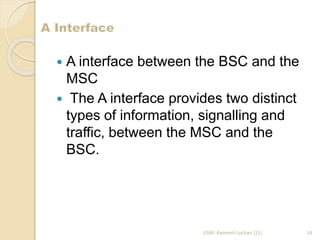
 A interface between the BSC and the 
MSC 
 The A interface provides two distinct 
types of information, signalling and 
traffic, between the MSC and the 
BSC. 
GSM- Animesh Lochan (11) 14
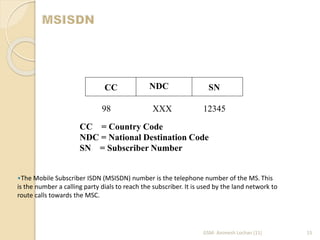
CC NDC SN 
98 XXX 12345 
CC = Country Code 
NDC = National Destination Code 
SN = Subscriber Number 
•The Mobile Subscriber ISDN (MSISDN) number is the telephone number of the MS. This 
is the number a calling party dials to reach the subscriber. It is used by the land network to 
route calls towards the MSC. 
GSM- Animesh Lochan (11) 15
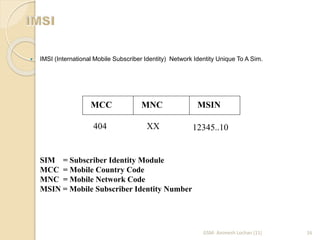
 IMSI (International Mobile Subscriber Identity) Network Identity Unique To A Sim. 
MCC MNC MSIN 
404 XX 12345..10 
SIM = Subscriber Identity Module 
MCC = Mobile Country Code 
MNC = Mobile Network Code 
MSIN = Mobile Subscriber Identity Number 
GSM- Animesh Lochan (11) 16
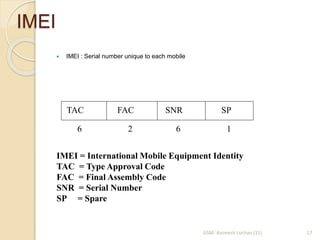
IMEI 
 IMEI : Serial number unique to each mobile 
TAC FAC SNR SP 
6 2 6 1 
IMEI = International Mobile Equipment Identity 
TAC = Type Approval Code 
FAC = Final Assembly Code 
SNR = Serial Number 
SP = Spare 
GSM- Animesh Lochan (11) 17
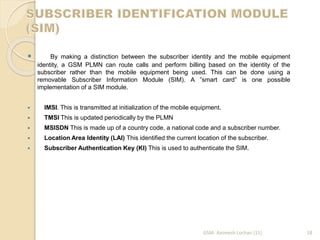
 By making a distinction between the subscriber identity and the mobile equipment 
identity, a GSM PLMN can route calls and perform billing based on the identity of the 
subscriber rather than the mobile equipment being used. This can be done using a 
removable Subscriber Information Module (SIM). A ”smart card” is one possible 
implementation of a SIM module. 
 IMSI. This is transmitted at initialization of the mobile equipment. 
 TMSI This is updated periodically by the PLMN 
 MSISDN This is made up of a country code, a national code and a subscriber number. 
 Location Area Identity (LAI) This identified the current location of the subscriber. 
 Subscriber Authentication Key (KI) This is used to authenticate the SIM. 
GSM- Animesh Lochan (11) 18
 
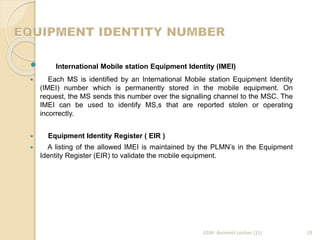
International Mobile station Equipment Identity (IMEI) 
 Each MS is identified by an International Mobile station Equipment Identity 
(IMEI) number which is permanently stored in the mobile equipment. On 
request, the MS sends this number over the signalling channel to the MSC. The 
IMEI can be used to identify MS,s that are reported stolen or operating 
incorrectly. 
 Equipment Identity Register ( EIR ) 
 A listing of the allowed IMEI is maintained by the PLMN’s in the Equipment 
Identity Register (EIR) to validate the mobile equipment. 
GSM- Animesh Lochan (11) 19
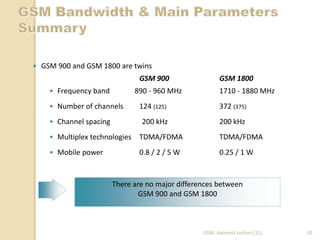
• GSM 900 and GSM 1800 are twins 
GSM 900 GSM 1800 
• Frequency band 890 - 960 MHz 1710 - 1880 MHz 
• Number of channels 124 (125) 372 (375) 
• Channel spacing 200 kHz 200 kHz 
• Multiplex technologies TDMA/FDMA TDMA/FDMA 
• Mobile power 0.8 / 2 / 5 W 0.25 / 1 W 
There are no major differences between 
GSM 900 and GSM 1800 
GSM- Animesh Lochan (11) 20
GSM- Animesh Lochan (11) 21
Definitions 
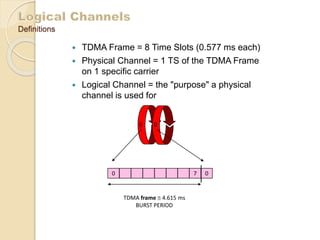
 TDMA Frame = 8 Time Slots (0.577 ms each) 
 Physical Channel = 1 TS of the TDMA Frame 
on 1 specific carrier 
 Logical Channel = the "purpose" a physical 
channel is used for 
0 0 
0 7 0 
TDMA frame  4.615 ms 
BURST PERIOD
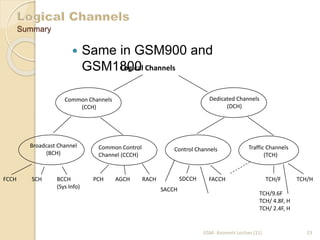
Summary 
 Same in GSM900 and 
GSM1800 
FCCH 
Dedicated Channels 
Traffic Channels 
(TCH) 
TCH/9.6F 
TCH/ 4.8F, H 
TCH/ 2.4F, H 
(DCH) 
Common Channels 
Broadcast Channel 
(BCH) 
Logical Channels 
Common Control Control Channels 
Channel (CCCH) 
SCH BCCH 
(Sys Info) 
(CCH) 
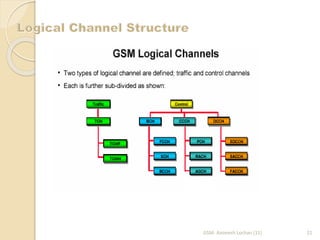
PCH AGCH RACH SDCCH FACCH TCH/F TCH/H 
SACCH 
GSM- Animesh Lochan (11) 23
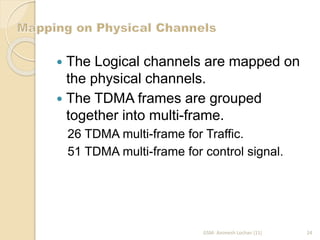
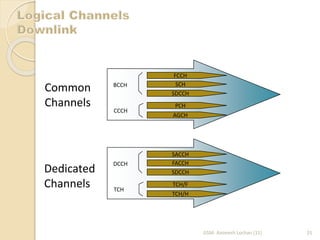
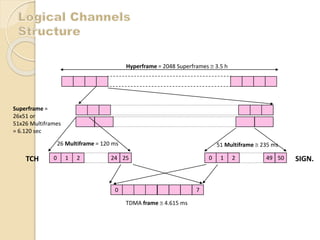
 The Logical channels are mapped on 
the physical channels. 
 The TDMA frames are grouped 
together into multi-frame. 
26 TDMA multi-frame for Traffic. 
51 TDMA multi-frame for control signal. 
GSM- Animesh Lochan (11) 24
FCCH 
SCH 
SDCCH 
PCH 
AGCH 
BCCH 
CCCH 
Common 
Channels 
Dedicated 
Channels 
SACCH 
FACCH 
SDCCH 
TCH/F 
TCH/H 
DCCH 
TCH 
GSM- Animesh Lochan (11) 25
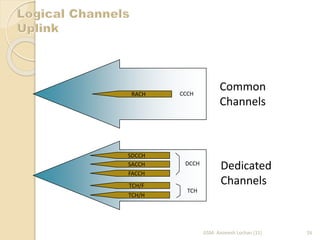
RACH CCCH 
Common 
Channels 
SDCCH 
SACCH 
FACCH 
TCH/F 
TCH/H 
DCCH 
TCH 
Dedicated 
Channels 
GSM- Animesh Lochan (11) 26
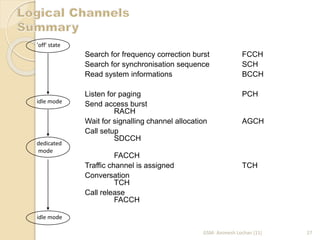
Search for frequency correction burst FCCH 
Search for synchronisation sequence SCH 
Read system informations BCCH 
Listen for paging PCH 
Send access burst 
RACH 
Wait for signalling channel allocation AGCH 
Call setup 
SDCCH 
FACCH 
Traffic channel is assigned TCH 
Conversation 
TCH 
Call release 
FACCH 
'off' state 
idle mode 
dedicated 
mode 
idle mode 
GSM- Animesh Lochan (11) 27
GSM- Animesh Lochan (11) 28
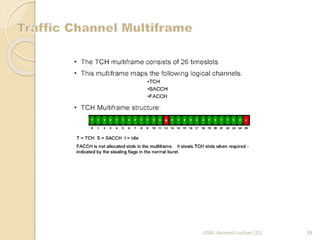
T 
15 
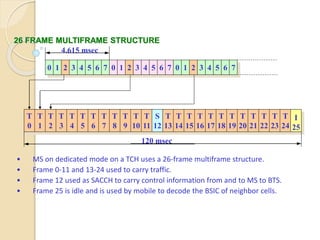
26 FRAME MULTIFRAME STRUCTURE 
T 
5 
T 
9 
T 
10 
T 
11 
S 
12 
T 
13 
T 
14 
T 
6 
T 
7 
T 
8 
T 
0 
T 
1 
T 
2 
T 
3 
T 
4 
T 
16 
T 
17 
T 
18 
T 
19 
T 
20 
T 
21 
T 
22 
T 
23 
T 
24 
I 
25 
0 1 2 3 4 5 6 7 0 1 2 3 4 5 6 7 0 1 2 3 4 5 6 7 
120 msec 
4.615 msec 
• MS on dedicated mode on a TCH uses a 26-frame multiframe structure. 
• Frame 0-11 and 13-24 used to carry traffic. 
• Frame 12 used as SACCH to carry control information from and to MS to BTS. 
• Frame 25 is idle and is used by mobile to decode the BSIC of neighbor cells.
Hyperframe = 2048 Superframes  3.5 h 
26 Multiframe = 120 ms 51 Multiframe  235 ms 
TCH 0 1 2 24 25 0 1 2 49 50 SIGN. 
0 7 
TDMA frame  4.615 ms 
Superframe = 
26x51 or 
51x26 Multiframes 
= 6.120 sec
GSM

GSM

  • 1.
    BUNDELKHAND INSTITUTE OFENGINEERING AND TECHNOLOGY, JHANSI PRESENTATION ON INDUSTRIAL TRAINING( 2014-15) At ERICSSON INDIA PVT. LTD, LUCKNOW STUDY OF GLOBAL SYSTEM FOR MOBILE COMMUNICATION (GSM) BY-ANIMESH LOCHAN 7th semester ECE- 1104331011
  • 2.
    COMPANY PROFILE Communicationis changing the way we live and work. Ericsson plays a key role in this evolution, using innovation to empower people, business and society. Ericsson provides communications networks, telecom services and support solutions, making it easier for people all over the globe to communicate.  Approximately 40 percent of the world’s mobile traffic passes through network equipment supplied by Ericsson.  The networks Ericsson supports for operators serve more than 2.5 billion subscribers.  Ericsson has over 64,000 services professionals.  Ericsson has customers in more than 180 countries.  Ericsson has been in the telecoms market for 138 years.  Ericsson is the fifth largest software supplier in the world. GSM- Animesh Lochan (11) 2
  • 3.
    GSM Overview •GlobalSystem for Mobile (GSM) is a second generation cellular standard developed to cater voice services and data delivery using digital modulation • GSM operating frequencies:- 850 MHz- 1900 MHz- America 900 MHz- 1800 MHz- Rest of world • Uplink frequency – 890MHz- 915 MHz Downlink frequency – 935MHz- 960 MHz GSM- Animesh Lochan (11) 3
  • 4.
    GSM ARCHITECTURE GSM-Animesh Lochan (11) 4
  • 5.
    Contd…  MobileStation (MS) Mobile Equipment (ME) Subscriber Identity Module (SIM)  Base Station Subsystem (BSS) Base Transceiver Station (BTS) Base Station Controller (BSC)  Network Switching Subsystem(NSS) Mobile Switching Center (MSC) Home Location Register (HLR) Visitor Location Register (VLR) Authentication Center (AUC) Equipment Identity Register (EIR) GSM- Animesh Lochan (11) 5
  • 6.
    Mobile Station (MS) 1. Mobile Equipment ◦ Portable, hand held device ◦ Uniquely identified by an IMEI (International Mobile Equipment Identity) ◦ Voice and data transmission ◦ Power level : 0.8W – 20 W ◦ 140 character long SMS. 2. Subscriber Identity Module (SIM) ◦ Smart card contains the International Mobile Subscriber Identity (IMSI) ◦ Allows user to send and receive calls and receive other subscribed services ◦ Protected by a password or PIN ◦ Can be moved from phone to phone – contains key information to activate the phone
  • 7.
    Base Station Subsystem(BSS) 1. Base Transceiver Station (BTS) ◦ Encodes, encrypts,multiplexes,modulates and feeds the RF signals to the antenna. ◦ Communicates with Mobile station and BSC 2. Base Station Controller (BSC) ◦ Assigns Frequency and time slots for all MS’s in its area ◦ Handles call set up ◦ It communicates with MSC and BTS
  • 8.
    Network Switching Subsystem(NSS) Mobile Switching Center (MSC)  Heart of the network  Manages communication between GSM and other networks  Call setup function and basic switching  Call routing  Billing information and collection  Mobility management - Registration - Location Updating  MSC does gateway function while its customer roams to other network by using HLR/VLR.
  • 9.
     Home LocationRegisters (HLR) - permanent database about mobile subscribers in a large service area (generally one per GSM network operator) - database contains IMSI, prepaid/postpaid, roaming restrictions, supplementary services.  Visitor Location Registers (VLR) - Temporary database which updates whenever new MS enters its area, by HLR database - Controls those mobiles roaming in its area
  • 10.
     Authentication Center(AUC) - Protects against intruders in air interface - Maintains authentication keys and algorithms and provides security. - Generally associated with HLR  Equipment Identity Register (EIR) - Database that is used to track handsets using the IMEI (International Mobile Equipment Identity) - Only one EIR per PLMN (public land mobile network )
  • 11.
     (Um) Airinterface - MS to BTS  A bis interface - BTS to BSC  A Interface - BSC to MSC  B Interface - MSC to VLR  C interface - MSC to HLR GSM- Animesh Lochan (11) 11
  • 12.
     This isthe interface between the mobile station and the Base station.  The Air interface uses the Time Division Multiple Access (TDMA) technique to transmit and receive traffic and signalling information between the BTS and MS.  The TDMA technique is used to divide each carrier into eight time slots.These time slots are then assigned to specific users,allowing up to eight conversations to be handled Simultaneously by the same carrier. GSM- Animesh Lochan (11) 12
  • 13.
     The A-bisinterface responsible for transmitting traffic and signalling information between the BSC and the BTS.  The transmission protocol used for sending signalling information on the A-bis interface is Link Access Protocol on the D Channel (LAPD) GSM- Animesh Lochan (11) 13
  • 14.
     A interfacebetween the BSC and the MSC  The A interface provides two distinct types of information, signalling and traffic, between the MSC and the BSC. GSM- Animesh Lochan (11) 14
  • 15.
    CC NDC SN 98 XXX 12345 CC = Country Code NDC = National Destination Code SN = Subscriber Number •The Mobile Subscriber ISDN (MSISDN) number is the telephone number of the MS. This is the number a calling party dials to reach the subscriber. It is used by the land network to route calls towards the MSC. GSM- Animesh Lochan (11) 15
  • 16.
     IMSI (InternationalMobile Subscriber Identity) Network Identity Unique To A Sim. MCC MNC MSIN 404 XX 12345..10 SIM = Subscriber Identity Module MCC = Mobile Country Code MNC = Mobile Network Code MSIN = Mobile Subscriber Identity Number GSM- Animesh Lochan (11) 16
  • 17.
    IMEI  IMEI: Serial number unique to each mobile TAC FAC SNR SP 6 2 6 1 IMEI = International Mobile Equipment Identity TAC = Type Approval Code FAC = Final Assembly Code SNR = Serial Number SP = Spare GSM- Animesh Lochan (11) 17
  • 18.
     By makinga distinction between the subscriber identity and the mobile equipment identity, a GSM PLMN can route calls and perform billing based on the identity of the subscriber rather than the mobile equipment being used. This can be done using a removable Subscriber Information Module (SIM). A ”smart card” is one possible implementation of a SIM module.  IMSI. This is transmitted at initialization of the mobile equipment.  TMSI This is updated periodically by the PLMN  MSISDN This is made up of a country code, a national code and a subscriber number.  Location Area Identity (LAI) This identified the current location of the subscriber.  Subscriber Authentication Key (KI) This is used to authenticate the SIM. GSM- Animesh Lochan (11) 18
  • 19.
     International Mobilestation Equipment Identity (IMEI)  Each MS is identified by an International Mobile station Equipment Identity (IMEI) number which is permanently stored in the mobile equipment. On request, the MS sends this number over the signalling channel to the MSC. The IMEI can be used to identify MS,s that are reported stolen or operating incorrectly.  Equipment Identity Register ( EIR )  A listing of the allowed IMEI is maintained by the PLMN’s in the Equipment Identity Register (EIR) to validate the mobile equipment. GSM- Animesh Lochan (11) 19
  • 20.
    • GSM 900and GSM 1800 are twins GSM 900 GSM 1800 • Frequency band 890 - 960 MHz 1710 - 1880 MHz • Number of channels 124 (125) 372 (375) • Channel spacing 200 kHz 200 kHz • Multiplex technologies TDMA/FDMA TDMA/FDMA • Mobile power 0.8 / 2 / 5 W 0.25 / 1 W There are no major differences between GSM 900 and GSM 1800 GSM- Animesh Lochan (11) 20
  • 21.
  • 22.
    Definitions  TDMAFrame = 8 Time Slots (0.577 ms each)  Physical Channel = 1 TS of the TDMA Frame on 1 specific carrier  Logical Channel = the "purpose" a physical channel is used for 0 0 0 7 0 TDMA frame  4.615 ms BURST PERIOD
  • 23.
    Summary  Samein GSM900 and GSM1800 FCCH Dedicated Channels Traffic Channels (TCH) TCH/9.6F TCH/ 4.8F, H TCH/ 2.4F, H (DCH) Common Channels Broadcast Channel (BCH) Logical Channels Common Control Control Channels Channel (CCCH) SCH BCCH (Sys Info) (CCH) PCH AGCH RACH SDCCH FACCH TCH/F TCH/H SACCH GSM- Animesh Lochan (11) 23
  • 24.
     The Logicalchannels are mapped on the physical channels.  The TDMA frames are grouped together into multi-frame. 26 TDMA multi-frame for Traffic. 51 TDMA multi-frame for control signal. GSM- Animesh Lochan (11) 24
  • 25.
    FCCH SCH SDCCH PCH AGCH BCCH CCCH Common Channels Dedicated Channels SACCH FACCH SDCCH TCH/F TCH/H DCCH TCH GSM- Animesh Lochan (11) 25
  • 26.
    RACH CCCH Common Channels SDCCH SACCH FACCH TCH/F TCH/H DCCH TCH Dedicated Channels GSM- Animesh Lochan (11) 26
  • 27.
    Search for frequencycorrection burst FCCH Search for synchronisation sequence SCH Read system informations BCCH Listen for paging PCH Send access burst RACH Wait for signalling channel allocation AGCH Call setup SDCCH FACCH Traffic channel is assigned TCH Conversation TCH Call release FACCH 'off' state idle mode dedicated mode idle mode GSM- Animesh Lochan (11) 27
  • 28.
  • 29.
    T 15 26FRAME MULTIFRAME STRUCTURE T 5 T 9 T 10 T 11 S 12 T 13 T 14 T 6 T 7 T 8 T 0 T 1 T 2 T 3 T 4 T 16 T 17 T 18 T 19 T 20 T 21 T 22 T 23 T 24 I 25 0 1 2 3 4 5 6 7 0 1 2 3 4 5 6 7 0 1 2 3 4 5 6 7 120 msec 4.615 msec • MS on dedicated mode on a TCH uses a 26-frame multiframe structure. • Frame 0-11 and 13-24 used to carry traffic. • Frame 12 used as SACCH to carry control information from and to MS to BTS. • Frame 25 is idle and is used by mobile to decode the BSIC of neighbor cells.
  • 30.
    Hyperframe = 2048Superframes  3.5 h 26 Multiframe = 120 ms 51 Multiframe  235 ms TCH 0 1 2 24 25 0 1 2 49 50 SIGN. 0 7 TDMA frame  4.615 ms Superframe = 26x51 or 51x26 Multiframes = 6.120 sec