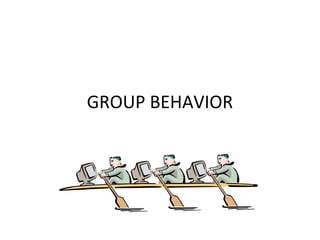

GROUP BEHAVIOR
GROUP
• G---Gregarious
• R--- Requirement
• O----of
• U----Universal
• P-----Phenomenon
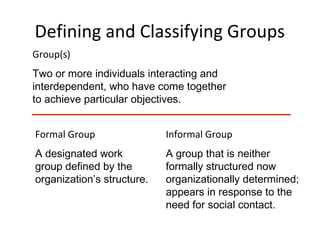
Defining and Classifying Groups
Group(s)
Two or more individuals interacting and
interdependent, who have come together
to achieve particular objectives.
Formal Group
A designated work
group defined by the
organization’s structure.
Informal Group
A group that is neither
formally structured now
organizationally determined;
appears in response to the
need for social contact.
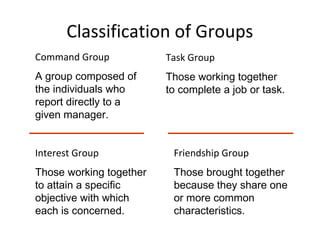
Classification of Groups
Command Group
A group composed of
the individuals who
report directly to a
given manager.
Task Group
Those working together
to complete a job or task.
Interest Group
Those working together
to attain a specific
objective with which
each is concerned.
Friendship Group
Those brought together
because they share one
or more common
characteristics.
Why People Join Groups
•Security
•Status
•Self-esteem
•Affiliation/ Interpersonal
•Support
•Power
•Goal Achievement
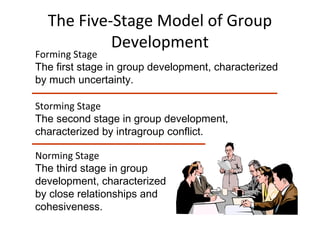
The Five-Stage Model of Group
Development
Forming Stage
The first stage in group development, characterized
by much uncertainty.
Storming Stage
The second stage in group development,
characterized by intragroup conflict.
Norming Stage
The third stage in group
development, characterized
by close relationships and
cohesiveness.
Performing Stage
The fourth stage in group development, when the
group is fully functional.
Adjourning Stage
The final stage in group
development for temporary
groups, characterized by
concern with wrapping up
activities rather than
performance.
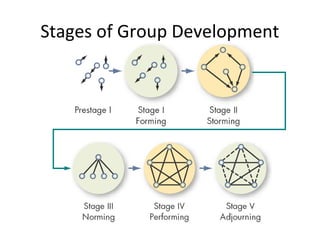
Stages of Group Development

Group development

  • 1.
  • 2.
    GROUP • G---Gregarious • R---Requirement • O----of • U----Universal • P-----Phenomenon
  • 3.
    Defining and ClassifyingGroups Group(s) Two or more individuals interacting and interdependent, who have come together to achieve particular objectives. Formal Group A designated work group defined by the organization’s structure. Informal Group A group that is neither formally structured now organizationally determined; appears in response to the need for social contact.
  • 4.
    Classification of Groups CommandGroup A group composed of the individuals who report directly to a given manager. Task Group Those working together to complete a job or task. Interest Group Those working together to attain a specific objective with which each is concerned. Friendship Group Those brought together because they share one or more common characteristics.
  • 5.
    Why People JoinGroups •Security •Status •Self-esteem •Affiliation/ Interpersonal •Support •Power •Goal Achievement
  • 6.
    The Five-Stage Modelof Group Development Forming Stage The first stage in group development, characterized by much uncertainty. Storming Stage The second stage in group development, characterized by intragroup conflict. Norming Stage The third stage in group development, characterized by close relationships and cohesiveness.
  • 7.
    Performing Stage The fourthstage in group development, when the group is fully functional. Adjourning Stage The final stage in group development for temporary groups, characterized by concern with wrapping up activities rather than performance.
  • 8.
    Stages of GroupDevelopment