Assignment -1
Subject: Organization Behavior –II
Topic: Group thinking
Study Program: MBA (HRM)
Submitted by: Badar-e-Alam-Anwar
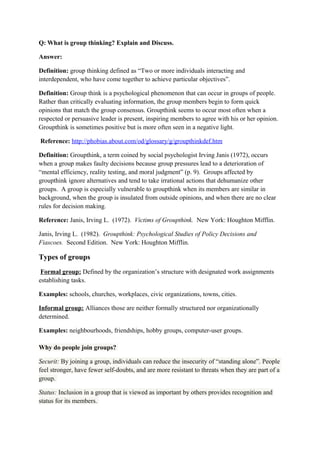
Q: What is group thinking? Explain and Discuss.
Answer:
Definition: group thinking defined as “Two or more individuals interacting and
interdependent, who have come together to achieve particular objectives”.
Definition: Group think is a psychological phenomenon that can occur in groups of people.
Rather than critically evaluating information, the group members begin to form quick
opinions that match the group consensus. Groupthink seems to occur most often when a
respected or persuasive leader is present, inspiring members to agree with his or her opinion.
Groupthink is sometimes positive but is more often seen in a negative light.
Reference: http://phobias.about.com/od/glossary/g/groupthinkdef.htm
Definition: Groupthink, a term coined by social psychologist Irving Janis (1972), occurs
when a group makes faulty decisions because group pressures lead to a deterioration of
“mental efficiency, reality testing, and moral judgment” (p. 9). Groups affected by
groupthink ignore alternatives and tend to take irrational actions that dehumanize other
groups. A group is especially vulnerable to groupthink when its members are similar in
background, when the group is insulated from outside opinions, and when there are no clear
rules for decision making.
Reference: Janis, Irving L. (1972). Victims of Groupthink. New York: Houghton Mifflin.
Janis, Irving L. (1982). Groupthink: Psychological Studies of Policy Decisions and
Fiascoes. Second Edition. New York: Houghton Mifflin.
Types of groups
Formal group: Defined by the organization’s structure with designated work assignments
establishing tasks.
Examples: schools, churches, workplaces, civic organizations, towns, cities.
Informal group: Alliances those are neither formally structured nor organizationally
determined.
Examples: neighbourhoods, friendships, hobby groups, computer-user groups.
Why do people join groups?
Securit: By joining a group, individuals can reduce the insecurity of “standing alone”. People
feel stronger, have fewer self-doubts, and are more resistant to threats when they are part of a
group.
Status: Inclusion in a group that is viewed as important by others provides recognition and
status for its members.
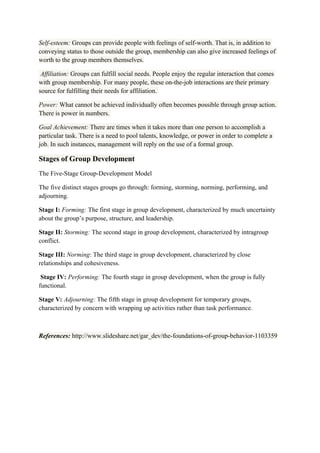
Self-esteem: Groups can provide people with feelings of self-worth. That is, in addition to
conveying status to those outside the group, membership can also give increased feelings of
worth to the group members themselves.
Affiliation: Groups can fulfill social needs. People enjoy the regular interaction that comes
with group membership. For many people, these on-the-job interactions are their primary
source for fulfilling their needs for affiliation.
Power: What cannot be achieved individually often becomes possible through group action.
There is power in numbers.
Goal Achievement: There are times when it takes more than one person to accomplish a
particular task. There is a need to pool talents, knowledge, or power in order to complete a
job. In such instances, management will reply on the use of a formal group.
Stages of Group Development
The Five-Stage Group-Development Model
The five distinct stages groups go through: forming, storming, norming, performing, and
adjourning.
Stage I: Forming: The first stage in group development, characterized by much uncertainty
about the group’s purpose, structure, and leadership.
Stage II: Storming: The second stage in group development, characterized by intragroup
conflict.
Stage III: Norming: The third stage in group development, characterized by close
relationships and cohesiveness.
Stage IV: Performing: The fourth stage in group development, when the group is fully
functional.
Stage V: Adjourning: The fifth stage in group development for temporary groups,
characterized by concern with wrapping up activities rather than task performance.
References: http://www.slideshare.net/gar_dev/the-foundations-of-group-behavior-1103359

Assignment ob-ii-1

  • 1.
    Assignment -1 Subject: OrganizationBehavior –II Topic: Group thinking Study Program: MBA (HRM) Submitted by: Badar-e-Alam-Anwar
  • 2.
    Q: What isgroup thinking? Explain and Discuss. Answer: Definition: group thinking defined as “Two or more individuals interacting and interdependent, who have come together to achieve particular objectives”. Definition: Group think is a psychological phenomenon that can occur in groups of people. Rather than critically evaluating information, the group members begin to form quick opinions that match the group consensus. Groupthink seems to occur most often when a respected or persuasive leader is present, inspiring members to agree with his or her opinion. Groupthink is sometimes positive but is more often seen in a negative light. Reference: http://phobias.about.com/od/glossary/g/groupthinkdef.htm Definition: Groupthink, a term coined by social psychologist Irving Janis (1972), occurs when a group makes faulty decisions because group pressures lead to a deterioration of “mental efficiency, reality testing, and moral judgment” (p. 9). Groups affected by groupthink ignore alternatives and tend to take irrational actions that dehumanize other groups. A group is especially vulnerable to groupthink when its members are similar in background, when the group is insulated from outside opinions, and when there are no clear rules for decision making. Reference: Janis, Irving L. (1972). Victims of Groupthink. New York: Houghton Mifflin. Janis, Irving L. (1982). Groupthink: Psychological Studies of Policy Decisions and Fiascoes. Second Edition. New York: Houghton Mifflin. Types of groups Formal group: Defined by the organization’s structure with designated work assignments establishing tasks. Examples: schools, churches, workplaces, civic organizations, towns, cities. Informal group: Alliances those are neither formally structured nor organizationally determined. Examples: neighbourhoods, friendships, hobby groups, computer-user groups. Why do people join groups? Securit: By joining a group, individuals can reduce the insecurity of “standing alone”. People feel stronger, have fewer self-doubts, and are more resistant to threats when they are part of a group. Status: Inclusion in a group that is viewed as important by others provides recognition and status for its members.
  • 3.
    Self-esteem: Groups canprovide people with feelings of self-worth. That is, in addition to conveying status to those outside the group, membership can also give increased feelings of worth to the group members themselves. Affiliation: Groups can fulfill social needs. People enjoy the regular interaction that comes with group membership. For many people, these on-the-job interactions are their primary source for fulfilling their needs for affiliation. Power: What cannot be achieved individually often becomes possible through group action. There is power in numbers. Goal Achievement: There are times when it takes more than one person to accomplish a particular task. There is a need to pool talents, knowledge, or power in order to complete a job. In such instances, management will reply on the use of a formal group. Stages of Group Development The Five-Stage Group-Development Model The five distinct stages groups go through: forming, storming, norming, performing, and adjourning. Stage I: Forming: The first stage in group development, characterized by much uncertainty about the group’s purpose, structure, and leadership. Stage II: Storming: The second stage in group development, characterized by intragroup conflict. Stage III: Norming: The third stage in group development, characterized by close relationships and cohesiveness. Stage IV: Performing: The fourth stage in group development, when the group is fully functional. Stage V: Adjourning: The fifth stage in group development for temporary groups, characterized by concern with wrapping up activities rather than task performance. References: http://www.slideshare.net/gar_dev/the-foundations-of-group-behavior-1103359