Conflict Resolution Success Stories
                Claudette Rowley
                    March 7, 2012


A Service
   Of:                         Sponsored by:
INTEGRATED PLANNING
            Advising nonprofits in:        www.synthesispartnership.com
            • Strategy
            • Planning                                    (617) 969-1881
            • Organizational Development   info@synthesispartnership.com


A Service
   Of:                                            Sponsored by:
Affordable collaborative data
             management in the cloud.

A Service
   Of:                        Sponsored by:
Today’s Speaker


                                               Claudette Rowley
                                              Coach, Consultant, Author
                                           Metavoice Coaching & Consulting
Hosting & Assisting with chat questions:
April Hunt, Nonprofit Webinars

A Service
   Of:                                             Sponsored by:
Conflict Resolution Success
          Stories

       NONPROFIT WEBINARS
  PRESENTED BY CLAUDETTE ROWLEY
          MARCH 7, 2012
Webinar Takeaways

Participants will learn:

 How three workplace conflicts were resolved.
 Best practices for resolving specific conflicts.
 Options for ongoing conflict management and
 prevention.
Case Study #1

       RELATIONSHIP REPAIR
BETWEEN MANAGER AND DIRECT REPORT
Context of Conflict

 Judy and Sharon are both leaders in a large health
  care institution.
 Judy is Sharon’s manager.
 They have experienced tension and conflict for
  several months.
 The level of conflict is affecting their respective
  teams.
Key Stakeholders in the Conflict

 Judy and Sharon


 Judy’s manager (who has tried to resolve the
 conflict)

 The employees who are affected by Judy and
 Sharon’s inability to communicate.
Conflict Analysis


1. Trust was heavily eroded between them.

2.Parties were unable to hear each other.

3. Assumption of negative intent was a driving force.
Conflict Resolution Process

 Initial four-way call to establish confidentiality, goals
 and guidelines for work.

 Judy, Sharon and I met for 4 one-hour sessions.


 Goals for the work: reestablish productive
 communication, clarify expectations of each other,
 and put plan in place for managing future conflict.
How Conflict Was Resolved

Pivotal points in the resolution process:
 We identified four areas of agreement.
 Sharon and Judy identified assumptions each was
   making about the other.
 Recognized they had different definitions of
   “micro-management”.
 Sharon felt micro-managed by Judy, while Judy
   was trying to avoid micro-managing.
How Conflict Was Resolved

 Each defined “support” and “micro-management”.
 They each reported that once they understood the
  other’s definition of support, they were more willing
  to give it.
 Judy understood how Sharon wanted to be
  supported.
 Sharon understood she needed to be clearer about
  her needs and ask for help.
How Conflict Was Resolved

 We discussed new experience of support – more
 open conversations and better exchange of
 information.

 Both reported relationship changes: understood each
 other’s intentions, needs and styles, and had fewer
 misunderstandings.
Plan for Prevention

1.   To check in with each other if tension builds.
2.   Stay away from assumptions – check them out.
3.   Ask to take breaks when needed, and reconvene
     later.
4.   Make time to process and plan individually.
5.   Schedule time to meet rather than responding in an
     emotionally triggered way.
Case Study #2

  UNADDRESSED TEAM CONFLICT:
REBUILDING TRUST AND IMPROVING
        COMMUNICATION
Context of Conflict

 Management team in mid-sized company in the
  service industry.
 Team members are in state of unaddressed conflict.
 Symptoms include: office gossip and drama,
  stonewalling, defensiveness, acting on assumptions.
 Productivity, communication and results are
  hindered.
Key Stakeholders in the Conflict


 The seven team members
 Their manager
 Senior leaders in the company
 Customers served by company
Conflict Analysis


 Trust on team was heavily eroded.


 Power dynamics tended toward distributive
 (either/or) versus integrative (both/and).

 Office drama, gossip and criticism had replaced
 communication.
Conflict Management Process


 Worked with this team for about one year.


 Facilitated several team building sessions.


 Shared a general summary with company leaders
 after each team building session. (This was
 contracted with the team.)
How Conflict Was Managed

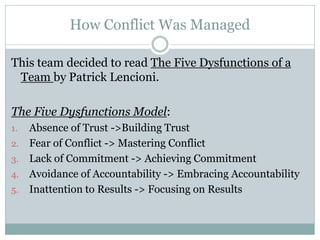
This team decided to read The Five Dysfunctions of a
 Team by Patrick Lencioni.

The Five Dysfunctions Model:
1. Absence of Trust ->Building Trust
2. Fear of Conflict -> Mastering Conflict
3. Lack of Commitment -> Achieving Commitment
4. Avoidance of Accountability -> Embracing Accountability
5. Inattention to Results -> Focusing on Results
How Conflict Was Managed

Pivotal points throughout the resolution process:
 After taking the Myers-Briggs Type Indicator, people
  began to view differences as differences, rather than
  threats.
 Team members created guidelines for handling
  conflict on the team.
 Discussed their vision for the team.
 Embraced conflict as a gateway for positive change.
How Conflict Was Managed

 Identified tendency toward negative assumptions of
  intent and lack of transparency in communication.
 Learned how each person wanted to be approached
  in communication and conflict.
 Team had habit of putting off important discussions;
  defined term “hot topics” and began to include on
  meeting agendas.
 Solved “hot topics” through discussion; learned how
  to plan and implement.
How Conflict Was Managed

 Focused on accountability – holding themselves and
  others accountable.
 Uncovered tendency to not ask for help “because
  everyone is so busy” – this caused conflict over time.
 Frustration on team decreased, team members
  reported their perceptions of each other began to
  shift to the positive, decreasing overall conflict.
 Team learned to have more positive regard for each
  other, to solve problems more creatively, and to
  diffuse tensions more directly.
Plan for Prevention

1.   Keep using lessons learned.
2.   Focus on transparent communication.
3.   “No gossip” zone.
4.   Handle conflicts as they surface; don’t allow them
     to fester.
5.   Recognize they can solve problems with positive,
     innovative solutions.
Case Study #3

RESOLVING INDIVIDUAL CONFLICT:
CONFLICT MANAGEMENT COACHING
Context of Conflict


 Bryant is the office manager of a 50 person start up.


 Company has grown rapidly over the past year.


 With recent expansion, he is frustrated and stressed.


 This stress has affected his communication skills,
 conflict management skills, and how he is perceived.
Key Stakeholders in the Conflict


 Bryant the office manager


 Bryant’s manager


 Bryant’s internal customers (employees who work
 for company)
Conflict Analysis

 As Bryant’s stress level increased (due to higher
  volume of work, more people to serve and rapid
  change), he struggled with communication, conflict
  management and stress management.
 The environmental changes required Bryant to make
  behavioral changes and he needed assistance with
  that.
 What once worked for him was no longer working
  well.
Conflict Resolution Process

 Bryant, his manager and I spoke to establish
 confidentiality, communication guidelines and goals
 for the work.

 We agreed I would meet with Bryant for 4 one-hour
 sessions, and then assess progress.

 Goals for the work: increase awareness of
 communication, to improve customer service skills,
 to manage stress more effectively.
How Conflict Was Resolved

Pivotal points throughout the coaching process:

 Bryant wanted to be perceived as receptive and
  dependable to others.
 Bryant was motivated to learn and make changes.
 Discussed how to repair relationships with
  employees – ways to boost his positive “PR”.
 He put new boundaries in place with employees.
  These boundaries decreased his sense of overwhelm
  and allowed him to better serve employees.
How Conflict Was Resolved

 Identified his emotional triggers. Implemented the
    tool “Stop,Think, React”.
   Discussed the art of discernment: When to let
    something go and when to address it?
   Bryant reported feeling better about himself, and his
    interactions with others were more positive and
    productive.
   When a conflict occurred, he was better able to
    respond from a calm place.
   He reported better self-observation.
Plan for Prevention

1. To continue to use the tools, skills and self-
    awareness he had been practicing.

2.To talk to his manager when feeling overwhelmed
   with his workload.
Find listings for our current season
          of webinars and register at:

            NonprofitWebinars.com


A Service
   Of:                     Sponsored by:

Conflict Resolution Success Stories

  • 1.
    Conflict Resolution SuccessStories Claudette Rowley March 7, 2012 A Service Of: Sponsored by:
  • 2.
    INTEGRATED PLANNING Advising nonprofits in: www.synthesispartnership.com • Strategy • Planning (617) 969-1881 • Organizational Development info@synthesispartnership.com A Service Of: Sponsored by:
  • 3.
    Affordable collaborative data management in the cloud. A Service Of: Sponsored by:
  • 4.
    Today’s Speaker Claudette Rowley Coach, Consultant, Author Metavoice Coaching & Consulting Hosting & Assisting with chat questions: April Hunt, Nonprofit Webinars A Service Of: Sponsored by:
  • 5.
    Conflict Resolution Success Stories NONPROFIT WEBINARS PRESENTED BY CLAUDETTE ROWLEY MARCH 7, 2012
  • 6.
    Webinar Takeaways Participants willlearn:  How three workplace conflicts were resolved.  Best practices for resolving specific conflicts.  Options for ongoing conflict management and prevention.
  • 7.
    Case Study #1 RELATIONSHIP REPAIR BETWEEN MANAGER AND DIRECT REPORT
  • 8.
    Context of Conflict Judy and Sharon are both leaders in a large health care institution.  Judy is Sharon’s manager.  They have experienced tension and conflict for several months.  The level of conflict is affecting their respective teams.
  • 9.
    Key Stakeholders inthe Conflict  Judy and Sharon  Judy’s manager (who has tried to resolve the conflict)  The employees who are affected by Judy and Sharon’s inability to communicate.
  • 10.
    Conflict Analysis 1. Trustwas heavily eroded between them. 2.Parties were unable to hear each other. 3. Assumption of negative intent was a driving force.
  • 11.
    Conflict Resolution Process Initial four-way call to establish confidentiality, goals and guidelines for work.  Judy, Sharon and I met for 4 one-hour sessions.  Goals for the work: reestablish productive communication, clarify expectations of each other, and put plan in place for managing future conflict.
  • 12.
    How Conflict WasResolved Pivotal points in the resolution process:  We identified four areas of agreement.  Sharon and Judy identified assumptions each was making about the other.  Recognized they had different definitions of “micro-management”.  Sharon felt micro-managed by Judy, while Judy was trying to avoid micro-managing.
  • 13.
    How Conflict WasResolved  Each defined “support” and “micro-management”.  They each reported that once they understood the other’s definition of support, they were more willing to give it.  Judy understood how Sharon wanted to be supported.  Sharon understood she needed to be clearer about her needs and ask for help.
  • 14.
    How Conflict WasResolved  We discussed new experience of support – more open conversations and better exchange of information.  Both reported relationship changes: understood each other’s intentions, needs and styles, and had fewer misunderstandings.
  • 15.
    Plan for Prevention 1. To check in with each other if tension builds. 2. Stay away from assumptions – check them out. 3. Ask to take breaks when needed, and reconvene later. 4. Make time to process and plan individually. 5. Schedule time to meet rather than responding in an emotionally triggered way.
  • 16.
    Case Study #2 UNADDRESSED TEAM CONFLICT: REBUILDING TRUST AND IMPROVING COMMUNICATION
  • 17.
    Context of Conflict Management team in mid-sized company in the service industry.  Team members are in state of unaddressed conflict.  Symptoms include: office gossip and drama, stonewalling, defensiveness, acting on assumptions.  Productivity, communication and results are hindered.
  • 18.
    Key Stakeholders inthe Conflict  The seven team members  Their manager  Senior leaders in the company  Customers served by company
  • 19.
    Conflict Analysis  Truston team was heavily eroded.  Power dynamics tended toward distributive (either/or) versus integrative (both/and).  Office drama, gossip and criticism had replaced communication.
  • 20.
    Conflict Management Process Worked with this team for about one year.  Facilitated several team building sessions.  Shared a general summary with company leaders after each team building session. (This was contracted with the team.)
  • 21.
    How Conflict WasManaged This team decided to read The Five Dysfunctions of a Team by Patrick Lencioni. The Five Dysfunctions Model: 1. Absence of Trust ->Building Trust 2. Fear of Conflict -> Mastering Conflict 3. Lack of Commitment -> Achieving Commitment 4. Avoidance of Accountability -> Embracing Accountability 5. Inattention to Results -> Focusing on Results
  • 22.
    How Conflict WasManaged Pivotal points throughout the resolution process:  After taking the Myers-Briggs Type Indicator, people began to view differences as differences, rather than threats.  Team members created guidelines for handling conflict on the team.  Discussed their vision for the team.  Embraced conflict as a gateway for positive change.
  • 23.
    How Conflict WasManaged  Identified tendency toward negative assumptions of intent and lack of transparency in communication.  Learned how each person wanted to be approached in communication and conflict.  Team had habit of putting off important discussions; defined term “hot topics” and began to include on meeting agendas.  Solved “hot topics” through discussion; learned how to plan and implement.
  • 24.
    How Conflict WasManaged  Focused on accountability – holding themselves and others accountable.  Uncovered tendency to not ask for help “because everyone is so busy” – this caused conflict over time.  Frustration on team decreased, team members reported their perceptions of each other began to shift to the positive, decreasing overall conflict.  Team learned to have more positive regard for each other, to solve problems more creatively, and to diffuse tensions more directly.
  • 25.
    Plan for Prevention 1. Keep using lessons learned. 2. Focus on transparent communication. 3. “No gossip” zone. 4. Handle conflicts as they surface; don’t allow them to fester. 5. Recognize they can solve problems with positive, innovative solutions.
  • 26.
    Case Study #3 RESOLVINGINDIVIDUAL CONFLICT: CONFLICT MANAGEMENT COACHING
  • 27.
    Context of Conflict Bryant is the office manager of a 50 person start up.  Company has grown rapidly over the past year.  With recent expansion, he is frustrated and stressed.  This stress has affected his communication skills, conflict management skills, and how he is perceived.
  • 28.
    Key Stakeholders inthe Conflict  Bryant the office manager  Bryant’s manager  Bryant’s internal customers (employees who work for company)
  • 29.
    Conflict Analysis  AsBryant’s stress level increased (due to higher volume of work, more people to serve and rapid change), he struggled with communication, conflict management and stress management.  The environmental changes required Bryant to make behavioral changes and he needed assistance with that.  What once worked for him was no longer working well.
  • 30.
    Conflict Resolution Process Bryant, his manager and I spoke to establish confidentiality, communication guidelines and goals for the work.  We agreed I would meet with Bryant for 4 one-hour sessions, and then assess progress.  Goals for the work: increase awareness of communication, to improve customer service skills, to manage stress more effectively.
  • 31.
    How Conflict WasResolved Pivotal points throughout the coaching process:  Bryant wanted to be perceived as receptive and dependable to others.  Bryant was motivated to learn and make changes.  Discussed how to repair relationships with employees – ways to boost his positive “PR”.  He put new boundaries in place with employees. These boundaries decreased his sense of overwhelm and allowed him to better serve employees.
  • 32.
    How Conflict WasResolved  Identified his emotional triggers. Implemented the tool “Stop,Think, React”.  Discussed the art of discernment: When to let something go and when to address it?  Bryant reported feeling better about himself, and his interactions with others were more positive and productive.  When a conflict occurred, he was better able to respond from a calm place.  He reported better self-observation.
  • 33.
    Plan for Prevention 1.To continue to use the tools, skills and self- awareness he had been practicing. 2.To talk to his manager when feeling overwhelmed with his workload.
  • 34.
    Find listings forour current season of webinars and register at: NonprofitWebinars.com A Service Of: Sponsored by: