NOMINAL GROUP TECHNIQUE


The nominal group technique is a widely used decisión makink technique
      that was developed by delbecq, Van de Ven and Gustafson.
Originally as an organizational
planning technique,a topic is
presented to the group members who
are then asked to write down thir
ideas on pad of paper.
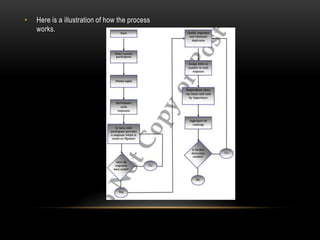
•   Here is a illustration of how the process
    works.
GROUP DECISION SUPPORT SYSTEMS (GDSS)


• GDSS are interactive, computer- based programs that
  assist group decision making, they involve a complex
  comumunications infraestructure and heuristic and
  quantitative methods
THE DISADVANTAGES OF GDSS


• Style of communication and focus on evaluating
  actions/consequences.
• The first disadvantage is the communication
  style, this refers to the lack of verbal interaction.
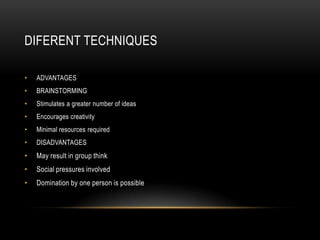
DIFERENT TECHNIQUES

•   ADVANTAGES
•   BRAINSTORMING
•   Stimulates a greater number of ideas
•   Encourages creativity
•   Minimal resources required
•   DISADVANTAGES
•   May result in group think
•   Social pressures involved
•   Domination by one person is possible
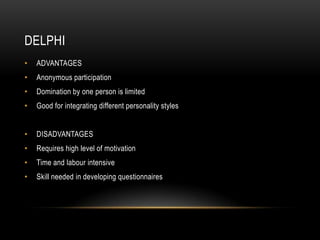
DELPHI
•   ADVANTAGES
•   Anonymous participation
•   Domination by one person is limited
•   Good for integrating different personality styles


•   DISADVANTAGES
•   Requires high level of motivation
•   Time and labour intensive
•   Skill needed in developing questionnaires
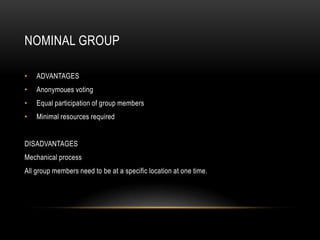
NOMINAL GROUP

•   ADVANTAGES
•   Anonymoues voting
•   Equal participation of group members
•   Minimal resources required


DISADVANTAGES
Mechanical process
All group members need to be at a specific location at one time.
GDSS
•   ADVANTAGES
•   Anonymous participation
•   Provide automated record keeping
•   Structured


•   DISADVANTAGES
•   No conversational interaction
•   Focuses only on one stage of decision making
•   Do not have a general application
DECISIONAL CONFLICTS AS SOURCES OF
STRESS


  • The process of decision making is
    not an easy one, intense conflicts
    are likely to occur when one has to
    make an important decision
CROSS- CULTURAL CONSIDERATIONS


• Culture has a big impact on people, behavior
  and perceptions, one particular cross- cultural
  difference to consider is how a problem is
  defined.
CONCLUSION
• The aim of gropu decision making is ultimately to
  develop and manage a successful and profitable
  organization.


• One way in doing so is to understand the process and
  dynamics that occur in group decision making, in order
  to fully understand such processes.

Group decision making.

  • 1.
    NOMINAL GROUP TECHNIQUE Thenominal group technique is a widely used decisión makink technique that was developed by delbecq, Van de Ven and Gustafson.
  • 2.
    Originally as anorganizational planning technique,a topic is presented to the group members who are then asked to write down thir ideas on pad of paper.
  • 3.
    Here is a illustration of how the process works.
  • 4.
    GROUP DECISION SUPPORTSYSTEMS (GDSS) • GDSS are interactive, computer- based programs that assist group decision making, they involve a complex comumunications infraestructure and heuristic and quantitative methods
  • 5.
    THE DISADVANTAGES OFGDSS • Style of communication and focus on evaluating actions/consequences. • The first disadvantage is the communication style, this refers to the lack of verbal interaction.
  • 6.
    DIFERENT TECHNIQUES • ADVANTAGES • BRAINSTORMING • Stimulates a greater number of ideas • Encourages creativity • Minimal resources required • DISADVANTAGES • May result in group think • Social pressures involved • Domination by one person is possible
  • 7.
    DELPHI • ADVANTAGES • Anonymous participation • Domination by one person is limited • Good for integrating different personality styles • DISADVANTAGES • Requires high level of motivation • Time and labour intensive • Skill needed in developing questionnaires
  • 8.
    NOMINAL GROUP • ADVANTAGES • Anonymoues voting • Equal participation of group members • Minimal resources required DISADVANTAGES Mechanical process All group members need to be at a specific location at one time.
  • 9.
    GDSS • ADVANTAGES • Anonymous participation • Provide automated record keeping • Structured • DISADVANTAGES • No conversational interaction • Focuses only on one stage of decision making • Do not have a general application
  • 10.
    DECISIONAL CONFLICTS ASSOURCES OF STRESS • The process of decision making is not an easy one, intense conflicts are likely to occur when one has to make an important decision
  • 11.
    CROSS- CULTURAL CONSIDERATIONS •Culture has a big impact on people, behavior and perceptions, one particular cross- cultural difference to consider is how a problem is defined.
  • 12.
    CONCLUSION • The aimof gropu decision making is ultimately to develop and manage a successful and profitable organization. • One way in doing so is to understand the process and dynamics that occur in group decision making, in order to fully understand such processes.