GROUP
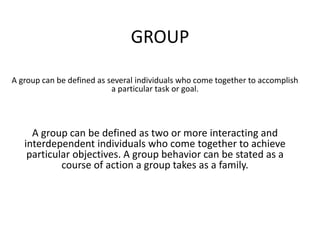
A group can be defined as several individuals who come together to accomplish
a particular task or goal.
A group can be defined as two or more interacting and
interdependent individuals who come together to achieve
particular objectives. A group behavior can be stated as a
course of action a group takes as a family.
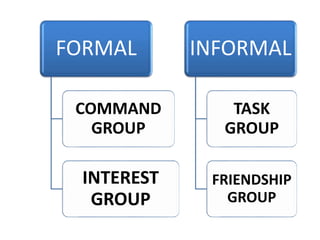
TYPES OF GROUP
GROUP
FORMAL INFORMAL
FORMAL
COMMAND
GROUP
INTEREST
GROUP
INFORMAL
TASK
GROUP
FRIENDSHIP
GROUP
WHY DO PEOPLE JOIN GROUPS?
Security mirrors strength in numbers.
Self-esteem transmits people's feelings of self-
worth.
Affiliation with groups can meet one's social
needs.
Groups represent power.
People may join a group for goal achievement.
GROUP PROPERTIES
1. Roles
2. Norms
3. Status
4. Diversity
5. Size
6. Cohesiveness
FOUNDATIONS OF GROUP BEHAVIOUR
- GROUP PROPERTIES
• 1. Roles : A set of expected behaviour patterns
attributed to someone occupying a given
position in a social unit.
• • We are expected to play diverse roles.
• • Role perception : An individual’s view of how he or
she is supposed to act in a given situation. • Friends,
books, movies, t.v. • Role expectations : The way others
believe you should act in a given context. • Eg. A
supreme court judge vs a football team manager. •
Psychological contract : An unwritten agreement that
sets out what management expects from an employee
and vice versa. • What happens when role
expectations implied in the psychological contract are
not met? • Role conflict : When compliance with one
role requirement may make it more difficult to comply
with another, the result is role conflict. Eg.: Work vs
Family
• 2. Norms : Acceptable standards of behaviour
within a group that are shared by the group’s
members. • 1. Performance norms : How hard
members should work, what the level of output
should be, how to get the job done, what level of
tardiness is appropriate. • 2. Appearance norms :
Dress codes, when to look busy. • 3. Social
arrangement norms : Whom to have lunch with,
whether to form friendships with co workers. • 4.
Resource allocation norms : Assignment of
difficult jobs, distribution of resources like pay or
equipment.
• Conformity : The adjustment of one’s behaviour to align
with the norms of the group. • People conform to the
important groups to which they belong or hope to belong.
These impotant groups are called Reference groups. • The
Solomon Asch studies: • Groups of 7 to 8 people were
asked to compare 2 cards held by the experimenter. •
Under ordinary conditions, fewer than 1% errors were
made. • But in the groups, the USS(UnSuspecting Subject)
gave atleast 1 answer that conformed – that they knew was
wrong but was consistent with the replies of other group
members – and the average conformer gave wrong answers
37% of the time. • As managers, we should be aware of
group norms, which press us or our subordinates or our
superiors towards conformity.
• 3. Status : A socially defined position or rank
given to groups or group members by others.
• Status characteristics theory : • 3 sources •
1. The power a person wields over others. •
Eg. control over a group’s resources. • 2. A
person’s ability to contribute to a group’s
goals. • Eg. Star sportspersons, crack lawyers
in law firms, top notch hospital administrators.
• 3. An individual’s personal characteristics. •
Eg. Money, intelligence, friendly personality
• Status and Norms : • High status individuals
(HSI) – more freedom to deviate from norms.
• High status individuals (Doctors, lawyers, top
executives) resent social pressure from low
status individuals. Eg. Insurance company
employees. • HSIs resist conformity pressures
more than others. Eg. Outstanding academics,
star athletes.
• Status and group interaction : • HSIs – more
assertive – speak out more, criticise more. •
Status differences actually inhibit diversity of
ideas, because lower status members tend to
participate less actively, and if they possess
expertise and insights, then it is a loss to the
group. • Status inequity : • It is important for
group members to believe the status hierarchy is
equitable. • People expect rewards to be
proportionate to costs incurred. • Eg. Reena and
Priya for the position of head nurse
• 4. Size • Smaller groups are faster at
completing tasks than larger ones. •
Individuals perform better in smaller groups
than in larger ones. • In problem solving,
larger groups consistently get better marks
than their smaller counterparts. • If the goal is
fact finding – larger groups more effective. •
Smaller groups –doing something productive
with that input
• 5. Cohesiveness : The degree to which group
members are attracted to each other and are
motivated to stay in the group. • Affected by:
• 1. Time spent together by the group
members. • 2. Size – the smaller, the more
cohesive. • 3. External threats. • Relationship
between cohesiveness and productivity
depends on the group’s performance related
norms. (Refer Diagram)

GROUP AND GROUP DYNAMICS

  • 1.
    GROUP A group canbe defined as several individuals who come together to accomplish a particular task or goal. A group can be defined as two or more interacting and interdependent individuals who come together to achieve particular objectives. A group behavior can be stated as a course of action a group takes as a family.
  • 2.
  • 4.
  • 5.
    WHY DO PEOPLEJOIN GROUPS? Security mirrors strength in numbers. Self-esteem transmits people's feelings of self- worth. Affiliation with groups can meet one's social needs. Groups represent power. People may join a group for goal achievement.
  • 6.
    GROUP PROPERTIES 1. Roles 2.Norms 3. Status 4. Diversity 5. Size 6. Cohesiveness
  • 7.
    FOUNDATIONS OF GROUPBEHAVIOUR - GROUP PROPERTIES • 1. Roles : A set of expected behaviour patterns attributed to someone occupying a given position in a social unit. • • We are expected to play diverse roles.
  • 8.
    • • Roleperception : An individual’s view of how he or she is supposed to act in a given situation. • Friends, books, movies, t.v. • Role expectations : The way others believe you should act in a given context. • Eg. A supreme court judge vs a football team manager. • Psychological contract : An unwritten agreement that sets out what management expects from an employee and vice versa. • What happens when role expectations implied in the psychological contract are not met? • Role conflict : When compliance with one role requirement may make it more difficult to comply with another, the result is role conflict. Eg.: Work vs Family
  • 9.
    • 2. Norms: Acceptable standards of behaviour within a group that are shared by the group’s members. • 1. Performance norms : How hard members should work, what the level of output should be, how to get the job done, what level of tardiness is appropriate. • 2. Appearance norms : Dress codes, when to look busy. • 3. Social arrangement norms : Whom to have lunch with, whether to form friendships with co workers. • 4. Resource allocation norms : Assignment of difficult jobs, distribution of resources like pay or equipment.
  • 10.
    • Conformity :The adjustment of one’s behaviour to align with the norms of the group. • People conform to the important groups to which they belong or hope to belong. These impotant groups are called Reference groups. • The Solomon Asch studies: • Groups of 7 to 8 people were asked to compare 2 cards held by the experimenter. • Under ordinary conditions, fewer than 1% errors were made. • But in the groups, the USS(UnSuspecting Subject) gave atleast 1 answer that conformed – that they knew was wrong but was consistent with the replies of other group members – and the average conformer gave wrong answers 37% of the time. • As managers, we should be aware of group norms, which press us or our subordinates or our superiors towards conformity.
  • 11.
    • 3. Status: A socially defined position or rank given to groups or group members by others. • Status characteristics theory : • 3 sources • 1. The power a person wields over others. • Eg. control over a group’s resources. • 2. A person’s ability to contribute to a group’s goals. • Eg. Star sportspersons, crack lawyers in law firms, top notch hospital administrators. • 3. An individual’s personal characteristics. • Eg. Money, intelligence, friendly personality
  • 12.
    • Status andNorms : • High status individuals (HSI) – more freedom to deviate from norms. • High status individuals (Doctors, lawyers, top executives) resent social pressure from low status individuals. Eg. Insurance company employees. • HSIs resist conformity pressures more than others. Eg. Outstanding academics, star athletes.
  • 13.
    • Status andgroup interaction : • HSIs – more assertive – speak out more, criticise more. • Status differences actually inhibit diversity of ideas, because lower status members tend to participate less actively, and if they possess expertise and insights, then it is a loss to the group. • Status inequity : • It is important for group members to believe the status hierarchy is equitable. • People expect rewards to be proportionate to costs incurred. • Eg. Reena and Priya for the position of head nurse
  • 14.
    • 4. Size• Smaller groups are faster at completing tasks than larger ones. • Individuals perform better in smaller groups than in larger ones. • In problem solving, larger groups consistently get better marks than their smaller counterparts. • If the goal is fact finding – larger groups more effective. • Smaller groups –doing something productive with that input
  • 15.
    • 5. Cohesiveness: The degree to which group members are attracted to each other and are motivated to stay in the group. • Affected by: • 1. Time spent together by the group members. • 2. Size – the smaller, the more cohesive. • 3. External threats. • Relationship between cohesiveness and productivity depends on the group’s performance related norms. (Refer Diagram)