Challenges of Modern
Banking
Presented by- Pratidhee Palak Jha
Introduction
 Banking can be defined as the business activity
of accepting and safeguarding money owned by
other individuals and entities, and then lending
out this money in order to earn a profit.
Evolution of Banking in India
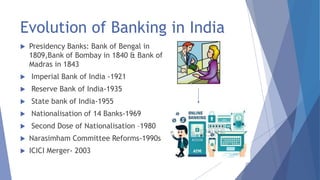
 Presidency Banks: Bank of Bengal in
1809,Bank of Bombay in 1840 & Bank of
Madras in 1843
 Imperial Bank of India -1921
 Reserve Bank of India-1935
 State bank of India-1955
 Nationalisation of 14 Banks-1969
 Second Dose of Nationalisation –1980
 Narasimham Committee Reforms-1990s
 ICICI Merger- 2003
Modern Banking
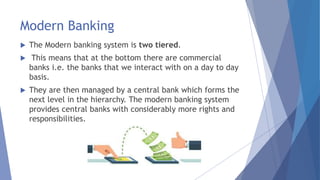
 The Modern banking system is two tiered.
 This means that at the bottom there are commercial
banks i.e. the banks that we interact with on a day to day
basis.
 They are then managed by a central bank which forms the
next level in the hierarchy. The modern banking system
provides central banks with considerably more rights and
responsibilities.
Challenges of modern banking
Macroeconomic risk
 Macroeconomic risk was the top concern for all survey
respondents despite the fact that many economies have
now returned to positive growth.
 For bankers, uncertainties in the macroeconomic
environment together with persistent and high levels of
debt across sovereign, corporate, and consumer sectors
lay the groundwork for asset bubbles to burst in the event
of significant instability.
Regulation
 There is slightly less of a concern for risk
managers and industry analysts, bankers
cite tightening regulatory requirements as
sometimes costly, excessive, and
ineffective.
 While bankers recognize the need for
tougher controls, concerns were raised
about the volume and complexity of current
regulation which were stated to eat into
management time and overall industry
margins.
Political interference
 Bankers expressed concern that governments
could intervene in banking operations for a
multitude of reasons, including to raise
revenues in a time of budget stress, increase
investor protection, and rebuild the national
tax base.
 Bankers also highlighted that the uncertainty
in several political environments including in
Europe and across the Middle East, as well as
the impact of the upcoming U.S. elections,
could result in greater interference over
banking management, lending policies, and
taxation.
Technology risk
 The outdated core IT systems were a significant concern for global
bankers. Failure to invest appropriately in secure, agile systems
that can enhance digital and mobile banking can result in
significant loss while compounding the risk for cyber attacks .
 According to Alexander Campbell, editor of Operational Risk &
Regulation Magazine, “the burden of multiple legacy systems at
some banks (due to a history of mergers) is already causing real
problems.”
Criminality
 Cyber attacks are increasingly seen as a top concern for
bankers. Many respondents worried that banks are not
currently equipped to prevent attacks from opportunistic
hackers, organized criminals, or government-funded corporate
(IP) espionage.
 The concern is further compounded by banks’ increased
embrace of newer (and potentially high-risk) tech including
distributed ledgers, crypto-currencies, and real-time
payments.
 Banks with strengthened technology systems are only as strong
as their weakest link, rendering them vulnerable to cyber
attacks from a multitude of sources.
Other few Challenges
 Not making enough money.
 Consumer expectations.
 Increasing competition from financial technology
companies.
 Regulatory pressure.
Challenges of Modern Banking

Challenges of Modern Banking

  • 1.
  • 2.
    Introduction  Banking canbe defined as the business activity of accepting and safeguarding money owned by other individuals and entities, and then lending out this money in order to earn a profit.
  • 3.
    Evolution of Bankingin India  Presidency Banks: Bank of Bengal in 1809,Bank of Bombay in 1840 & Bank of Madras in 1843  Imperial Bank of India -1921  Reserve Bank of India-1935  State bank of India-1955  Nationalisation of 14 Banks-1969  Second Dose of Nationalisation –1980  Narasimham Committee Reforms-1990s  ICICI Merger- 2003
  • 4.
    Modern Banking  TheModern banking system is two tiered.  This means that at the bottom there are commercial banks i.e. the banks that we interact with on a day to day basis.  They are then managed by a central bank which forms the next level in the hierarchy. The modern banking system provides central banks with considerably more rights and responsibilities.
  • 5.
    Challenges of modernbanking Macroeconomic risk  Macroeconomic risk was the top concern for all survey respondents despite the fact that many economies have now returned to positive growth.  For bankers, uncertainties in the macroeconomic environment together with persistent and high levels of debt across sovereign, corporate, and consumer sectors lay the groundwork for asset bubbles to burst in the event of significant instability.
  • 6.
    Regulation  There isslightly less of a concern for risk managers and industry analysts, bankers cite tightening regulatory requirements as sometimes costly, excessive, and ineffective.  While bankers recognize the need for tougher controls, concerns were raised about the volume and complexity of current regulation which were stated to eat into management time and overall industry margins.
  • 7.
    Political interference  Bankersexpressed concern that governments could intervene in banking operations for a multitude of reasons, including to raise revenues in a time of budget stress, increase investor protection, and rebuild the national tax base.  Bankers also highlighted that the uncertainty in several political environments including in Europe and across the Middle East, as well as the impact of the upcoming U.S. elections, could result in greater interference over banking management, lending policies, and taxation.
  • 8.
    Technology risk  Theoutdated core IT systems were a significant concern for global bankers. Failure to invest appropriately in secure, agile systems that can enhance digital and mobile banking can result in significant loss while compounding the risk for cyber attacks .  According to Alexander Campbell, editor of Operational Risk & Regulation Magazine, “the burden of multiple legacy systems at some banks (due to a history of mergers) is already causing real problems.”
  • 9.
    Criminality  Cyber attacksare increasingly seen as a top concern for bankers. Many respondents worried that banks are not currently equipped to prevent attacks from opportunistic hackers, organized criminals, or government-funded corporate (IP) espionage.  The concern is further compounded by banks’ increased embrace of newer (and potentially high-risk) tech including distributed ledgers, crypto-currencies, and real-time payments.  Banks with strengthened technology systems are only as strong as their weakest link, rendering them vulnerable to cyber attacks from a multitude of sources.
  • 10.
    Other few Challenges Not making enough money.  Consumer expectations.  Increasing competition from financial technology companies.  Regulatory pressure.