What is Management?
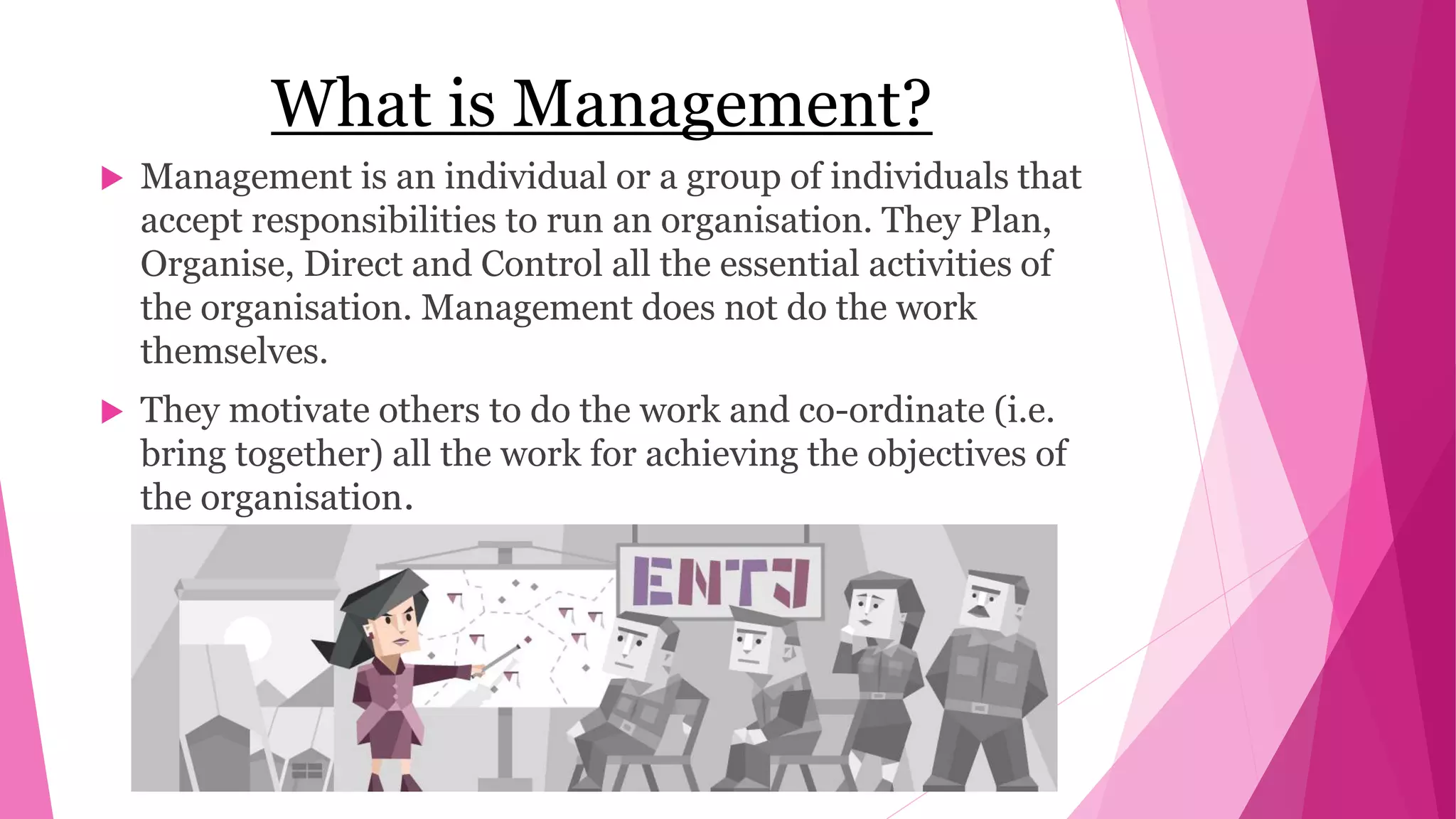
 Management is an individual or a group of individuals that
accept responsibilities to run an organisation. They Plan,
Organise, Direct and Control all the essential activities of
the organisation. Management does not do the work
themselves.
 They motivate others to do the work and co-ordinate (i.e.
bring together) all the work for achieving the objectives of
the organisation.
Management Process
 Management is a process making people work together to plan and to lead.
The 4 functions of management includes:-
 Planning: Planning takes a strategic view of the major plans and processes.
At the strategic level, each agency must plan, manage, and account for
both how and to what extent it achieves that mission.
 Organizing: Organizing in management refers to the relationship between
people, work and resources used to achieve the common goals. An
important task is performed by the administrators working at the top level
of management.
 Leading: This goes beyond simply managing tasks rather it involves
communicating, motivating, inspiring and encouraging employees towards a
higher level of productivity
 Controlling: controlling requires the existence of plans, since planning
provides the necessary performance objectives.
Management skills
 It is the ability to make business decisions and lead
subordinates and peers within a company. Three most
common skills include:-
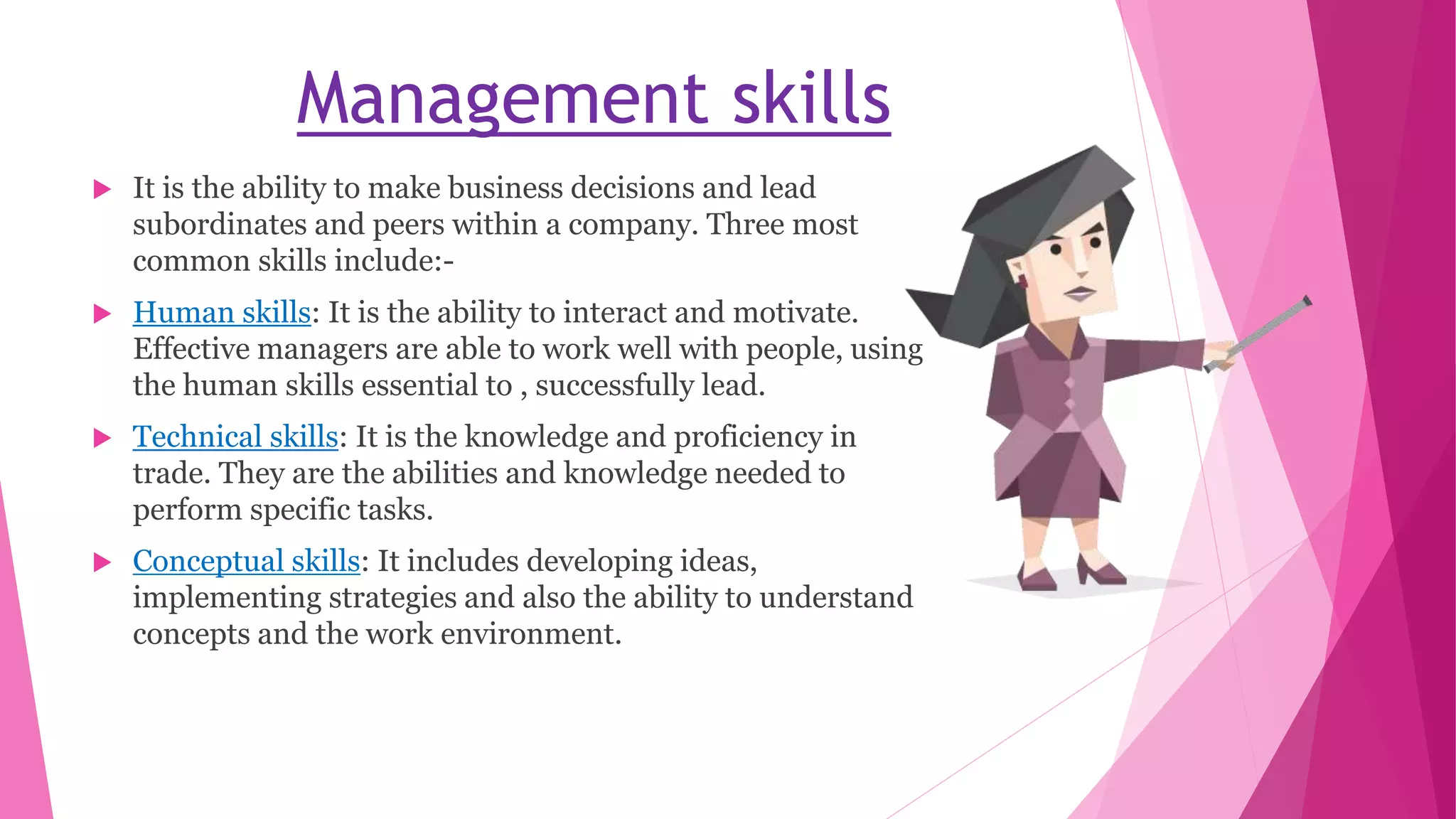
 Human skills: It is the ability to interact and motivate.
Effective managers are able to work well with people, using
the human skills essential to , successfully lead.
 Technical skills: It is the knowledge and proficiency in
trade. They are the abilities and knowledge needed to
perform specific tasks.
 Conceptual skills: It includes developing ideas,
implementing strategies and also the ability to understand
concepts and the work environment.
Management practices
 Design economic incentives so employees at all levels of an organization
can benefit from them.
 Provide meaningful feedback in a constructive manner on a regular
basis.
 Respect employees as individuals, in addition to the job they do.
 Be sure management at all levels of an organization receives adequate
training.
 Provide support for employees when it's genuinely needed.
 Don't be emotionally stingy.
 Ensure senior leadership models behaviour that makes the rank-and-file
proud to be part of the team.
Company selected
Company’s profile:
 Cadbury is a British multinational confectionery company wholly owned
by Mondelez International (originally Kraft Foods) since 2010.
 It is the second-largest confectionery brand in the world after Wrigley's.
 Cadbury is internationally headquartered in Uxbridge, west London, and
operates in more than fifty countries worldwide. It is famous for its Dairy Milk
chocolate, the Crème Egg and Roses selection box, and many other
confectionery products. One of the best-known British brands, in 2013 The
Daily Telegraph named Cadbury among Britain's most successful exports.
 Cadbury was established in Birmingham, England in 1824, by John Cadbury who
sold tea, coffee and drinking chocolate.
 Cadbury merged with J. S. Fry & Sons in 1919, and Schweppes in 1969. Cadbury
was a constant constituent of the FTSE 100 on the London Stock Exchange from
the index's 1984 inception until the company was bought by Kraft Foods in
2010.
MISSION & VISION
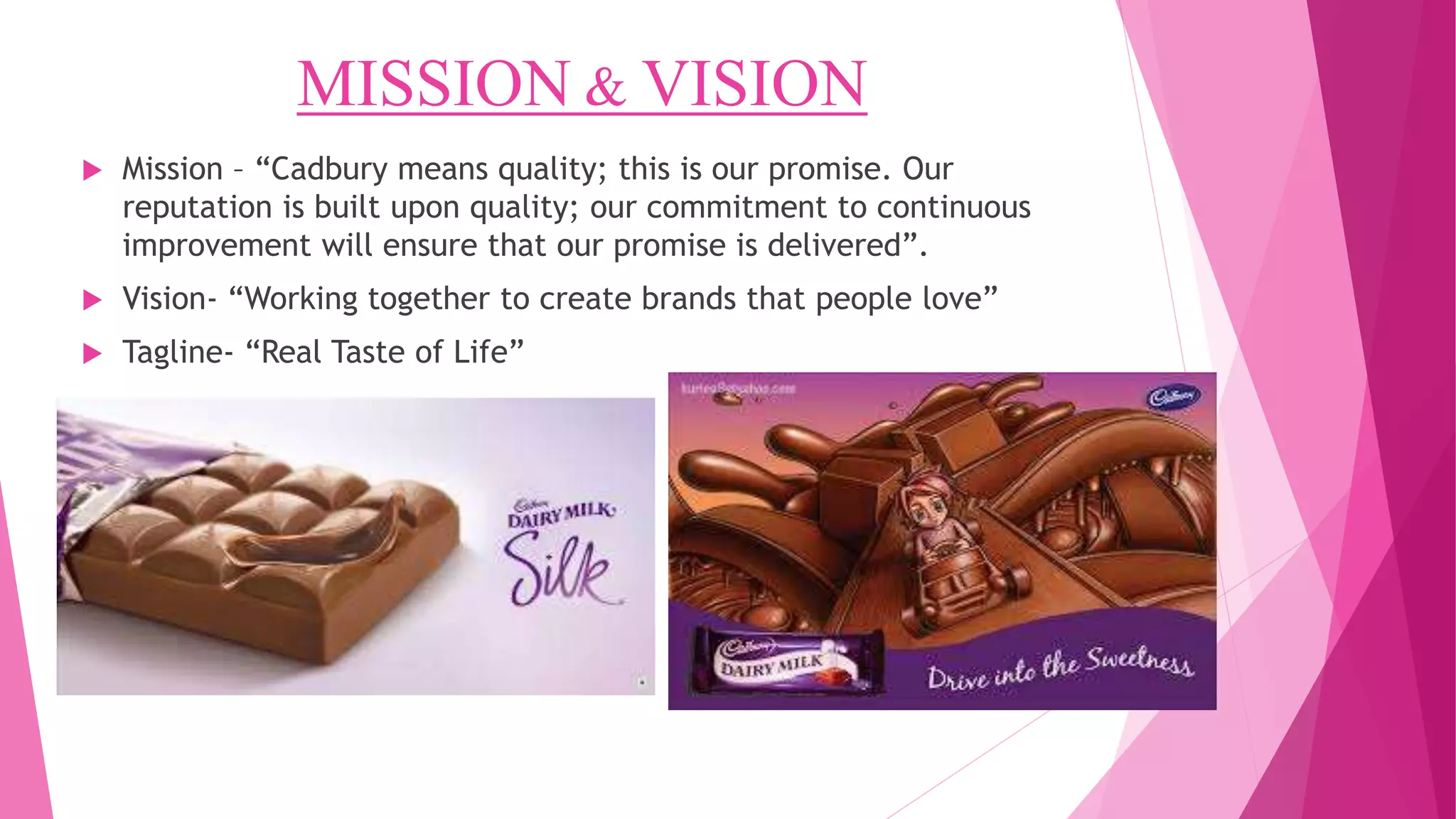
 Mission – “Cadbury means quality; this is our promise. Our
reputation is built upon quality; our commitment to continuous
improvement will ensure that our promise is delivered”.
 Vision- “Working together to create brands that people love”
 Tagline- “Real Taste of Life”
SWOT Analysis
Cadbury is one of the topmost FMCG brands in India and hence there is no doubt that
the strengths and opportunities of Cadbury are far more than it’s weaknesses and
threats. Let us delve deeper in the SWOT of Cadbury.
STRENGTHS:
World leader – Cadbury is the world’s leader in chocolates. Known to have the best
manufacturing and a wide distribution channel, Cadbury has a presence in 200 or more
countries.
 Powerhouse brands and Products – Cadbury has many strong brands in its product
portfolio such as dairy milk, Bournvita, Oreo, five star and others.
 Brand name, brand equity and Brand loyalty – Cadbury products are blessed with
a fantastic brand loyalty. Due to its marketing and strong branding over the years,
the brand equity of Cadbury is also high and hence Cadbury is comfortable charging
a premium for its product because of the high brand equity.
 Positioning as gift – The smartest tactic that Cadbury has done over the years with
products like dairy milk and celebrations is that these chocolates are positioned for
gifting.
Cont..
 Promotions – With an amazing tag line of “kuch meetha ho jaye” this
further imparts strength to Cadbury because it provides excellent brand
recall.
 Indian connect – Cadbury is one of the few brands which connects so well
with the Indian diaspora. For Indians, family, friends and love are all
important parts of their life. And Cadbury has always focused on
emotional marketing to connect with the Indian audience.
 Placement and distribution – Cadbury has a superb distribution strategy
in place and like all FMCG companies, it uses the strategy of breaking the
bulk. Distributing to 200 countries with a variety of more than 40 variants
is not a small feat. And Cadbury has been achieving the same for the past
many years. It is known to have one of the best FMCG distribution
channels in India.
Weakness
 A brand like Cadbury is expected to have many strengths and few weaknesses,
and the same is the case. Cadbury’s weakness is its rural distribution
considering India has such a wide rural diaspora which can be covered.
 A few cases , here and there have happened based on the quality of the
product where cockroaches or other rodents were found in the chocolate. It is
inexcusable for a brand like Cadbury to show such ignorance because such
infected chocolates should not leave quality control at all. Thus quality
control needs to be strengthened.
Opportunities
 Rural markets – What is a weakness can become an opportunity.
Penetrating rural markets and distribution in rural markets can be a
large opportunity for Cadbury. It is present in foreign countries and a
rural presence is much needed for Cadbury which will boost the brands
presence and turnover.
 New Tastes – Indian consumers have a sweet tooth and they frequently
like to eat small chocolates as well as chocolate bars. On top of it,
there are various flavours which consumers like. Thus, new tastes and
new flavours are an opportunity which Cadbury can generate regularly.
Threats
Cost and price increase – With an increase in fuel cost as well as cost of transportation,
distribution cost has gone up. At the same time, the cost of procurement and manufacturing is high as
well. Thus, over the years, the constant increase in costing and thereby pricing of the product is a
threat to Cadbury as it creates a gap for other companies to enter.
Health consciousness on the rise – Health consciousness is on the rise amongst the Indian
population. Many people prefer drinking health juices as well as fruits rather than having chocolates.
Decreasing importance of festivals – Cadbury has spent years to get the position of a gift on
festivals and occasions. What happens when the importance of these festivals drops? The buying of
chocolates also drops.
Rising demand of people, growing purchasing power – Nowadays, if you gift a chocolate to
children, they are likely to demand a toy car, a bicycle or for a young adult, a computer. Thus, with a
rise in purchasing power, the demands of gifts also has gone up in value and just a chocolate will not
suffice. This is also a threat for Cadbury.
Company’s strategies
 Competitive advantage in the Marketing strategy of Cadbury – Distribution and
brand equity are two major competitive advantage for Cadbury. Cadbury is making
its product available from small to high end departmental stores, which is only
possible due to its extensive distribution channel creating competitive edge over
others. The main competitive advantage of Cadbury comes from its ability to
market its products through altering the theme & functionality of the products on
continuous basis. Also smartly designing its promotion & communications to handle
the controversies & educate customers more about the confectionaries had helped
the company to spread positive word of mouth resulting from negative marketing.
 Chocolates are stars as it has large assortments in chocolates worldwide & it is the
world’s second confectionary company having high market share in most of the
markets.
CORPORATE EXCELLENCE
It is defined as the ability of the company to outsmart
Competitors consistently over a long period of time.
The successful organizations are different from excellent
organizations. Success may be of one dimensions
but excellence is of multiple dimensional in the company.
Company’s strategies
 Distribution in the Marketing strategy of Cadbury – Although Cadbury is not
so extensively in FMCG but they are able to make the product available in the
extreme regions in Urban as well as rural areas but they focus more on Urban
markets due to the demand economics. Products are being made available
through the C&F to wholesaler to retailer & then to the end customer, which
is actually a 3-tier distribution approach.
 Brand equity in the Marketing strategy of Cadbury- Cadbury addresses the
needs of each and every consumer, from childhood to maturity, from impulse
purchase to family treats. Cadbury designs products to coincide with
Christmas, Easter, Valentine’s, Mother’s and Father’s Day and other calendar
landmarks. Cadbury use marketing strategies such as the ‘Choose Cadbury’
strategy to encourage a link between chocolate and these events ensuring
there is a Cadbury chocolate product suitable and available for every
occasion. The marketing communications over the years as well the lovely
taste of Cadbury and its consistence have given a fantastic brand equity to the
brand.
Company’s strategies
 Competitive analysis in the Marketing strategy of Cadbury – The confectionaries
industry is highly competitive & is overcrowded by local & national players. While
Cadbury’s parent company Mondelez International is the world leader in Bars &
chocolates for middle age income group, other players like Nestle, Ferrero Rocher ,
Perfett, Amul , Kraft foods etc. have product categories & customer groups in which they
are specialized in. Due to high R& D and change in organoleptic of milk, changing lifestyle
of Asian markets, eating habits etc. this industry will observe high growth momentum in
the coming years.
 Market analysis in the Marketing strategy of Cadbury – Confectionaries business is ever
growing & due to the changing consumption of milk and daity products, there is more &
more opportunity that is lying ahead in this industry. The market is ruled by few
companies such as Cadbury, nestle, Mars, Heinz, Perfetti van etc. Cadbury has a broad
product portfolio in the chocolate segment like dairy milk, Bournville, Cadbury crunch,
Eclairs etc. due to which they are able to lead the market in this segment but their other
product categories like biscuits & cakes are suffering due to the narrow product
portfolio.
 Customer analysis in the Marketing strategy of Cadbury – Customers of Cadbury are
from all segments & people from all age group consume chocolates, biscuits & beverages
but it is the growing middle income group as well as the youngsters who form the major
consumer segment.
Problems faced by the Cadbury:
 Cadbury India Ltd. In October 2003, just a month before Diwali, customers in
Mumbai complained about finding worms in Cadbury Dairy Milk chocolates.
Quick to respond, the Maharashtra Food and Drug Administration seized the
chocolate stocks manufactured at Cadbury's Pune plant.
 In defence, Cadbury issued a statement that the infestation was not possible
at the manufacturing stage and poor storage at the retailers was the most
likely cause of the reported case of worms.
Problems (cont.)
 FIA officials conducted raids at the
Talegaon plant of the company as
well as at the stockists premises
throughout Maharastra.
 The authorities have, however
decided not to shut down the plant
or to cancel the company’s license
to produce chocolates.
 The chocolates were out of sale
since July 2003, so there were a
very few of them left in the
market and the company was also
asked to withdraw the entire
batch, said by Mr Uttam.
Remedies
 A focused and intense communications program was
implemented over the next 6 months to rebuild
credibility and restore confidence among the key
stakeholders.
 In a damage-control exercise, appropriately called
,”Project VISHWAS” Cadbury India announced a 3-
step strategic programme involving its packaging,
distribution chain and retail channels. For the first
time in 30 yrs, the company discontinued the system
of loss of sales for Cadbury Dairy Milk and also
changed it outer package design.
 By investing up to Rs 15 crore (Rs 150 million) on
imported machinery, Cadbury's revamped the
packaging of Dairy Milk. The metallic poly-flow, was
costlier by 10-15 per cent, but Cadbury didn't hike
the pack price.
 The company upped ad spends for the Jan-March
quarter by over 15 per cent. The recovery began in
May 2004, and by June, Cadbury's claimed
that consumer confidence was back.
Status of the company:
 Growth
More than $10 billion of acquisitions have diversified Cadbury's
business into faster-growing, more-profitable segments of the
confectionery market. Going forward, we expect that the firm
will seek to drive growth through small bolt-on acquisitions as
well as further penetration of its existing brand portfolio.
 Profitability
Management projects a midteens operating margin by 2011.
Although we believe Cadbury will be able to cut a lot of low-
hanging fruit, particularly in the early years of its initiatives, we
assume the firm will achieve the low end of its midteens margin
target and most likely over a time frame beyond management's
forecast.
 Financial Health
We're not concerned by Cadbury's debt levels, as the firm
operates with nearly £1.4 billion of long-term debt, and
adjusted earnings before interest and taxes of more than 4
times through the first six months of 2009.
CONCLUSION
 A manager is the one who should be aware of certain skills which are required
for implementing new ideas and strategies and even innovating new things for
the achievement of certain goals and objectives .
 He should have good communication skills with his employees and motivating
power which acts as a key role for the support for his organisation .
 A manager is ought to coordinate with his subordinates and peers for the
attainment for the mission of the company .
 He should also have proper subject knowledge so that he could guide his
teammates in case of any technical issues. He should be able to adjust
according to the situations that arise in the organisation.
Management and cadbury

Management and cadbury

  • 1.
    What is Management? Management is an individual or a group of individuals that accept responsibilities to run an organisation. They Plan, Organise, Direct and Control all the essential activities of the organisation. Management does not do the work themselves.  They motivate others to do the work and co-ordinate (i.e. bring together) all the work for achieving the objectives of the organisation.
  • 2.
    Management Process  Managementis a process making people work together to plan and to lead. The 4 functions of management includes:-  Planning: Planning takes a strategic view of the major plans and processes. At the strategic level, each agency must plan, manage, and account for both how and to what extent it achieves that mission.  Organizing: Organizing in management refers to the relationship between people, work and resources used to achieve the common goals. An important task is performed by the administrators working at the top level of management.  Leading: This goes beyond simply managing tasks rather it involves communicating, motivating, inspiring and encouraging employees towards a higher level of productivity  Controlling: controlling requires the existence of plans, since planning provides the necessary performance objectives.
  • 3.
    Management skills  Itis the ability to make business decisions and lead subordinates and peers within a company. Three most common skills include:-  Human skills: It is the ability to interact and motivate. Effective managers are able to work well with people, using the human skills essential to , successfully lead.  Technical skills: It is the knowledge and proficiency in trade. They are the abilities and knowledge needed to perform specific tasks.  Conceptual skills: It includes developing ideas, implementing strategies and also the ability to understand concepts and the work environment.
  • 4.
    Management practices  Designeconomic incentives so employees at all levels of an organization can benefit from them.  Provide meaningful feedback in a constructive manner on a regular basis.  Respect employees as individuals, in addition to the job they do.  Be sure management at all levels of an organization receives adequate training.  Provide support for employees when it's genuinely needed.  Don't be emotionally stingy.  Ensure senior leadership models behaviour that makes the rank-and-file proud to be part of the team.
  • 5.
  • 6.
    Company’s profile:  Cadburyis a British multinational confectionery company wholly owned by Mondelez International (originally Kraft Foods) since 2010.  It is the second-largest confectionery brand in the world after Wrigley's.  Cadbury is internationally headquartered in Uxbridge, west London, and operates in more than fifty countries worldwide. It is famous for its Dairy Milk chocolate, the Crème Egg and Roses selection box, and many other confectionery products. One of the best-known British brands, in 2013 The Daily Telegraph named Cadbury among Britain's most successful exports.  Cadbury was established in Birmingham, England in 1824, by John Cadbury who sold tea, coffee and drinking chocolate.  Cadbury merged with J. S. Fry & Sons in 1919, and Schweppes in 1969. Cadbury was a constant constituent of the FTSE 100 on the London Stock Exchange from the index's 1984 inception until the company was bought by Kraft Foods in 2010.
  • 7.
    MISSION & VISION Mission – “Cadbury means quality; this is our promise. Our reputation is built upon quality; our commitment to continuous improvement will ensure that our promise is delivered”.  Vision- “Working together to create brands that people love”  Tagline- “Real Taste of Life”
  • 8.
    SWOT Analysis Cadbury isone of the topmost FMCG brands in India and hence there is no doubt that the strengths and opportunities of Cadbury are far more than it’s weaknesses and threats. Let us delve deeper in the SWOT of Cadbury. STRENGTHS: World leader – Cadbury is the world’s leader in chocolates. Known to have the best manufacturing and a wide distribution channel, Cadbury has a presence in 200 or more countries.  Powerhouse brands and Products – Cadbury has many strong brands in its product portfolio such as dairy milk, Bournvita, Oreo, five star and others.  Brand name, brand equity and Brand loyalty – Cadbury products are blessed with a fantastic brand loyalty. Due to its marketing and strong branding over the years, the brand equity of Cadbury is also high and hence Cadbury is comfortable charging a premium for its product because of the high brand equity.  Positioning as gift – The smartest tactic that Cadbury has done over the years with products like dairy milk and celebrations is that these chocolates are positioned for gifting.
  • 9.
    Cont..  Promotions –With an amazing tag line of “kuch meetha ho jaye” this further imparts strength to Cadbury because it provides excellent brand recall.  Indian connect – Cadbury is one of the few brands which connects so well with the Indian diaspora. For Indians, family, friends and love are all important parts of their life. And Cadbury has always focused on emotional marketing to connect with the Indian audience.  Placement and distribution – Cadbury has a superb distribution strategy in place and like all FMCG companies, it uses the strategy of breaking the bulk. Distributing to 200 countries with a variety of more than 40 variants is not a small feat. And Cadbury has been achieving the same for the past many years. It is known to have one of the best FMCG distribution channels in India.
  • 10.
    Weakness  A brandlike Cadbury is expected to have many strengths and few weaknesses, and the same is the case. Cadbury’s weakness is its rural distribution considering India has such a wide rural diaspora which can be covered.  A few cases , here and there have happened based on the quality of the product where cockroaches or other rodents were found in the chocolate. It is inexcusable for a brand like Cadbury to show such ignorance because such infected chocolates should not leave quality control at all. Thus quality control needs to be strengthened.
  • 11.
    Opportunities  Rural markets– What is a weakness can become an opportunity. Penetrating rural markets and distribution in rural markets can be a large opportunity for Cadbury. It is present in foreign countries and a rural presence is much needed for Cadbury which will boost the brands presence and turnover.  New Tastes – Indian consumers have a sweet tooth and they frequently like to eat small chocolates as well as chocolate bars. On top of it, there are various flavours which consumers like. Thus, new tastes and new flavours are an opportunity which Cadbury can generate regularly.
  • 12.
    Threats Cost and priceincrease – With an increase in fuel cost as well as cost of transportation, distribution cost has gone up. At the same time, the cost of procurement and manufacturing is high as well. Thus, over the years, the constant increase in costing and thereby pricing of the product is a threat to Cadbury as it creates a gap for other companies to enter. Health consciousness on the rise – Health consciousness is on the rise amongst the Indian population. Many people prefer drinking health juices as well as fruits rather than having chocolates. Decreasing importance of festivals – Cadbury has spent years to get the position of a gift on festivals and occasions. What happens when the importance of these festivals drops? The buying of chocolates also drops. Rising demand of people, growing purchasing power – Nowadays, if you gift a chocolate to children, they are likely to demand a toy car, a bicycle or for a young adult, a computer. Thus, with a rise in purchasing power, the demands of gifts also has gone up in value and just a chocolate will not suffice. This is also a threat for Cadbury.
  • 13.
    Company’s strategies  Competitiveadvantage in the Marketing strategy of Cadbury – Distribution and brand equity are two major competitive advantage for Cadbury. Cadbury is making its product available from small to high end departmental stores, which is only possible due to its extensive distribution channel creating competitive edge over others. The main competitive advantage of Cadbury comes from its ability to market its products through altering the theme & functionality of the products on continuous basis. Also smartly designing its promotion & communications to handle the controversies & educate customers more about the confectionaries had helped the company to spread positive word of mouth resulting from negative marketing.  Chocolates are stars as it has large assortments in chocolates worldwide & it is the world’s second confectionary company having high market share in most of the markets.
  • 14.
    CORPORATE EXCELLENCE It isdefined as the ability of the company to outsmart Competitors consistently over a long period of time. The successful organizations are different from excellent organizations. Success may be of one dimensions but excellence is of multiple dimensional in the company.
  • 15.
    Company’s strategies  Distributionin the Marketing strategy of Cadbury – Although Cadbury is not so extensively in FMCG but they are able to make the product available in the extreme regions in Urban as well as rural areas but they focus more on Urban markets due to the demand economics. Products are being made available through the C&F to wholesaler to retailer & then to the end customer, which is actually a 3-tier distribution approach.  Brand equity in the Marketing strategy of Cadbury- Cadbury addresses the needs of each and every consumer, from childhood to maturity, from impulse purchase to family treats. Cadbury designs products to coincide with Christmas, Easter, Valentine’s, Mother’s and Father’s Day and other calendar landmarks. Cadbury use marketing strategies such as the ‘Choose Cadbury’ strategy to encourage a link between chocolate and these events ensuring there is a Cadbury chocolate product suitable and available for every occasion. The marketing communications over the years as well the lovely taste of Cadbury and its consistence have given a fantastic brand equity to the brand.
  • 16.
    Company’s strategies  Competitiveanalysis in the Marketing strategy of Cadbury – The confectionaries industry is highly competitive & is overcrowded by local & national players. While Cadbury’s parent company Mondelez International is the world leader in Bars & chocolates for middle age income group, other players like Nestle, Ferrero Rocher , Perfett, Amul , Kraft foods etc. have product categories & customer groups in which they are specialized in. Due to high R& D and change in organoleptic of milk, changing lifestyle of Asian markets, eating habits etc. this industry will observe high growth momentum in the coming years.  Market analysis in the Marketing strategy of Cadbury – Confectionaries business is ever growing & due to the changing consumption of milk and daity products, there is more & more opportunity that is lying ahead in this industry. The market is ruled by few companies such as Cadbury, nestle, Mars, Heinz, Perfetti van etc. Cadbury has a broad product portfolio in the chocolate segment like dairy milk, Bournville, Cadbury crunch, Eclairs etc. due to which they are able to lead the market in this segment but their other product categories like biscuits & cakes are suffering due to the narrow product portfolio.  Customer analysis in the Marketing strategy of Cadbury – Customers of Cadbury are from all segments & people from all age group consume chocolates, biscuits & beverages but it is the growing middle income group as well as the youngsters who form the major consumer segment.
  • 17.
    Problems faced bythe Cadbury:  Cadbury India Ltd. In October 2003, just a month before Diwali, customers in Mumbai complained about finding worms in Cadbury Dairy Milk chocolates. Quick to respond, the Maharashtra Food and Drug Administration seized the chocolate stocks manufactured at Cadbury's Pune plant.  In defence, Cadbury issued a statement that the infestation was not possible at the manufacturing stage and poor storage at the retailers was the most likely cause of the reported case of worms.
  • 18.
    Problems (cont.)  FIAofficials conducted raids at the Talegaon plant of the company as well as at the stockists premises throughout Maharastra.  The authorities have, however decided not to shut down the plant or to cancel the company’s license to produce chocolates.  The chocolates were out of sale since July 2003, so there were a very few of them left in the market and the company was also asked to withdraw the entire batch, said by Mr Uttam.
  • 19.
    Remedies  A focusedand intense communications program was implemented over the next 6 months to rebuild credibility and restore confidence among the key stakeholders.  In a damage-control exercise, appropriately called ,”Project VISHWAS” Cadbury India announced a 3- step strategic programme involving its packaging, distribution chain and retail channels. For the first time in 30 yrs, the company discontinued the system of loss of sales for Cadbury Dairy Milk and also changed it outer package design.  By investing up to Rs 15 crore (Rs 150 million) on imported machinery, Cadbury's revamped the packaging of Dairy Milk. The metallic poly-flow, was costlier by 10-15 per cent, but Cadbury didn't hike the pack price.  The company upped ad spends for the Jan-March quarter by over 15 per cent. The recovery began in May 2004, and by June, Cadbury's claimed that consumer confidence was back.
  • 20.
    Status of thecompany:  Growth More than $10 billion of acquisitions have diversified Cadbury's business into faster-growing, more-profitable segments of the confectionery market. Going forward, we expect that the firm will seek to drive growth through small bolt-on acquisitions as well as further penetration of its existing brand portfolio.  Profitability Management projects a midteens operating margin by 2011. Although we believe Cadbury will be able to cut a lot of low- hanging fruit, particularly in the early years of its initiatives, we assume the firm will achieve the low end of its midteens margin target and most likely over a time frame beyond management's forecast.  Financial Health We're not concerned by Cadbury's debt levels, as the firm operates with nearly £1.4 billion of long-term debt, and adjusted earnings before interest and taxes of more than 4 times through the first six months of 2009.
  • 21.
    CONCLUSION  A manageris the one who should be aware of certain skills which are required for implementing new ideas and strategies and even innovating new things for the achievement of certain goals and objectives .  He should have good communication skills with his employees and motivating power which acts as a key role for the support for his organisation .  A manager is ought to coordinate with his subordinates and peers for the attainment for the mission of the company .  He should also have proper subject knowledge so that he could guide his teammates in case of any technical issues. He should be able to adjust according to the situations that arise in the organisation.