Group Behaviour
Topics to be Studied
• Group and Group Behaviour
• Characteristics of Groups
• Types of Groups
• Reasons to Join Groups
• Stages of Group
Development
• Properties of Groups
Farhan Ahmad
CSS 2019 Qualifier
MBA Finance Gold Medalist
Co-Author of District Wise
Economic Profile of KP
Group, its characteristics Group Behaviour
Group Behaviour
Group Behaviour refers to people
with a similar goal behaving in
the same way, which might be
different from how they would
normally behave if they were
alone or as individuals. It is the
type of behaviour that takes
place when individuals act
together or collectively.
• 2 or more persons (if it is one person. it is not a group)
• Formal social structure (the rules of the game are defined)
• Common goals (the destiny is the same and emotionally
connected)
• Face-to-face interaction (they will talk with, each other)
• Interdependence (each one is complementary to the
other)
• Recognition by others (yes. you belong to the group)
Characteristics:
Group
a number of people or things
that are located, gathered, or
classed together.
Global North and Global South
Relations
Global North and Global South
Southern nations are dependent upon Northern nations (dependency)
Interdependence
Capitalism
20% 80% Bourgeoisie (Ameer log) Owners
80% 20% Proletariat (Ghreeb log) Working Class
Types of Groups
Group
Informal
Group
Formal Group
Task Group
Command
Group
Friendship
Group
Interest
Group
Shawal Power
Usman Tech
Basit Energy
Task Force
Task : To eradicate Corona
Ministry of Education
Ministry of Health
Ministry of PD&R
Ministry of Finance
Types of Groups
Formal groups are
the ones that are
created as per
official authority,
so as to fulfill the
desired objective.
Informal groups ar
e formed by the
employees as per
their likes,
interests, and
attitudes.
Command group is a formal group,
determined by the organization's
hierarchal chart and composed of the
individuals that report to a particular
manager. For instance, the manager
of training has a command group of
his employees, the training group.
Task groups are designed to accomplish
identified work goals. They include
committees, task forces and social action groups,
study circles and learning groups, planning and
discussion groups, and other group experiences
where the participants have a task to accomplish
that is external to the individual members
Advocacy groups, also known as
interest groups, use various forms of
advocacy in order to influence public
opinion and ultimately policy.
Those brought together because of their shared
interests or common characteristics is known
as friendship group.
Reasons to Join Groups
People join groups for a variety of reasons. For example, students may have to take a certain class, they join
functional groups simply by virtue of joining organizations and accepting a specific job assignment that involves
working with a designated group of other people.
The need for belonging: According to Maslow’s hierarchy of needs, the need for belonging is one of the
basic human’s needs. According to Maslow people feel that they want to be a part
of a group as a part of their nature.
To feel superior: According to individual psychology, the desire to feel superior is a desire that all
humans experience. By joining the superior group people can help themselves
achieve the need for superiority.
To survive: Since the early days, humans used to join groups to increase their survival abilities
and to be better able to protect themselves.
To project an identity: Some people can join certain groups to project certain identities. People usually
buy branded clothes in order to project a certain identity to others.
It increases one’s self-
esteem:
According to the sociometer model, a person’s self-esteem can increase when a
person joins a certain social group. According to this Theory, the self-esteem boost
arises from the fact that a person feels accepted by the group.
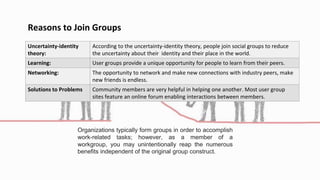
Reasons to Join Groups
Uncertainty-identity
theory:
According to the uncertainty-identity theory, people join social groups to reduce
the uncertainty about their identity and their place in the world.
Learning: User groups provide a unique opportunity for people to learn from their peers.
Networking: The opportunity to network and make new connections with industry peers, make
new friends is endless.
Solutions to Problems Community members are very helpful in helping one another. Most user group
sites feature an online forum enabling interactions between members.
Organizations typically form groups in order to accomplish
work-related tasks; however, as a member of a
workgroup, you may unintentionally reap the numerous
benefits independent of the original group construct.
Five Stages of Group Development
Group Properties
Norms
Cohesiveness
Group Properties
Roles
Status
Size
Working groups are not
unorganized mobs. The
workgroup has properties that
shape the behavior of
members and make it possible
to explain and predict a large
portion of the individual
behaviour for within the
groups as well as the
performance of the group
itself. Some of these
properties are roles, norms,
status, group size and degree
of group cohesiveness.
Roles The role is a set of expected behavior patterns attributed to someone occupying a
given position in a social unit.
Role identity:
Attitudes and actual behaviors consistent
with a role, and they create the role
identity. People have the ability to shift
roles rapidly where they recognize that a
situation and its demands clearly require
major changes. E.g. Promotion, Demotion
Roles perception:
Activities of managers and
workers alike are guided by their
role perceptions, that is, how
they are supposed to act in their
own roles and how others should
act in their roles.
Roles Expectation:
Roles expectations are
defined as the way
others believe you
should act in a given
situation
Role conflict:
When others have different perception or expectations of a
person’s role, that person tends to experience role conflict.
Such conflict makes it difficult to meet one set of
expectations without rejecting another. A company president
faced role Conflict, for example, when she learned that both
the controller and the personnel director wanted her to
allocate the new organizational planning function to their
departments.
Role ambiguity:
When the role is inadequately defined
or is substantially unknown, role
ambiguity exists, because people are
not sure how they should act in
situations of this type. When role
conflict and role ambiguity exist, job
satisfaction and organizational
commitment will likely decline
Group Properties
Norms Norms is an acceptable standard of behavior within a group that are shared by the group
members. It tells the member what they ought and ought not to do under certain
circumstances.
Performance norms: Here
workgroups typically provide
their members with explicit
cues on how hard they should
work. how to get the job done
Appearance norms: A second category
encompasses appearance norms. This includes
things like appropriate dress. loyalty to the
workgroup or organization, when to look busy,
and when it is acceptable
Arrangement norms: These
norms come from informal work
groups and primarily regulate
social interactions within the
group.
Group Properties
Common Classes of norms:
Resources norms: A final category relates to allocation of resources norms. These norms can originate in the group or in
the organization and cover things like pay’ assignment of difficult jobs, and allocation of new tools and equipment.
Status
The status that is, a socially defined
position or rank is given to group or
group’s member by others permeates
every society. Even the smallest group
will develop roles, rights, and rituals to
differentiate its members. Status is an
important factor in understanding human
behavior because it is a significant
motivator and has major behavioral
consequences when individuals perceive
the disparity between what they believe
their status to be what others perceive it
to be.
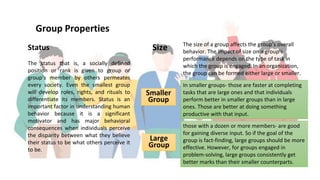
Group Properties
The size of a group affects the group’s overall
behavior. The impact of size on a group’s
performance depends on the type of task in
which the group is engaged. In an organization,
the group can be formed either large or smaller.
Size
In smaller groups- those are faster at completing
tasks that are large ones and that individuals
perform better in smaller groups than in large
ones. Those are better at doing something
productive with that input.
Smaller
Group
those with a dozen or more members- are good
for gaining diverse input. So if the goal of the
group is fact-finding, large groups should be more
effective. However, for groups engaged in
problem-solving, large groups consistently get
better marks than their smaller counterparts.
Large
Group
Cohesiveness
Group differs in their cohesiveness-
that is, the degree to which
members are attracted to each
other and are motivated to stay in
the groups. For instances, some
work groups are cohesive because
the members have spent a great
deal of time together, or the group’s
small size facilities high interaction,
or the group has experienced
external threats that have brought
members closer together.
Cohesiveness is important because
it has been found to be related to
group productivity.
Group Properties
Thank you

Group Behaviour.pptx

  • 1.
    Group Behaviour Topics tobe Studied • Group and Group Behaviour • Characteristics of Groups • Types of Groups • Reasons to Join Groups • Stages of Group Development • Properties of Groups Farhan Ahmad CSS 2019 Qualifier MBA Finance Gold Medalist Co-Author of District Wise Economic Profile of KP
  • 2.
    Group, its characteristicsGroup Behaviour Group Behaviour Group Behaviour refers to people with a similar goal behaving in the same way, which might be different from how they would normally behave if they were alone or as individuals. It is the type of behaviour that takes place when individuals act together or collectively. • 2 or more persons (if it is one person. it is not a group) • Formal social structure (the rules of the game are defined) • Common goals (the destiny is the same and emotionally connected) • Face-to-face interaction (they will talk with, each other) • Interdependence (each one is complementary to the other) • Recognition by others (yes. you belong to the group) Characteristics: Group a number of people or things that are located, gathered, or classed together. Global North and Global South Relations
  • 3.
    Global North andGlobal South Southern nations are dependent upon Northern nations (dependency) Interdependence Capitalism 20% 80% Bourgeoisie (Ameer log) Owners 80% 20% Proletariat (Ghreeb log) Working Class
  • 4.
    Types of Groups Group Informal Group FormalGroup Task Group Command Group Friendship Group Interest Group Shawal Power Usman Tech Basit Energy Task Force Task : To eradicate Corona Ministry of Education Ministry of Health Ministry of PD&R Ministry of Finance
  • 5.
    Types of Groups Formalgroups are the ones that are created as per official authority, so as to fulfill the desired objective. Informal groups ar e formed by the employees as per their likes, interests, and attitudes. Command group is a formal group, determined by the organization's hierarchal chart and composed of the individuals that report to a particular manager. For instance, the manager of training has a command group of his employees, the training group. Task groups are designed to accomplish identified work goals. They include committees, task forces and social action groups, study circles and learning groups, planning and discussion groups, and other group experiences where the participants have a task to accomplish that is external to the individual members Advocacy groups, also known as interest groups, use various forms of advocacy in order to influence public opinion and ultimately policy. Those brought together because of their shared interests or common characteristics is known as friendship group.
  • 6.
    Reasons to JoinGroups People join groups for a variety of reasons. For example, students may have to take a certain class, they join functional groups simply by virtue of joining organizations and accepting a specific job assignment that involves working with a designated group of other people. The need for belonging: According to Maslow’s hierarchy of needs, the need for belonging is one of the basic human’s needs. According to Maslow people feel that they want to be a part of a group as a part of their nature. To feel superior: According to individual psychology, the desire to feel superior is a desire that all humans experience. By joining the superior group people can help themselves achieve the need for superiority. To survive: Since the early days, humans used to join groups to increase their survival abilities and to be better able to protect themselves. To project an identity: Some people can join certain groups to project certain identities. People usually buy branded clothes in order to project a certain identity to others. It increases one’s self- esteem: According to the sociometer model, a person’s self-esteem can increase when a person joins a certain social group. According to this Theory, the self-esteem boost arises from the fact that a person feels accepted by the group.
  • 7.
    Reasons to JoinGroups Uncertainty-identity theory: According to the uncertainty-identity theory, people join social groups to reduce the uncertainty about their identity and their place in the world. Learning: User groups provide a unique opportunity for people to learn from their peers. Networking: The opportunity to network and make new connections with industry peers, make new friends is endless. Solutions to Problems Community members are very helpful in helping one another. Most user group sites feature an online forum enabling interactions between members. Organizations typically form groups in order to accomplish work-related tasks; however, as a member of a workgroup, you may unintentionally reap the numerous benefits independent of the original group construct.
  • 8.
    Five Stages ofGroup Development
  • 9.
    Group Properties Norms Cohesiveness Group Properties Roles Status Size Workinggroups are not unorganized mobs. The workgroup has properties that shape the behavior of members and make it possible to explain and predict a large portion of the individual behaviour for within the groups as well as the performance of the group itself. Some of these properties are roles, norms, status, group size and degree of group cohesiveness.
  • 10.
    Roles The roleis a set of expected behavior patterns attributed to someone occupying a given position in a social unit. Role identity: Attitudes and actual behaviors consistent with a role, and they create the role identity. People have the ability to shift roles rapidly where they recognize that a situation and its demands clearly require major changes. E.g. Promotion, Demotion Roles perception: Activities of managers and workers alike are guided by their role perceptions, that is, how they are supposed to act in their own roles and how others should act in their roles. Roles Expectation: Roles expectations are defined as the way others believe you should act in a given situation Role conflict: When others have different perception or expectations of a person’s role, that person tends to experience role conflict. Such conflict makes it difficult to meet one set of expectations without rejecting another. A company president faced role Conflict, for example, when she learned that both the controller and the personnel director wanted her to allocate the new organizational planning function to their departments. Role ambiguity: When the role is inadequately defined or is substantially unknown, role ambiguity exists, because people are not sure how they should act in situations of this type. When role conflict and role ambiguity exist, job satisfaction and organizational commitment will likely decline Group Properties
  • 11.
    Norms Norms isan acceptable standard of behavior within a group that are shared by the group members. It tells the member what they ought and ought not to do under certain circumstances. Performance norms: Here workgroups typically provide their members with explicit cues on how hard they should work. how to get the job done Appearance norms: A second category encompasses appearance norms. This includes things like appropriate dress. loyalty to the workgroup or organization, when to look busy, and when it is acceptable Arrangement norms: These norms come from informal work groups and primarily regulate social interactions within the group. Group Properties Common Classes of norms: Resources norms: A final category relates to allocation of resources norms. These norms can originate in the group or in the organization and cover things like pay’ assignment of difficult jobs, and allocation of new tools and equipment.
  • 12.
    Status The status thatis, a socially defined position or rank is given to group or group’s member by others permeates every society. Even the smallest group will develop roles, rights, and rituals to differentiate its members. Status is an important factor in understanding human behavior because it is a significant motivator and has major behavioral consequences when individuals perceive the disparity between what they believe their status to be what others perceive it to be. Group Properties The size of a group affects the group’s overall behavior. The impact of size on a group’s performance depends on the type of task in which the group is engaged. In an organization, the group can be formed either large or smaller. Size In smaller groups- those are faster at completing tasks that are large ones and that individuals perform better in smaller groups than in large ones. Those are better at doing something productive with that input. Smaller Group those with a dozen or more members- are good for gaining diverse input. So if the goal of the group is fact-finding, large groups should be more effective. However, for groups engaged in problem-solving, large groups consistently get better marks than their smaller counterparts. Large Group
  • 13.
    Cohesiveness Group differs intheir cohesiveness- that is, the degree to which members are attracted to each other and are motivated to stay in the groups. For instances, some work groups are cohesive because the members have spent a great deal of time together, or the group’s small size facilities high interaction, or the group has experienced external threats that have brought members closer together. Cohesiveness is important because it has been found to be related to group productivity. Group Properties
  • 14.