SMALL GROUP
COMMUNICATION
DEFINITION
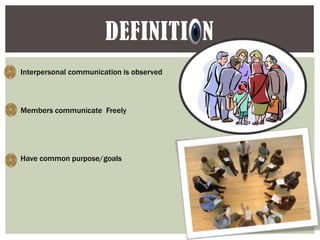
Interpersonal communication is observed
Members communicate Freely
Have common purpose/goals
PRIMARY FEATURES
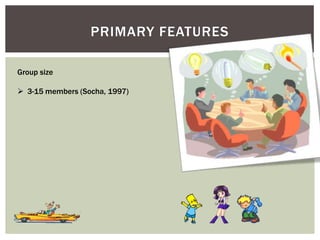
Group size
 3-15 members (Socha, 1997)
>Members
coordinate to
do certain
tasks.
“ What a
member do will
affect the
entire group.”
TASK
Considered as
the purpose of
the group.
NORMS
limits of allowable behaviors of individual members of
the group.
It is a guideline or rule to regulate the behavior of the goup
members.
SECONDARY FEATURES
IDENTITY
Psychological
and/or physical
boundaries that
distinguished
group members
from a non-
group
members.
 4 types
Problem- solving talk
Centers on accomplishing group task
Role talk
centers on the specific role each group member plays in the
group.
Consciousness-raising talk
centers on group identification and pride and is
essential to group development, morale, and identity.
Encounter talk
consists of interpersonal communication.
TALK
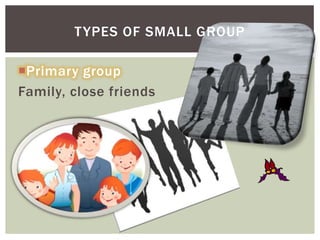
Primary group
Family, close friends
TYPES OF SMALL GROUP
Same
interest, hobbies, with
common activities.
SOCIAL GROUP
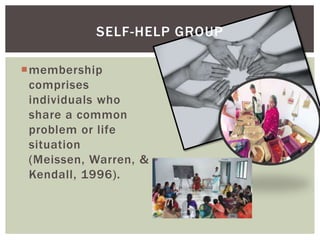
membership
comprises
individuals who
share a common
problem or life
situation
(Meissen, Warren, &
Kendall, 1996).
SELF-HELP GROUP
Study
groups, research
groups, etc.
LEARNING GROUP
Volunteers, service
groups in
campus, etc.
SERVICE GROUP
Symposium, panel
discussion, etc.
PUBLIC GROUP
Common in
organizational
context.
Complete a common
task on behalf of an
organization.
WORK GROUP
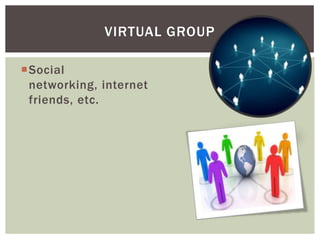
Social
networking, internet
friends, etc.
VIRTUAL GROUP
 http://www.sagepub.com/upm
-data/18524_Chapter1.pdf
 http://katelynmeno.blogspot.c
om/2009/11/small-group-
communication-definition.html
 http://en.wikipedia.org/wiki/
Communication_in_small_grou
ps
 http://2012books.lardbucket.
org/books/communication-in-
the-real-world-an-introduction-
to-communication-
studies/section_13.html
 http://www.buzzle.com/article
s/small-group-communication-
effective-team-
communication.html
REFERENCES

Small group communication