 General characteristics of Amphibians
 Classification of Amphibians
 Parental Care in Amphibians
 Evolution of Amphibians
 Comparative study of Respiratory
physiology from fish to mammals
Topics
General characteristics of
Amphibians
Axolotl
Larva
Glass Frog
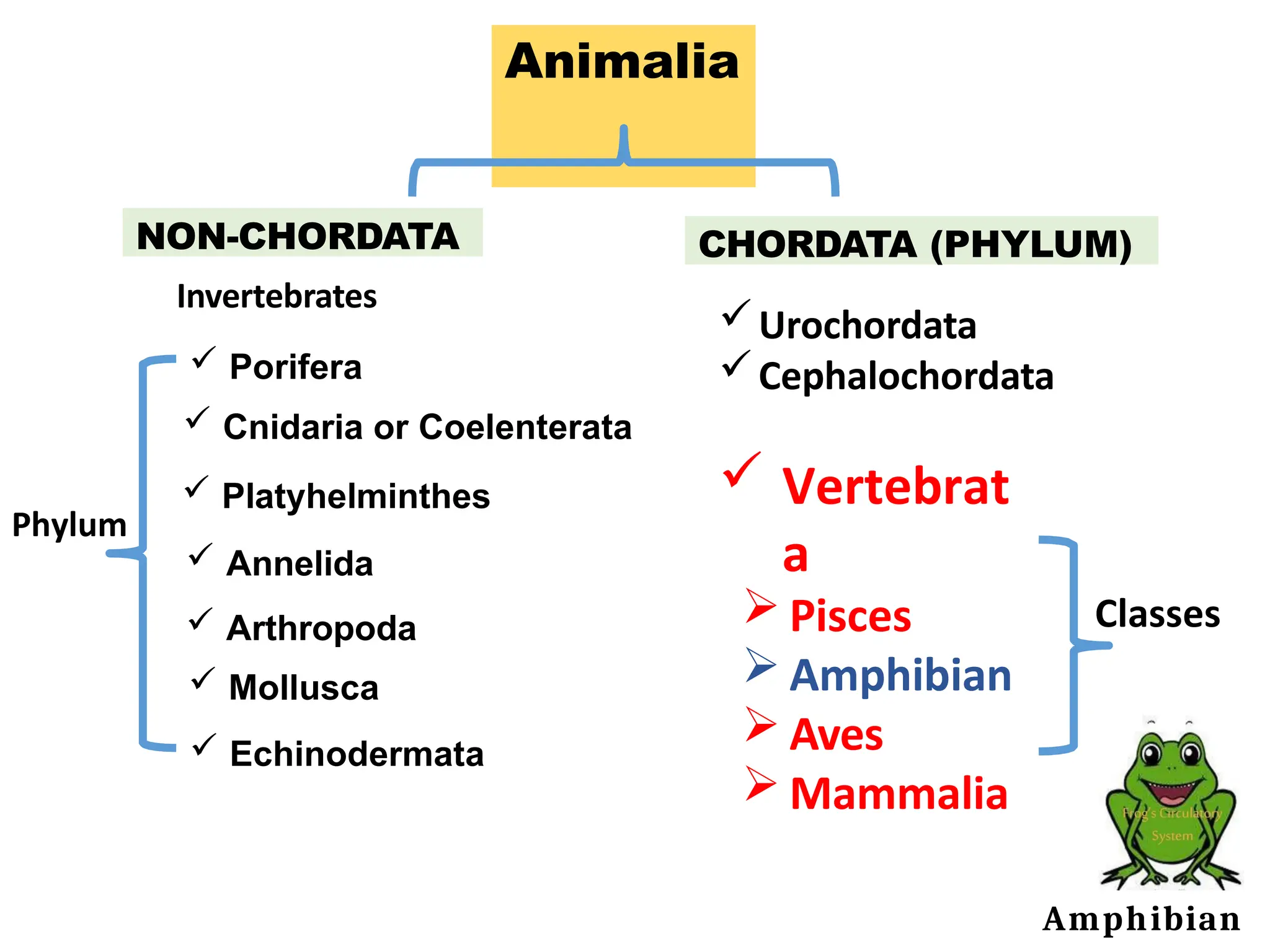
Animalia
Invertebrates
 Porifera
 Cnidaria or Coelenterata
 Platyhelminthes
 Annelida
 Arthropoda
 Mollusca
 Echinodermata
Phylum
CHORDATA (PHYLUM)
Urochordata
Cephalochordata
 Vertebrat
a
 Pisces
 Amphibian
 Aves
 Mammalia
Classes
NON-CHORDATA
Amphibian
What the Amphibian mean?
The word amphibian comes from the Greek
word amphibious, which means
"to live a double life."
amphi, meaning "of both kinds" and bios, meaning "life."
Cold-blooded vertebrate typically living on land
but breeding in water; aquatic larvae undergo
metamorphosis into adult form
General Characteristics of Amphibian
 Pair of limbs
 Skin is moist, without scales
 Eye have eye lid
 Tympanum represents ear
 Cloaca- Urinary, Reproduction
 Respiration- gills
 Heart- 3 chambered
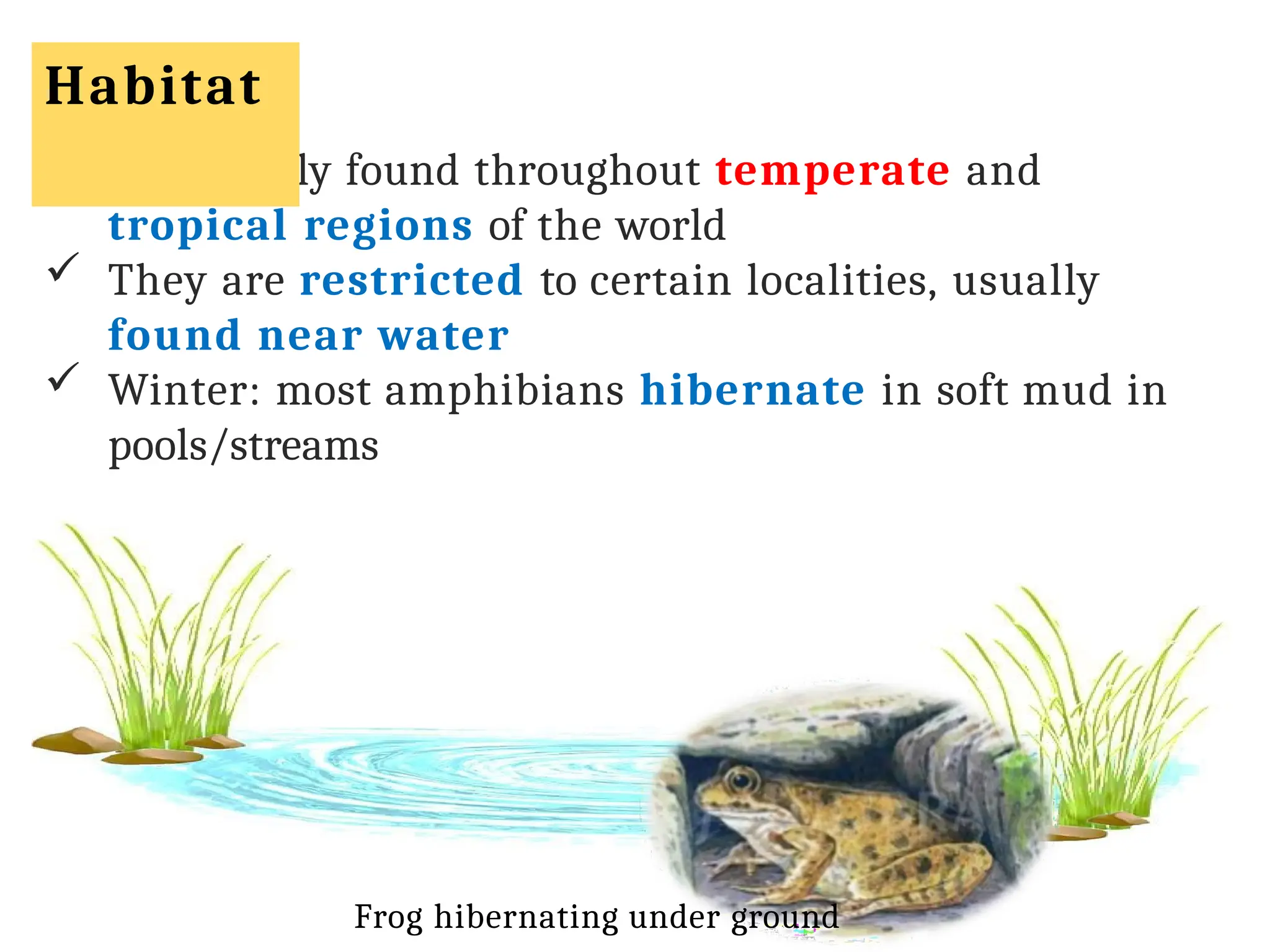
 The mostly found throughout temperate and
tropical regions of the world
 They are restricted to certain localities, usually
found near water
 Winter: most amphibians hibernate in soft mud in
pools/streams
Habitat
Frog hibernating under ground
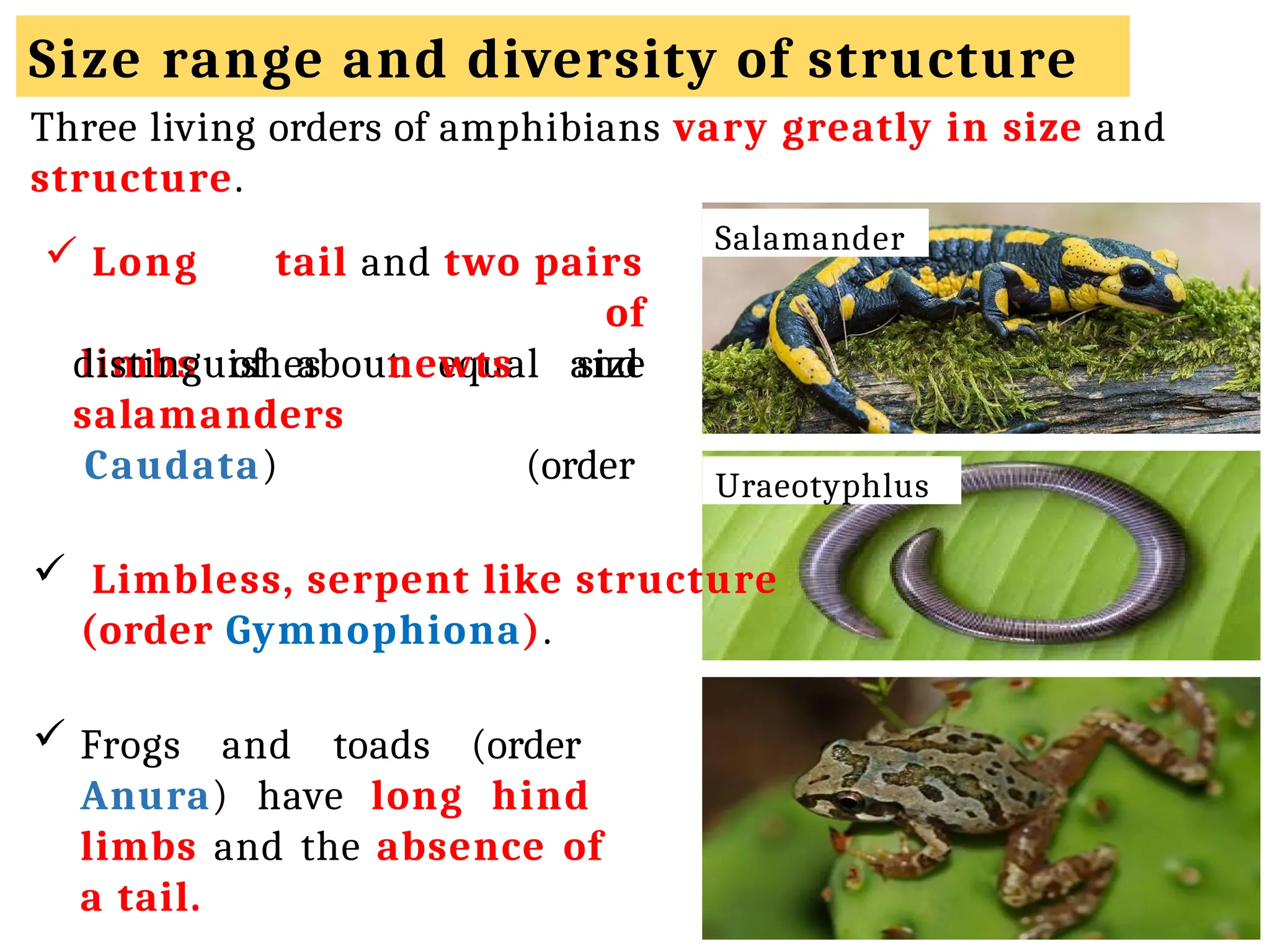
Size range and diversity of structure
Three living orders of amphibians vary greatly in size and
structure.
 Long tail and two pairs
of
limbs of about equal size
newts and
(order
distinguishes
salamanders
Caudata) Uraeotyphlus
 Limbless, serpent like structure
(order Gymnophiona).
 Frogs and toads (order
Anura) have long hind
limbs and the absence of
a tail.
Salamander
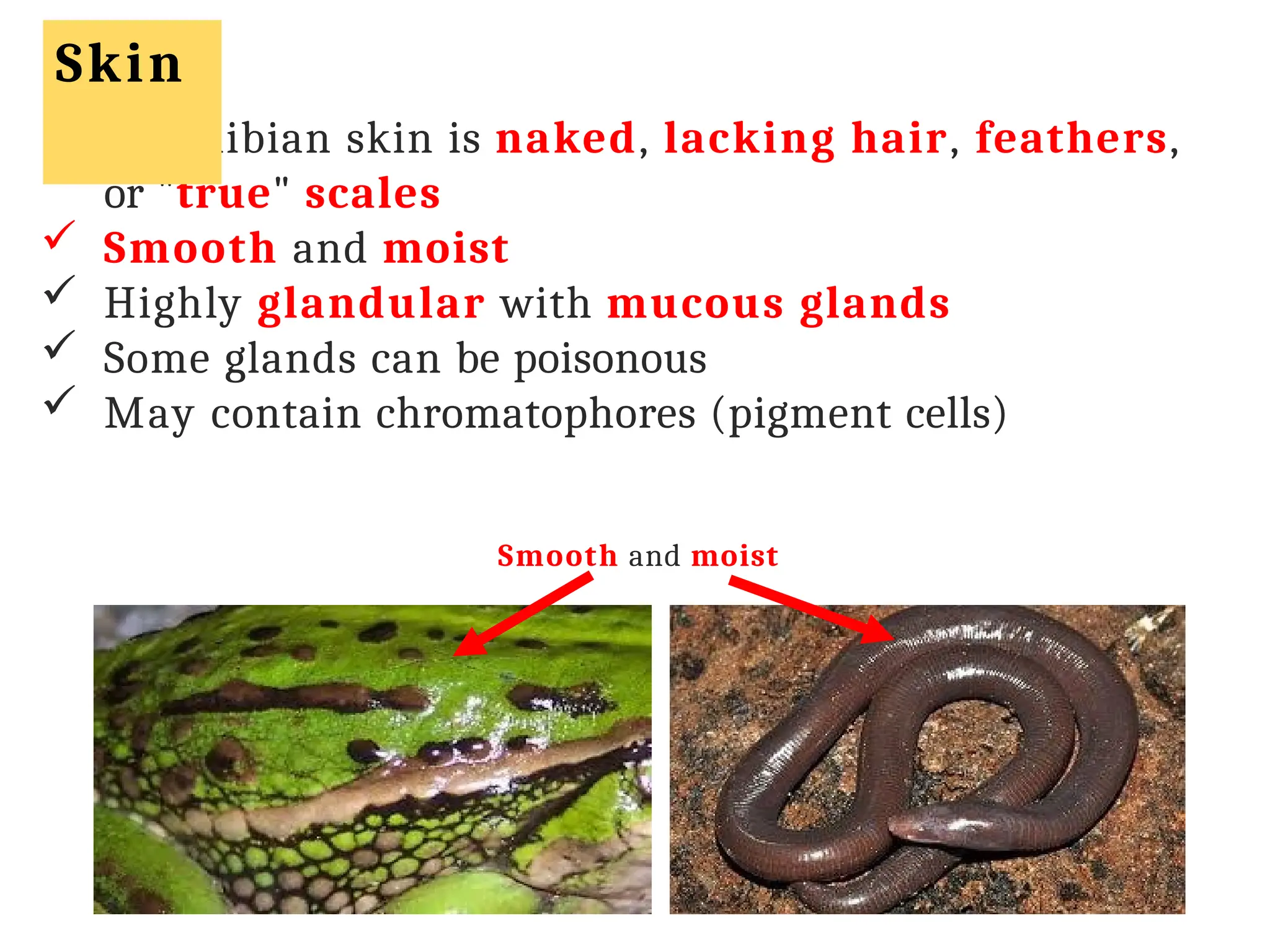
 Amphibian skin is naked, lacking hair, feathers,
or "true" scales
 Smooth and moist
 Highly glandular with mucous glands
 Some glands can be poisonous
 May contain chromatophores (pigment cells)
Skin
Smooth and moist
 Most are tetrapod (four-legged)
 Some are legless (limbless)
 Webbed feet often present
 No true nails or claws
 Forelimb usually has 4-5 digits
Appendages/Limbs
Respiration
 Salamander larvae possess external gills
 Frogs and toad larvae possess internal gills
Adult frog don’t have gills and they to use other
organ
Skin
Lungs
Lining of mouth
This type of respiration need moist surroundings to help breathe
External gills
 Mouth cavity is large with
small teeth
(in both upper/lower jaws)
 stomach
 small/large intestine
 spleen
 liver (two lobes)
 gallbladder
 pancreas
 cloaca and cloacal opening
Digestion
 Most bony with varying numbers of
vertebrae
 Ribs present in most
 Exoskeleton is absent
 They have only five to nine vertebrae in
backbone, or vertebral column
Skeleton
 Three-chambered heart
 Contains two atria, one ventricle
 Double circulation through heart
 Skin is always supplied with blood vessels/oxygen
Circulation
 Paired mesonephric
kidneys, bladder also
present
 Cloaca—holding cell
for the waste products
 Urea is main waste
product
Excretion
 Separate sexes
 Fertilization internal in salamanders/caecilians
 Fertilization mostly external in frogs/toads
 Mostly oviparous
 Most produce shell-less (amniotic) eggs that are
deposited in the water
 These eggs rely on moisture from their surrounding
water source
 Enclosed in protective, gelatin envelope
 Nourished for very short time by mother
Reproduction
Development
Development is indirect
No extra embryonic membranes
Larva tadpole which metamorphoses into adult
Tadpole Frog
Classification of
Amphibians
What the Amphibian mean?
The word amphibian comes from the Greek
word amphibious, which means
"to live a double life."
amphi, meaning "of both kinds" and bios, meaning "life."
Cold-blooded vertebrate typically living on land
but breeding in water; aquatic larvae undergo
metamorphosis into adult form
General Characteristics of Amphibian
 Pair of limbs
 Skin is moist, without scales
 Eye have eye lid
 Tympanum represents ear
 Cloaca- Urinary, Reproduction
 Respiration- gills, lungs
 Heart- 3 chambered
Stegocephalia
Lissamphibia
3 Order
3 Order
Amphibia
Class
Extinct
Living Group
Subclass 1 Labyrinthodontia
Lepospondyli
Phyllospondyli
Subclass 2
Gymnophiona
Anura
Caudata
Classification of Class Amphibia
Amphibians are divided into two subclasses, of which
one is extinct.
1) Subclass Stegocephalia –
Order 1 Labyrinthodonts
 Paleozoic and early Mesozoic group.
 Earliest ancestors with labyrinthine folds in teeth.
 Giant amphibians like Eryops, Cacops, Buettneria.
 Ancestors of reptiles such as Seymoria.
Eryops
2) Order Lepospondyli –
 Paleozoic group with scale-like ossification in
vertebrae.
 Ancestors of caecilians. Extinct.
 Eg. Diplocaulus
Diplocaulus
Ichthyostega
3) Order Phyllospondyli –
 Paleozoic ancestors of urodeles and anurans with
leaf-like ossification around the notochord.
 They had short body and tail. Extinct.
 Eg. Branchiosaurs (Ichtyostega)
 The earliest known fossil amphibian (Icthyostega)
 Found in upper-Devonian freshwater deposits in
Greenland and was probably descended from
crossopterygian fishes.
2) Subclass Lissamphibia
 Living groups which have smooth scaleless skin.
 Frogs, toads, salamanders, newts, etc.
 Modern amphibians.
 Eg. Frog, Uroaetyphlus
All modern amphibians are included in the subclass
Lissamphibia, which is usually considered a clade, a group of
species that have evolved from a common ancestor.
The three modern orders are:
 Order 1 : Gymnophiona (or Apoda, the caecilians).
 Order 2 : Caudata (or Urodela, the salamanders
and
newts
 Order 3 : Anura (the frogs and toads),
Order 1 : Gymnophiona (or Apoda, the caecilians)
Unique among amphibians in that they do not have
limbs
These animals generally live their lives burrowing in
the soil
 Caecilian species range in length from about 10 cm
to nearly 1.5 meters.
 Slender vermiform burrowers with compact skull,
no limbs or girdles
 Greatly reduced eyes that are buried in the skin.
 Tail short or absent
 Skull compact, roofed with bone
Ex. About 55 species ; Ichthyophis, Uroaeotyphlus
Uroaeotyphlus
Ichthyophis
 Order 2 : Caudata (or Urodela, the salamanders
and newts
Characterized by having a prominent tail throughout
their lives
 They generally have elongated bodies that range in
size from about 2 cm to nearly 2 m long.
.
 Lizard like amphibians with distinct tail
 Limbs 2 pair, usually weak, almost equal size
 They are adapted for walking on terrestrial and
swimming in aquatic habitats
 Gills are permanent or lost in adults
An unusual characteristic of salamanders is :
 Their ability to regenerate limbs
 They shows neoteny – and paedogenesis
Retention of larval character in adult is called
neoteny and reproduction by them is called
paedogenesis
Necturus (Mud puppy)
Permanent larval forms
Tiger Salamanders
(Ambystoma)
Amphiuma
Order 3 : Anura (the frogs and toads) or
Silientia
Salienes- Leaping; Anura – Without tail
Specialised amphibian without tail in adults
Hind limbs usually adapted for leaping and
swimming
Adults without Gills or gill opening
Eyelid well formed, Tympanum present
Skin loosely fitting, scale less
Mandible toothless
Pectoral girdle bony. Ribs absent or reduced
Fully metamorphosed without neotinic forms
Tree Frogs
Rana tigrina
common frog
F rogs
Mid wife toad (Alytus)
Bufo (Common toad)
Toad
Origin and Evolution of Amphibia
Origin : from which group amphibian originated
Evolution: What are evolutionary changes occurs in
them
AMPHIBIANS
The Conquest Of The Land
 Amphibians were the first group of vertebrates to
develop limbs and to be able to leave the water to
conquer the land.
 Amphibians show a wide diversity of survival
strategies which have allowed them to occupy most
terrestrial and fresh-water habitats.
 At the end of
Devonian period
 The climate was hot
and arid
 Water in shallow pools,
lakes become warmer
 Seasonal drought also
occurs
Some fish began to crawl
out of the water and started
Walking on land
Breathing on land
The earliest signs of the transition from swimming to walking are
fossilized tracks that date back about 390 million years ago in
Devonian period
Early Amphibians
The fossil record provides evidence of the first tetrapod : now-
extinct amphibian species dating to nearly 400- 300 million years ago
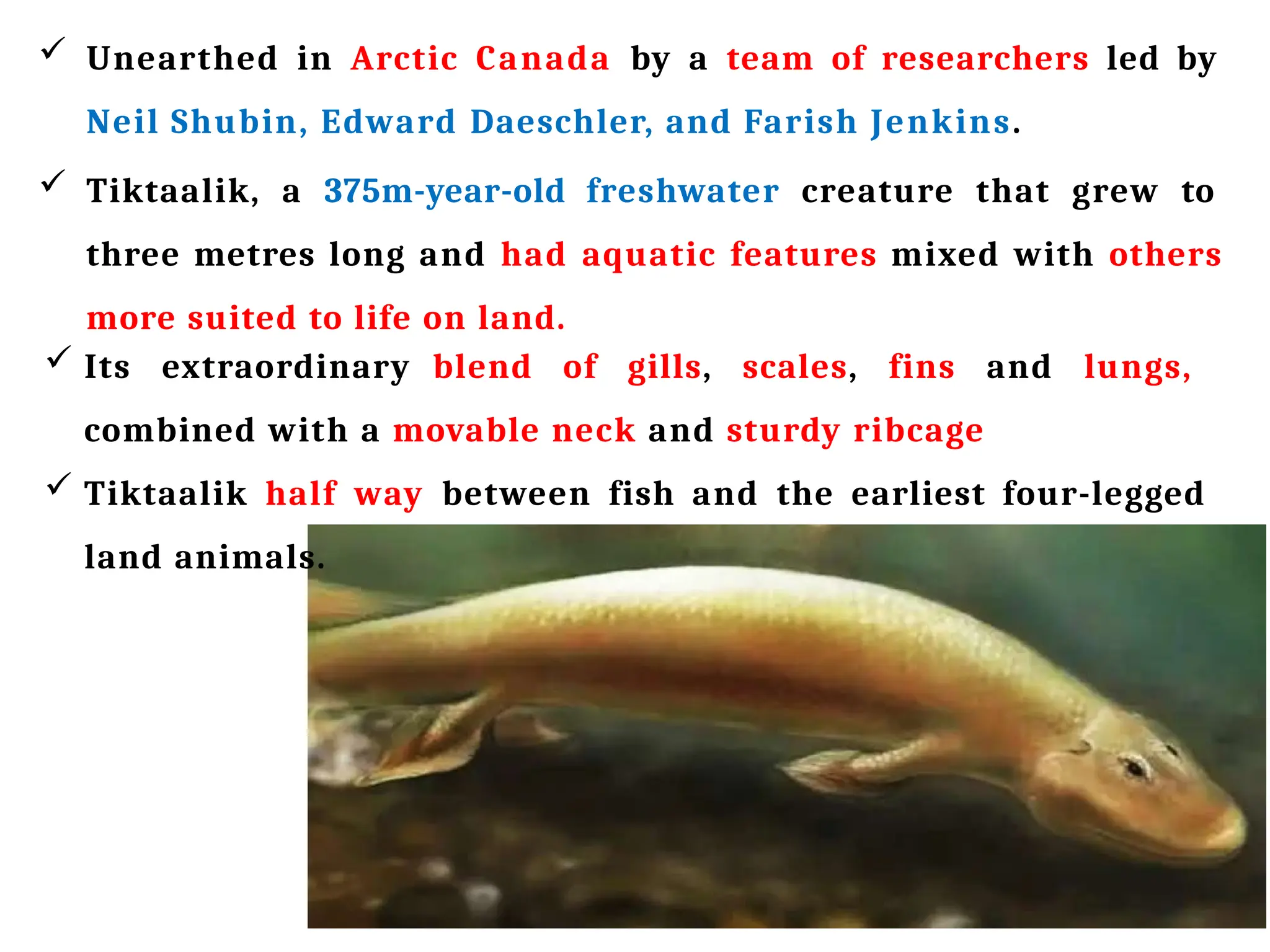
A) Tiktaalik
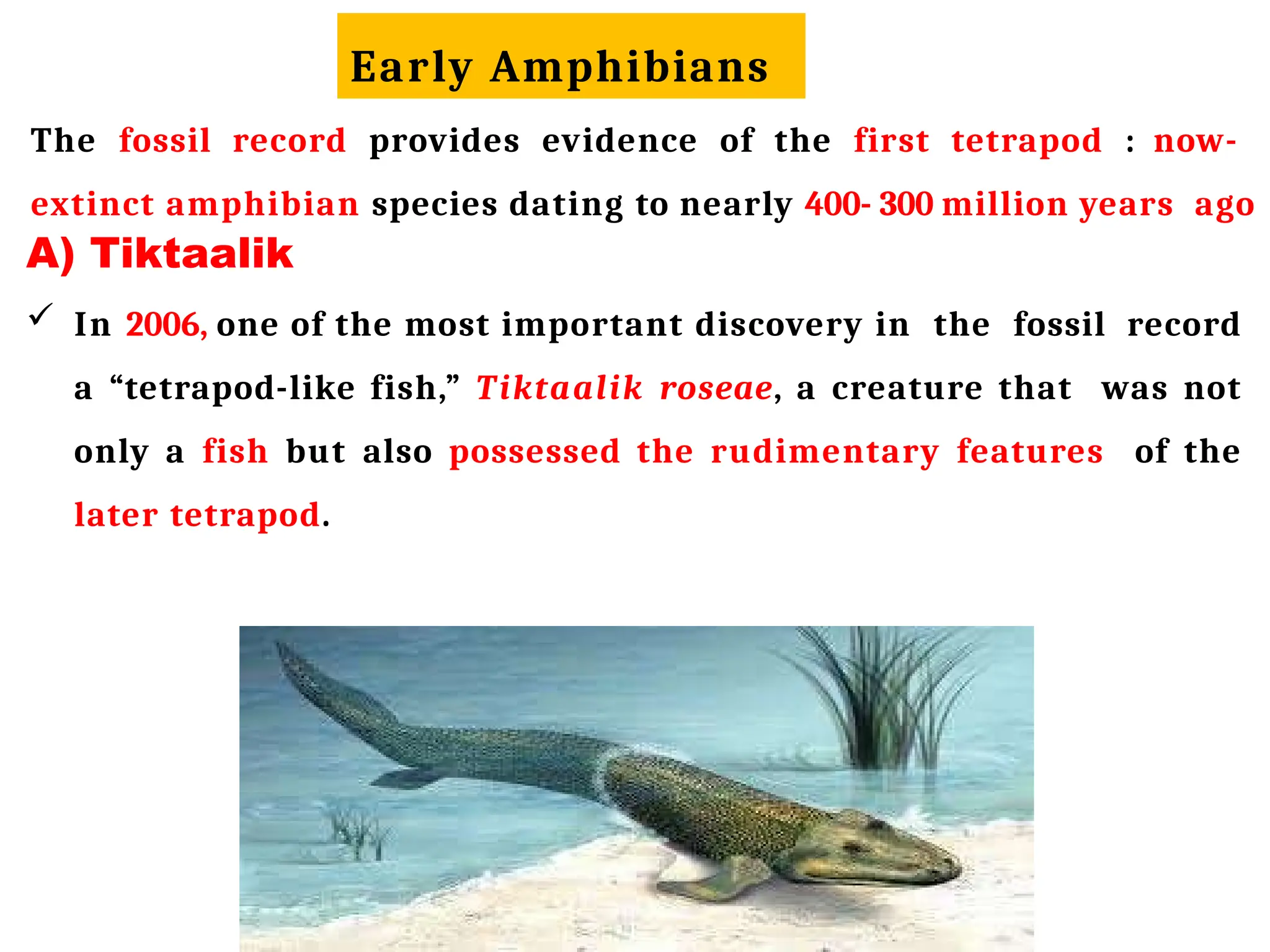
 In 2006, one of the most important discovery in the fossil record
a “tetrapod-like fish,” Tiktaalik roseae, a creature that was not
only a fish but also possessed the rudimentary features of the
later tetrapod.
 Unearthed in Arctic Canada by a team of researchers led by
Neil Shubin, Edward Daeschler, and Farish Jenkins.
 Tiktaalik, a 375m-year-old freshwater creature that grew to
three metres long and had aquatic features mixed with others
more suited to life on land.
 Its extraordinary blend of gills, scales, fins and lungs,
combined with a movable neck and sturdy ribcage
 Tiktaalik half way between fish and the earliest four-legged
land animals.
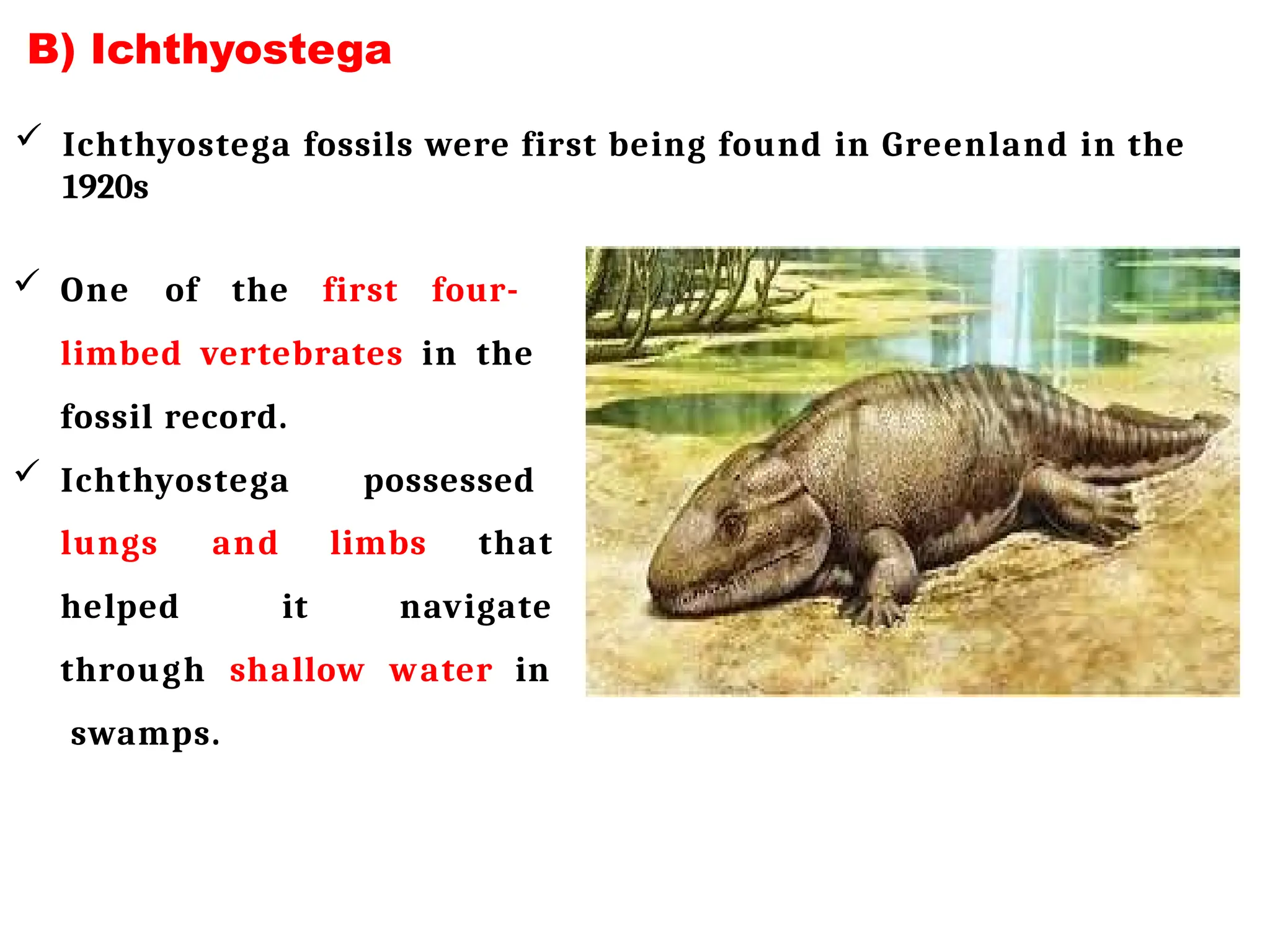
B) Ichthyostega
lungs
helped
and limbs that
it navigate
through shallow water in
swamps.
 Ichthyostega fossils were first being found in Greenland in the
1920s
 One of the first four-
limbed vertebrates in the
fossil record.
 Ichthyostega possessed
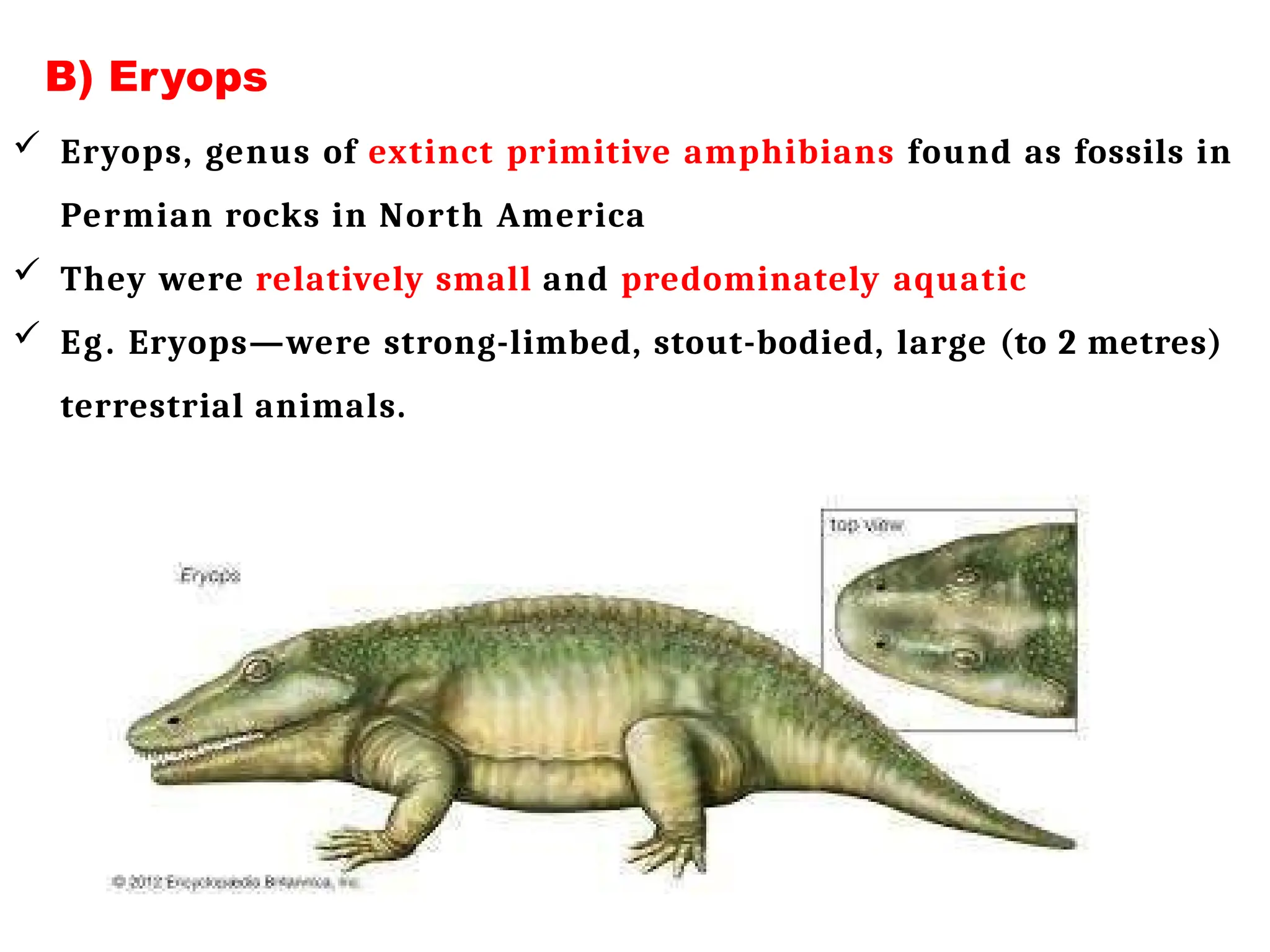
 Eryops, genus of extinct primitive amphibians found as fossils in
Permian rocks in North America
 They were relatively small and predominately aquatic
 Eg. Eryops—were strong-limbed, stout-bodied, large (to 2 metres)
terrestrial animals.
B) Eryops
Origin : From which group amphibian
originated
It was consider that some fish may the ancestor of
amphibians
That must have two important features
The presence of lungs as simple pouches leading
from throat, which developed a rich supply of
blood vessel
Development of limbs from the bony supports of
the fins
However we don’t have direct fossils that link the two
groups
Therefore, most likely ancestry of the amphibian are
Pisces
Piscine ancestry
 Both are cold blooded
 Both respire by gills early in life
 Both have air bladder serving as lungs
 Usually both lay eggs in water
Which groups of fishes arises amphibian?
Three groups of fishes of advanced bony group fishes
were contemporaries of Labrinothondontia during
Devonian period
Advanced bony fishes
Actinopterygii Dipnoi Crossopterygii
 Far off the tetrapod
evolution
 Many
specialization
 Resemblance to
Amphibia in anatomy
and embryology
 Highly specialised
 Skelton of the fins are
not reminiscent of
primitive tetrapod
Earliest
amphibians
(labrothodont)
resembles to
primitive
crossopterygii
Crossopterigians: directs the channel of amphibian
evolution
 Lived in shallow marshy locations and already possessed
lungs for respiration and lobed fins to support their bodies
on muddy banks of ponds, rivers and marshland.
 It is considered that rhipidistian crossopterygians of
Devonian period – genera Osteolepis and Eusthenopteron
 Extinct group of lobe-finned bony fishes of order
Crossopterygii
Morphological similarities with early
amphibians
or Labrithondonts
Both were predators, armed with sharp, stony teeth,
with a peculiar labyrinthine infolding of enamel
Position of external and internal nares are similar
Air bladder were used as lungs during
short
migration from pond to pond
Cross-section of a labyrinthodont tooth
Pentadactyl limb of amphibians of amphibian is supposed to
arisen from crossopterygian
Pectoral fin of Eusthenopteron can be compared to the
forelimbs of amphibia. The single proximal piece of bone can be
homologized with the humrus and the next two pieces can be
compared to radius and ulna.
Bony pattern of jaws and skull are comparable to that
observed in early amphibians.
 Two large bones on the top of a skull can
be
homologized as the amphibian parietal bones.
Possible Polyphyletic Origin of Amphibians
1. Polyphyletic view of amphibian origin
 Carroll and Currie (1975), Jarvik (1980) hypothesized that the
three living orders, e.g., Anura, Urodela and Apoda have
evolved separately.
 Jarvik also pointed out that the amphibians originated
independently from more than one group of rhipidistian fishes.
 But this view is readily rejected by all scientists.
The three order of living amphibian
Apoda
Urodella
Anura
These are so different in their morphology and habit
it is suggest
polyphyletic origin of amphibian
 According to this view all living amphibians have evolved from the
earliest amphibians the Ichthyostega and this group is also
derived from Osteolepid fish.
 The proponents of this view are Noble (1931), Bolt (1979), McFarland
(1985), Duellman and Trueb (1986).
2. Di-phyletic view of amphibian origin:
 Romer (1945), Romer and Watson (1962) opined that both salamanders
and caecilians share a common ancestor and anurans were
developed separately.
 By emphasizing on the vertebral column similarities in the different
groups, it is considered that anurans have evolved from
labyrinthodonts and urodeles and apodans from lepospondyls.
3. Monophyletic view of amphibian origin:
Evolutionary changes in Amphibians for
amphibious life
 The conquest of land was not done from one day to the other;
it was possible with the combination of multiple adaptations.
 Most important characteristics that allowed the
first
amphibians to leave the water were:
1) Respiration
 Evolution of lungs, which are homologous to the gas bladder
that allows fish to control its buoyancy. Lungs appeared as an
additional way to get oxygen from the air.
 Cutaneous respiration supplements pulmonary respiration
2 ) Locomotion : Streamlined body retained for swimming. Limbs
development in place of paired fins
3)Skelton: Vertebral column become more rigid. Pectoral girdle
lost connection with skull. Pelvic girdle attached to vertebral
column and two half firmly united
4) They need to avoid dehydration : skin
This problem was solved by a thicker, impermeable skin which
allows to less water. While Amphibians have semi-permeable
skin which helps them in respiration also, higher vertebrates
have impermeable skin.
5) Circulatory system
Amphibians have two circulatory routes: one for oxygenation
of the blood through the lungs and skin, and the other to take
oxygen to the rest of the body.
Amphibians have a three-chambered heart that has two atria
and one ventricle rather than the two-chambered heart of fish.
6) They needed to protect themselves against the harmful solar
radiation.
This was
whatever
done
means
was skin pigments, feathers, hair, fur or
to filter the harmful radiation. While
amphibians have skin pigments, other higher vertebrates have
other means for the same purpose.
7) They needed to eliminate waste with less amount of water
available.
Ammonia is highly soluble in water and essentially excretion
of ammonia is feasible only in aquatic animals. When they are
on ground, they need to save water. This was possible by
excreting nitrogenous wastes as Urea or Uric Acid as they
need less water to dissolve. In amphibians, while their larvae
release ammonia (thus called Ammonotelic), the adult
amphibians need economy of water and thus excrete Urea.
In Birds, the system is even more efficient as they excrete Uric
Acid which needs least water.
8) Need to solve the problem of fertilization.
In amphibians also male and female release the gametes in water.
However, in higher vertebrates this problem was solved by internal
fertilization.
Parental Care in Amphibians
Definition of parental care
Parental care may be defined as all activities that are directed by
an animal towards the protection and maintenance of its own
offspring or those of a near relative.
Parental Care in Amphibians
 Comparison with birds and mammals, amphibians generally thought
to exhibit little parental care.
 However, in recent years both field and laboratory studies have
provided evidence for an astonishing array of parental care in
amphibians.
 Parental care may be defined as any behavior exhibited by a parent
toward its offspring that Increases the offspring’s chances of survival
 Among amphibians, parental care includes attendance of the eggs,
transportation of eggs or larvae, and feeding of larvae.
Some amphibians lay their eggs in safe and moist land, very
near to water
 Rhacophorus schleglii of Japan, lays eggs in a hole on muddy bank
of river or pond with foamy mucus cover to prevent the eggs from
drying.
 In Gyrinophilus the eggs are laid under the stones in stream.
 In case of Hylodes, eggs are laid on the under surface of leaves
hanging above water.
 In Triton the eggs may be fixed with the aquatic weeds by glues.
There are various ways by which the parental care is
manifested in amphibians.
A) Protection by nursery, shelter and nest
1. Selection of Site
In Rhacophorus maculates, after the eggs are laid, surrounding
water is made frothy by the limb movements, which prevent the eggs
from desiccation and escaping from the eyes of the predators.
3. Defending Eggs:
 Males of green frog Rana clamitans defend their eggs by
not allowing small sized intruders in their territories.
 Males of Mantophryne robusta holds with hands cluster of eggs in
gelatinous envelop.
2. Frothing of Water:
 Some amphibians build nests for deposition of eggs.
 Mud Nest: Hyla faber digs small holes in the mud for deposition
and development of the eggs.
 Leaf Nest: In a South American tree frog Phyllomedusa
hypochondrales, margin of the leaves are folded and glued together
which acts as nest for the eggs.
 Shoot Nest: Triton construct the nest by fixing the shoots with a
gelatinous secretion.
4. Formation of Nests:
Some terrestrial or tree frogs, like Hylodes and Hyla nebulosa, the
eggs hatch directly into tiny juveniles avoiding predator attach and
larval mortality.
5. Direct development:
B) Direct caring by parents
i) Coiling around eggs:
Amphuima, Ichthyphis females after
laying eggs guard them by coiling body till the eggs hatch.
In Megalobatrachus, the males perform the same function.
ii) Transferring tadpoles to water:
Phylobates species inhabiting tropical Africa and South America hold
the newly hatched tadpoles on the back and transport them to water.
6. Carrying eggs over the body
Salamander Desmognathus fuscus females carry cluster of eggs glued to
their body.
In Sri Lankan tree frog, Rhacophorus reticulates, the eggs are glued to
the belly of the females.
In a European frog, Alytes obstericans, instead of female’s parental care,
the male entangles the eggs around his hind legs.
7) Eggs glued to the body:
Alytes obstericans
 In Hyla goeldii, the females carry the eggs on their back.
 In Pipa pipa, the eggs are carried by females on the back.
 In Cryptobatrachus evansi the dorsal skin contains many
small
pockets for lodging of eggs.
 In Pipa dorsigera, the eggs are developed in the pits on the back of the
females. During breeding season, the dorsal skin becomes soft,
spongy, and vascular.
Embryonic development occurs within the pits and physiological
exchanges takes place between the females and the larva.
8) Eggs in back pouches:
Pipa pipa
Hyla goeldii
South American male frog of Rhinoderma darwinii keeps fertilized
eggs in his vocal sacs where they undergo complete development.
In H ylambates breviceps, the female carries eggs in her
buccal
cavity.
9. Organs as brooding pouches:
A special type of reproductive behavior is observed in Salamandra
atra and S. maculosa. The eggs are placed inside the uterine cavity
where the entire development takes place. The uterine wall functions
physiologically as primitive placenta.
c) Viviparity:
Benefits of Parental care
https://www.youtube.com/watch?v=l3uO2lO9JDk
https://www.youtube.com/watch?v=HCxv6Ab
BwJI

Amphibia --General characteristics .pptx

  • 1.
     General characteristicsof Amphibians  Classification of Amphibians  Parental Care in Amphibians  Evolution of Amphibians  Comparative study of Respiratory physiology from fish to mammals Topics
  • 2.
  • 3.
    Animalia Invertebrates  Porifera  Cnidariaor Coelenterata  Platyhelminthes  Annelida  Arthropoda  Mollusca  Echinodermata Phylum CHORDATA (PHYLUM) Urochordata Cephalochordata  Vertebrat a  Pisces  Amphibian  Aves  Mammalia Classes NON-CHORDATA Amphibian
  • 4.
    What the Amphibianmean? The word amphibian comes from the Greek word amphibious, which means "to live a double life." amphi, meaning "of both kinds" and bios, meaning "life." Cold-blooded vertebrate typically living on land but breeding in water; aquatic larvae undergo metamorphosis into adult form
  • 5.
    General Characteristics ofAmphibian  Pair of limbs  Skin is moist, without scales  Eye have eye lid  Tympanum represents ear  Cloaca- Urinary, Reproduction  Respiration- gills  Heart- 3 chambered
  • 6.
     The mostlyfound throughout temperate and tropical regions of the world  They are restricted to certain localities, usually found near water  Winter: most amphibians hibernate in soft mud in pools/streams Habitat Frog hibernating under ground
  • 7.
    Size range anddiversity of structure Three living orders of amphibians vary greatly in size and structure.  Long tail and two pairs of limbs of about equal size newts and (order distinguishes salamanders Caudata) Uraeotyphlus  Limbless, serpent like structure (order Gymnophiona).  Frogs and toads (order Anura) have long hind limbs and the absence of a tail. Salamander
  • 8.
     Amphibian skinis naked, lacking hair, feathers, or "true" scales  Smooth and moist  Highly glandular with mucous glands  Some glands can be poisonous  May contain chromatophores (pigment cells) Skin Smooth and moist
  • 9.
     Most aretetrapod (four-legged)  Some are legless (limbless)  Webbed feet often present  No true nails or claws  Forelimb usually has 4-5 digits Appendages/Limbs
  • 10.
    Respiration  Salamander larvaepossess external gills  Frogs and toad larvae possess internal gills Adult frog don’t have gills and they to use other organ Skin Lungs Lining of mouth This type of respiration need moist surroundings to help breathe External gills
  • 11.
     Mouth cavityis large with small teeth (in both upper/lower jaws)  stomach  small/large intestine  spleen  liver (two lobes)  gallbladder  pancreas  cloaca and cloacal opening Digestion
  • 12.
     Most bonywith varying numbers of vertebrae  Ribs present in most  Exoskeleton is absent  They have only five to nine vertebrae in backbone, or vertebral column Skeleton
  • 13.
     Three-chambered heart Contains two atria, one ventricle  Double circulation through heart  Skin is always supplied with blood vessels/oxygen Circulation
  • 14.
     Paired mesonephric kidneys,bladder also present  Cloaca—holding cell for the waste products  Urea is main waste product Excretion
  • 15.
     Separate sexes Fertilization internal in salamanders/caecilians  Fertilization mostly external in frogs/toads  Mostly oviparous  Most produce shell-less (amniotic) eggs that are deposited in the water  These eggs rely on moisture from their surrounding water source  Enclosed in protective, gelatin envelope  Nourished for very short time by mother Reproduction
  • 16.
    Development Development is indirect Noextra embryonic membranes Larva tadpole which metamorphoses into adult Tadpole Frog
  • 18.
  • 19.
    What the Amphibianmean? The word amphibian comes from the Greek word amphibious, which means "to live a double life." amphi, meaning "of both kinds" and bios, meaning "life." Cold-blooded vertebrate typically living on land but breeding in water; aquatic larvae undergo metamorphosis into adult form
  • 20.
    General Characteristics ofAmphibian  Pair of limbs  Skin is moist, without scales  Eye have eye lid  Tympanum represents ear  Cloaca- Urinary, Reproduction  Respiration- gills, lungs  Heart- 3 chambered
  • 21.
    Stegocephalia Lissamphibia 3 Order 3 Order Amphibia Class Extinct LivingGroup Subclass 1 Labyrinthodontia Lepospondyli Phyllospondyli Subclass 2 Gymnophiona Anura Caudata Classification of Class Amphibia
  • 22.
    Amphibians are dividedinto two subclasses, of which one is extinct. 1) Subclass Stegocephalia – Order 1 Labyrinthodonts  Paleozoic and early Mesozoic group.  Earliest ancestors with labyrinthine folds in teeth.  Giant amphibians like Eryops, Cacops, Buettneria.  Ancestors of reptiles such as Seymoria. Eryops
  • 23.
    2) Order Lepospondyli–  Paleozoic group with scale-like ossification in vertebrae.  Ancestors of caecilians. Extinct.  Eg. Diplocaulus Diplocaulus
  • 24.
    Ichthyostega 3) Order Phyllospondyli–  Paleozoic ancestors of urodeles and anurans with leaf-like ossification around the notochord.  They had short body and tail. Extinct.  Eg. Branchiosaurs (Ichtyostega)
  • 25.
     The earliestknown fossil amphibian (Icthyostega)  Found in upper-Devonian freshwater deposits in Greenland and was probably descended from crossopterygian fishes. 2) Subclass Lissamphibia  Living groups which have smooth scaleless skin.  Frogs, toads, salamanders, newts, etc.  Modern amphibians.  Eg. Frog, Uroaetyphlus
  • 26.
    All modern amphibiansare included in the subclass Lissamphibia, which is usually considered a clade, a group of species that have evolved from a common ancestor. The three modern orders are:  Order 1 : Gymnophiona (or Apoda, the caecilians).  Order 2 : Caudata (or Urodela, the salamanders and newts  Order 3 : Anura (the frogs and toads),
  • 27.
    Order 1 :Gymnophiona (or Apoda, the caecilians) Unique among amphibians in that they do not have limbs These animals generally live their lives burrowing in the soil  Caecilian species range in length from about 10 cm to nearly 1.5 meters.  Slender vermiform burrowers with compact skull, no limbs or girdles  Greatly reduced eyes that are buried in the skin.  Tail short or absent  Skull compact, roofed with bone Ex. About 55 species ; Ichthyophis, Uroaeotyphlus
  • 28.
  • 29.
     Order 2: Caudata (or Urodela, the salamanders and newts Characterized by having a prominent tail throughout their lives  They generally have elongated bodies that range in size from about 2 cm to nearly 2 m long. .  Lizard like amphibians with distinct tail  Limbs 2 pair, usually weak, almost equal size  They are adapted for walking on terrestrial and swimming in aquatic habitats  Gills are permanent or lost in adults
  • 30.
    An unusual characteristicof salamanders is :  Their ability to regenerate limbs  They shows neoteny – and paedogenesis Retention of larval character in adult is called neoteny and reproduction by them is called paedogenesis Necturus (Mud puppy) Permanent larval forms
  • 31.
  • 32.
    Order 3 :Anura (the frogs and toads) or Silientia Salienes- Leaping; Anura – Without tail Specialised amphibian without tail in adults Hind limbs usually adapted for leaping and swimming Adults without Gills or gill opening Eyelid well formed, Tympanum present Skin loosely fitting, scale less Mandible toothless Pectoral girdle bony. Ribs absent or reduced Fully metamorphosed without neotinic forms
  • 33.
  • 34.
    Mid wife toad(Alytus) Bufo (Common toad) Toad
  • 35.
    Origin and Evolutionof Amphibia Origin : from which group amphibian originated Evolution: What are evolutionary changes occurs in them
  • 36.
    AMPHIBIANS The Conquest OfThe Land  Amphibians were the first group of vertebrates to develop limbs and to be able to leave the water to conquer the land.  Amphibians show a wide diversity of survival strategies which have allowed them to occupy most terrestrial and fresh-water habitats.
  • 38.
     At theend of Devonian period  The climate was hot and arid  Water in shallow pools, lakes become warmer  Seasonal drought also occurs Some fish began to crawl out of the water and started Walking on land Breathing on land The earliest signs of the transition from swimming to walking are fossilized tracks that date back about 390 million years ago in Devonian period
  • 39.
    Early Amphibians The fossilrecord provides evidence of the first tetrapod : now- extinct amphibian species dating to nearly 400- 300 million years ago A) Tiktaalik  In 2006, one of the most important discovery in the fossil record a “tetrapod-like fish,” Tiktaalik roseae, a creature that was not only a fish but also possessed the rudimentary features of the later tetrapod.
  • 40.
     Unearthed inArctic Canada by a team of researchers led by Neil Shubin, Edward Daeschler, and Farish Jenkins.  Tiktaalik, a 375m-year-old freshwater creature that grew to three metres long and had aquatic features mixed with others more suited to life on land.  Its extraordinary blend of gills, scales, fins and lungs, combined with a movable neck and sturdy ribcage  Tiktaalik half way between fish and the earliest four-legged land animals.
  • 41.
    B) Ichthyostega lungs helped and limbsthat it navigate through shallow water in swamps.  Ichthyostega fossils were first being found in Greenland in the 1920s  One of the first four- limbed vertebrates in the fossil record.  Ichthyostega possessed
  • 42.
     Eryops, genusof extinct primitive amphibians found as fossils in Permian rocks in North America  They were relatively small and predominately aquatic  Eg. Eryops—were strong-limbed, stout-bodied, large (to 2 metres) terrestrial animals. B) Eryops
  • 43.
    Origin : Fromwhich group amphibian originated It was consider that some fish may the ancestor of amphibians That must have two important features The presence of lungs as simple pouches leading from throat, which developed a rich supply of blood vessel Development of limbs from the bony supports of the fins However we don’t have direct fossils that link the two groups Therefore, most likely ancestry of the amphibian are Pisces
  • 44.
    Piscine ancestry  Bothare cold blooded  Both respire by gills early in life  Both have air bladder serving as lungs  Usually both lay eggs in water Which groups of fishes arises amphibian? Three groups of fishes of advanced bony group fishes were contemporaries of Labrinothondontia during Devonian period
  • 45.
    Advanced bony fishes ActinopterygiiDipnoi Crossopterygii  Far off the tetrapod evolution  Many specialization  Resemblance to Amphibia in anatomy and embryology  Highly specialised  Skelton of the fins are not reminiscent of primitive tetrapod Earliest amphibians (labrothodont) resembles to primitive crossopterygii
  • 46.
    Crossopterigians: directs thechannel of amphibian evolution  Lived in shallow marshy locations and already possessed lungs for respiration and lobed fins to support their bodies on muddy banks of ponds, rivers and marshland.  It is considered that rhipidistian crossopterygians of Devonian period – genera Osteolepis and Eusthenopteron  Extinct group of lobe-finned bony fishes of order Crossopterygii
  • 48.
    Morphological similarities withearly amphibians or Labrithondonts Both were predators, armed with sharp, stony teeth, with a peculiar labyrinthine infolding of enamel Position of external and internal nares are similar Air bladder were used as lungs during short migration from pond to pond Cross-section of a labyrinthodont tooth
  • 49.
    Pentadactyl limb ofamphibians of amphibian is supposed to arisen from crossopterygian Pectoral fin of Eusthenopteron can be compared to the forelimbs of amphibia. The single proximal piece of bone can be homologized with the humrus and the next two pieces can be compared to radius and ulna. Bony pattern of jaws and skull are comparable to that observed in early amphibians.  Two large bones on the top of a skull can be homologized as the amphibian parietal bones.
  • 50.
    Possible Polyphyletic Originof Amphibians 1. Polyphyletic view of amphibian origin  Carroll and Currie (1975), Jarvik (1980) hypothesized that the three living orders, e.g., Anura, Urodela and Apoda have evolved separately.  Jarvik also pointed out that the amphibians originated independently from more than one group of rhipidistian fishes.  But this view is readily rejected by all scientists. The three order of living amphibian Apoda Urodella Anura These are so different in their morphology and habit it is suggest polyphyletic origin of amphibian
  • 51.
     According tothis view all living amphibians have evolved from the earliest amphibians the Ichthyostega and this group is also derived from Osteolepid fish.  The proponents of this view are Noble (1931), Bolt (1979), McFarland (1985), Duellman and Trueb (1986). 2. Di-phyletic view of amphibian origin:  Romer (1945), Romer and Watson (1962) opined that both salamanders and caecilians share a common ancestor and anurans were developed separately.  By emphasizing on the vertebral column similarities in the different groups, it is considered that anurans have evolved from labyrinthodonts and urodeles and apodans from lepospondyls. 3. Monophyletic view of amphibian origin:
  • 52.
    Evolutionary changes inAmphibians for amphibious life  The conquest of land was not done from one day to the other; it was possible with the combination of multiple adaptations.  Most important characteristics that allowed the first amphibians to leave the water were: 1) Respiration  Evolution of lungs, which are homologous to the gas bladder that allows fish to control its buoyancy. Lungs appeared as an additional way to get oxygen from the air.  Cutaneous respiration supplements pulmonary respiration
  • 53.
    2 ) Locomotion: Streamlined body retained for swimming. Limbs development in place of paired fins 3)Skelton: Vertebral column become more rigid. Pectoral girdle lost connection with skull. Pelvic girdle attached to vertebral column and two half firmly united 4) They need to avoid dehydration : skin This problem was solved by a thicker, impermeable skin which allows to less water. While Amphibians have semi-permeable skin which helps them in respiration also, higher vertebrates have impermeable skin.
  • 54.
    5) Circulatory system Amphibianshave two circulatory routes: one for oxygenation of the blood through the lungs and skin, and the other to take oxygen to the rest of the body. Amphibians have a three-chambered heart that has two atria and one ventricle rather than the two-chambered heart of fish. 6) They needed to protect themselves against the harmful solar radiation. This was whatever done means was skin pigments, feathers, hair, fur or to filter the harmful radiation. While amphibians have skin pigments, other higher vertebrates have other means for the same purpose.
  • 55.
    7) They neededto eliminate waste with less amount of water available. Ammonia is highly soluble in water and essentially excretion of ammonia is feasible only in aquatic animals. When they are on ground, they need to save water. This was possible by excreting nitrogenous wastes as Urea or Uric Acid as they need less water to dissolve. In amphibians, while their larvae release ammonia (thus called Ammonotelic), the adult amphibians need economy of water and thus excrete Urea. In Birds, the system is even more efficient as they excrete Uric Acid which needs least water.
  • 56.
    8) Need tosolve the problem of fertilization. In amphibians also male and female release the gametes in water. However, in higher vertebrates this problem was solved by internal fertilization.
  • 57.
    Parental Care inAmphibians
  • 58.
    Definition of parentalcare Parental care may be defined as all activities that are directed by an animal towards the protection and maintenance of its own offspring or those of a near relative. Parental Care in Amphibians  Comparison with birds and mammals, amphibians generally thought to exhibit little parental care.  However, in recent years both field and laboratory studies have provided evidence for an astonishing array of parental care in amphibians.  Parental care may be defined as any behavior exhibited by a parent toward its offspring that Increases the offspring’s chances of survival  Among amphibians, parental care includes attendance of the eggs, transportation of eggs or larvae, and feeding of larvae.
  • 59.
    Some amphibians laytheir eggs in safe and moist land, very near to water  Rhacophorus schleglii of Japan, lays eggs in a hole on muddy bank of river or pond with foamy mucus cover to prevent the eggs from drying.  In Gyrinophilus the eggs are laid under the stones in stream.  In case of Hylodes, eggs are laid on the under surface of leaves hanging above water.  In Triton the eggs may be fixed with the aquatic weeds by glues. There are various ways by which the parental care is manifested in amphibians. A) Protection by nursery, shelter and nest 1. Selection of Site
  • 60.
    In Rhacophorus maculates,after the eggs are laid, surrounding water is made frothy by the limb movements, which prevent the eggs from desiccation and escaping from the eyes of the predators. 3. Defending Eggs:  Males of green frog Rana clamitans defend their eggs by not allowing small sized intruders in their territories.  Males of Mantophryne robusta holds with hands cluster of eggs in gelatinous envelop. 2. Frothing of Water:
  • 61.
     Some amphibiansbuild nests for deposition of eggs.  Mud Nest: Hyla faber digs small holes in the mud for deposition and development of the eggs.  Leaf Nest: In a South American tree frog Phyllomedusa hypochondrales, margin of the leaves are folded and glued together which acts as nest for the eggs.  Shoot Nest: Triton construct the nest by fixing the shoots with a gelatinous secretion. 4. Formation of Nests:
  • 62.
    Some terrestrial ortree frogs, like Hylodes and Hyla nebulosa, the eggs hatch directly into tiny juveniles avoiding predator attach and larval mortality. 5. Direct development: B) Direct caring by parents
  • 63.
    i) Coiling aroundeggs: Amphuima, Ichthyphis females after laying eggs guard them by coiling body till the eggs hatch. In Megalobatrachus, the males perform the same function. ii) Transferring tadpoles to water: Phylobates species inhabiting tropical Africa and South America hold the newly hatched tadpoles on the back and transport them to water. 6. Carrying eggs over the body
  • 64.
    Salamander Desmognathus fuscusfemales carry cluster of eggs glued to their body. In Sri Lankan tree frog, Rhacophorus reticulates, the eggs are glued to the belly of the females. In a European frog, Alytes obstericans, instead of female’s parental care, the male entangles the eggs around his hind legs. 7) Eggs glued to the body: Alytes obstericans
  • 65.
     In Hylagoeldii, the females carry the eggs on their back.  In Pipa pipa, the eggs are carried by females on the back.  In Cryptobatrachus evansi the dorsal skin contains many small pockets for lodging of eggs.  In Pipa dorsigera, the eggs are developed in the pits on the back of the females. During breeding season, the dorsal skin becomes soft, spongy, and vascular. Embryonic development occurs within the pits and physiological exchanges takes place between the females and the larva. 8) Eggs in back pouches: Pipa pipa Hyla goeldii
  • 66.
    South American malefrog of Rhinoderma darwinii keeps fertilized eggs in his vocal sacs where they undergo complete development. In H ylambates breviceps, the female carries eggs in her buccal cavity. 9. Organs as brooding pouches:
  • 67.
    A special typeof reproductive behavior is observed in Salamandra atra and S. maculosa. The eggs are placed inside the uterine cavity where the entire development takes place. The uterine wall functions physiologically as primitive placenta. c) Viviparity:
  • 68.
  • 69.