Dr. V. R Ghodake,
Sinhgad College of Engineering, Pune.
Mob- +919764484757, Email- vyanky.g@gmail.com
OutcropOutcrop
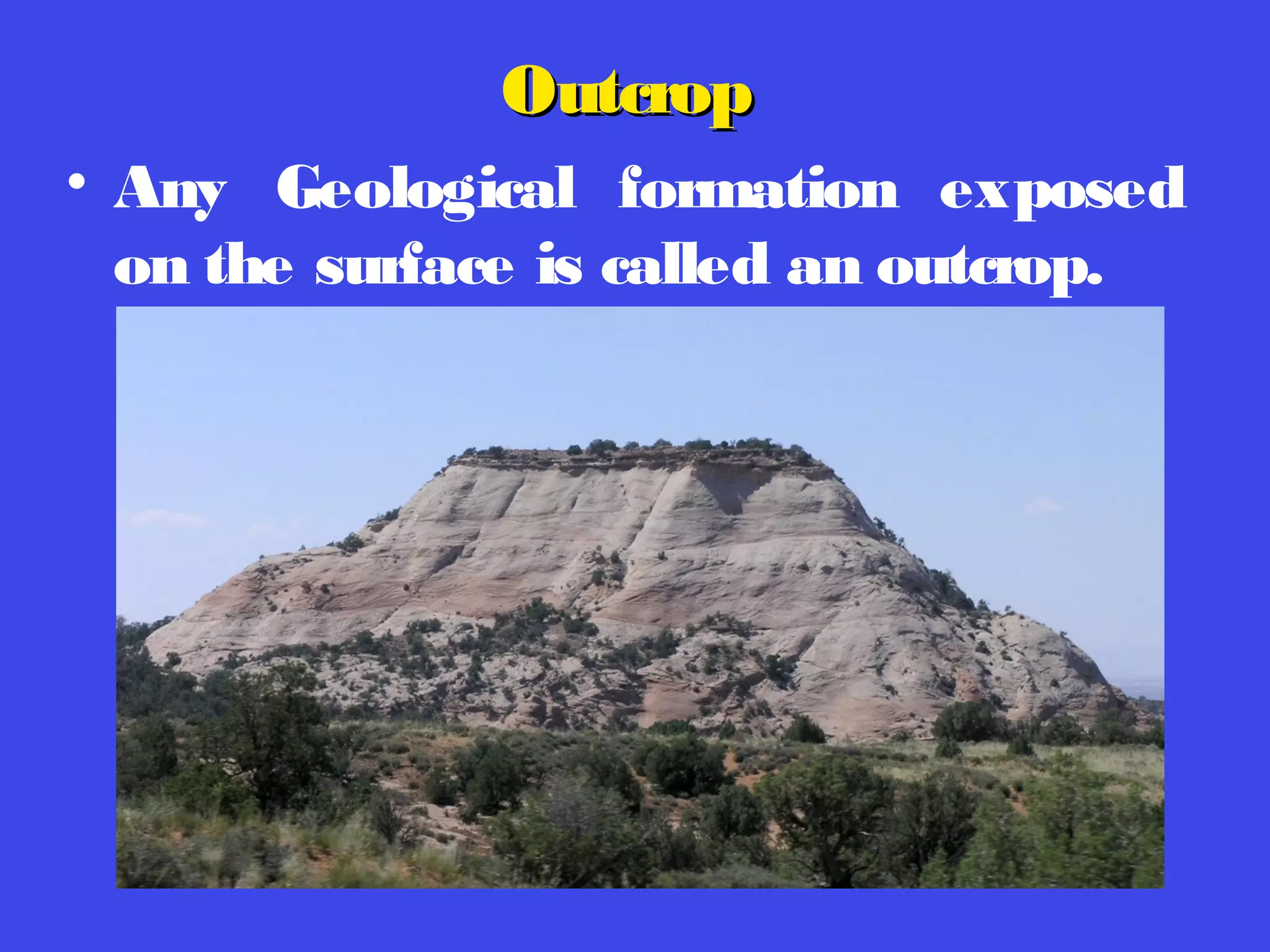
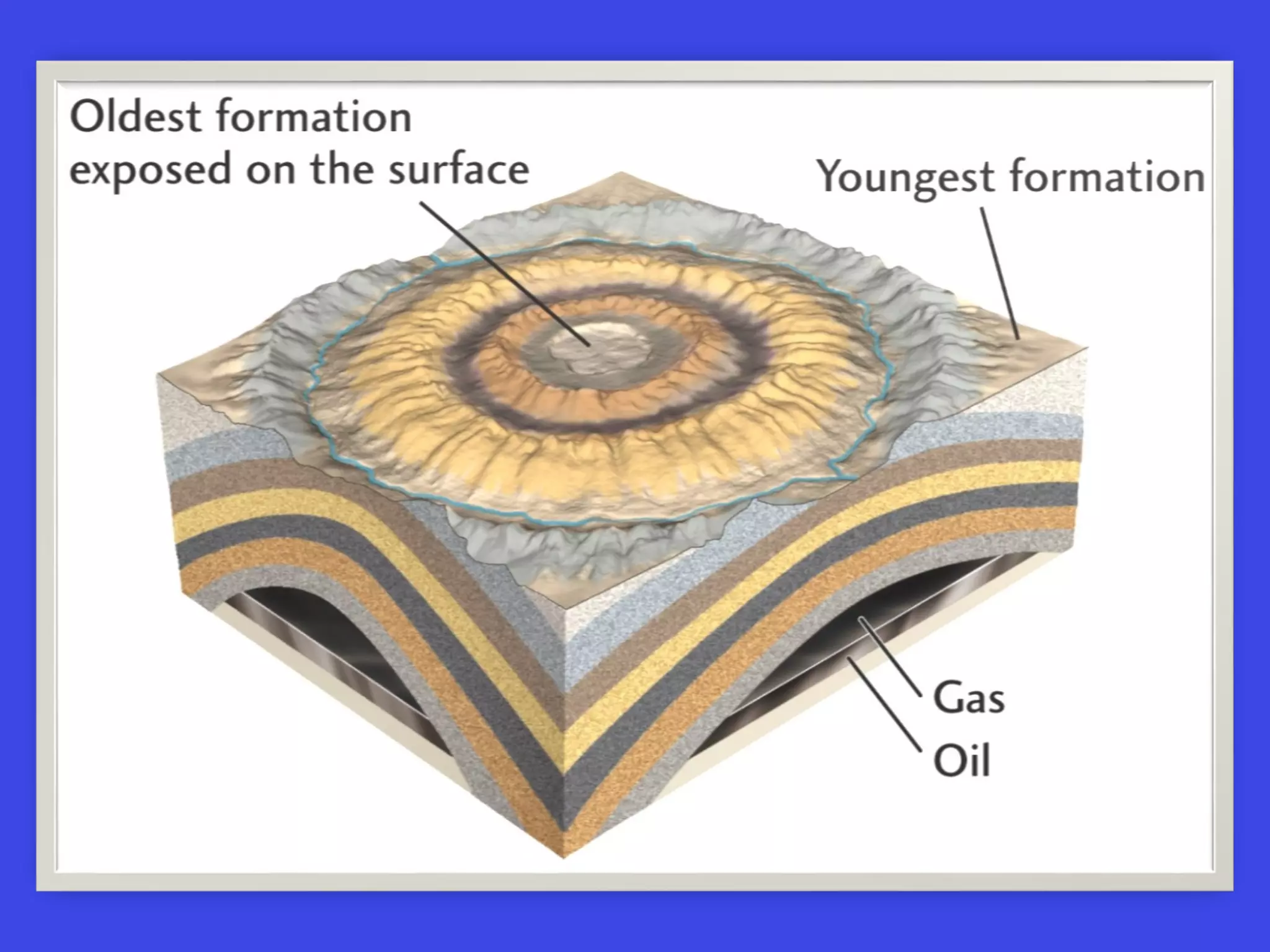
• Any Geological formation exposed
on the surface is called an outcrop.
Deformation ofDeformation of
RocksRocks
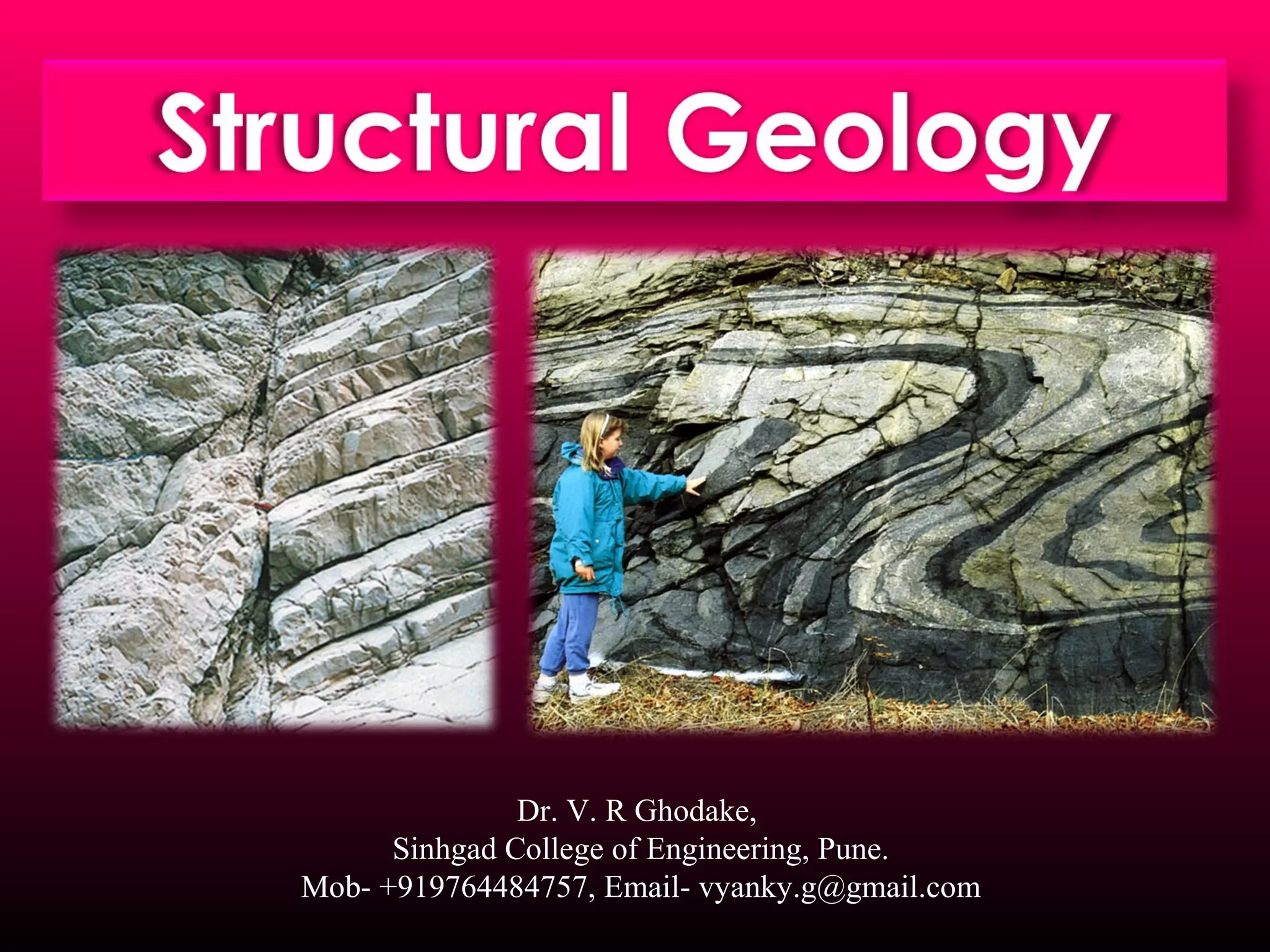
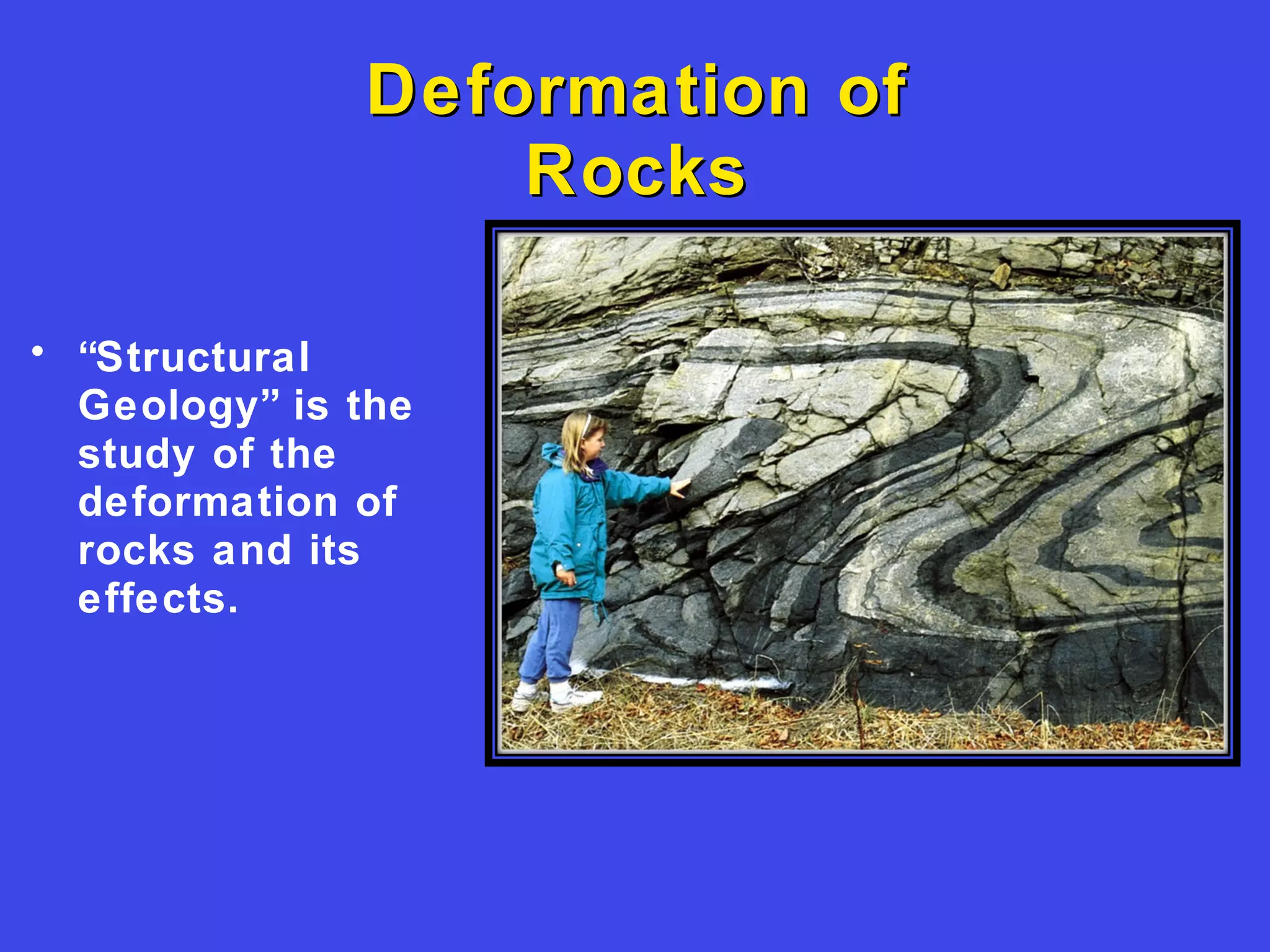
• “Structural
Geology” is the
study of the
deformation of
rocks and its
effects.
Orientation of DeformedOrientation of Deformed
RocksRocks
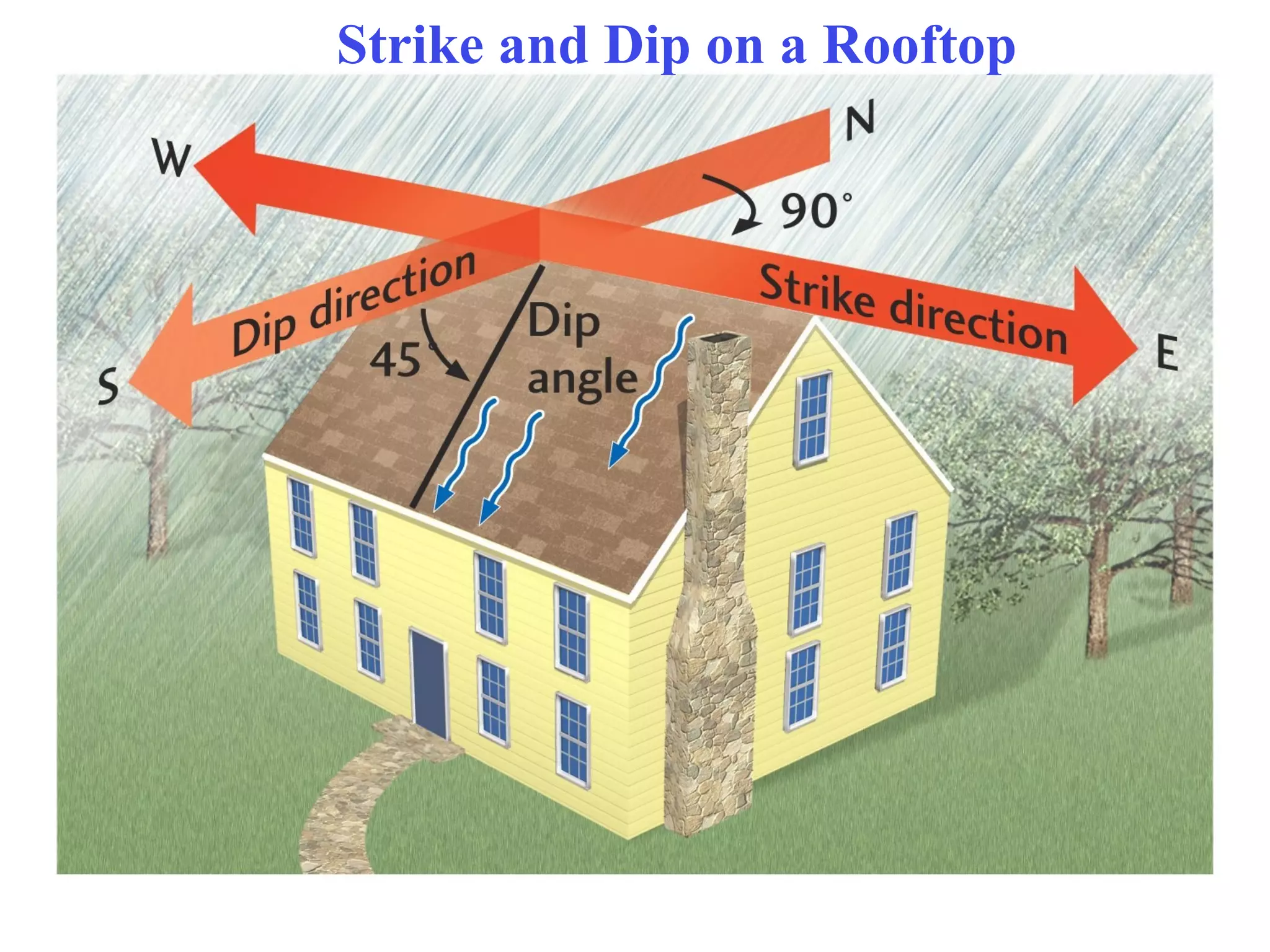
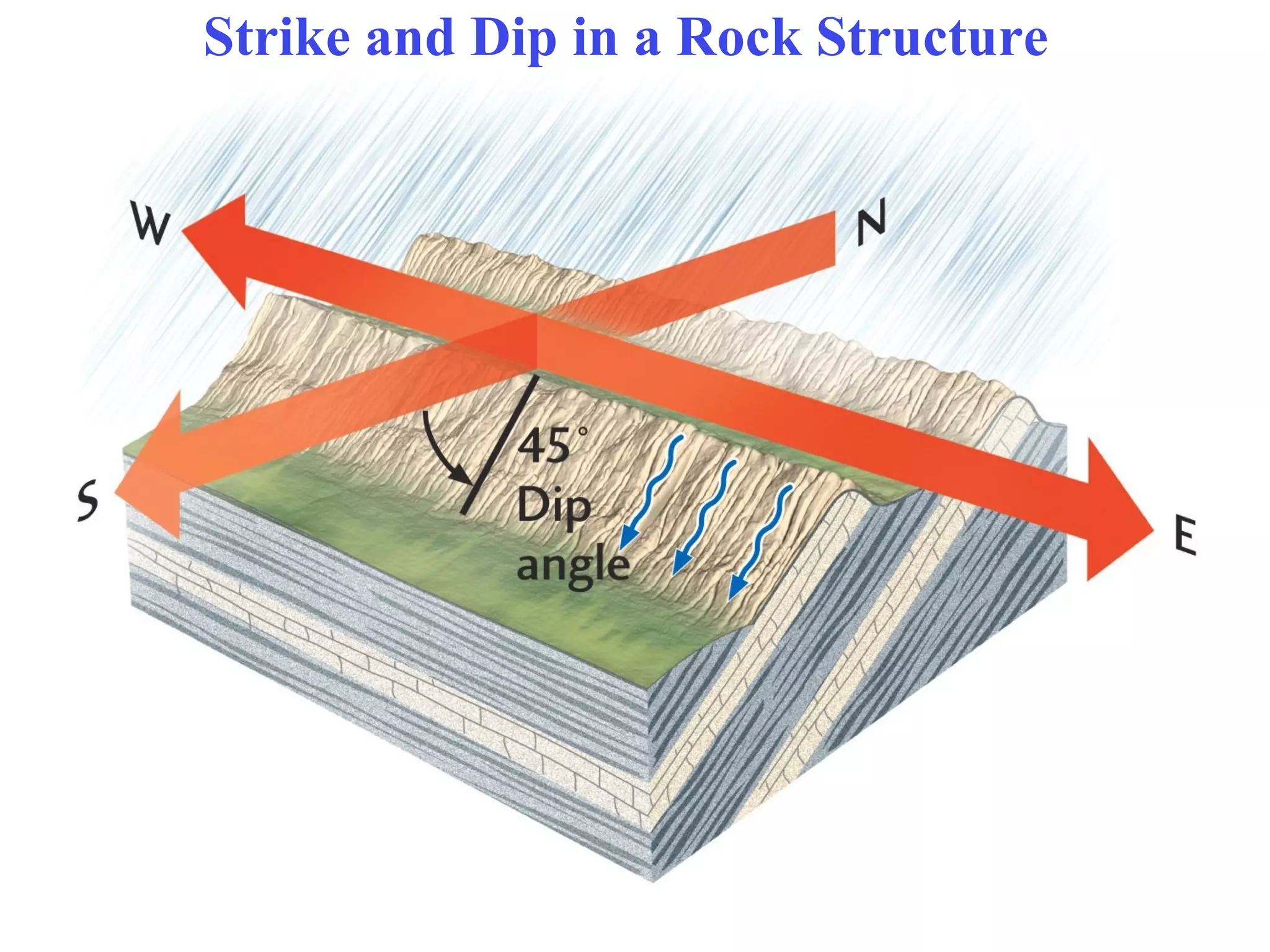
We need some way to describe the
geometry of geologic structures. So
we use the terms strike and dip.
Strike: Orientation of beds with
respect to horizon.
Dip: Maximum inclinatioin of beds
with respect to horizon,
Dip is always perpendicular to strike.
Strike and Dip on a Rooftop
Strike and Dip in a Rock Structure
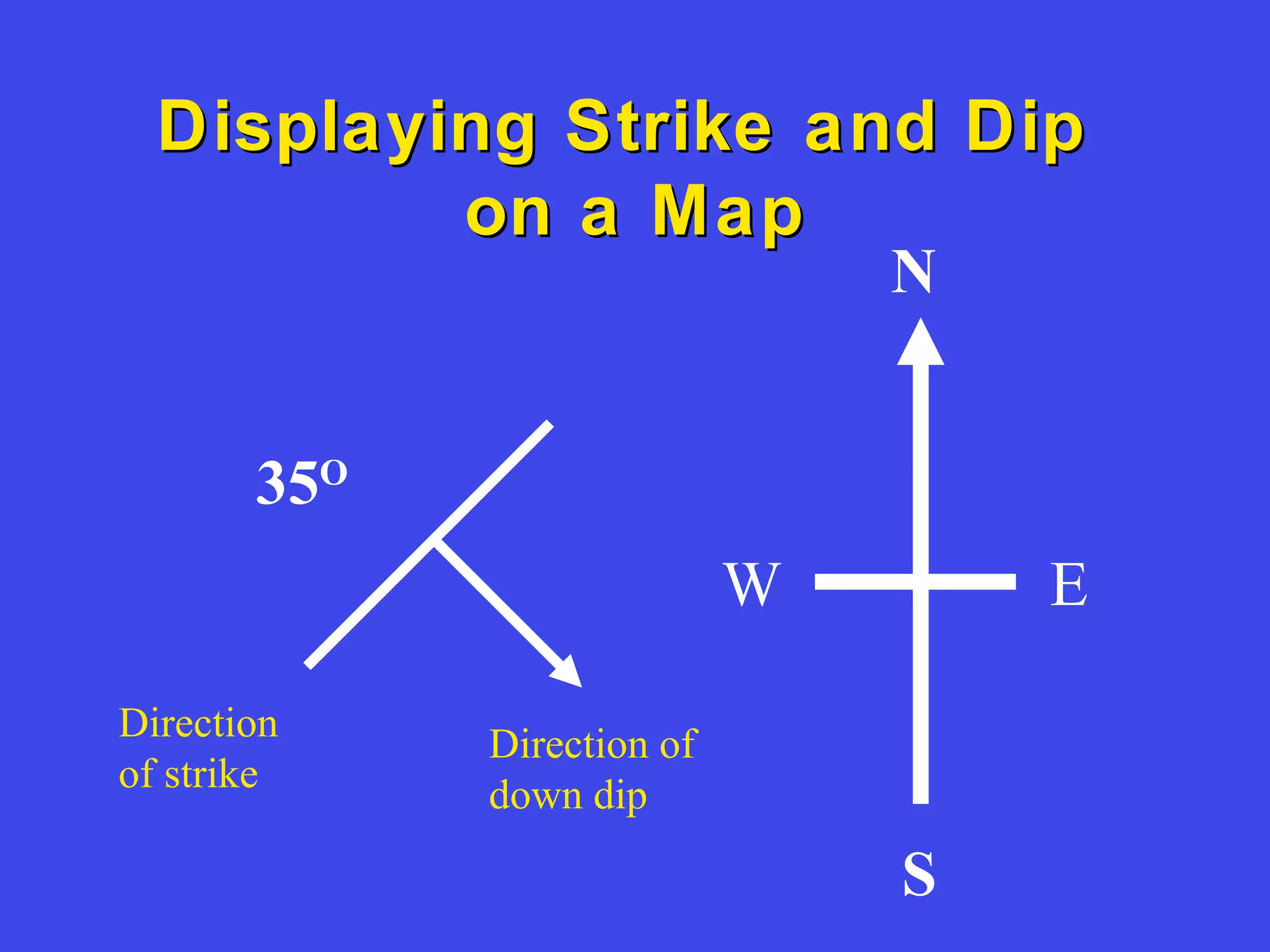
Displaying Strike and DipDisplaying Strike and Dip
on a Mapon a Map
35O
N
S
Direction
of strike
E
Direction of
down dip
W
What determines if aWhat determines if a
rockrock
Folds (bends)Folds (bends)
or faults (breaks)?or faults (breaks)?
• Type of force applied
• Pressure
• Temperature
• Rock (mineral) composition
Depth at Which theDepth at Which the
Deformation Occurs is aDeformation Occurs is a
Direct FactorDirect Factor
• At shallow crust depths, rock
has a greater probability of
breaking
• At deeper crust depths, rock
usually deforms
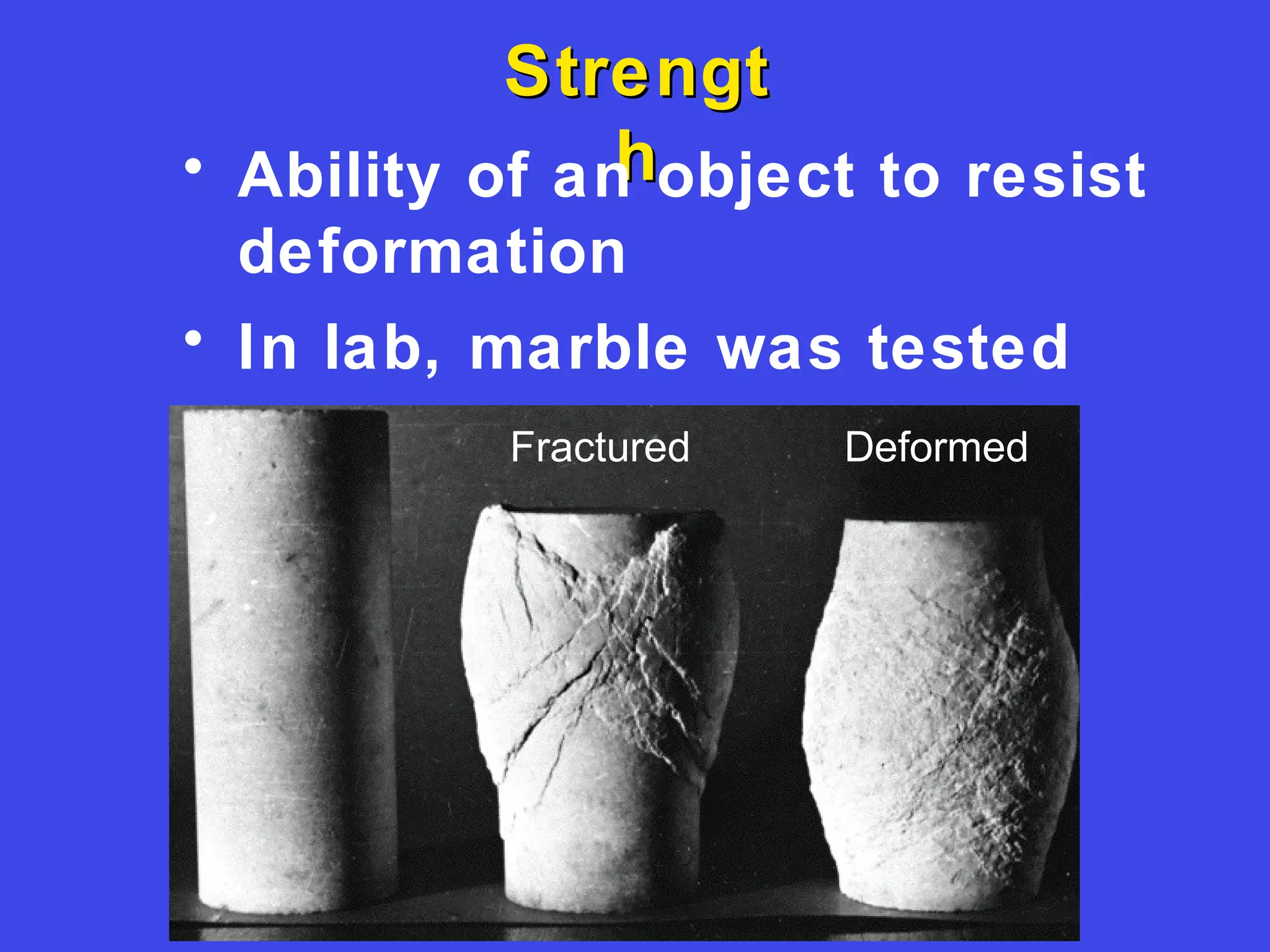
StrengtStrengt
hh• Ability of an object to resist
deformation
• In lab, marble was tested
Fractured Deformed
StraiStrai
nnAny change in original shape or size of an
object in response to stress acting on the
object
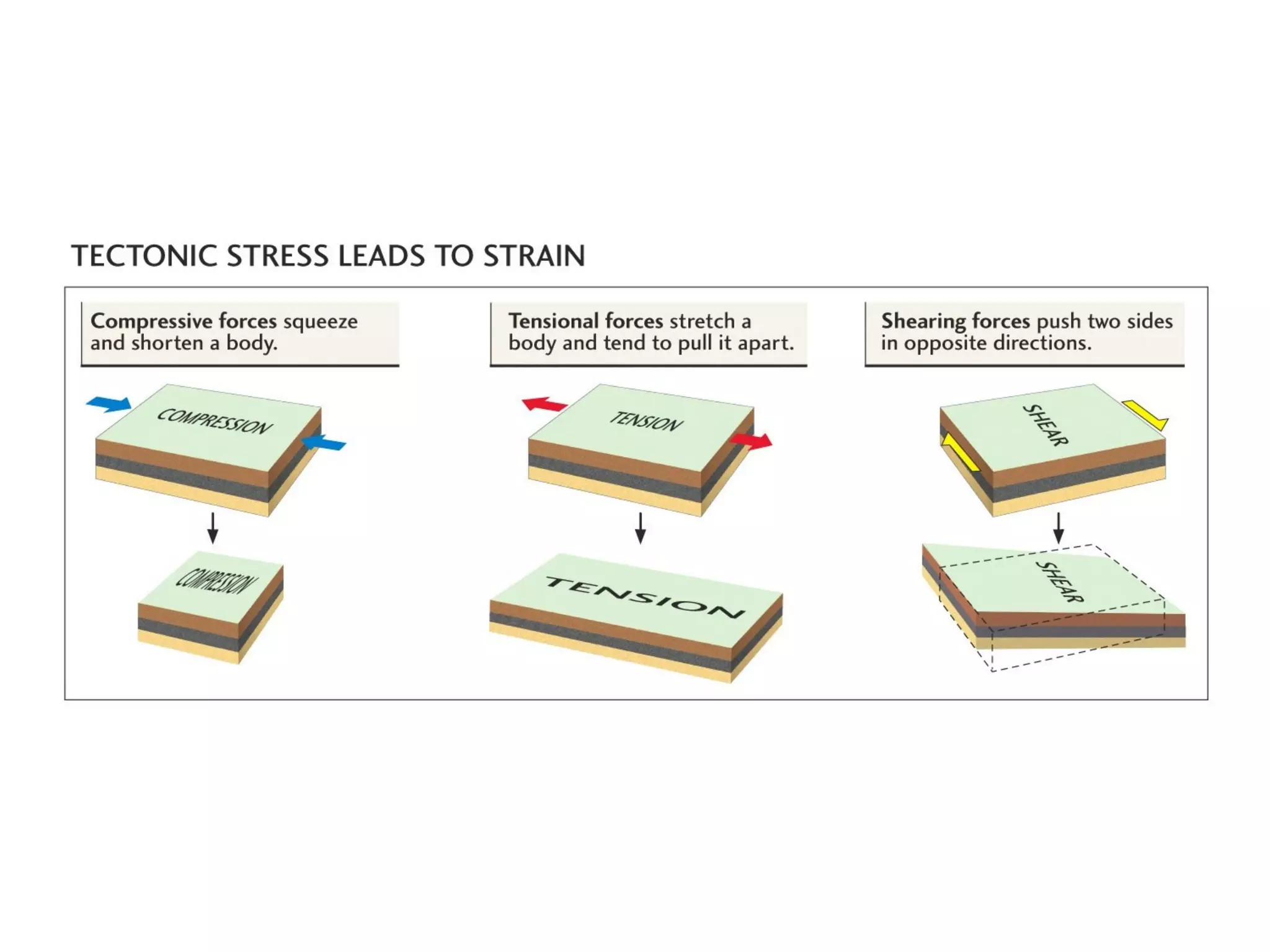
Three Major TypesThree Major Types
of Directed Stressof Directed Stress
• Compression
• Extension
• Shear
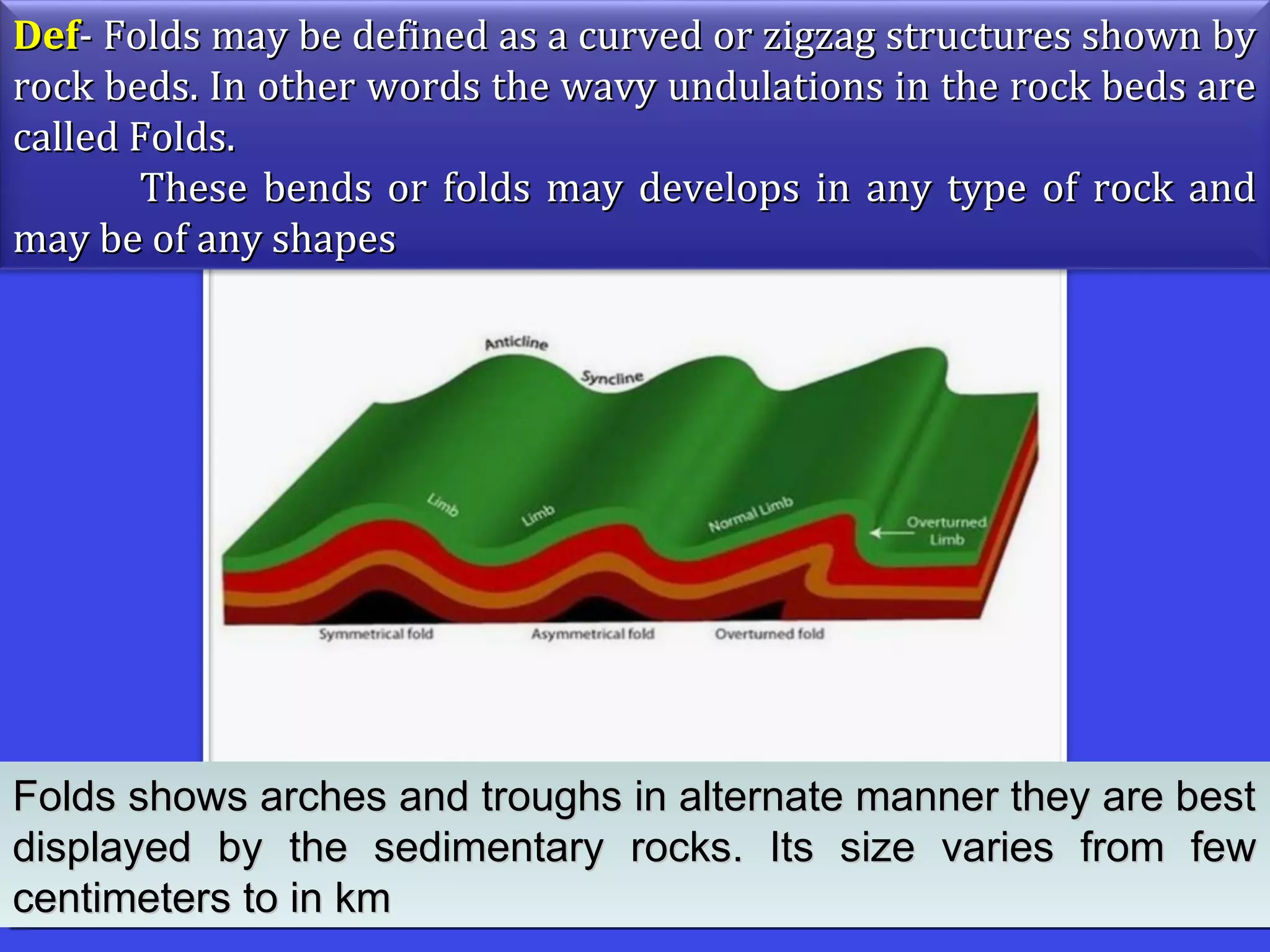
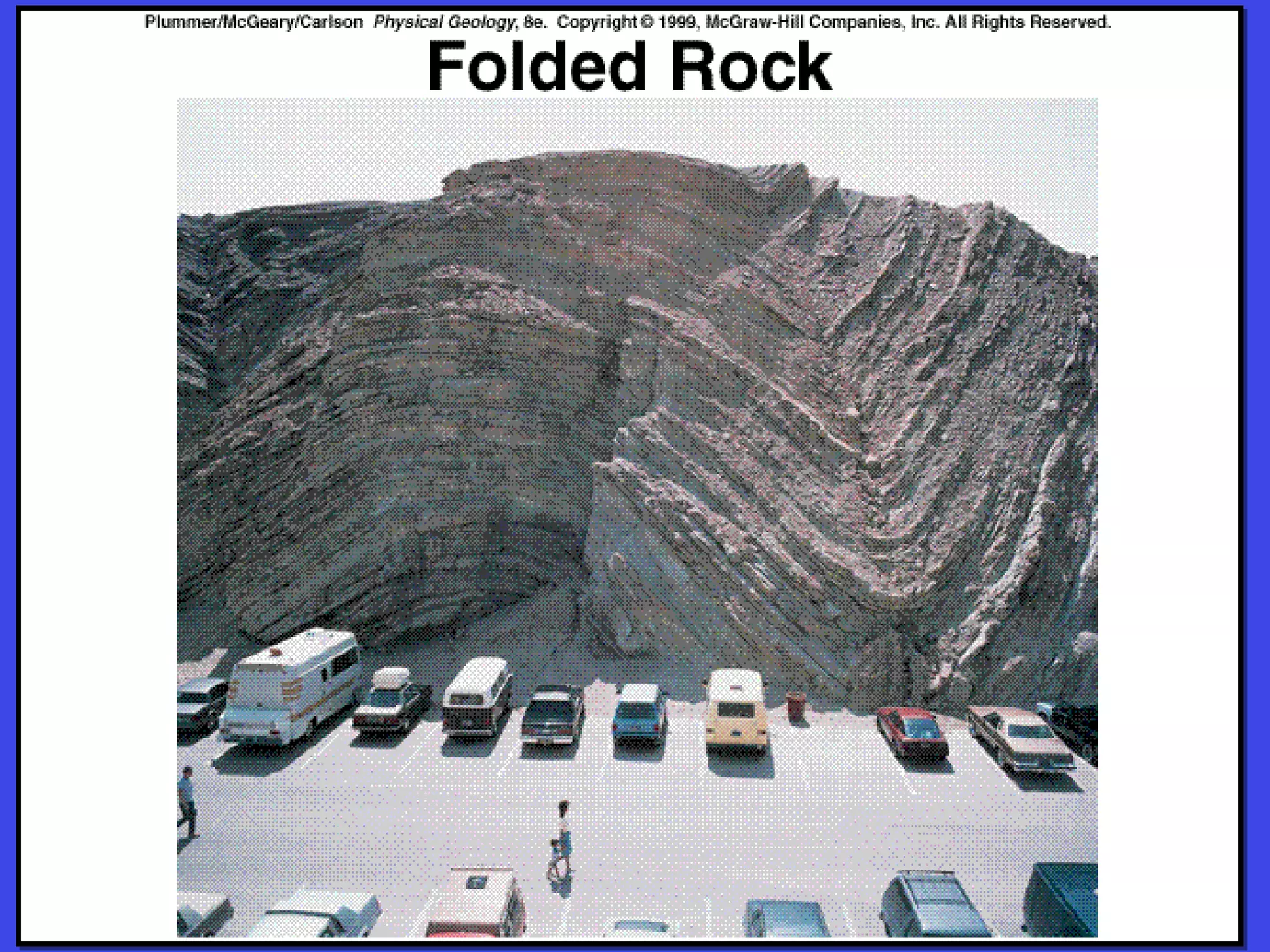
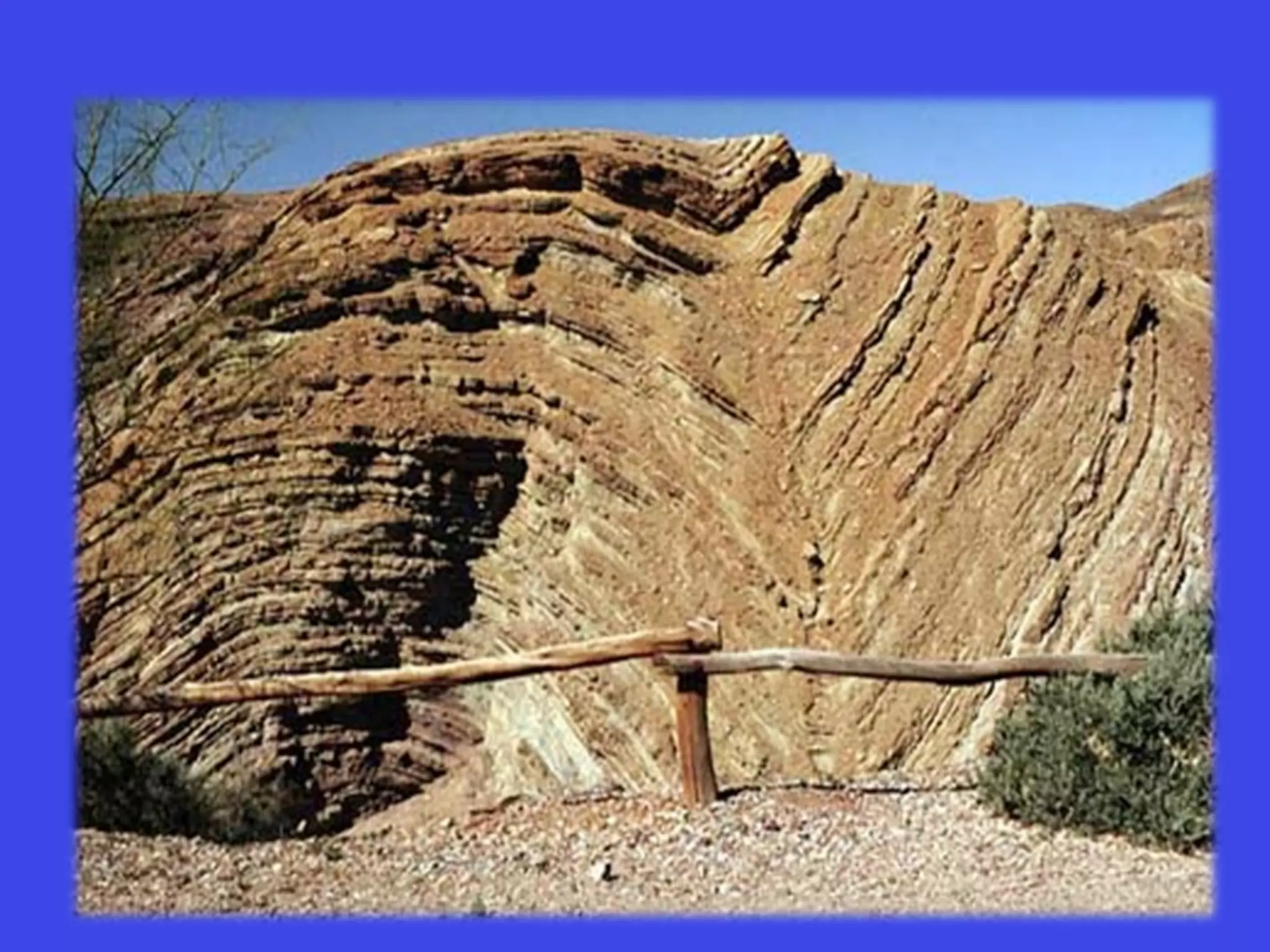
DefDef- Folds may be defined as a curved or zigzag structures shown by- Folds may be defined as a curved or zigzag structures shown by
rock beds. In other words the wavy undulations in the rock beds arerock beds. In other words the wavy undulations in the rock beds are
called Folds.called Folds.
These bends or folds may develops in any type of rock andThese bends or folds may develops in any type of rock and
may be of any shapesmay be of any shapes
Folds shows arches and troughs in alternate manner they are bestFolds shows arches and troughs in alternate manner they are best
displayed by the sedimentary rocks. Its size varies from fewdisplayed by the sedimentary rocks. Its size varies from few
centimeters to in kmcentimeters to in km
Folds shows arches and troughs in alternate manner they are bestFolds shows arches and troughs in alternate manner they are best
displayed by the sedimentary rocks. Its size varies from fewdisplayed by the sedimentary rocks. Its size varies from few
centimeters to in kmcentimeters to in km
Parts of Folds
•Limbs:
•Axial Planes
•Axis of Fold
•Hinge Line
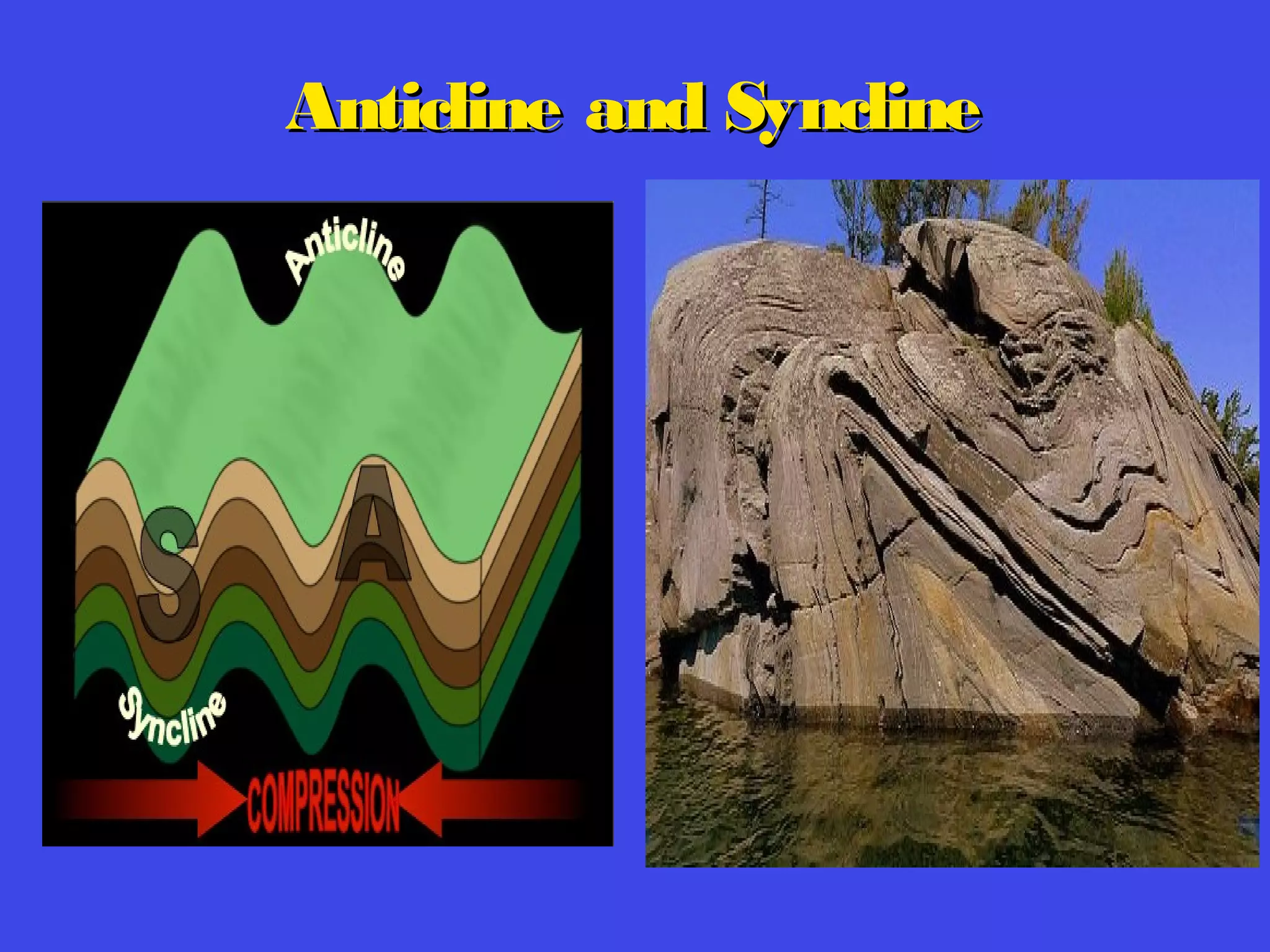
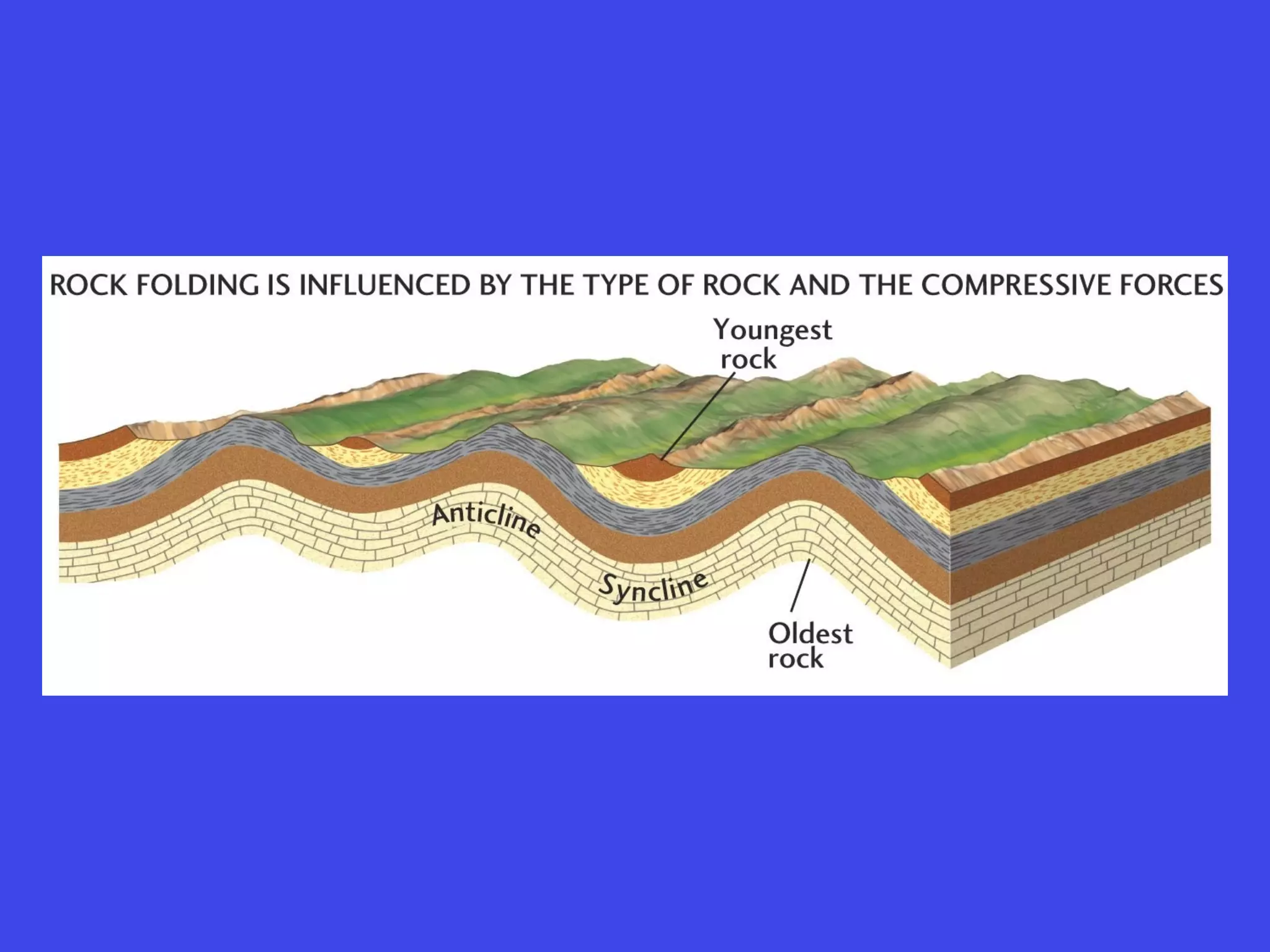
Anticline and SynclineAnticline and Syncline
AnticlineAnticline – is a up fold where the limb dip away from axis of fold, these– is a up fold where the limb dip away from axis of fold, these
shows convex upwardsshows convex upwards
SynclineSyncline – is a down fold where the limb dip towards the axis of fold, these– is a down fold where the limb dip towards the axis of fold, these
shows concave, or reversed anticline shape.shows concave, or reversed anticline shape.
SynclineSyncline – is a down fold where the limb dip towards the axis of fold, these– is a down fold where the limb dip towards the axis of fold, these
shows concave, or reversed anticline shape.shows concave, or reversed anticline shape.
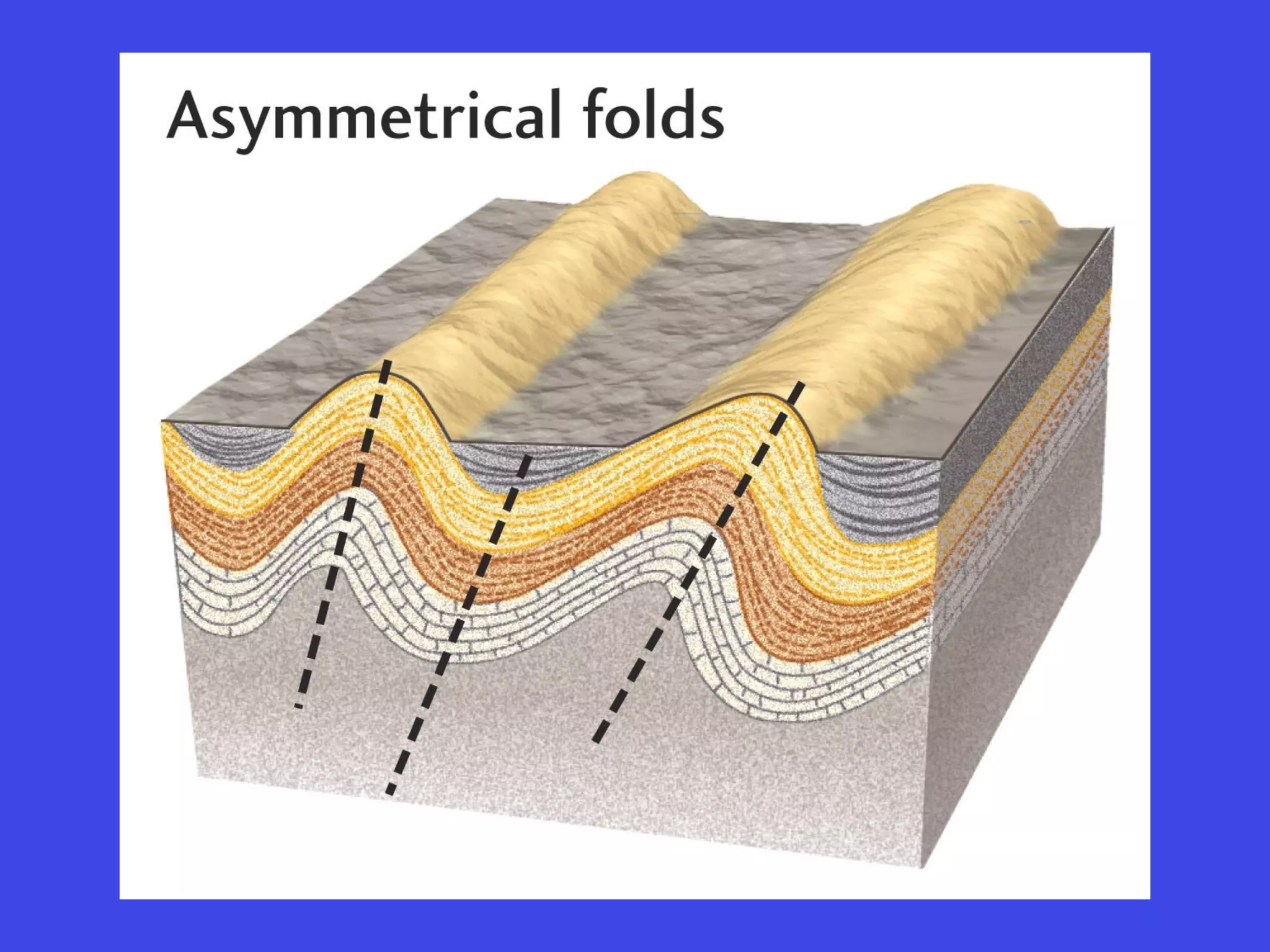
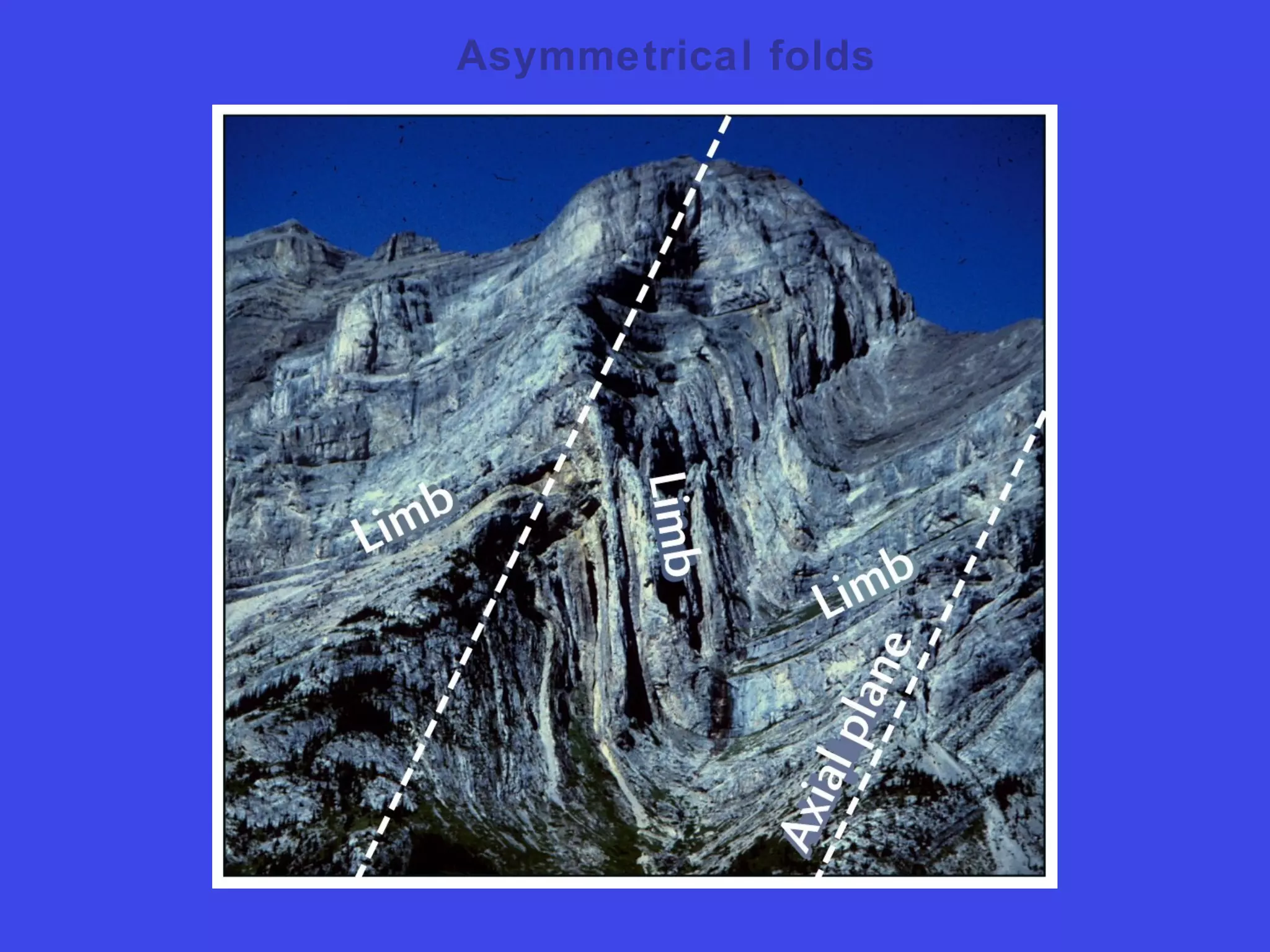
Asymmetrical folds
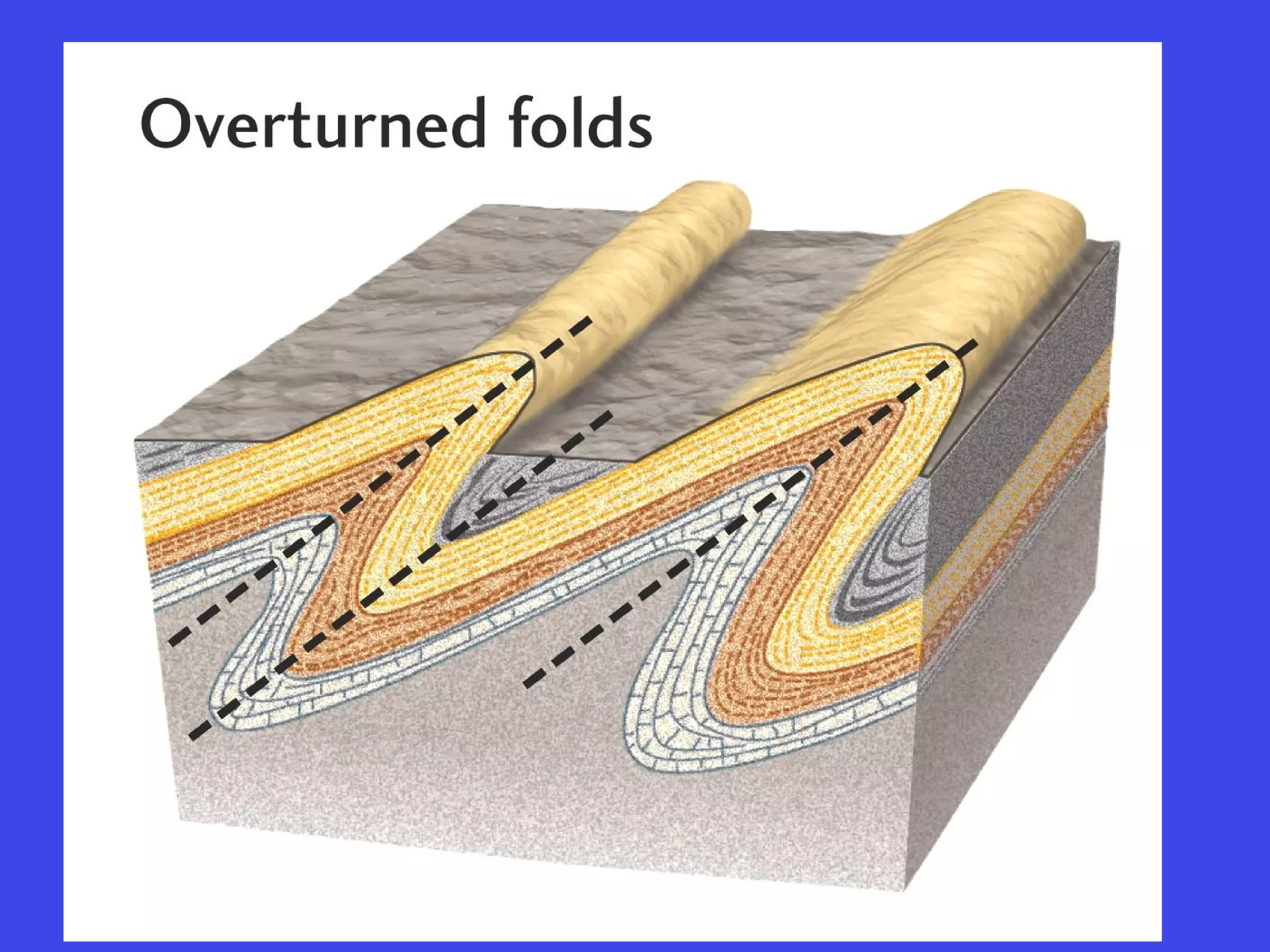
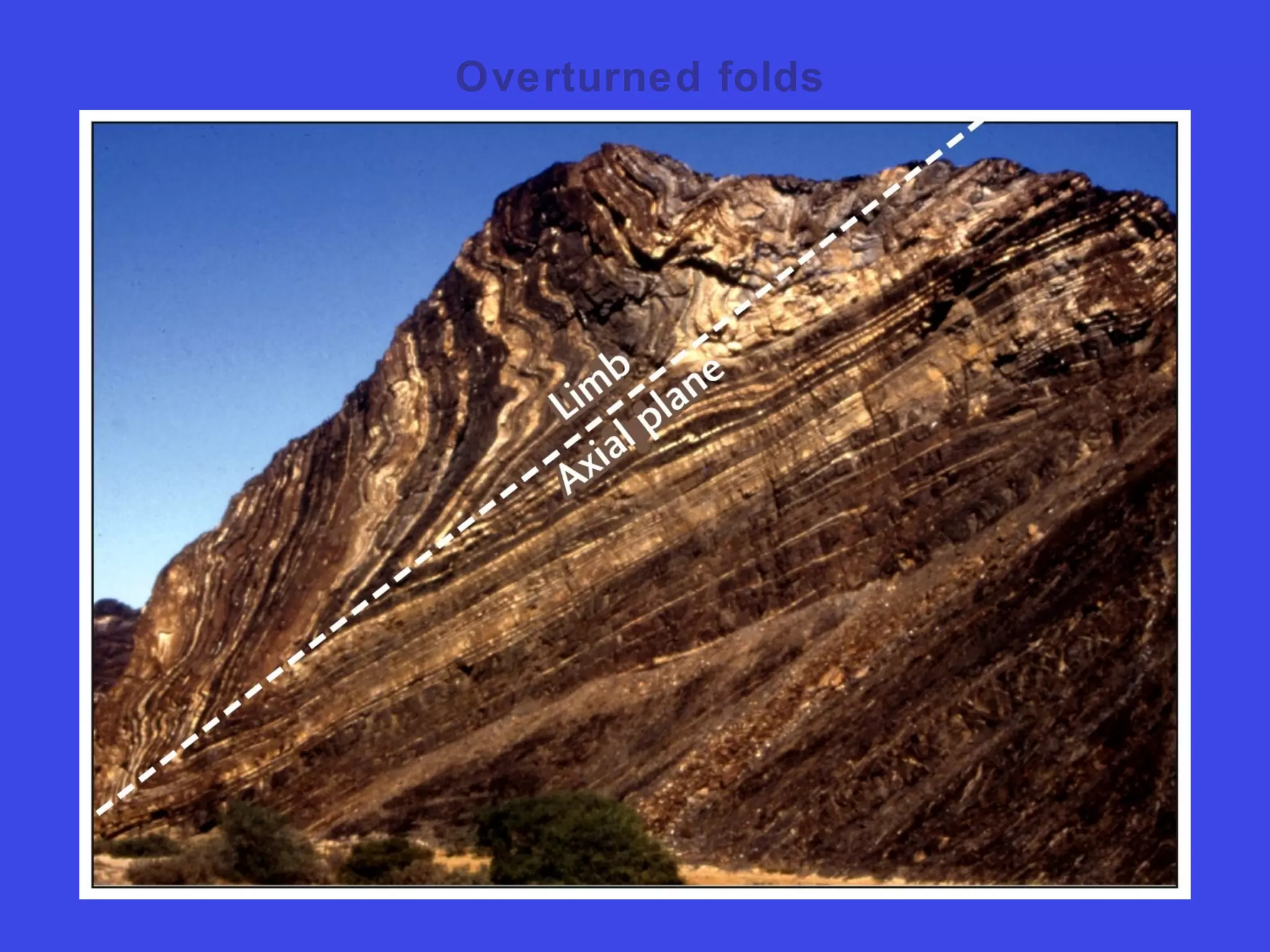
Overturned folds
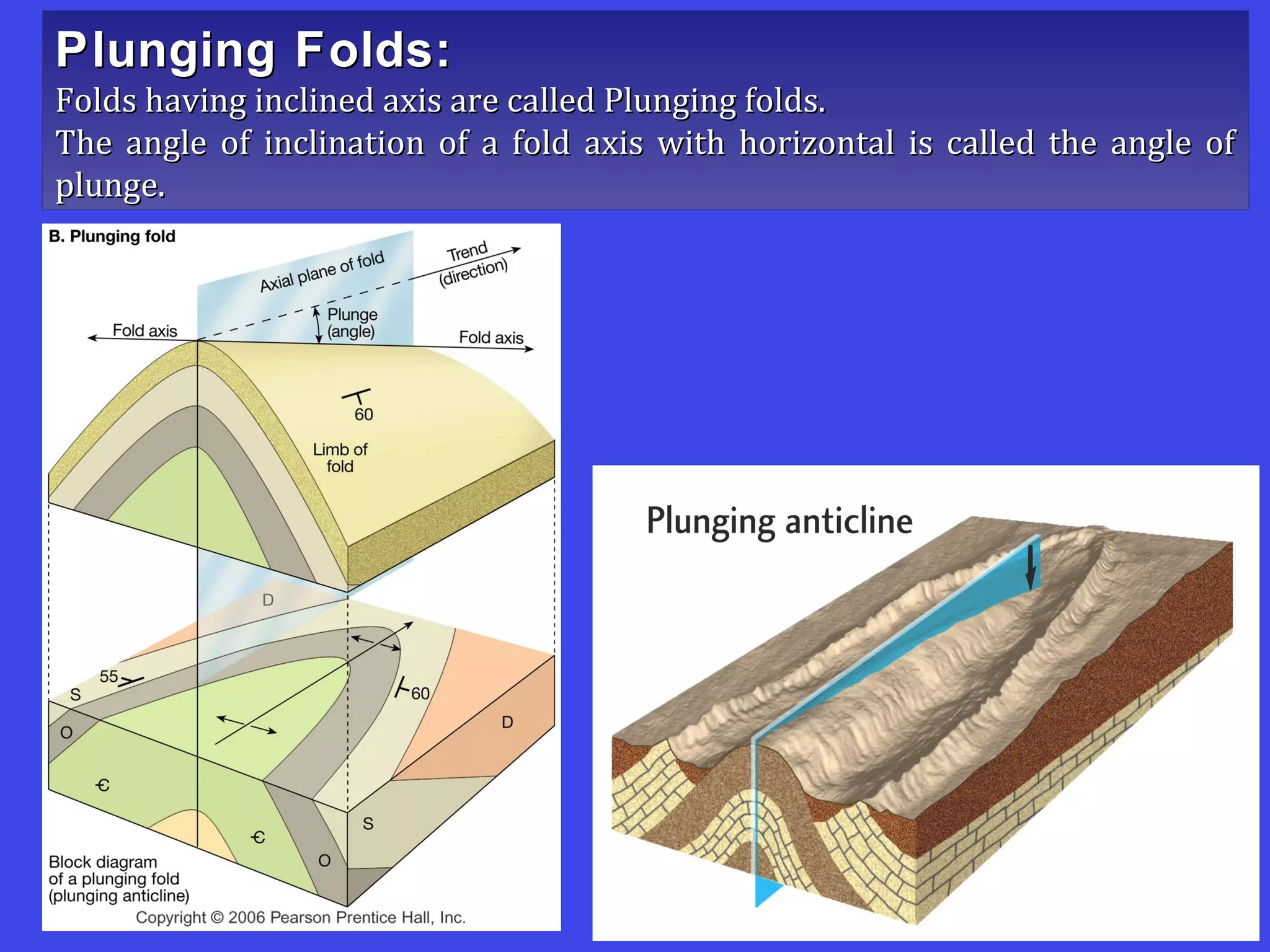
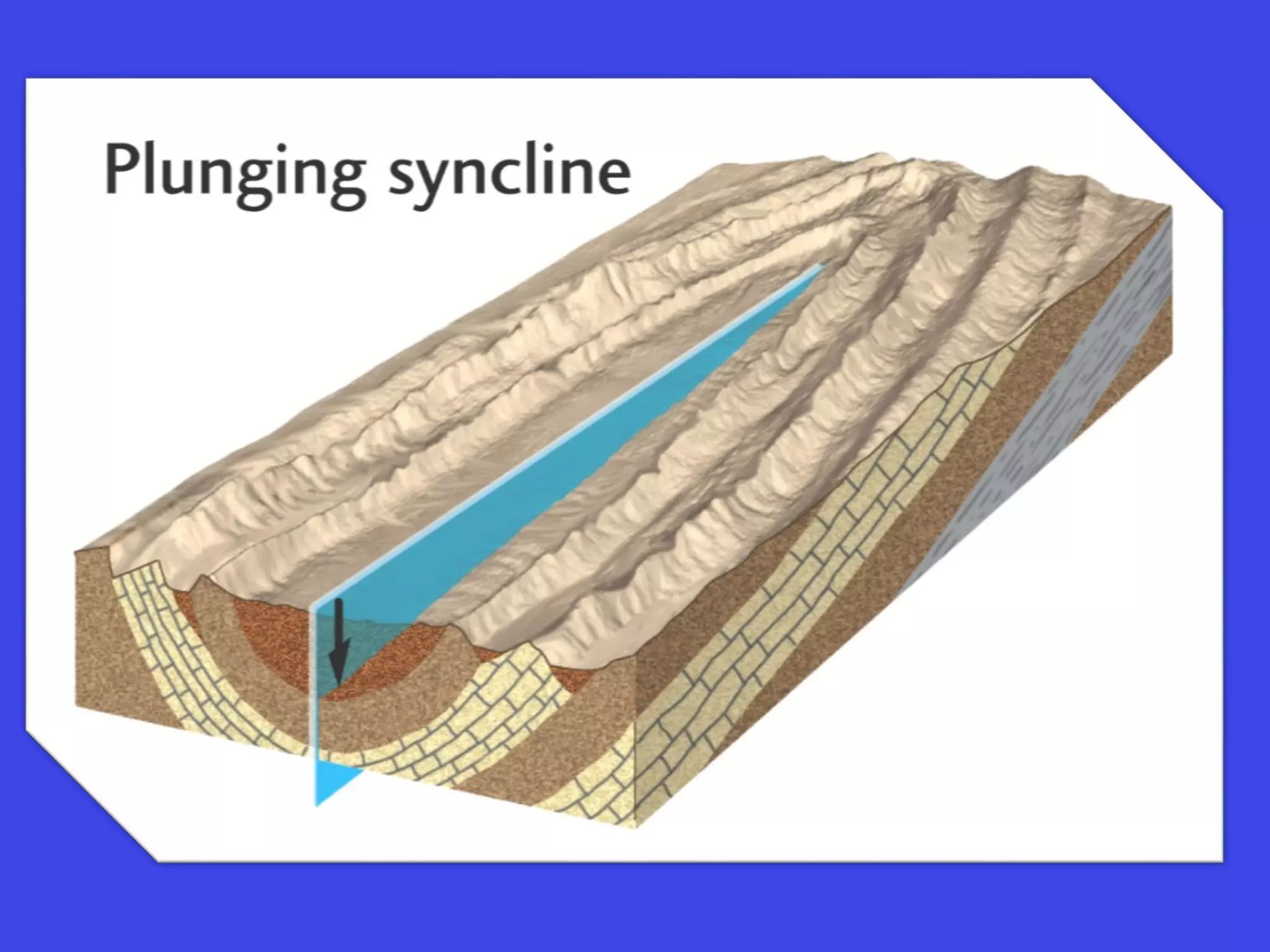
Plunging Folds:Plunging Folds:
Folds having inclined axis are called Plunging folds.Folds having inclined axis are called Plunging folds.
The angle of inclination of a fold axis with horizontal is called the angle ofThe angle of inclination of a fold axis with horizontal is called the angle of
plunge.plunge.
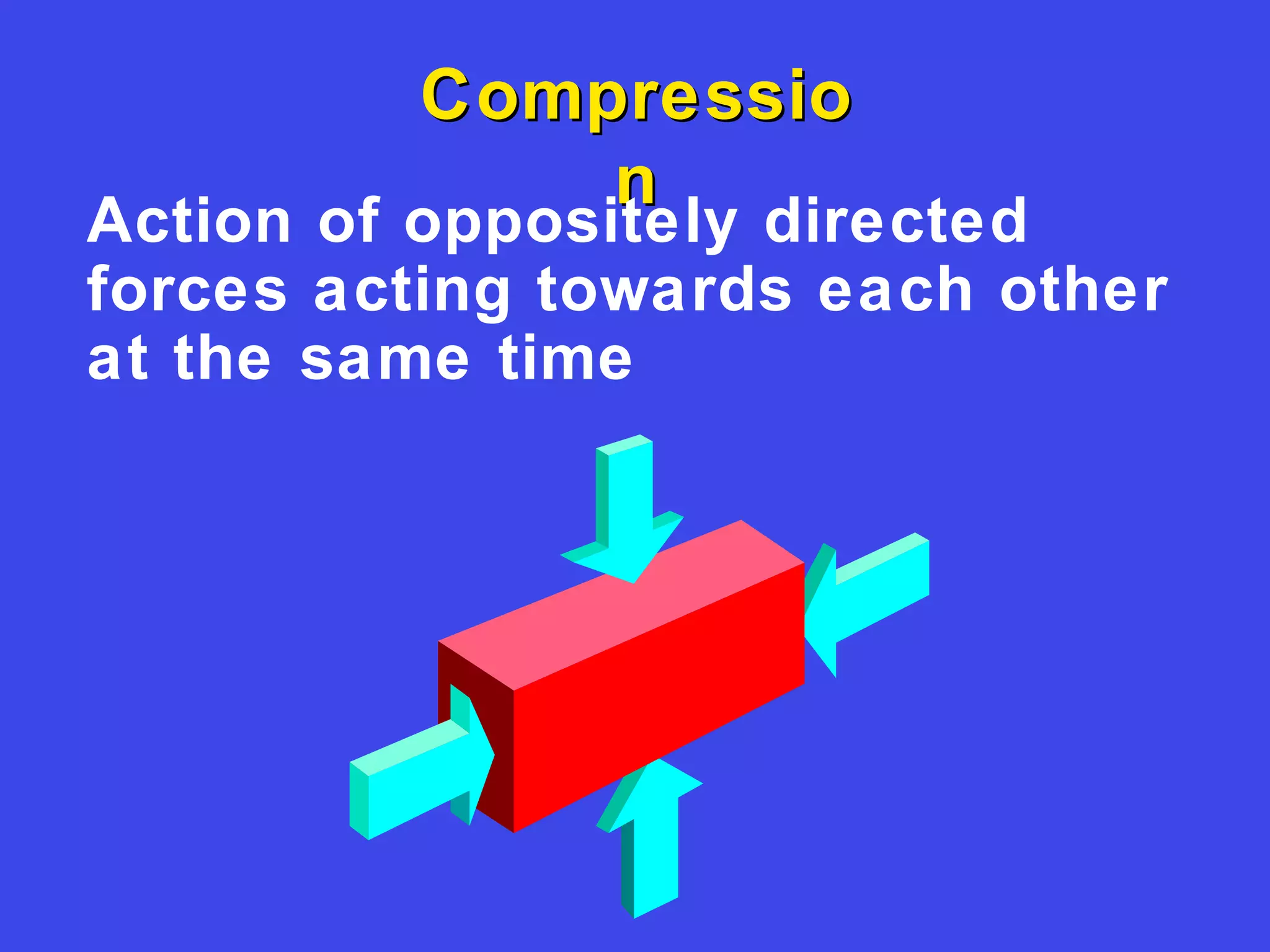
CompressioCompressio
nn
Action of oppositely directed
forces acting towards each other
at the same time
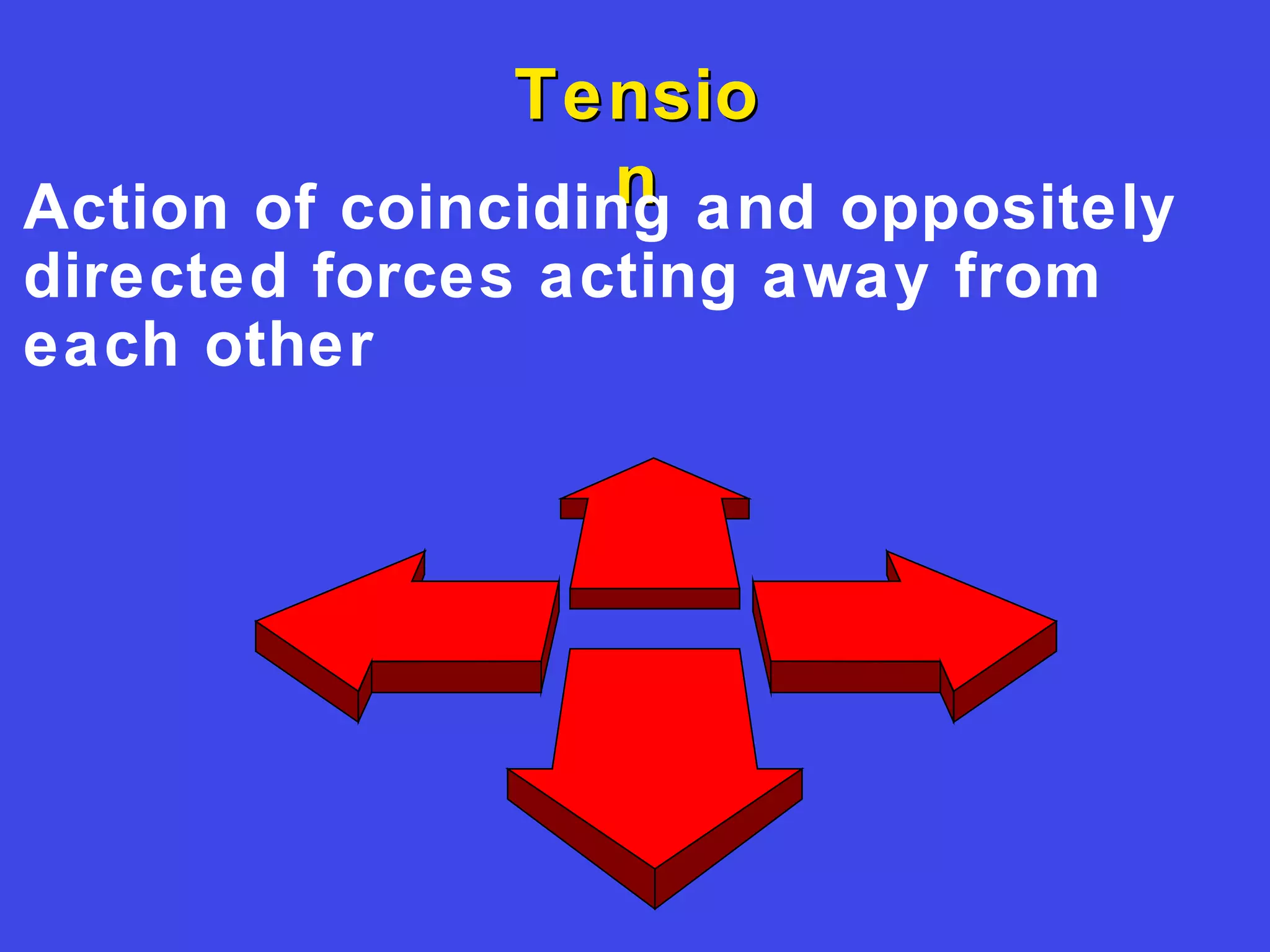
TensioTensio
nnAction of coinciding and oppositely
directed forces acting away from
each other
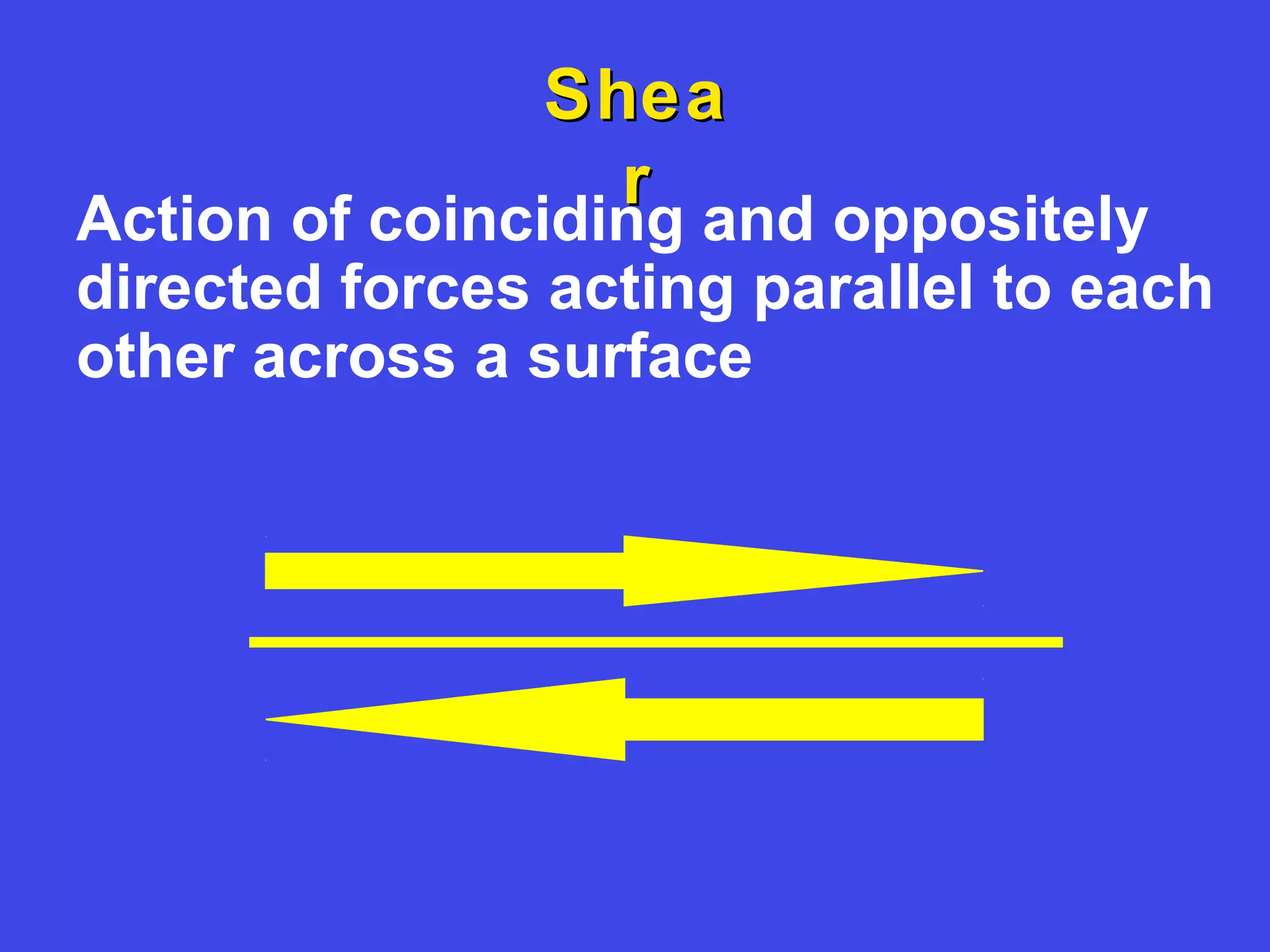
SheaShea
rr
Action of coinciding and oppositely
directed forces acting parallel to each
other across a surface
Types ofTypes of
DeformationDeformation
• ElasticElastic
• Ductile (plastic)Ductile (plastic)
• Brittle (rupture)Brittle (rupture)
ElasticElastic
DeformationDeformation
Temporary change in shape
or size that is recovered
when the deforming force is
removed
(Like squeezing a piece of
rubber)
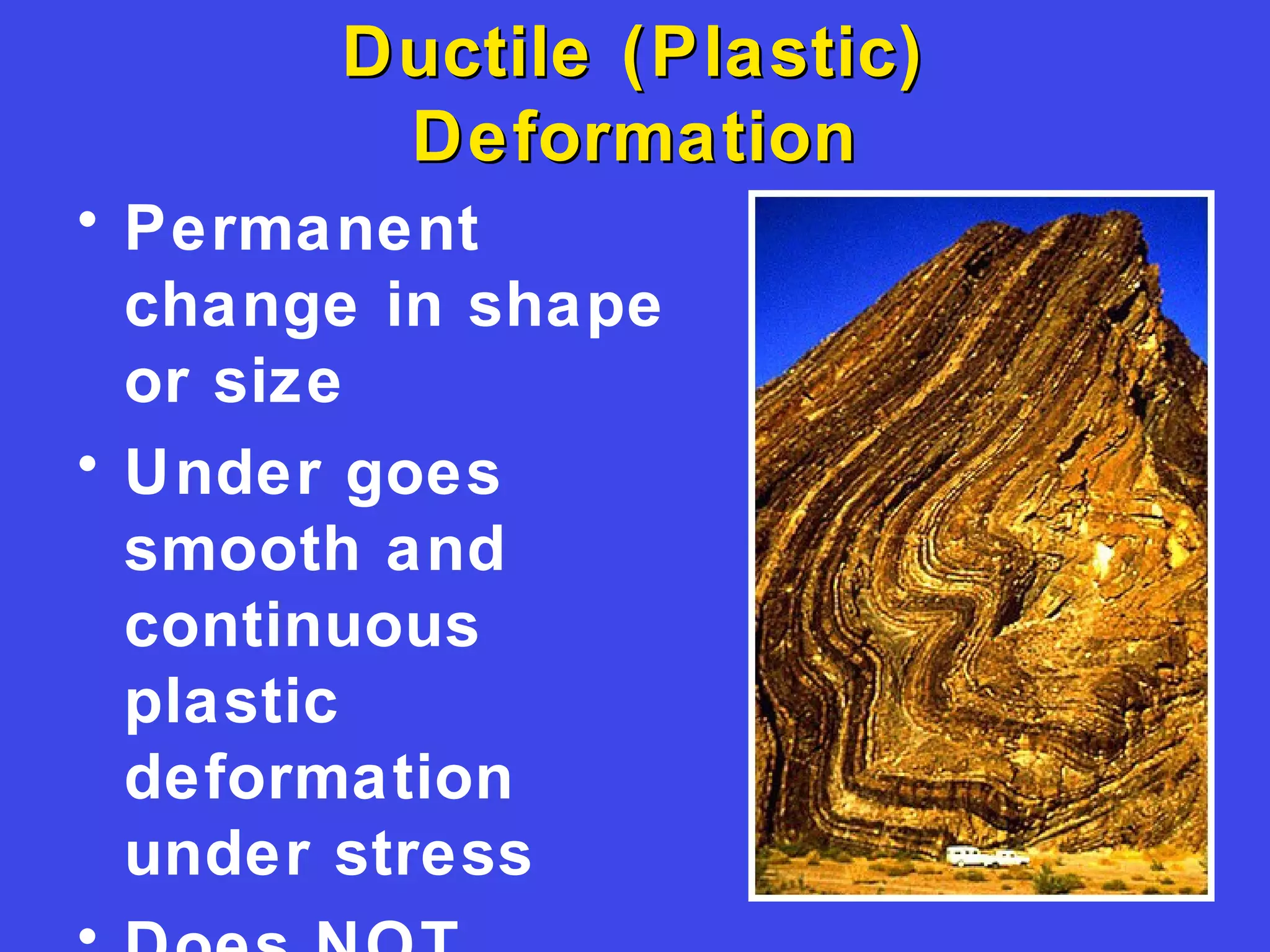
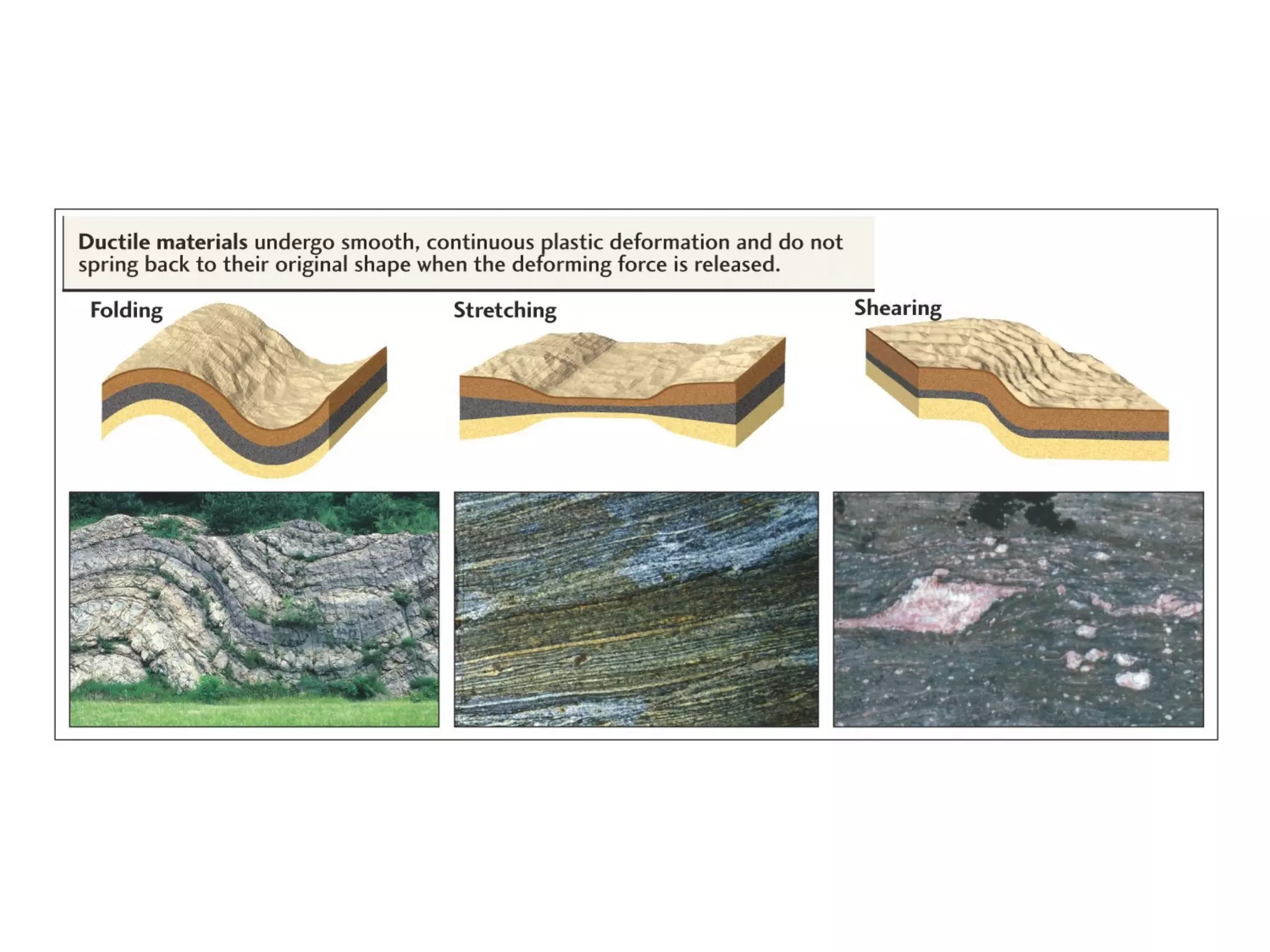
Ductile (Plastic)Ductile (Plastic)
DeformationDeformation
• Permanent
change in shape
or size
• Under goes
smooth and
continuous
plastic
deformation
under stress
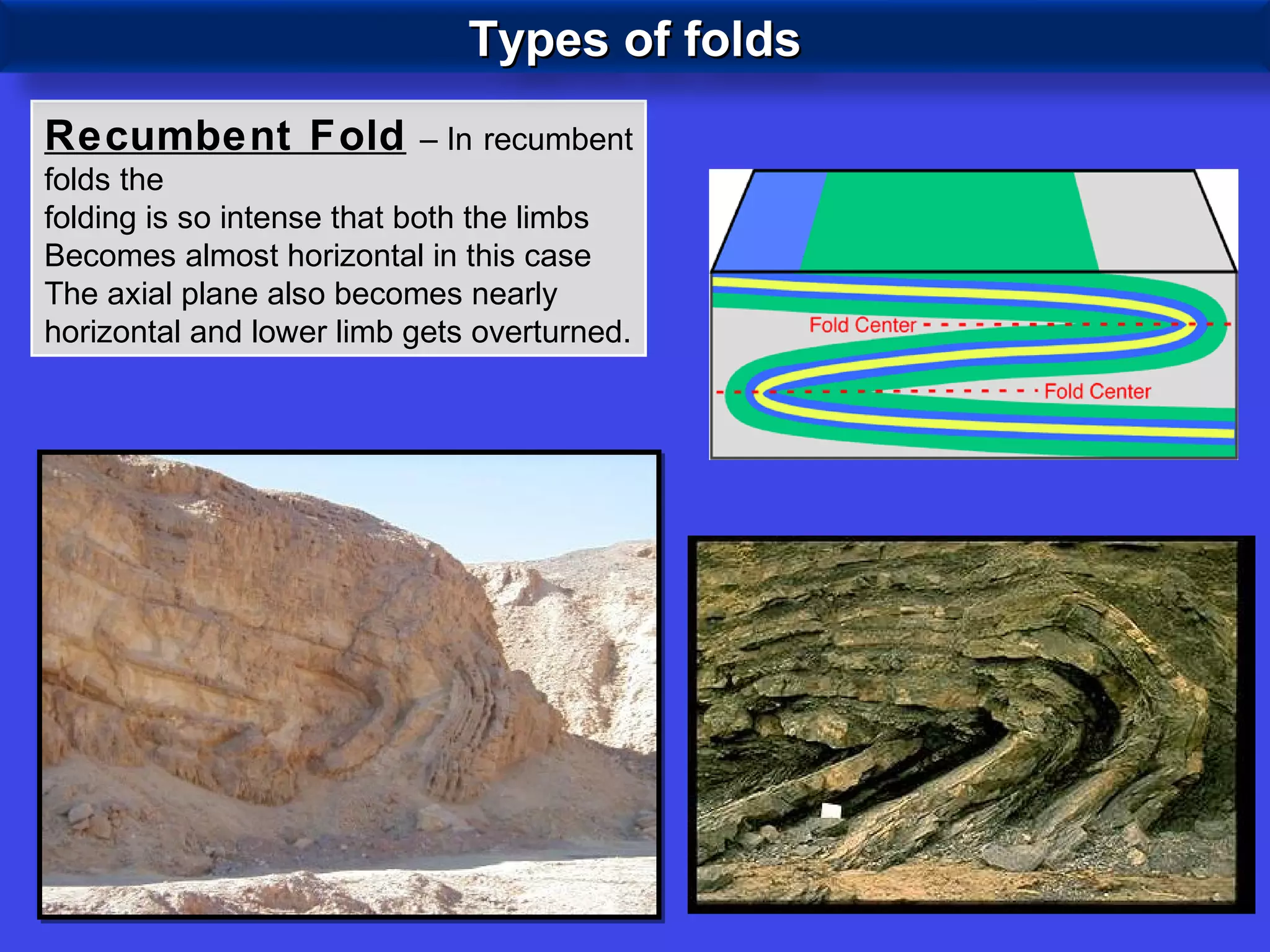
Recumbent Fold – In recumbent
folds the
folding is so intense that both the limbs
Becomes almost horizontal in this case
The axial plane also becomes nearly
horizontal and lower limb gets overturned.
Types of foldsTypes of folds
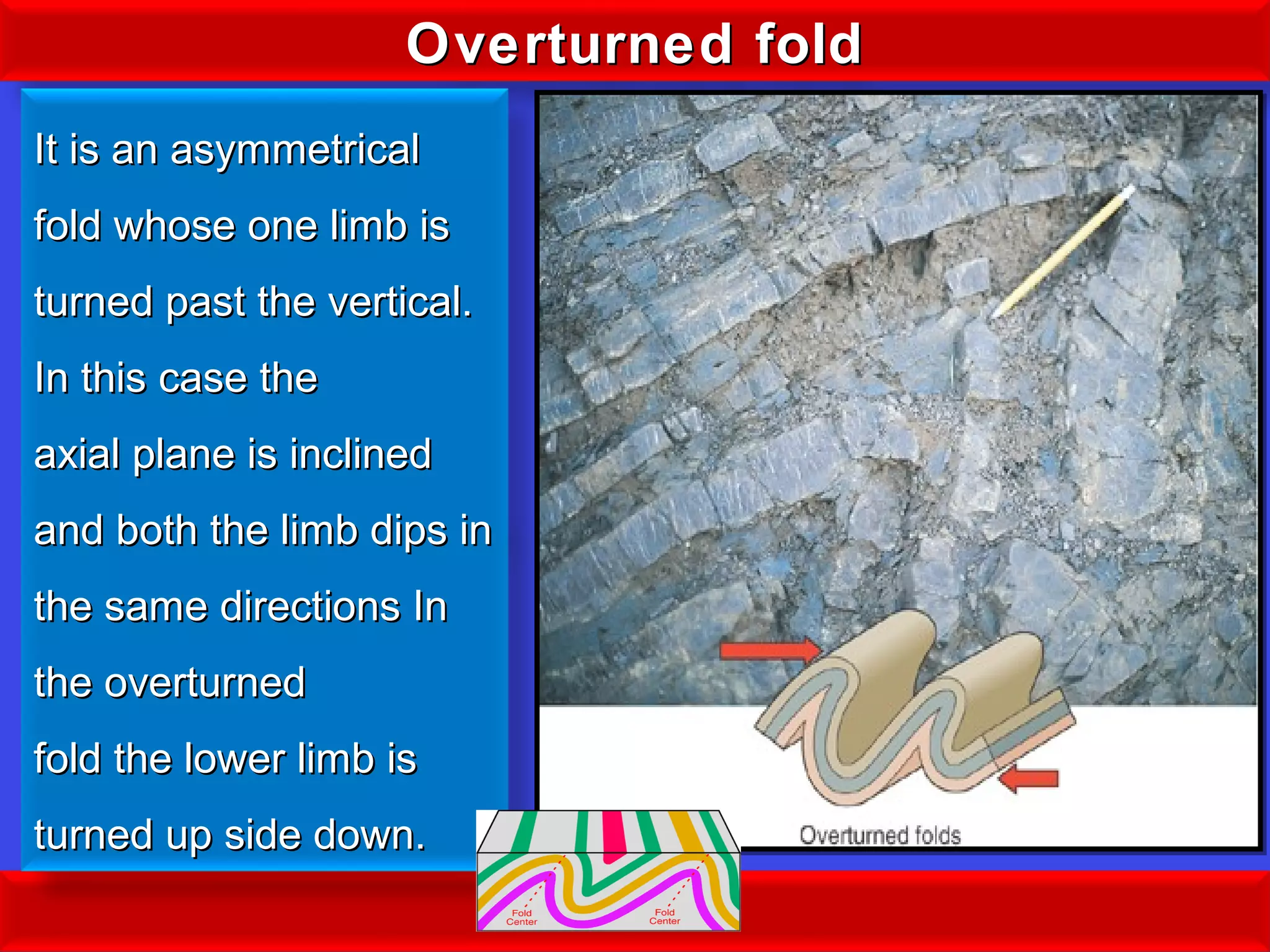
Overturned foldOverturned fold
It is an asymmetricalIt is an asymmetrical
fold whose one limb isfold whose one limb is
turned past the vertical.turned past the vertical.
In this case theIn this case the
axial plane is inclinedaxial plane is inclined
and both the limb dips inand both the limb dips in
the same directions Inthe same directions In
the overturnedthe overturned
fold the lower limb isfold the lower limb is
turned up side down.turned up side down.
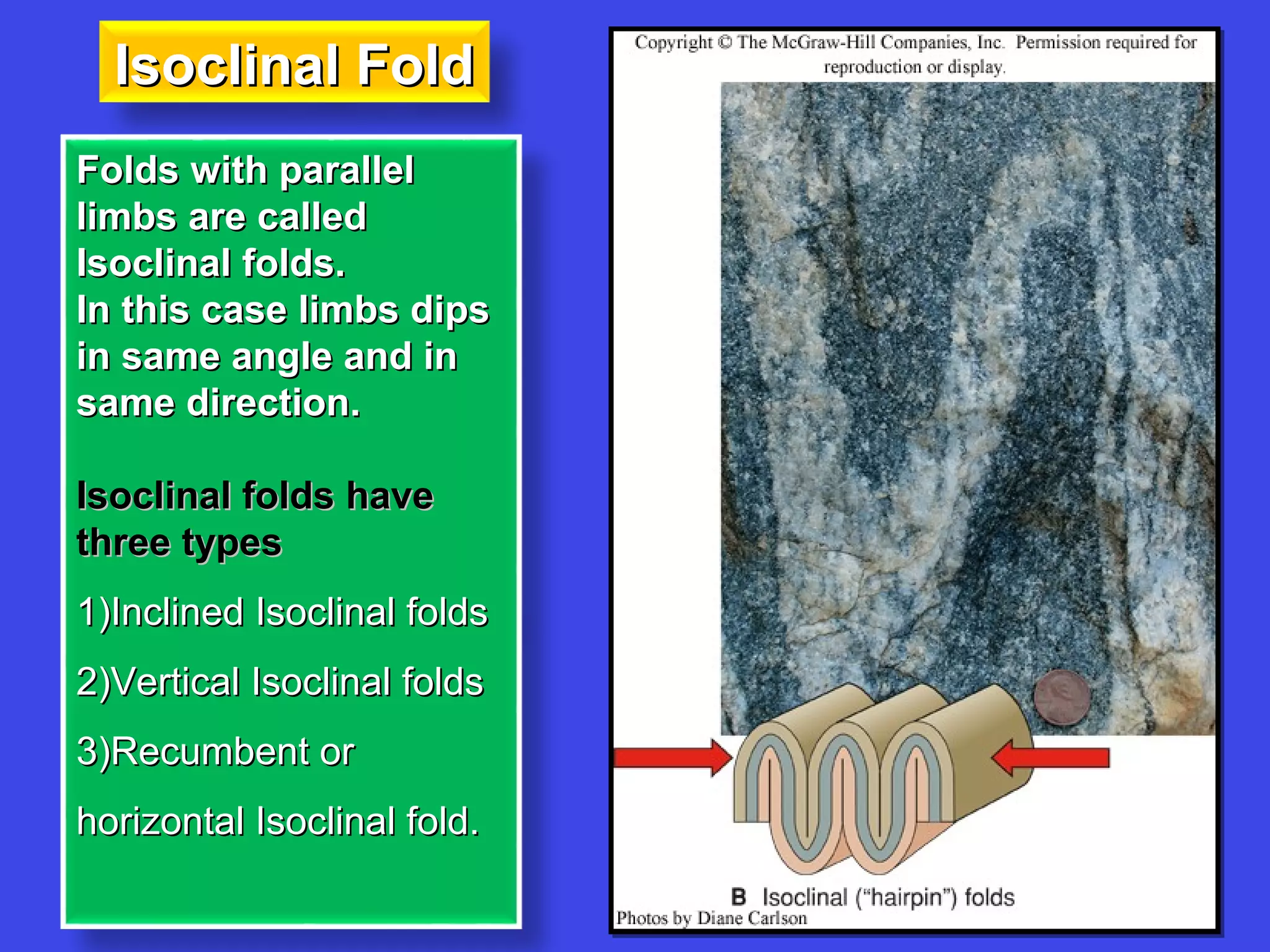
Isoclinal FoldIsoclinal Fold
Folds with parallelFolds with parallel
limbs are calledlimbs are called
Isoclinal folds.Isoclinal folds.
In this case limbs dipsIn this case limbs dips
in same angle and inin same angle and in
same direction.same direction.
Isoclinal folds haveIsoclinal folds have
three typesthree types
1)1)Inclined Isoclinal foldsInclined Isoclinal folds
2)2)Vertical Isoclinal foldsVertical Isoclinal folds
3)3)Recumbent orRecumbent or
horizontal Isoclinal fold.horizontal Isoclinal fold.
Some Special Type of FoldsSome Special Type of Folds
Anticlinorium and SynclinoriumAnticlinorium and Synclinorium
An anticlinorium is a large anticline running oftenAn anticlinorium is a large anticline running often
for several hundred kilometers in length andfor several hundred kilometers in length and
several kilometers in width which is furtherseveral kilometers in width which is further
thrown into smaller folds. Similarly a syclinoriumthrown into smaller folds. Similarly a syclinorium
is a large syncline further consisting of smalleris a large syncline further consisting of smaller
folds.folds.
Geanticline and GeosynclineGeanticline and Geosyncline
An anticline of excessively large dimensions isAn anticline of excessively large dimensions is
called a ‘geanticline’ and similar a syncline ofcalled a ‘geanticline’ and similar a syncline of
huge dimensions is known as a ‘geosyncline’huge dimensions is known as a ‘geosyncline’
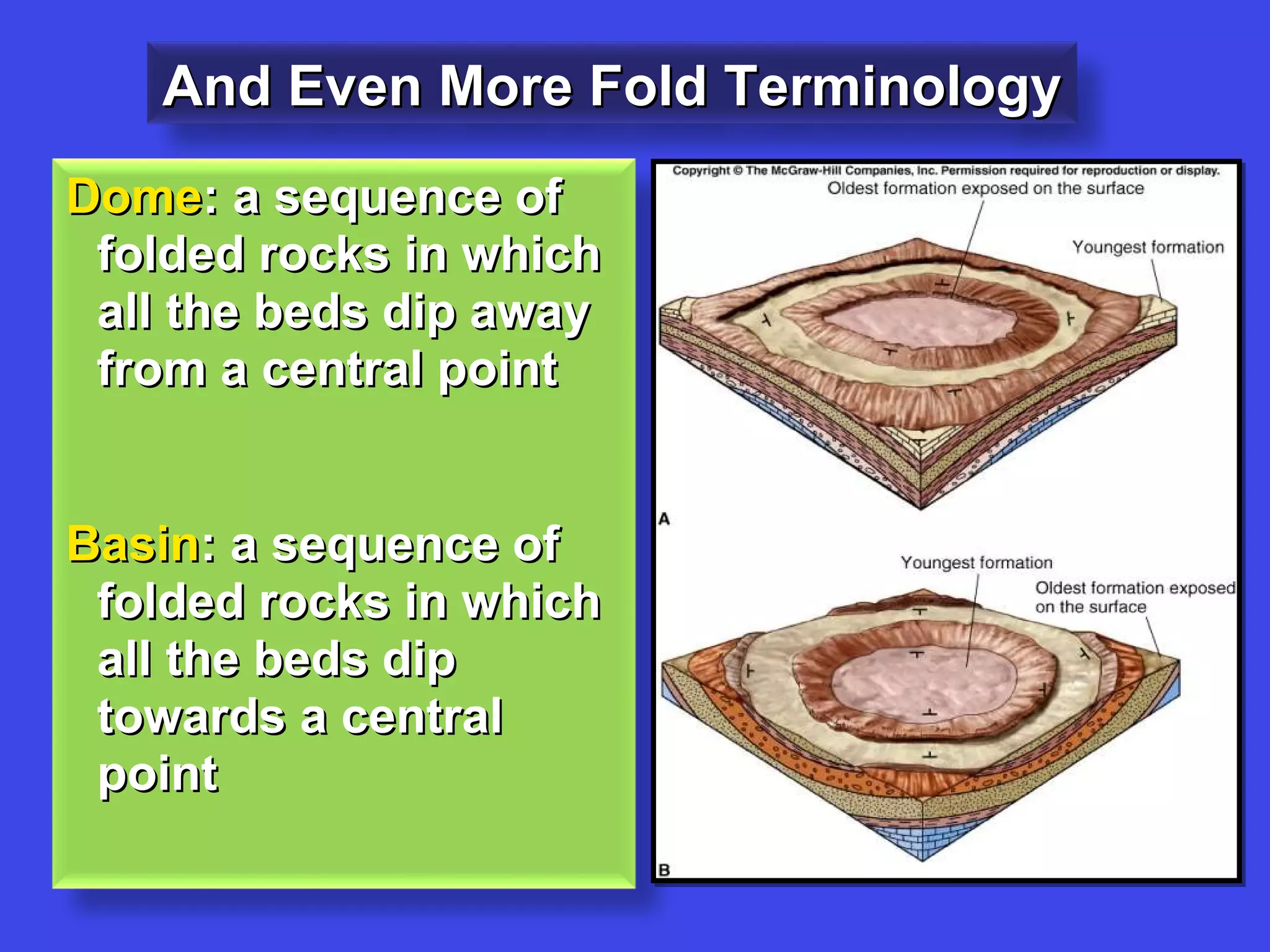
And Even More Fold TerminologyAnd Even More Fold Terminology
DomeDome: a sequence of: a sequence of
folded rocks in whichfolded rocks in which
all the beds dip awayall the beds dip away
from a central pointfrom a central point
BasinBasin: a sequence of: a sequence of
folded rocks in whichfolded rocks in which
all the beds dipall the beds dip
towards a centraltowards a central
pointpoint
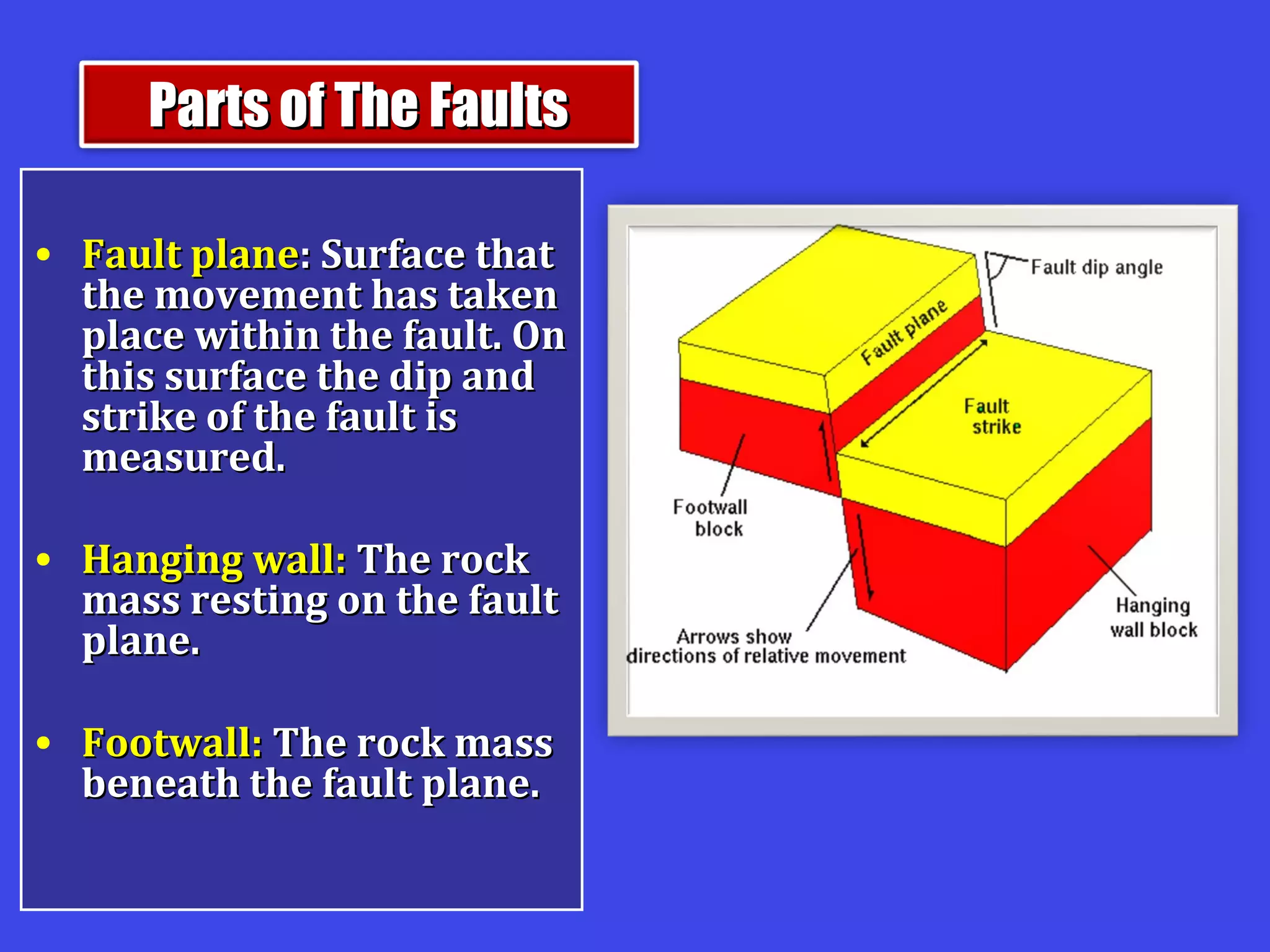
• Fault planeFault plane: Surface that: Surface that
the movement has takenthe movement has taken
place within the fault. Onplace within the fault. On
this surface the dip andthis surface the dip and
strike of the fault isstrike of the fault is
measured.measured.
• Hanging wall:Hanging wall: The rockThe rock
mass resting on the faultmass resting on the fault
plane.plane.
• Footwall:Footwall: The rock massThe rock mass
beneath the fault plane.beneath the fault plane.
Parts of The FaultsParts of The Faults
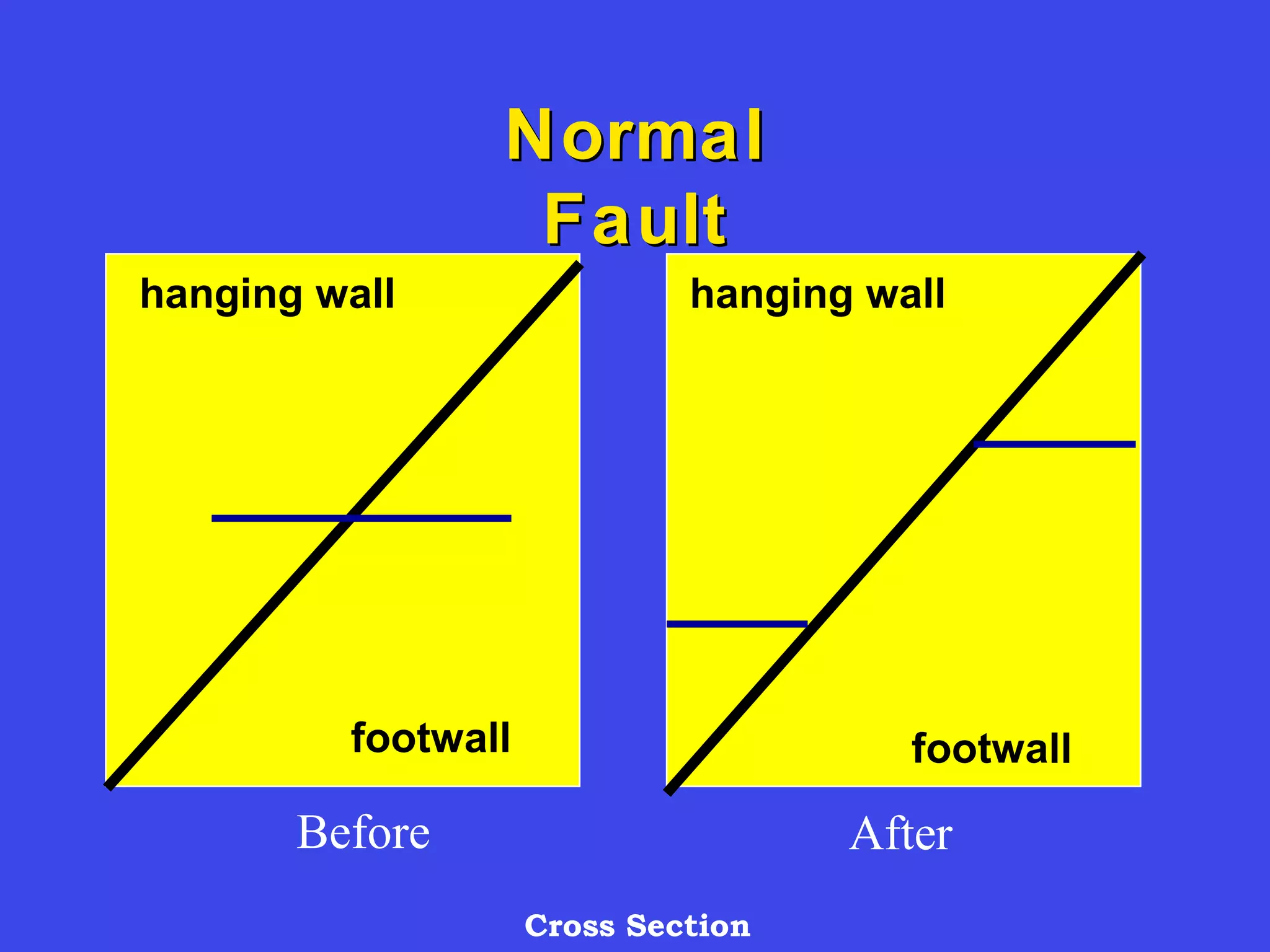
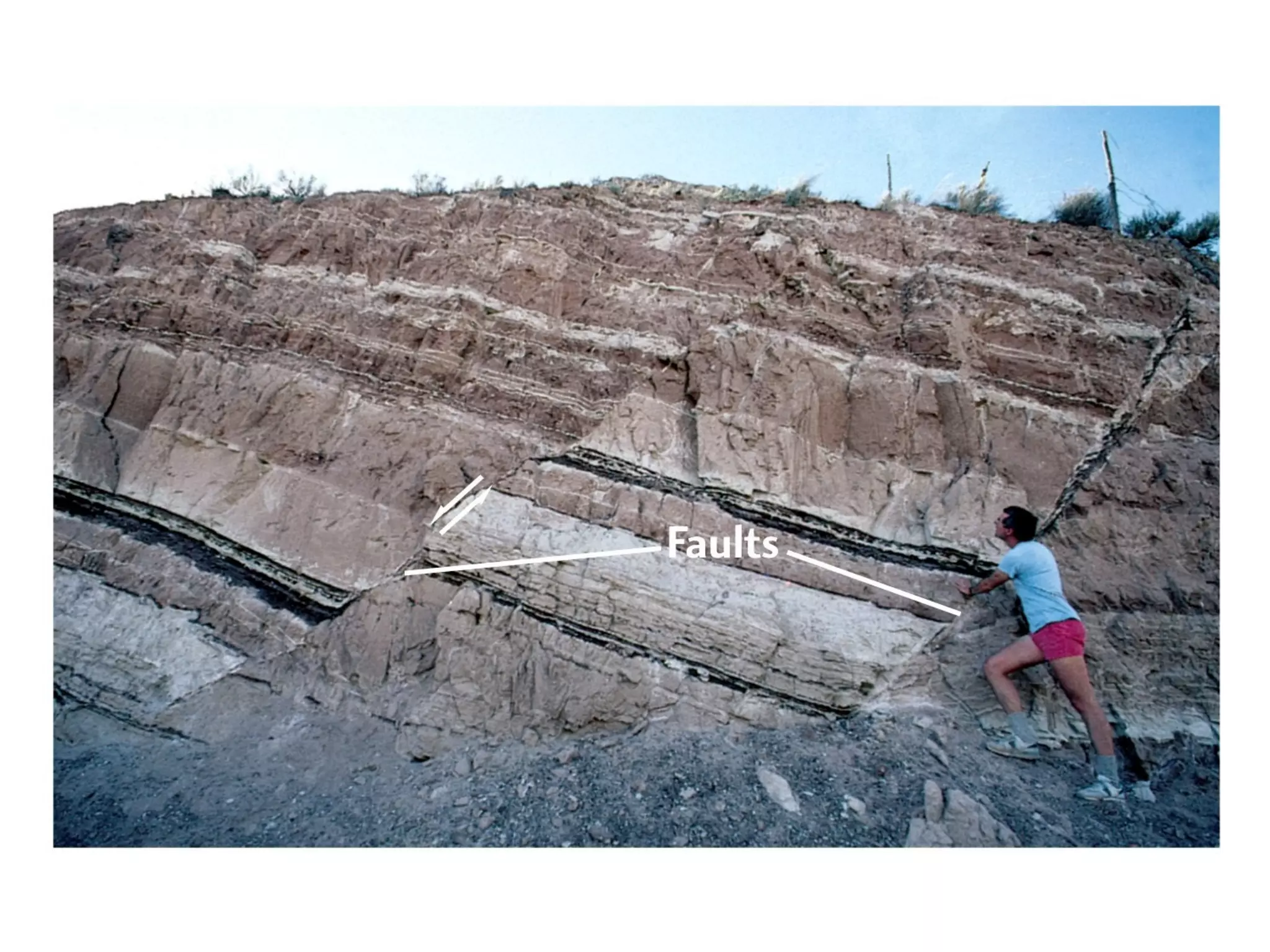
NormalNormal
FaultFault
footwall
hanging wall
Cross Section
hanging wall
footwall
Before After
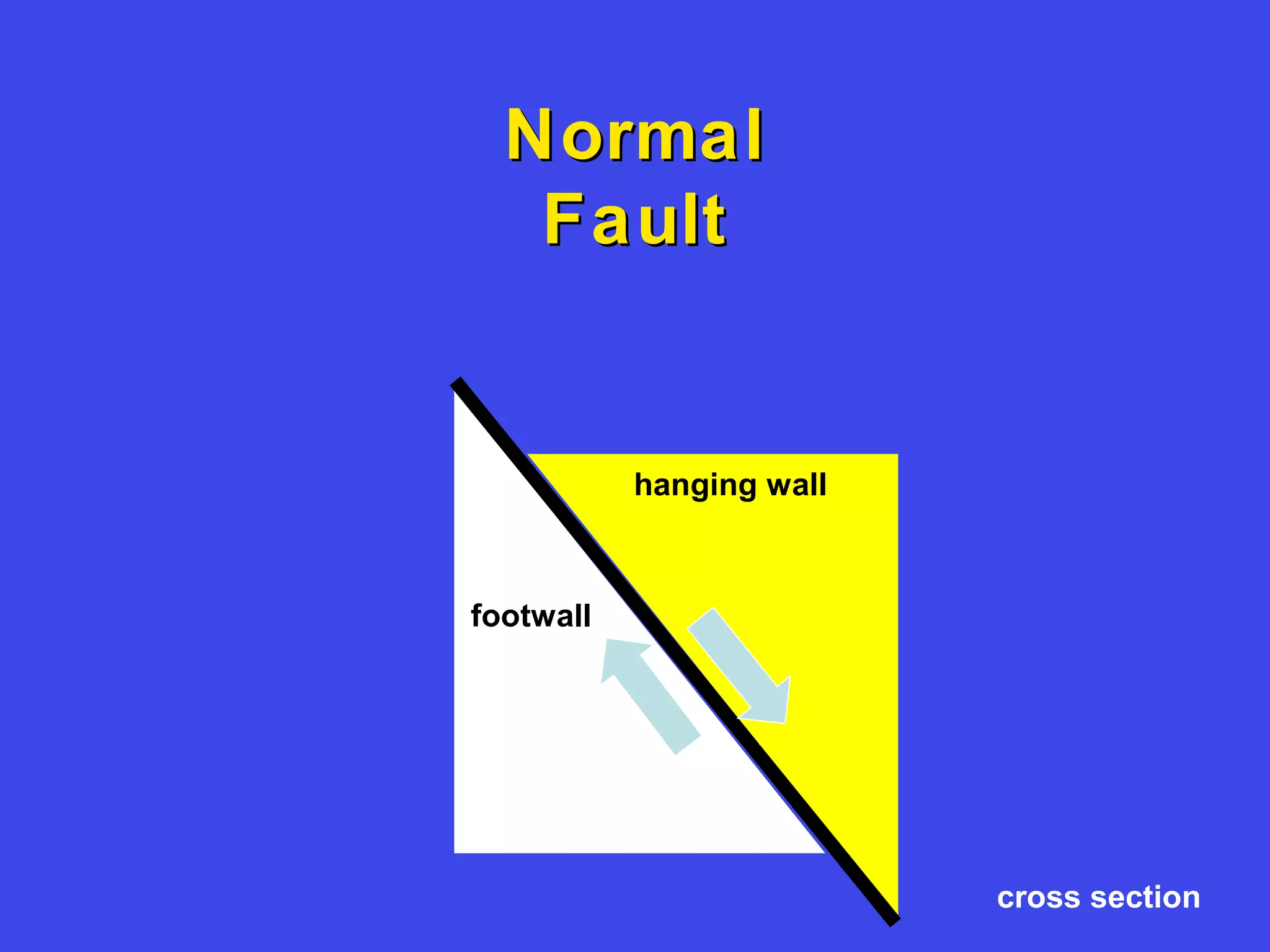
NormalNormal
FaultFault
hanging wall
footwall
cross section
Hangingwall
Foot wall
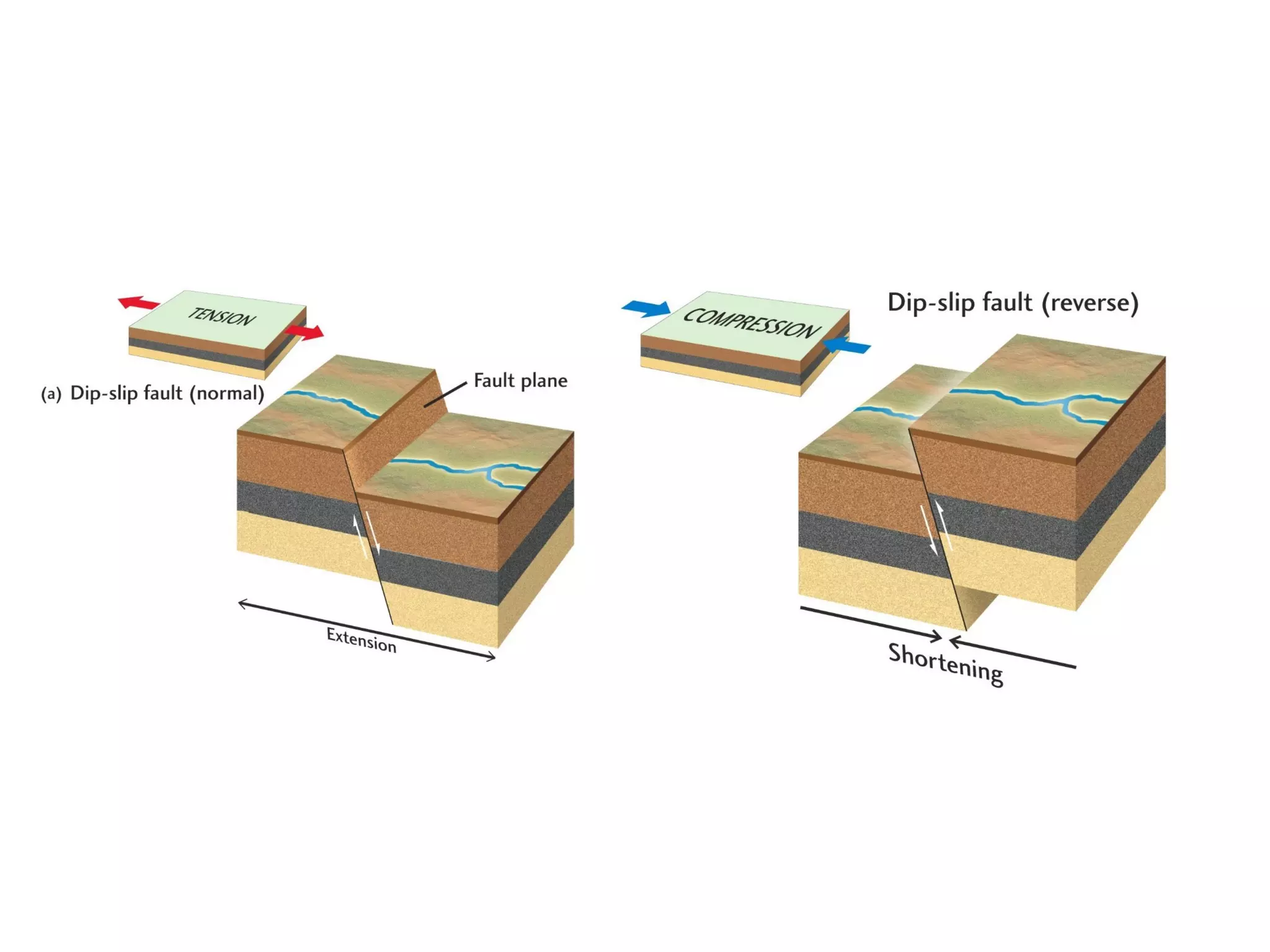
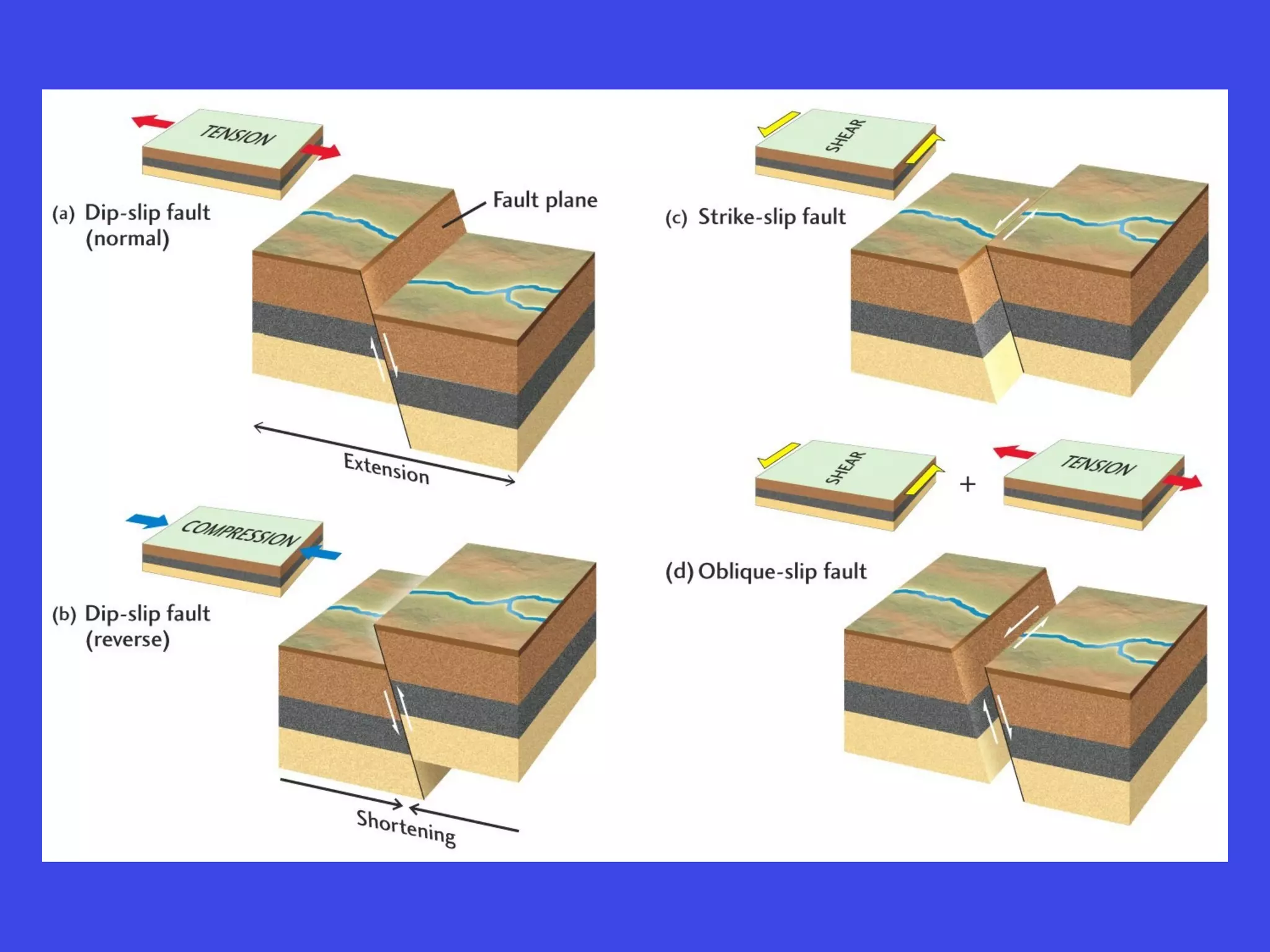
Dip-slipDip-slip
FaultsFaults
• Motion of the fault blocks is
parallel to the dip direction
• Two types:
Normal – movement is down
dip
Reverse – movement is up dip
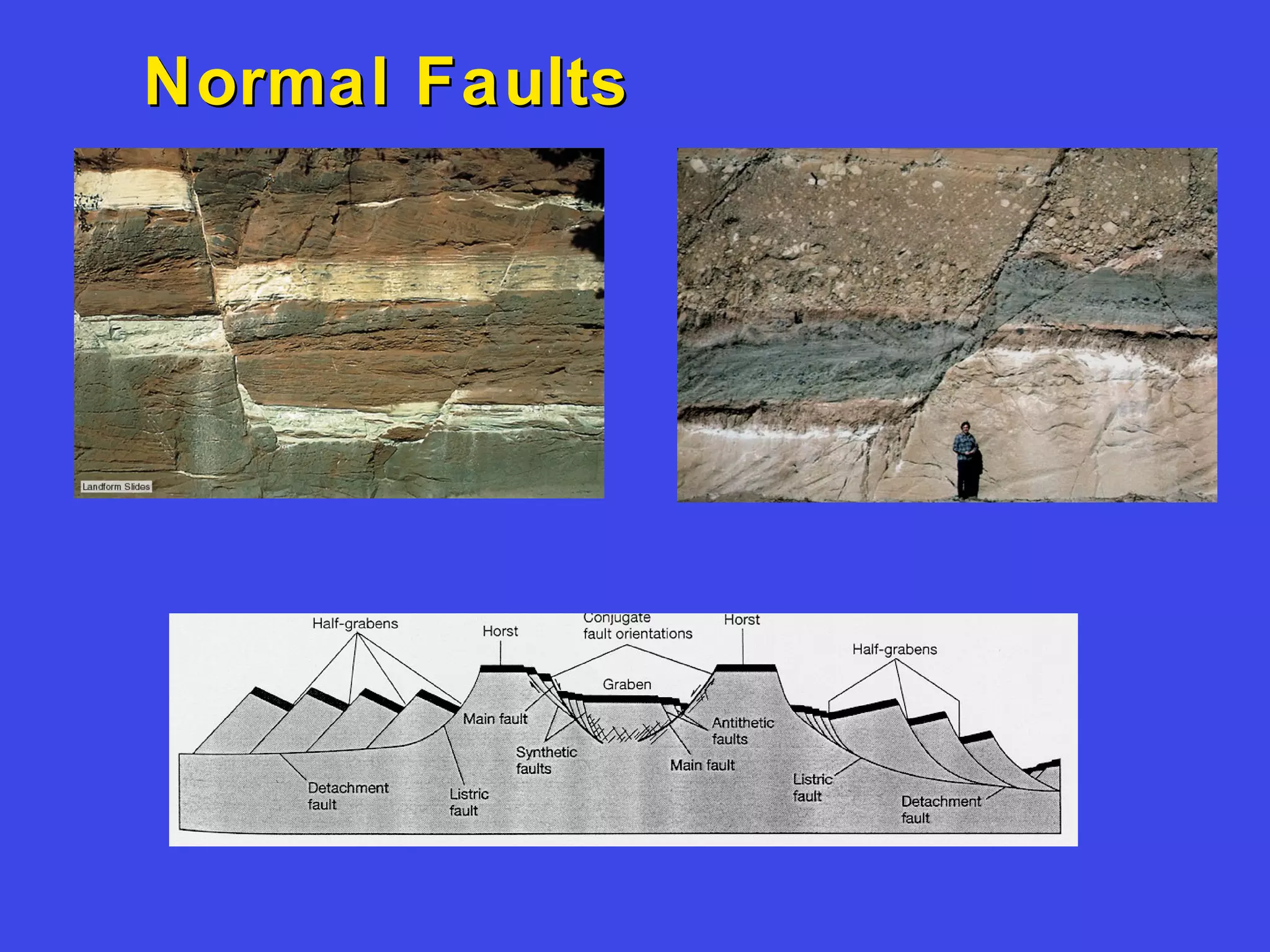
Types of FaultsTypes of Faults
Normal FaultsNormal Faults
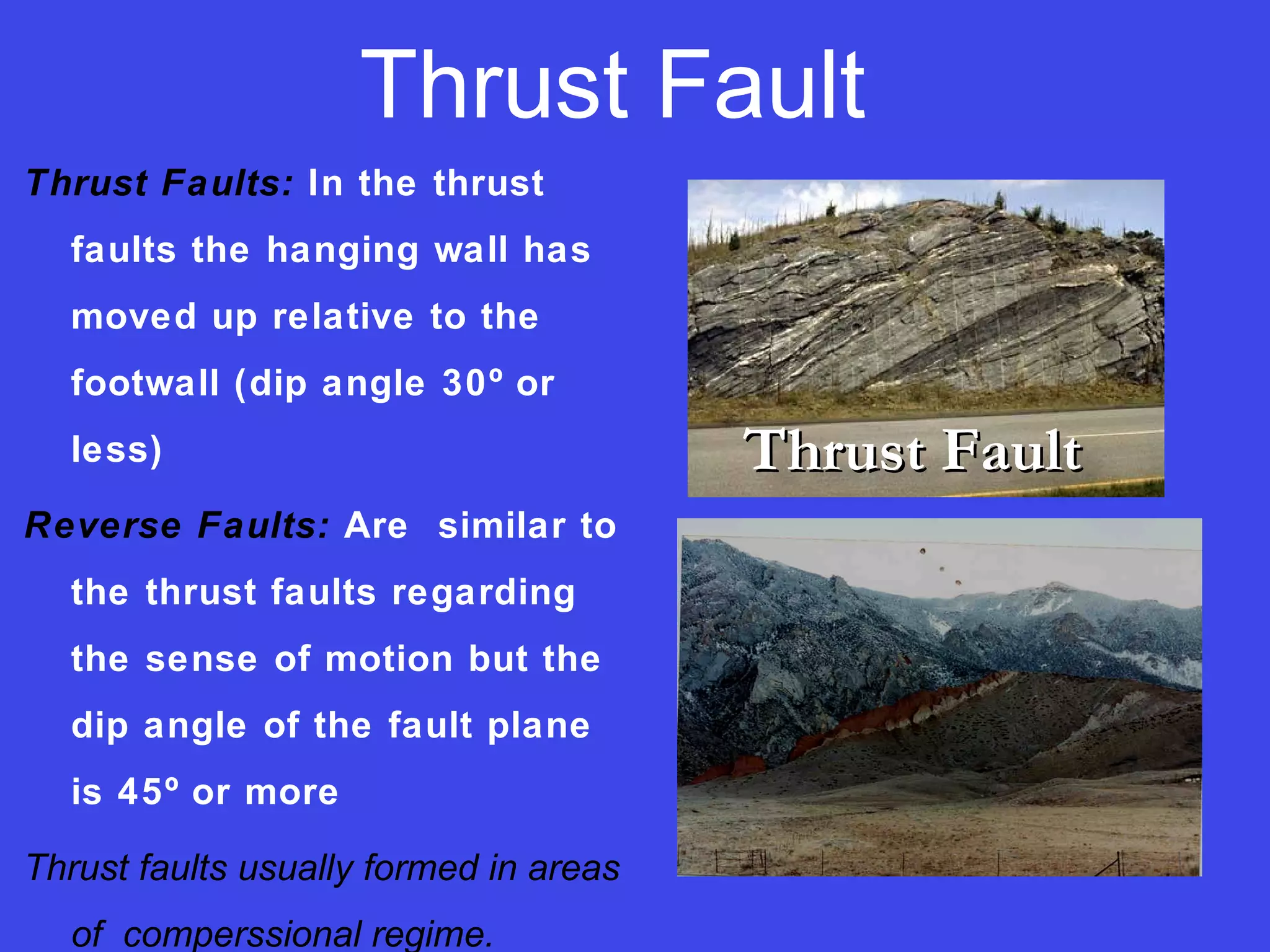
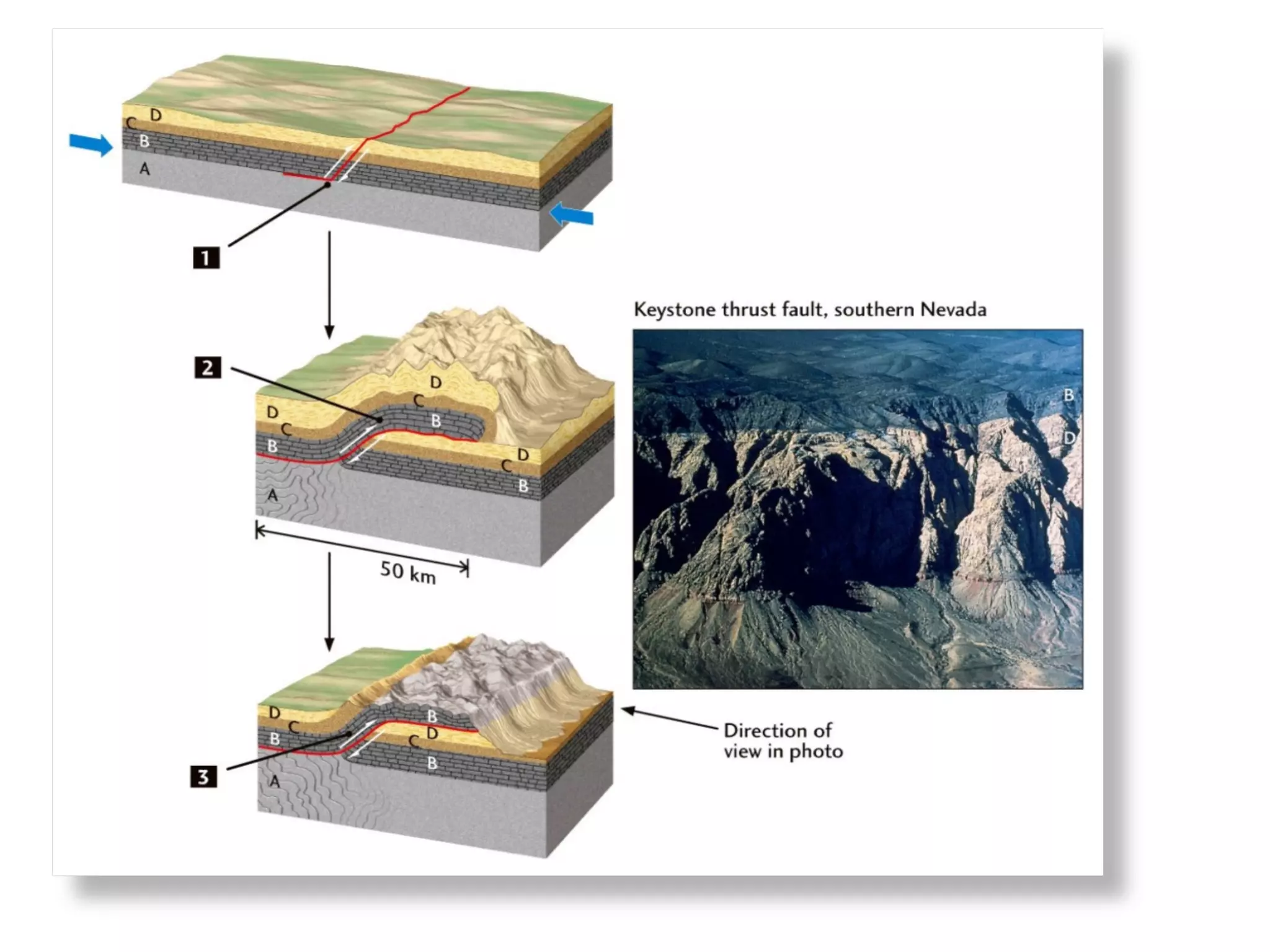
Thrust Fault
Thrust Faults: In the thrust
faults the hanging wall has
moved up relative to the
footwall (dip angle 30º or
less)
Reverse Faults: Are similar to
the thrust faults regarding
the sense of motion but the
dip angle of the fault plane
is 45º or more
Thrust faults usually formed in areas
of comperssional regime.
Thrust FaultThrust Fault
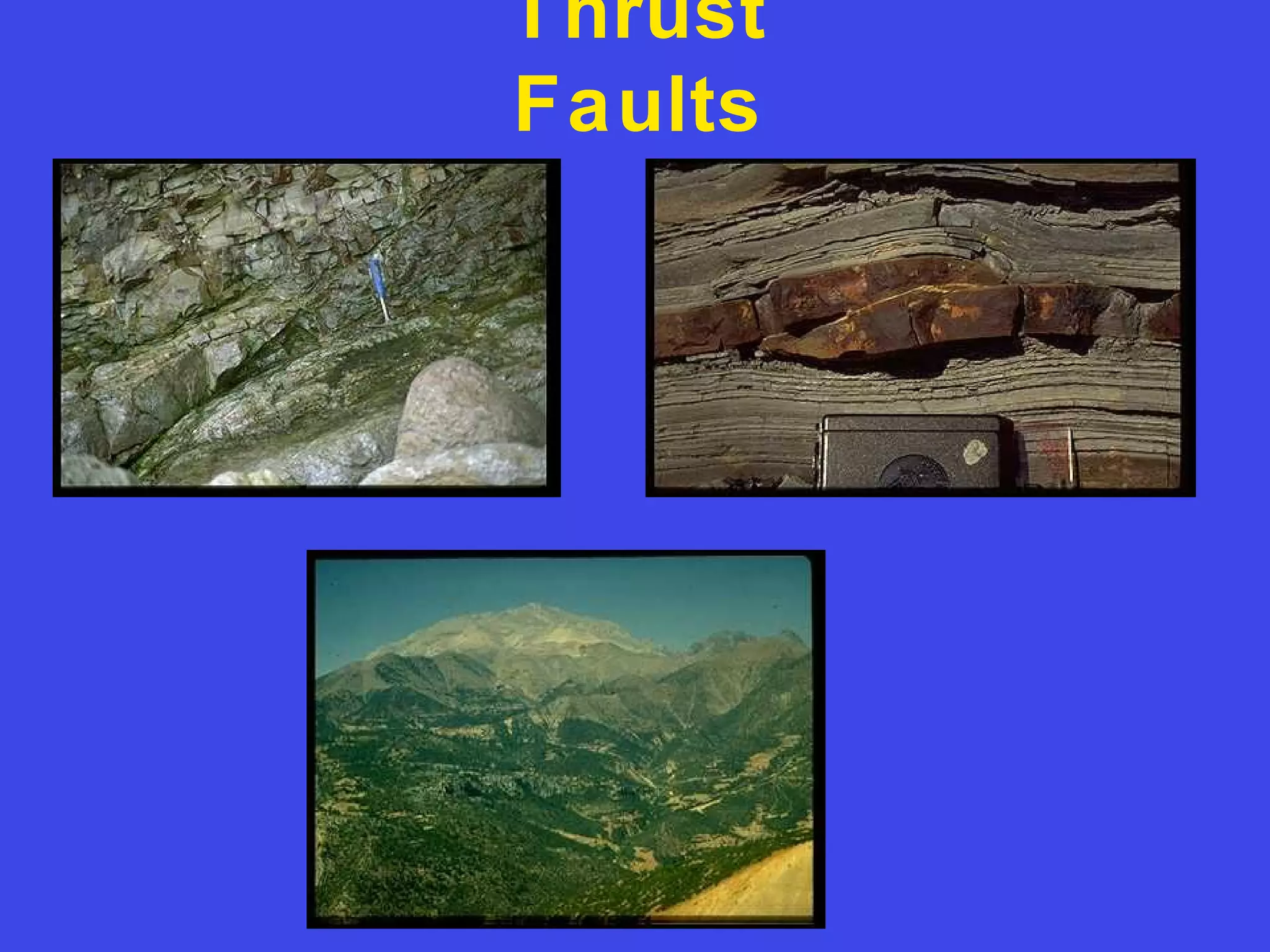
Thrust
Faults
Strike-slipStrike-slip
FaultsFaults
Motion of the fault blocks is
parallel to the strike
direction
There are 2 types
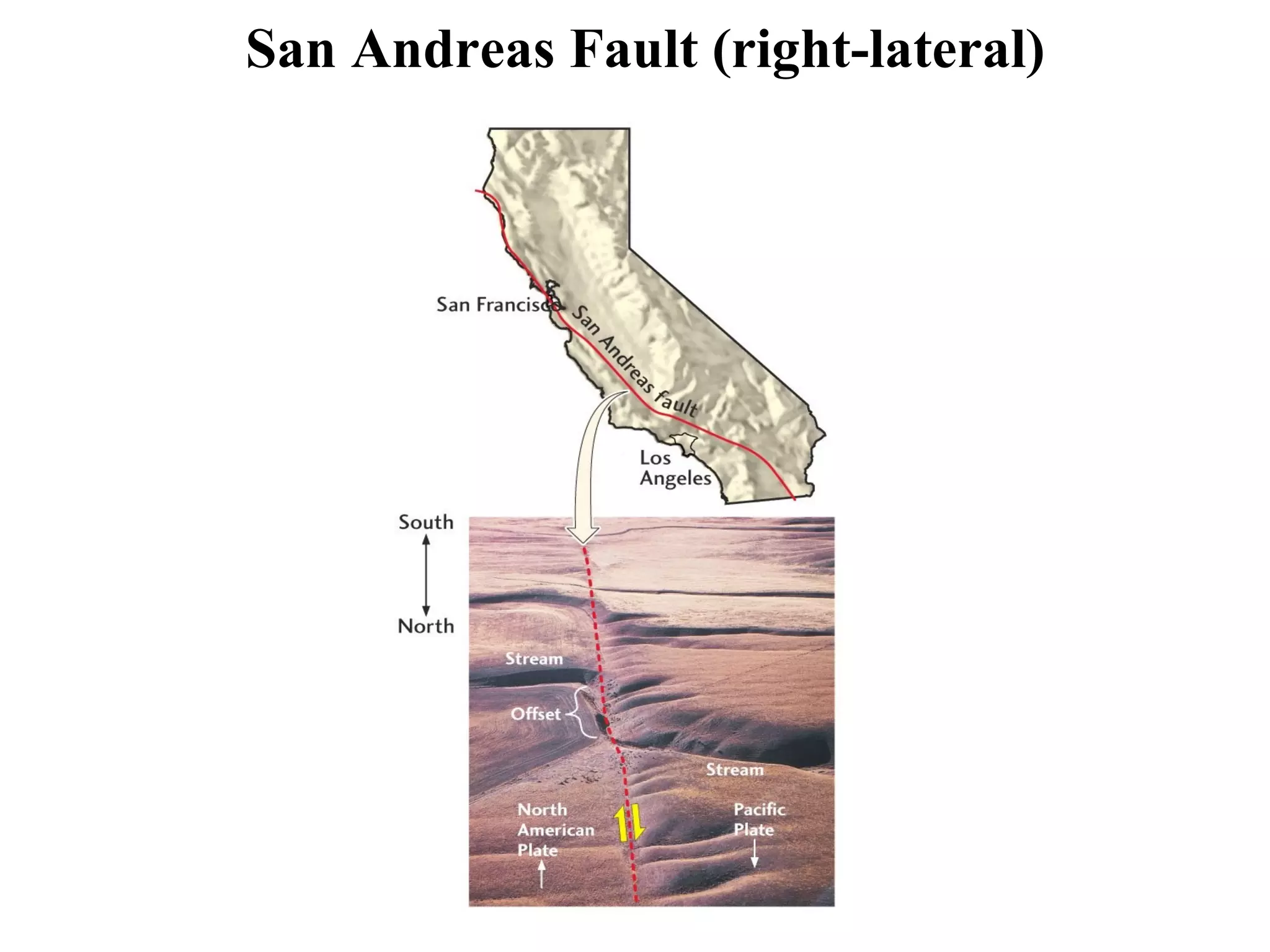
Right-lateral
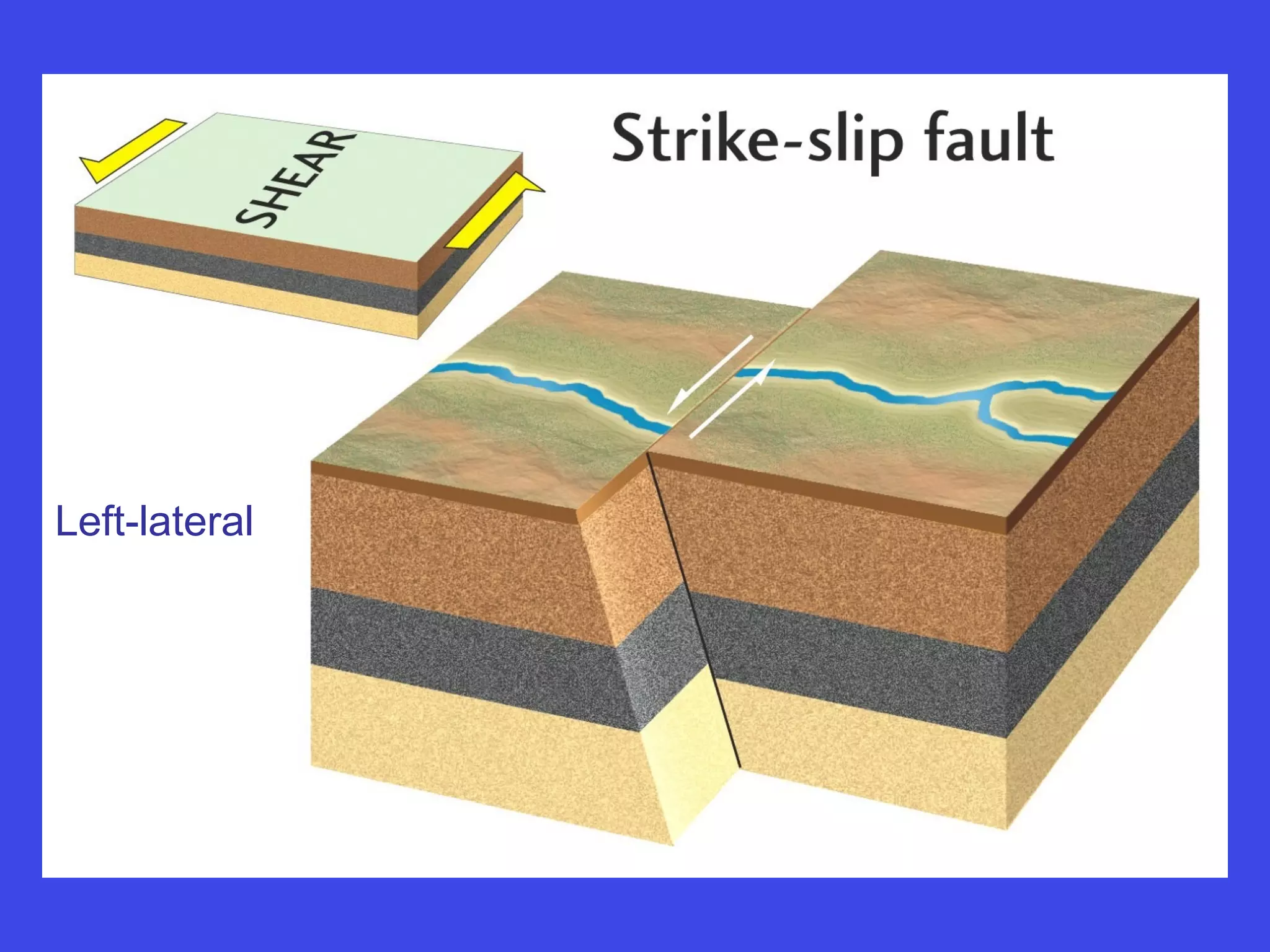
Left-lateral
Strike-Slip Fault
Strike-slip Faults: Are faults that
have movement along strikes.
There are two types of strike slip
faults:
A] Right lateral strike-slip fault
(dextral): Where the side opposite
the observer moves to the right.
B] Left lateral strike-slip fault
(sinistral): Where the side opposite
the observer moves to the left.
Note that the same sense of movement
will also be observed from the other
side of the fault.
Strike-Slip Faults
Left-lateral
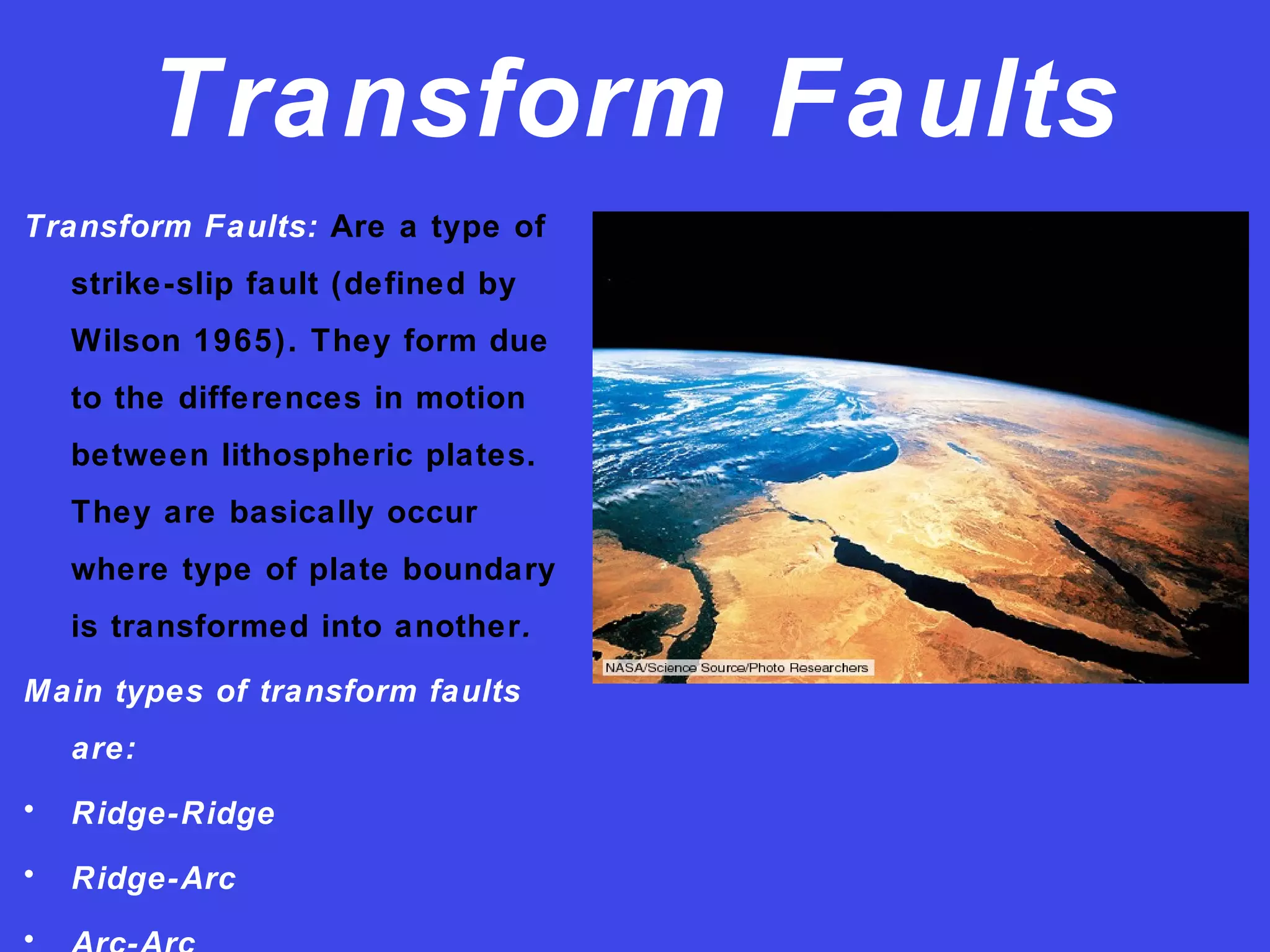
Transform Faults
Transform Faults: Are a type of
strike-slip fault (defined by
Wilson 1965). They form due
to the differences in motion
between lithospheric plates.
They are basically occur
where type of plate boundary
is transformed into another.
Main types of transform faults
are:
• Ridge-Ridge
• Ridge-Arc
•
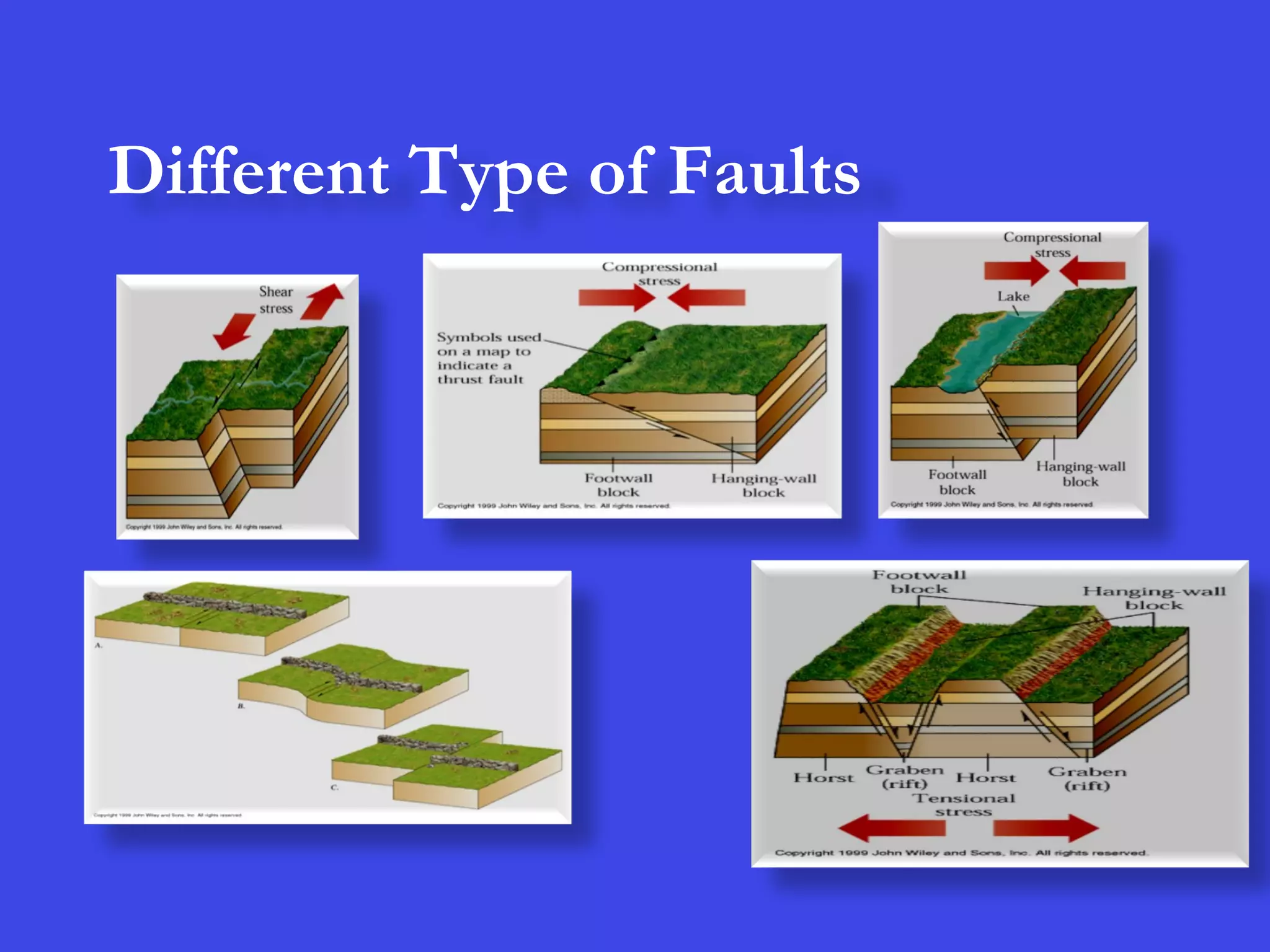
Types of Faults
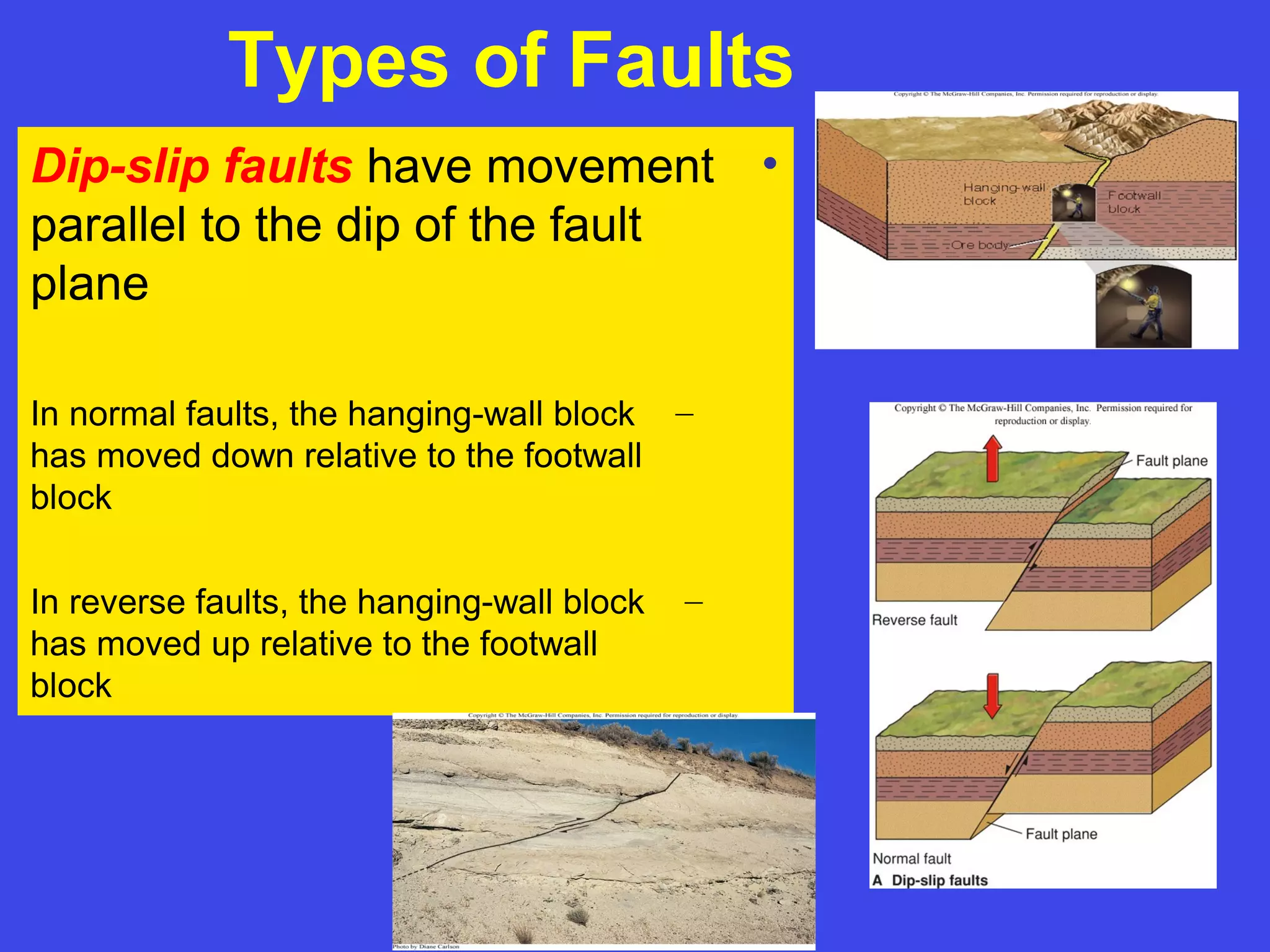
•Dip-slip faults have movement
parallel to the dip of the fault
plane
–In normal faults, the hanging-wall block
has moved down relative to the footwall
block
–In reverse faults, the hanging-wall block
has moved up relative to the footwall
block
Types of Faults
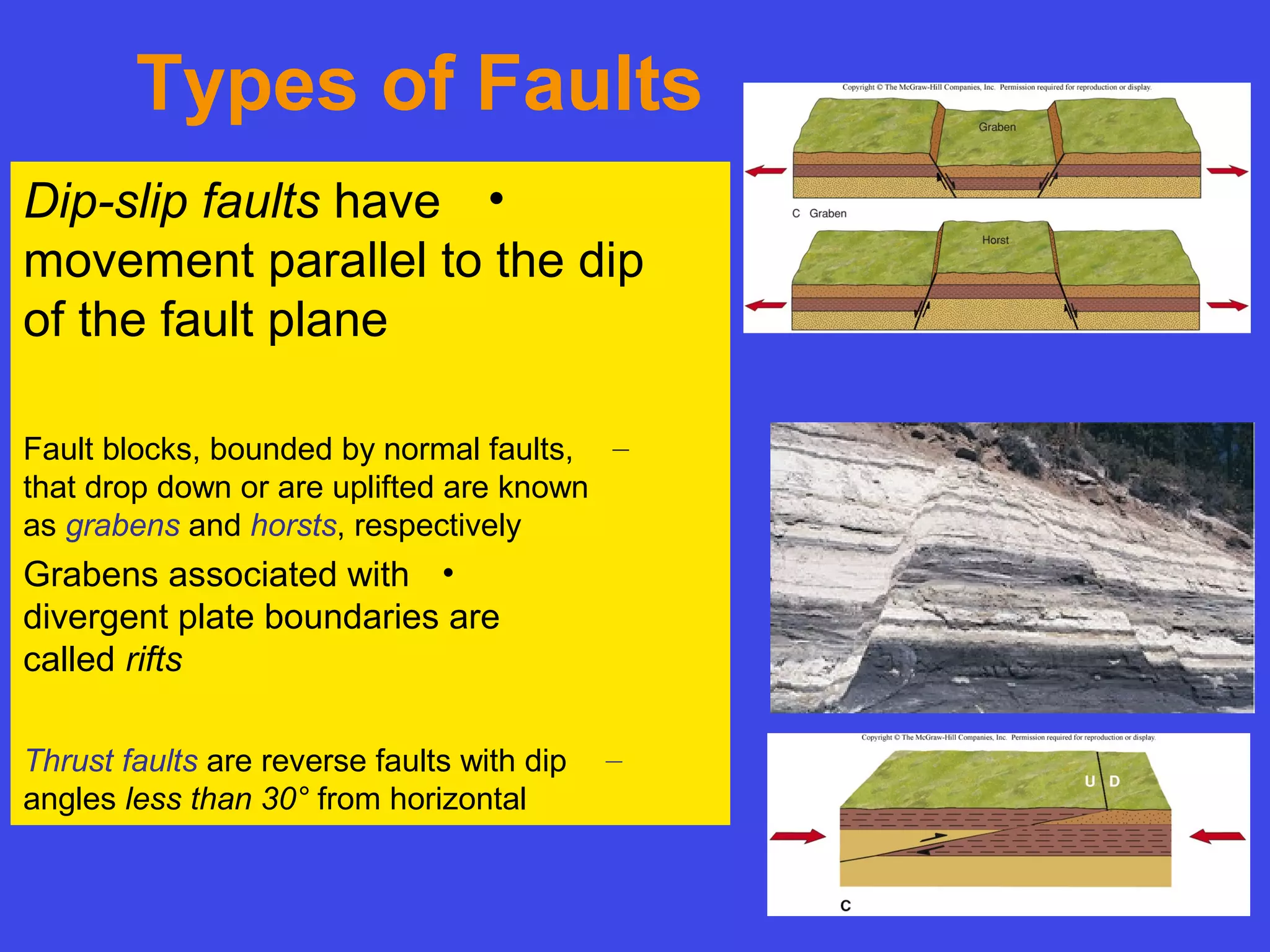
•Dip-slip faults have
movement parallel to the dip
of the fault plane
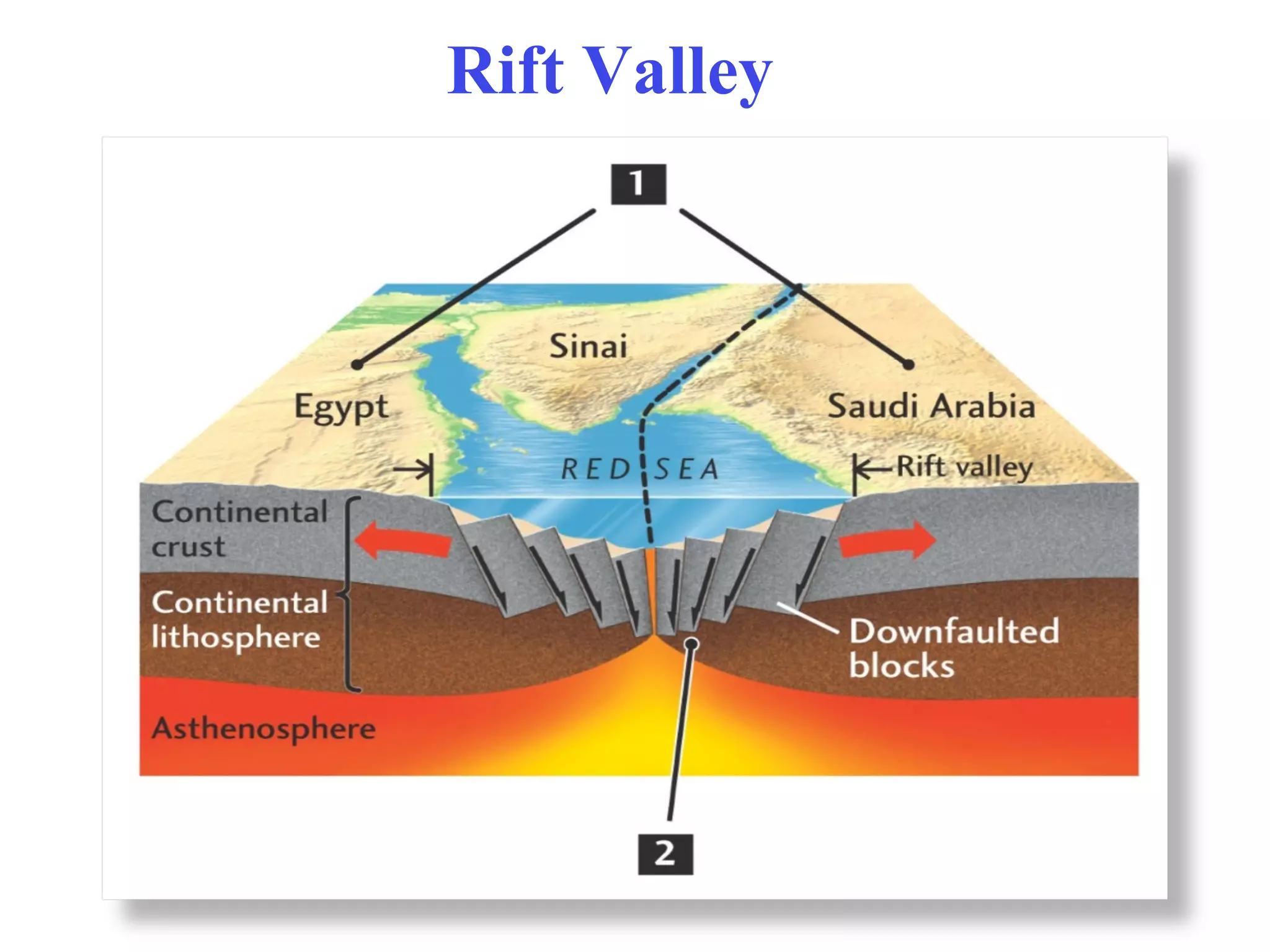
–Fault blocks, bounded by normal faults,
that drop down or are uplifted are known
as grabens and horsts, respectively
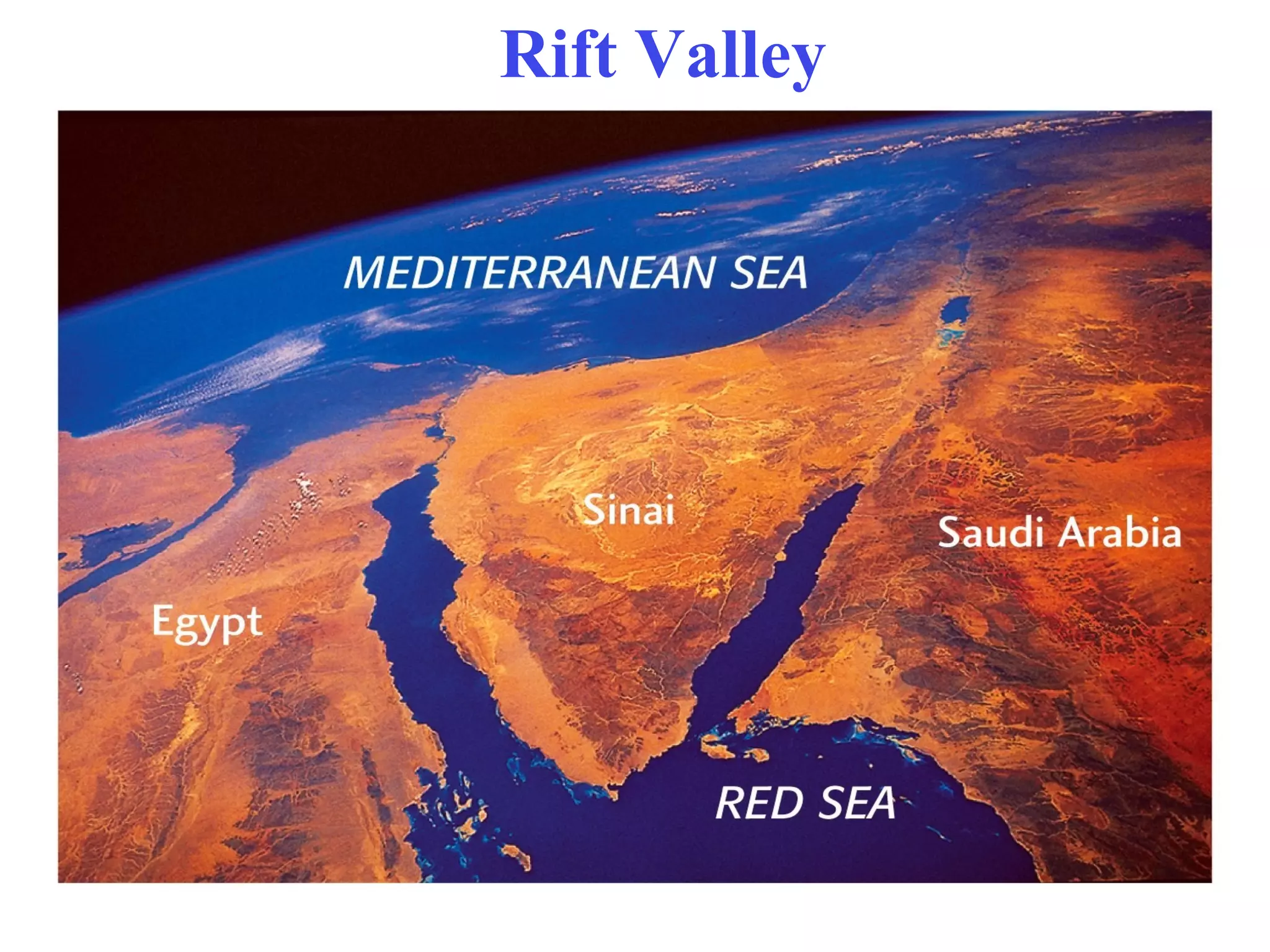
•Grabens associated with
divergent plate boundaries are
called rifts
–Thrust faults are reverse faults with dip
angles less than 30° from horizontal
Types of Faults
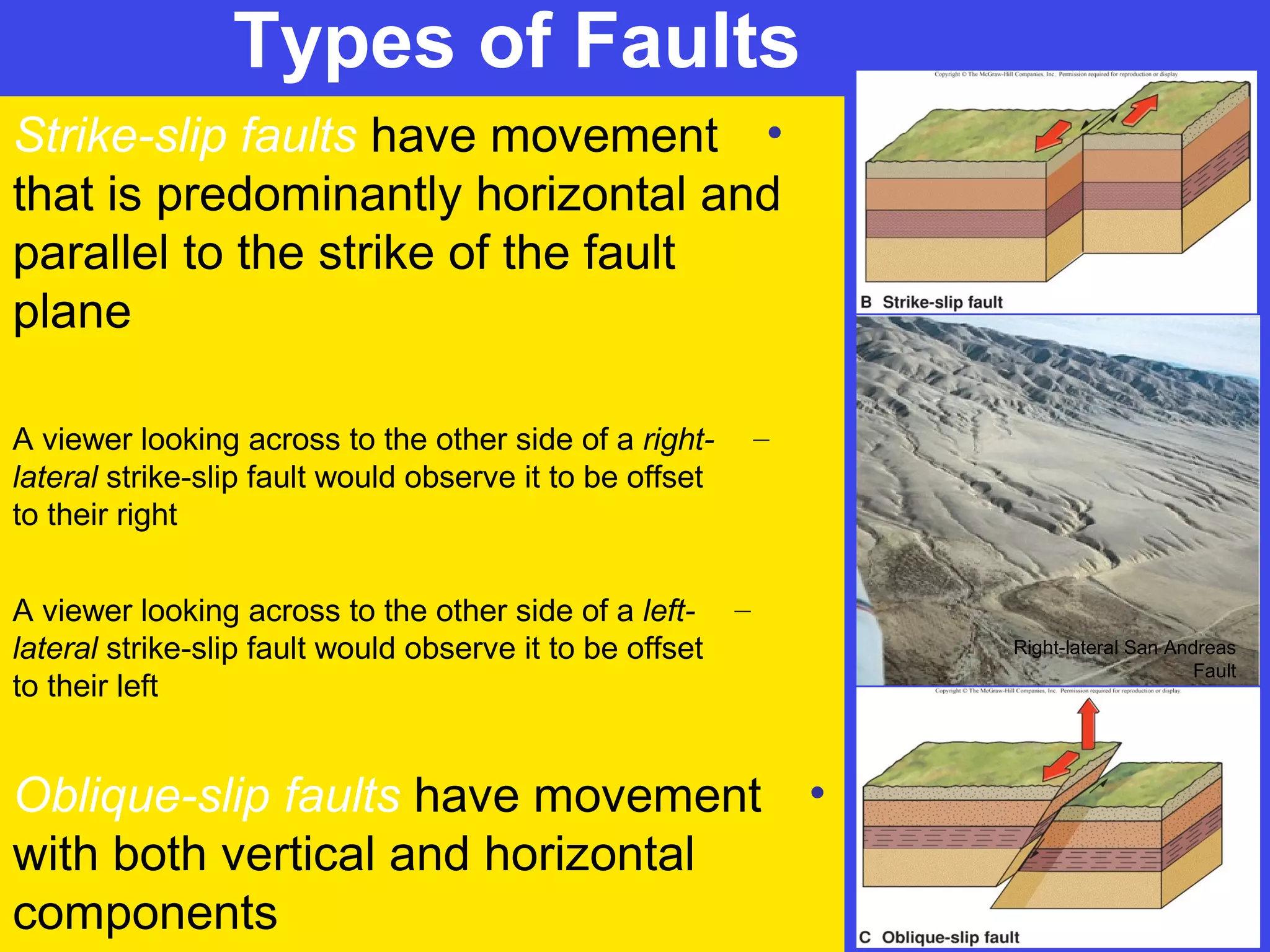
•Strike-slip faults have movement
that is predominantly horizontal and
parallel to the strike of the fault
plane
–A viewer looking across to the other side of a right-
lateral strike-slip fault would observe it to be offset
to their right
–A viewer looking across to the other side of a left-
lateral strike-slip fault would observe it to be offset
to their left
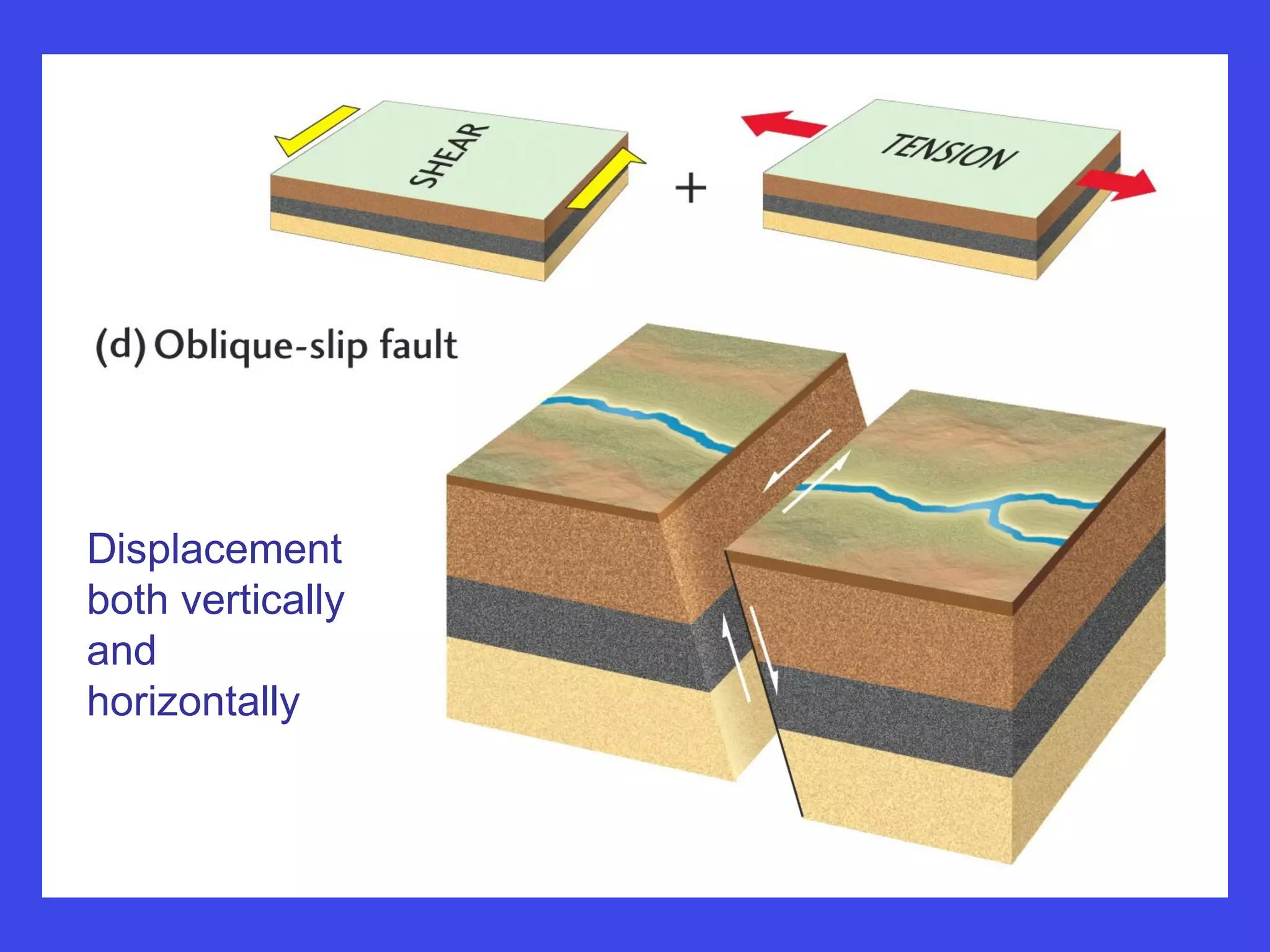
•Oblique-slip faults have movement
with both vertical and horizontal
components
Right-lateral San Andreas
Fault
Displacement
both vertically
and
horizontally
Different Type of Faults
Rift Valley
Rift Valley
San Andreas Fault (right-lateral)
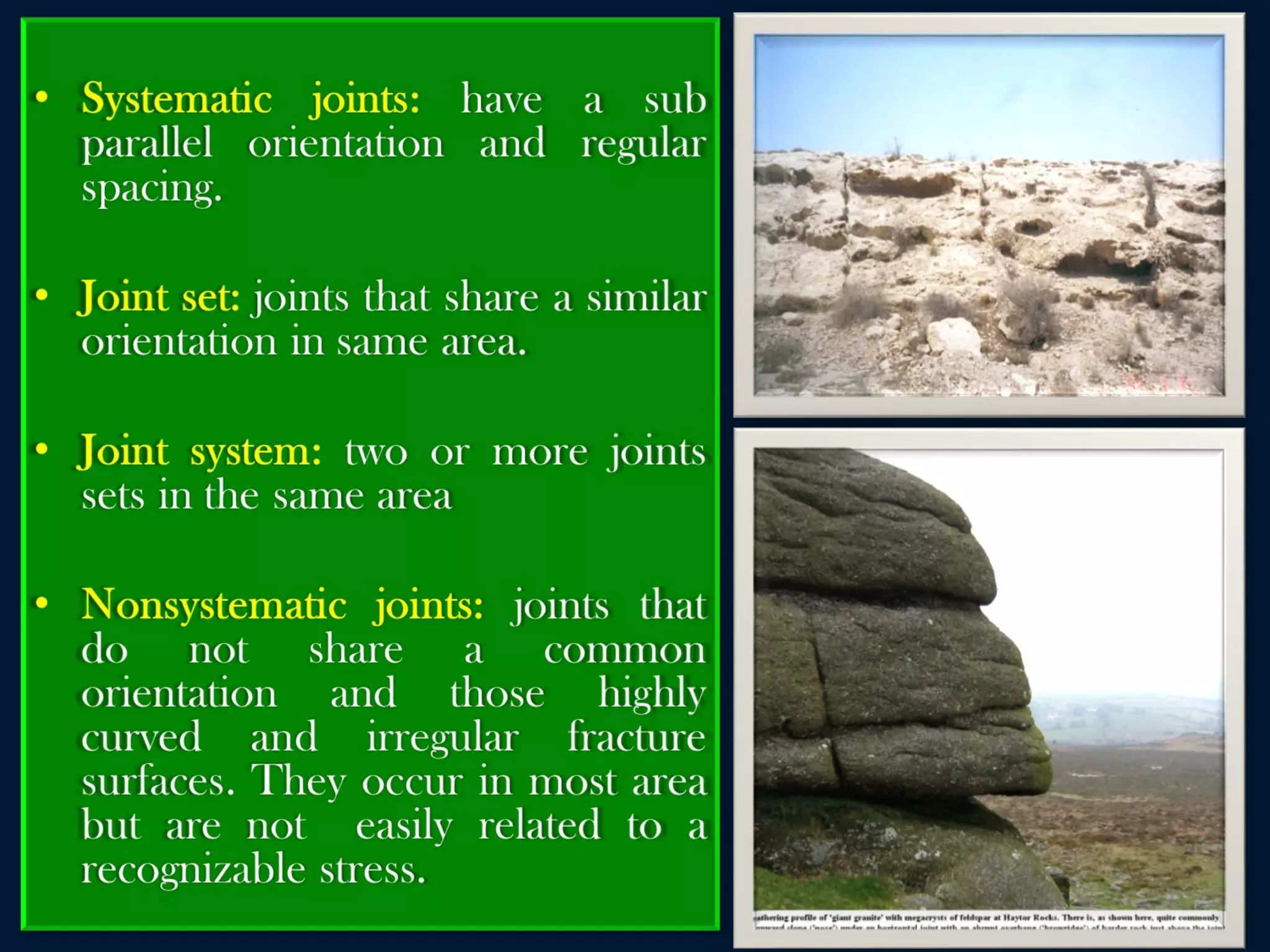
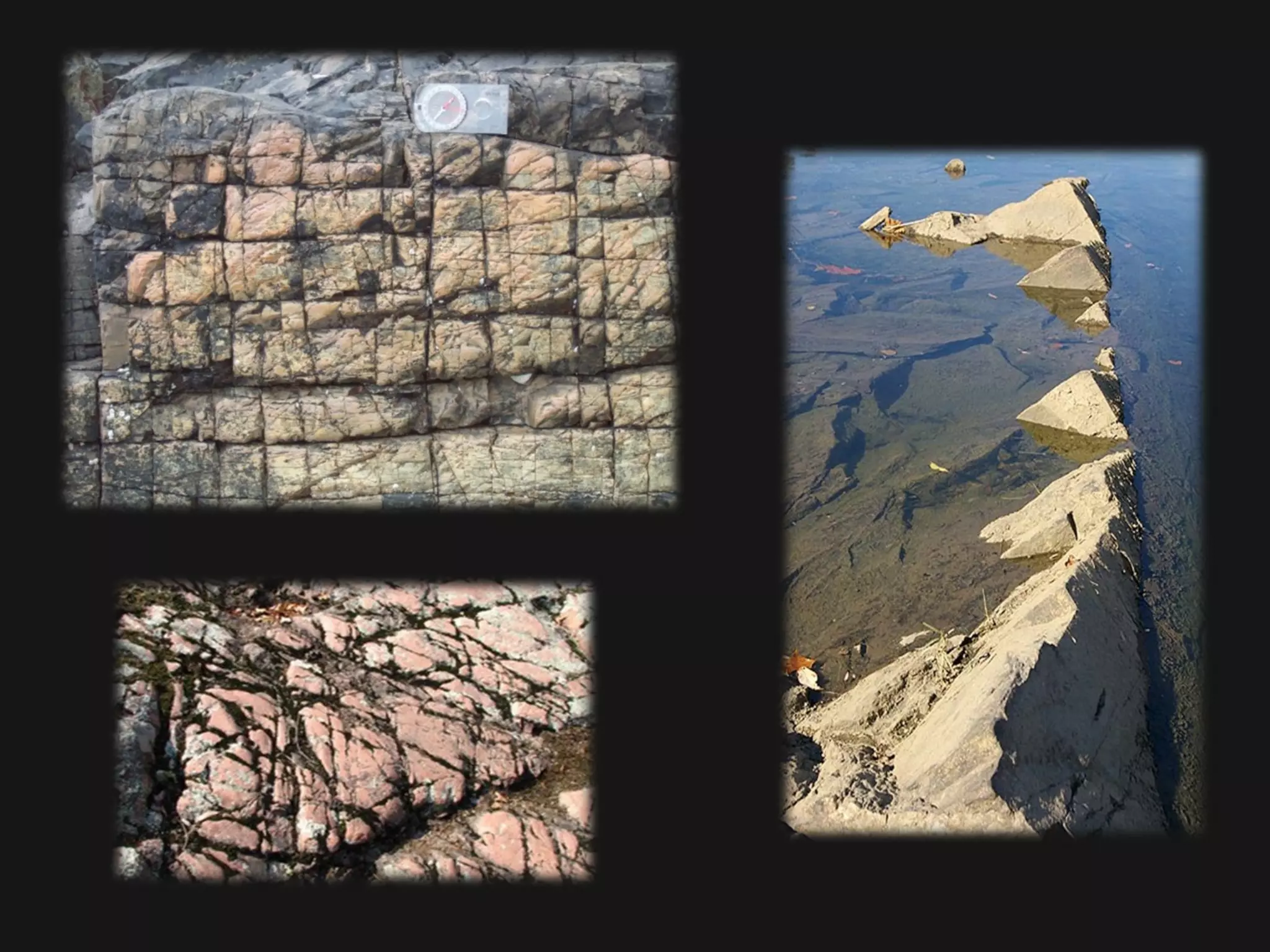
Joints
Definition:Definition:
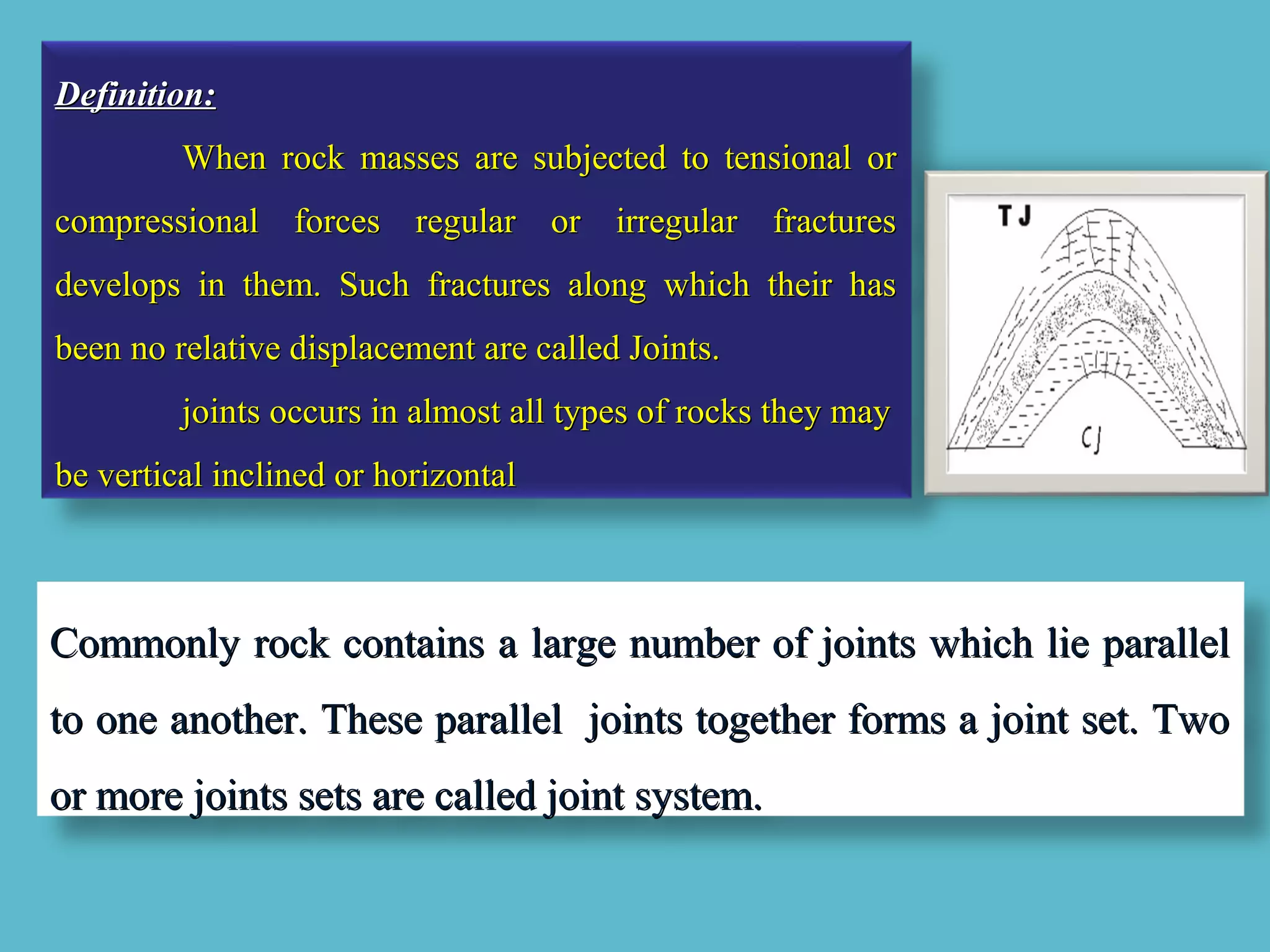
When rock masses are subjected to tensional orWhen rock masses are subjected to tensional or
compressional forces regular or irregular fracturescompressional forces regular or irregular fractures
develops in them. Such fractures along which their hasdevelops in them. Such fractures along which their has
been no relative displacement are called Joints.been no relative displacement are called Joints.
joints occurs in almost all types of rocks they mayjoints occurs in almost all types of rocks they may
be vertical inclined or horizontalbe vertical inclined or horizontal
Commonly rock contains a large number of joints which lie parallelCommonly rock contains a large number of joints which lie parallel
to one another. These parallel joints together forms a joint set. Twoto one another. These parallel joints together forms a joint set. Two
or more joints sets are called joint system.or more joints sets are called joint system.
Classification of JointsClassification of Joints
•Tension Joints: Tension joints are those which are formed as a result of
tensional forces. These joints are relatively open and have rough and irregular
surface.
•Shear Joints: Shear joints are those which are formed due to compressional
forces involved in the folding and faulting of rocks. This type of joints are clean and
tightly closed
Classification of joints :
1)Strike joints- The joints are parallel to strike of the country rocks
2)Dip joints- The joints are parallel to direction of dip of country rocks
3)Oblique joints - Runs oblique to strike and Dip directions of country rocks.
Common Type of jointsCommon Type of joints
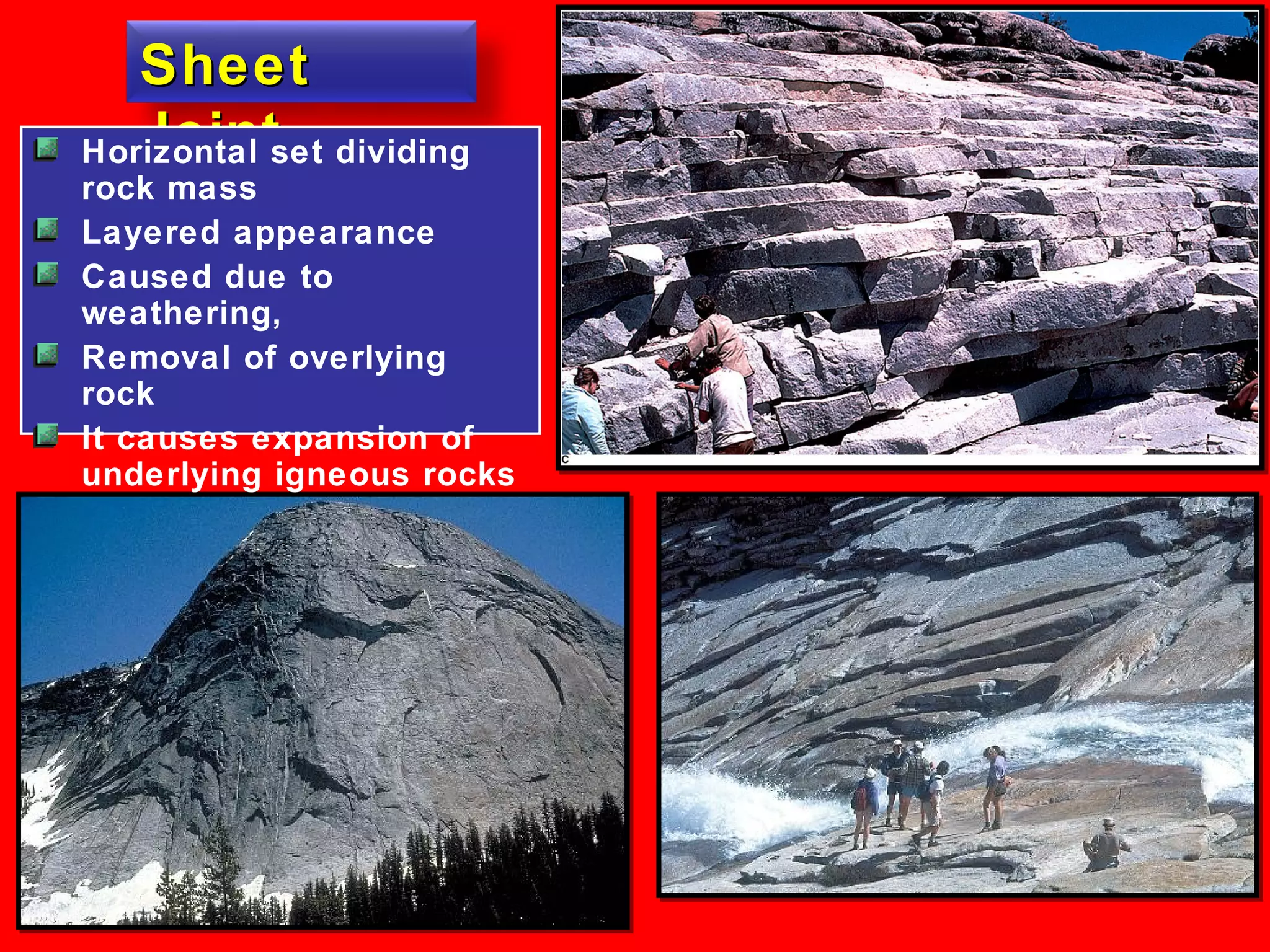
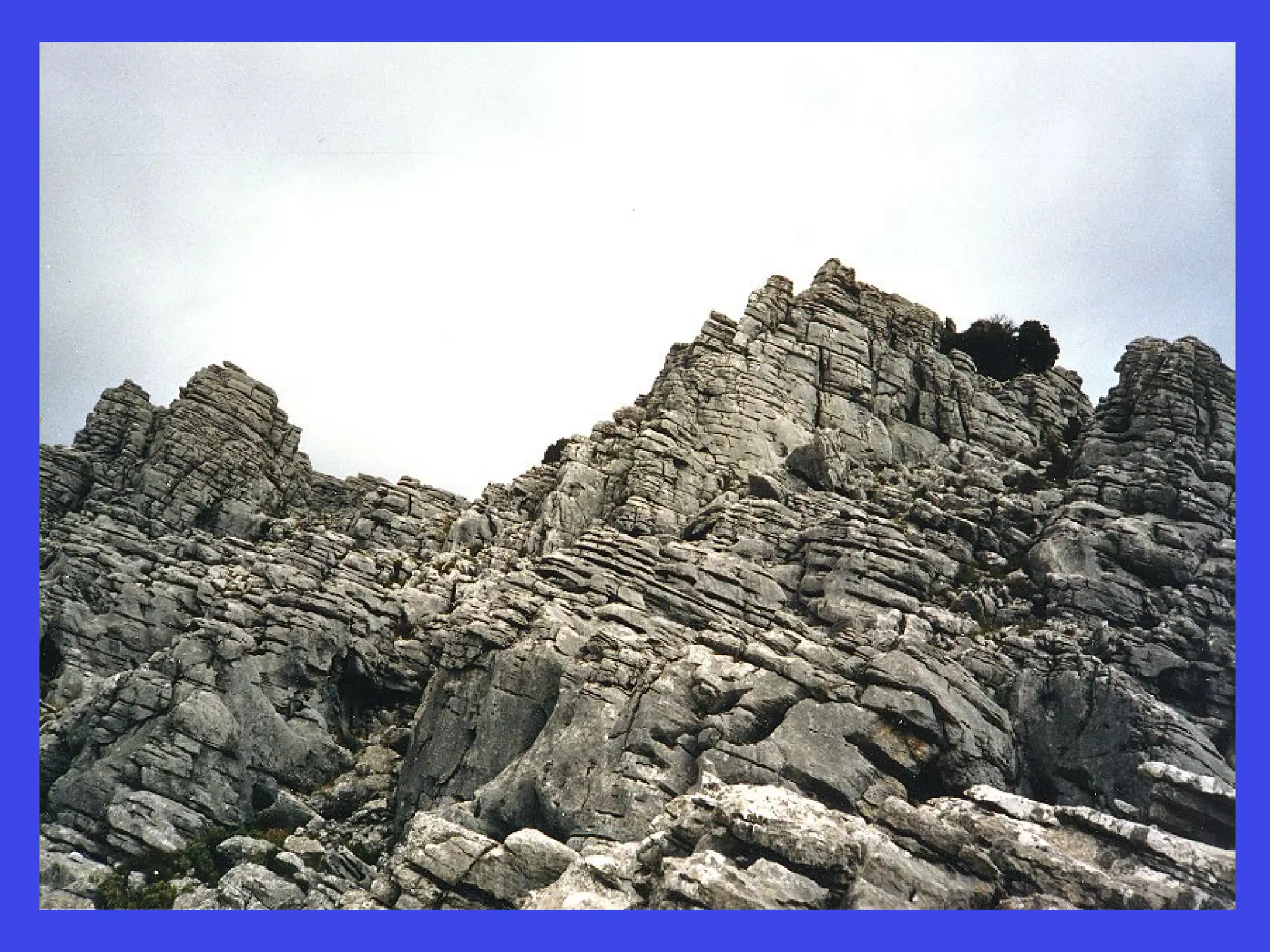
SheetSheet
JointJointHorizontal set dividing
rock mass
Layered appearance
Caused due to
weathering,
Removal of overlying
rock
It causes expansion of
underlying igneous rocks
Dr. N. J. Sathe, SCOE, Pune. 78
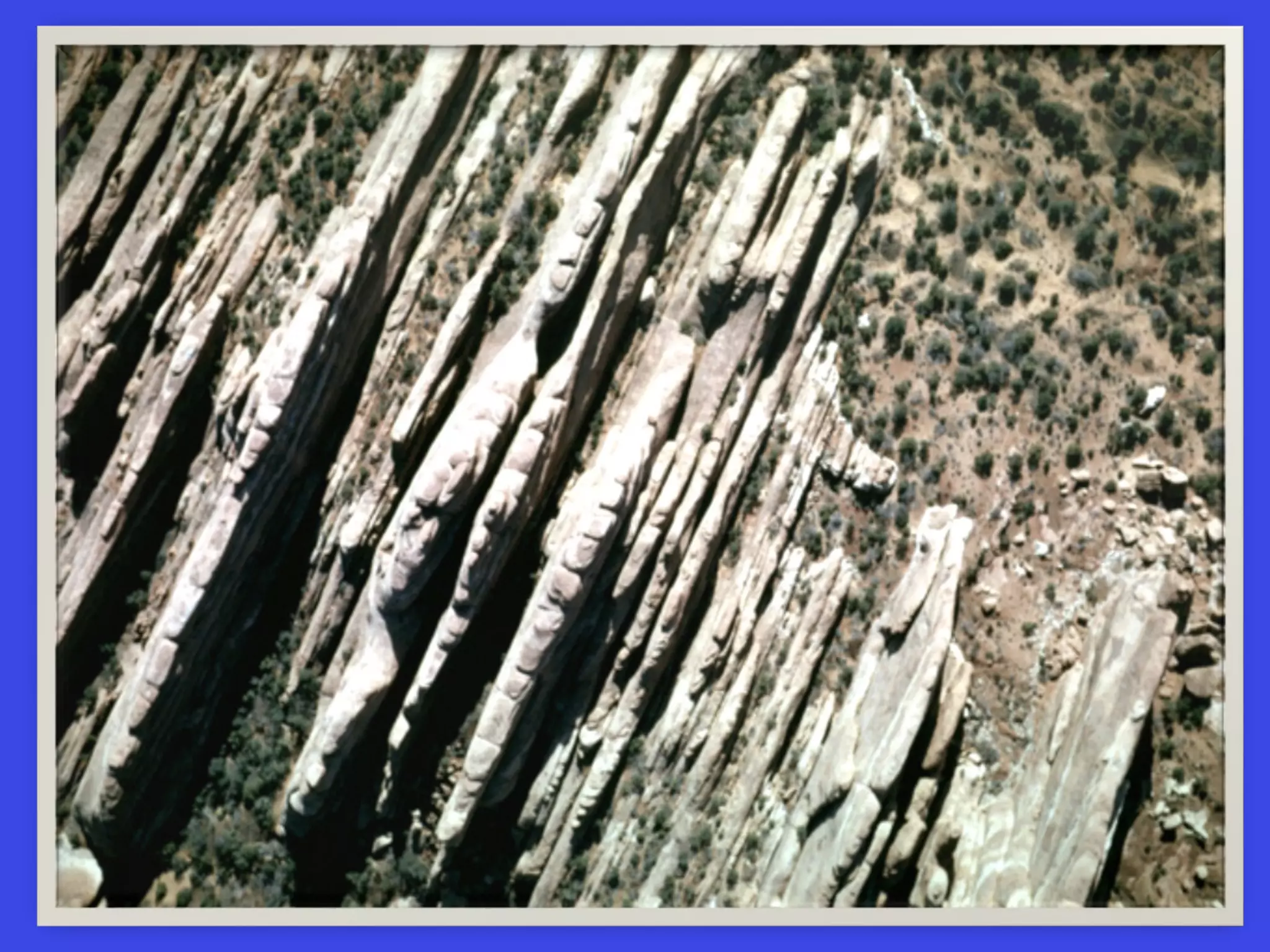
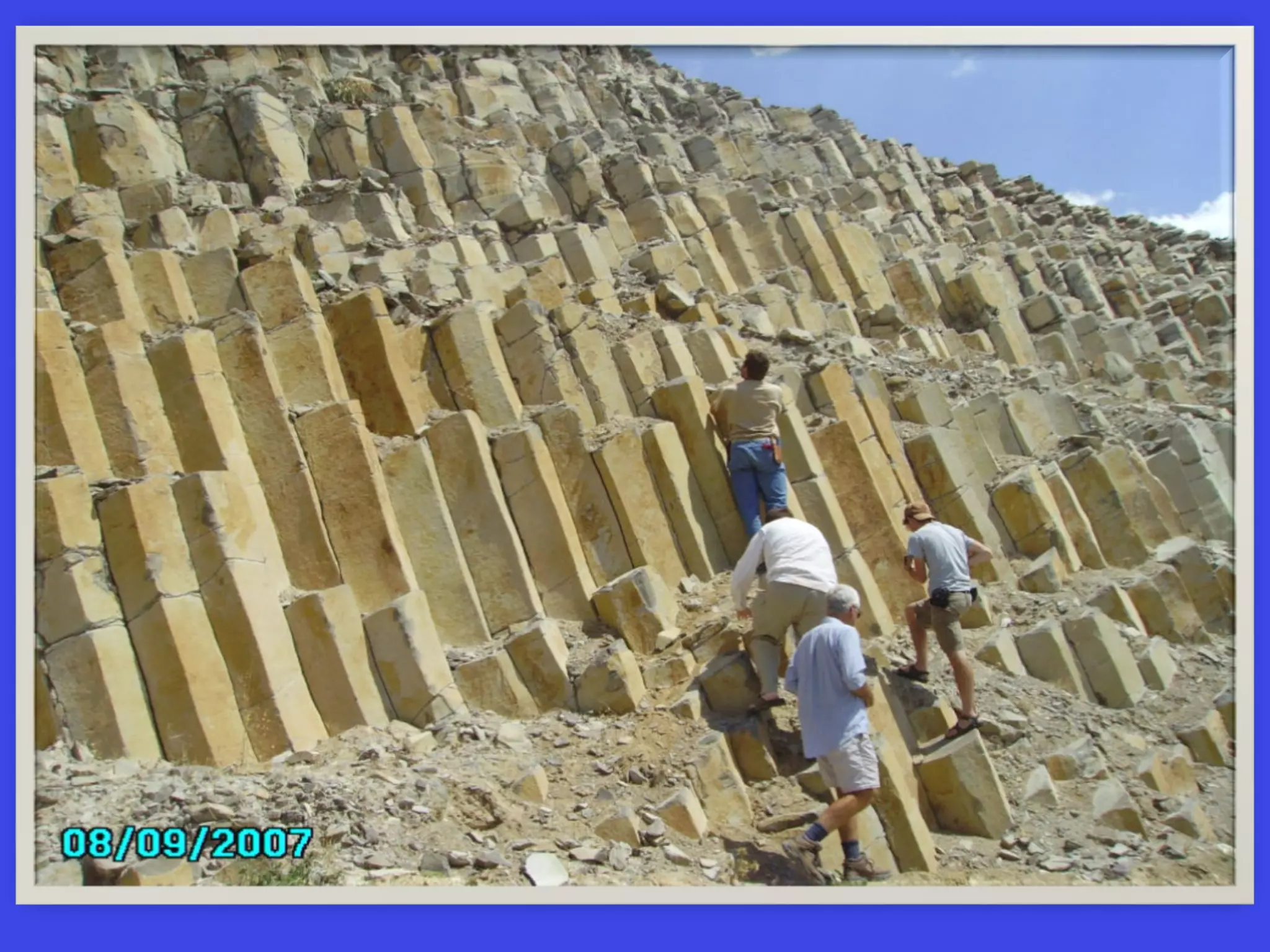
Photograph showing MURAL jointsPhotograph showing MURAL joints
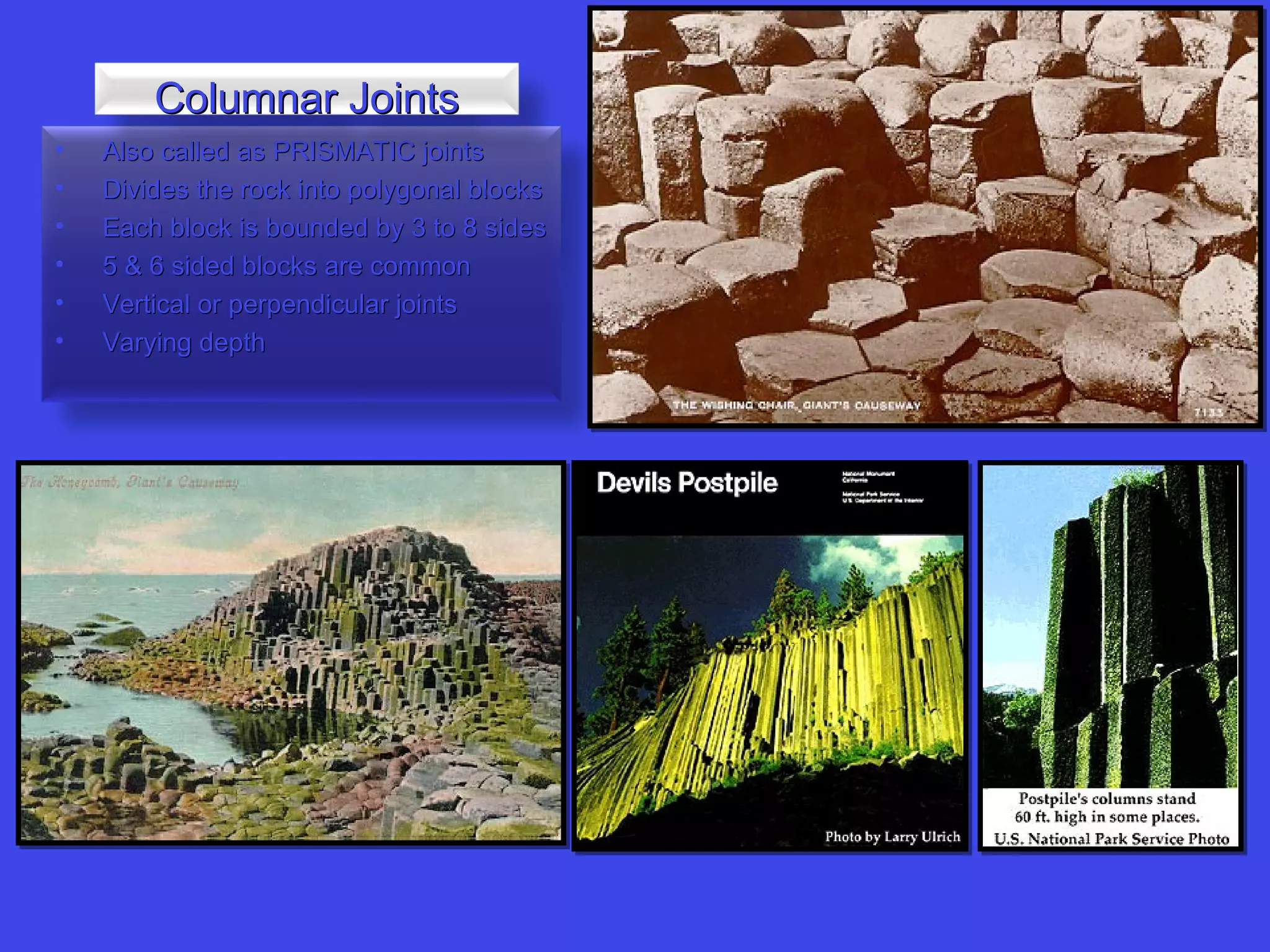
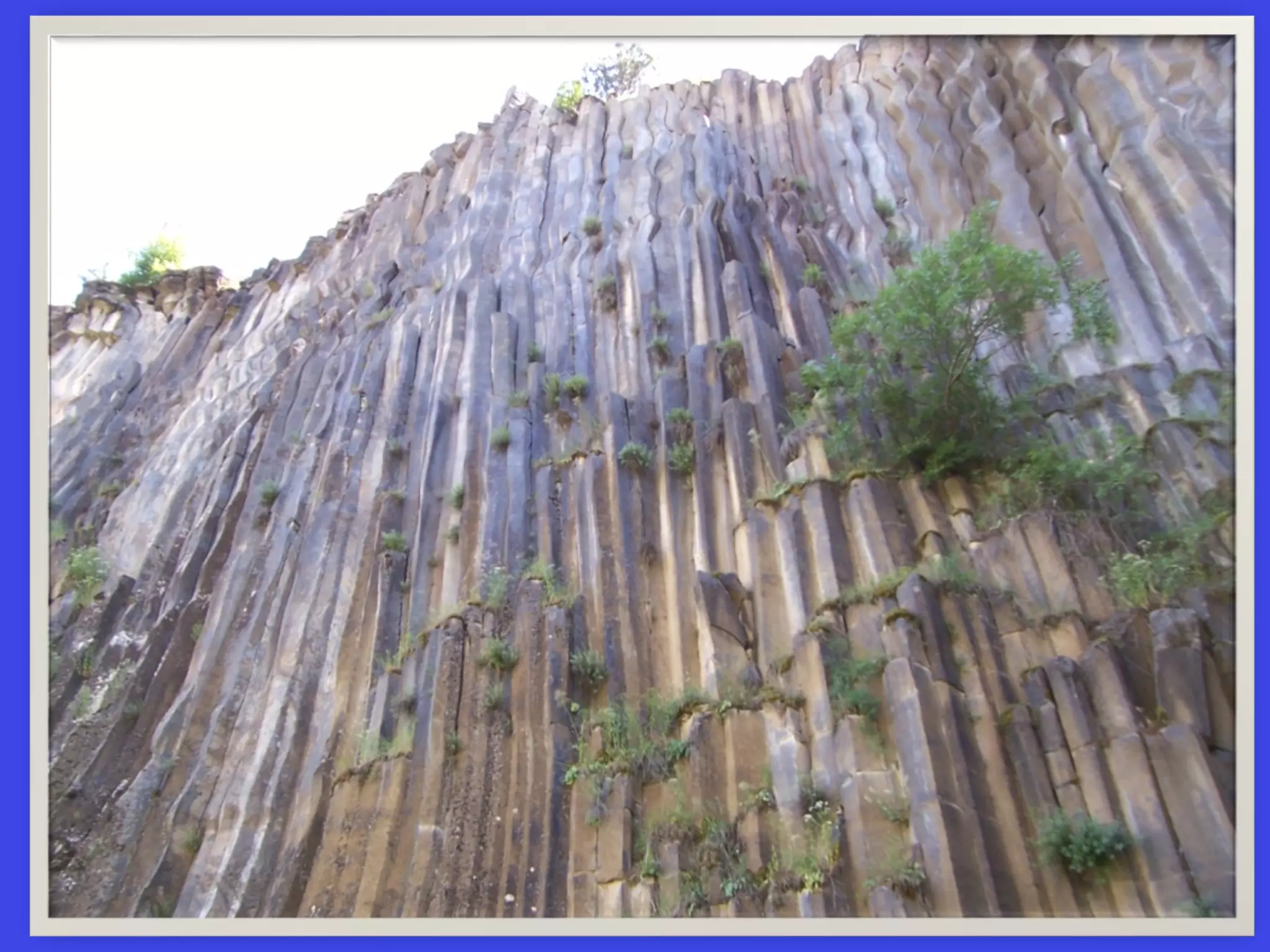
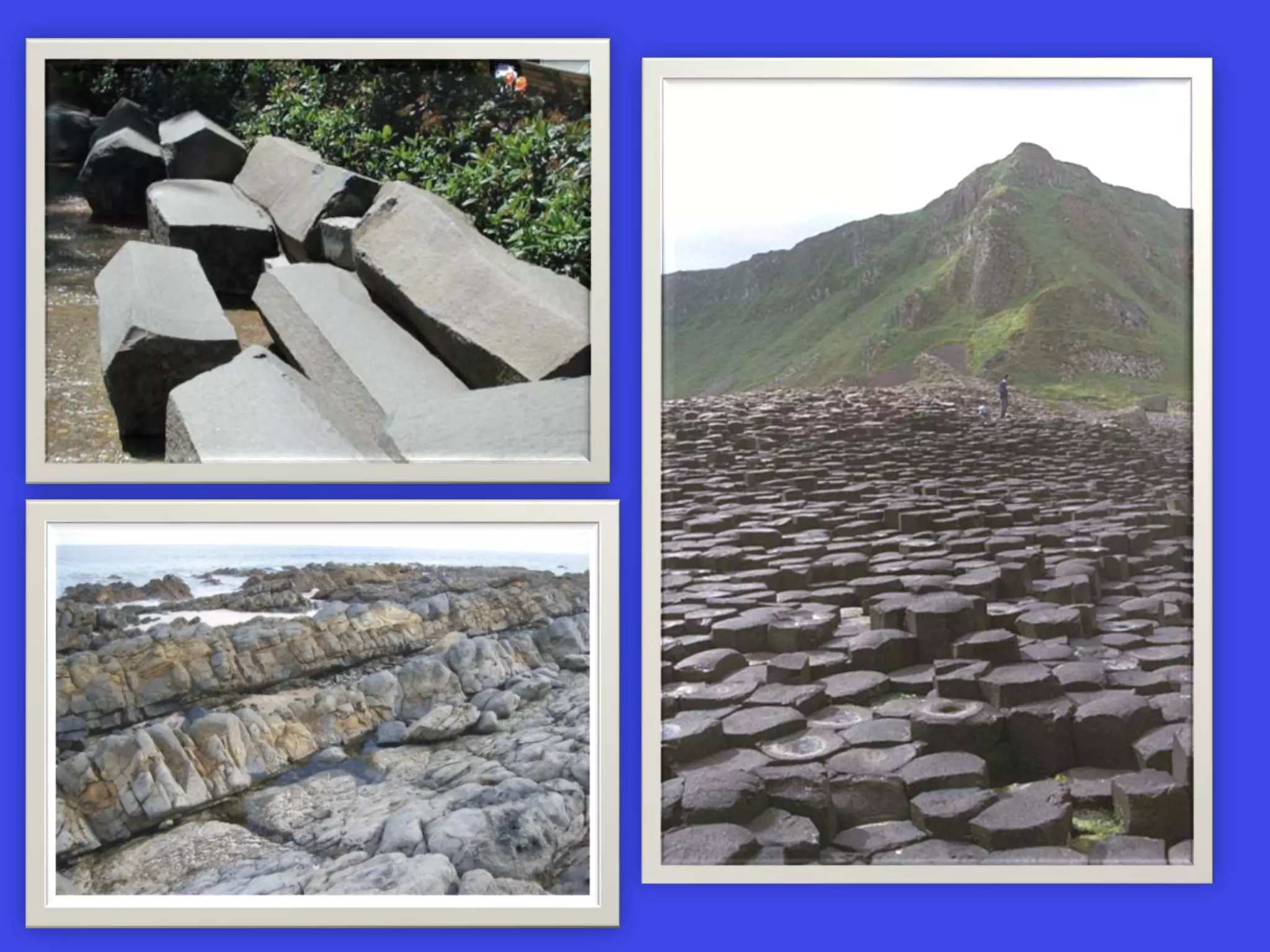
• Also called as PRISMATIC jointsAlso called as PRISMATIC joints
• Divides the rock into polygonal blocksDivides the rock into polygonal blocks
• Each block is bounded by 3 to 8 sidesEach block is bounded by 3 to 8 sides
• 5 & 6 sided blocks are common5 & 6 sided blocks are common
• Vertical or perpendicular jointsVertical or perpendicular joints
• Varying depthVarying depth
Columnar JointsColumnar Joints
Thank YouThank You

Structural features fold, fault, joints

  • 1.
    Dr. V. RGhodake, Sinhgad College of Engineering, Pune. Mob- +919764484757, Email- vyanky.g@gmail.com
  • 2.
    OutcropOutcrop • Any Geologicalformation exposed on the surface is called an outcrop.
  • 3.
    Deformation ofDeformation of RocksRocks •“Structural Geology” is the study of the deformation of rocks and its effects.
  • 4.
    Orientation of DeformedOrientationof Deformed RocksRocks We need some way to describe the geometry of geologic structures. So we use the terms strike and dip. Strike: Orientation of beds with respect to horizon. Dip: Maximum inclinatioin of beds with respect to horizon, Dip is always perpendicular to strike.
  • 5.
    Strike and Dipon a Rooftop
  • 6.
    Strike and Dipin a Rock Structure
  • 7.
    Displaying Strike andDipDisplaying Strike and Dip on a Mapon a Map 35O N S Direction of strike E Direction of down dip W
  • 8.
    What determines ifaWhat determines if a rockrock Folds (bends)Folds (bends) or faults (breaks)?or faults (breaks)? • Type of force applied • Pressure • Temperature • Rock (mineral) composition
  • 9.
    Depth at WhichtheDepth at Which the Deformation Occurs is aDeformation Occurs is a Direct FactorDirect Factor • At shallow crust depths, rock has a greater probability of breaking • At deeper crust depths, rock usually deforms
  • 10.
    StrengtStrengt hh• Ability ofan object to resist deformation • In lab, marble was tested Fractured Deformed
  • 11.
    StraiStrai nnAny change inoriginal shape or size of an object in response to stress acting on the object
  • 12.
    Three Major TypesThreeMajor Types of Directed Stressof Directed Stress • Compression • Extension • Shear
  • 13.
    DefDef- Folds maybe defined as a curved or zigzag structures shown by- Folds may be defined as a curved or zigzag structures shown by rock beds. In other words the wavy undulations in the rock beds arerock beds. In other words the wavy undulations in the rock beds are called Folds.called Folds. These bends or folds may develops in any type of rock andThese bends or folds may develops in any type of rock and may be of any shapesmay be of any shapes Folds shows arches and troughs in alternate manner they are bestFolds shows arches and troughs in alternate manner they are best displayed by the sedimentary rocks. Its size varies from fewdisplayed by the sedimentary rocks. Its size varies from few centimeters to in kmcentimeters to in km Folds shows arches and troughs in alternate manner they are bestFolds shows arches and troughs in alternate manner they are best displayed by the sedimentary rocks. Its size varies from fewdisplayed by the sedimentary rocks. Its size varies from few centimeters to in kmcentimeters to in km
  • 14.
    Parts of Folds •Limbs: •AxialPlanes •Axis of Fold •Hinge Line
  • 15.
  • 18.
    AnticlineAnticline – isa up fold where the limb dip away from axis of fold, these– is a up fold where the limb dip away from axis of fold, these shows convex upwardsshows convex upwards SynclineSyncline – is a down fold where the limb dip towards the axis of fold, these– is a down fold where the limb dip towards the axis of fold, these shows concave, or reversed anticline shape.shows concave, or reversed anticline shape. SynclineSyncline – is a down fold where the limb dip towards the axis of fold, these– is a down fold where the limb dip towards the axis of fold, these shows concave, or reversed anticline shape.shows concave, or reversed anticline shape.
  • 22.
  • 24.
  • 25.
    Plunging Folds:Plunging Folds: Foldshaving inclined axis are called Plunging folds.Folds having inclined axis are called Plunging folds. The angle of inclination of a fold axis with horizontal is called the angle ofThe angle of inclination of a fold axis with horizontal is called the angle of plunge.plunge.
  • 29.
    CompressioCompressio nn Action of oppositelydirected forces acting towards each other at the same time
  • 30.
    TensioTensio nnAction of coincidingand oppositely directed forces acting away from each other
  • 31.
    SheaShea rr Action of coincidingand oppositely directed forces acting parallel to each other across a surface
  • 32.
    Types ofTypes of DeformationDeformation •ElasticElastic • Ductile (plastic)Ductile (plastic) • Brittle (rupture)Brittle (rupture)
  • 33.
    ElasticElastic DeformationDeformation Temporary change inshape or size that is recovered when the deforming force is removed (Like squeezing a piece of rubber)
  • 34.
    Ductile (Plastic)Ductile (Plastic) DeformationDeformation •Permanent change in shape or size • Under goes smooth and continuous plastic deformation under stress
  • 36.
    Recumbent Fold –In recumbent folds the folding is so intense that both the limbs Becomes almost horizontal in this case The axial plane also becomes nearly horizontal and lower limb gets overturned. Types of foldsTypes of folds
  • 37.
    Overturned foldOverturned fold Itis an asymmetricalIt is an asymmetrical fold whose one limb isfold whose one limb is turned past the vertical.turned past the vertical. In this case theIn this case the axial plane is inclinedaxial plane is inclined and both the limb dips inand both the limb dips in the same directions Inthe same directions In the overturnedthe overturned fold the lower limb isfold the lower limb is turned up side down.turned up side down.
  • 38.
    Isoclinal FoldIsoclinal Fold Foldswith parallelFolds with parallel limbs are calledlimbs are called Isoclinal folds.Isoclinal folds. In this case limbs dipsIn this case limbs dips in same angle and inin same angle and in same direction.same direction. Isoclinal folds haveIsoclinal folds have three typesthree types 1)1)Inclined Isoclinal foldsInclined Isoclinal folds 2)2)Vertical Isoclinal foldsVertical Isoclinal folds 3)3)Recumbent orRecumbent or horizontal Isoclinal fold.horizontal Isoclinal fold.
  • 39.
    Some Special Typeof FoldsSome Special Type of Folds Anticlinorium and SynclinoriumAnticlinorium and Synclinorium An anticlinorium is a large anticline running oftenAn anticlinorium is a large anticline running often for several hundred kilometers in length andfor several hundred kilometers in length and several kilometers in width which is furtherseveral kilometers in width which is further thrown into smaller folds. Similarly a syclinoriumthrown into smaller folds. Similarly a syclinorium is a large syncline further consisting of smalleris a large syncline further consisting of smaller folds.folds. Geanticline and GeosynclineGeanticline and Geosyncline An anticline of excessively large dimensions isAn anticline of excessively large dimensions is called a ‘geanticline’ and similar a syncline ofcalled a ‘geanticline’ and similar a syncline of huge dimensions is known as a ‘geosyncline’huge dimensions is known as a ‘geosyncline’
  • 40.
    And Even MoreFold TerminologyAnd Even More Fold Terminology DomeDome: a sequence of: a sequence of folded rocks in whichfolded rocks in which all the beds dip awayall the beds dip away from a central pointfrom a central point BasinBasin: a sequence of: a sequence of folded rocks in whichfolded rocks in which all the beds dipall the beds dip towards a centraltowards a central pointpoint
  • 44.
    • Fault planeFaultplane: Surface that: Surface that the movement has takenthe movement has taken place within the fault. Onplace within the fault. On this surface the dip andthis surface the dip and strike of the fault isstrike of the fault is measured.measured. • Hanging wall:Hanging wall: The rockThe rock mass resting on the faultmass resting on the fault plane.plane. • Footwall:Footwall: The rock massThe rock mass beneath the fault plane.beneath the fault plane. Parts of The FaultsParts of The Faults
  • 45.
  • 46.
  • 47.
  • 50.
    Dip-slipDip-slip FaultsFaults • Motion ofthe fault blocks is parallel to the dip direction • Two types: Normal – movement is down dip Reverse – movement is up dip
  • 52.
  • 53.
  • 54.
    Thrust Fault Thrust Faults:In the thrust faults the hanging wall has moved up relative to the footwall (dip angle 30º or less) Reverse Faults: Are similar to the thrust faults regarding the sense of motion but the dip angle of the fault plane is 45º or more Thrust faults usually formed in areas of comperssional regime. Thrust FaultThrust Fault
  • 55.
  • 56.
    Strike-slipStrike-slip FaultsFaults Motion of thefault blocks is parallel to the strike direction There are 2 types Right-lateral Left-lateral
  • 57.
    Strike-Slip Fault Strike-slip Faults:Are faults that have movement along strikes. There are two types of strike slip faults: A] Right lateral strike-slip fault (dextral): Where the side opposite the observer moves to the right. B] Left lateral strike-slip fault (sinistral): Where the side opposite the observer moves to the left. Note that the same sense of movement will also be observed from the other side of the fault. Strike-Slip Faults
  • 58.
  • 59.
    Transform Faults Transform Faults:Are a type of strike-slip fault (defined by Wilson 1965). They form due to the differences in motion between lithospheric plates. They are basically occur where type of plate boundary is transformed into another. Main types of transform faults are: • Ridge-Ridge • Ridge-Arc •
  • 60.
    Types of Faults •Dip-slipfaults have movement parallel to the dip of the fault plane –In normal faults, the hanging-wall block has moved down relative to the footwall block –In reverse faults, the hanging-wall block has moved up relative to the footwall block
  • 61.
    Types of Faults •Dip-slipfaults have movement parallel to the dip of the fault plane –Fault blocks, bounded by normal faults, that drop down or are uplifted are known as grabens and horsts, respectively •Grabens associated with divergent plate boundaries are called rifts –Thrust faults are reverse faults with dip angles less than 30° from horizontal
  • 62.
    Types of Faults •Strike-slipfaults have movement that is predominantly horizontal and parallel to the strike of the fault plane –A viewer looking across to the other side of a right- lateral strike-slip fault would observe it to be offset to their right –A viewer looking across to the other side of a left- lateral strike-slip fault would observe it to be offset to their left •Oblique-slip faults have movement with both vertical and horizontal components Right-lateral San Andreas Fault
  • 63.
  • 65.
  • 66.
  • 67.
  • 69.
    San Andreas Fault(right-lateral)
  • 70.
  • 71.
    Definition:Definition: When rock massesare subjected to tensional orWhen rock masses are subjected to tensional or compressional forces regular or irregular fracturescompressional forces regular or irregular fractures develops in them. Such fractures along which their hasdevelops in them. Such fractures along which their has been no relative displacement are called Joints.been no relative displacement are called Joints. joints occurs in almost all types of rocks they mayjoints occurs in almost all types of rocks they may be vertical inclined or horizontalbe vertical inclined or horizontal Commonly rock contains a large number of joints which lie parallelCommonly rock contains a large number of joints which lie parallel to one another. These parallel joints together forms a joint set. Twoto one another. These parallel joints together forms a joint set. Two or more joints sets are called joint system.or more joints sets are called joint system.
  • 72.
    Classification of JointsClassificationof Joints •Tension Joints: Tension joints are those which are formed as a result of tensional forces. These joints are relatively open and have rough and irregular surface. •Shear Joints: Shear joints are those which are formed due to compressional forces involved in the folding and faulting of rocks. This type of joints are clean and tightly closed Classification of joints : 1)Strike joints- The joints are parallel to strike of the country rocks 2)Dip joints- The joints are parallel to direction of dip of country rocks 3)Oblique joints - Runs oblique to strike and Dip directions of country rocks.
  • 73.
    Common Type ofjointsCommon Type of joints
  • 77.
    SheetSheet JointJointHorizontal set dividing rockmass Layered appearance Caused due to weathering, Removal of overlying rock It causes expansion of underlying igneous rocks
  • 78.
    Dr. N. J.Sathe, SCOE, Pune. 78 Photograph showing MURAL jointsPhotograph showing MURAL joints
  • 79.
    • Also calledas PRISMATIC jointsAlso called as PRISMATIC joints • Divides the rock into polygonal blocksDivides the rock into polygonal blocks • Each block is bounded by 3 to 8 sidesEach block is bounded by 3 to 8 sides • 5 & 6 sided blocks are common5 & 6 sided blocks are common • Vertical or perpendicular jointsVertical or perpendicular joints • Varying depthVarying depth Columnar JointsColumnar Joints
  • 85.