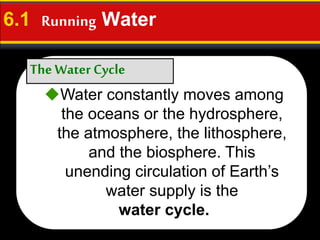
The RunningWater and Groundwater
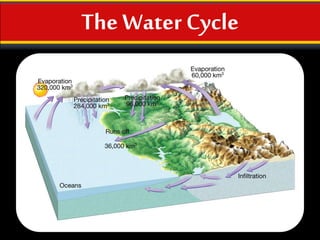
The Water Cycle
6.1 Running Water
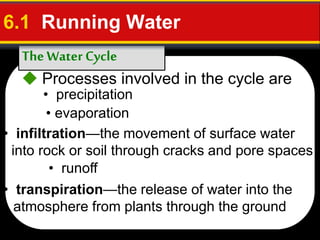
Water constantly moves among
the oceans or the hydrosphere,
the atmosphere, the lithosphere,
and the biosphere. This
unending circulation of Earth’s
water supply is the
water cycle.
The Water Cycle
6.1 Running Water
 Processes involved in the cycle are
• infiltration—the movement of surface water
into rock or soil through cracks and pore spaces
• transpiration—the release of water into the
atmosphere from plants through the ground
• precipitation
• evaporation
• runoff
The Water Cycle
6.1 Running Water
Running water represents
the single most important
agent sculpturing our
planet's landscapes.
Stream
6.1 Running Water
- The stream channel is the
course the water in a stream
follows.
A natural body of
running water flowing on
or under the earth.
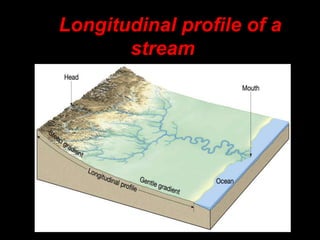
Longitudinal profile of a
stream
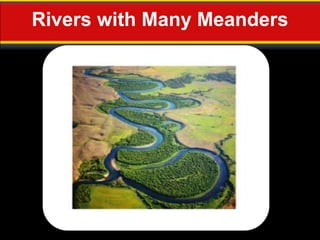
Rivers with Many Meanders
Erosion
6.2 The Workof Streams
 Streams generally erode their
channels, lifting loose particles
by abrasion, grinding, and by
dissolving soluble material.
Floods and Flood Control
6.2 The Workof Streams
 A flood occurs when the discharge of
a stream becomes so great that it
exceeds the capacity of its channel
and overflows its banks.
 Measures to control flooding include
artificial levees, flood control dams,
and placing limits on floodplain
development.
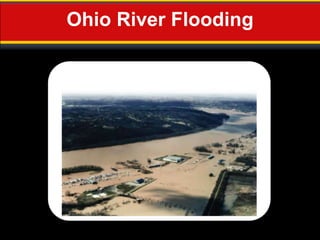
Ohio River Flooding
Drainage Basins
6.2 The Workof Streams
 A drainage basin is the land
area that contributes water to a
stream.
 A divide is an imaginary line that
separates the drainage basins of
one stream from another.
6.3 GROUND WATER
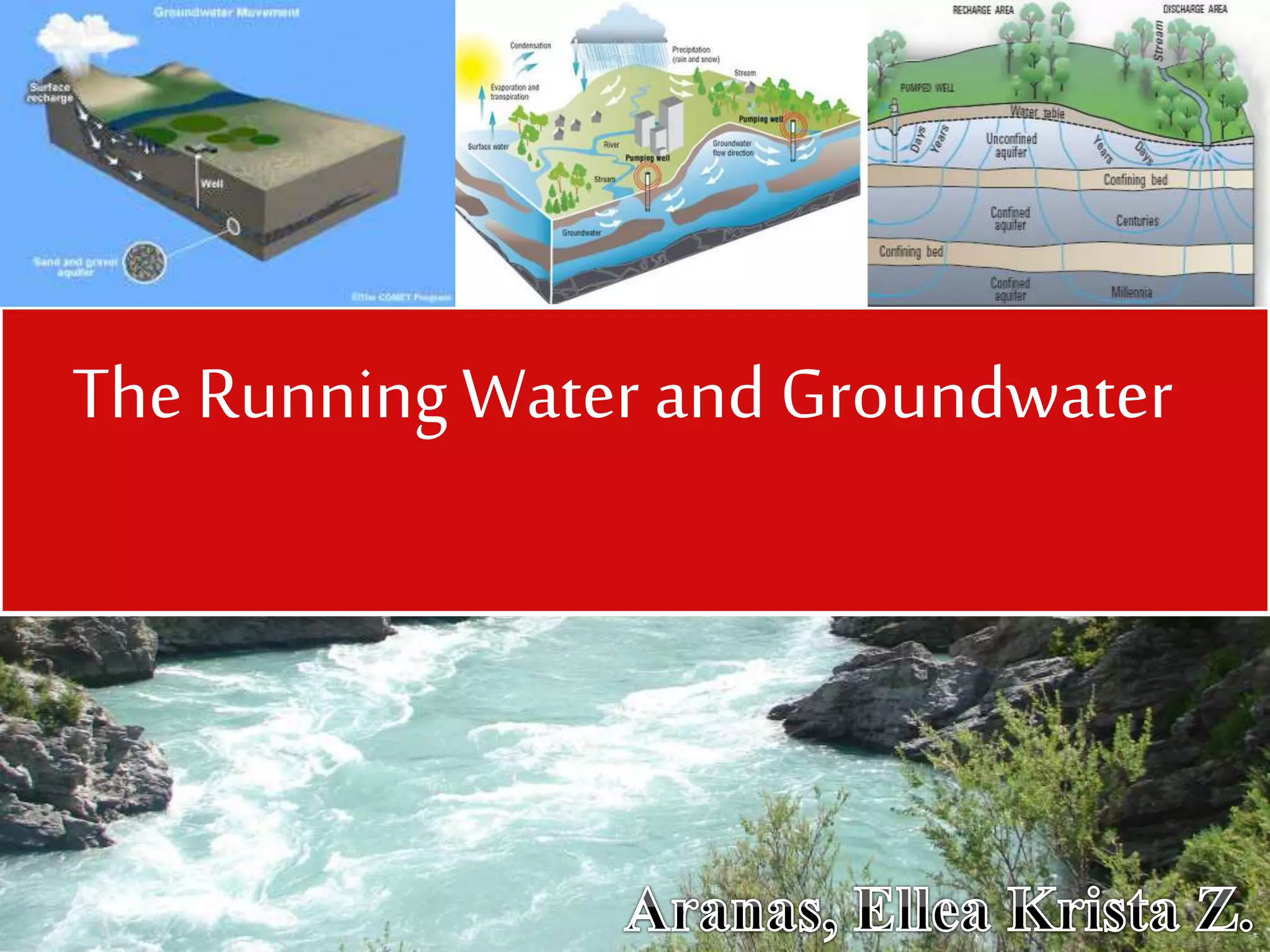
As a resource, groundwater represents the
largest reservoir of freshwater that is
readily available to humans.
About 0.6% of the world's water found
underground. It provides:
50% of the world's drinking water
40% of the water used for irrigation
26% of industry's needs
Distribution and Movement ofWaterUnderground
6.3 WaterBeneaththe Surface
 Much of the water in soil seeps downward
until it reaches the zone of saturation.
 The zone of saturation is the area where
water fills all of the open spaces in
sediment and rock.
• Groundwater is the water within this zone.
• The water table is the upper level of the
saturation zone of groundwater.
Movement ofWater Underground
6.3 WaterBeneaththe Surface
 Movement
• Groundwater moves by twisting and
turning through interconnected small
openings.
• The groundwater moves more slowly
when the pore spaces are smaller.
Springs
6.3 Water Beneath the Surface
 A spring forms whenever the water table
intersects the ground surface.
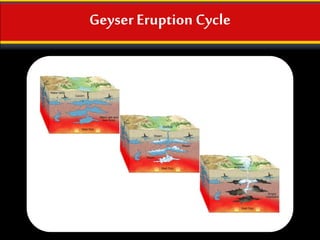
• Intermittent hot springs
 Hot Springs
 Geysers
• Water is 6–9ºC warmer than the mean air
temperature of the locality.
• Water is heated by cooling of igneous rock.
• Water turns to steam and erupts.
GeyserEruption Cycle
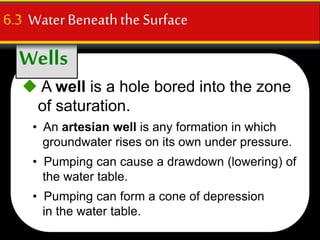
Wells
6.3 WaterBeneaththe Surface
 A well is a hole bored into the zone
of saturation.
• An artesian well is any formation in which
groundwater rises on its own under pressure.
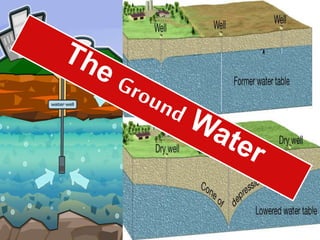
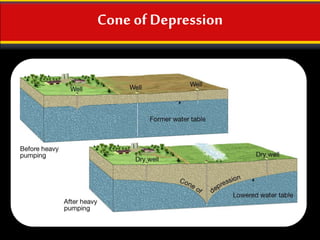
• Pumping can cause a drawdown (lowering) of
the water table.
• Pumping can form a cone of depression
in the water table.
Cone of Depression
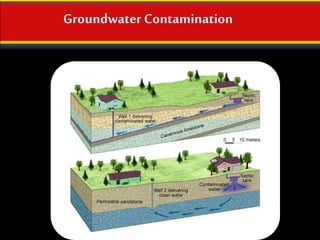
Groundwater Contamination
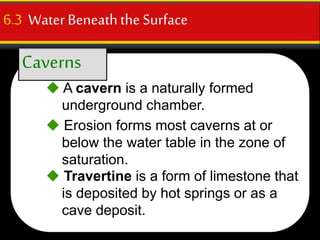
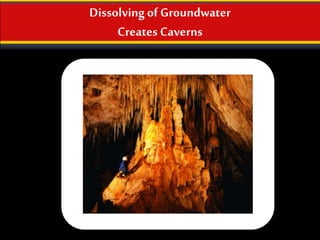
Caverns
6.3 WaterBeneaththe Surface
 Erosion forms most caverns at or
below the water table in the zone of
saturation.
 A cavern is a naturally formed
underground chamber.
 Travertine is a form of limestone that
is deposited by hot springs or as a
cave deposit.
Dissolving of Groundwater
Creates Caverns
Prentice Hall
EARTH SCIENCE
Tarbuck Lutgens

Earth Science-Pearson
Geowords.com
Santiago Canyon College-Hovanitz.com
Groundwater is a hidden resource, while
running water is the water we see such
as in rivers, streams and etc. they both
have the greatest impact on people.
Running water are being used as source
of energy, public and industrial use,
travel(navigation) while Ground water
represents the largest reservoir of
freshwater that is readily available to
humans.
We should take good care and maintain
the cleanliness of our running and
ground water as it provides as with our
necessities. Our body is composed
mainly of water for about 65%.Water is
also considered as the UNIVERSAL
SOLVENT. And if we continue to
degrade our water supply there might
not be enough in the near future.
WIKIPEDIA,THE FREEENCYCLOPEDIA
EarthScience-Pearson
Geowords.com
Santiago Canyon College-Hovanitz.com
Prentice HallEARTH SCIENCE
Tarbuck Lutgens

RUNNING WATER AND GROUND WATER

  • 1.
  • 2.
    The Water Cycle 6.1Running Water Water constantly moves among the oceans or the hydrosphere, the atmosphere, the lithosphere, and the biosphere. This unending circulation of Earth’s water supply is the water cycle.
  • 3.
    The Water Cycle 6.1Running Water  Processes involved in the cycle are • infiltration—the movement of surface water into rock or soil through cracks and pore spaces • transpiration—the release of water into the atmosphere from plants through the ground • precipitation • evaporation • runoff
  • 4.
  • 6.
    6.1 Running Water Runningwater represents the single most important agent sculpturing our planet's landscapes.
  • 7.
    Stream 6.1 Running Water -The stream channel is the course the water in a stream follows. A natural body of running water flowing on or under the earth.
  • 8.
  • 9.
  • 10.
    Erosion 6.2 The WorkofStreams  Streams generally erode their channels, lifting loose particles by abrasion, grinding, and by dissolving soluble material.
  • 11.
    Floods and FloodControl 6.2 The Workof Streams  A flood occurs when the discharge of a stream becomes so great that it exceeds the capacity of its channel and overflows its banks.  Measures to control flooding include artificial levees, flood control dams, and placing limits on floodplain development.
  • 12.
  • 13.
    Drainage Basins 6.2 TheWorkof Streams  A drainage basin is the land area that contributes water to a stream.  A divide is an imaginary line that separates the drainage basins of one stream from another.
  • 15.
    6.3 GROUND WATER Asa resource, groundwater represents the largest reservoir of freshwater that is readily available to humans. About 0.6% of the world's water found underground. It provides: 50% of the world's drinking water 40% of the water used for irrigation 26% of industry's needs
  • 16.
    Distribution and MovementofWaterUnderground 6.3 WaterBeneaththe Surface  Much of the water in soil seeps downward until it reaches the zone of saturation.  The zone of saturation is the area where water fills all of the open spaces in sediment and rock. • Groundwater is the water within this zone. • The water table is the upper level of the saturation zone of groundwater.
  • 17.
    Movement ofWater Underground 6.3WaterBeneaththe Surface  Movement • Groundwater moves by twisting and turning through interconnected small openings. • The groundwater moves more slowly when the pore spaces are smaller.
  • 18.
    Springs 6.3 Water Beneaththe Surface  A spring forms whenever the water table intersects the ground surface. • Intermittent hot springs  Hot Springs  Geysers • Water is 6–9ºC warmer than the mean air temperature of the locality. • Water is heated by cooling of igneous rock. • Water turns to steam and erupts.
  • 19.
  • 20.
    Wells 6.3 WaterBeneaththe Surface A well is a hole bored into the zone of saturation. • An artesian well is any formation in which groundwater rises on its own under pressure. • Pumping can cause a drawdown (lowering) of the water table. • Pumping can form a cone of depression in the water table.
  • 21.
  • 22.
  • 23.
    Caverns 6.3 WaterBeneaththe Surface Erosion forms most caverns at or below the water table in the zone of saturation.  A cavern is a naturally formed underground chamber.  Travertine is a form of limestone that is deposited by hot springs or as a cave deposit.
  • 24.
  • 25.
    Prentice Hall EARTH SCIENCE TarbuckLutgens  Earth Science-Pearson Geowords.com Santiago Canyon College-Hovanitz.com
  • 28.
    Groundwater is ahidden resource, while running water is the water we see such as in rivers, streams and etc. they both have the greatest impact on people. Running water are being used as source of energy, public and industrial use, travel(navigation) while Ground water represents the largest reservoir of freshwater that is readily available to humans.
  • 30.
    We should takegood care and maintain the cleanliness of our running and ground water as it provides as with our necessities. Our body is composed mainly of water for about 65%.Water is also considered as the UNIVERSAL SOLVENT. And if we continue to degrade our water supply there might not be enough in the near future.
  • 31.
    WIKIPEDIA,THE FREEENCYCLOPEDIA EarthScience-Pearson Geowords.com Santiago CanyonCollege-Hovanitz.com Prentice HallEARTH SCIENCE Tarbuck Lutgens