01-Mar-19
1
GROUND FREEZING
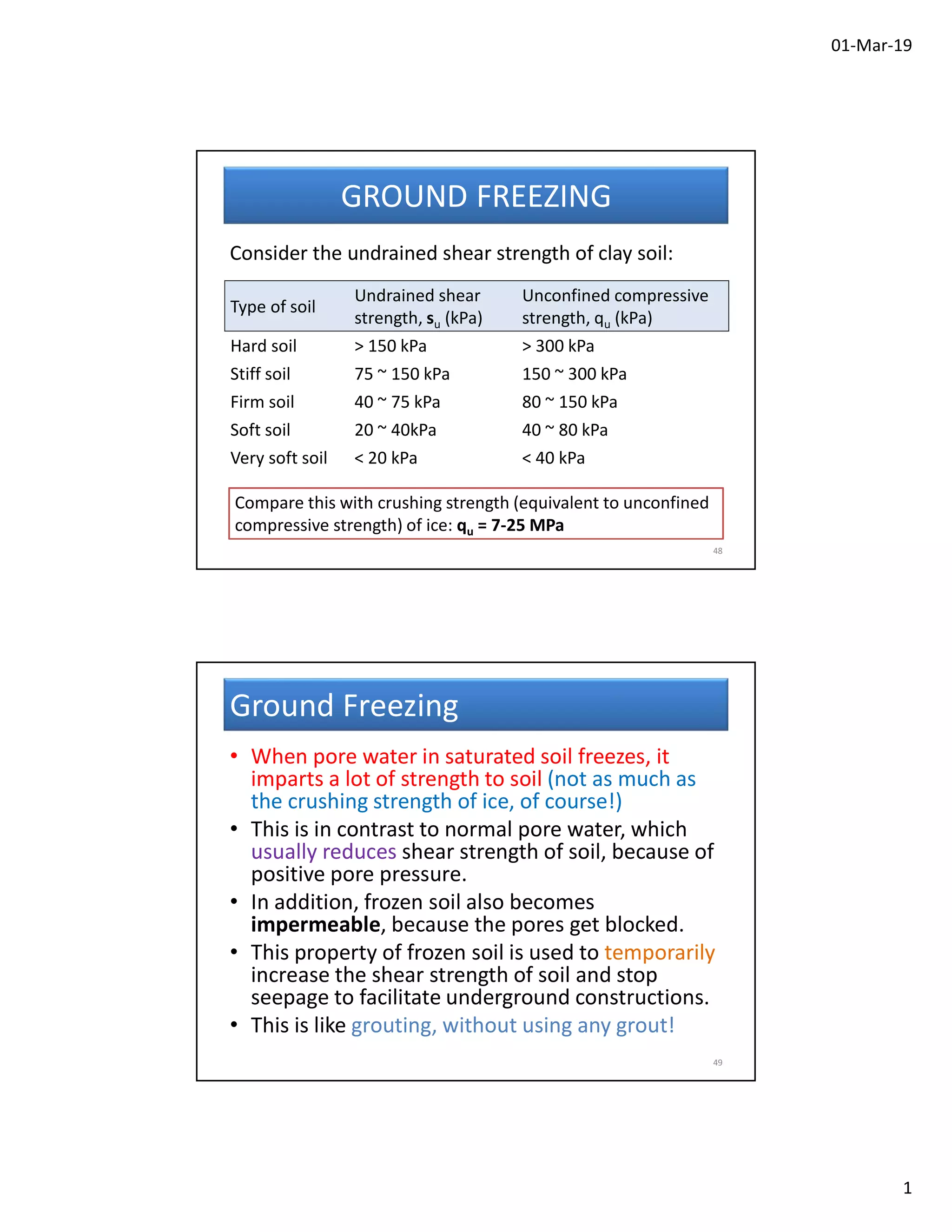
Consider the undrained shear strength of clay soil:
Type of soil
Undrained shear
strength, su (kPa)
Unconfined compressive
strength, qu (kPa)
Hard soil > 150 kPa > 300 kPa
Stiff soil 75 ~ 150 kPa 150 ~ 300 kPa
Firm soil 40 ~ 75 kPa 80 ~ 150 kPa
Soft soil 20 ~ 40kPa 40 ~ 80 kPa
Very soft soil < 20 kPa < 40 kPa
Compare this with crushing strength (equivalent to unconfined
compressive strength) of ice: qu = 7-25 MPa
48
• When pore water in saturated soil freezes, it
imparts a lot of strength to soil (not as much as
the crushing strength of ice, of course!)
• This is in contrast to normal pore water, which
usually reduces shear strength of soil, because of
positive pore pressure.
• In addition, frozen soil also becomes
impermeable, because the pores get blocked.
• This property of frozen soil is used to temporarily
increase the shear strength of soil and stop
seepage to facilitate underground constructions.
• This is like grouting, without using any grout!
Ground Freezing
49
01-Mar-19
2
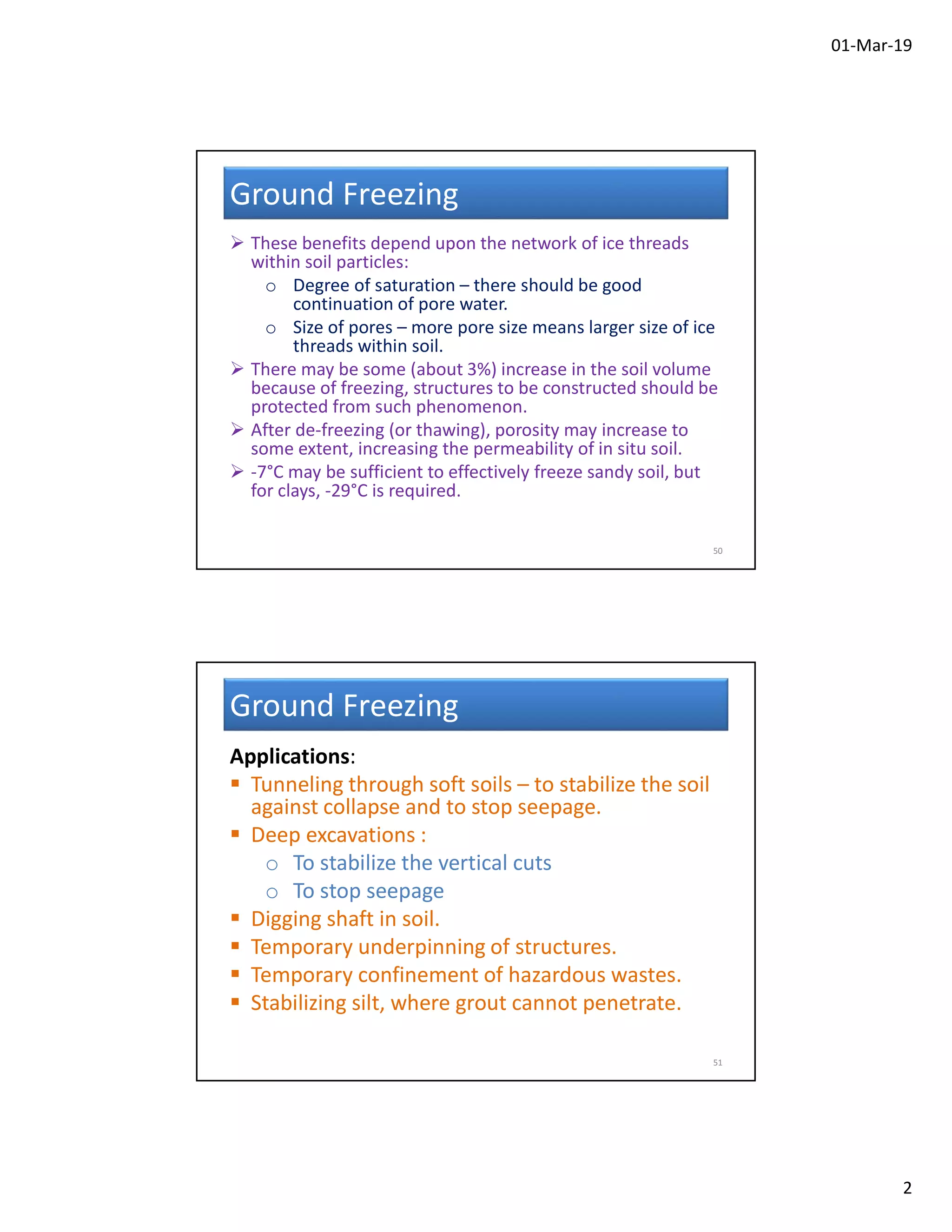
 These benefits depend upon the network of ice threads
within soil particles:
o Degree of saturation – there should be good
continuation of pore water.
o Size of pores – more pore size means larger size of ice
threads within soil.
 There may be some (about 3%) increase in the soil volume
because of freezing, structures to be constructed should be
protected from such phenomenon.
 After de-freezing (or thawing), porosity may increase to
some extent, increasing the permeability of in situ soil.
 -7°C may be sufficient to effectively freeze sandy soil, but
for clays, -29°C is required.
Ground Freezing
50
Applications:
 Tunneling through soft soils – to stabilize the soil
against collapse and to stop seepage.
 Deep excavations :
o To stabilize the vertical cuts
o To stop seepage
 Digging shaft in soil.
 Temporary underpinning of structures.
 Temporary confinement of hazardous wastes.
 Stabilizing silt, where grout cannot penetrate.
Ground Freezing
51
01-Mar-19
3
• Thermal conductivity of water = 0.6 W m-1°C-1 (watt
per metre per degree celcius)
• Thermal conductivity of soil = 1.4 W m-1°C-1
• Thermal conductivity of ice = 2.2 W m-1°C-1
52
Ground Freezing
53
01-Mar-19
4
Ground Freezing
54
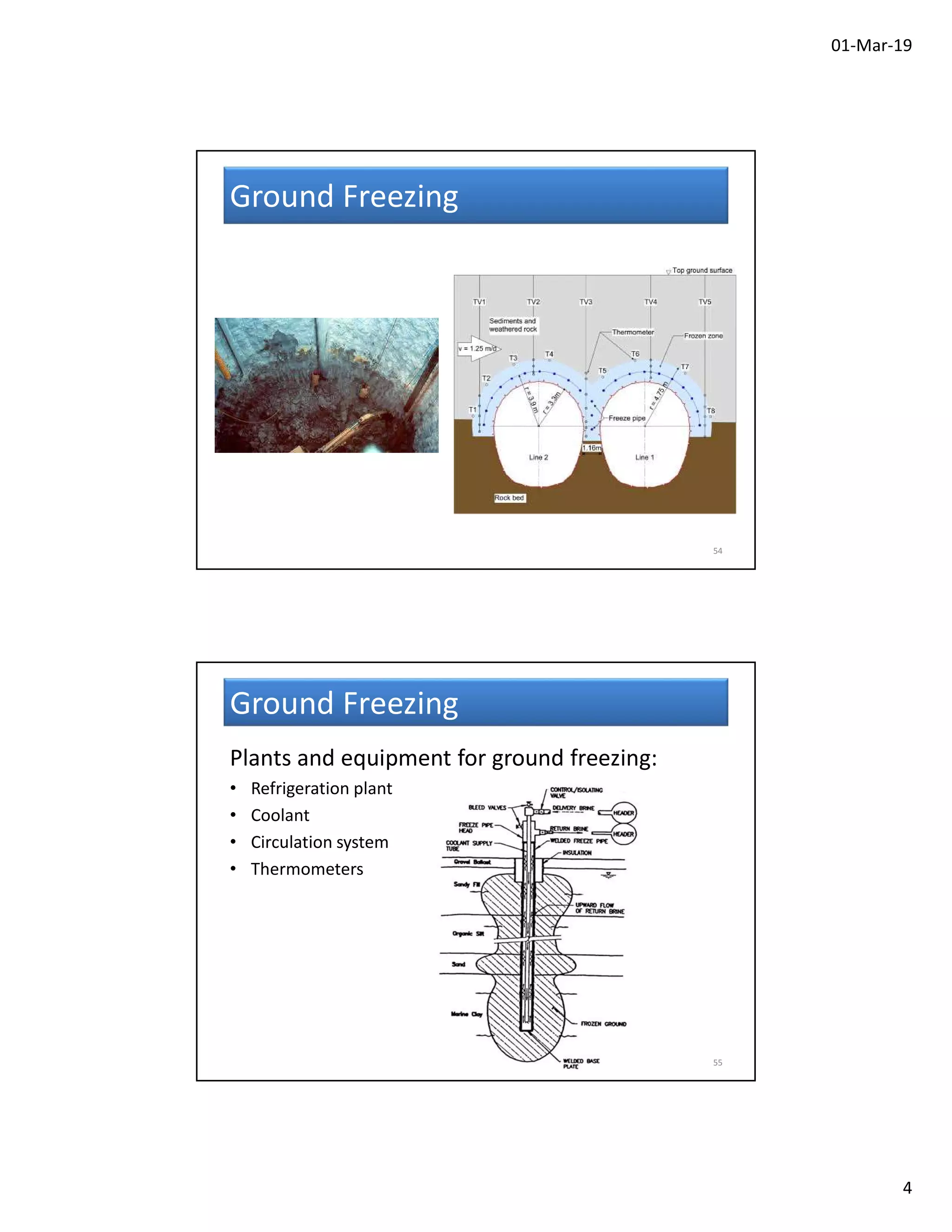
Plants and equipment for ground freezing:
• Refrigeration plant
• Coolant
• Circulation system
• Thermometers
Ground Freezing
55
01-Mar-19
5
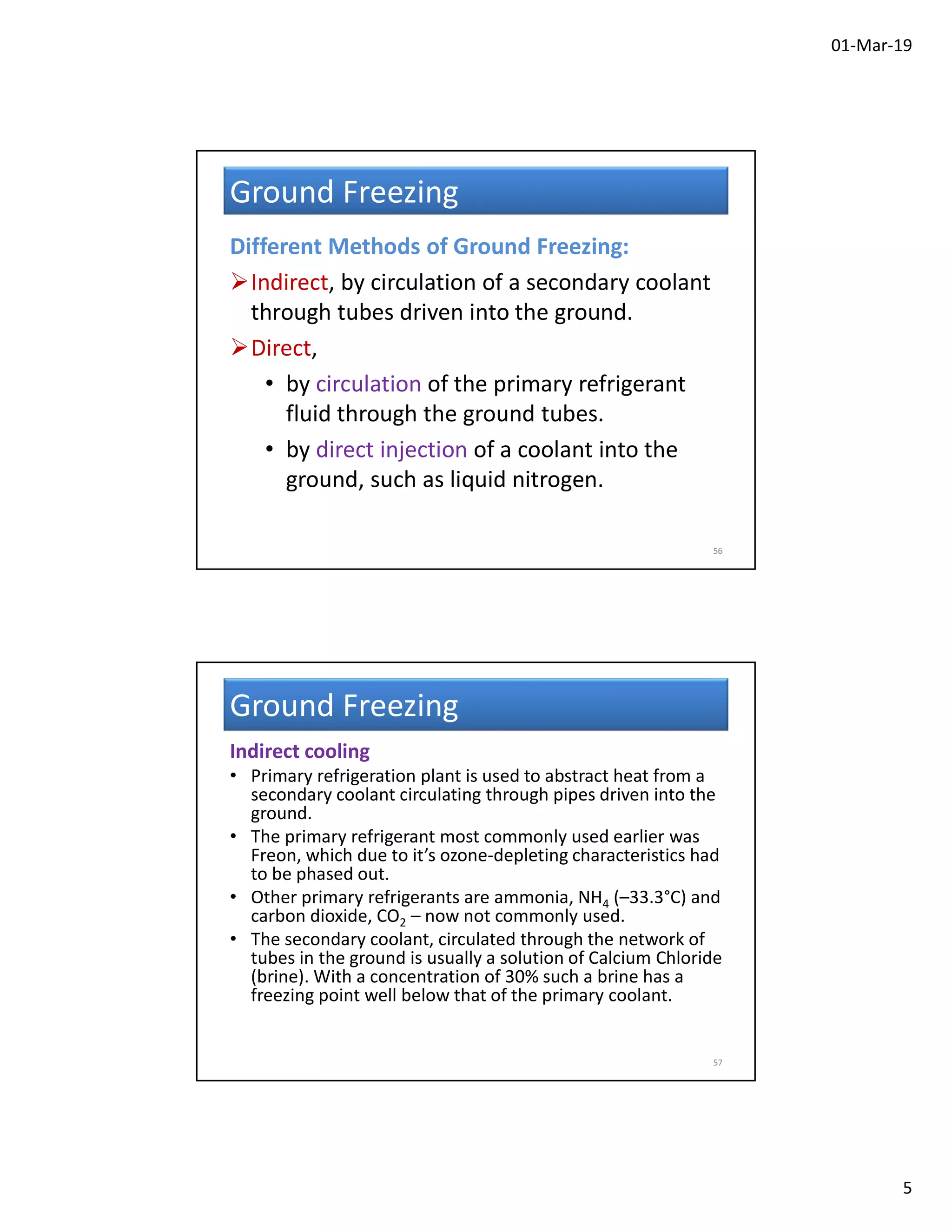
Different Methods of Ground Freezing:
Indirect, by circulation of a secondary coolant
through tubes driven into the ground.
Direct,
• by circulation of the primary refrigerant
fluid through the ground tubes.
• by direct injection of a coolant into the
ground, such as liquid nitrogen.
Ground Freezing
56
Indirect cooling
• Primary refrigeration plant is used to abstract heat from a
secondary coolant circulating through pipes driven into the
ground.
• The primary refrigerant most commonly used earlier was
Freon, which due to it’s ozone-depleting characteristics had
to be phased out.
• Other primary refrigerants are ammonia, NH4 (–33.3°C) and
carbon dioxide, CO2 – now not commonly used.
• The secondary coolant, circulated through the network of
tubes in the ground is usually a solution of Calcium Chloride
(brine). With a concentration of 30% such a brine has a
freezing point well below that of the primary coolant.
Ground Freezing
57
01-Mar-19
6
Ground Freezing
58
Ground Freezing
59
01-Mar-19
7
Direct cooling
• In this process, the primary refrigerant is circulated through
the system of tubes in the ground, extracting the heat directly.
Thus , it has a higher efficiency than the indirect process.
• Direct freezing time is similar to that for the indirect process.
The choice will depend on plant availability, cost of set up and
operation, and judgment of the engineer.
Ground Freezing
Soil heat
Primary
Refrigerant
heat AtmosphereDirect
In-
direct
60
Liquid Nitrogen (LN2) Method (Direct Cooling Process)
 Liquid nitrogen is prepared by compressing and cooling nitrogen
gas. LN2 boils at -196°C at normal pressure, absorbing a lot of
heat from the surrounding, thereby cooling the surrounding very
fast.
 With this method, a large refrigeration plant is not necessary at
the site, as LN2 can be prepared at a distant plant and brought to
the site in insulated tankers. It can be stored on site in insulated
containers.
 It is advantageous for emergency use, where quick freezing is
required without setting up of large plant and equipment.
 This is also advantageous on sites away from power supplies.
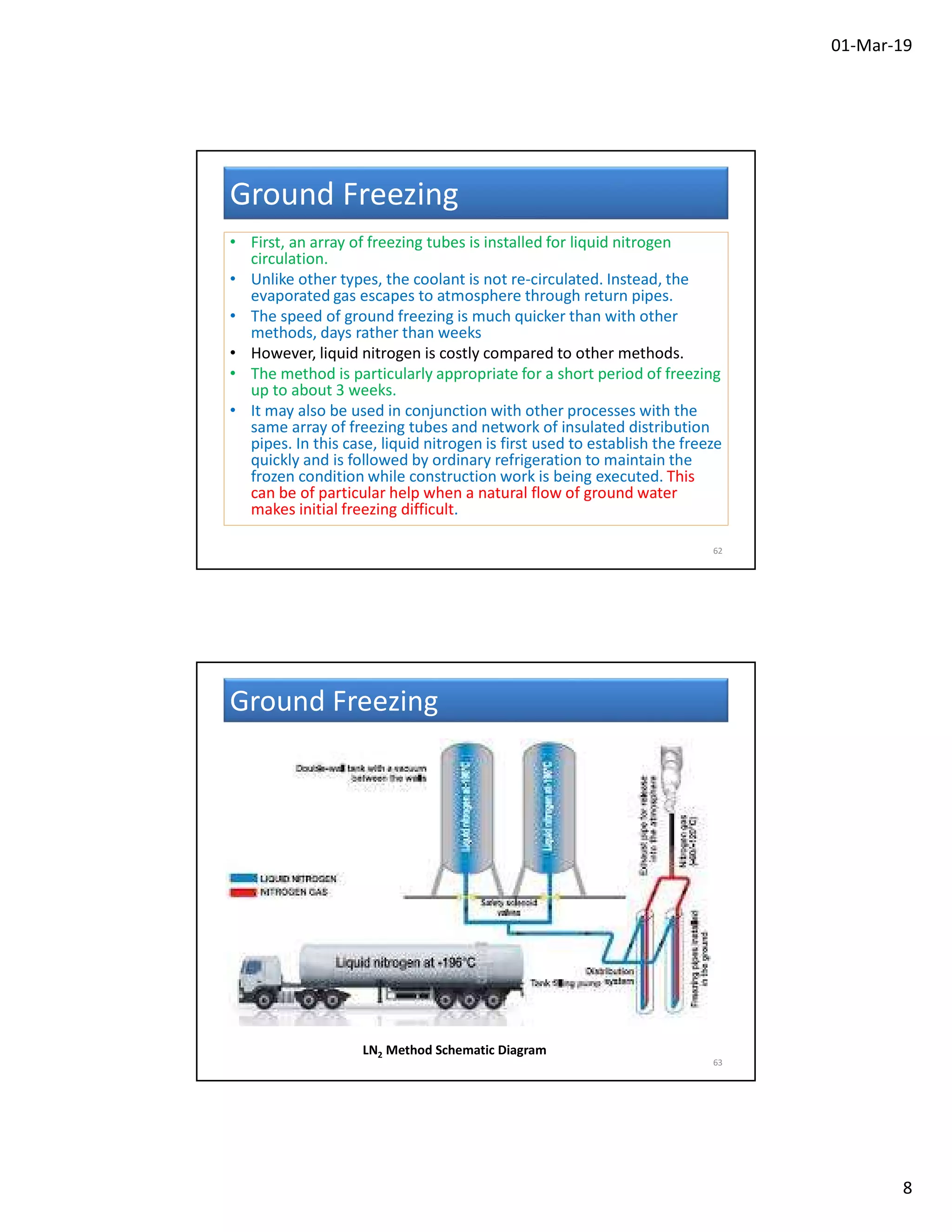
 LN2 can be discharged directly through tubes driven into the
ground, and allowed to escape to the atmosphere.
 Precautions for adequate ventilation must be taken at site.
Otherwise, workers may suffocate.
Ground Freezing
61
01-Mar-19
8
• First, an array of freezing tubes is installed for liquid nitrogen
circulation.
• Unlike other types, the coolant is not re-circulated. Instead, the
evaporated gas escapes to atmosphere through return pipes.
• The speed of ground freezing is much quicker than with other
methods, days rather than weeks
• However, liquid nitrogen is costly compared to other methods.
• The method is particularly appropriate for a short period of freezing
up to about 3 weeks.
• It may also be used in conjunction with other processes with the
same array of freezing tubes and network of insulated distribution
pipes. In this case, liquid nitrogen is first used to establish the freeze
quickly and is followed by ordinary refrigeration to maintain the
frozen condition while construction work is being executed. This
can be of particular help when a natural flow of ground water
makes initial freezing difficult.
Ground Freezing
62
Ground Freezing
LN2 Method Schematic Diagram
63
01-Mar-19
9
Ground Freezing
Plan
64
Ground Freezing
Rig for Installation of Pipes
65
01-Mar-19
10
Ground Freezing
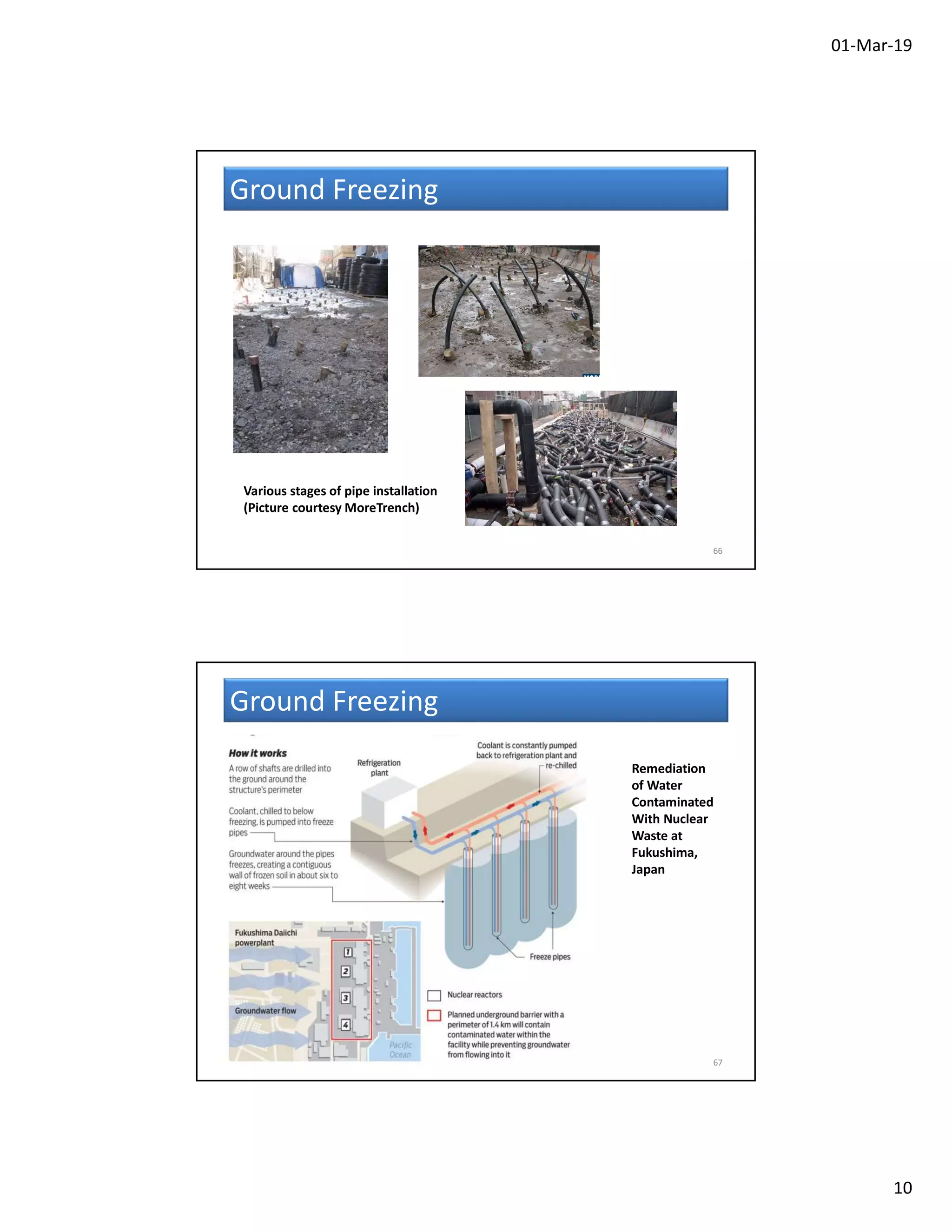
Various stages of pipe installation
(Picture courtesy MoreTrench)
66
Ground Freezing
Remediation
of Water
Contaminated
With Nuclear
Waste at
Fukushima,
Japan
67

ground freezing

  • 1.
    01-Mar-19 1 GROUND FREEZING Consider theundrained shear strength of clay soil: Type of soil Undrained shear strength, su (kPa) Unconfined compressive strength, qu (kPa) Hard soil > 150 kPa > 300 kPa Stiff soil 75 ~ 150 kPa 150 ~ 300 kPa Firm soil 40 ~ 75 kPa 80 ~ 150 kPa Soft soil 20 ~ 40kPa 40 ~ 80 kPa Very soft soil < 20 kPa < 40 kPa Compare this with crushing strength (equivalent to unconfined compressive strength) of ice: qu = 7-25 MPa 48 • When pore water in saturated soil freezes, it imparts a lot of strength to soil (not as much as the crushing strength of ice, of course!) • This is in contrast to normal pore water, which usually reduces shear strength of soil, because of positive pore pressure. • In addition, frozen soil also becomes impermeable, because the pores get blocked. • This property of frozen soil is used to temporarily increase the shear strength of soil and stop seepage to facilitate underground constructions. • This is like grouting, without using any grout! Ground Freezing 49
  • 2.
    01-Mar-19 2  These benefitsdepend upon the network of ice threads within soil particles: o Degree of saturation – there should be good continuation of pore water. o Size of pores – more pore size means larger size of ice threads within soil.  There may be some (about 3%) increase in the soil volume because of freezing, structures to be constructed should be protected from such phenomenon.  After de-freezing (or thawing), porosity may increase to some extent, increasing the permeability of in situ soil.  -7°C may be sufficient to effectively freeze sandy soil, but for clays, -29°C is required. Ground Freezing 50 Applications:  Tunneling through soft soils – to stabilize the soil against collapse and to stop seepage.  Deep excavations : o To stabilize the vertical cuts o To stop seepage  Digging shaft in soil.  Temporary underpinning of structures.  Temporary confinement of hazardous wastes.  Stabilizing silt, where grout cannot penetrate. Ground Freezing 51
  • 3.
    01-Mar-19 3 • Thermal conductivityof water = 0.6 W m-1°C-1 (watt per metre per degree celcius) • Thermal conductivity of soil = 1.4 W m-1°C-1 • Thermal conductivity of ice = 2.2 W m-1°C-1 52 Ground Freezing 53
  • 4.
    01-Mar-19 4 Ground Freezing 54 Plants andequipment for ground freezing: • Refrigeration plant • Coolant • Circulation system • Thermometers Ground Freezing 55
  • 5.
    01-Mar-19 5 Different Methods ofGround Freezing: Indirect, by circulation of a secondary coolant through tubes driven into the ground. Direct, • by circulation of the primary refrigerant fluid through the ground tubes. • by direct injection of a coolant into the ground, such as liquid nitrogen. Ground Freezing 56 Indirect cooling • Primary refrigeration plant is used to abstract heat from a secondary coolant circulating through pipes driven into the ground. • The primary refrigerant most commonly used earlier was Freon, which due to it’s ozone-depleting characteristics had to be phased out. • Other primary refrigerants are ammonia, NH4 (–33.3°C) and carbon dioxide, CO2 – now not commonly used. • The secondary coolant, circulated through the network of tubes in the ground is usually a solution of Calcium Chloride (brine). With a concentration of 30% such a brine has a freezing point well below that of the primary coolant. Ground Freezing 57
  • 6.
  • 7.
    01-Mar-19 7 Direct cooling • Inthis process, the primary refrigerant is circulated through the system of tubes in the ground, extracting the heat directly. Thus , it has a higher efficiency than the indirect process. • Direct freezing time is similar to that for the indirect process. The choice will depend on plant availability, cost of set up and operation, and judgment of the engineer. Ground Freezing Soil heat Primary Refrigerant heat AtmosphereDirect In- direct 60 Liquid Nitrogen (LN2) Method (Direct Cooling Process)  Liquid nitrogen is prepared by compressing and cooling nitrogen gas. LN2 boils at -196°C at normal pressure, absorbing a lot of heat from the surrounding, thereby cooling the surrounding very fast.  With this method, a large refrigeration plant is not necessary at the site, as LN2 can be prepared at a distant plant and brought to the site in insulated tankers. It can be stored on site in insulated containers.  It is advantageous for emergency use, where quick freezing is required without setting up of large plant and equipment.  This is also advantageous on sites away from power supplies.  LN2 can be discharged directly through tubes driven into the ground, and allowed to escape to the atmosphere.  Precautions for adequate ventilation must be taken at site. Otherwise, workers may suffocate. Ground Freezing 61
  • 8.
    01-Mar-19 8 • First, anarray of freezing tubes is installed for liquid nitrogen circulation. • Unlike other types, the coolant is not re-circulated. Instead, the evaporated gas escapes to atmosphere through return pipes. • The speed of ground freezing is much quicker than with other methods, days rather than weeks • However, liquid nitrogen is costly compared to other methods. • The method is particularly appropriate for a short period of freezing up to about 3 weeks. • It may also be used in conjunction with other processes with the same array of freezing tubes and network of insulated distribution pipes. In this case, liquid nitrogen is first used to establish the freeze quickly and is followed by ordinary refrigeration to maintain the frozen condition while construction work is being executed. This can be of particular help when a natural flow of ground water makes initial freezing difficult. Ground Freezing 62 Ground Freezing LN2 Method Schematic Diagram 63
  • 9.
  • 10.
    01-Mar-19 10 Ground Freezing Various stagesof pipe installation (Picture courtesy MoreTrench) 66 Ground Freezing Remediation of Water Contaminated With Nuclear Waste at Fukushima, Japan 67