Biological synthesis of Zn
and Ag nanoparticles from
plants
1
• Nanotechnology is termed as a result of the synthesis, characterization,
exploration and application of nano-sized materials in the event of science and
technology.
• A nanoparticle is a small particle that ranges between 1 to 100 nanometres in
size.
• Nano derived from the Greek word Nanos which means dwarf or extremely small.
2
• The “bottom-up” approach, which implies assembling single atoms and molecules
into larger nanostructures.
• The “top-down” approach, which involves the breaking down of large pieces of
material to generate the required nanostructures from them.
Bottom up
Top down
3
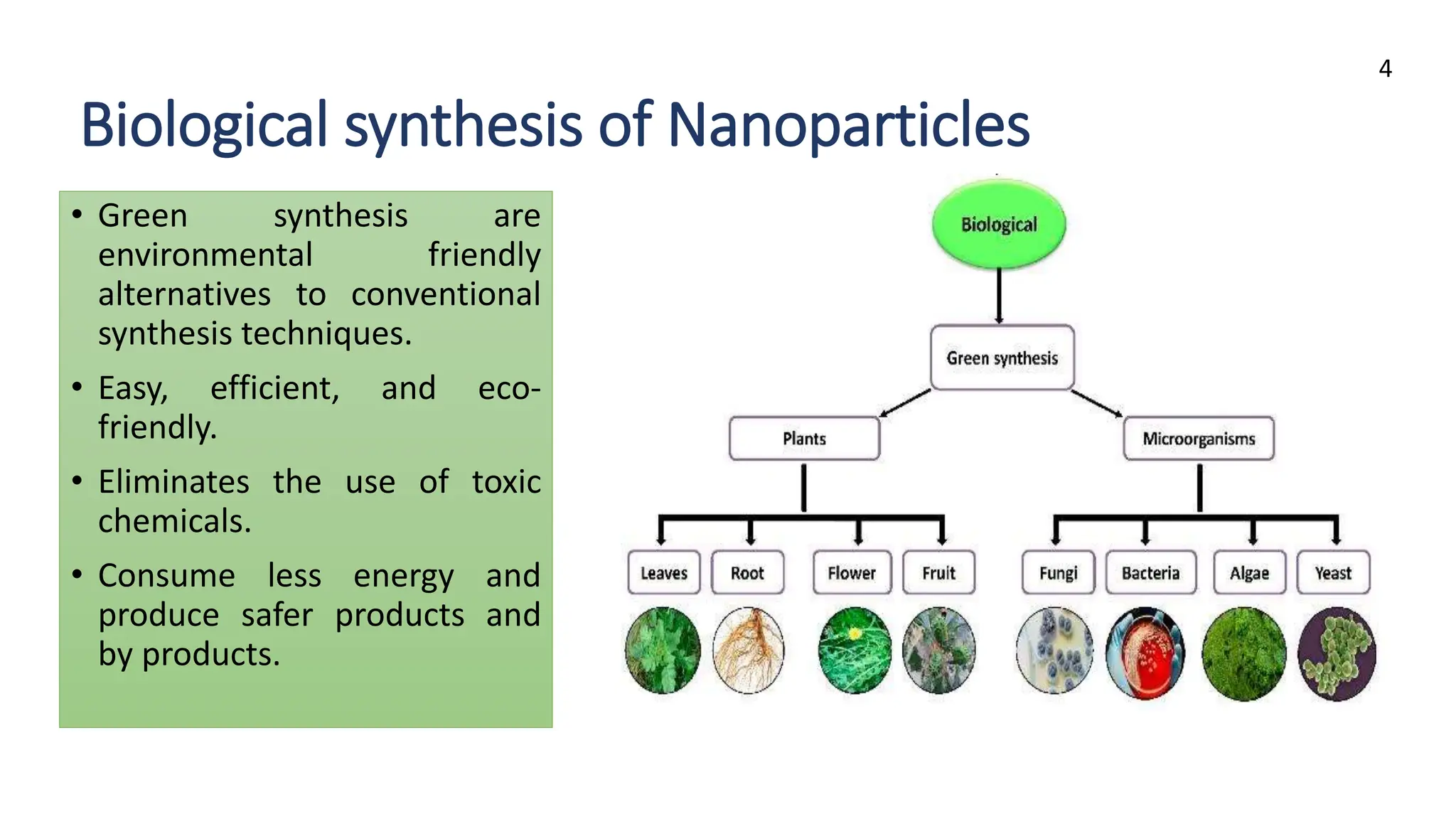
Biological synthesis of Nanoparticles
• Green synthesis are
environmental friendly
alternatives to conventional
synthesis techniques.
• Easy, efficient, and eco-
friendly.
• Eliminates the use of toxic
chemicals.
• Consume less energy and
produce safer products and
by products.
4
Phytonanotechnology
• Phytonanotechnology is the synthesis of nanoparticles using fresh plants or plant
extracts.
• Various plant parts, including leaves, fruits, stems, roots, and their extracts, have
been used for the synthesis of metal nanoparticles.
• The nontoxic nature of plants are suitable for fulfilling the high demand for
nanoparticles.
5
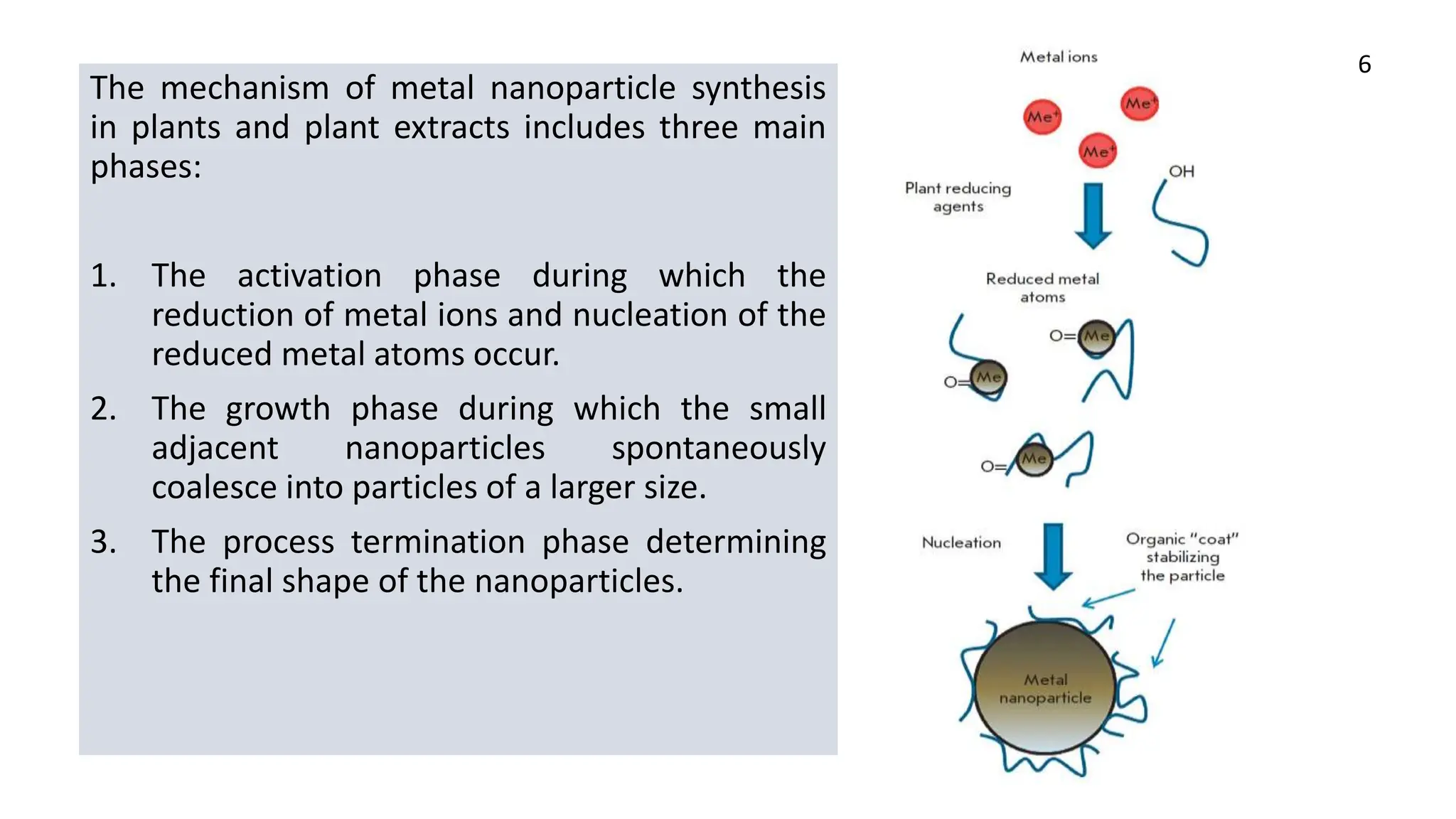
The mechanism of metal nanoparticle synthesis
in plants and plant extracts includes three main
phases:
1. The activation phase during which the
reduction of metal ions and nucleation of the
reduced metal atoms occur.
2. The growth phase during which the small
adjacent nanoparticles spontaneously
coalesce into particles of a larger size.
3. The process termination phase determining
the final shape of the nanoparticles.
6
7
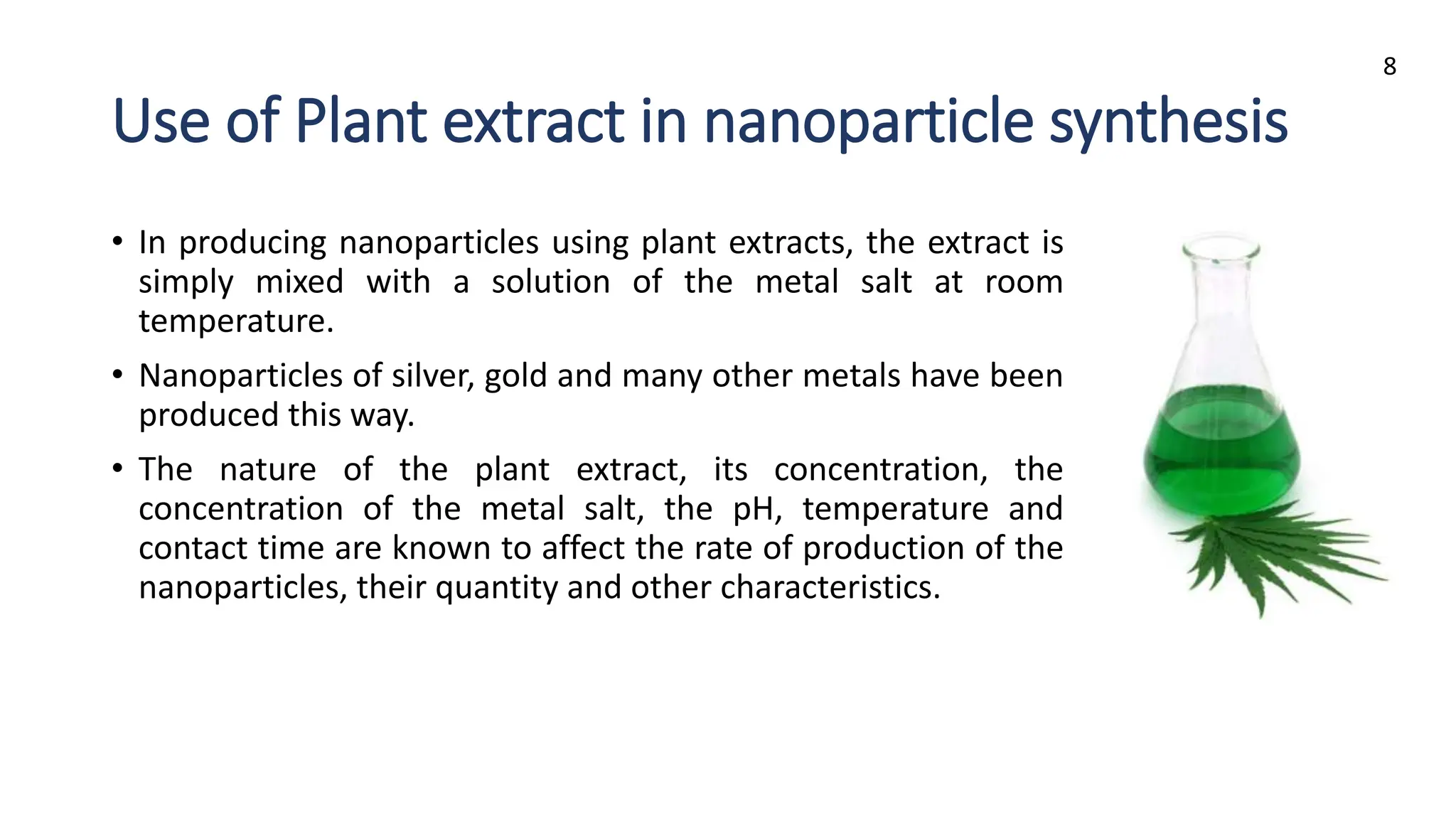
Use of Plant extract in nanoparticle synthesis
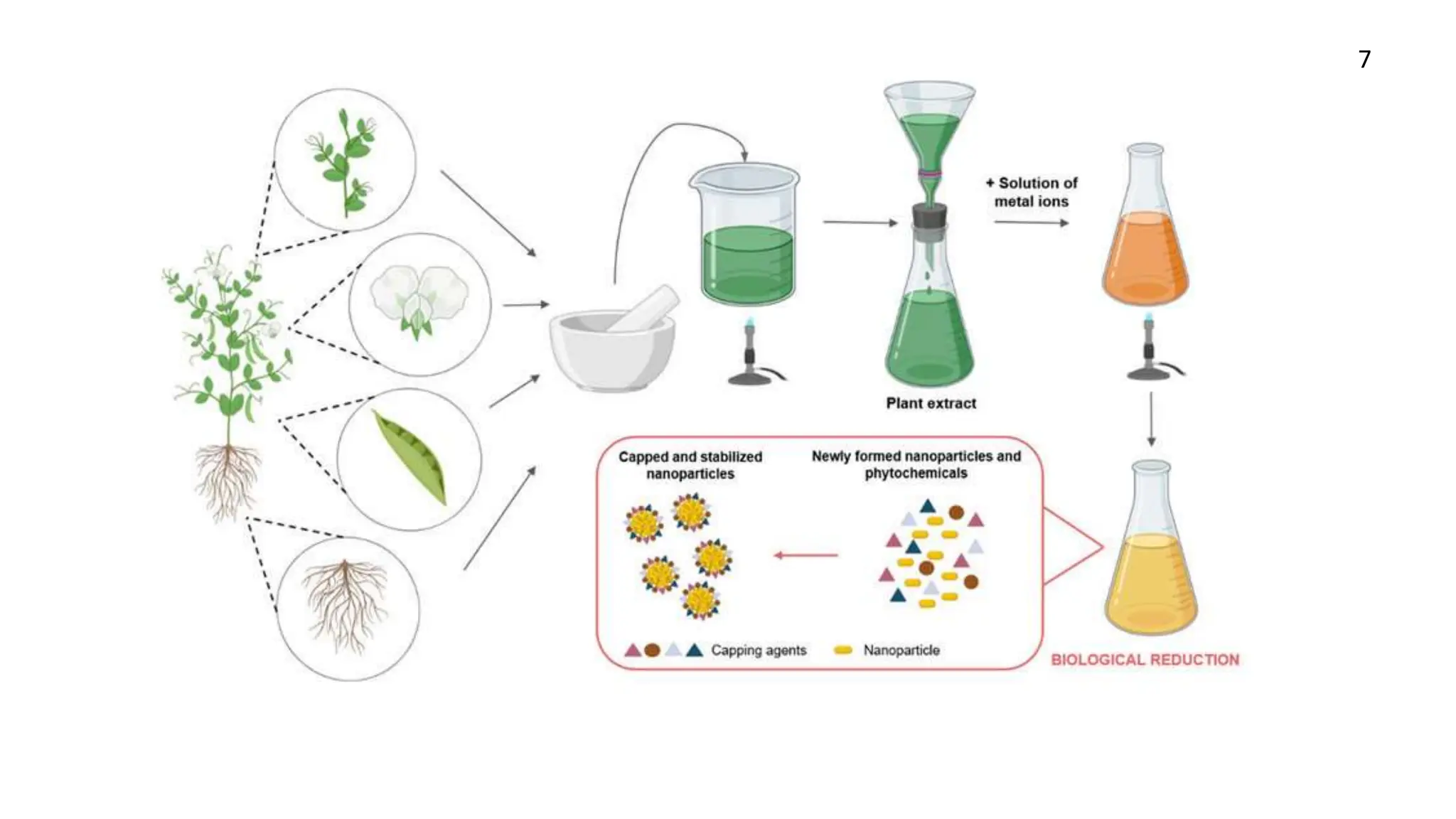
• In producing nanoparticles using plant extracts, the extract is
simply mixed with a solution of the metal salt at room
temperature.
• Nanoparticles of silver, gold and many other metals have been
produced this way.
• The nature of the plant extract, its concentration, the
concentration of the metal salt, the pH, temperature and
contact time are known to affect the rate of production of the
nanoparticles, their quantity and other characteristics.
8
Biological synthesis of Zn nanoparticles from
plants
1. The plants are collected from different sources, they are washed with water.
The plant part (root, stem, leaves, fruit) is ground and immersed in water by
stirring at room temperature for a while. Then, the solutions are filtered and
the eluted extract solution is separated.
2. Afterward, zinc precursors and plant extracts are reacted under various pH and
temperature conditions. The phytochemicals present in the plant extract can
act as reducing agents for converting the metal precursors to metal
nanoparticles.
3. Finally, the obtained powders are washed with methanol or ethanol and
annealed at high temperatures to attain purity.
9
10
Example: Cayratia pedata
Preparation of plant extract
• 50gm of leaves were weighed and crushed using mortar and pestle by adding
sufficient amount of water.
• The extract was then pretreated by boiling it for 15 minutes, followed by filtering
using Whatman No. 1 filter paper.
• In order to remove the debris, it is then centrifuged at 2400rpm for 5 min, and
the supernatant is taken for further experimentation.
11
1. 5ml of Zinc nitrate solution (Zn(NO 3) 2·6H2O) poured into the homogeneous
leaf extracts prepared, and the mixture is stirred at 65°C for 20min.
2. The sample turned light yellow were then collected and allowed to heat
overnight at the same temperature until a thick yellow paste was obtained.
This paste was then dried completely and calcined at 400°C for 2h.
3. Then the characterization of the nanoparticles was done by FTIR, SEM, TEM,
XRD, etc.
12
13
14
Other examples,
1. Brassica oleracea
2. Deverra tortuosa
3. Euphorbia petiolata
4. Punica granatum
5. Mussoende frondosa
6. Eucalyptus globulus
15
Biological synthesis of silver (Ag) nanoparticles
from plants
• Nanoparticles of silver having size range between 1 and 100 nm in size having
unique properties such as electrical, optical and magnetic having wide range of
applicability.
• Plants (especially plant extracts) are able to reduce silver ions faster than fungi
or bacteria.
• In biological synthetic methods, it was shown that the Ag NPs produced by
plants are more stable in comparison with those produced by other organisms.
• Almost all plants have the potential to be exploited to prepare AgNPs.
16
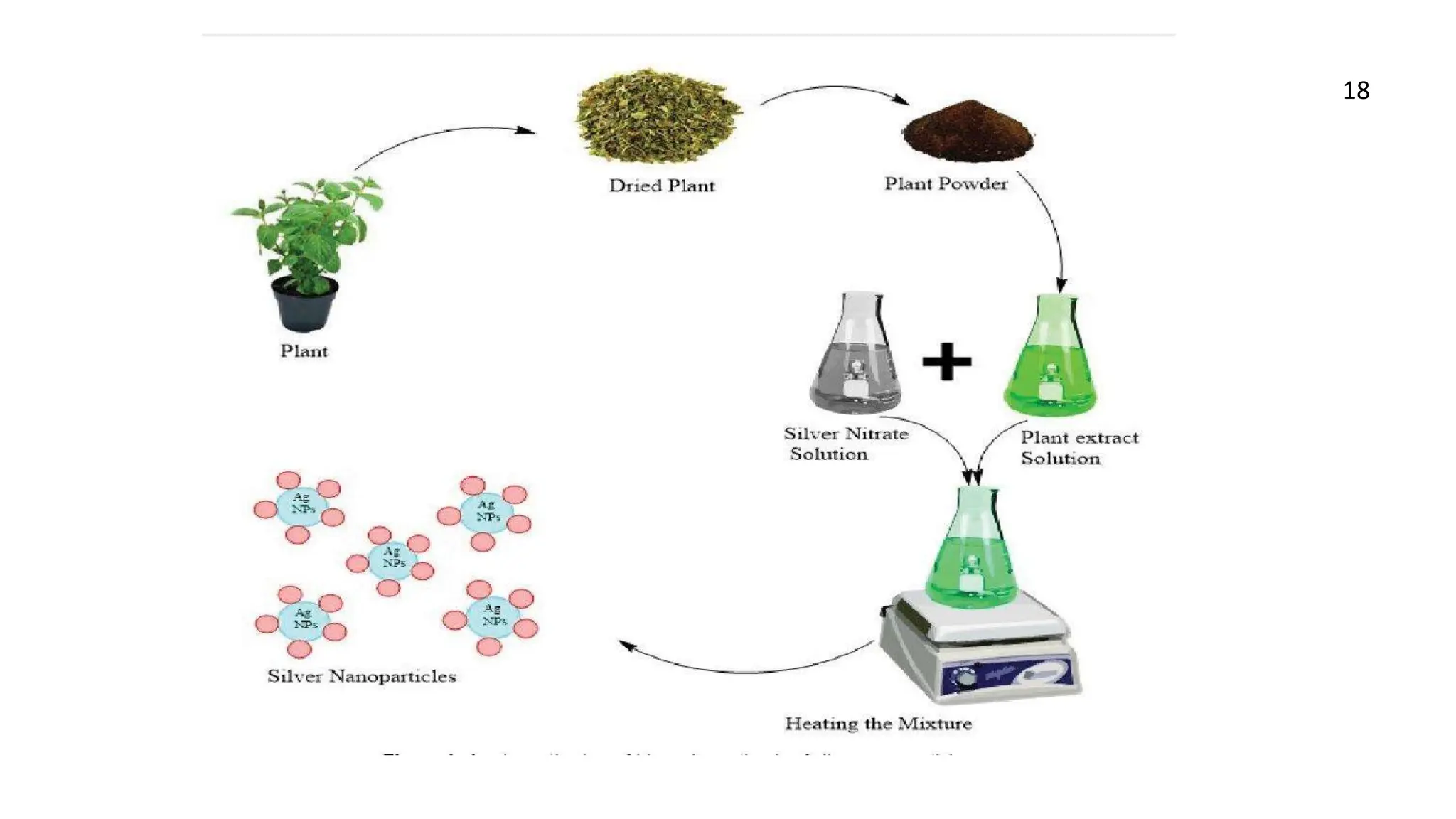
• For the green synthesis of silver
nanoparticles, a silver metal ion
solution and a reducing biological
agent are required.
• The easiest and least expensive
method for producing AgNPs is to
reduce and stabilize Ag ions using a
mixture of biomolecules, such as
polysaccharides, vitamins, amino acids,
proteins, phenolics, saponins,
alkaloids, and/or terpenes.
17
18
Example: Catharanthus roseus
1. Take 10g of C.roseus leaves along with 100ml of distilled water and boil the
mixture for 5 minutes. The extract was filtered through Whatman filter paper
no.1 and stored at -15 °C.
2. The filtrate was treated with aqueous 1 mM AgNO3 solution and incubated at
room temperature. As a result, a brown-yellow solution was formed, indicating
the formation of silver nanoparticles.
19
20
Biological synthesis of gold (Au) nanoparticles
from plants
Leaf extract was inoculated with
an aqueous solution of chloroauric
acid (HAuCla). This short exposure
of leaf broth with aqueous
chloroaurate ions caused a rapid
reduction of the metal ions leading
to the formation of stable gold
nanoparticles of variable size and
shapes.
21
Advantages
• Environmental friendly
• Easily scaled up for large synthesis of nanoparticles
• No need of high temperature, pressure, energy and toxic chemicals
• Reduces cost of microorganism isolation and their culture media
• Zero contamination.
• Free toxicity from hazardous chemical solvent
• Cost effective
• Easily available and does not require rigorous processing
22
Disadvantages
• Plants cannot be manipulated as the choice of nanoparticles through optimized
synthesis through genetic engineering.
• Plant produce low yield of secreted proteins which decreases the synthesis rate.
23
Thank you
25

green synthesis of nanoparticles from plants.pptx

  • 1.
    Biological synthesis ofZn and Ag nanoparticles from plants 1
  • 2.
    • Nanotechnology istermed as a result of the synthesis, characterization, exploration and application of nano-sized materials in the event of science and technology. • A nanoparticle is a small particle that ranges between 1 to 100 nanometres in size. • Nano derived from the Greek word Nanos which means dwarf or extremely small. 2
  • 3.
    • The “bottom-up”approach, which implies assembling single atoms and molecules into larger nanostructures. • The “top-down” approach, which involves the breaking down of large pieces of material to generate the required nanostructures from them. Bottom up Top down 3
  • 4.
    Biological synthesis ofNanoparticles • Green synthesis are environmental friendly alternatives to conventional synthesis techniques. • Easy, efficient, and eco- friendly. • Eliminates the use of toxic chemicals. • Consume less energy and produce safer products and by products. 4
  • 5.
    Phytonanotechnology • Phytonanotechnology isthe synthesis of nanoparticles using fresh plants or plant extracts. • Various plant parts, including leaves, fruits, stems, roots, and their extracts, have been used for the synthesis of metal nanoparticles. • The nontoxic nature of plants are suitable for fulfilling the high demand for nanoparticles. 5
  • 6.
    The mechanism ofmetal nanoparticle synthesis in plants and plant extracts includes three main phases: 1. The activation phase during which the reduction of metal ions and nucleation of the reduced metal atoms occur. 2. The growth phase during which the small adjacent nanoparticles spontaneously coalesce into particles of a larger size. 3. The process termination phase determining the final shape of the nanoparticles. 6
  • 7.
  • 8.
    Use of Plantextract in nanoparticle synthesis • In producing nanoparticles using plant extracts, the extract is simply mixed with a solution of the metal salt at room temperature. • Nanoparticles of silver, gold and many other metals have been produced this way. • The nature of the plant extract, its concentration, the concentration of the metal salt, the pH, temperature and contact time are known to affect the rate of production of the nanoparticles, their quantity and other characteristics. 8
  • 9.
    Biological synthesis ofZn nanoparticles from plants 1. The plants are collected from different sources, they are washed with water. The plant part (root, stem, leaves, fruit) is ground and immersed in water by stirring at room temperature for a while. Then, the solutions are filtered and the eluted extract solution is separated. 2. Afterward, zinc precursors and plant extracts are reacted under various pH and temperature conditions. The phytochemicals present in the plant extract can act as reducing agents for converting the metal precursors to metal nanoparticles. 3. Finally, the obtained powders are washed with methanol or ethanol and annealed at high temperatures to attain purity. 9
  • 10.
  • 11.
    Example: Cayratia pedata Preparationof plant extract • 50gm of leaves were weighed and crushed using mortar and pestle by adding sufficient amount of water. • The extract was then pretreated by boiling it for 15 minutes, followed by filtering using Whatman No. 1 filter paper. • In order to remove the debris, it is then centrifuged at 2400rpm for 5 min, and the supernatant is taken for further experimentation. 11
  • 12.
    1. 5ml ofZinc nitrate solution (Zn(NO 3) 2·6H2O) poured into the homogeneous leaf extracts prepared, and the mixture is stirred at 65°C for 20min. 2. The sample turned light yellow were then collected and allowed to heat overnight at the same temperature until a thick yellow paste was obtained. This paste was then dried completely and calcined at 400°C for 2h. 3. Then the characterization of the nanoparticles was done by FTIR, SEM, TEM, XRD, etc. 12
  • 13.
  • 14.
  • 15.
    Other examples, 1. Brassicaoleracea 2. Deverra tortuosa 3. Euphorbia petiolata 4. Punica granatum 5. Mussoende frondosa 6. Eucalyptus globulus 15
  • 16.
    Biological synthesis ofsilver (Ag) nanoparticles from plants • Nanoparticles of silver having size range between 1 and 100 nm in size having unique properties such as electrical, optical and magnetic having wide range of applicability. • Plants (especially plant extracts) are able to reduce silver ions faster than fungi or bacteria. • In biological synthetic methods, it was shown that the Ag NPs produced by plants are more stable in comparison with those produced by other organisms. • Almost all plants have the potential to be exploited to prepare AgNPs. 16
  • 17.
    • For thegreen synthesis of silver nanoparticles, a silver metal ion solution and a reducing biological agent are required. • The easiest and least expensive method for producing AgNPs is to reduce and stabilize Ag ions using a mixture of biomolecules, such as polysaccharides, vitamins, amino acids, proteins, phenolics, saponins, alkaloids, and/or terpenes. 17
  • 18.
  • 19.
    Example: Catharanthus roseus 1.Take 10g of C.roseus leaves along with 100ml of distilled water and boil the mixture for 5 minutes. The extract was filtered through Whatman filter paper no.1 and stored at -15 °C. 2. The filtrate was treated with aqueous 1 mM AgNO3 solution and incubated at room temperature. As a result, a brown-yellow solution was formed, indicating the formation of silver nanoparticles. 19
  • 20.
  • 21.
    Biological synthesis ofgold (Au) nanoparticles from plants Leaf extract was inoculated with an aqueous solution of chloroauric acid (HAuCla). This short exposure of leaf broth with aqueous chloroaurate ions caused a rapid reduction of the metal ions leading to the formation of stable gold nanoparticles of variable size and shapes. 21
  • 22.
    Advantages • Environmental friendly •Easily scaled up for large synthesis of nanoparticles • No need of high temperature, pressure, energy and toxic chemicals • Reduces cost of microorganism isolation and their culture media • Zero contamination. • Free toxicity from hazardous chemical solvent • Cost effective • Easily available and does not require rigorous processing 22
  • 23.
    Disadvantages • Plants cannotbe manipulated as the choice of nanoparticles through optimized synthesis through genetic engineering. • Plant produce low yield of secreted proteins which decreases the synthesis rate. 23
  • 24.