GREEN
BUILDING
PRESENTATION BY:
ISHA WANJARI
SUJITH NADAR
SHWETA NATHAN
BINAY HAZRA
PRANALI TAJNE
ISHAN KOKATE
ADITI SATHE
KALPESH SHINDE
CONTENTS:
 INTRODUCTION
 OBJECTIVE
 FUNDAMENTAL PRINCIPLES
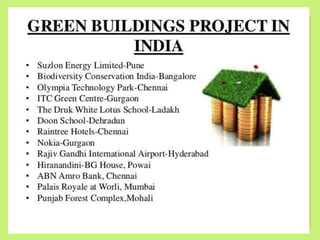
 GREEN BUILDING PROJECTS
 DIFFERENT FROM OTHER BUILDINGS
 INDIAN GREEN BUILDING COUNCIL
 IGBC RATING SYSTEM
 INCREASING GREEN BUILDINGS IN INDIA
 BENEFITS OF GREEN BUILDINGS
 AFFECT ON NATRUAL SOURCES
 CONCLUSION
 REFERENCES
INTRODUCTION:
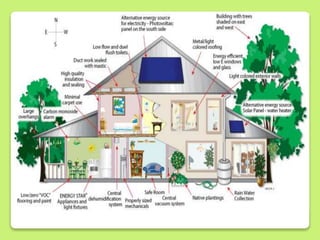
 Green building (also known
as greenconstruction or sustainable building)
refers to both a structure and the using of
processes that are environmentally responsible
and resource-efficient throughout
a building's life-cycle: from siting to design,
construction, operation, maintenance,
renovation, and demolition.
 Sustainable, or "green building," design and
construction provide an opportunity to use
resources more efficiently, while creating
healthier and more energy-efficient homes and
commercial buildings.
 . In other words, green-building design involves
finding the delicate balance between
homebuilding and a sustainable environment.
OBJECTIVE OF GREEN BUILDING
 Green buildings are degined to reduce the
overall impact on human health and the
natrual environment in the following
ways.
 Using energy water and other resources
efficiently
 By reducing waste,pollution and
environmental degradation.
FUNDAMENTAL PRINCIPLES
• STRUCTURE DESIGN
EFFICIENCY
• ENERGY EFFICIENCY
• WATER EFFICIENCY
• MATERIAL EFFIECIENCY
• WASTE AND TOXIC
REDUCTION
STRUCTURE EFFICIENCY
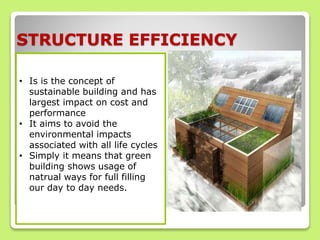
• Is is the concept of
sustainable building and has
largest impact on cost and
performance
• It aims to avoid the
environmental impacts
associated with all life cycles
• Simply it means that green
building shows usage of
natrual ways for full filling
our day to day needs.
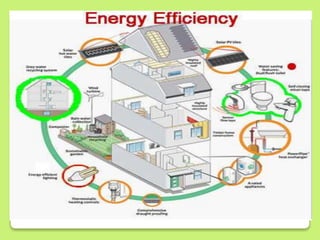
ENERGY EFFICIENCY.
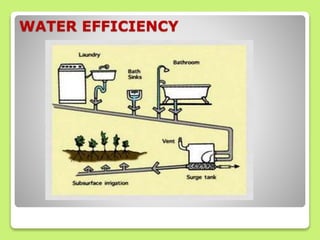
WATER EFFICIENCY
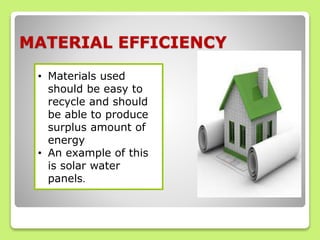
MATERIAL EFFICIENCY
• Materials used
should be easy to
recycle and should
be able to produce
surplus amount of
energy
• An example of this
is solar water
panels.
INDIAN GREEN BUILDING
COUNCIL.
 The Indian Green Building Council (IGBC), part of the
Confederation of Indian Industry (CII) was formed in
the year 2001. The vision of the council is, "To enable
a sustainable built environment for all and facilitate
India to be one of the global leaders in the
sustainable built environment by 2025".

The council offers a wide array of services which
include developing new green building rating
programmes, certification services and green building
training programmes. The council also organises
Green Building Congress, its annual flagship event on
green buildings.
IGBC Vision
"To enable a sustainable
built environment for all
and facilitate India to be
one of the global leaders
in the sustainable built
environment by 2025".
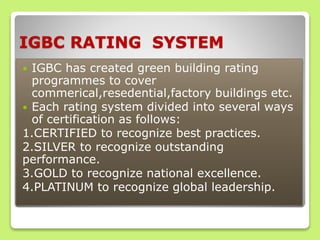
IGBC RATING SYSTEM
 IGBC has created green building rating
programmes to cover
commerical,resedential,factory buildings etc.
 Each rating system divided into several ways
of certification as follows:
1.CERTIFIED to recognize best practices.
2.SILVER to recognize outstanding
performance.
3.GOLD to recognize national excellence.
4.PLATINUM to recognize global leadership.
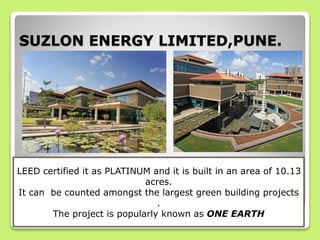
SUZLON ENERGY LIMITED,PUNE.
LEED certified it as PLATINUM and it is built in an area of 10.13
acres.
It can be counted amongst the largest green building projects
.
The project is popularly known as ONE EARTH
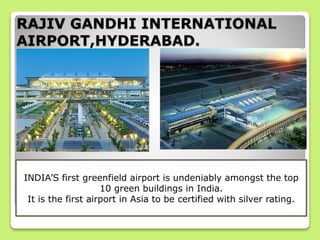
RAJIV GANDHI INTERNATIONAL
AIRPORT,HYDERABAD.
INDIA’S first greenfield airport is undeniably amongst the top
10 green buildings in India.
It is the first airport in Asia to be certified with silver rating.
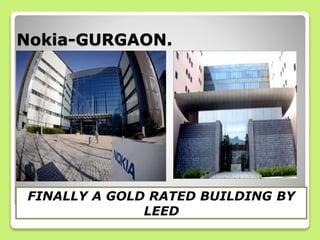
Nokia-GURGAON.
FINALLY A GOLD RATED BUILDING BY
LEED
DIFFERENT FROM ANOTHER
BUILDINGS.
 The design,maintainence and construction of
building have tremendous effect on our
environment and natural resources.
 Green buildings are different from other
buildings because they use minimum amount
of non renewable energy., produces minimal
pollution, increases the comfort, health and
safety of the people who work in them
 It also minimizes the waste in construction by
recovering materials, reusing and recycling
them.
BENEFITS OF GREEN BUILDINGS.
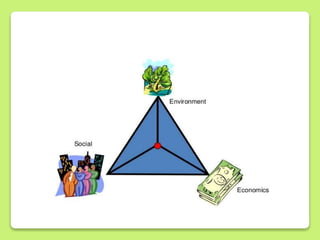
 Buildings have large effect on the
environment, health and the economy.
 The successful adaption of GREEN
BUILDING can maximize both the
ECONOMIC and the ENVIRONMENTAL
performance of the building.
ENVIRONMENTAL BENEFITS.
1.Protect BIODIVERSITY and ECOSYSTEM.
2.Improve air and water quality.
3.Reduce waste streams.
4.Conserve natrual resources
ECONOMIC BENEFITS
1.Reduce operating cost.
2.Create,expand and shape markets for
green products and services.
3.Improve occcupant productivity.
SOCIAL BENEFITS.
1.Enhance occupant comfort and health.
2.Heighten asthetic qualities.
3.Minimize strain on local infrastructure.
4.Improve overall quality of life.
Green building ppt
Green building ppt
Green building ppt
Green building ppt
Green building ppt
Green building ppt

Green building ppt

  • 1.
    GREEN BUILDING PRESENTATION BY: ISHA WANJARI SUJITHNADAR SHWETA NATHAN BINAY HAZRA PRANALI TAJNE ISHAN KOKATE ADITI SATHE KALPESH SHINDE
  • 2.
    CONTENTS:  INTRODUCTION  OBJECTIVE FUNDAMENTAL PRINCIPLES  GREEN BUILDING PROJECTS  DIFFERENT FROM OTHER BUILDINGS  INDIAN GREEN BUILDING COUNCIL  IGBC RATING SYSTEM  INCREASING GREEN BUILDINGS IN INDIA  BENEFITS OF GREEN BUILDINGS  AFFECT ON NATRUAL SOURCES  CONCLUSION  REFERENCES
  • 3.
    INTRODUCTION:  Green building(also known as greenconstruction or sustainable building) refers to both a structure and the using of processes that are environmentally responsible and resource-efficient throughout a building's life-cycle: from siting to design, construction, operation, maintenance, renovation, and demolition.
  • 4.
     Sustainable, or"green building," design and construction provide an opportunity to use resources more efficiently, while creating healthier and more energy-efficient homes and commercial buildings.  . In other words, green-building design involves finding the delicate balance between homebuilding and a sustainable environment.
  • 6.
    OBJECTIVE OF GREENBUILDING  Green buildings are degined to reduce the overall impact on human health and the natrual environment in the following ways.  Using energy water and other resources efficiently  By reducing waste,pollution and environmental degradation.
  • 7.
    FUNDAMENTAL PRINCIPLES • STRUCTUREDESIGN EFFICIENCY • ENERGY EFFICIENCY • WATER EFFICIENCY • MATERIAL EFFIECIENCY • WASTE AND TOXIC REDUCTION
  • 8.
    STRUCTURE EFFICIENCY • Isis the concept of sustainable building and has largest impact on cost and performance • It aims to avoid the environmental impacts associated with all life cycles • Simply it means that green building shows usage of natrual ways for full filling our day to day needs.
  • 9.
  • 10.
  • 11.
    MATERIAL EFFICIENCY • Materialsused should be easy to recycle and should be able to produce surplus amount of energy • An example of this is solar water panels.
  • 12.
    INDIAN GREEN BUILDING COUNCIL. The Indian Green Building Council (IGBC), part of the Confederation of Indian Industry (CII) was formed in the year 2001. The vision of the council is, "To enable a sustainable built environment for all and facilitate India to be one of the global leaders in the sustainable built environment by 2025".  The council offers a wide array of services which include developing new green building rating programmes, certification services and green building training programmes. The council also organises Green Building Congress, its annual flagship event on green buildings.
  • 13.
    IGBC Vision "To enablea sustainable built environment for all and facilitate India to be one of the global leaders in the sustainable built environment by 2025".
  • 14.
    IGBC RATING SYSTEM IGBC has created green building rating programmes to cover commerical,resedential,factory buildings etc.  Each rating system divided into several ways of certification as follows: 1.CERTIFIED to recognize best practices. 2.SILVER to recognize outstanding performance. 3.GOLD to recognize national excellence. 4.PLATINUM to recognize global leadership.
  • 16.
    SUZLON ENERGY LIMITED,PUNE. LEEDcertified it as PLATINUM and it is built in an area of 10.13 acres. It can be counted amongst the largest green building projects . The project is popularly known as ONE EARTH
  • 17.
    RAJIV GANDHI INTERNATIONAL AIRPORT,HYDERABAD. INDIA’Sfirst greenfield airport is undeniably amongst the top 10 green buildings in India. It is the first airport in Asia to be certified with silver rating.
  • 18.
    Nokia-GURGAON. FINALLY A GOLDRATED BUILDING BY LEED
  • 20.
    DIFFERENT FROM ANOTHER BUILDINGS. The design,maintainence and construction of building have tremendous effect on our environment and natural resources.  Green buildings are different from other buildings because they use minimum amount of non renewable energy., produces minimal pollution, increases the comfort, health and safety of the people who work in them  It also minimizes the waste in construction by recovering materials, reusing and recycling them.
  • 22.
    BENEFITS OF GREENBUILDINGS.  Buildings have large effect on the environment, health and the economy.  The successful adaption of GREEN BUILDING can maximize both the ECONOMIC and the ENVIRONMENTAL performance of the building.
  • 23.
    ENVIRONMENTAL BENEFITS. 1.Protect BIODIVERSITYand ECOSYSTEM. 2.Improve air and water quality. 3.Reduce waste streams. 4.Conserve natrual resources
  • 24.
    ECONOMIC BENEFITS 1.Reduce operatingcost. 2.Create,expand and shape markets for green products and services. 3.Improve occcupant productivity.
  • 25.
    SOCIAL BENEFITS. 1.Enhance occupantcomfort and health. 2.Heighten asthetic qualities. 3.Minimize strain on local infrastructure. 4.Improve overall quality of life.