PRESENTED BY:-
AMIT KUMAR
1BI17CV013
BANGALORE INSTITUTE OF TECHNOLOGY
K.R. Road, V.V. Puram, Bangalore- 560004
DEPARTMENT OF CIVIL ENGINEERING
TECHNICAL SEMINAR
ON
GREEN BUILDING
UNDER THE GUIDANCE OF:-
DR. K.V.VIJAYENDRA
PROFESSOR
DEPT. OF CIVIL ENGINEERING
BANGALORE INSTITUTE OF TECHNOLOGY
CONTENTS
 Introduction
 Objective
 Literature Review
 Methodology
 Working principles
 Materials replaced in Green building
 Green building projects in India
 Infinity Benchmark
 Salient features of the Building
 Benefits of Green building
 Advantages & Disadvantages of green building
 Results and discussion
 Conclusion
 References
INTRODUCTION
 Green building (also known as green construction or sustainable building)
expands and complements the building design concerns of economy, utility,
durability, and comfort.
 A Green Building is one which uses less water, optimizes energy efficiency,
conserves natural resources, generates less waste and provides healthier space
for occupants as compared to conventional buildings.
OBJECTIVES
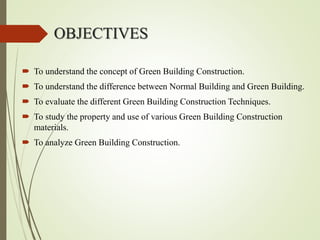
 To understand the concept of Green Building Construction.
 To understand the difference between Normal Building and Green Building.
 To evaluate the different Green Building Construction Techniques.
 To study the property and use of various Green Building Construction
materials.
 To analyze Green Building Construction.
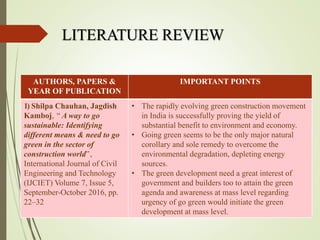
LITERATURE REVIEW
AUTHORS, PAPERS &
YEAR OF PUBLICATION
IMPORTANT POINTS
1) Shilpa Chauhan, Jagdish
Kamboj, “ A way to go
sustainable: Identifying
different means & need to go
green in the sector of
construction world”,
International Journal of Civil
Engineering and Technology
(IJCIET) Volume 7, Issue 5,
September-October 2016, pp.
22–32
• The rapidly evolving green construction movement
in India is successfully proving the yield of
substantial benefit to environment and economy.
• Going green seems to be the only major natural
corollary and sole remedy to overcome the
environmental degradation, depleting energy
sources.
• The green development need a great interest of
government and builders too to attain the green
agenda and awareness at mass level regarding
urgency of go green would initiate the green
development at mass level.
AUTHORS, PAPERS & YEAR
OF PUBLICATION
IMPORTANT POINTS
2) Hemant Kumar, Vaishali
Shah, “ Performance and rating
of residential green building ”,
Civil Engineering and Urban
Planning: An International Journal
(CiVEJ), Vol.2, No.2, June-2015
3.) Geeta Mehta, Amit Mehta,
Bidhan Sharma, “Selection of
material for green construction”,
IOSR Journal of Mechanical and
Civil Engineering (IOSR-JMCE),
Volume 11, Issue 6 Ver. III (Nov-
Dec. 2014), PP 80-83
• The final rating system for small residential
building shows that people are mainly focused
towards conservation & reuse of water and energy
optimization because it is directly related to their
daily usage and cost of living.
• To achieve sustainable development, certain
mandatory criteria must be followed to achieve
good economic, environmental and social system.
• It can be concluded that there are various
materials which can be adopted for green
construction, but we need to select the material
which may be renewable, and causes less harm to
environment.
• The materials chosen must increase energy
efficiency of the structure.
CONTD.
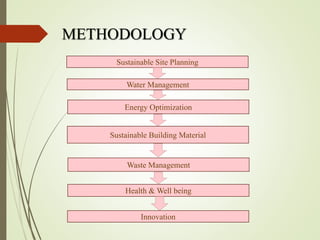
METHODOLOGY
Sustainable Site Planning
Water Management
Energy Optimization
Sustainable Building Material
Waste Management
Health & Well being
Innovation
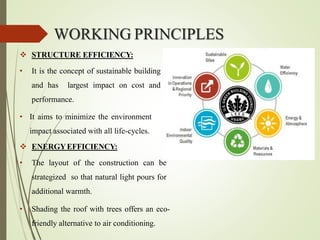
 STRUCTURE EFFICIENCY:
• It is the concept of sustainable building
and has largest impact on cost and
performance.
• It aims to minimize the environment
impact associated with all life-cycles.
 ENERGYEFFICIENCY:
• The layout of the construction can be
strategized so that natural light pours for
additional warmth.
• Shading the roof with trees offers an eco-
friendly alternative to air conditioning.
WORKING PRINCIPLES
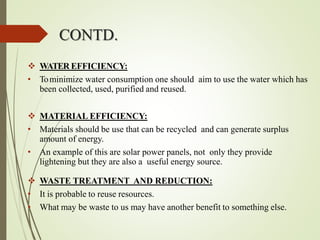
 WATER EFFICIENCY:
• Tominimize water consumption one should aim to use the water which has
been collected, used, purified and reused.
 MATERIAL EFFICIENCY:
• Materials should be use that can be recycled and can generate surplus
amount of energy.
• An example of this are solar power panels, not only they provide
lightening but they are also a useful energy source.
 WASTE TREATMENT AND REDUCTION:
• It is probable to reuse resources.
• What may be waste to us may have another benefit to something else.
CONTD.
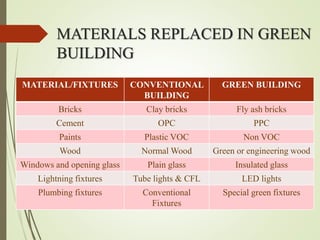
MATERIALS REPLACED IN GREEN
BUILDING
MATERIAL/FIXTURES CONVENTIONAL
BUILDING
GREEN BUILDING
Bricks Clay bricks Fly ash bricks
Cement OPC PPC
Paints Plastic VOC Non VOC
Wood Normal Wood Green or engineering wood
Windows and opening glass Plain glass Insulated glass
Lightning fixtures Tube lights & CFL LED lights
Plumbing fixtures Conventional
Fixtures
Special green fixtures
• Infinity Benchmark- Kolkata
• Suzlon Energy Limited-Pune
• Biodiversity Conservation India-Bangalore
• Olympia Technology Park-Chennai
• ITC Green Centre-Gurgaon
• The Druk White Lotus School-Ladakh
• Doon School-Dehradun
• Raintree Hotels-Chennai
• Nokia-Gurgaon
• Rajiv Gandhi InternationalAirport-Hyderabad
• Hiranandani-BG House, Powai
GREEN BUILDING PROJECTS IN
INDIA
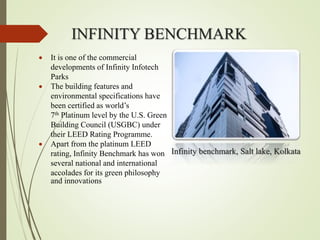
INFINITY BENCHMARK
Infinity benchmark, Salt lake, Kolkata
 It is one of the commercial
developments of Infinity Infotech
Parks
 The building features and
environmental specifications have
been certified as world’s
7th Platinum level by the U.S. Green
Building Council (USGBC) under
their LEED Rating Programme.
 Apart from the platinum LEED
rating, Infinity Benchmark has won
several national and international
accolades for its green philosophy
and innovations
SALIENT FEATURES OF THE
BUILDING
 Indoor air quality
 Zero-discharge water facility
 Effective insulationfor energy efficiency
 Effective glazing
 Electric car for communications
 Ahealthywork environment
 Recyclable constructionmaterial
BENEFITS OF GREEN BUILDING
Environmental Economic Social
• Improve air and water
quality
• Conserve and restore
natural resources
• Reduce waste streams
• Reduce operating
costs
• Improve occupant
productivity
• Enhance assets value
and profits
• Enhance occupant
health and comfort
• Improve indoor air
quality
• Improve overall
quality of life
ADVANTAGES & DISADVANTAGES
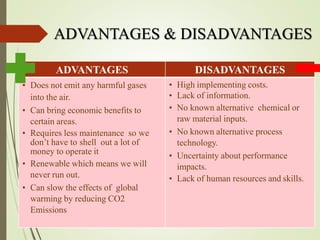
ADVANTAGES DISADVANTAGES
• Does not emit any harmful gases
into the air.
• Can bring economic benefits to
certain areas.
• Requires less maintenance so we
don’t have to shell out a lot of
money to operate it
• Renewable which means we will
never run out.
• Can slow the effects of global
warming by reducing CO2
Emissions
• High implementing costs.
• Lack of information.
• No known alternative chemical or
raw material inputs.
• No known alternative process
technology.
• Uncertainty about performance
impacts.
• Lack of human resources and skills.
RESULT AND DISCUSSION
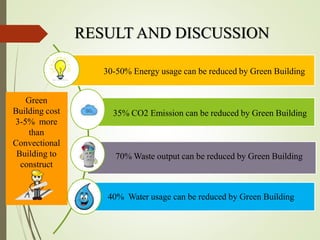
30-50% Energy usage can be reduced by Green Building
35% CO2 Emission can be reduced by Green Building
70% Waste output can be reduced by Green Building
40% Water usage can be reduced by Green Building
Green
Building cost
3-5% more
than
Convectional
Building to
construct
CONCLUSION
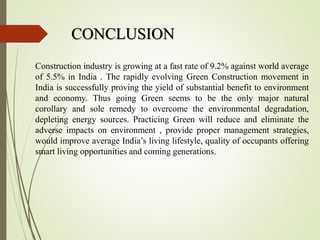
Construction industry is growing at a fast rate of 9.2% against world average
of 5.5% in India . The rapidly evolving Green Construction movement in
India is successfully proving the yield of substantial benefit to environment
and economy. Thus going Green seems to be the only major natural
corollary and sole remedy to overcome the environmental degradation,
depleting energy sources. Practicing Green will reduce and eliminate the
adverse impacts on environment , provide proper management strategies,
would improve average India’s living lifestyle, quality of occupants offering
smart living opportunities and coming generations.
REFERENCES
[1] Shilpa Chauhan, Jagdish Kamboj, “ A way to go sustainable: Identifying
different means & need to go green in the sector of construction world”,
International Journal of Civil Engineering and Technology (IJCIET) Volume 7,
Issue 5, September-October 2016, pp. 22–32.
[2] Hemant Kumar, Vaishali Shah, “Performance and rating of residential green
building”, Civil Engineering and Urban Planning: An International Journal
(CiVEJ), Vol.2, No.2, June-2015.
[3] Geeta Mehta, Amit Mehta, Bidhan Sharma, “Selection of material for green
construction”, IOSR Journal of Mechanical and Civil Engineering (IOSR-
JMCE), Volume 11, Issue 6 Ver. III (Nov-Dec. 2014), PP 80-83.
[4] M. Samer, “T
oward the implementation of Green building concept in
agricultural buildings”, Cairo University, Faculty of Agriculture, Department of
Agricultural Engineering, El-Gammaa Street, 12613 Giza, Egypt, July- 2013.
[5] M. N. Uddin, A. Muthu Selvam, J. Shahoonda, R. Prasanth, “Optimization of
Green Building for Low-income People at Pondicherry”, Centre for Green
Energy Technology, Pondicherry University, Puducherry, India, 2018.
Green building

Green building

  • 1.
    PRESENTED BY:- AMIT KUMAR 1BI17CV013 BANGALOREINSTITUTE OF TECHNOLOGY K.R. Road, V.V. Puram, Bangalore- 560004 DEPARTMENT OF CIVIL ENGINEERING TECHNICAL SEMINAR ON GREEN BUILDING UNDER THE GUIDANCE OF:- DR. K.V.VIJAYENDRA PROFESSOR DEPT. OF CIVIL ENGINEERING BANGALORE INSTITUTE OF TECHNOLOGY
  • 2.
    CONTENTS  Introduction  Objective Literature Review  Methodology  Working principles  Materials replaced in Green building  Green building projects in India  Infinity Benchmark  Salient features of the Building  Benefits of Green building  Advantages & Disadvantages of green building  Results and discussion  Conclusion  References
  • 3.
    INTRODUCTION  Green building(also known as green construction or sustainable building) expands and complements the building design concerns of economy, utility, durability, and comfort.  A Green Building is one which uses less water, optimizes energy efficiency, conserves natural resources, generates less waste and provides healthier space for occupants as compared to conventional buildings.
  • 4.
    OBJECTIVES  To understandthe concept of Green Building Construction.  To understand the difference between Normal Building and Green Building.  To evaluate the different Green Building Construction Techniques.  To study the property and use of various Green Building Construction materials.  To analyze Green Building Construction.
  • 5.
    LITERATURE REVIEW AUTHORS, PAPERS& YEAR OF PUBLICATION IMPORTANT POINTS 1) Shilpa Chauhan, Jagdish Kamboj, “ A way to go sustainable: Identifying different means & need to go green in the sector of construction world”, International Journal of Civil Engineering and Technology (IJCIET) Volume 7, Issue 5, September-October 2016, pp. 22–32 • The rapidly evolving green construction movement in India is successfully proving the yield of substantial benefit to environment and economy. • Going green seems to be the only major natural corollary and sole remedy to overcome the environmental degradation, depleting energy sources. • The green development need a great interest of government and builders too to attain the green agenda and awareness at mass level regarding urgency of go green would initiate the green development at mass level.
  • 6.
    AUTHORS, PAPERS &YEAR OF PUBLICATION IMPORTANT POINTS 2) Hemant Kumar, Vaishali Shah, “ Performance and rating of residential green building ”, Civil Engineering and Urban Planning: An International Journal (CiVEJ), Vol.2, No.2, June-2015 3.) Geeta Mehta, Amit Mehta, Bidhan Sharma, “Selection of material for green construction”, IOSR Journal of Mechanical and Civil Engineering (IOSR-JMCE), Volume 11, Issue 6 Ver. III (Nov- Dec. 2014), PP 80-83 • The final rating system for small residential building shows that people are mainly focused towards conservation & reuse of water and energy optimization because it is directly related to their daily usage and cost of living. • To achieve sustainable development, certain mandatory criteria must be followed to achieve good economic, environmental and social system. • It can be concluded that there are various materials which can be adopted for green construction, but we need to select the material which may be renewable, and causes less harm to environment. • The materials chosen must increase energy efficiency of the structure. CONTD.
  • 7.
    METHODOLOGY Sustainable Site Planning WaterManagement Energy Optimization Sustainable Building Material Waste Management Health & Well being Innovation
  • 8.
     STRUCTURE EFFICIENCY: •It is the concept of sustainable building and has largest impact on cost and performance. • It aims to minimize the environment impact associated with all life-cycles.  ENERGYEFFICIENCY: • The layout of the construction can be strategized so that natural light pours for additional warmth. • Shading the roof with trees offers an eco- friendly alternative to air conditioning. WORKING PRINCIPLES
  • 9.
     WATER EFFICIENCY: •Tominimize water consumption one should aim to use the water which has been collected, used, purified and reused.  MATERIAL EFFICIENCY: • Materials should be use that can be recycled and can generate surplus amount of energy. • An example of this are solar power panels, not only they provide lightening but they are also a useful energy source.  WASTE TREATMENT AND REDUCTION: • It is probable to reuse resources. • What may be waste to us may have another benefit to something else. CONTD.
  • 10.
    MATERIALS REPLACED INGREEN BUILDING MATERIAL/FIXTURES CONVENTIONAL BUILDING GREEN BUILDING Bricks Clay bricks Fly ash bricks Cement OPC PPC Paints Plastic VOC Non VOC Wood Normal Wood Green or engineering wood Windows and opening glass Plain glass Insulated glass Lightning fixtures Tube lights & CFL LED lights Plumbing fixtures Conventional Fixtures Special green fixtures
  • 11.
    • Infinity Benchmark-Kolkata • Suzlon Energy Limited-Pune • Biodiversity Conservation India-Bangalore • Olympia Technology Park-Chennai • ITC Green Centre-Gurgaon • The Druk White Lotus School-Ladakh • Doon School-Dehradun • Raintree Hotels-Chennai • Nokia-Gurgaon • Rajiv Gandhi InternationalAirport-Hyderabad • Hiranandani-BG House, Powai GREEN BUILDING PROJECTS IN INDIA
  • 12.
    INFINITY BENCHMARK Infinity benchmark,Salt lake, Kolkata  It is one of the commercial developments of Infinity Infotech Parks  The building features and environmental specifications have been certified as world’s 7th Platinum level by the U.S. Green Building Council (USGBC) under their LEED Rating Programme.  Apart from the platinum LEED rating, Infinity Benchmark has won several national and international accolades for its green philosophy and innovations
  • 13.
    SALIENT FEATURES OFTHE BUILDING  Indoor air quality  Zero-discharge water facility  Effective insulationfor energy efficiency  Effective glazing  Electric car for communications  Ahealthywork environment  Recyclable constructionmaterial
  • 14.
    BENEFITS OF GREENBUILDING Environmental Economic Social • Improve air and water quality • Conserve and restore natural resources • Reduce waste streams • Reduce operating costs • Improve occupant productivity • Enhance assets value and profits • Enhance occupant health and comfort • Improve indoor air quality • Improve overall quality of life
  • 15.
    ADVANTAGES & DISADVANTAGES ADVANTAGESDISADVANTAGES • Does not emit any harmful gases into the air. • Can bring economic benefits to certain areas. • Requires less maintenance so we don’t have to shell out a lot of money to operate it • Renewable which means we will never run out. • Can slow the effects of global warming by reducing CO2 Emissions • High implementing costs. • Lack of information. • No known alternative chemical or raw material inputs. • No known alternative process technology. • Uncertainty about performance impacts. • Lack of human resources and skills.
  • 16.
    RESULT AND DISCUSSION 30-50%Energy usage can be reduced by Green Building 35% CO2 Emission can be reduced by Green Building 70% Waste output can be reduced by Green Building 40% Water usage can be reduced by Green Building Green Building cost 3-5% more than Convectional Building to construct
  • 17.
    CONCLUSION Construction industry isgrowing at a fast rate of 9.2% against world average of 5.5% in India . The rapidly evolving Green Construction movement in India is successfully proving the yield of substantial benefit to environment and economy. Thus going Green seems to be the only major natural corollary and sole remedy to overcome the environmental degradation, depleting energy sources. Practicing Green will reduce and eliminate the adverse impacts on environment , provide proper management strategies, would improve average India’s living lifestyle, quality of occupants offering smart living opportunities and coming generations.
  • 18.
    REFERENCES [1] Shilpa Chauhan,Jagdish Kamboj, “ A way to go sustainable: Identifying different means & need to go green in the sector of construction world”, International Journal of Civil Engineering and Technology (IJCIET) Volume 7, Issue 5, September-October 2016, pp. 22–32. [2] Hemant Kumar, Vaishali Shah, “Performance and rating of residential green building”, Civil Engineering and Urban Planning: An International Journal (CiVEJ), Vol.2, No.2, June-2015. [3] Geeta Mehta, Amit Mehta, Bidhan Sharma, “Selection of material for green construction”, IOSR Journal of Mechanical and Civil Engineering (IOSR- JMCE), Volume 11, Issue 6 Ver. III (Nov-Dec. 2014), PP 80-83. [4] M. Samer, “T oward the implementation of Green building concept in agricultural buildings”, Cairo University, Faculty of Agriculture, Department of Agricultural Engineering, El-Gammaa Street, 12613 Giza, Egypt, July- 2013. [5] M. N. Uddin, A. Muthu Selvam, J. Shahoonda, R. Prasanth, “Optimization of Green Building for Low-income People at Pondicherry”, Centre for Green Energy Technology, Pondicherry University, Puducherry, India, 2018.