GUIDED BY :
Dr.M.N.HEDAOO PRESENTED BY:
ATHAR KAMIL SHAIKH KASIM
(20001071)
GREEN
BUILDING
GOVERNMENT COLLEGE OF ENGINEERING, AMRAVATI (444604)
(An Autonomous Institute of Government of Maharashtra)
Department of Civil Engineering
1
TABLE OF CONTENTS
Introduction : Green Building
Benefits of Green Building
Factors of Green Building
Materials used in green
construction
Merits and Demerits
Green Buildings in India
Conclusion
References
WHAT IS GREEN BUILDING
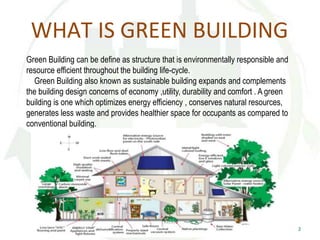
Green Building can be define as structure that is environmentally responsible and
resource efficient throughout the building life-cycle.
Green Building also known as sustainable building expands and complements
the building design concerns of economy ,utility, durability and comfort . A green
building is one which optimizes energy efficiency , conserves natural resources,
generates less waste and provides healthier space for occupants as compared to
conventional building.
2
Green building
The Design and
construction
practices that
significantly reduce
or
eliminate the
negative impact of
buildings on the
environment and its
occupants. Green
Buildings are the
Eco-Friendly
Structures .
The concept of Green
Building Technology
envision a new approach
to save water, energy
and material resources
in the construction and
maintenance of the
buildings and can
reduce or eliminate the
adverse impact of
buildings on the
environment and
occupants.
The fundamental
objectives of green
buildings are to
conserve natural
resources and increase
energy efficiency.
Increasing energy
efficiency involves
harnessing nature to
minimize need for
energy for operation
and maintenance of
the building.
A green building
may cost more up
front, but saves
through lower
operating costs over
the life of the
building. The green
building approach
applies a project life
cycle cost analysis for
determining the
appropriate up-front
expenditure.
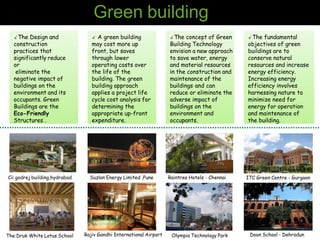
Cii godrej building,hydrabad Suzlon Energy Limited ,Pune ITC Green Centre - Gurgaon
Raintree Hotels - Chennai
The Druk White Lotus School Doon School - Dehradun
Olympia Technology Park
Rajiv Gandhi International Airport
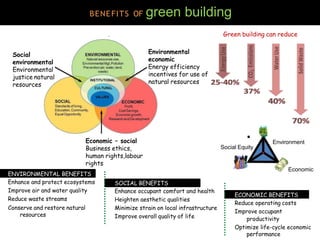
Social
environmental
Environmental
justice natural
resources
Environmental
economic
Energy efficiency
incentives for use of
natural resources
Economic – social
Business ethics,
human rights,labour
rights
BENEFITS OF green building
Green building can reduce
SOCIAL BENEFITS
Enhance occupant comfort and health
Heighten aesthetic qualities
Minimize strain on local infrastructure
Improve overall quality of life
ENVIRONMENTAL BENEFITS
Enhance and protect ecosystems
Improve air and water quality
Reduce waste streams
Conserve and restore natural
resources
ECONOMIC BENEFITS
Reduce operating costs
Improve occupant
productivity
Optimize life-cycle economic
performance
Economic
Social Equity
Environment
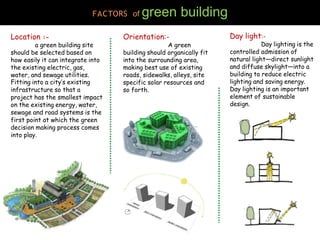
Location :-
a green building site
should be selected based on
how easily it can integrate into
the existing electric, gas,
water, and sewage utilities.
Fitting into a city’s existing
infrastructure so that a
project has the smallest impact
on the existing energy, water,
sewage and road systems is the
first point at which the green
decision making process comes
into play.
Day light:-
Day lighting is the
controlled admission of
natural light—direct sunlight
and diffuse skylight—into a
building to reduce electric
lighting and saving energy.
Day lighting is an important
element of sustainable
design.
FACTORS of green building
Orientation:-
A green
building should organically fit
into the surrounding area,
making best use of existing
roads, sidewalks, alleys, site
specific solar resources and
so forth.
FACTORS of green building
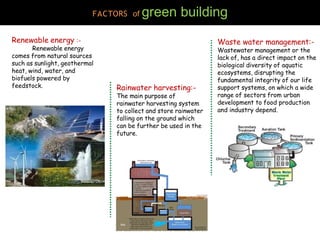
Renewable energy :-
Renewable energy
comes from natural sources
such as sunlight, geothermal
heat, wind, water, and
biofuels powered by
feedstock.
Waste water management:-
Wastewater management or the
lack of, has a direct impact on the
biological diversity of aquatic
ecosystems, disrupting the
fundamental integrity of our life
support systems, on which a wide
range of sectors from urban
development to food production
and industry depend.
Rainwater harvesting:-
The main purpose of
rainwater harvesting system
to collect and store rainwater
falling on the ground which
can be further be used in the
future.
Materials Used In Green
Constructions
7
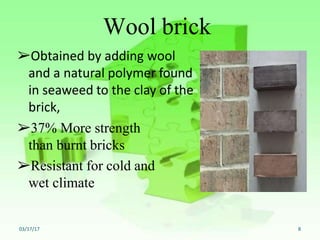
Wool brick
➢Obtained by adding wool
and a natural polymer found
in seaweed to the clay of the
brick,
➢37% More strength
than burnt bricks
➢Resistant for cold and
wet climate
03/17/17 8
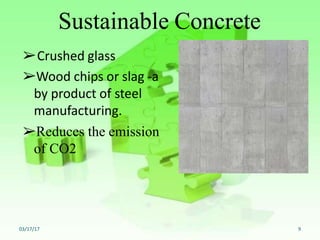
Sustainable Concrete
➢Crushed glass
➢Wood chips or slag -a
by product of steel
manufacturing.
➢Reduces the emission
of CO2
03/17/17 9
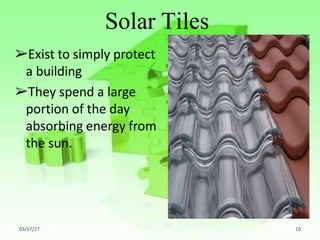
Solar Tiles
➢Exist to simply protect
a building
➢They spend a large
portion of the day
absorbing energy from
the sun.
03/17/17 10
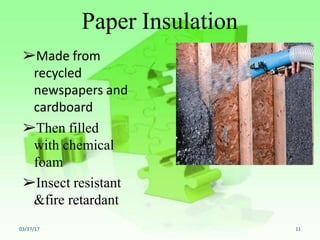
Paper Insulation
➢Made from
recycled
newspapers and
cardboard
➢Then filled
with chemical
foam
➢Insect resistant
&fire retardant
03/17/17 11
Triple-Glazed Windows
➢Super-
efficient
windows
➢Stops heat to enter the
building & from direct
sunlight
03/17/17 12
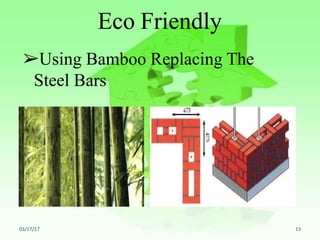
Eco Friendly
➢Using Bamboo Replacing The
Steel Bars
03/17/17 13
Merits & Demerits Of
Green Building
14
Merits Of Green Building
➢
➢
➢
➢
➢
Minimum damage to
Environment
Easier Maintenance Return
On Investment
Improved Indoor Air Quality
Energy Efficiency
Water Efficiency
15
➢Waste Reduction
➢Temperature Moderation
➢Water Conservation
➢Economical Construction For Poor
➢Healthier Lifestyles and
Recreation
➢Improved Health.
16
DEMERITS OF GREEN BUILDING:
➢INITIAL COST IS HIGH
➢AVAILABILITY OF MATERIALS
➢NEED MORE TIME TO CONSTRUCT
➢NEED SKILED WORKER
17
Indian Green Building Council (IGBC)
• Vision of IGBC
– To usher in a green building
revolution in India
– India to become one of the world
leaders in green buildings by 2015
GREEN BUILDING PRACTICES IN INDIA
With 146 certified buildings and spaces, or almost
2.8 million gross square meters , India was placed
third in the world for Leadership in Energy and
Environmental Design (LEED) of green buildings in
2021.
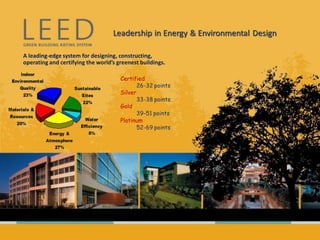
A leading-edge system for designing, constructing,
operating and certifying the world’s greenest buildings.
Certified
26-32 points
Silver
33-38 points
Gold
39-51 points
Platinum
52-69 points
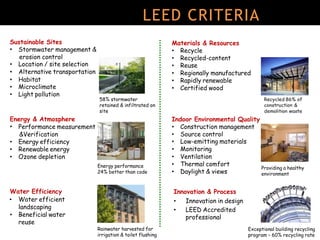
Sustainable Sites
• Stormwater management &
erosion control
• Location / site selection
• Alternative transportation
• Habitat
• Microclimate
• Light pollution
LEED CRITERIA
• Reuse
Materials & Resources
• Recycle
• Recycled-content
• Regionally manufactured
• Rapidly renewable
• Certified wood
Indoor Environmental Quality
• Construction management
• Source control
• Low-emitting materials
• Monitoring
• Ventilation
• Thermal comfort
• Daylight & views
Innovation & Process
• Innovation in design
• LEED Accredited
professional
Exceptional building recycling
program – 60% recycling rate
58% stormwater
retained & infiltrated on
site
Energy & Atmosphere
Water Efficiency
• Water efficient
landscaping
• Beneficial water
reuse
Rainwater harvested for
irrigation & toilet flushing
• Performance measurement
&Verification
• Energy efficiency
• Renewable energy
• Ozone depletion
Energy performance
24% better than code
Providing a healthy
environment
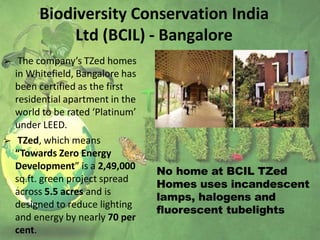
Biodiversity Conservation India
Ltd (BCIL) - Bangalore
➢ The company’s TZed homes
in Whitefield, Bangalore has
been certified as the first
residential apartment in the
world to be rated ‘Platinum’
under LEED.
➢ TZed, which means
“Towards Zero Energy
Development” is a 2,49,000
sq.ft. green project spread
across 5.5 acres and is
designed to reduce lighting
and energy by nearly 70 per
cent.
No home at BCIL TZed
Homes uses incandescent
lamps, halogens and
fluorescent tubelights
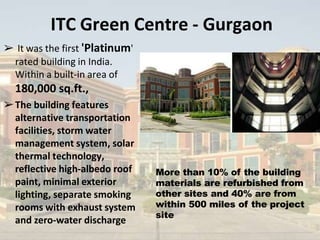
ITC Green Centre - Gurgaon
➢ It was the first 'Platinum'
rated building in India.
Within a built-in area of
180,000 sq.ft.,
➢The building features
alternative transportation
facilities, storm water
management system, solar
thermal technology,
reflective high-albedo roof
paint, minimal exterior
lighting, separate smoking
rooms with exhaust system
and zero-water discharge
More than 10% of the building
materials are refurbished from
other sites and 40% are from
within 500 miles of the project
site
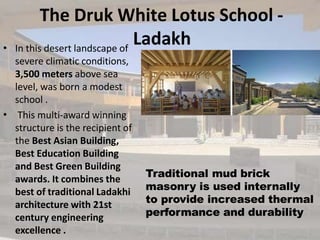
The Druk White Lotus School -
Ladakh
•
•
In this desert landscape of
severe climatic conditions,
3,500 meters above sea
level, was born a modest
school .
This multi-award winning
structure is the recipient of
the Best Asian Building,
Best Education Building
and Best Green Building
awards. It combines the
best of traditional Ladakhi
architecture with 21st
century engineering
excellence .
Traditional mud brick
masonry is used internally
to provide increased thermal
performance and durability
CONCLUSION:
25
Green buildings have tremendous benefits both
tangible and intangible. Most tangible benefits
are substantially reduction in operating energy
and water cost. Intangible benefits are increasing
productivity , better health and healthy
environment to the occupants.
With an increased focus on energy efficiency,
modular construction, green building ratings
systems, technology integration, and occupant
health and well-being we can reduce the
negative impact on environment and it will
ultimately result in more sustainable and livable
shelter for people around the world.
THANK YOU
REFERENCES
• http://www.igbc.in/site/igbc/tests.jsp?event=22869
• http://www.greenbuildingsindia.com/Green- Buildings.html
• http://www.biperusa.org/6-objectives-of-green- building.html
• http://www.brighthub.com/environment/green-
living/articles/51601.aspx
• http://ecenter.colorado.edu/greening-cu/green-
buildinghttp://www.chillibreeze.com/articles/top-10-green-
buildings-in-India-1011.asp
• http://gbindia.wordpress.com/igbc-rating-system-2/

ATHAR PPT.pptx

  • 1.
    GUIDED BY : Dr.M.N.HEDAOOPRESENTED BY: ATHAR KAMIL SHAIKH KASIM (20001071) GREEN BUILDING GOVERNMENT COLLEGE OF ENGINEERING, AMRAVATI (444604) (An Autonomous Institute of Government of Maharashtra) Department of Civil Engineering
  • 2.
    1 TABLE OF CONTENTS Introduction: Green Building Benefits of Green Building Factors of Green Building Materials used in green construction Merits and Demerits Green Buildings in India Conclusion References
  • 3.
    WHAT IS GREENBUILDING Green Building can be define as structure that is environmentally responsible and resource efficient throughout the building life-cycle. Green Building also known as sustainable building expands and complements the building design concerns of economy ,utility, durability and comfort . A green building is one which optimizes energy efficiency , conserves natural resources, generates less waste and provides healthier space for occupants as compared to conventional building. 2
  • 4.
    Green building The Designand construction practices that significantly reduce or eliminate the negative impact of buildings on the environment and its occupants. Green Buildings are the Eco-Friendly Structures . The concept of Green Building Technology envision a new approach to save water, energy and material resources in the construction and maintenance of the buildings and can reduce or eliminate the adverse impact of buildings on the environment and occupants. The fundamental objectives of green buildings are to conserve natural resources and increase energy efficiency. Increasing energy efficiency involves harnessing nature to minimize need for energy for operation and maintenance of the building. A green building may cost more up front, but saves through lower operating costs over the life of the building. The green building approach applies a project life cycle cost analysis for determining the appropriate up-front expenditure. Cii godrej building,hydrabad Suzlon Energy Limited ,Pune ITC Green Centre - Gurgaon Raintree Hotels - Chennai The Druk White Lotus School Doon School - Dehradun Olympia Technology Park Rajiv Gandhi International Airport
  • 5.
    Social environmental Environmental justice natural resources Environmental economic Energy efficiency incentivesfor use of natural resources Economic – social Business ethics, human rights,labour rights BENEFITS OF green building Green building can reduce SOCIAL BENEFITS Enhance occupant comfort and health Heighten aesthetic qualities Minimize strain on local infrastructure Improve overall quality of life ENVIRONMENTAL BENEFITS Enhance and protect ecosystems Improve air and water quality Reduce waste streams Conserve and restore natural resources ECONOMIC BENEFITS Reduce operating costs Improve occupant productivity Optimize life-cycle economic performance Economic Social Equity Environment
  • 6.
    Location :- a greenbuilding site should be selected based on how easily it can integrate into the existing electric, gas, water, and sewage utilities. Fitting into a city’s existing infrastructure so that a project has the smallest impact on the existing energy, water, sewage and road systems is the first point at which the green decision making process comes into play. Day light:- Day lighting is the controlled admission of natural light—direct sunlight and diffuse skylight—into a building to reduce electric lighting and saving energy. Day lighting is an important element of sustainable design. FACTORS of green building Orientation:- A green building should organically fit into the surrounding area, making best use of existing roads, sidewalks, alleys, site specific solar resources and so forth.
  • 7.
    FACTORS of greenbuilding Renewable energy :- Renewable energy comes from natural sources such as sunlight, geothermal heat, wind, water, and biofuels powered by feedstock. Waste water management:- Wastewater management or the lack of, has a direct impact on the biological diversity of aquatic ecosystems, disrupting the fundamental integrity of our life support systems, on which a wide range of sectors from urban development to food production and industry depend. Rainwater harvesting:- The main purpose of rainwater harvesting system to collect and store rainwater falling on the ground which can be further be used in the future.
  • 8.
    Materials Used InGreen Constructions 7
  • 9.
    Wool brick ➢Obtained byadding wool and a natural polymer found in seaweed to the clay of the brick, ➢37% More strength than burnt bricks ➢Resistant for cold and wet climate 03/17/17 8
  • 10.
    Sustainable Concrete ➢Crushed glass ➢Woodchips or slag -a by product of steel manufacturing. ➢Reduces the emission of CO2 03/17/17 9
  • 11.
    Solar Tiles ➢Exist tosimply protect a building ➢They spend a large portion of the day absorbing energy from the sun. 03/17/17 10
  • 12.
    Paper Insulation ➢Made from recycled newspapersand cardboard ➢Then filled with chemical foam ➢Insect resistant &fire retardant 03/17/17 11
  • 13.
    Triple-Glazed Windows ➢Super- efficient windows ➢Stops heatto enter the building & from direct sunlight 03/17/17 12
  • 14.
    Eco Friendly ➢Using BambooReplacing The Steel Bars 03/17/17 13
  • 15.
    Merits & DemeritsOf Green Building 14
  • 16.
    Merits Of GreenBuilding ➢ ➢ ➢ ➢ ➢ Minimum damage to Environment Easier Maintenance Return On Investment Improved Indoor Air Quality Energy Efficiency Water Efficiency 15
  • 17.
    ➢Waste Reduction ➢Temperature Moderation ➢WaterConservation ➢Economical Construction For Poor ➢Healthier Lifestyles and Recreation ➢Improved Health. 16
  • 18.
    DEMERITS OF GREENBUILDING: ➢INITIAL COST IS HIGH ➢AVAILABILITY OF MATERIALS ➢NEED MORE TIME TO CONSTRUCT ➢NEED SKILED WORKER 17
  • 19.
    Indian Green BuildingCouncil (IGBC) • Vision of IGBC – To usher in a green building revolution in India – India to become one of the world leaders in green buildings by 2015 GREEN BUILDING PRACTICES IN INDIA With 146 certified buildings and spaces, or almost 2.8 million gross square meters , India was placed third in the world for Leadership in Energy and Environmental Design (LEED) of green buildings in 2021.
  • 20.
    A leading-edge systemfor designing, constructing, operating and certifying the world’s greenest buildings. Certified 26-32 points Silver 33-38 points Gold 39-51 points Platinum 52-69 points
  • 21.
    Sustainable Sites • Stormwatermanagement & erosion control • Location / site selection • Alternative transportation • Habitat • Microclimate • Light pollution LEED CRITERIA • Reuse Materials & Resources • Recycle • Recycled-content • Regionally manufactured • Rapidly renewable • Certified wood Indoor Environmental Quality • Construction management • Source control • Low-emitting materials • Monitoring • Ventilation • Thermal comfort • Daylight & views Innovation & Process • Innovation in design • LEED Accredited professional Exceptional building recycling program – 60% recycling rate 58% stormwater retained & infiltrated on site Energy & Atmosphere Water Efficiency • Water efficient landscaping • Beneficial water reuse Rainwater harvested for irrigation & toilet flushing • Performance measurement &Verification • Energy efficiency • Renewable energy • Ozone depletion Energy performance 24% better than code Providing a healthy environment
  • 22.
    Biodiversity Conservation India Ltd(BCIL) - Bangalore ➢ The company’s TZed homes in Whitefield, Bangalore has been certified as the first residential apartment in the world to be rated ‘Platinum’ under LEED. ➢ TZed, which means “Towards Zero Energy Development” is a 2,49,000 sq.ft. green project spread across 5.5 acres and is designed to reduce lighting and energy by nearly 70 per cent. No home at BCIL TZed Homes uses incandescent lamps, halogens and fluorescent tubelights
  • 23.
    ITC Green Centre- Gurgaon ➢ It was the first 'Platinum' rated building in India. Within a built-in area of 180,000 sq.ft., ➢The building features alternative transportation facilities, storm water management system, solar thermal technology, reflective high-albedo roof paint, minimal exterior lighting, separate smoking rooms with exhaust system and zero-water discharge More than 10% of the building materials are refurbished from other sites and 40% are from within 500 miles of the project site
  • 24.
    The Druk WhiteLotus School - Ladakh • • In this desert landscape of severe climatic conditions, 3,500 meters above sea level, was born a modest school . This multi-award winning structure is the recipient of the Best Asian Building, Best Education Building and Best Green Building awards. It combines the best of traditional Ladakhi architecture with 21st century engineering excellence . Traditional mud brick masonry is used internally to provide increased thermal performance and durability
  • 25.
    CONCLUSION: 25 Green buildings havetremendous benefits both tangible and intangible. Most tangible benefits are substantially reduction in operating energy and water cost. Intangible benefits are increasing productivity , better health and healthy environment to the occupants. With an increased focus on energy efficiency, modular construction, green building ratings systems, technology integration, and occupant health and well-being we can reduce the negative impact on environment and it will ultimately result in more sustainable and livable shelter for people around the world.
  • 26.
  • 27.
    REFERENCES • http://www.igbc.in/site/igbc/tests.jsp?event=22869 • http://www.greenbuildingsindia.com/Green-Buildings.html • http://www.biperusa.org/6-objectives-of-green- building.html • http://www.brighthub.com/environment/green- living/articles/51601.aspx • http://ecenter.colorado.edu/greening-cu/green- buildinghttp://www.chillibreeze.com/articles/top-10-green- buildings-in-India-1011.asp • http://gbindia.wordpress.com/igbc-rating-system-2/