

Firoz.GSK & Sravanthi. M
II B.Tech (2013), Civil Engineering,
G.Pulla Reddy Engineering College
(Autonomous)
Kurnool,Andhra Pradesh.
An Approach towards Pollution Prevention
The goal of the “GREEN BUILDINGS” is to reduce the impact of construction on the
environment.
Green buildings slowly becoming more accepted but it is not occurring fast enough and needs a
booster to help it integrate into modern society more efficiently & effectively! Green buildings will ensure
that the environment stops being devastated at its current rate and that there will still be forests populating the
Earth 50 years from now and beyond. Consumers, Designers and builders have many alternative energy
sources that they are able to choose from and implement into their homes and buildings if they choose to
construct green buildings or convert existing buildings into green buildings. To assit the shift into green
buildings, the United States Green Buildings Council established Leadership in Energy and Environmental
Design (LEED) to provide the public with a frame work on building sustainable, green buildings. The
adoption of green buildings can be achieved through the use of teaching, quality and availability incentives
and government regulations.
Green building - also known as
sustainable or high performance
building - is the practice of :-
• Increasing the efficiency with
which buildings and their sites use
and harvest energy, water, and
materials; and
• Protecting and restoring human
health and the environment,
throughout the building life-cycle:
siting, design, construction,
operation, maintenance, renovation
and deconstruction.
INTRODUCTION
The `Green Building' concept is
gaining importance in various
countries, including India. These
are buildings that ensure that
waste is minimized at every stage
during the construction and
operation of the building, resulting
in low costs, according to experts
in the technology.
• The techniques associated with the
`Green Building' include measures to
prevent erosion of soil, rainwater
harvesting, preparation of landscapes
to reduce heat, reduction in usage of
potable water, recycling of waste water
and use of world class energy efficient
practices.
Continution…..
 Materials, production, use and disposal must be
safe for the planet. Most of the materials have
specific range of conditions in which they best work
 Sustainable building materials have the following
features :-
1) Durable and easily maintained
2) Less processing required
3) Low odour
4) Low emitting
5) Cost-effective
6) Aesthetic
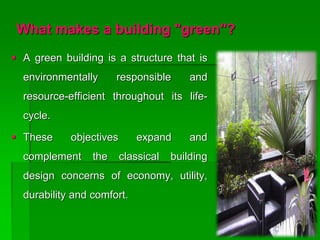
What makes a building "green"?
 A green building is a structure that is
environmentally responsible and
resource-efficient throughout its life-
cycle.
 These objectives expand and
complement the classical building
design concerns of economy, utility,
durability and comfort.
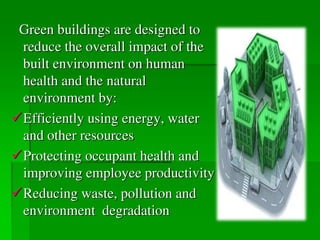
Green buildings are designed to
reduce the overall impact of the
built environment on human
health and the natural
environment by:
Efficiently using energy, water
and other resources
Protecting occupant health and
improving employee productivity
Reducing waste, pollution and
environment degradation
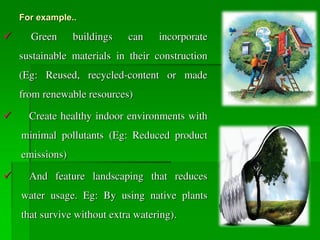
For example..
 Green buildings can incorporate
sustainable materials in their construction
(Eg: Reused, recycled-content or made
from renewable resources)
 Create healthy indoor environments with
minimal pollutants (Eg: Reduced product
emissions)
 And feature landscaping that reduces
water usage. Eg: By using native plants
that survive without extra watering).
How can homes become GREEN..
Types of Buildings
 Residential buildings
 Institutional buildings
 Commercial Buildings
 Laboratories
 Health care Facilities
Benefits of Green Buildings..
Buildings have an enormous impact
on the :-
a) Environment
b) Human health &
c) Economy
The successful adoption of green
building strategies can maximize
both the economic and
environmental performance of
buildings.
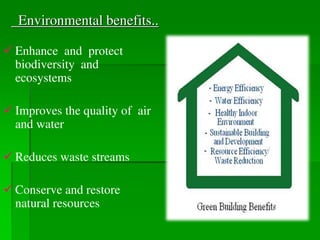
Environmental benefits..
 Enhance and protect
biodiversity and
ecosystems
 Improves the quality of air
and water
 Reduces waste streams
 Conserve and restore
natural resources
Economic benefits..
Reduces operating costs
Create, expand and shape
markets for green product
and services
Improves occupant productivity
Optimize life-cycle economic
performance
Social benefits..
Enhance occupant comfort and health
Heighten aesthetic qualities
Minimize strain on local infrastructure
Improve overall quality of life
How do buildings affect natural
resources?
 Buildings and development have significant environmental
impacts on our natural resources including.
 According to surveys conducted in 2002, 107.3 million acres of
the 1.983 billion acres of total land area in the U.S. is developed,
which represents an increase of 24% in developed land over the
past 10 years.
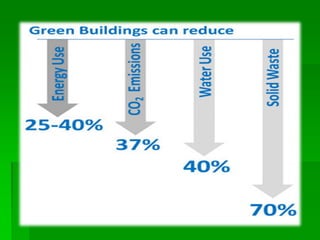
 In terms of energy, buildings accounted for 39.4% of total U.S.
energy consumption and 67.9 percent of total U.S. electricity
consumption in 2002.
Cont…
 Building occupants use 12.2% of the total water consumed in the
U.S. per day.
 Buildings and the transportation infrastructure that serves them,
replace natural surfaces with impermeable materials, creating
runoff that washes pollutants and sediments into surface waters.
Urban runoff constitutes a major threat to water resources, as it has
been identified as the fourth leading source of impairment in rivers,
third in lakes and second on estuaries.
How do buildings affect climate change?
o The energy used for heat and power of
our buildings leads to the consumption of
large amounts of energy, mainly from
burning fossil fuels - oil, natural gas and
coal - which generate significant amounts
of carbon dioxide (CO2), the most
widespread greenhouse gas. Buildings in
the U.S. contribute 38.1% of the nation's
total carbon dioxide emissions.
Cont….
o Reducing the energy use and greenhouse gas emissions
produced by buildings is therefore fundamental to the effort
to slow the pace of global climate change. Buildings may be
associated with the release of greenhouse gases in other
ways, for example, construction and demolition debris that
degrades in landfills may generate methane, and the
extraction and manufacturing of building materials may also
generate greenhouse gas emissions.
www.usgbc.org – US Green Building Council
www.usgbc.org/Resources/links.asp - Extensive Resource List
www.greenerbuildings.com
The HOK Guidebook to Sustainable Design
WWW.Oikos.com
www.iso.org – ISO 14001 EMS
www.epa.gov/ems/index.htm - EPA’ EMS i e
www.doe.gov – US DOE
www.epa.gov – US EPA
www.housing.sc.edu/westquadhandbook.asp - West Quad
Handbook
www.buildinggreen.com – Environmental Building News
www.edcmag.com – Environmental Design & Construction
www.gbapgh.org – Green Building Alliance
www.greenglobes.com – Green Globes
Green buildings

Green buildings

  • 1.
    Firoz.GSK & Sravanthi.M II B.Tech (2013), Civil Engineering, G.Pulla Reddy Engineering College (Autonomous) Kurnool,Andhra Pradesh. An Approach towards Pollution Prevention
  • 2.
    The goal ofthe “GREEN BUILDINGS” is to reduce the impact of construction on the environment. Green buildings slowly becoming more accepted but it is not occurring fast enough and needs a booster to help it integrate into modern society more efficiently & effectively! Green buildings will ensure that the environment stops being devastated at its current rate and that there will still be forests populating the Earth 50 years from now and beyond. Consumers, Designers and builders have many alternative energy sources that they are able to choose from and implement into their homes and buildings if they choose to construct green buildings or convert existing buildings into green buildings. To assit the shift into green buildings, the United States Green Buildings Council established Leadership in Energy and Environmental Design (LEED) to provide the public with a frame work on building sustainable, green buildings. The adoption of green buildings can be achieved through the use of teaching, quality and availability incentives and government regulations.
  • 3.
    Green building -also known as sustainable or high performance building - is the practice of :- • Increasing the efficiency with which buildings and their sites use and harvest energy, water, and materials; and • Protecting and restoring human health and the environment, throughout the building life-cycle: siting, design, construction, operation, maintenance, renovation and deconstruction. INTRODUCTION
  • 4.
    The `Green Building'concept is gaining importance in various countries, including India. These are buildings that ensure that waste is minimized at every stage during the construction and operation of the building, resulting in low costs, according to experts in the technology.
  • 5.
    • The techniquesassociated with the `Green Building' include measures to prevent erosion of soil, rainwater harvesting, preparation of landscapes to reduce heat, reduction in usage of potable water, recycling of waste water and use of world class energy efficient practices. Continution…..
  • 6.
     Materials, production,use and disposal must be safe for the planet. Most of the materials have specific range of conditions in which they best work  Sustainable building materials have the following features :- 1) Durable and easily maintained 2) Less processing required 3) Low odour 4) Low emitting 5) Cost-effective 6) Aesthetic
  • 7.
    What makes abuilding "green"?  A green building is a structure that is environmentally responsible and resource-efficient throughout its life- cycle.  These objectives expand and complement the classical building design concerns of economy, utility, durability and comfort.
  • 8.
    Green buildings aredesigned to reduce the overall impact of the built environment on human health and the natural environment by: Efficiently using energy, water and other resources Protecting occupant health and improving employee productivity Reducing waste, pollution and environment degradation
  • 9.
    For example..  Greenbuildings can incorporate sustainable materials in their construction (Eg: Reused, recycled-content or made from renewable resources)  Create healthy indoor environments with minimal pollutants (Eg: Reduced product emissions)  And feature landscaping that reduces water usage. Eg: By using native plants that survive without extra watering).
  • 10.
    How can homesbecome GREEN..
  • 11.
    Types of Buildings Residential buildings  Institutional buildings  Commercial Buildings  Laboratories  Health care Facilities
  • 12.
    Benefits of GreenBuildings.. Buildings have an enormous impact on the :- a) Environment b) Human health & c) Economy The successful adoption of green building strategies can maximize both the economic and environmental performance of buildings.
  • 13.
    Environmental benefits..  Enhanceand protect biodiversity and ecosystems  Improves the quality of air and water  Reduces waste streams  Conserve and restore natural resources
  • 15.
    Economic benefits.. Reduces operatingcosts Create, expand and shape markets for green product and services Improves occupant productivity Optimize life-cycle economic performance
  • 16.
    Social benefits.. Enhance occupantcomfort and health Heighten aesthetic qualities Minimize strain on local infrastructure Improve overall quality of life
  • 17.
    How do buildingsaffect natural resources?  Buildings and development have significant environmental impacts on our natural resources including.  According to surveys conducted in 2002, 107.3 million acres of the 1.983 billion acres of total land area in the U.S. is developed, which represents an increase of 24% in developed land over the past 10 years.  In terms of energy, buildings accounted for 39.4% of total U.S. energy consumption and 67.9 percent of total U.S. electricity consumption in 2002.
  • 18.
    Cont…  Building occupantsuse 12.2% of the total water consumed in the U.S. per day.  Buildings and the transportation infrastructure that serves them, replace natural surfaces with impermeable materials, creating runoff that washes pollutants and sediments into surface waters. Urban runoff constitutes a major threat to water resources, as it has been identified as the fourth leading source of impairment in rivers, third in lakes and second on estuaries.
  • 19.
    How do buildingsaffect climate change? o The energy used for heat and power of our buildings leads to the consumption of large amounts of energy, mainly from burning fossil fuels - oil, natural gas and coal - which generate significant amounts of carbon dioxide (CO2), the most widespread greenhouse gas. Buildings in the U.S. contribute 38.1% of the nation's total carbon dioxide emissions.
  • 20.
    Cont…. o Reducing theenergy use and greenhouse gas emissions produced by buildings is therefore fundamental to the effort to slow the pace of global climate change. Buildings may be associated with the release of greenhouse gases in other ways, for example, construction and demolition debris that degrades in landfills may generate methane, and the extraction and manufacturing of building materials may also generate greenhouse gas emissions.
  • 26.
    www.usgbc.org – USGreen Building Council www.usgbc.org/Resources/links.asp - Extensive Resource List www.greenerbuildings.com The HOK Guidebook to Sustainable Design WWW.Oikos.com www.iso.org – ISO 14001 EMS www.epa.gov/ems/index.htm - EPA’ EMS i e www.doe.gov – US DOE www.epa.gov – US EPA www.housing.sc.edu/westquadhandbook.asp - West Quad Handbook www.buildinggreen.com – Environmental Building News www.edcmag.com – Environmental Design & Construction www.gbapgh.org – Green Building Alliance www.greenglobes.com – Green Globes