
Manar Ramadan
 Why energy efficiency buildings?
 Goal 11: Sustainable cities and communities
 Life time sustainability
 Reduction in fuel and electricity bills cost
 Low running cost on the building life cycle
 Environmental friendly
• Lower energy demand
• Less operating costEconomically
• Less dependence on fossil fuels (Co2 emissions)
• Less pressure on the environment and resources
• Sustainable energy access
Environment
• Healthier for the individuals
• Natural healthy setting will increase people’s
productivity
Socially
 i. Site selection
 Distance from basic services
 Low altitude winter sun spot (passive solar heating)
 Natural wind shelters (less heat loss)
 Renewable energy potential spots
 ii. Building form and orientation
 Compact building (A/V ratio)
 Longer sides facing the south (light, heat)
 Projects like bay and dormer should be kept to minimum
 Pitched roofs towards the south for solar collection
 iii. Energy assessment
What kind of energy will be used? Solar? Bio?
Calculation of consumption and compare alternatives
(i) Insulation:
 Both ceilings and floors
 Avoid thermal bridges (more heat loss, condensation)
(ii) Ventilation:
 Adequate openings to
assure efficient natural
ventilation
 Mechanical ventilation
 with heat recovery
(iii) Passive solar features
 Avoid increased south facing glass areas
 Choose windowns with low emissivity
 Choose double glazing to reduce heat loss
 Well fitting curtains on glasses
 (iv) Building material
 It should have least environmental impact
 Long life and durability
 Recyclable
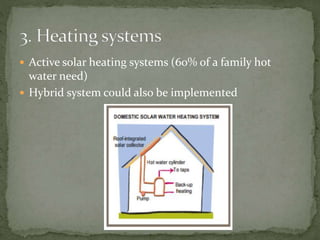
 Active solar heating systems (60% of a family hot
water need)
 Hybrid system could also be implemented
 Grey water recycle
 Laundry and toilet flushing
 Irrigation: nutrients (P,N ) excellent for the plants
 Rain water harvesting
 Waste management
 Bio fuel
 Compoting
Planning and building energy efficiency buildings

Planning and building energy efficiency buildings

  • 1.
  • 2.
     Why energyefficiency buildings?
  • 3.
     Goal 11:Sustainable cities and communities  Life time sustainability  Reduction in fuel and electricity bills cost  Low running cost on the building life cycle  Environmental friendly
  • 4.
    • Lower energydemand • Less operating costEconomically • Less dependence on fossil fuels (Co2 emissions) • Less pressure on the environment and resources • Sustainable energy access Environment • Healthier for the individuals • Natural healthy setting will increase people’s productivity Socially
  • 5.
     i. Siteselection  Distance from basic services  Low altitude winter sun spot (passive solar heating)  Natural wind shelters (less heat loss)  Renewable energy potential spots
  • 6.
     ii. Buildingform and orientation  Compact building (A/V ratio)  Longer sides facing the south (light, heat)  Projects like bay and dormer should be kept to minimum  Pitched roofs towards the south for solar collection  iii. Energy assessment What kind of energy will be used? Solar? Bio? Calculation of consumption and compare alternatives
  • 7.
    (i) Insulation:  Bothceilings and floors  Avoid thermal bridges (more heat loss, condensation) (ii) Ventilation:  Adequate openings to assure efficient natural ventilation  Mechanical ventilation  with heat recovery
  • 8.
    (iii) Passive solarfeatures  Avoid increased south facing glass areas  Choose windowns with low emissivity  Choose double glazing to reduce heat loss  Well fitting curtains on glasses  (iv) Building material  It should have least environmental impact  Long life and durability  Recyclable
  • 9.
     Active solarheating systems (60% of a family hot water need)  Hybrid system could also be implemented
  • 10.
     Grey waterrecycle  Laundry and toilet flushing  Irrigation: nutrients (P,N ) excellent for the plants  Rain water harvesting  Waste management  Bio fuel  Compoting

Editor's Notes

  • #4 Assuring sustainable use of the resources and savings for the building life time Apart from reducing fuel and electricity bills, an energy-efficient building design can provide improved comfort for occupants while helping to protect the environment. It can also provide insurance against future increases in fuel costs. The aim of this paper is to provide broad headingsthat should be taken in consideration while building/ buying a building
  • #6 - Distance from basic services: The energy consumed in driving in access to work places, schools, public transport routes could be reduced to the minimum when the site is perfectly being selected close to those services. - Transmission of sunshine through windows (passive solar heating) can reduce heating costs. The selection of a site which is exposed to the low-altitude winter sun can allow for passive solar heating. - Surrounding of height as a shelter from wind to reduce heat loss: Locations sheltered from the wind, heat loss from the building can be reduced. Shelter can be provided by nearby trees, adjacent buildings or surrounding hills. If no such shelter exists, it can be provided in time through planting trees or shrubs. - Locations that are potential for renewable energy intervention: in a good location in terms of solar energy and wind energy exposure, or the ability to install underground bio fuel digester, to be used later in heating or power supply of the building Building form and orientation: A compact building (minimum surface-to-volume ratio), closer to rectangular shape is best for reducing heat loss.
  • #7 Building form and orientation: - A compact building (minimum surface-to-volume ratio), closer to rectangular shape is best for reducing heat loss. - Adjustment of the longer facades facing south can allow for increased passive solar heating, day-lighting and natural ventilation which will eventually decrease energy cost. - Projections such as bay and dormer windows should be kept to a minimum, since by increasing the surface-to-volume ratio of the building, they will increase heat loss. They also tend to be more difficult to insulate effectively. Pitched roofs for solar collection: should have one slope oriented south to allow for optimum performance of a roof-mounted or roof-integrated active solar heating system. Energy assessment: Many decisions affecting the energy performance of a house are taken early in the design process. A method of calculating annual heating energy consumption should be used to compare alternatives at the preliminary design stage.
  • #8 Building fabrics and structure: Insulation - High level of insulation should be distributed over all the building sides in roof, likewise on floor for example to minimize the heat loss. Higher level of insulation that required is economically justified on the long run. - Avoid thermal bridges: Short circuit during insulations which leads to higher heat transfer resulting in an overall reduction in thermal insulation of the building and possible condensation problems. Ventilation Controlled vents should be installed in every room; slot vents incorporated in window frames can ensure a reasonable amount of continuous fresh air and can be opened up or closed down to a minimum as required. Never seal up a house completely, as a minimum of fresh air is required for health and safety reasons. A balanced ventilation system involving fans, ductwork and a heat exchanger can transfer heat from warm stale outgoing air to incoming fresh air (this is called “mechanical ventilation with heat recovery”). Stale air is usually extracted from rooms such as kitchens and bathrooms, and warmed fresh air supplied to living rooms and bedrooms.
  • #9 Passive solar features Avoid increasing south-facing glazed areas. Otherwise additional measures will be required to avoid overheating in summer and excessive heat loss at night and on overcast days in winter. Windows should have a high resistance to heat loss. ‘Lowemissivity’ double glazing, which has a special coating to reduce heat loss, is required. Well-fitting curtains can help to retain heat at night. Building material The building materials selected should have minimum environmental impact during their entire life cycle, including extraction, manufacture, use and disposal. Building components should be designed for long life and durability, and ideally should be recyclable at the end of their operating lives.
  • #10 Heating systems (Solar) Solar Active solar heating systems, including a solar collector on a south-facing roof, can contribute to heating needs with about 60% of a family hot water need. The system can be connected to backup conventional heating system.
  • #11 Other points that should be taken in consideration Grey water recycling system: recycling any domestic wastewater, including water coming out of sinks and showers, and excluding sewage. With proper treatment greywater can be put to good use. These uses include: water for laundry and toilet flushing Irrigation of plants: both food and nonfood producing plants. The nutrients in the greywater (such as phosphorus and nitrogen) provide an excellent food source for these plants. Waste management: In the implementation phase, underground bio fuel reservoir should be constructed and all organic waste of the house should be thrown there. The gas produced should be compressed and transmitted in pipe lines for cooking purposes for example. Organic waste also could be used as compost for home gardening