Prepared by
Dr. Nedhal Al-Tamimi
Arch. Eng. Dept.,
Faculty of Engineering
Najran University, KSA
naaltamimi@nu.edu.sa
Designing
Building
Envelope
Lecture No.
5
Climatic Design AE 353-2
Scope
of
Presentation
1. Overview
2. Building Envelope Definition
3. Building Envelope Components
4. What is Building Envelope Do?
5. Differentiating Passive vs. Active Design
6. How to protect the Buildings from the Sun
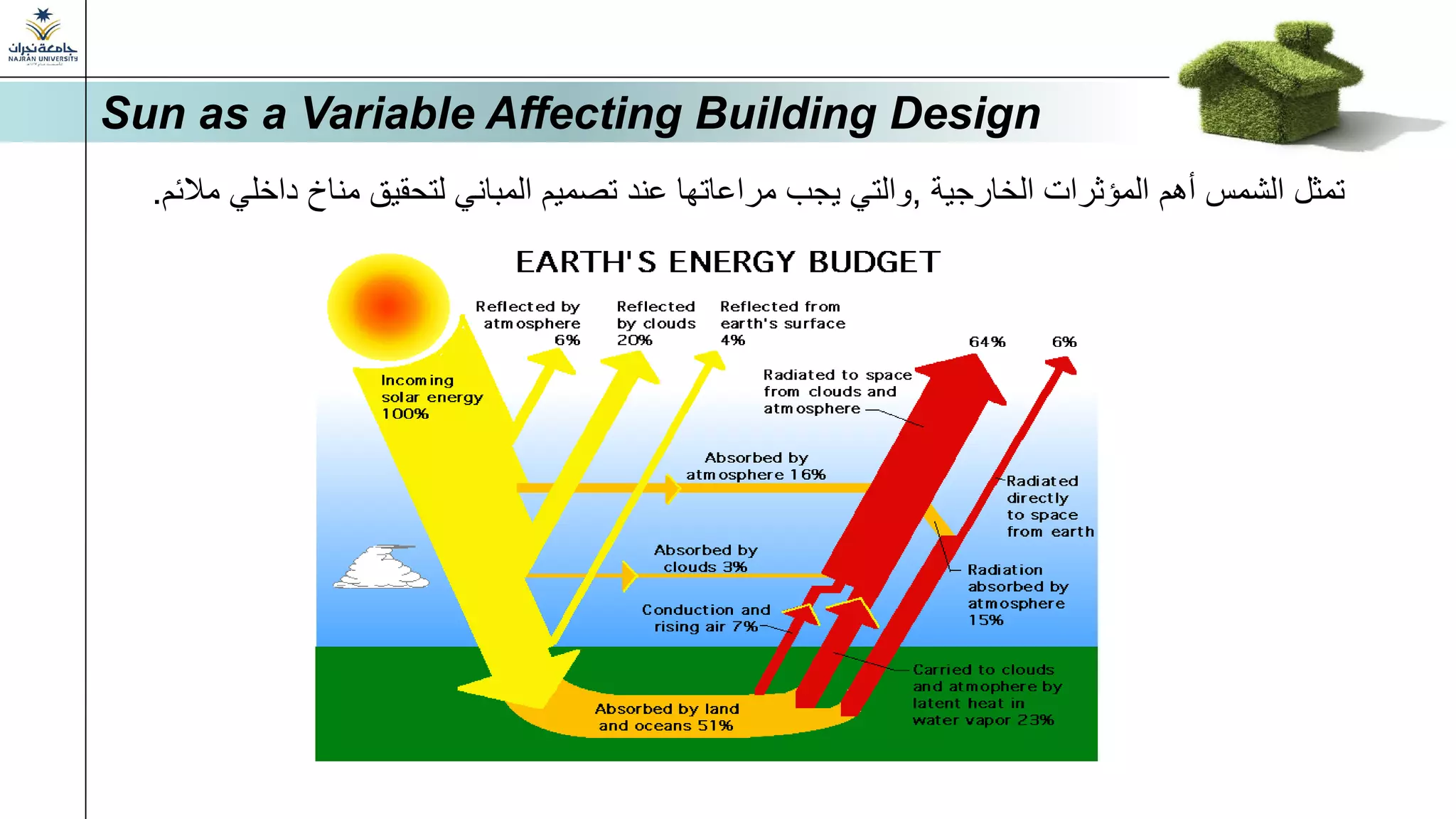
‫الخارجية‬ ‫المؤثرات‬ ‫أهم‬ ‫الشمس‬ ‫تمثل‬
,
‫المباني‬ ‫تصميم‬ ‫عند‬ ‫مراعاتها‬ ‫يجب‬ ‫والتي‬
‫لتحقيق‬
‫مالئ‬ ‫داخلي‬ ‫مناخ‬
‫م‬
.
Sun as a Variable Affecting Building Design
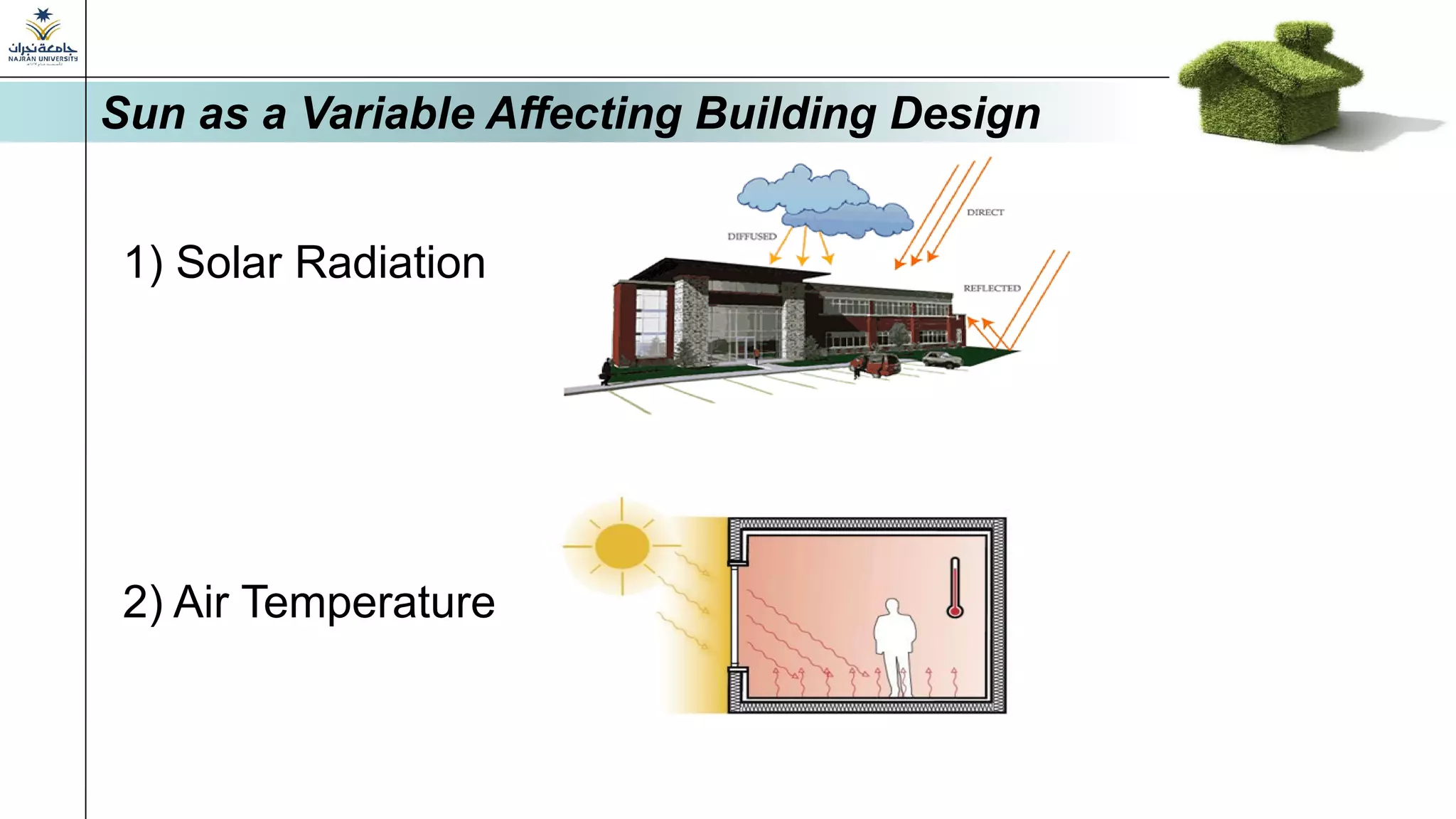
1) Solar Radiation
2) Air Temperature
Sun Effects on Buildings
Sun as a Variable Affecting Building Design
Humans first created shelters to provide thermal comfort and protection
from natural elements, and this still remains a primary objective of
buildings.
Definition:
The Building Envelope: is the physical separator between the interior
and exterior of a building.
The building is not just a shelter, or a barrier against unwanted influences (rain,
wind, cold), but the building envelope should be considered as a selective filter:
to exclude the unwanted influences, but admit the desirable and useful ones,
such as daylight, solar radiation in winter or natural ventilation.
Sun and daylight are admitted or rejected; breezes and sounds are channelled or
deflected; and rain is repelled or collected.
Building Envelope Definition
Components of the envelope are typically:
walls, floors, roofs, fenestrations and doors .
Fenestration:
are any opening in the structure: windows, skylights, etc.
When designing the building envelope, knowing some
fundamentals of building materials and heat transfer will
help to make the right trade-off decisions.
Building Envelope Components
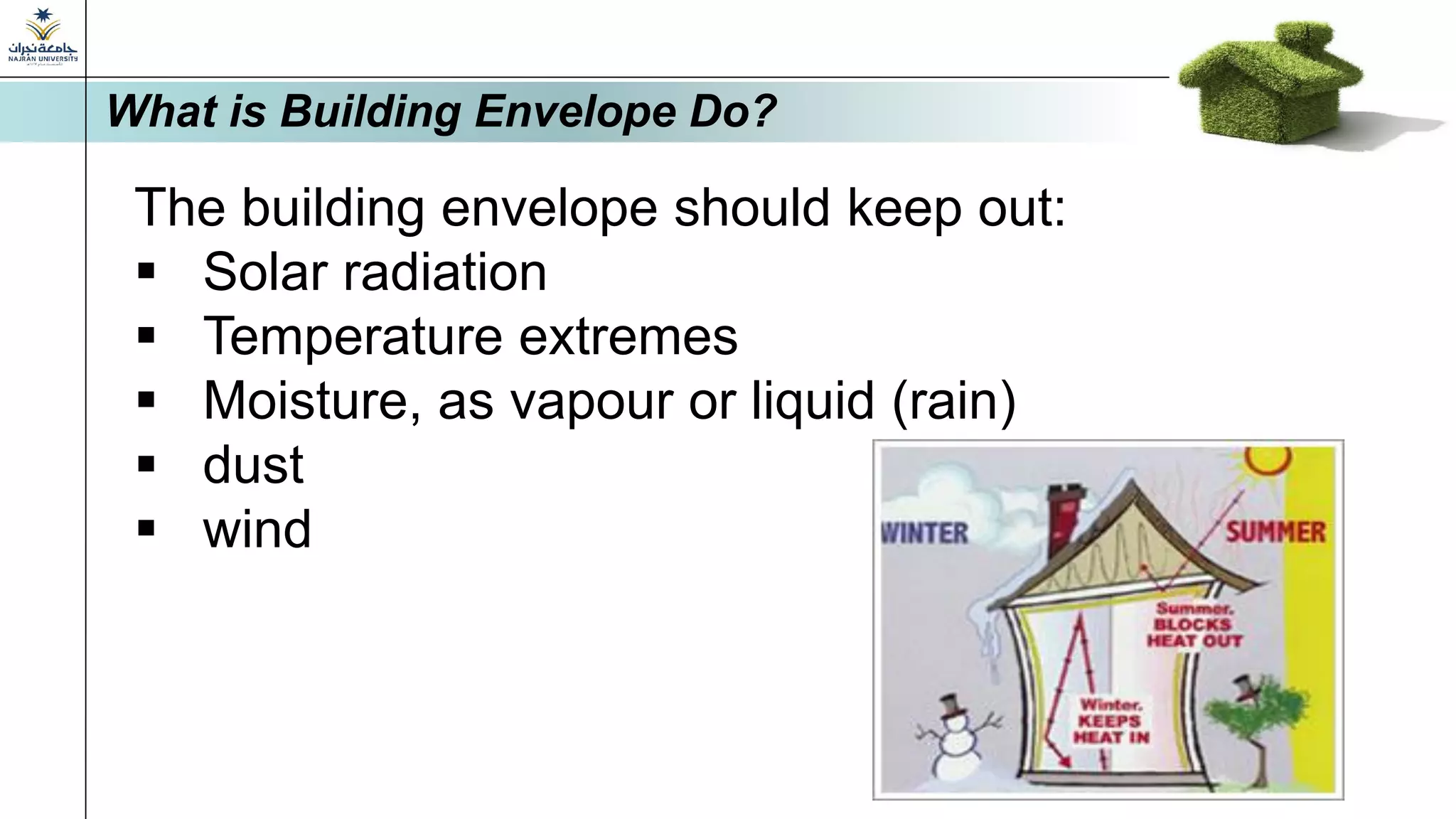
The building envelope should keep out:
▪ Solar radiation
▪ Temperature extremes
▪ Moisture, as vapour or liquid (rain)
▪ dust
▪ wind
What is Building Envelope Do?
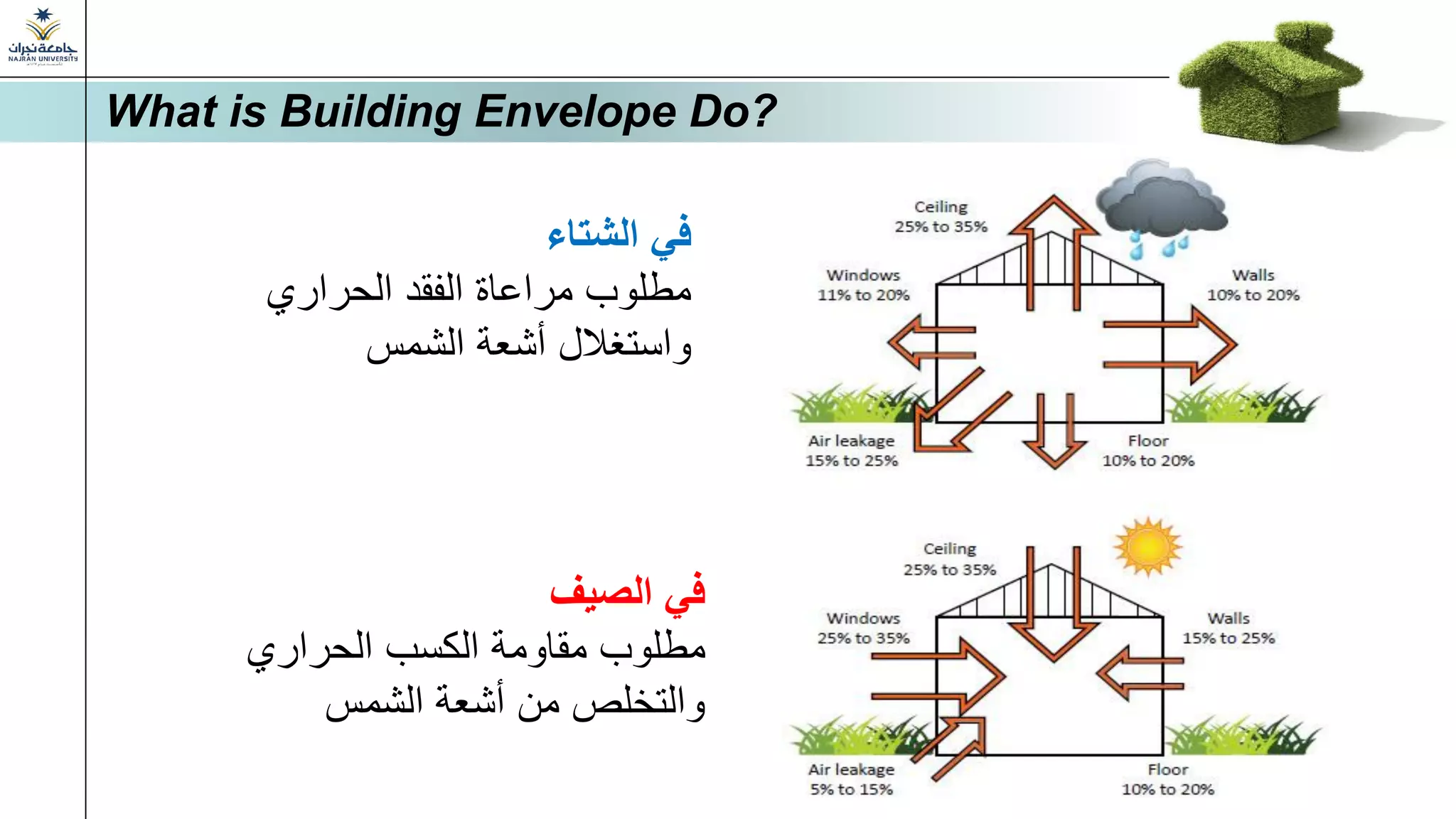
‫الشتاء‬ ‫في‬
‫الحراري‬ ‫الفقد‬ ‫مراعاة‬ ‫مطلوب‬
‫الشمس‬ ‫أشعة‬ ‫واستغالل‬
‫الصيف‬ ‫في‬
‫الحراري‬ ‫الكسب‬ ‫مقاومة‬ ‫مطلوب‬
‫الشمس‬ ‫أشعة‬ ‫من‬ ‫والتخلص‬
What is Building Envelope Do?
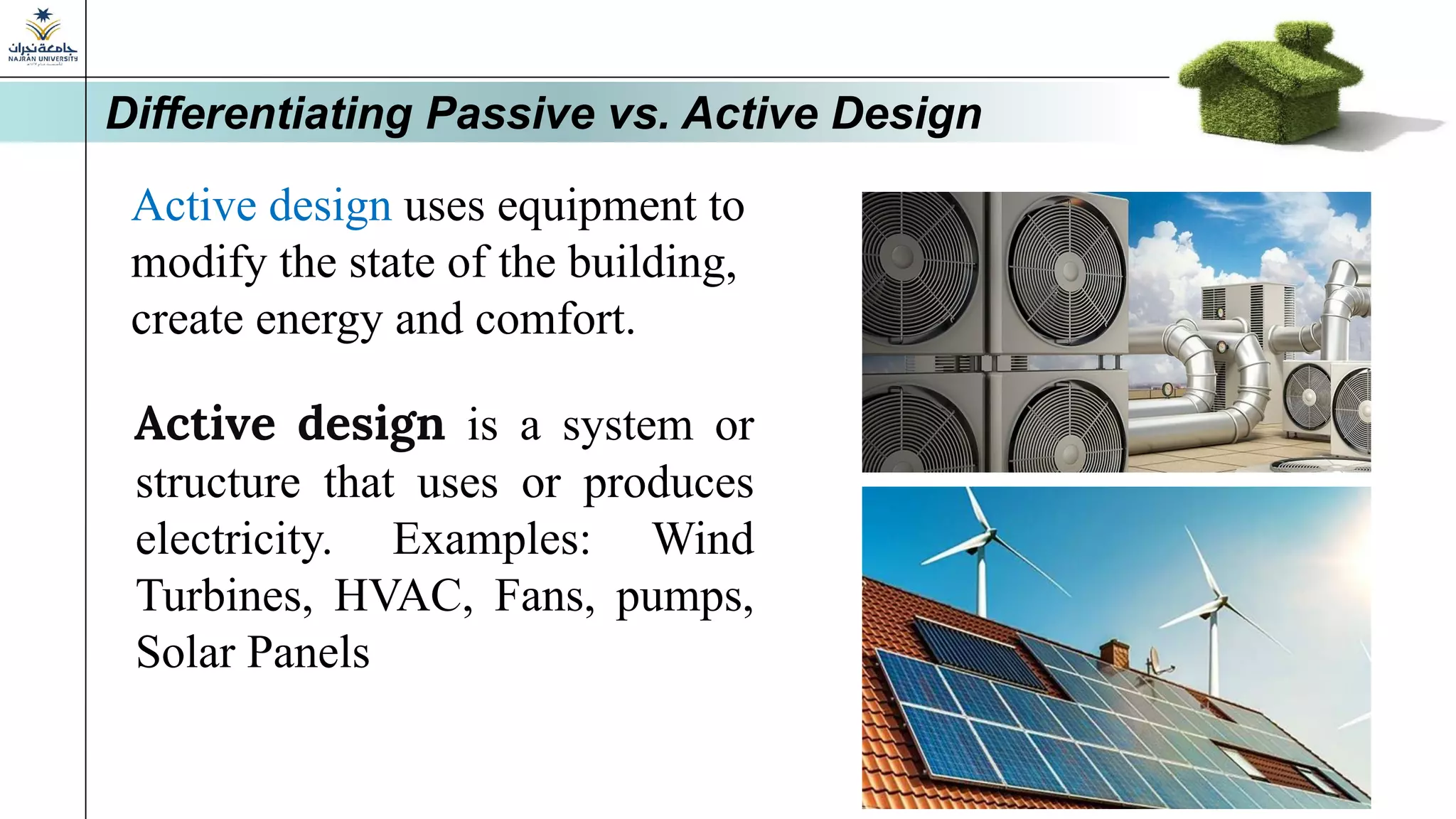
Active design is a system or
structure that uses or produces
electricity. Examples: Wind
Turbines, HVAC, Fans, pumps,
Solar Panels
Active design uses equipment to
modify the state of the building,
create energy and comfort.
Differentiating Passive vs. Active Design
What is Passive Design?
▪ Is based upon climate considerations
▪ Attempts to control comfort (heating and cooling) without
consuming fuels
▪ Uses the orientation of the building to control heat gain and
heat loss
▪ Uses the shape of the building (plan, section) to control air
flow
▪ Uses materials to control heat
▪ Maximizes use of free ventilation for cooling
▪ Uses shade (natural or architectural) to control heat gain
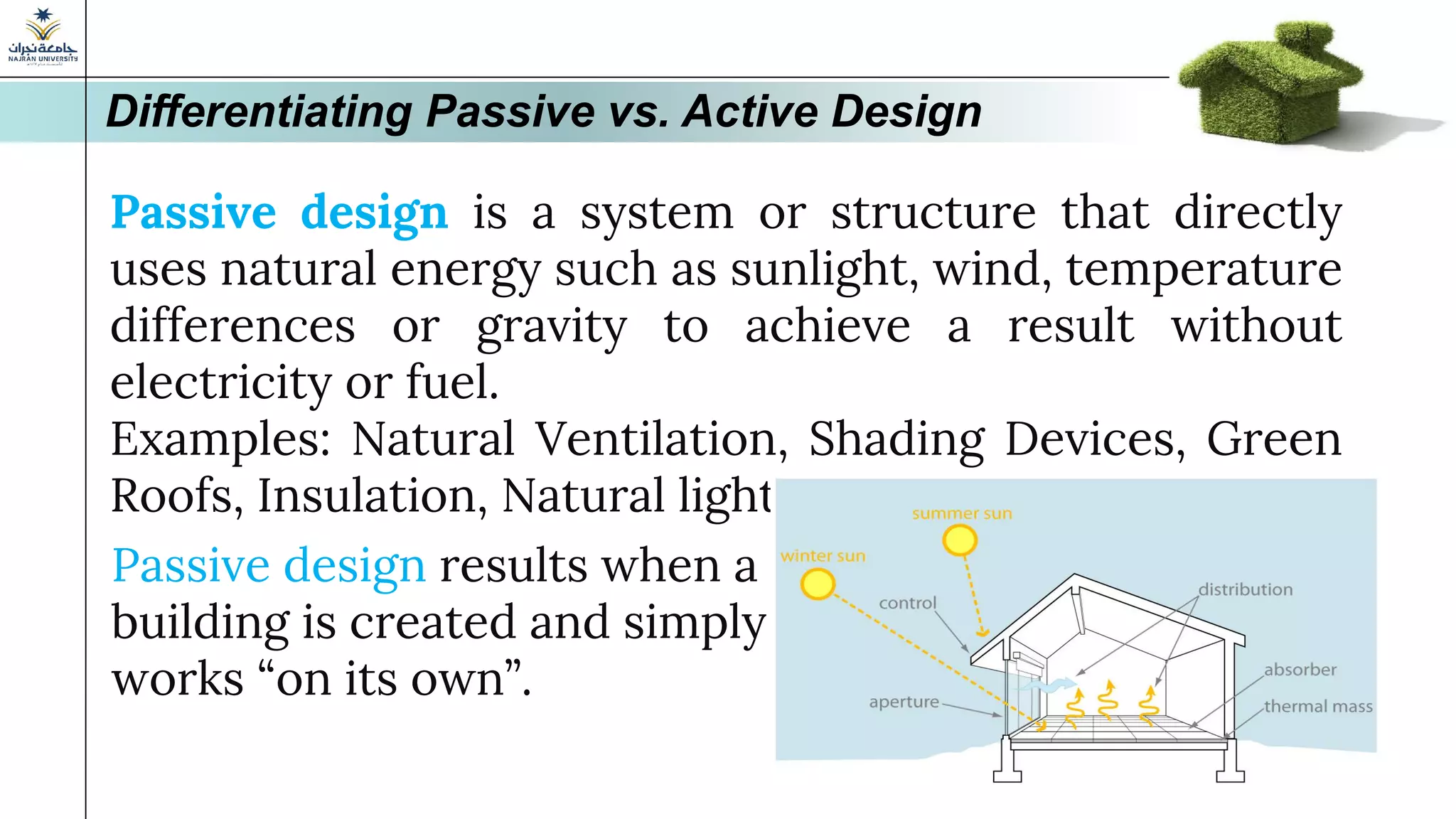
Passive design is a system or structure that directly
uses natural energy such as sunlight, wind, temperature
differences or gravity to achieve a result without
electricity or fuel.
Examples: Natural Ventilation, Shading Devices, Green
Roofs, Insulation, Natural light
Differentiating Passive vs. Active Design
Passive design results when a
building is created and simply
works “on its own”.
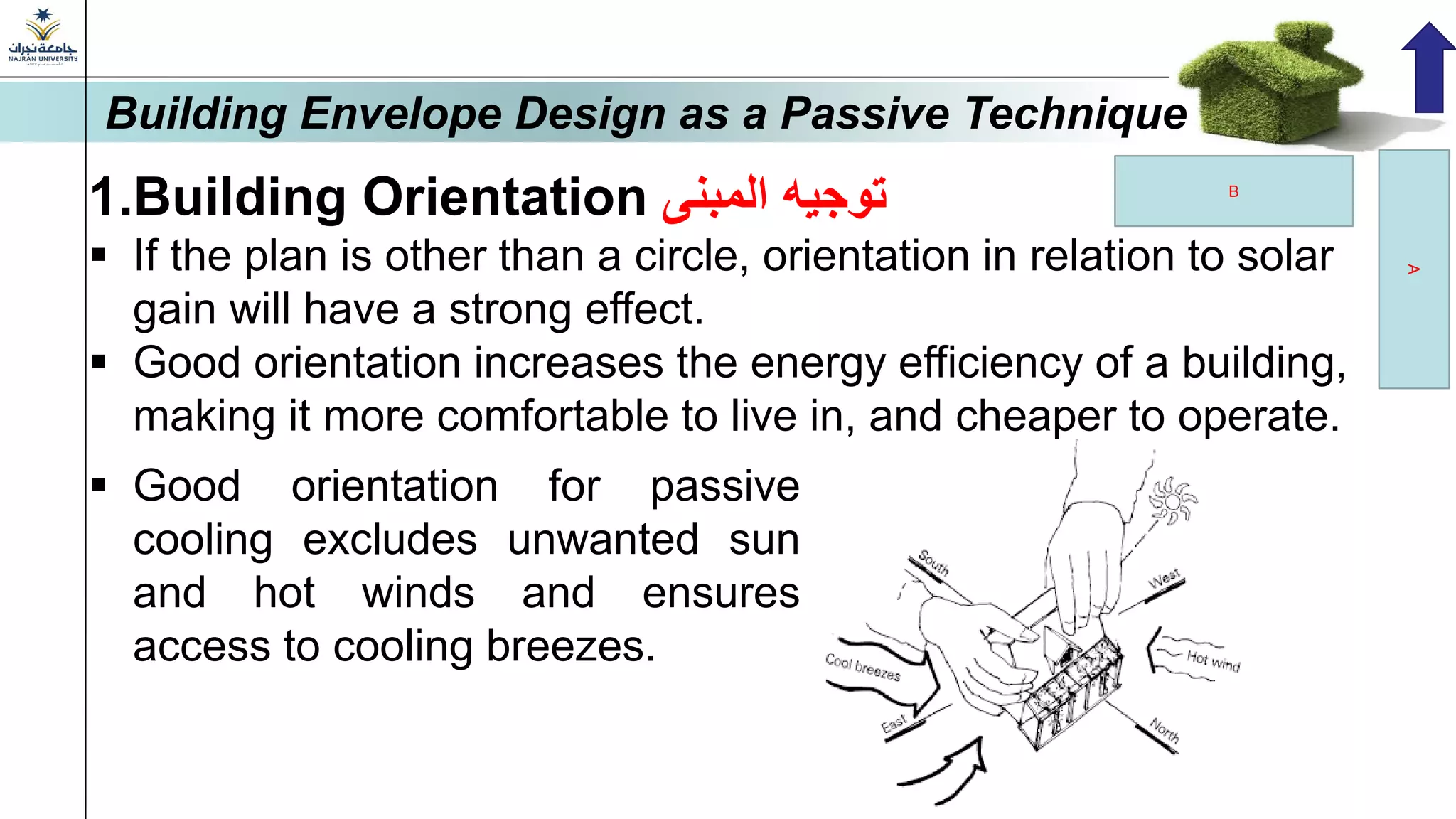
1.Building Orientation ‫توجيه‬
‫المبنى‬
▪ If the plan is other than a circle, orientation in relation to solar
gain will have a strong effect.
▪ Good orientation increases the energy efficiency of a building,
making it more comfortable to live in, and cheaper to operate.
▪ Good orientation for passive
cooling excludes unwanted sun
and hot winds and ensures
access to cooling breezes.
Building Envelope Design as a Passive Technique
B
A
2. Building Form ‫المبنى‬ ‫تكوين‬
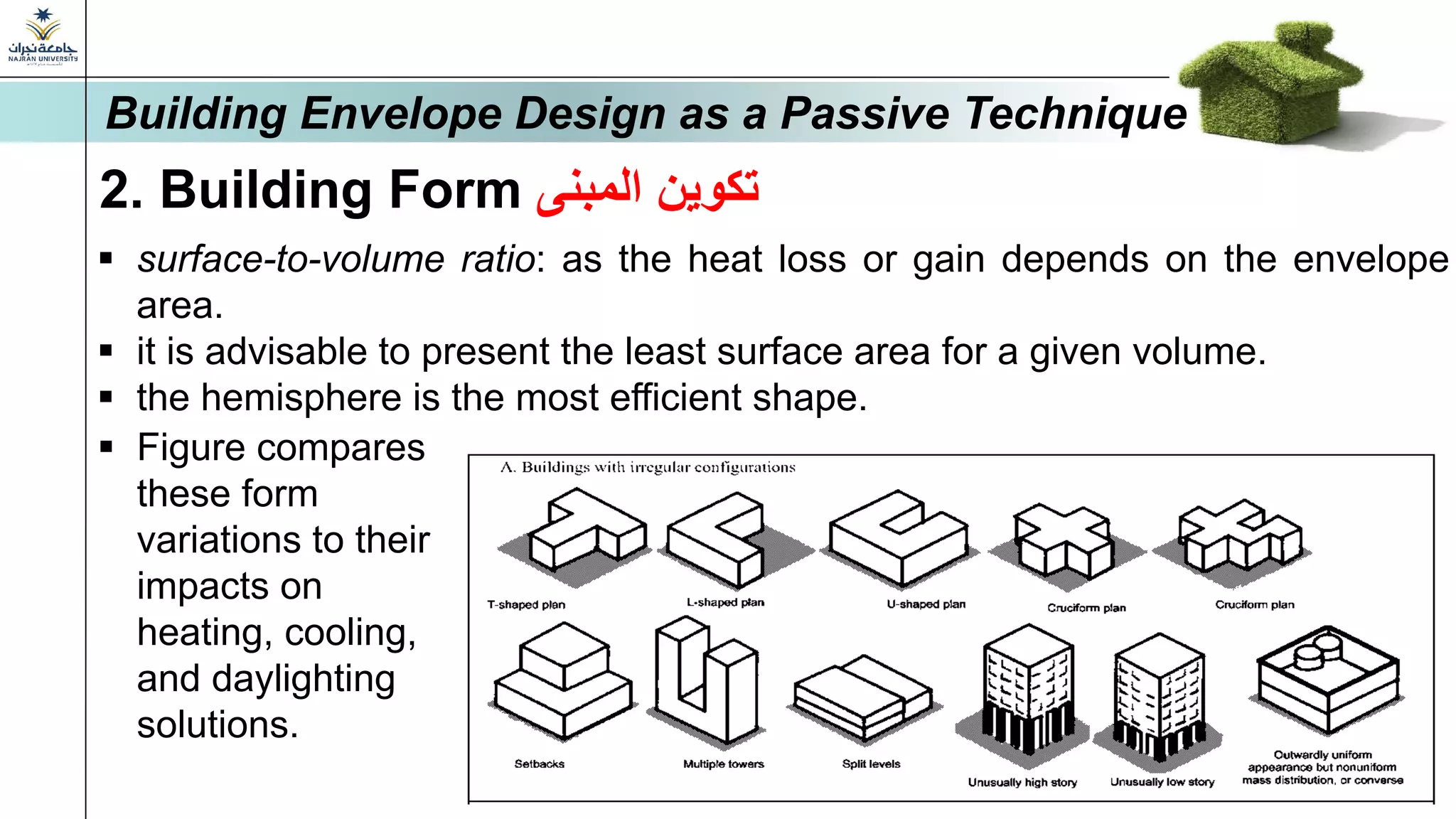
▪ surface-to-volume ratio: as the heat loss or gain depends on the envelope
area.
▪ it is advisable to present the least surface area for a given volume.
▪ the hemisphere is the most efficient shape.
Building Envelope Design as a Passive Technique
▪ Figure compares
these form
variations to their
impacts on
heating, cooling,
and daylighting
solutions.
2. Building Form ‫المبنى‬ ‫تكوين‬
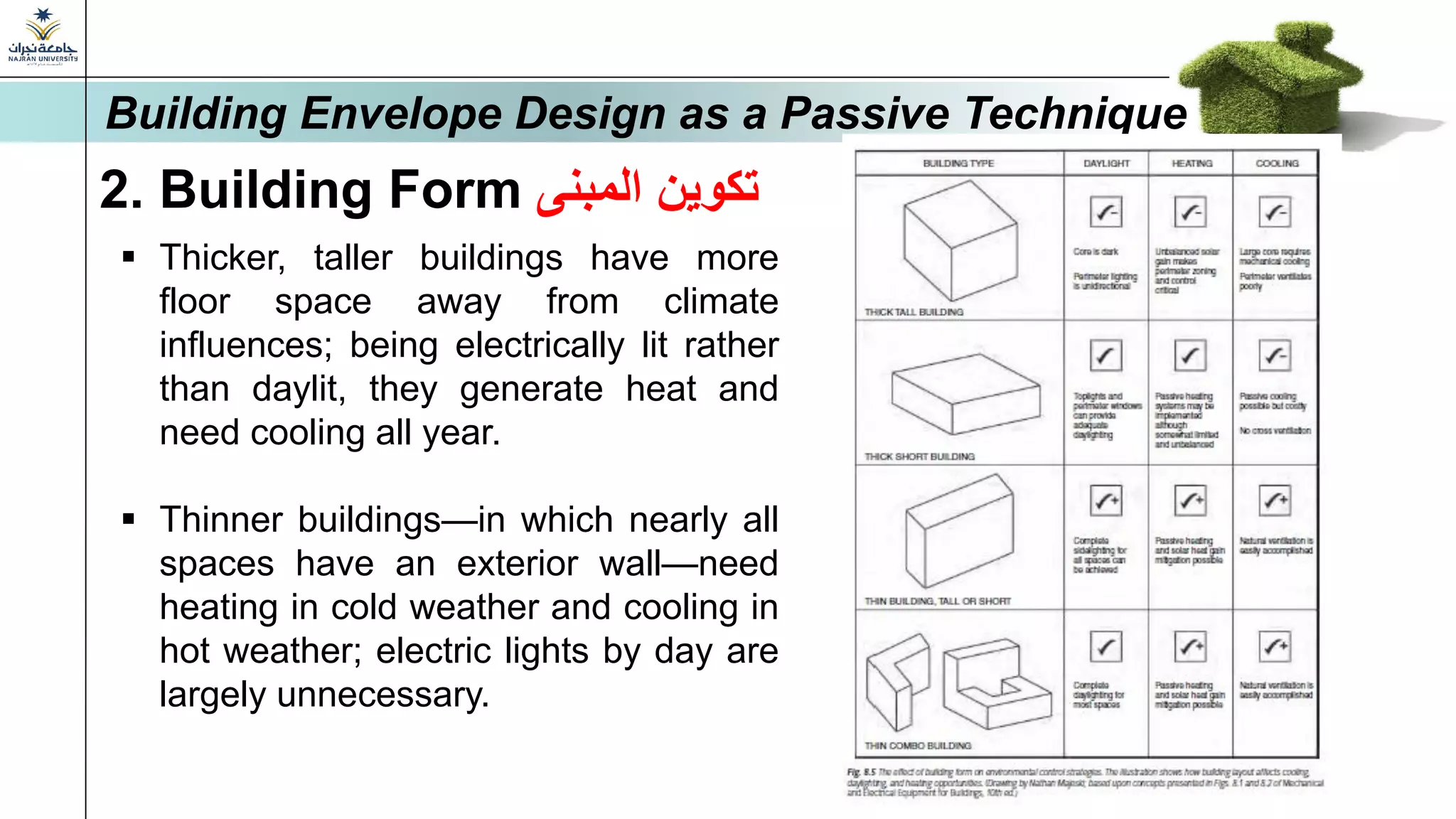
▪ Thicker, taller buildings have more
floor space away from climate
influences; being electrically lit rather
than daylit, they generate heat and
need cooling all year.
▪ Thinner buildings—in which nearly all
spaces have an exterior wall—need
heating in cold weather and cooling in
hot weather; electric lights by day are
largely unnecessary.
Building Envelope Design as a Passive Technique
3. Solid components ‫المصمتة‬ ‫االجزاء‬
a) Double roofs
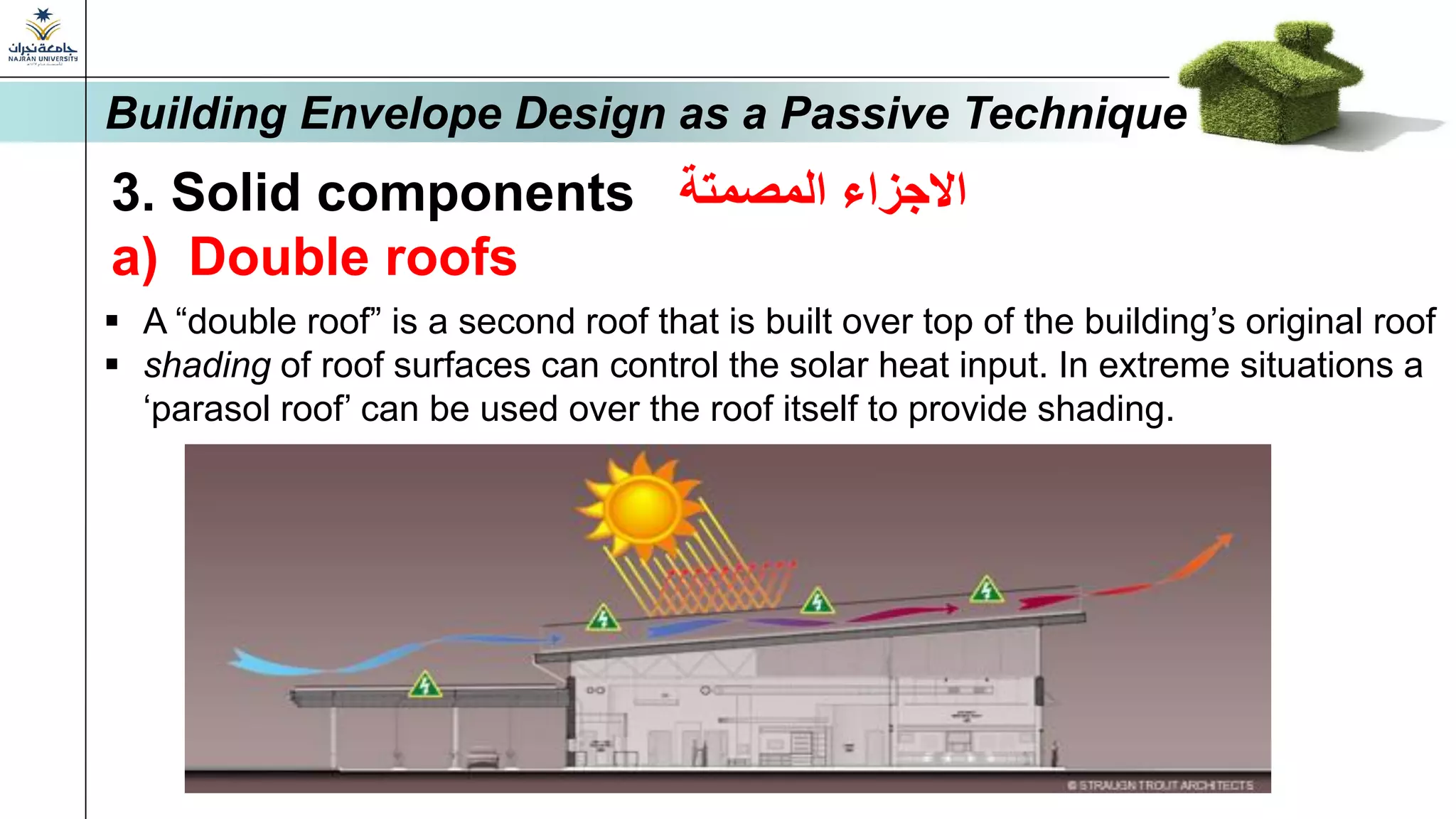
▪ A “double roof” is a second roof that is built over top of the building’s original roof
▪ shading of roof surfaces can control the solar heat input. In extreme situations a
‘parasol roof’ can be used over the roof itself to provide shading.
Building Envelope Design as a Passive Technique
3. Solid components ‫المصمتة‬ ‫االجزاء‬
b) Green roofs
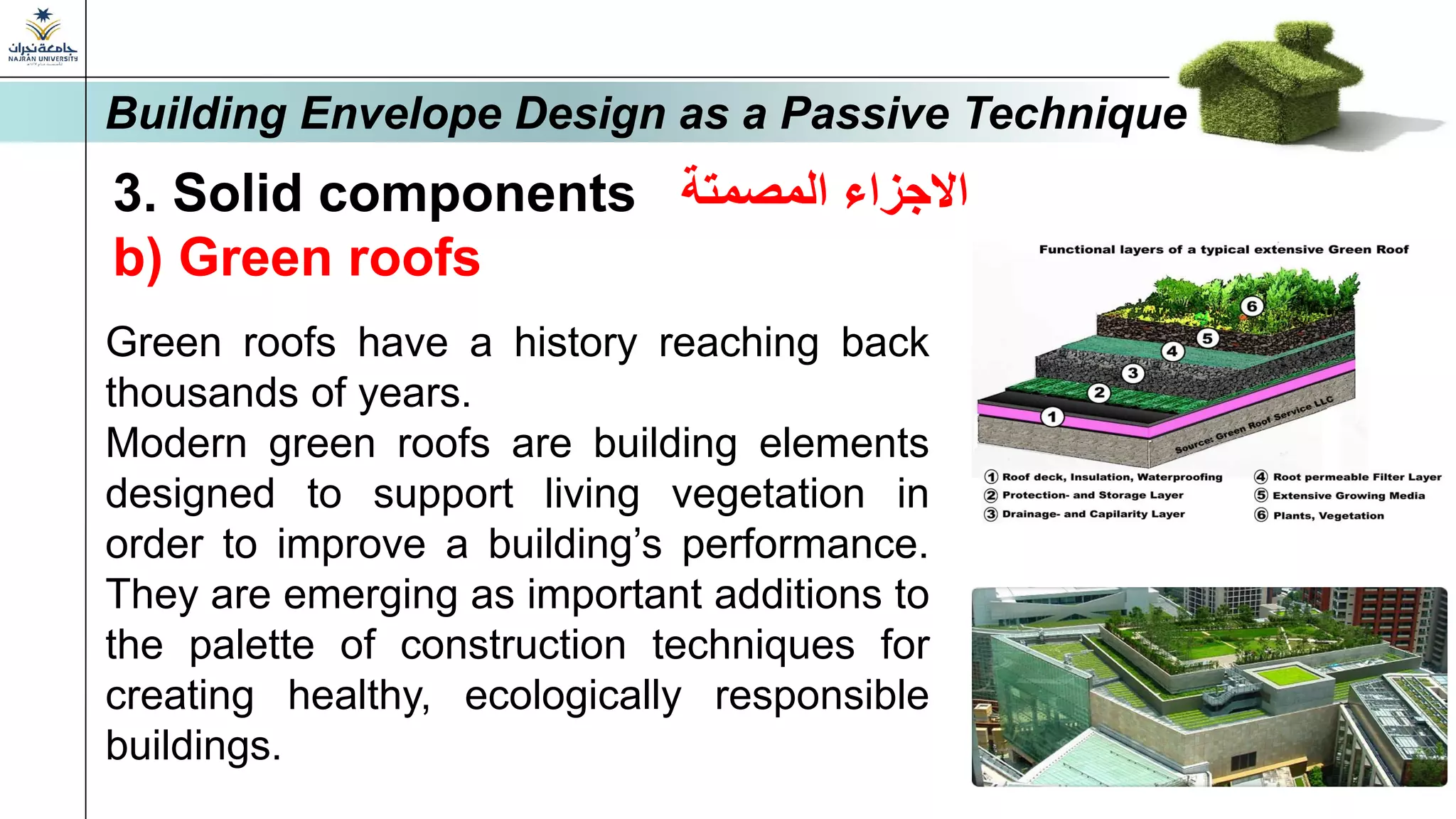
Green roofs have a history reaching back
thousands of years.
Modern green roofs are building elements
designed to support living vegetation in
order to improve a building’s performance.
They are emerging as important additions to
the palette of construction techniques for
creating healthy, ecologically responsible
buildings.
Building Envelope Design as a Passive Technique
3. Solid components ‫المصمتة‬ ‫االجزاء‬
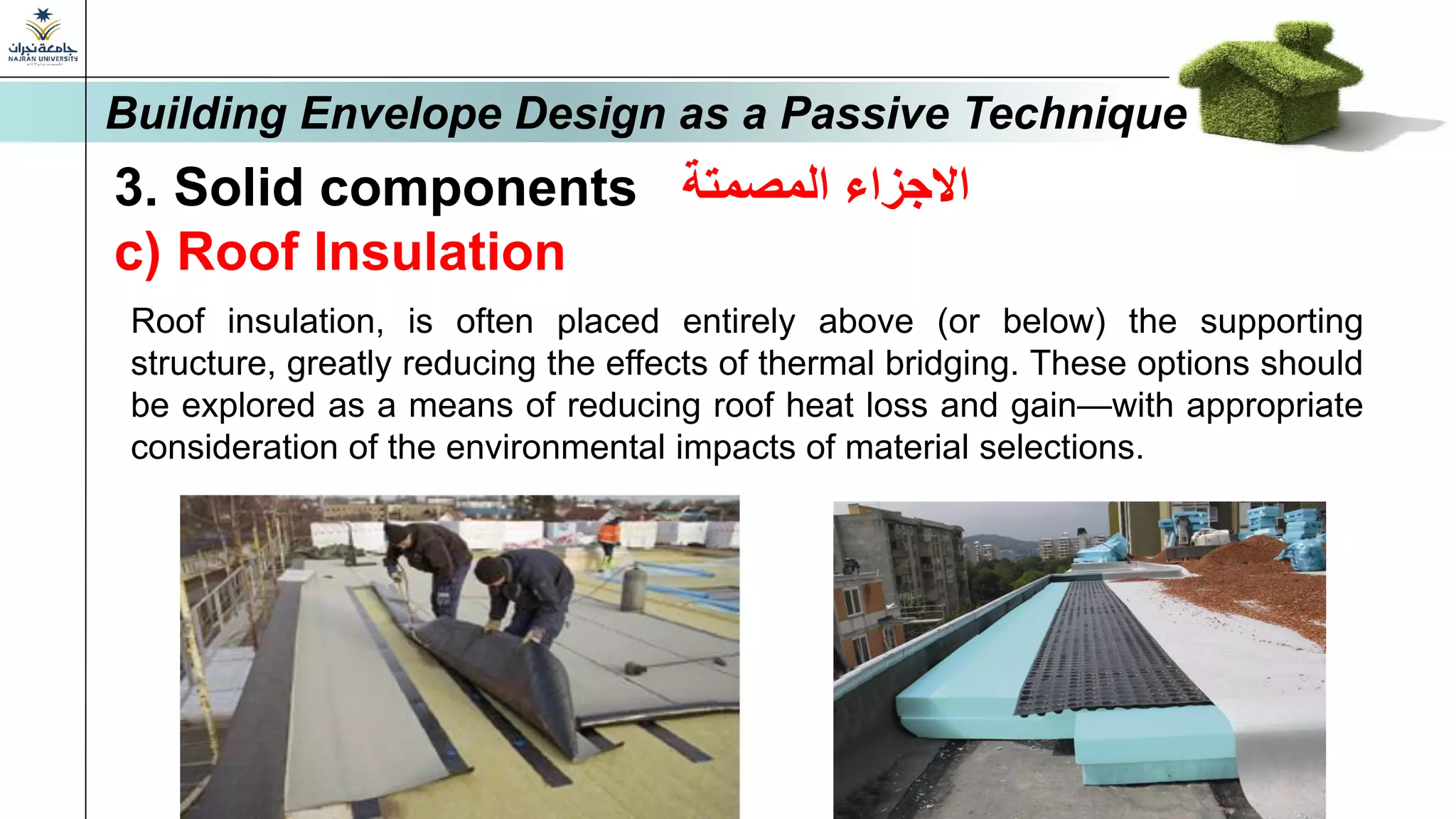
c) Roof Insulation
Roof insulation, is often placed entirely above (or below) the supporting
structure, greatly reducing the effects of thermal bridging. These options should
be explored as a means of reducing roof heat loss and gain—with appropriate
consideration of the environmental impacts of material selections.
Building Envelope Design as a Passive Technique
3. Solid components ‫المصمتة‬ ‫االجزاء‬
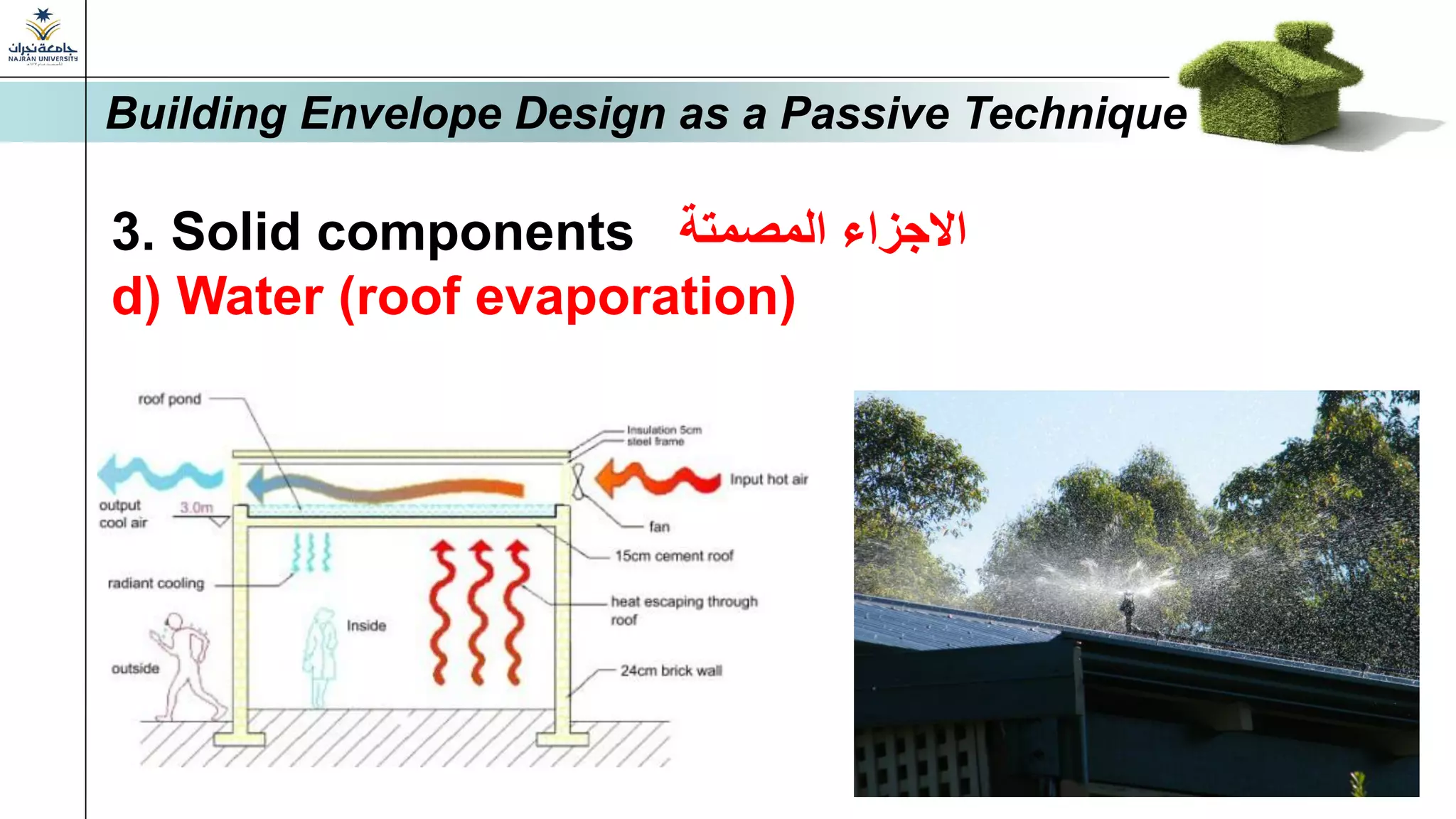
d) Water (roof evaporation)
Building Envelope Design as a Passive Technique
3. Solid components ‫المصمتة‬ ‫االجزاء‬
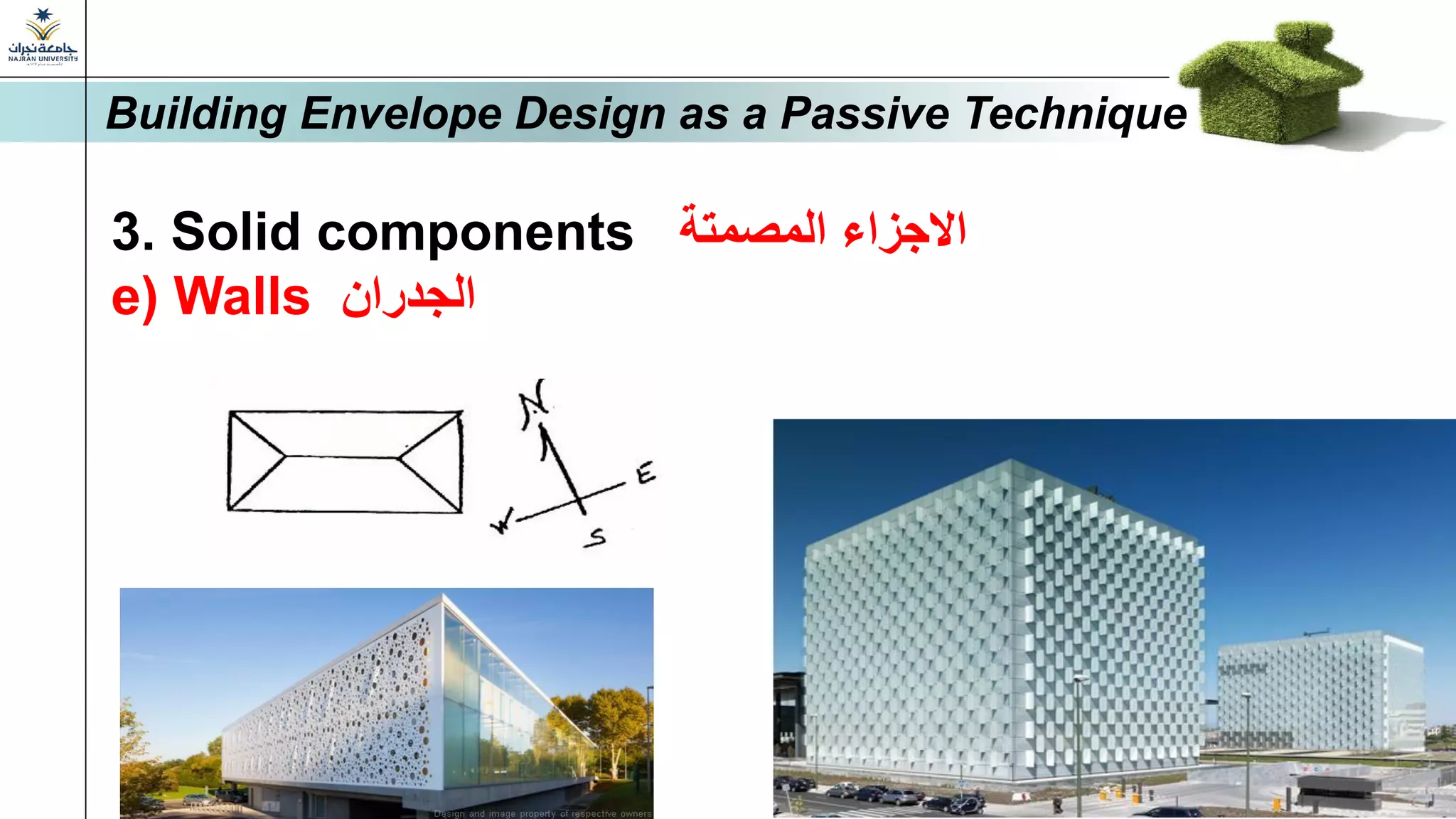
e) Walls ‫الجدران‬
Building Envelope Design as a Passive Technique
3. Solid components ‫المصمتة‬ ‫االجزاء‬
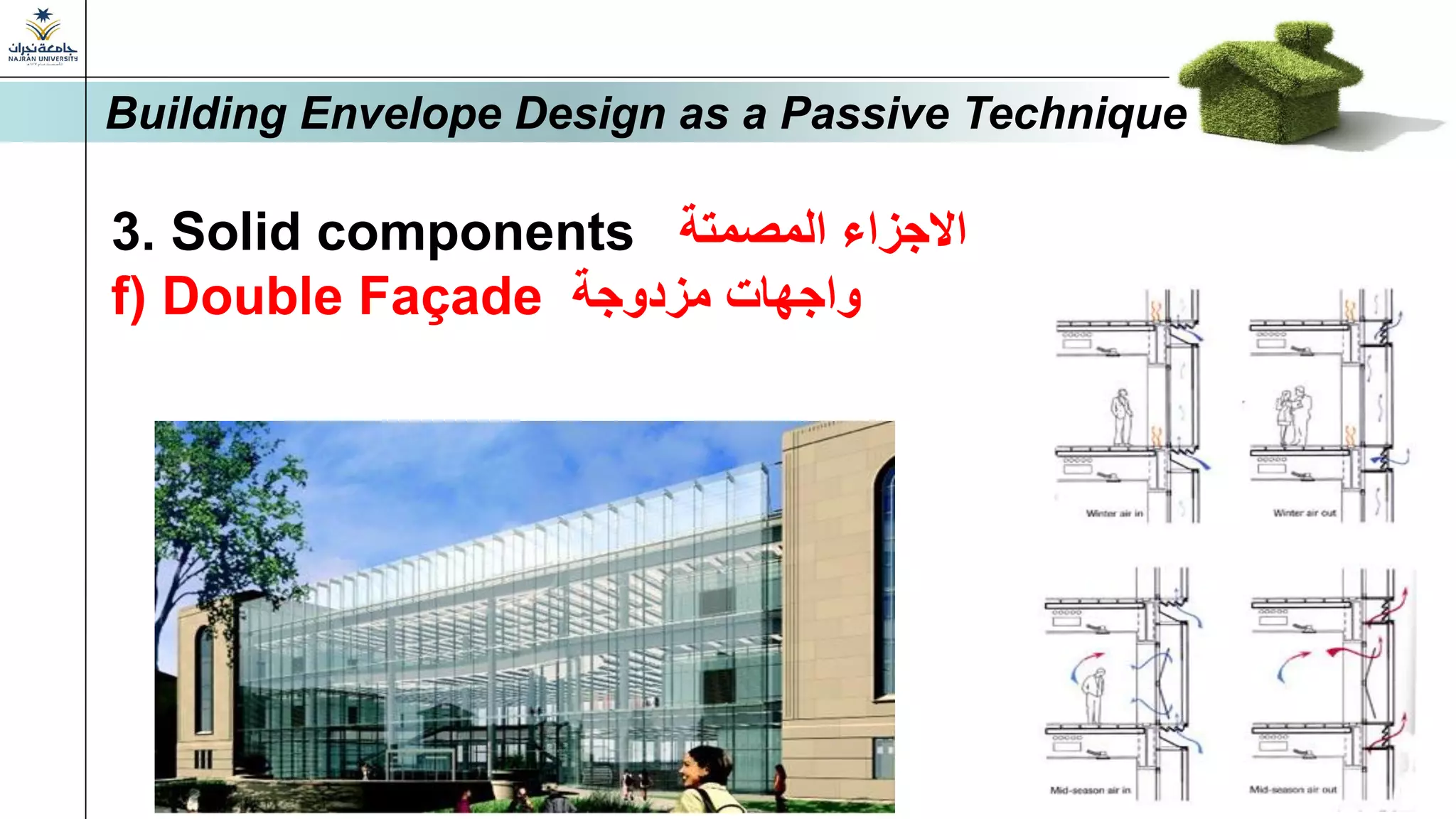
f) Double Façade ‫مزدوجة‬ ‫واجهات‬
Building Envelope Design as a Passive Technique
3. Solid components ‫المصمتة‬ ‫االجزاء‬
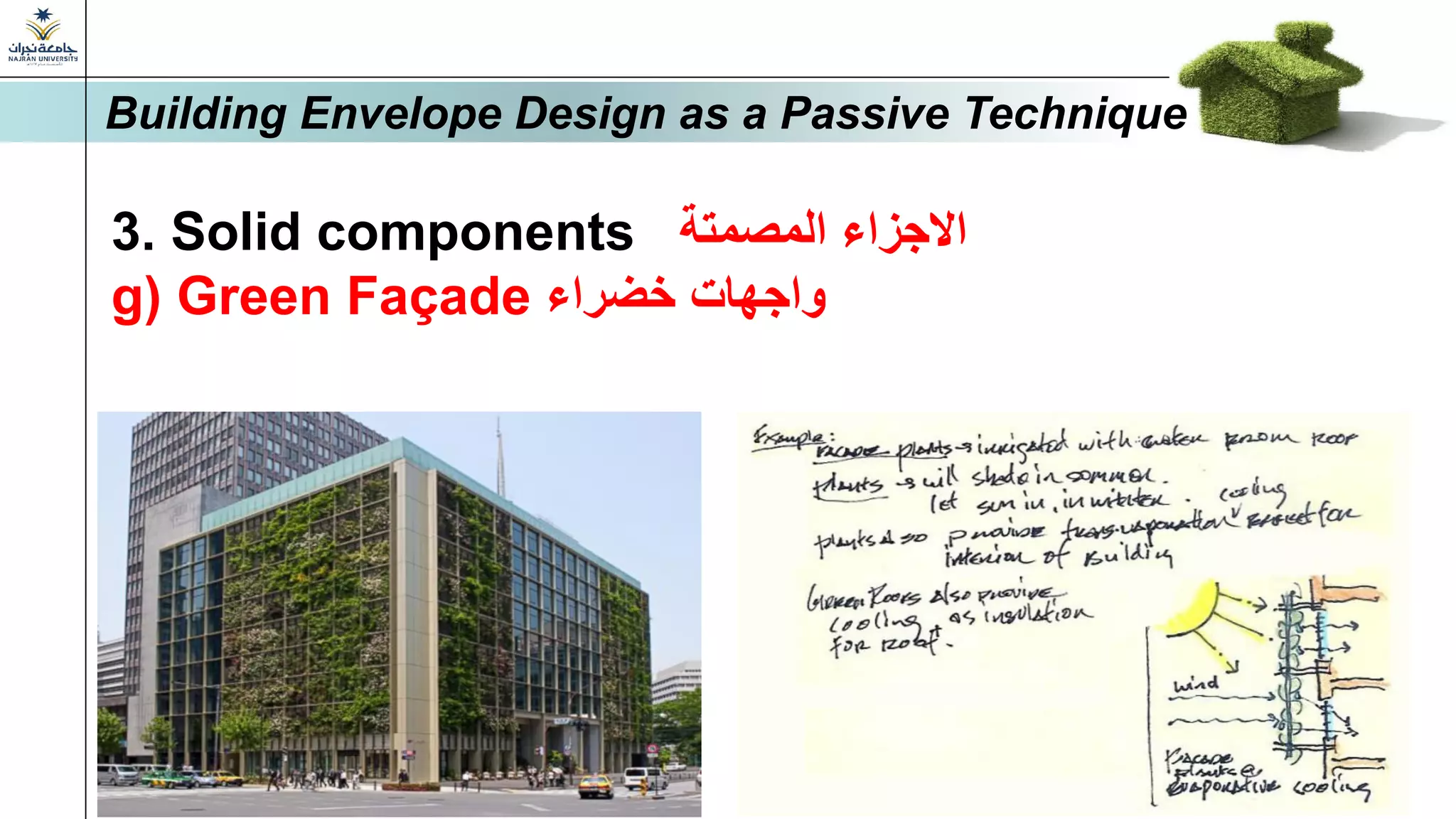
g) Green Façade ‫خضراء‬ ‫واجهات‬
Building Envelope Design as a Passive Technique
3. Solid components ‫المصمتة‬ ‫االجزاء‬
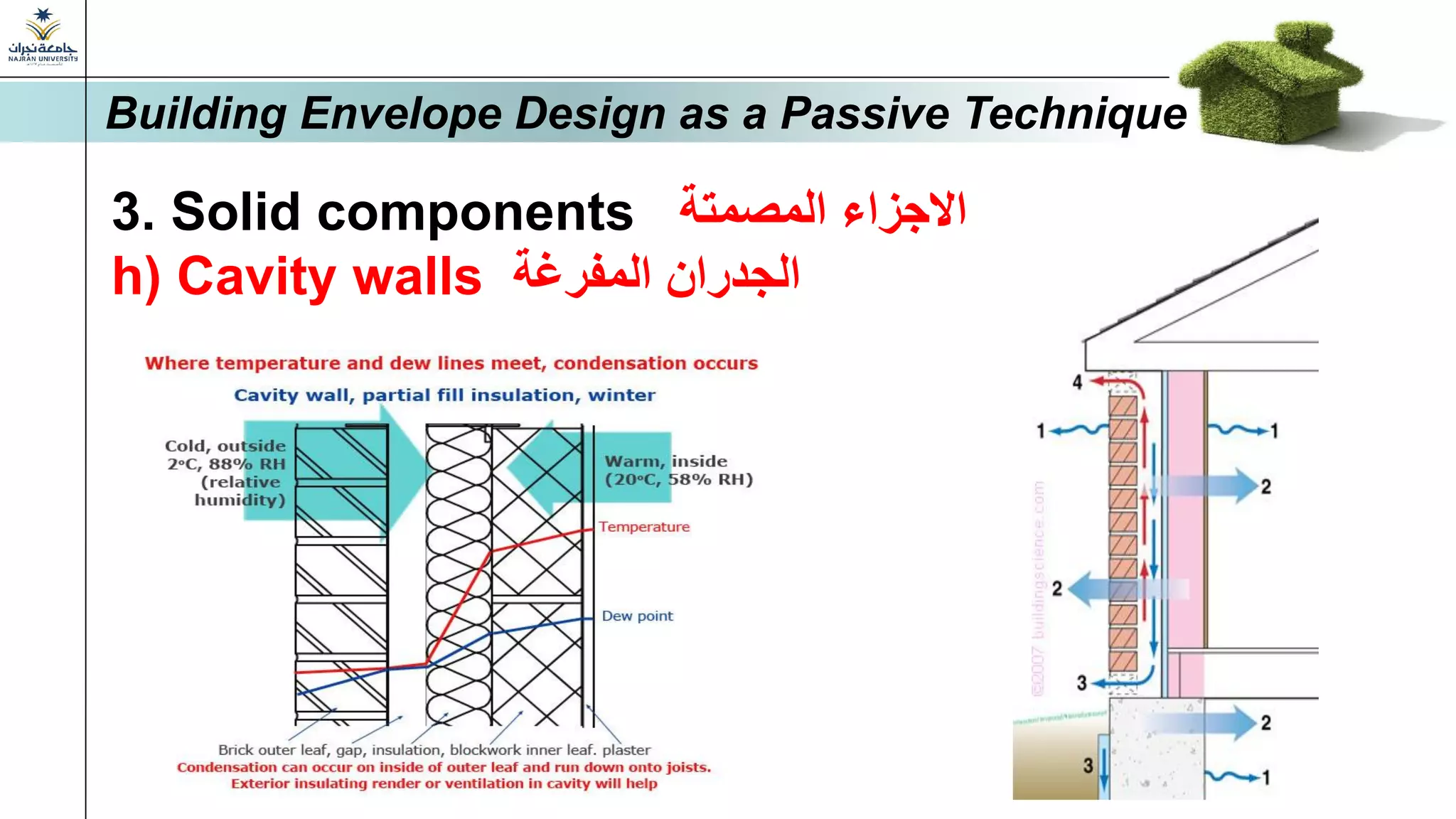
h) Cavity walls ‫المفرغة‬ ‫الجدران‬
Building Envelope Design as a Passive Technique
3. Solid components ‫المصمتة‬ ‫االجزاء‬
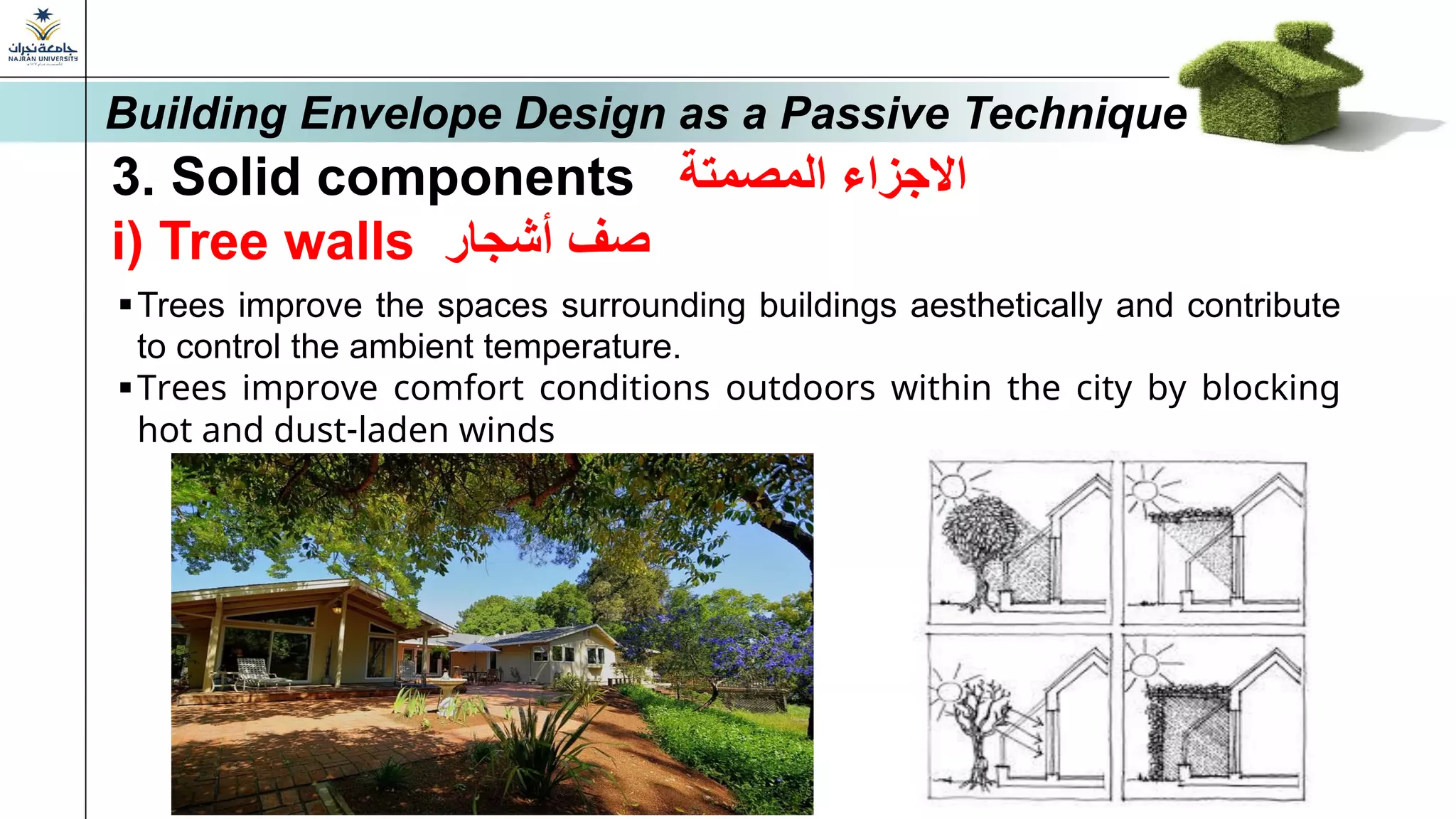
i) Tree walls ‫أشجار‬ ‫صف‬
▪Trees improve the spaces surrounding buildings aesthetically and contribute
to control the ambient temperature.
▪Trees improve comfort conditions outdoors within the city by blocking
hot and dust-laden winds
Building Envelope Design as a Passive Technique
4. Fenestrations (opening) ‫الفتحات‬
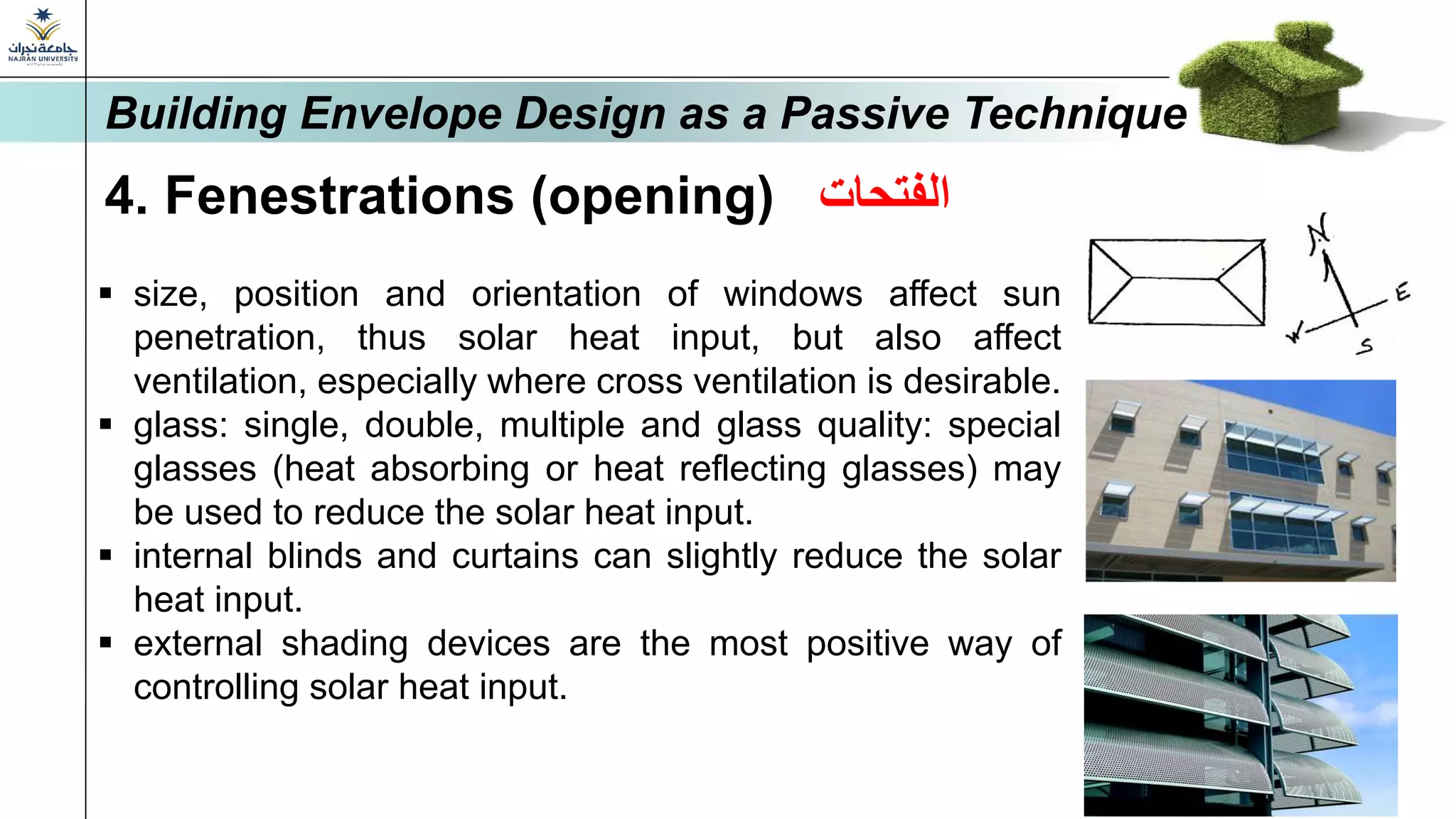
▪ size, position and orientation of windows affect sun
penetration, thus solar heat input, but also affect
ventilation, especially where cross ventilation is desirable.
▪ glass: single, double, multiple and glass quality: special
glasses (heat absorbing or heat reflecting glasses) may
be used to reduce the solar heat input.
▪ internal blinds and curtains can slightly reduce the solar
heat input.
▪ external shading devices are the most positive way of
controlling solar heat input.
Building Envelope Design as a Passive Technique
Thermal Insulation in
Buildings
Next Lecture
6
1. Thermal insulation in Buildings
2. Overall heat transfer coefficient
3. Types of thermal insulation
4. Thermal Mass
5. Benefits of thermal insulation
6. KSA Government Efforts
Climatic Design Thank You
Dr. Nedhal Al-Tamimi
AE 353-2

Lecture 5 designing building envelope

  • 1.
    Prepared by Dr. NedhalAl-Tamimi Arch. Eng. Dept., Faculty of Engineering Najran University, KSA naaltamimi@nu.edu.sa Designing Building Envelope Lecture No. 5 Climatic Design AE 353-2
  • 2.
    Scope of Presentation 1. Overview 2. BuildingEnvelope Definition 3. Building Envelope Components 4. What is Building Envelope Do? 5. Differentiating Passive vs. Active Design 6. How to protect the Buildings from the Sun
  • 3.
    ‫الخارجية‬ ‫المؤثرات‬ ‫أهم‬‫الشمس‬ ‫تمثل‬ , ‫المباني‬ ‫تصميم‬ ‫عند‬ ‫مراعاتها‬ ‫يجب‬ ‫والتي‬ ‫لتحقيق‬ ‫مالئ‬ ‫داخلي‬ ‫مناخ‬ ‫م‬ . Sun as a Variable Affecting Building Design
  • 4.
    1) Solar Radiation 2)Air Temperature Sun Effects on Buildings Sun as a Variable Affecting Building Design
  • 5.
    Humans first createdshelters to provide thermal comfort and protection from natural elements, and this still remains a primary objective of buildings. Definition: The Building Envelope: is the physical separator between the interior and exterior of a building. The building is not just a shelter, or a barrier against unwanted influences (rain, wind, cold), but the building envelope should be considered as a selective filter: to exclude the unwanted influences, but admit the desirable and useful ones, such as daylight, solar radiation in winter or natural ventilation. Sun and daylight are admitted or rejected; breezes and sounds are channelled or deflected; and rain is repelled or collected. Building Envelope Definition
  • 6.
    Components of theenvelope are typically: walls, floors, roofs, fenestrations and doors . Fenestration: are any opening in the structure: windows, skylights, etc. When designing the building envelope, knowing some fundamentals of building materials and heat transfer will help to make the right trade-off decisions. Building Envelope Components
  • 7.
    The building envelopeshould keep out: ▪ Solar radiation ▪ Temperature extremes ▪ Moisture, as vapour or liquid (rain) ▪ dust ▪ wind What is Building Envelope Do?
  • 8.
    ‫الشتاء‬ ‫في‬ ‫الحراري‬ ‫الفقد‬‫مراعاة‬ ‫مطلوب‬ ‫الشمس‬ ‫أشعة‬ ‫واستغالل‬ ‫الصيف‬ ‫في‬ ‫الحراري‬ ‫الكسب‬ ‫مقاومة‬ ‫مطلوب‬ ‫الشمس‬ ‫أشعة‬ ‫من‬ ‫والتخلص‬ What is Building Envelope Do?
  • 9.
    Active design isa system or structure that uses or produces electricity. Examples: Wind Turbines, HVAC, Fans, pumps, Solar Panels Active design uses equipment to modify the state of the building, create energy and comfort. Differentiating Passive vs. Active Design
  • 10.
    Differentiating Passive vs.Active Design What is Passive Design? ▪ Is based upon climate considerations ▪ Attempts to control comfort (heating and cooling) without consuming fuels ▪ Uses the orientation of the building to control heat gain and heat loss ▪ Uses the shape of the building (plan, section) to control air flow ▪ Uses materials to control heat ▪ Maximizes use of free ventilation for cooling ▪ Uses shade (natural or architectural) to control heat gain
  • 11.
    Passive design isa system or structure that directly uses natural energy such as sunlight, wind, temperature differences or gravity to achieve a result without electricity or fuel. Examples: Natural Ventilation, Shading Devices, Green Roofs, Insulation, Natural light Differentiating Passive vs. Active Design Passive design results when a building is created and simply works “on its own”.
  • 12.
    1.Building Orientation ‫توجيه‬ ‫المبنى‬ ▪If the plan is other than a circle, orientation in relation to solar gain will have a strong effect. ▪ Good orientation increases the energy efficiency of a building, making it more comfortable to live in, and cheaper to operate. ▪ Good orientation for passive cooling excludes unwanted sun and hot winds and ensures access to cooling breezes. Building Envelope Design as a Passive Technique B A
  • 13.
    2. Building Form‫المبنى‬ ‫تكوين‬ ▪ surface-to-volume ratio: as the heat loss or gain depends on the envelope area. ▪ it is advisable to present the least surface area for a given volume. ▪ the hemisphere is the most efficient shape. Building Envelope Design as a Passive Technique ▪ Figure compares these form variations to their impacts on heating, cooling, and daylighting solutions.
  • 14.
    2. Building Form‫المبنى‬ ‫تكوين‬ ▪ Thicker, taller buildings have more floor space away from climate influences; being electrically lit rather than daylit, they generate heat and need cooling all year. ▪ Thinner buildings—in which nearly all spaces have an exterior wall—need heating in cold weather and cooling in hot weather; electric lights by day are largely unnecessary. Building Envelope Design as a Passive Technique
  • 15.
    3. Solid components‫المصمتة‬ ‫االجزاء‬ a) Double roofs ▪ A “double roof” is a second roof that is built over top of the building’s original roof ▪ shading of roof surfaces can control the solar heat input. In extreme situations a ‘parasol roof’ can be used over the roof itself to provide shading. Building Envelope Design as a Passive Technique
  • 16.
    3. Solid components‫المصمتة‬ ‫االجزاء‬ b) Green roofs Green roofs have a history reaching back thousands of years. Modern green roofs are building elements designed to support living vegetation in order to improve a building’s performance. They are emerging as important additions to the palette of construction techniques for creating healthy, ecologically responsible buildings. Building Envelope Design as a Passive Technique
  • 17.
    3. Solid components‫المصمتة‬ ‫االجزاء‬ c) Roof Insulation Roof insulation, is often placed entirely above (or below) the supporting structure, greatly reducing the effects of thermal bridging. These options should be explored as a means of reducing roof heat loss and gain—with appropriate consideration of the environmental impacts of material selections. Building Envelope Design as a Passive Technique
  • 18.
    3. Solid components‫المصمتة‬ ‫االجزاء‬ d) Water (roof evaporation) Building Envelope Design as a Passive Technique
  • 19.
    3. Solid components‫المصمتة‬ ‫االجزاء‬ e) Walls ‫الجدران‬ Building Envelope Design as a Passive Technique
  • 20.
    3. Solid components‫المصمتة‬ ‫االجزاء‬ f) Double Façade ‫مزدوجة‬ ‫واجهات‬ Building Envelope Design as a Passive Technique
  • 21.
    3. Solid components‫المصمتة‬ ‫االجزاء‬ g) Green Façade ‫خضراء‬ ‫واجهات‬ Building Envelope Design as a Passive Technique
  • 22.
    3. Solid components‫المصمتة‬ ‫االجزاء‬ h) Cavity walls ‫المفرغة‬ ‫الجدران‬ Building Envelope Design as a Passive Technique
  • 23.
    3. Solid components‫المصمتة‬ ‫االجزاء‬ i) Tree walls ‫أشجار‬ ‫صف‬ ▪Trees improve the spaces surrounding buildings aesthetically and contribute to control the ambient temperature. ▪Trees improve comfort conditions outdoors within the city by blocking hot and dust-laden winds Building Envelope Design as a Passive Technique
  • 24.
    4. Fenestrations (opening)‫الفتحات‬ ▪ size, position and orientation of windows affect sun penetration, thus solar heat input, but also affect ventilation, especially where cross ventilation is desirable. ▪ glass: single, double, multiple and glass quality: special glasses (heat absorbing or heat reflecting glasses) may be used to reduce the solar heat input. ▪ internal blinds and curtains can slightly reduce the solar heat input. ▪ external shading devices are the most positive way of controlling solar heat input. Building Envelope Design as a Passive Technique
  • 25.
    Thermal Insulation in Buildings NextLecture 6 1. Thermal insulation in Buildings 2. Overall heat transfer coefficient 3. Types of thermal insulation 4. Thermal Mass 5. Benefits of thermal insulation 6. KSA Government Efforts
  • 26.
    Climatic Design ThankYou Dr. Nedhal Al-Tamimi AE 353-2