Graphs
Introduction to Graphs
Definition: A simple graph G = (V, E) consists of V, a
nonempty set of vertices, and E, a set of unordered
pairs of distinct elements of V called edges.
Definition: A directed graph G = (V, E) consists of a set
V of vertices and a set E of edges that are ordered
pairs of elements in V.
• A simple graph is just like a directed graph, but with
no specified direction of its edges.
Graph Models
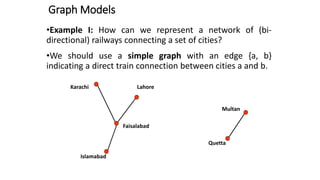
•Example I: How can we represent a network of (bi-
directional) railways connecting a set of cities?
•We should use a simple graph with an edge {a, b}
indicating a direct train connection between cities a and b.
Faisalabad
Lahore
Islamabad
Multan
Karachi
Quetta
Graph Models
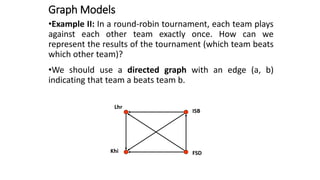
•Example II: In a round-robin tournament, each team plays
against each other team exactly once. How can we
represent the results of the tournament (which team beats
which other team)?
•We should use a directed graph with an edge (a, b)
indicating that team a beats team b.
Khi
ISB
FSD
Lhr
Graph Terminology
•Definition: Two vertices u and v in an undirected
graph G are called adjacent (or neighbors) in G if {u, v}
is an edge in G.
•If e = {u, v}, the edge e is called incident with the
vertices u and v. The edge e is also said to connect u
and v.
•The vertices u and v are called endpoints of the edge
{u, v}.
Graph Terminology
Definition: The degree of a vertex in an undirected graph
is the number of edges incident with it, except that a
loop at a vertex contributes twice to the degree of that
vertex.
•In other words, you can determine the degree of a
vertex in a displayed graph by counting the lines that
touch it.
•The degree of the vertex v is denoted by deg(v).
Graph Terminology
•A vertex of degree 0 is called isolated, since it is not
adjacent to any vertex.
•Note: A vertex with a loop at it has at least degree 2 and,
by definition, is not isolated, even if it is not adjacent to
any other vertex.
•A vertex of degree 1 is called pendant. It is adjacent to
exactly one other vertex.
Graph Terminology
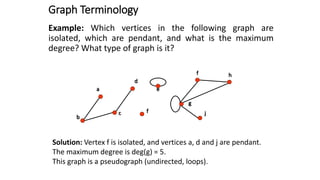
Example: Which vertices in the following graph are
isolated, which are pendant, and what is the maximum
degree? What type of graph is it?
a
b
c
d
f h
g
jf
e
Solution: Vertex f is isolated, and vertices a, d and j are pendant.
The maximum degree is deg(g) = 5.
This graph is a pseudograph (undirected, loops).
Graph Terminology
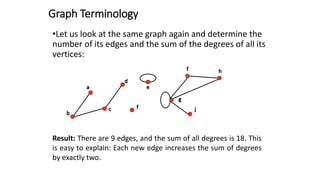
•Let us look at the same graph again and determine the
number of its edges and the sum of the degrees of all its
vertices:
a
b
c
d
f h
g
jf
e
Result: There are 9 edges, and the sum of all degrees is 18. This
is easy to explain: Each new edge increases the sum of degrees
by exactly two.
Graph Terminology
•The Handshaking Theorem: Let G = (V, E) be an
undirected graph with e edges. Then
2e = vV deg(v)
•Example: How many edges are there in a graph with 10
vertices, each of degree 6?
•Solution: The sum of the degrees of the vertices is 610 =
60. According to the Handshaking Theorem, it follows
that 2e = 60, so there are 30 edges.
Graph Terminology
•Definition: When (u, v) is an edge of the graph G with
directed edges, u is said to be adjacent to v, and v is said
to be adjacent from u.
•The vertex u is called the initial vertex of (u, v), and
vertex v is called the terminal vertex of (u, v).
•The initial vertex and terminal vertex of a loop are the
same.
Graph Terminology
•Definition: In a graph with directed edges, the in-degree
of a vertex v, denoted by deg-(v), is the number of edges
with v as their terminal vertex.
•The out-degree of v, denoted by deg+(v), is the number
of edges with v as their initial vertex.
•Question: How does adding a loop to a vertex change
the in-degree and out-degree of that vertex?
•Answer: It increases both the in-degree and the out-
degree by one.
Graph Terminology
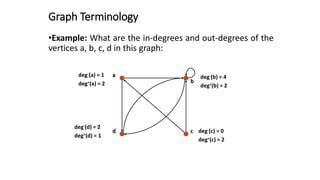
•Example: What are the in-degrees and out-degrees of the
vertices a, b, c, d in this graph:
a
b
cd
deg-(a) = 1
deg+(a) = 2
deg-(b) = 4
deg+(b) = 2
deg-(d) = 2
deg+(d) = 1
deg-(c) = 0
deg+(c) = 2
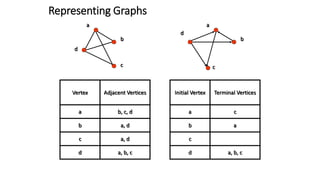
Representing Graphs
a
b
c
d
a
b
c
d
a, db
a, dc
a, b, cd
b, c, da
Adjacent VerticesVertex
ab
c
a, b, cd
ca
Terminal VerticesInitial Vertex
Representing Graphs
a
b
c
d
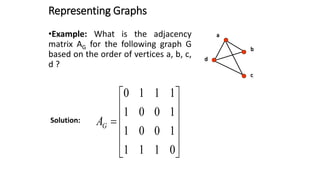
•Example: What is the adjacency
matrix AG for the following graph G
based on the order of vertices a, b, c,
d ?
Solution:













0111
1001
1001
1110
GA
Representing Graphs
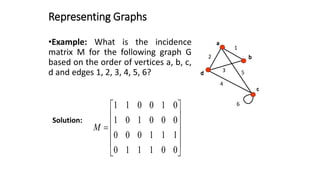
•Example: What is the incidence
matrix M for the following graph G
based on the order of vertices a, b, c,
d and edges 1, 2, 3, 4, 5, 6?
Solution:
a
b
c
d
1
2
4
53
6













001110
111000
000101
010011
M

Graphs (Models & Terminology)

  • 1.
  • 2.
    Introduction to Graphs Definition:A simple graph G = (V, E) consists of V, a nonempty set of vertices, and E, a set of unordered pairs of distinct elements of V called edges. Definition: A directed graph G = (V, E) consists of a set V of vertices and a set E of edges that are ordered pairs of elements in V. • A simple graph is just like a directed graph, but with no specified direction of its edges.
  • 3.
    Graph Models •Example I:How can we represent a network of (bi- directional) railways connecting a set of cities? •We should use a simple graph with an edge {a, b} indicating a direct train connection between cities a and b. Faisalabad Lahore Islamabad Multan Karachi Quetta
  • 4.
    Graph Models •Example II:In a round-robin tournament, each team plays against each other team exactly once. How can we represent the results of the tournament (which team beats which other team)? •We should use a directed graph with an edge (a, b) indicating that team a beats team b. Khi ISB FSD Lhr
  • 5.
    Graph Terminology •Definition: Twovertices u and v in an undirected graph G are called adjacent (or neighbors) in G if {u, v} is an edge in G. •If e = {u, v}, the edge e is called incident with the vertices u and v. The edge e is also said to connect u and v. •The vertices u and v are called endpoints of the edge {u, v}.
  • 6.
    Graph Terminology Definition: Thedegree of a vertex in an undirected graph is the number of edges incident with it, except that a loop at a vertex contributes twice to the degree of that vertex. •In other words, you can determine the degree of a vertex in a displayed graph by counting the lines that touch it. •The degree of the vertex v is denoted by deg(v).
  • 7.
    Graph Terminology •A vertexof degree 0 is called isolated, since it is not adjacent to any vertex. •Note: A vertex with a loop at it has at least degree 2 and, by definition, is not isolated, even if it is not adjacent to any other vertex. •A vertex of degree 1 is called pendant. It is adjacent to exactly one other vertex.
  • 8.
    Graph Terminology Example: Whichvertices in the following graph are isolated, which are pendant, and what is the maximum degree? What type of graph is it? a b c d f h g jf e Solution: Vertex f is isolated, and vertices a, d and j are pendant. The maximum degree is deg(g) = 5. This graph is a pseudograph (undirected, loops).
  • 9.
    Graph Terminology •Let uslook at the same graph again and determine the number of its edges and the sum of the degrees of all its vertices: a b c d f h g jf e Result: There are 9 edges, and the sum of all degrees is 18. This is easy to explain: Each new edge increases the sum of degrees by exactly two.
  • 10.
    Graph Terminology •The HandshakingTheorem: Let G = (V, E) be an undirected graph with e edges. Then 2e = vV deg(v) •Example: How many edges are there in a graph with 10 vertices, each of degree 6? •Solution: The sum of the degrees of the vertices is 610 = 60. According to the Handshaking Theorem, it follows that 2e = 60, so there are 30 edges.
  • 11.
    Graph Terminology •Definition: When(u, v) is an edge of the graph G with directed edges, u is said to be adjacent to v, and v is said to be adjacent from u. •The vertex u is called the initial vertex of (u, v), and vertex v is called the terminal vertex of (u, v). •The initial vertex and terminal vertex of a loop are the same.
  • 12.
    Graph Terminology •Definition: Ina graph with directed edges, the in-degree of a vertex v, denoted by deg-(v), is the number of edges with v as their terminal vertex. •The out-degree of v, denoted by deg+(v), is the number of edges with v as their initial vertex. •Question: How does adding a loop to a vertex change the in-degree and out-degree of that vertex? •Answer: It increases both the in-degree and the out- degree by one.
  • 13.
    Graph Terminology •Example: Whatare the in-degrees and out-degrees of the vertices a, b, c, d in this graph: a b cd deg-(a) = 1 deg+(a) = 2 deg-(b) = 4 deg+(b) = 2 deg-(d) = 2 deg+(d) = 1 deg-(c) = 0 deg+(c) = 2
  • 14.
    Representing Graphs a b c d a b c d a, db a,dc a, b, cd b, c, da Adjacent VerticesVertex ab c a, b, cd ca Terminal VerticesInitial Vertex
  • 15.
    Representing Graphs a b c d •Example: Whatis the adjacency matrix AG for the following graph G based on the order of vertices a, b, c, d ? Solution:              0111 1001 1001 1110 GA
  • 16.
    Representing Graphs •Example: Whatis the incidence matrix M for the following graph G based on the order of vertices a, b, c, d and edges 1, 2, 3, 4, 5, 6? Solution: a b c d 1 2 4 53 6              001110 111000 000101 010011 M