Graph and Its Applications
1
• Nonlinear data Structures.
• A graph G consists of two properties:
(a) A set V of elements called vertices or nodes.
(b) A set E of connectors called edges such that each edge e is identified as
e = (u,v) (unordered pair of vertices). Here is a edge between u and v and
they are said to be the adjacent nodes or neighbors .
 The order of a graph is |V| (the number of vertices).
 A graph's size is |E|, the number of edges.
 A tree is a graph with no cycle.
Example:
A B
C D
E
In Graph G1
• 5 Vertices:{A, B, C, D, E}
• 6 Edges: {[A,B], [A,C], [B,D],
[B,E], [C,D], [D,E]}
Figure1: A graph G1
GraphGraph
2
Definitions
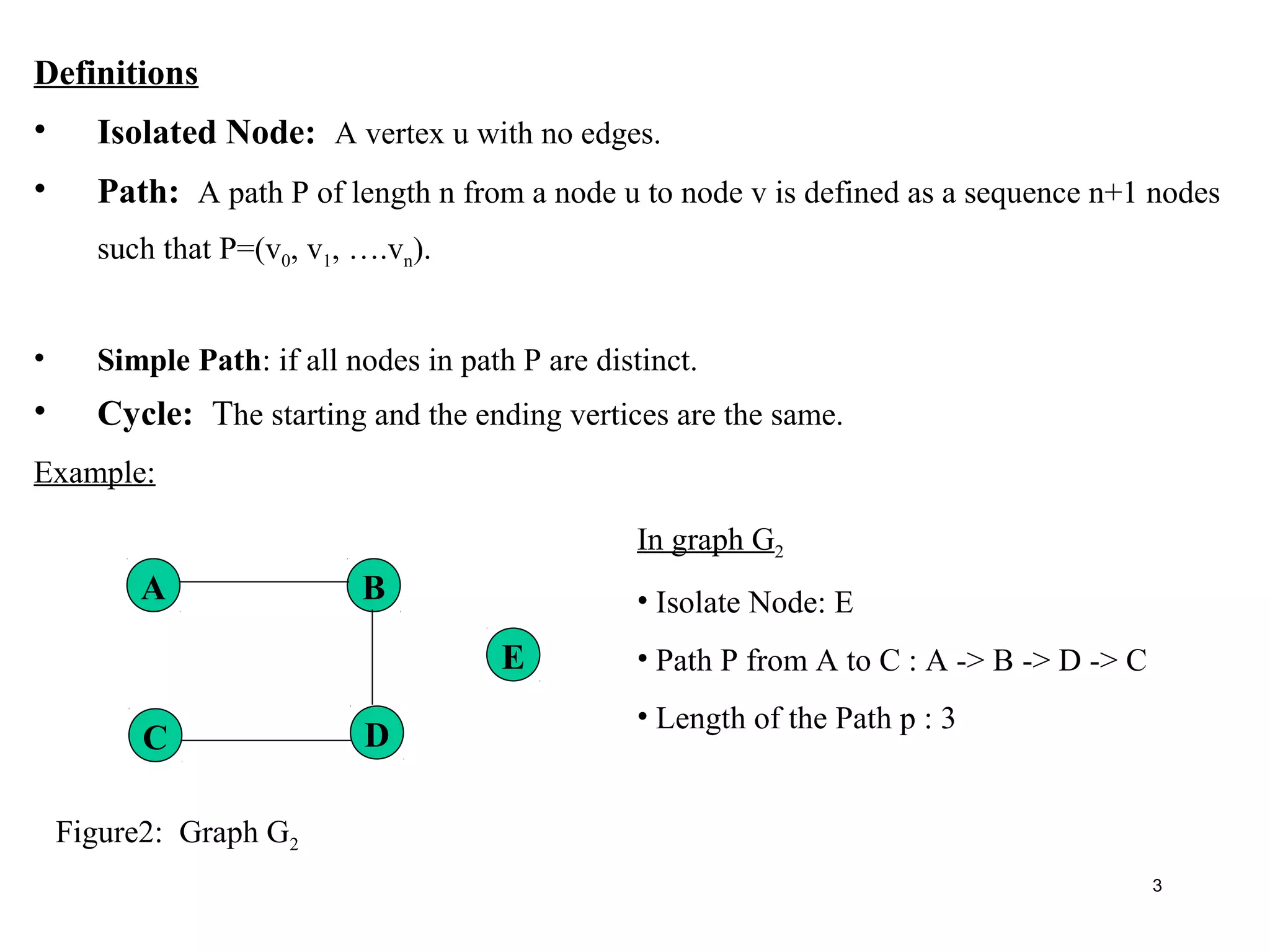
• Isolated Node: A vertex u with no edges.
• Path: A path P of length n from a node u to node v is defined as a sequence n+1 nodes
such that P=(v0, v1, ….vn).
• Simple Path: if all nodes in path P are distinct.
• Cycle: The starting and the ending vertices are the same.
Example:
A B
C D
E
In graph G2
• Isolate Node: E
• Path P from A to C : A -> B -> D -> C
• Length of the Path p : 3
Figure2: Graph G2
3
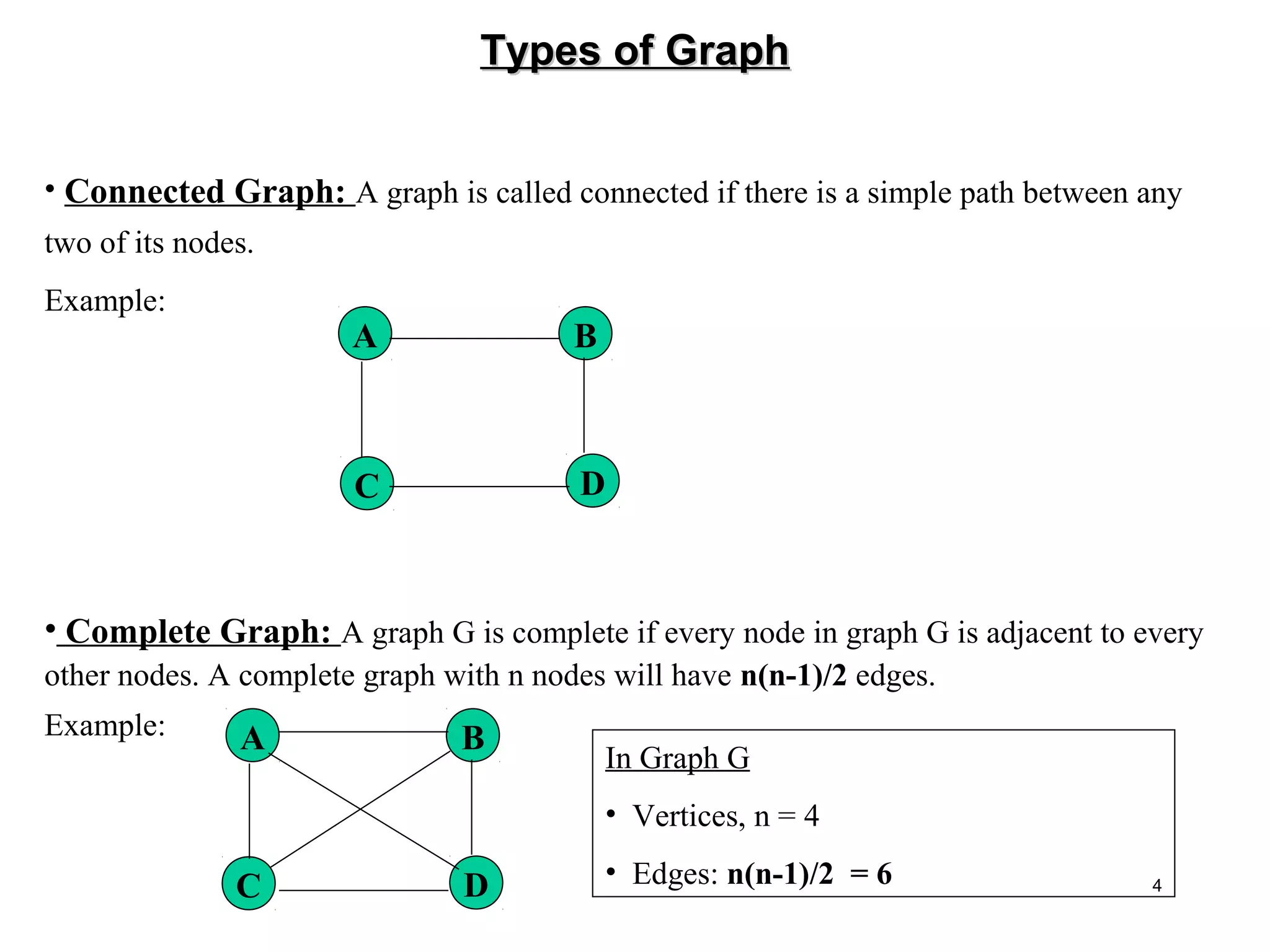
• Connected Graph: A graph is called connected if there is a simple path between any
two of its nodes.
Example:
• Complete Graph: A graph G is complete if every node in graph G is adjacent to every
other nodes. A complete graph with n nodes will have n(n-1)/2 edges.
Example:
C
A B
D
A B
C D
4
Types of GraphTypes of Graph
In Graph G
• Vertices, n = 4
• Edges: n(n-1)/2 = 6
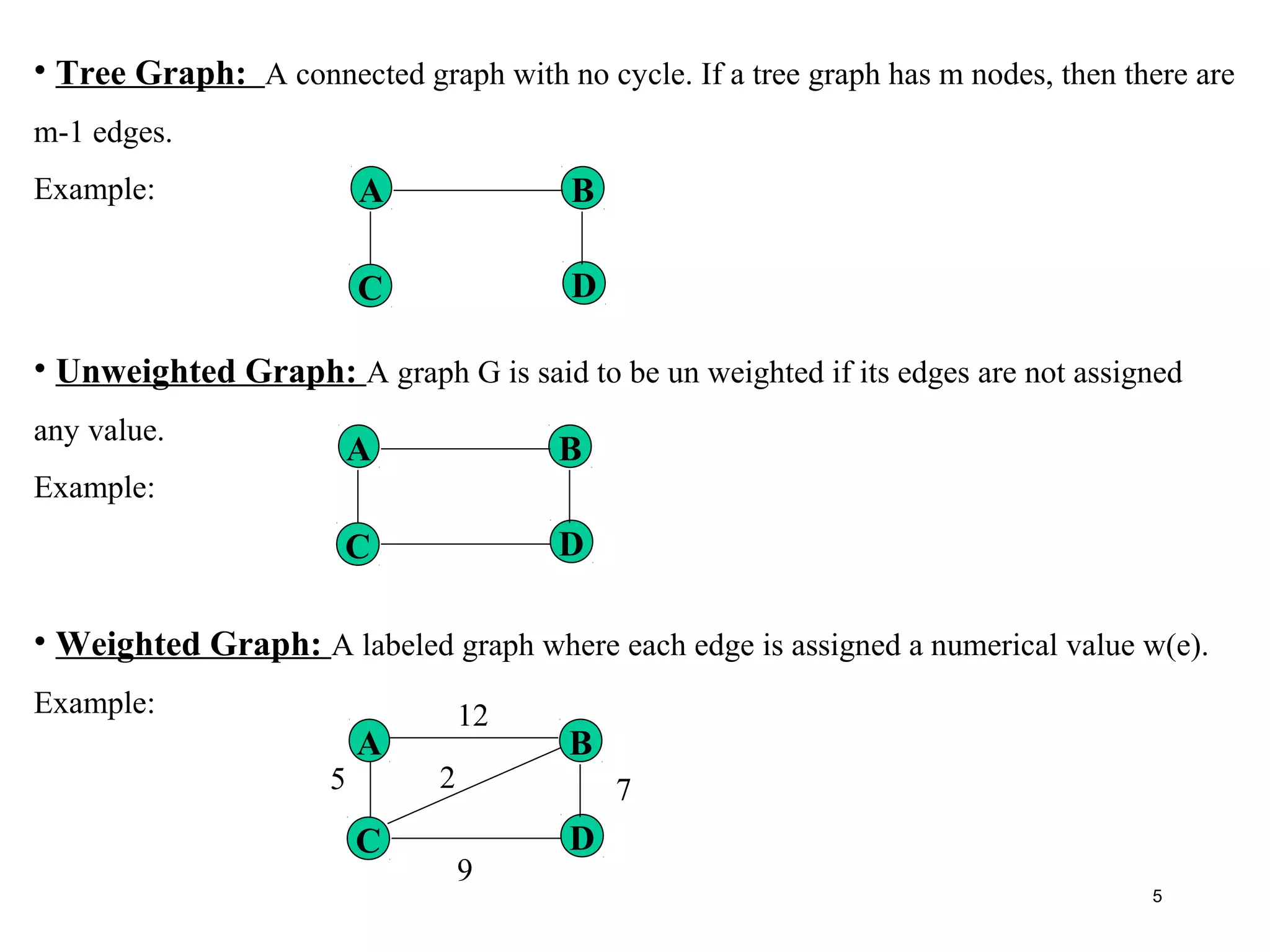
• Tree Graph: A connected graph with no cycle. If a tree graph has m nodes, then there are
m-1 edges.
Example:
• Unweighted Graph: A graph G is said to be un weighted if its edges are not assigned
any value.
Example:
• Weighted Graph: A labeled graph where each edge is assigned a numerical value w(e).
Example:
A B
C D
A B
C D
A B
C D
5
12
7
9
2
5
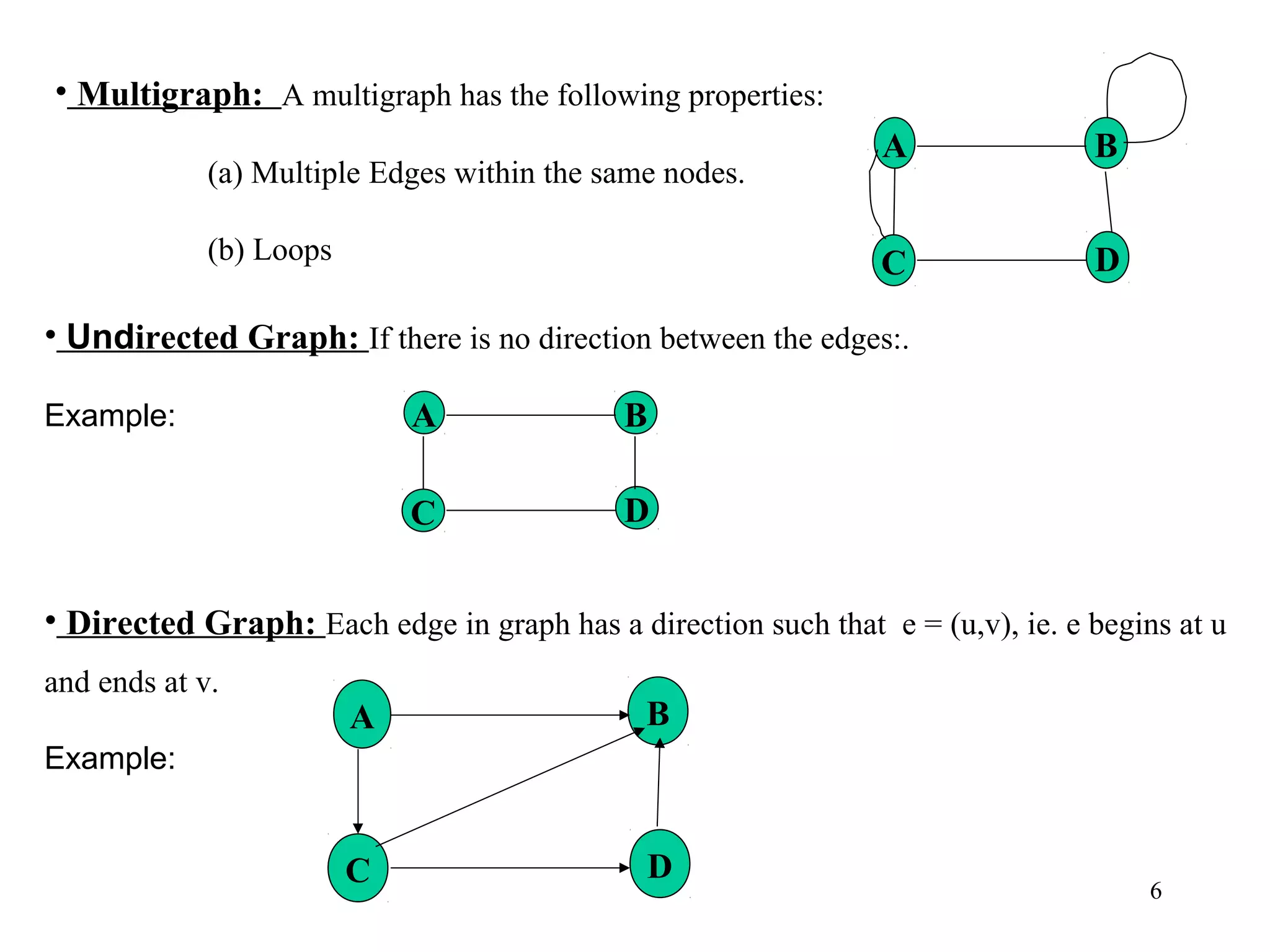
• Multigraph: A multigraph has the following properties:
(a) Multiple Edges within the same nodes.
(b) Loops
• Directed Graph: Each edge in graph has a direction such that e = (u,v), ie. e begins at u
and ends at v.
Example:
A B
C D
A B
C D
6
• Undirected Graph: If there is no direction between the edges:.
Example: A B
C D
• Degree of a Node: No. of edges connected to a node.
(a) Indegree: No. of edges ending at a node.
(b) Outdegree: No. of edges beginning at a node.
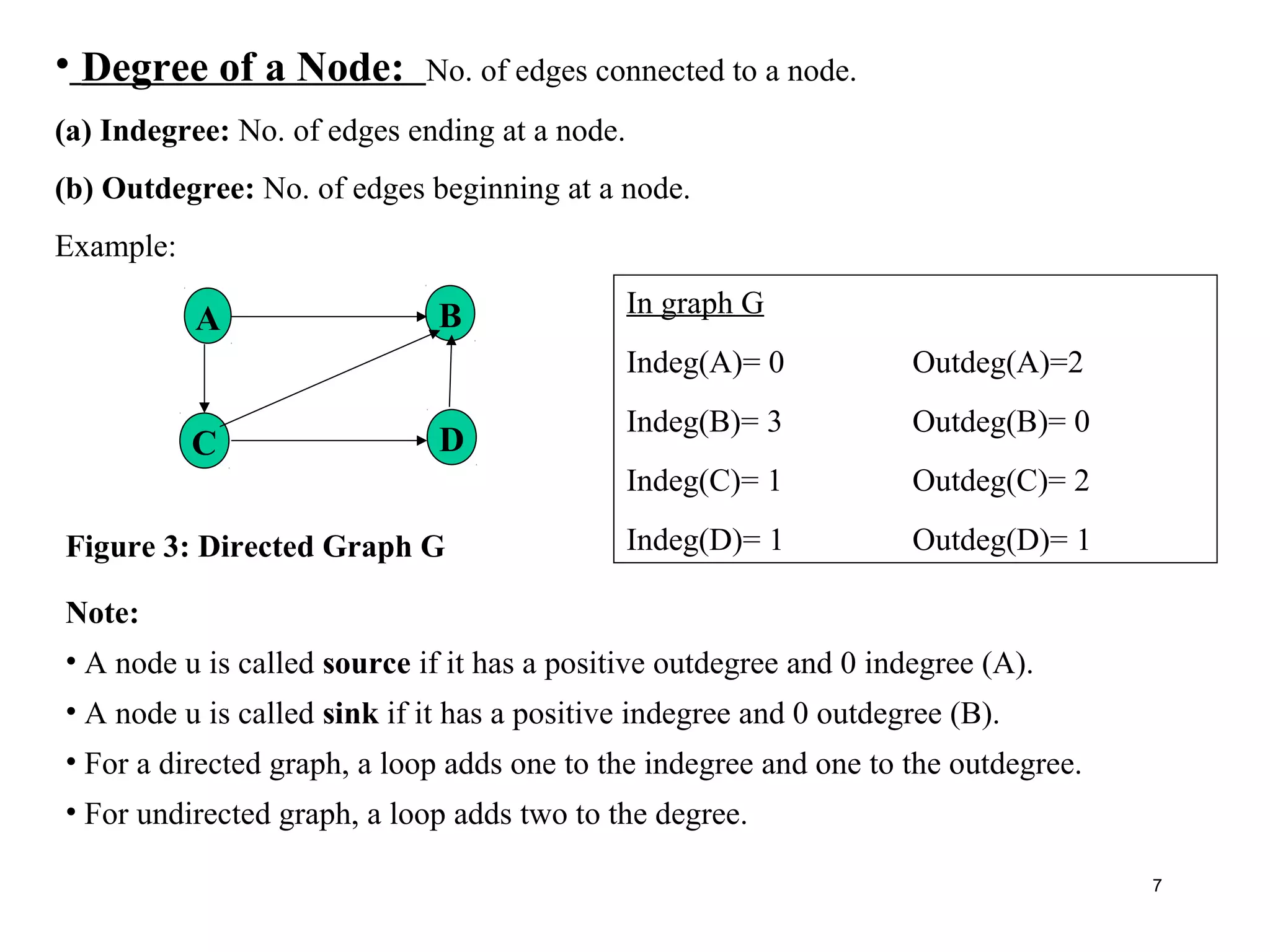
Example:
A B
C D
In graph G
Indeg(A)= 0 Outdeg(A)=2
Indeg(B)= 3 Outdeg(B)= 0
Indeg(C)= 1 Outdeg(C)= 2
Indeg(D)= 1 Outdeg(D)= 1Figure 3: Directed Graph G
Note:
• A node u is called source if it has a positive outdegree and 0 indegree (A).
• A node u is called sink if it has a positive indegree and 0 outdegree (B).
• For a directed graph, a loop adds one to the indegree and one to the outdegree.
• For undirected graph, a loop adds two to the degree.
7
Representation of Graph
(1) Sequential Representation / Adjacency Matrix
(2) Linked Representation / Adjucency List
Sequential Representation/ Adjacency Matrix
• Use Adjacency Matrix (Boolean Matrix).
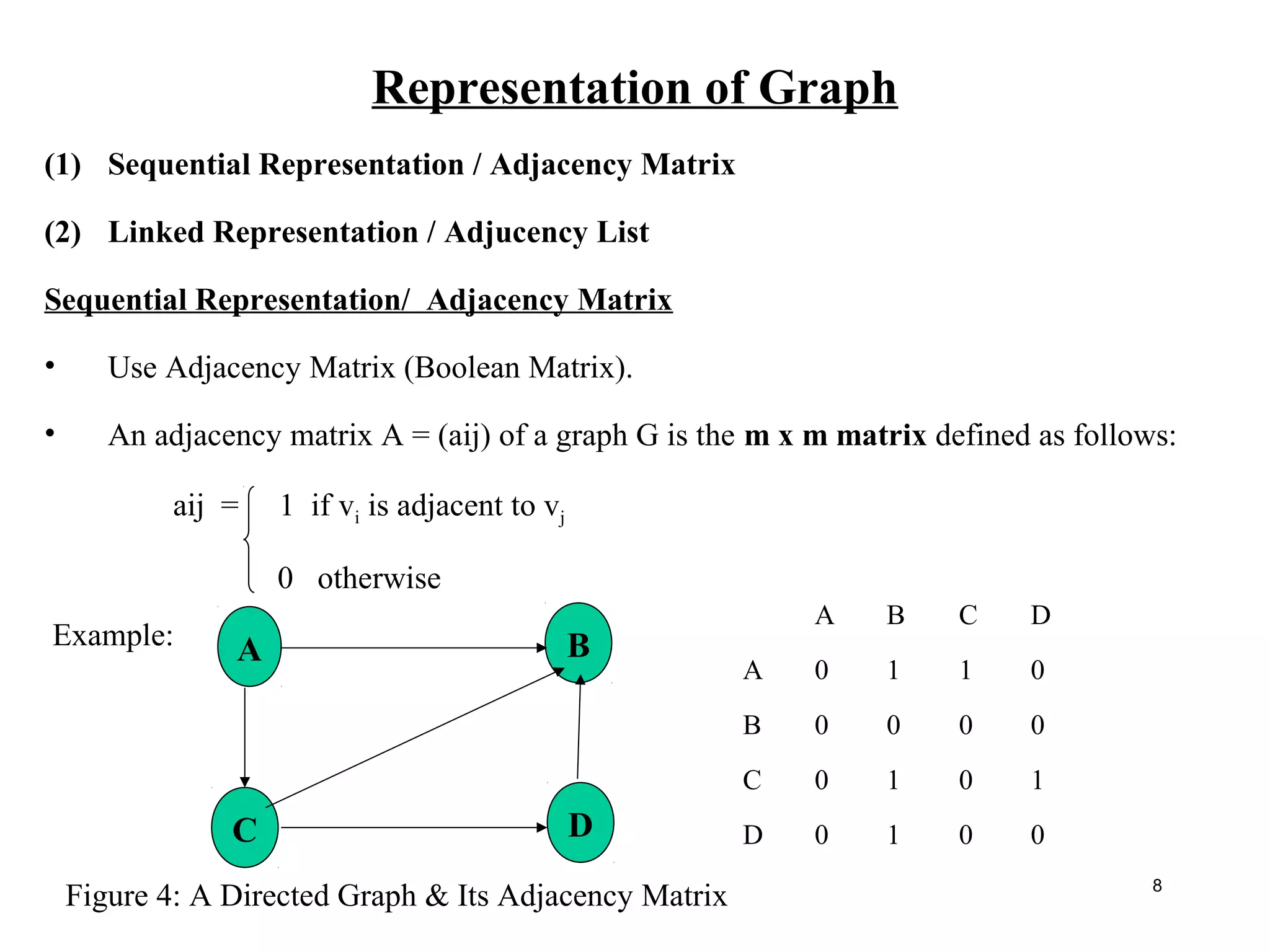
• An adjacency matrix A = (aij) of a graph G is the m x m matrix defined as follows:
aij = 1 if vi is adjacent to vj
0 otherwise
Example: A B
C D
A B C D
A 0 1 1 0
B 0 0 0 0
C 0 1 0 1
D 0 1 0 0
Figure 4: A Directed Graph & Its Adjacency Matrix 8
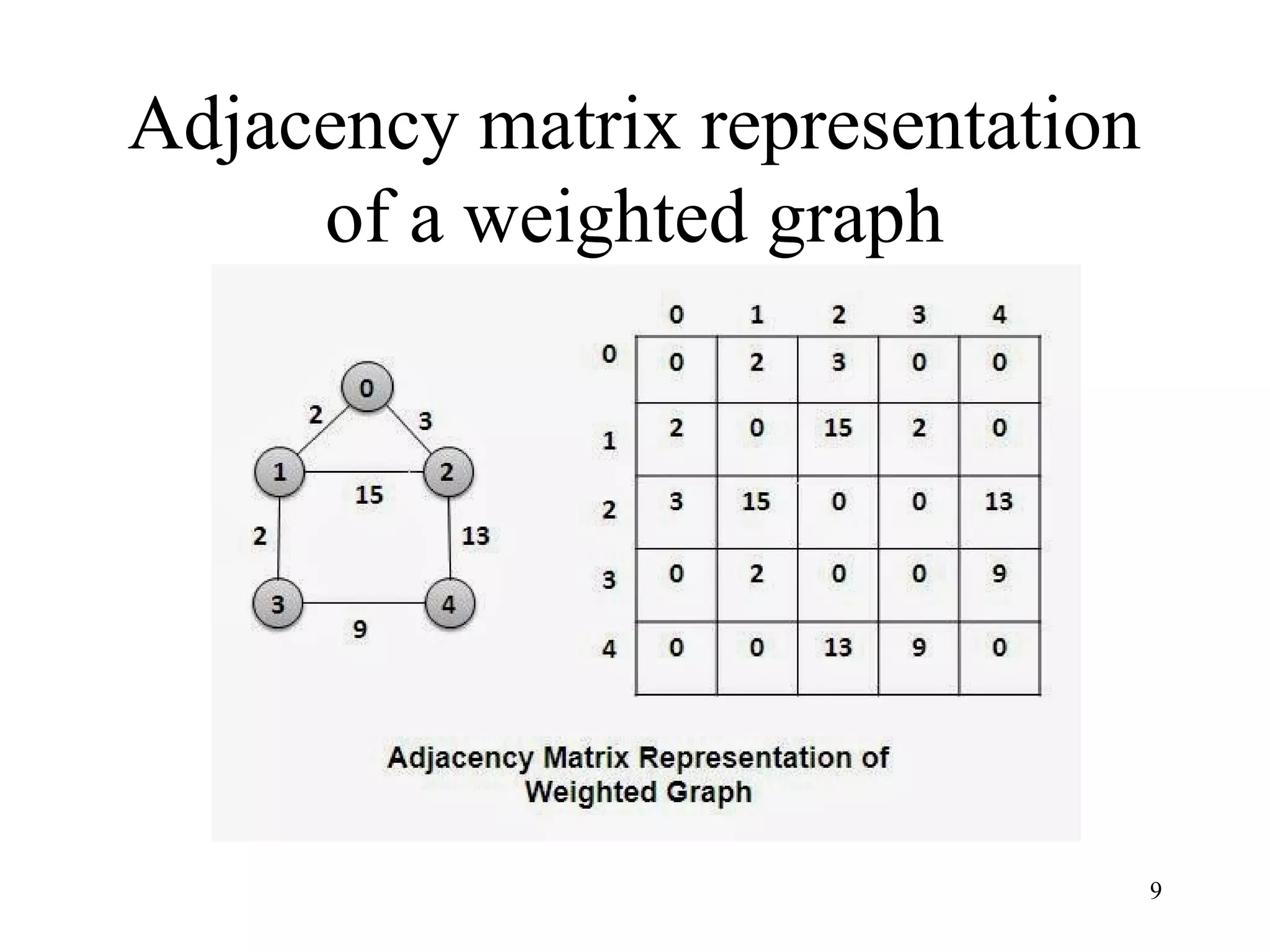
Adjacency matrix representation
of a weighted graph
9
Linked Representation of a GraphLinked Representation of a Graph
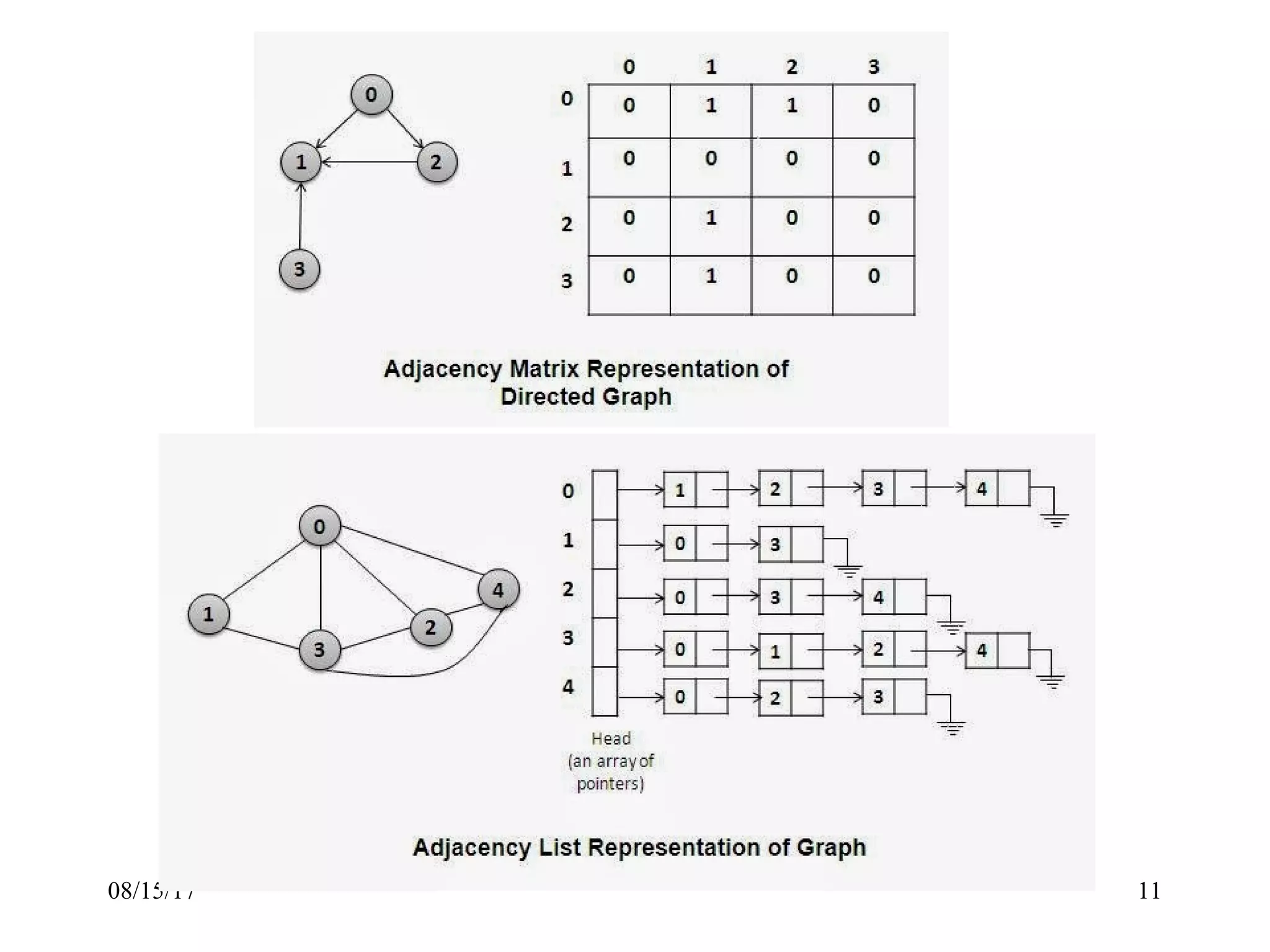
•Adjacency List:
An array of linked lists is used. Size of the array is equal to number of vertices. Let the
array be array[]. An entry array[i] represents the linked list of vertices adjacent to the ith
vertex. This representation can also be used to represent a weighted graph. The weights of
edges can be stored in nodes of linked lists. Following is adjacency list representation of
the above graph.
Example:
Figure: Directed Graph and Corresponding Adjacency List
10
08/15/17 11
Which Representation Is Better?
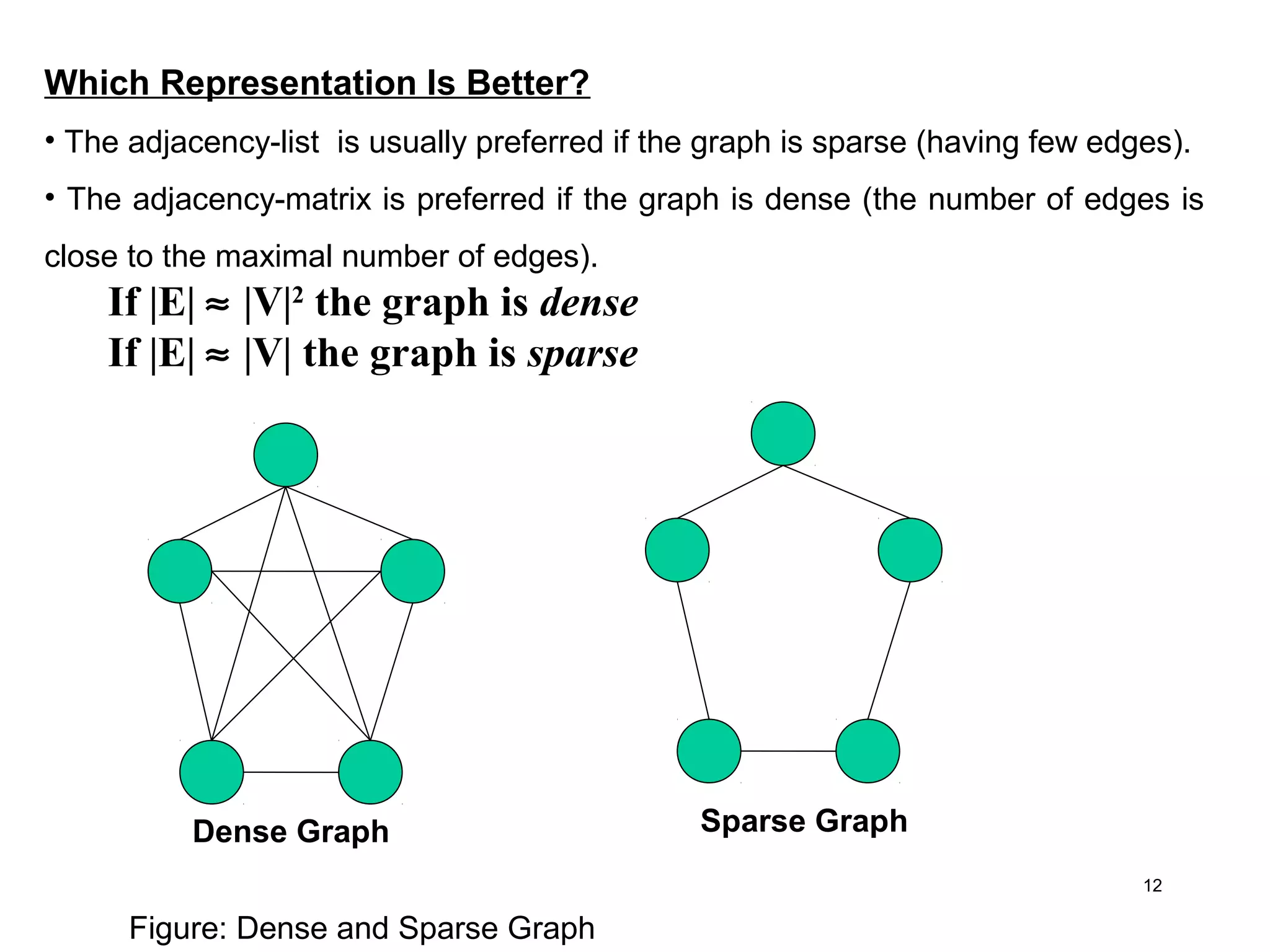
• The adjacency-list is usually preferred if the graph is sparse (having few edges).
• The adjacency-matrix is preferred if the graph is dense (the number of edges is
close to the maximal number of edges).
If |E| ≈ |V|2
the graph is dense
If |E| ≈ |V| the graph is sparse
Dense Graph Sparse Graph
Figure: Dense and Sparse Graph
12
13
END!!!

Basics of graph

  • 1.
    Graph and ItsApplications 1
  • 2.
    • Nonlinear dataStructures. • A graph G consists of two properties: (a) A set V of elements called vertices or nodes. (b) A set E of connectors called edges such that each edge e is identified as e = (u,v) (unordered pair of vertices). Here is a edge between u and v and they are said to be the adjacent nodes or neighbors .  The order of a graph is |V| (the number of vertices).  A graph's size is |E|, the number of edges.  A tree is a graph with no cycle. Example: A B C D E In Graph G1 • 5 Vertices:{A, B, C, D, E} • 6 Edges: {[A,B], [A,C], [B,D], [B,E], [C,D], [D,E]} Figure1: A graph G1 GraphGraph 2
  • 3.
    Definitions • Isolated Node:A vertex u with no edges. • Path: A path P of length n from a node u to node v is defined as a sequence n+1 nodes such that P=(v0, v1, ….vn). • Simple Path: if all nodes in path P are distinct. • Cycle: The starting and the ending vertices are the same. Example: A B C D E In graph G2 • Isolate Node: E • Path P from A to C : A -> B -> D -> C • Length of the Path p : 3 Figure2: Graph G2 3
  • 4.
    • Connected Graph:A graph is called connected if there is a simple path between any two of its nodes. Example: • Complete Graph: A graph G is complete if every node in graph G is adjacent to every other nodes. A complete graph with n nodes will have n(n-1)/2 edges. Example: C A B D A B C D 4 Types of GraphTypes of Graph In Graph G • Vertices, n = 4 • Edges: n(n-1)/2 = 6
  • 5.
    • Tree Graph:A connected graph with no cycle. If a tree graph has m nodes, then there are m-1 edges. Example: • Unweighted Graph: A graph G is said to be un weighted if its edges are not assigned any value. Example: • Weighted Graph: A labeled graph where each edge is assigned a numerical value w(e). Example: A B C D A B C D A B C D 5 12 7 9 2 5
  • 6.
    • Multigraph: Amultigraph has the following properties: (a) Multiple Edges within the same nodes. (b) Loops • Directed Graph: Each edge in graph has a direction such that e = (u,v), ie. e begins at u and ends at v. Example: A B C D A B C D 6 • Undirected Graph: If there is no direction between the edges:. Example: A B C D
  • 7.
    • Degree ofa Node: No. of edges connected to a node. (a) Indegree: No. of edges ending at a node. (b) Outdegree: No. of edges beginning at a node. Example: A B C D In graph G Indeg(A)= 0 Outdeg(A)=2 Indeg(B)= 3 Outdeg(B)= 0 Indeg(C)= 1 Outdeg(C)= 2 Indeg(D)= 1 Outdeg(D)= 1Figure 3: Directed Graph G Note: • A node u is called source if it has a positive outdegree and 0 indegree (A). • A node u is called sink if it has a positive indegree and 0 outdegree (B). • For a directed graph, a loop adds one to the indegree and one to the outdegree. • For undirected graph, a loop adds two to the degree. 7
  • 8.
    Representation of Graph (1)Sequential Representation / Adjacency Matrix (2) Linked Representation / Adjucency List Sequential Representation/ Adjacency Matrix • Use Adjacency Matrix (Boolean Matrix). • An adjacency matrix A = (aij) of a graph G is the m x m matrix defined as follows: aij = 1 if vi is adjacent to vj 0 otherwise Example: A B C D A B C D A 0 1 1 0 B 0 0 0 0 C 0 1 0 1 D 0 1 0 0 Figure 4: A Directed Graph & Its Adjacency Matrix 8
  • 9.
  • 10.
    Linked Representation ofa GraphLinked Representation of a Graph •Adjacency List: An array of linked lists is used. Size of the array is equal to number of vertices. Let the array be array[]. An entry array[i] represents the linked list of vertices adjacent to the ith vertex. This representation can also be used to represent a weighted graph. The weights of edges can be stored in nodes of linked lists. Following is adjacency list representation of the above graph. Example: Figure: Directed Graph and Corresponding Adjacency List 10
  • 11.
  • 12.
    Which Representation IsBetter? • The adjacency-list is usually preferred if the graph is sparse (having few edges). • The adjacency-matrix is preferred if the graph is dense (the number of edges is close to the maximal number of edges). If |E| ≈ |V|2 the graph is dense If |E| ≈ |V| the graph is sparse Dense Graph Sparse Graph Figure: Dense and Sparse Graph 12
  • 13.