Tsuyoshi Murata
Tokyo Institute of Technology
murata@c.titech.ac.jp
www.net.c.titech.ac.jp
Deep Learning Approaches
for Networks
Complex Networks
• Community detection, graph partitioning, overlapping
communities,
• Local communities, community assessment and
benchmarking
• Effective algorithms for sorting nodes in large graphs,
finding patterns in graphs
• Visualization and exploration of large graphs
• Study and simulation of phenomena occurring on
networks
• Network evolution, link prediction, diffusion models
https://iutdijon.u-bourgogne.fr/marami/
Deep Neural Networks (DNNs)
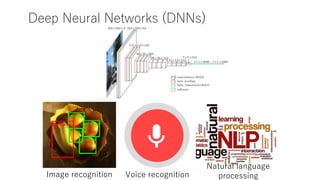
Image recognition Voice recognition
Natural language
processing
Complex Networks + Deep Learning
• Neural networks as complex networks
• Deep compression [Han, ICLR 2016] : compressing neural networks
by pruning, quantization and Huffman coding
• Using neural networks for the tasks of complex networks
• Network Embedding
• Graph Neural Networks
Outline of This Talk
• Network Embedding
• Learning Community Structure with Variational Autoencoder (ICDM
2018)
• MELL: Effective Embedding Method for Multiplex Networks
(MATNet 2018)
• Graph Neural Networks
• Fast Approximations of Betweenness Centrality using Graph Neural
Networks (CIKM 2019)
• Linear Graph Convolutional Model for Diagnosing Brain Disorders
(Complex Networks 2019)
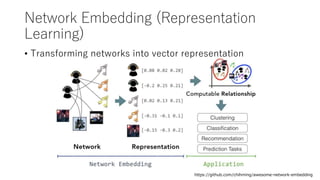
Network Embedding (Representation
Learning)
• Transforming networks into vector representation
https://github.com/chihming/awesome-network-embedding
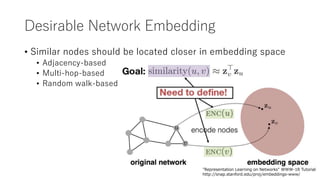
"Representation Learning on Networks" WWW-18 Tutorial
http://snap.stanford.edu/proj/embeddings-www/
Desirable Network Embedding
• Similar nodes should be located closer in embedding space
• Adjacency-based
• Multi-hop-based
• Random walk-based
Challenges of Network Embedding
• Complex topological structure
• no spatial locality like grids
• methods for images do not work
• Defining similarity is not easy
• Combination of attributes and structure
• Several types of networks
• Signed networks (SIDE [Kim 2018], StEM [Rahaman 2018], SiNE [Wang
2018])
• Directed networks ([Perrault-joncas 2011], ATP [Sun 2018])
• Multilayer networks (MTNE [Xu 2017], MELL [Matsuno 2018])
• Temporal networks ([Singer 2019])
A Comprehensive Survey on Graph Neural Networks
https://arxiv.org/abs/1901.00596
Survey, Tutorial, Link
• A Survey on Network Embedding [Cui et al., 2017]
• https://arxiv.org/abs/1711.08752
• WWW-18 Tutorial : Representation Learning on Networks
• http://snap.stanford.edu/proj/embeddings-www/
• Awesome network embedding (links to papers and codes)
• https://github.com/chihming/awesome-network-embedding
Our Attempts for Network Embedding
• Learning Community Structure with Variational Autoencoder
(ICDM 2018)
• MELL: Effective Embedding Method for Multiplex Networks
(MATNet’18)
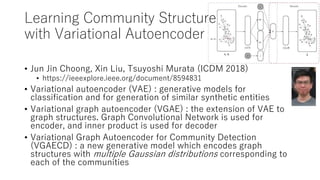
Learning Community Structure
with Variational Autoencoder
• Jun Jin Choong, Xin Liu, Tsuyoshi Murata (ICDM 2018)
• https://ieeexplore.ieee.org/document/8594831
• Variational autoencoder (VAE) : generative models for
classification and for generation of similar synthetic entities
• Variational graph autoencoder (VGAE) : the extension of VAE to
graph structures. Graph Convolutional Network is used for
encoder, and inner product is used for decoder
• Variational Graph Autoencoder for Community Detection
(VGAECD) : a new generative model which encodes graph
structures with multiple Gaussian distributions corresponding to
each of the communities
• Slides from Mr. Choong Jun Jin
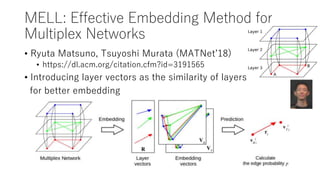
MELL: Effective Embedding Method for
Multiplex Networks
• Ryuta Matsuno, Tsuyoshi Murata (MATNet’18)
• https://dl.acm.org/citation.cfm?id=3191565
• Introducing layer vectors as the similarity of layers
for better embedding
• Slides from Mr. Ryuta Matsuno
Outline of This Talk
• Network Embedding
• Learning Community Structure with Variational Autoencoder (ICDM
2018)
• MELL: Effective Embedding Method for Multiplex Networks
(MATNet 2018)
• Graph Neural Networks
• Fast Approximations of Betweenness Centrality using Graph Neural
Networks (CIKM 2019)
• Linear Graph Convolutional Model for Diagnosing Brain Disorders
(Complex Networks 2019)
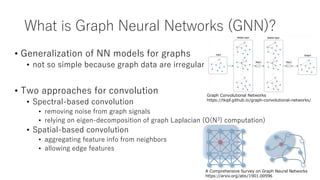
What is Graph Neural Networks (GNN)?
• Generalization of NN models for graphs
• not so simple because graph data are irregular
• Two approaches for convolution
• Spectral-based convolution
• removing noise from graph signals
• relying on eigen-decomposition of graph Laplacian (O(N3) computation)
• Spatial-based convolution
• aggregating feature info from neighbors
• allowing edge features
A Comprehensive Survey on Graph Neural Networks
https://arxiv.org/abs/1901.00596
Graph Convolutional Networks
https://tkipf.github.io/graph-convolutional-networks/
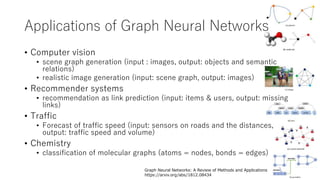
Applications of Graph Neural Networks
• Computer vision
• scene graph generation (input : images, output: objects and semantic
relations)
• realistic image generation (input: scene graph, output: images)
• Recommender systems
• recommendation as link prediction (input: items & users, output: missing
links)
• Traffic
• Forecast of traffic speed (input: sensors on roads and the distances,
output: traffic speed and volume)
• Chemistry
• classification of molecular graphs (atoms = nodes, bonds = edges)
Graph Neural Networks: A Review of Methods and Applications
https://arxiv.org/abs/1812.08434
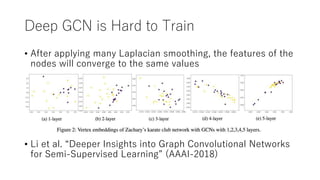
Deep GCN is Hard to Train
• After applying many Laplacian smoothing, the features of the
nodes will converge to the same values
• Li et al. “Deeper Insights into Graph Convolutional Networks
for Semi-Supervised Learning” (AAAI-2018)
Survey Papers of GNN
• “A Comprehensive Survey on Graph Neural Networks”
• Zonghan Wu, Shirui Pan, Fengwen Chen, Guodong Long, Chengqi Zhang,
Philip S. Yu
• https://arxiv.org/abs/1901.00596
• “Graph Neural Networks: A Review of Methods and Applications”
• Jie Zhou, Ganqu Cui, Zhengyan Zhang, Cheng Yang, Zhiyuan Liu, Lifeng
Wang, Changcheng Li, Maosong Sun
• https://arxiv.org/abs/1812.08434
• “Deep Learning on Graphs: A Survey”
• Ziwei Zhang, Peng Cui, Wenwu Zhu
• https://arxiv.org/abs/1812.04202
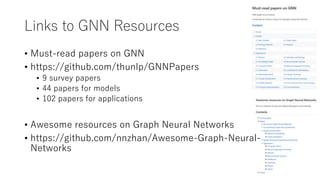
Links to GNN Resources
• Must-read papers on GNN
• https://github.com/thunlp/GNNPapers
• 9 survey papers
• 44 papers for models
• 102 papers for applications
• Awesome resources on Graph Neural Networks
• https://github.com/nnzhan/Awesome-Graph-Neural-
Networks
Towards Deep and Large GNNs
• “Cluster-GCN : An Efficient Algorithm for Training Deep and
Large Graph Convolutional Networks”, Wei-Lin Chiang,
Xuanqing Liu, Si Si, Yang Li, Samy Bengio, Cho-Jui Hsieh
[KDD 2019]
• https://arxiv.org/abs/1905.07953
• Neighborhood expansion is restricted within the clusters
Representation Properties and Limitations
of GNN
• “How Powerful Are Graph Neural Networks?”
• Keyulu Xu, Weihua Hu, Jure Leskovec, Stefanie Jegelka
• https://arxiv.org/abs/1810.00826
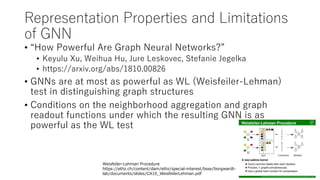
• GNNs are at most as powerful as WL (Weisfeiler-Lehman)
test in distinguishing graph structures
• Conditions on the neighborhood aggregation and graph
readout functions under which the resulting GNN is as
powerful as the WL test
Weisfeiler-Lehman Procedure
https://ethz.ch/content/dam/ethz/special-interest/bsse/borgwardt-
lab/documents/slides/CA10_WeisfeilerLehman.pdf
Computational Capacity Limits of GNN
• “What graph neural networks cannot learn: depth vs width”
• Andreas Loukas, 2019
• https://arxiv.org/abs/1907.03199
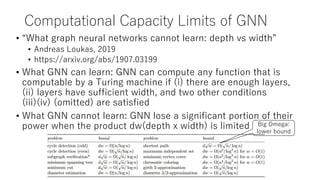
• What GNN can learn: GNN can compute any function that is
computable by a Turing machine if (i) there are enough layers,
(ii) layers have sufficient width, and two other conditions
(iii)(iv) (omitted) are satisfied
• What GNN cannot learn: GNN lose a significant portion of their
power when the product dw(depth x width) is limited Big Omega:
lower bound
Explainability of GNN
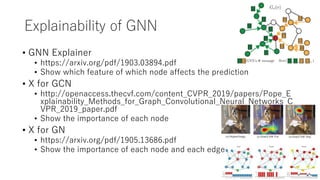
• GNN Explainer
• https://arxiv.org/pdf/1903.03894.pdf
• Show which feature of which node affects the prediction
• X for GCN
• http://openaccess.thecvf.com/content_CVPR_2019/papers/Pope_E
xplainability_Methods_for_Graph_Convolutional_Neural_Networks_C
VPR_2019_paper.pdf
• Show the importance of each node
• X for GN
• https://arxiv.org/pdf/1905.13686.pdf
• Show the importance of each node and each edge
Online Resources
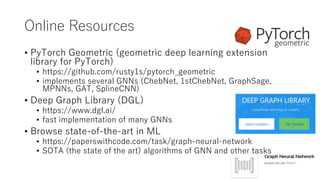
• PyTorch Geometric (geometric deep learning extension
library for PyTorch)
• https://github.com/rusty1s/pytorch_geometric
• implements several GNNs (ChebNet, 1stChebNet, GraphSage,
MPNNs, GAT, SplineCNN)
• Deep Graph Library (DGL)
• https://www.dgl.ai/
• fast implementation of many GNNs
• Browse state-of-the-art in ML
• https://paperswithcode.com/task/graph-neural-network
• SOTA (the state of the art) algorithms of GNN and other tasks
Open Problems of GNNs
• shallow structures
• dynamic graphs
• non-structural scenarios
• scalability
Open Problems 1: Shallow Structure
• Traditional DNN can stack hundreds of layers to get better
performance (because deeper structure has more
parameters which improve the expressive power)
• GNN are always shallow, most of which are no more than
three layers
• Stacking multiple GCN layers will result in over-smoothing
(all vertices will converge to the same value)
Open problems 2: Dynamic Graphs
• Static graphs are stable so they can be modeled feasibly
• When edges and nodes appear and disappear, GNN cannot
change adaptively
Open Problems 3: Non-structural Scenarios
• There is no optimal methods to generate graphs from raw
data
• Finding the best graph generation approach will offer a wider
range of GNN application
Open Problems 4: Scalability
• How to apply embedding methods in Web-scale conditions
has been a fatal problem for almost all graph embedding
algorithms, and GNN is not an exception
• Scaling up GNN is difficult because many of the core steps
are computationally consuming in big data environment
• Graph data are not regular Euclidean, so batches cannot be applied
• Calculating graph Laplacian is also unfeasible when there are
millions of nodes and edges
Our Attempts for GNN
• Fast Approximations of Betweenness Centrality using Graph
Neural Networks (CIKM 2019)
• Linear Graph Convolutional Model for Diagnosing Brain
Disorders (Complex Networks 2019)
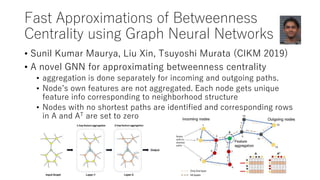
Fast Approximations of Betweenness
Centrality using Graph Neural Networks
• Sunil Kumar Maurya, Liu Xin, Tsuyoshi Murata (CIKM 2019)
• A novel GNN for approximating betweenness centrality
• aggregation is done separately for incoming and outgoing paths.
• Node’s own features are not aggregated. Each node gets unique
feature info corresponding to neighborhood structure
• Nodes with no shortest paths are identified and corresponding rows
in A and AT are set to zero
• Slides from Mr. Sunil Kumar Maurya
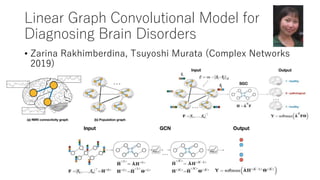
Linear Graph Convolutional Model for
Diagnosing Brain Disorders
• Zarina Rakhimberdina, Tsuyoshi Murata (Complex Networks
2019)
Semi-supervised learning on network using
structure features and graph convolution
[Tachibana et al., 2018]
• GCN uses local info only(such as 2-hop neighborhood info)
• Info about global structure is expected to improve the
performance
+
JSAI incentive award 2018
Semi-supervised learning on network using structure
features and graph convolution
https://jsai.ixsq.nii.ac.jp/ej/?action=pages_view_main&
active_action=repository_view_main_item_detail&item_i
d=9541&item_no=1&page_id=13&block_id=23
Complex Networks + Deep Learning :
Future Directions
• Explainable AI (XAI)
• Interpretable Machine Learning
• https://christophm.github.io/interpretable-ml-book/index.html
• Scene graph
• Interactions among objects can be easily modeled as a graph
• “LinkNet: Relational Embedding for Scene Graph” [NIPS 2018]
• Neural networks as complex networks
• Deep compression [Han, ICLR 2016]
• Deep learning systems as complex networks [Testolin, 2018]
• https://arxiv.org/abs/1809.10941
Acknowledgements
• Thank you for the organizers of MARAMI 2019
• Research funds
• JSPS Grant-in-Aid for Scientific Research (B)(Grant Number
17H01785)
• JST CREST (Grant Number JPMJCR1687)
• Many collaborators, especially Dr. Xin Liu (National
Institute of Advanced Industrial Science and Technology
(AIST), Japan)
Tsuyoshi Murata
Tokyo Institute of Technology
murata@c.titech.ac.jp
www.net.c.titech.ac.jp
Deep Learning Approaches for
Networks

20191107 deeplearningapproachesfornetworks

  • 1.
    Tsuyoshi Murata Tokyo Instituteof Technology murata@c.titech.ac.jp www.net.c.titech.ac.jp Deep Learning Approaches for Networks
  • 2.
    Complex Networks • Communitydetection, graph partitioning, overlapping communities, • Local communities, community assessment and benchmarking • Effective algorithms for sorting nodes in large graphs, finding patterns in graphs • Visualization and exploration of large graphs • Study and simulation of phenomena occurring on networks • Network evolution, link prediction, diffusion models https://iutdijon.u-bourgogne.fr/marami/
  • 3.
    Deep Neural Networks(DNNs) Image recognition Voice recognition Natural language processing
  • 4.
    Complex Networks +Deep Learning • Neural networks as complex networks • Deep compression [Han, ICLR 2016] : compressing neural networks by pruning, quantization and Huffman coding • Using neural networks for the tasks of complex networks • Network Embedding • Graph Neural Networks
  • 5.
    Outline of ThisTalk • Network Embedding • Learning Community Structure with Variational Autoencoder (ICDM 2018) • MELL: Effective Embedding Method for Multiplex Networks (MATNet 2018) • Graph Neural Networks • Fast Approximations of Betweenness Centrality using Graph Neural Networks (CIKM 2019) • Linear Graph Convolutional Model for Diagnosing Brain Disorders (Complex Networks 2019)
  • 6.
    Network Embedding (Representation Learning) •Transforming networks into vector representation https://github.com/chihming/awesome-network-embedding
  • 7.
    "Representation Learning onNetworks" WWW-18 Tutorial http://snap.stanford.edu/proj/embeddings-www/ Desirable Network Embedding • Similar nodes should be located closer in embedding space • Adjacency-based • Multi-hop-based • Random walk-based
  • 8.
    Challenges of NetworkEmbedding • Complex topological structure • no spatial locality like grids • methods for images do not work • Defining similarity is not easy • Combination of attributes and structure • Several types of networks • Signed networks (SIDE [Kim 2018], StEM [Rahaman 2018], SiNE [Wang 2018]) • Directed networks ([Perrault-joncas 2011], ATP [Sun 2018]) • Multilayer networks (MTNE [Xu 2017], MELL [Matsuno 2018]) • Temporal networks ([Singer 2019]) A Comprehensive Survey on Graph Neural Networks https://arxiv.org/abs/1901.00596
  • 9.
    Survey, Tutorial, Link •A Survey on Network Embedding [Cui et al., 2017] • https://arxiv.org/abs/1711.08752 • WWW-18 Tutorial : Representation Learning on Networks • http://snap.stanford.edu/proj/embeddings-www/ • Awesome network embedding (links to papers and codes) • https://github.com/chihming/awesome-network-embedding
  • 10.
    Our Attempts forNetwork Embedding • Learning Community Structure with Variational Autoencoder (ICDM 2018) • MELL: Effective Embedding Method for Multiplex Networks (MATNet’18)
  • 11.
    Learning Community Structure withVariational Autoencoder • Jun Jin Choong, Xin Liu, Tsuyoshi Murata (ICDM 2018) • https://ieeexplore.ieee.org/document/8594831 • Variational autoencoder (VAE) : generative models for classification and for generation of similar synthetic entities • Variational graph autoencoder (VGAE) : the extension of VAE to graph structures. Graph Convolutional Network is used for encoder, and inner product is used for decoder • Variational Graph Autoencoder for Community Detection (VGAECD) : a new generative model which encodes graph structures with multiple Gaussian distributions corresponding to each of the communities
  • 12.
    • Slides fromMr. Choong Jun Jin
  • 13.
    MELL: Effective EmbeddingMethod for Multiplex Networks • Ryuta Matsuno, Tsuyoshi Murata (MATNet’18) • https://dl.acm.org/citation.cfm?id=3191565 • Introducing layer vectors as the similarity of layers for better embedding
  • 14.
    • Slides fromMr. Ryuta Matsuno
  • 15.
    Outline of ThisTalk • Network Embedding • Learning Community Structure with Variational Autoencoder (ICDM 2018) • MELL: Effective Embedding Method for Multiplex Networks (MATNet 2018) • Graph Neural Networks • Fast Approximations of Betweenness Centrality using Graph Neural Networks (CIKM 2019) • Linear Graph Convolutional Model for Diagnosing Brain Disorders (Complex Networks 2019)
  • 16.
    What is GraphNeural Networks (GNN)? • Generalization of NN models for graphs • not so simple because graph data are irregular • Two approaches for convolution • Spectral-based convolution • removing noise from graph signals • relying on eigen-decomposition of graph Laplacian (O(N3) computation) • Spatial-based convolution • aggregating feature info from neighbors • allowing edge features A Comprehensive Survey on Graph Neural Networks https://arxiv.org/abs/1901.00596 Graph Convolutional Networks https://tkipf.github.io/graph-convolutional-networks/
  • 17.
    Applications of GraphNeural Networks • Computer vision • scene graph generation (input : images, output: objects and semantic relations) • realistic image generation (input: scene graph, output: images) • Recommender systems • recommendation as link prediction (input: items & users, output: missing links) • Traffic • Forecast of traffic speed (input: sensors on roads and the distances, output: traffic speed and volume) • Chemistry • classification of molecular graphs (atoms = nodes, bonds = edges) Graph Neural Networks: A Review of Methods and Applications https://arxiv.org/abs/1812.08434
  • 18.
    Deep GCN isHard to Train • After applying many Laplacian smoothing, the features of the nodes will converge to the same values • Li et al. “Deeper Insights into Graph Convolutional Networks for Semi-Supervised Learning” (AAAI-2018)
  • 19.
    Survey Papers ofGNN • “A Comprehensive Survey on Graph Neural Networks” • Zonghan Wu, Shirui Pan, Fengwen Chen, Guodong Long, Chengqi Zhang, Philip S. Yu • https://arxiv.org/abs/1901.00596 • “Graph Neural Networks: A Review of Methods and Applications” • Jie Zhou, Ganqu Cui, Zhengyan Zhang, Cheng Yang, Zhiyuan Liu, Lifeng Wang, Changcheng Li, Maosong Sun • https://arxiv.org/abs/1812.08434 • “Deep Learning on Graphs: A Survey” • Ziwei Zhang, Peng Cui, Wenwu Zhu • https://arxiv.org/abs/1812.04202
  • 20.
    Links to GNNResources • Must-read papers on GNN • https://github.com/thunlp/GNNPapers • 9 survey papers • 44 papers for models • 102 papers for applications • Awesome resources on Graph Neural Networks • https://github.com/nnzhan/Awesome-Graph-Neural- Networks
  • 21.
    Towards Deep andLarge GNNs • “Cluster-GCN : An Efficient Algorithm for Training Deep and Large Graph Convolutional Networks”, Wei-Lin Chiang, Xuanqing Liu, Si Si, Yang Li, Samy Bengio, Cho-Jui Hsieh [KDD 2019] • https://arxiv.org/abs/1905.07953 • Neighborhood expansion is restricted within the clusters
  • 22.
    Representation Properties andLimitations of GNN • “How Powerful Are Graph Neural Networks?” • Keyulu Xu, Weihua Hu, Jure Leskovec, Stefanie Jegelka • https://arxiv.org/abs/1810.00826 • GNNs are at most as powerful as WL (Weisfeiler-Lehman) test in distinguishing graph structures • Conditions on the neighborhood aggregation and graph readout functions under which the resulting GNN is as powerful as the WL test Weisfeiler-Lehman Procedure https://ethz.ch/content/dam/ethz/special-interest/bsse/borgwardt- lab/documents/slides/CA10_WeisfeilerLehman.pdf
  • 23.
    Computational Capacity Limitsof GNN • “What graph neural networks cannot learn: depth vs width” • Andreas Loukas, 2019 • https://arxiv.org/abs/1907.03199 • What GNN can learn: GNN can compute any function that is computable by a Turing machine if (i) there are enough layers, (ii) layers have sufficient width, and two other conditions (iii)(iv) (omitted) are satisfied • What GNN cannot learn: GNN lose a significant portion of their power when the product dw(depth x width) is limited Big Omega: lower bound
  • 24.
    Explainability of GNN •GNN Explainer • https://arxiv.org/pdf/1903.03894.pdf • Show which feature of which node affects the prediction • X for GCN • http://openaccess.thecvf.com/content_CVPR_2019/papers/Pope_E xplainability_Methods_for_Graph_Convolutional_Neural_Networks_C VPR_2019_paper.pdf • Show the importance of each node • X for GN • https://arxiv.org/pdf/1905.13686.pdf • Show the importance of each node and each edge
  • 25.
    Online Resources • PyTorchGeometric (geometric deep learning extension library for PyTorch) • https://github.com/rusty1s/pytorch_geometric • implements several GNNs (ChebNet, 1stChebNet, GraphSage, MPNNs, GAT, SplineCNN) • Deep Graph Library (DGL) • https://www.dgl.ai/ • fast implementation of many GNNs • Browse state-of-the-art in ML • https://paperswithcode.com/task/graph-neural-network • SOTA (the state of the art) algorithms of GNN and other tasks
  • 26.
    Open Problems ofGNNs • shallow structures • dynamic graphs • non-structural scenarios • scalability
  • 27.
    Open Problems 1:Shallow Structure • Traditional DNN can stack hundreds of layers to get better performance (because deeper structure has more parameters which improve the expressive power) • GNN are always shallow, most of which are no more than three layers • Stacking multiple GCN layers will result in over-smoothing (all vertices will converge to the same value)
  • 28.
    Open problems 2:Dynamic Graphs • Static graphs are stable so they can be modeled feasibly • When edges and nodes appear and disappear, GNN cannot change adaptively
  • 29.
    Open Problems 3:Non-structural Scenarios • There is no optimal methods to generate graphs from raw data • Finding the best graph generation approach will offer a wider range of GNN application
  • 30.
    Open Problems 4:Scalability • How to apply embedding methods in Web-scale conditions has been a fatal problem for almost all graph embedding algorithms, and GNN is not an exception • Scaling up GNN is difficult because many of the core steps are computationally consuming in big data environment • Graph data are not regular Euclidean, so batches cannot be applied • Calculating graph Laplacian is also unfeasible when there are millions of nodes and edges
  • 31.
    Our Attempts forGNN • Fast Approximations of Betweenness Centrality using Graph Neural Networks (CIKM 2019) • Linear Graph Convolutional Model for Diagnosing Brain Disorders (Complex Networks 2019)
  • 32.
    Fast Approximations ofBetweenness Centrality using Graph Neural Networks • Sunil Kumar Maurya, Liu Xin, Tsuyoshi Murata (CIKM 2019) • A novel GNN for approximating betweenness centrality • aggregation is done separately for incoming and outgoing paths. • Node’s own features are not aggregated. Each node gets unique feature info corresponding to neighborhood structure • Nodes with no shortest paths are identified and corresponding rows in A and AT are set to zero
  • 33.
    • Slides fromMr. Sunil Kumar Maurya
  • 34.
    Linear Graph ConvolutionalModel for Diagnosing Brain Disorders • Zarina Rakhimberdina, Tsuyoshi Murata (Complex Networks 2019)
  • 35.
    Semi-supervised learning onnetwork using structure features and graph convolution [Tachibana et al., 2018] • GCN uses local info only(such as 2-hop neighborhood info) • Info about global structure is expected to improve the performance + JSAI incentive award 2018 Semi-supervised learning on network using structure features and graph convolution https://jsai.ixsq.nii.ac.jp/ej/?action=pages_view_main& active_action=repository_view_main_item_detail&item_i d=9541&item_no=1&page_id=13&block_id=23
  • 36.
    Complex Networks +Deep Learning : Future Directions • Explainable AI (XAI) • Interpretable Machine Learning • https://christophm.github.io/interpretable-ml-book/index.html • Scene graph • Interactions among objects can be easily modeled as a graph • “LinkNet: Relational Embedding for Scene Graph” [NIPS 2018] • Neural networks as complex networks • Deep compression [Han, ICLR 2016] • Deep learning systems as complex networks [Testolin, 2018] • https://arxiv.org/abs/1809.10941
  • 37.
    Acknowledgements • Thank youfor the organizers of MARAMI 2019 • Research funds • JSPS Grant-in-Aid for Scientific Research (B)(Grant Number 17H01785) • JST CREST (Grant Number JPMJCR1687) • Many collaborators, especially Dr. Xin Liu (National Institute of Advanced Industrial Science and Technology (AIST), Japan)
  • 38.
    Tsuyoshi Murata Tokyo Instituteof Technology murata@c.titech.ac.jp www.net.c.titech.ac.jp Deep Learning Approaches for Networks