More Related Content


Similar to Les verbes réfléchis au passé


Les verbes réfléchis au passé
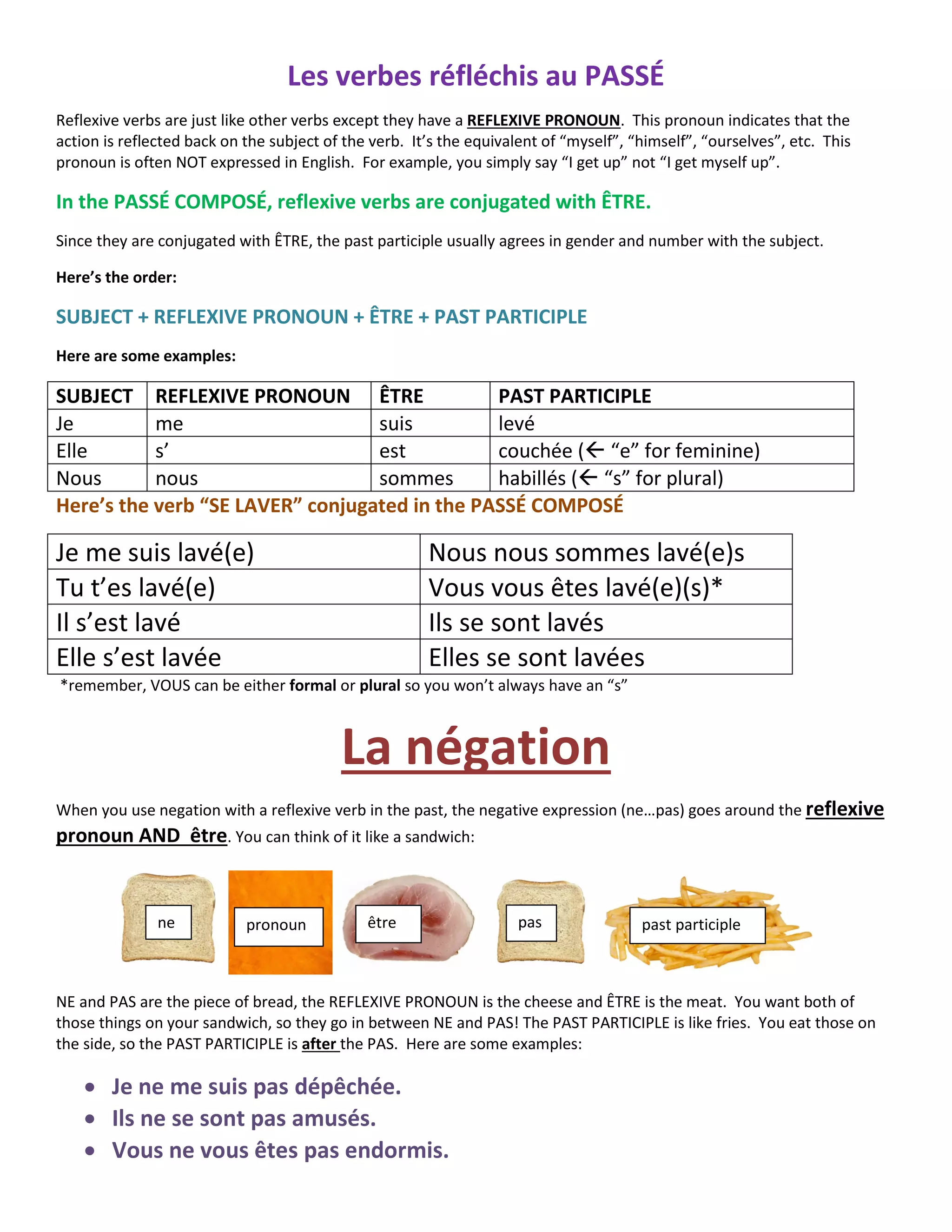
- 1. Les verbes réfléchisau PASSÉ Reflexive verbs are just like other verbs except they have a REFLEXIVE PRONOUN. This pronoun indicates that the action is reflected back on the subject of the verb. It’s the equivalent of “myself”, “himself”, “ourselves”, etc. This pronoun is often NOT expressed in English. For example, you simply say “I get up” not “I get myself up”. In the PASSÉ COMPOSÉ, reflexive verbs are conjugated with ÊTRE. Since they are conjugated with ÊTRE, the past participle usually agrees in gender and number with the subject. Here’s the order: SUBJECT + REFLEXIVE PRONOUN + ÊTRE + PAST PARTICIPLE Here are some examples: SUBJECT REFLEXIVE PRONOUN ÊTRE PAST PARTICIPLE Je me suis levé Elle s’ est couchée ( “e” for feminine) Nous nous sommes habillés ( “s” for plural) Here’s the verb “SE LAVER” conjugated in the PASSÉ COMPOSÉ Je me suis lavé(e) Nous nous sommes lavé(e)s Tu t’es lavé(e) Vous vous êtes lavé(e)(s)* Il s’est lavé Ils se sont lavés Elle s’est lavée Elles se sont lavées *remember, VOUS can be either formal or plural so you won’t always have an “s” La négation When you use negation with a reflexive verb in the past, the negative expression (ne…pas) goes around the reflexive pronoun AND être. You can think of it like a sandwich: NE and PAS are the piece of bread, the REFLEXIVE PRONOUN is the cheese and ÊTRE is the meat. You want both of those things on your sandwich, so they go in between NE and PAS! The PAST PARTICIPLE is like fries. You eat those on the side, so the PAST PARTICIPLE is after the PAS. Here are some examples: •Je ne me suis pas dépêchée. •Ils ne se sont pas amusés. •Vous ne vous êtes pas endormis. ne past participle pronoun être pas