By: Elena Anderson
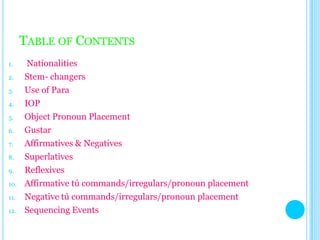
TABLE OF CONTENTS
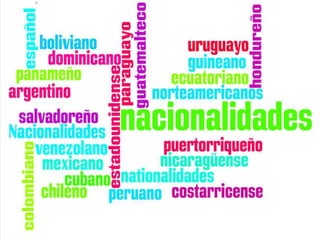
1.     Nationalities
2.    Stem- changers
3.    Use of Para
4.    IOP
5.    Object Pronoun Placement
6.    Gustar
7.    Affirmatives & Negatives
8.    Superlatives
9.    Reflexives
10.   Affirmative tú commands/irregulars/pronoun placement
11.   Negative tú commands/irregulars/pronoun placement
12.   Sequencing Events
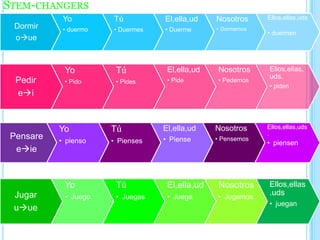
STEM-CHANGERS
            Yo         Tú          El,ella,ud    Nosotros     Ellos,ellas,uds
 Dormir                                                       .
            • duermo   • Duermes   • Duerme      • Dormemos
                                                              • duermen
 oue


            Yo          Tú          El,ella,ud   Nosotros     Ellos,ellas,
                                                              uds.
  Pedir     • Pido      • Pides     • Pide       • Pedemos
                                                              • piden
  ei


           Yo          Tú          El,ella,ud    Nosotros     Ellos,ellas,uds
                                                              .
 Pensare   • pienso    • Pienses   • Piense      • Pensemos
                                                              • piensen
  eie


            Yo          Tú          El,ella,ud   Nosotros     Ellos,ellas
 Jugar      • Juego                 • Juega      • Jugamos
                                                              .uds
                        • Juegas
                                                              • juegan
 uue
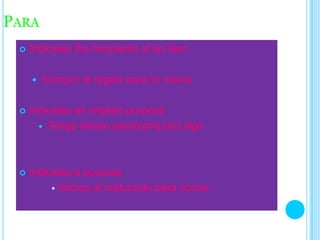
PARA
    Indicates the recipients of an item

        Compro el regalo para tú mama

    Indicates an implied purpose
        Tengo dinero para(comprar) algo


    Indicates a purpose
           Vamos al resturante para comer
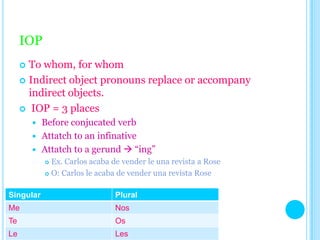
IOP
      To whom, for whom
      Indirect object pronouns replace or accompany
       indirect objects.
      IOP = 3 places
          Before conjucated verb
          Attatch to an infinative
          Attatch to a gerund  “ing”
              Ex. Carlos acaba de vender le una revista a Rose
              O: Carlos le acaba de vender una revista Rose


Singular                         Plural
Me                               Nos
Te                               Os
Le                               Les
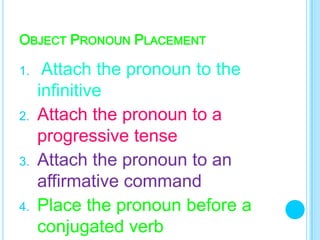
OBJECT PRONOUN PLACEMENT

1.    Attach the pronoun to the
     infinitive
2.   Attach the pronoun to a
     progressive tense
3.   Attach the pronoun to an
     affirmative command
4.   Place the pronoun before a
     conjugated verb
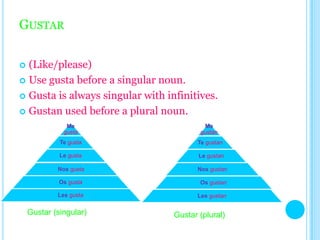
GUSTAR

 (Like/please)
 Use gusta before a singular noun.

 Gusta is always singular with infinitives.

 Gustan used before a plural noun.
               Me                         Me
              gusta                      gustan
             Te gusta                   Te gustan

             Le gusta                    Le gustan

            Nos gusta                   Nos gustan

             Os gusta                    Os gustan

            Les gusta                   Les gustan

    Gustar (singular)             Gustar (plural)
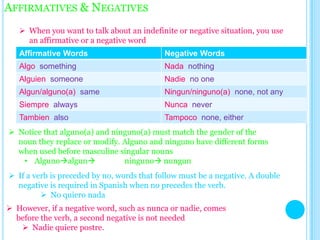
AFFIRMATIVES & NEGATIVES
    When you want to talk about an indefinite or negative situation, you use
     an affirmative or a negative word
   Affirmative Words                        Negative Words
   Algo something                           Nada nothing
   Alguien someone                          Nadie no one
   Algun/alguno(a) same                     Ningun/ninguno(a) none, not any
   Siempre always                           Nunca never
   Tambien also                             Tampoco none, either
 Notice that alguno(a) and ninguno(a) must match the gender of the
  noun they replace or modify. Alguno and ninguno have different forms
  when used before masculine singular nouns
   • Algunoalgun             ninguno nungun
 If a verb is preceded by no, words that follow must be a negative. A double
  negative is required in Spanish when no precedes the verb.
          No quiero nada
 However, if a negative word, such as nunca or nadie, comes
  before the verb, a second negative is not needed
    Nadie quiere postre.
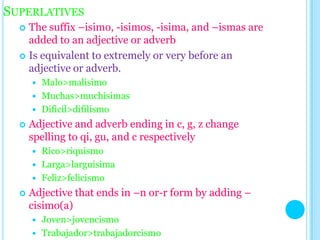
SUPERLATIVES
   The suffix –isimo, -isimos, -isima, and –ismas are
    added to an adjective or adverb
   Is equivalent to extremely or very before an
    adjective or adverb.
         Malo>malisimo
         Muchas>muchisimas
         Dificil>difilismo
     Adjective and adverb ending in c, g, z change
      spelling to qi, gu, and c respectively
       Rico>riquismo
       Larga>larguisima
       Feliz>felicismo

     Adjective that ends in –n or-r form by adding –
      cisimo(a)
       Joven>jovencismo
       Trabajador>trabajadorcismo
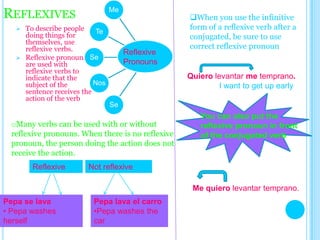
REFLEXIVES                       Me
                                                  When you use the infinitive
    To describe people                           form of a reflexive verb after a
                            Te
     doing things for                             conjugated, be sure to use
     themselves, use
     reflexive verbs.                             correct reflexive pronoun
                                      Reflexive
    Reflexive pronouns Se
     are used with                    Pronouns
     reflexive verbs to
     indicate that the                            Quiero levantar me temprano.
     subject of the        Nos                             I want to get up early
     sentence receives the
     action of the verb
                                 Se
                                                     You can also put the
 oMany verbs can be used with or without             reflexive pronoun in front
 reflexive pronouns. When there is no reflexive      of the conjugated verb
 pronoun, the person doing the action does not
 receive the action.
       Reflexive        Not reflexive

                                                   Me quiero levantar temprano.
Pepa se lava              Pepa lava el carro
• Pepa washes             •Pepa washes the
herself                   car
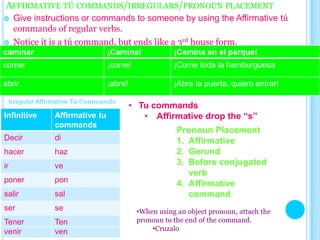
AFFIRMATIVE TÚ COMMANDS/IRREGULARS/PRONOUN PLACEMENT
     Give instructions or commands to someone by using the Affirmative tú
      commands of regular verbs.
     Notice it is a tú command, but ends like a 3rd house form.
caminar                             ¡Camina!             ¡Camina en el parque!
comer                               ¡come!               ¡Come toda la hamburguesa

abrir                               ¡abre!               ¡Abre la puerta, quiero entrar!

     Irregular Affirmative Tú Commands
                                             • Tu commands
Infinitive         Affirmative tu               • Affirmative drop the “s”
                   commands
                                                          Pronoun Placement
Decir              di                                     1. Affirmative
hacer              haz                                    2. Gerund
ir                 ve                                     3. Before conjugated
                                                             verb
poner              pon                                    4. Affirmative
salir              sal                                       command
ser                se                         •When using an object pronoun, attach the
Tener              Ten                        pronoun to the end of the command.
venir              ven                            •Cruzalo
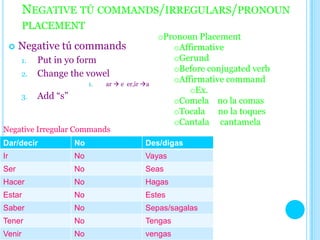
NEGATIVE TÚ COMMANDS/IRREGULARS/PRONOUN
         PLACEMENT
                                                    oPronoun Placement
        Negative tú commands                          oAffirmative
         1.   Put in yo form                           oGerund
                                                       oBefore conjugated verb
         2.   Change the vowel
                             1.   ar  e er,ir a
                                                       oAffirmative command
                                                           oEx.
         3.   Add “s”                                  oComela no la comas
                                                       oTocala no la toques
                                                       oCantala cantamela
Negative Irregular Commands
Dar/decir               No                     Des/digas
Ir                      No                     Vayas
Ser                     No                     Seas
Hacer                   No                     Hagas
Estar                   No                     Estes
Saber                   No                     Sepas/sagalas
Tener                   No                     Tengas
Venir                   No                     vengas
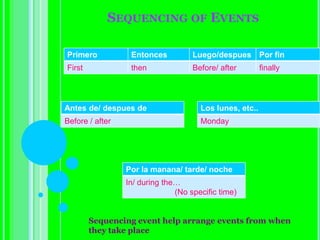
SEQUENCING OF EVENTS

Primero           Entonces          Luego/despues Por fin
First             then              Before/ after        finally


Antes de/ despues de                  Los lunes, etc..
Before / after                        Monday


                 Por la manana/ tarde/ noche
                 In/ during the…
                               (No specific time)


        Sequencing event help arrange events from when
        they take place

Grammar book Elyse

  • 1.
  • 2.
    TABLE OF CONTENTS 1. Nationalities 2. Stem- changers 3. Use of Para 4. IOP 5. Object Pronoun Placement 6. Gustar 7. Affirmatives & Negatives 8. Superlatives 9. Reflexives 10. Affirmative tú commands/irregulars/pronoun placement 11. Negative tú commands/irregulars/pronoun placement 12. Sequencing Events
  • 4.
    STEM-CHANGERS Yo Tú El,ella,ud Nosotros Ellos,ellas,uds Dormir . • duermo • Duermes • Duerme • Dormemos • duermen oue Yo Tú El,ella,ud Nosotros Ellos,ellas, uds. Pedir • Pido • Pides • Pide • Pedemos • piden ei Yo Tú El,ella,ud Nosotros Ellos,ellas,uds . Pensare • pienso • Pienses • Piense • Pensemos • piensen eie Yo Tú El,ella,ud Nosotros Ellos,ellas Jugar • Juego • Juega • Jugamos .uds • Juegas • juegan uue
  • 5.
    PARA  Indicates the recipients of an item  Compro el regalo para tú mama  Indicates an implied purpose  Tengo dinero para(comprar) algo  Indicates a purpose  Vamos al resturante para comer
  • 6.
    IOP  To whom, for whom  Indirect object pronouns replace or accompany indirect objects.  IOP = 3 places  Before conjucated verb  Attatch to an infinative  Attatch to a gerund  “ing”  Ex. Carlos acaba de vender le una revista a Rose  O: Carlos le acaba de vender una revista Rose Singular Plural Me Nos Te Os Le Les
  • 7.
    OBJECT PRONOUN PLACEMENT 1. Attach the pronoun to the infinitive 2. Attach the pronoun to a progressive tense 3. Attach the pronoun to an affirmative command 4. Place the pronoun before a conjugated verb
  • 8.
    GUSTAR  (Like/please)  Usegusta before a singular noun.  Gusta is always singular with infinitives.  Gustan used before a plural noun. Me Me gusta gustan Te gusta Te gustan Le gusta Le gustan Nos gusta Nos gustan Os gusta Os gustan Les gusta Les gustan Gustar (singular) Gustar (plural)
  • 9.
    AFFIRMATIVES & NEGATIVES  When you want to talk about an indefinite or negative situation, you use an affirmative or a negative word Affirmative Words Negative Words Algo something Nada nothing Alguien someone Nadie no one Algun/alguno(a) same Ningun/ninguno(a) none, not any Siempre always Nunca never Tambien also Tampoco none, either  Notice that alguno(a) and ninguno(a) must match the gender of the noun they replace or modify. Alguno and ninguno have different forms when used before masculine singular nouns • Algunoalgun ninguno nungun  If a verb is preceded by no, words that follow must be a negative. A double negative is required in Spanish when no precedes the verb.  No quiero nada  However, if a negative word, such as nunca or nadie, comes before the verb, a second negative is not needed  Nadie quiere postre.
  • 10.
    SUPERLATIVES The suffix –isimo, -isimos, -isima, and –ismas are added to an adjective or adverb  Is equivalent to extremely or very before an adjective or adverb.  Malo>malisimo  Muchas>muchisimas  Dificil>difilismo  Adjective and adverb ending in c, g, z change spelling to qi, gu, and c respectively  Rico>riquismo  Larga>larguisima  Feliz>felicismo  Adjective that ends in –n or-r form by adding – cisimo(a)  Joven>jovencismo  Trabajador>trabajadorcismo
  • 11.
    REFLEXIVES Me When you use the infinitive  To describe people form of a reflexive verb after a Te doing things for conjugated, be sure to use themselves, use reflexive verbs. correct reflexive pronoun Reflexive  Reflexive pronouns Se are used with Pronouns reflexive verbs to indicate that the Quiero levantar me temprano. subject of the Nos I want to get up early sentence receives the action of the verb Se You can also put the oMany verbs can be used with or without reflexive pronoun in front reflexive pronouns. When there is no reflexive of the conjugated verb pronoun, the person doing the action does not receive the action. Reflexive Not reflexive Me quiero levantar temprano. Pepa se lava Pepa lava el carro • Pepa washes •Pepa washes the herself car
  • 12.
    AFFIRMATIVE TÚ COMMANDS/IRREGULARS/PRONOUNPLACEMENT  Give instructions or commands to someone by using the Affirmative tú commands of regular verbs.  Notice it is a tú command, but ends like a 3rd house form. caminar ¡Camina! ¡Camina en el parque! comer ¡come! ¡Come toda la hamburguesa abrir ¡abre! ¡Abre la puerta, quiero entrar! Irregular Affirmative Tú Commands • Tu commands Infinitive Affirmative tu • Affirmative drop the “s” commands Pronoun Placement Decir di 1. Affirmative hacer haz 2. Gerund ir ve 3. Before conjugated verb poner pon 4. Affirmative salir sal command ser se •When using an object pronoun, attach the Tener Ten pronoun to the end of the command. venir ven •Cruzalo
  • 13.
    NEGATIVE TÚ COMMANDS/IRREGULARS/PRONOUN PLACEMENT oPronoun Placement  Negative tú commands oAffirmative 1. Put in yo form oGerund oBefore conjugated verb 2. Change the vowel 1. ar  e er,ir a oAffirmative command oEx. 3. Add “s” oComela no la comas oTocala no la toques oCantala cantamela Negative Irregular Commands Dar/decir No Des/digas Ir No Vayas Ser No Seas Hacer No Hagas Estar No Estes Saber No Sepas/sagalas Tener No Tengas Venir No vengas
  • 14.
    SEQUENCING OF EVENTS Primero Entonces Luego/despues Por fin First then Before/ after finally Antes de/ despues de Los lunes, etc.. Before / after Monday Por la manana/ tarde/ noche In/ during the… (No specific time) Sequencing event help arrange events from when they take place