

Y669 International
Political Economy
Jeffrey Hart
November 12, 2010
Economics in the
American School of IPE
• “Political scientists have an inferiority
complex when it comes to economics.
Even such notables as Katzenstein,
Keohane, and Krasner bow their heads,
describing economics as ‘reigning king
of the social sciences.’”
Source: Cohen, p. 207.
Key Early Works in the
American School of IPE
• Keohane and Nye
– Transnational Relations and World Politics
(1972)
– Power and Interdependence (1977)
• Katzenstein
– Between Power and Plenty (1978)
• Krasner
– Intl. Regimes (1983)
The British School
• Focus on the foundational role of
Susan Strange and Robert Cox
• Contrast with the American School:
– More interdisciplinary
– More normative
– Less wedded to scientific method
– More ambitious research agenda
Walter and Sen, Ch. 8
• “Although we now have a much better
understanding than two decades ago of
the domestic determinants of economic
policies, we have made less progress as
regards the relative influence of
international institutional and political
factors.”
Source: Walter and Sen, p. 232.
Walter and Sen, Ch. 8
• “It may indicate the biasing effects of
an excessive reliance by IPE scholars
on standard economic theories…”
Source: Walter and Sen, p. 232
Trade, Finance,
Investment: Interactions
• “MNCs have thus been prime clients for
global banks offering derivatives
instruments that reduce their exchange
rate exposure. This has strengthened
the coalition favoring financial
innovation.”
Source: Walter and Sen, p. 234.
My books on the Politics of
International Competition:
• Rival Capitalists (1992)
• Managing New Industry Creation
(2002)
• Technology, Television, and
Competition (2004)
Industries I have studied
so far:
• Steel, autos, semiconductors
• Consumer electronics, broadcasting
• Telecommunications equipment and
services
• Software
• Motion pictures
• Biotechnology
What is an industry?
• A set of firms that compete in the same
market for goods and/or services
• May or may not include
upstream/downstream activities
• Boundaries with other industries may be
fuzzy and may change over time
• Often self-identified via lobbying efforts and
the formation of industry associations
Sectors vs. Industries
• Sectors are at a higher level of
aggregation
• In economics, primary=extractive,
secondary=manufacturing,
tertiary=services
• Industry studies provide more
information about differences within
“sectors” or similarities across “sectors”
Key variables:
• Size, growth rate, market share, no.
employed, exports, imports, etc.
• Concentration of ownership/control
• Regulated vs. self-regulated vs.
unregulated
• High-tech vs. low-tech
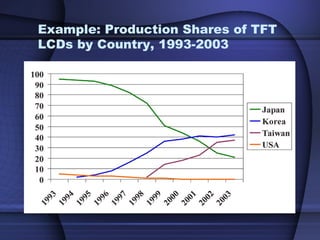
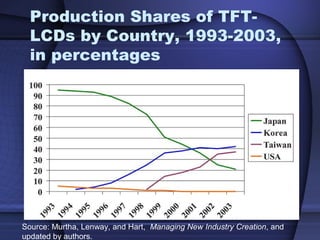
Example: Production Shares of TFT
LCDs by Country, 1993-2003
Key questions:
• What is the role of government policy
relative to other factors in industrial
growth and international
competitiveness?
• Is it possible to promote the growth and
development of high-tech industries?
Theoretical approaches:
• Neoclassical
• Regulatory State
• Developmental State
• Competition State
Methods
• Collection of empirical and especially
quantitative data on key variables
• Elite interviews with managers and
public policy officials
• Site visits to major facilities
Problems:
• Research is costly and difficult
• Difficulty of aggregating across
industries
• Possible selection biases in industries
studied
• Confusing/complex nature of the role of
the state
Important findings:
• Major impact of globalization of the world
economy on manufacturing location decision
in high-tech industries
• Changing view on what needs to be studied:
e.g. industries vs. “value chains”
• Role of government policy varies over time
and across industries
• Creation and diffusion of technology is a key
mediating variable
Flat Panel Display Industry
• Major Flat Technology Segments
– Thin Film Transistor (TFT) Liquid Crystal Displays
(LCDs)
– Single Twist Nematic (STN) Liquid Crystal Displays
(also called passive LCDs)
– Plasma Display Panels (PDPs)
– Organic Light Emitting Displays (OLEDs)
• Competing Technologies
– Cathode Ray Tubes (CRTs)
– Projection Displays
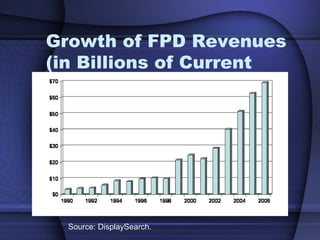
Growth of FPD Revenues
(in Billions of Current
Dollars), 1990-2006
Source: DisplaySearch.
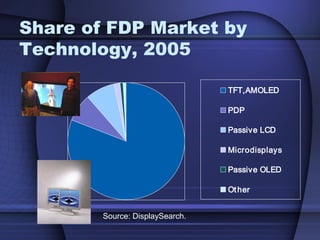
Share of FDP Market by
Technology, 2005
TFT,AMOLED
PDP
Passive LCD
Microdisplays
Passive OLED
Other
Source: DisplaySearch.
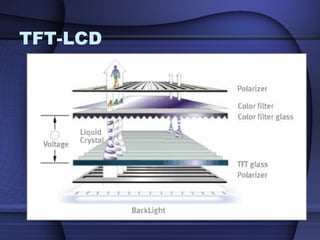
TFT-LCD
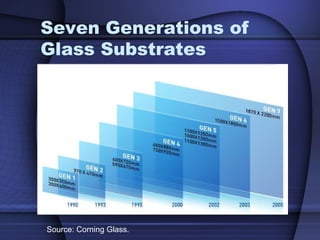
Seven Generations of
Glass Substrates
Source: Corning Glass.
6th
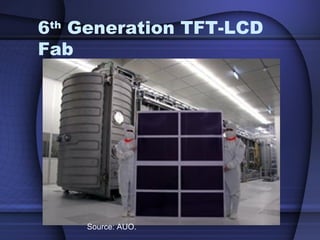
Generation TFT-LCD
Fab
Source: AUO.
Production Shares of TFT-
LCDs by Country, 1993-2003,
in percentages
Source: Murtha, Lenway, and Hart, Managing New Industry Creation, and
updated by authors.
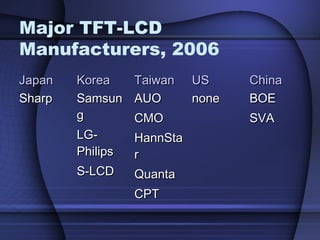
Major TFT-LCD
Manufacturers, 2006
JapanJapan KoreaKorea TaiwanTaiwan USUS ChinaChina
SharpSharp SamsunSamsun
gg
LG-LG-
PhilipsPhilips
S-LCDS-LCD
AUOAUO
CMOCMO
HannStaHannSta
rr
QuantaQuanta
CPTCPT
nonenone BOEBOE
SVASVA
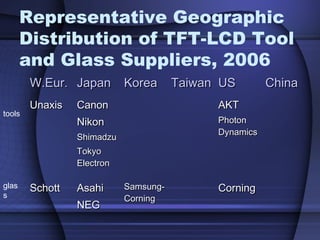
Representative Geographic
Distribution of TFT-LCD Tool
and Glass Suppliers, 2006
W.Eur.W.Eur. JapanJapan KoreaKorea TaiwanTaiwan USUS ChinaChina
UnaxisUnaxis CanonCanon
NikonNikon
ShimadzuShimadzu
TokyoTokyo
ElectronElectron
AKTAKT
PhotonPhoton
DynamicsDynamics
SchottSchott AsahiAsahi
NEGNEG
Samsung-Samsung-
CorningCorning
CorningCorning
tools
glas
s
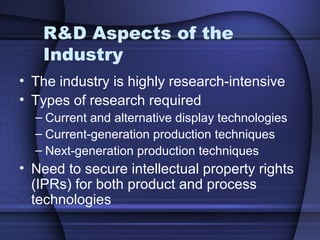
R&D Aspects of the
Industry
• The industry is highly research-intensive
• Types of research required
– Current and alternative display technologies
– Current-generation production techniques
– Next-generation production techniques
• Need to secure intellectual property rights
(IPRs) for both product and process
technologies
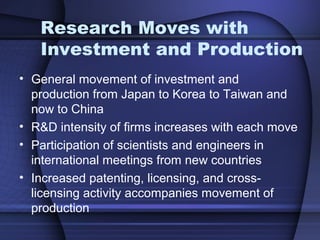
Research Moves with
Investment and Production
• General movement of investment and
production from Japan to Korea to Taiwan and
now to China
• R&D intensity of firms increases with each move
• Participation of scientists and engineers in
international meetings from new countries
• Increased patenting, licensing, and cross-
licensing activity accompanies movement of
production

Gradipe09

  • 1.
  • 2.
    Economics in the AmericanSchool of IPE • “Political scientists have an inferiority complex when it comes to economics. Even such notables as Katzenstein, Keohane, and Krasner bow their heads, describing economics as ‘reigning king of the social sciences.’” Source: Cohen, p. 207.
  • 3.
    Key Early Worksin the American School of IPE • Keohane and Nye – Transnational Relations and World Politics (1972) – Power and Interdependence (1977) • Katzenstein – Between Power and Plenty (1978) • Krasner – Intl. Regimes (1983)
  • 4.
    The British School •Focus on the foundational role of Susan Strange and Robert Cox • Contrast with the American School: – More interdisciplinary – More normative – Less wedded to scientific method – More ambitious research agenda
  • 5.
    Walter and Sen,Ch. 8 • “Although we now have a much better understanding than two decades ago of the domestic determinants of economic policies, we have made less progress as regards the relative influence of international institutional and political factors.” Source: Walter and Sen, p. 232.
  • 6.
    Walter and Sen,Ch. 8 • “It may indicate the biasing effects of an excessive reliance by IPE scholars on standard economic theories…” Source: Walter and Sen, p. 232
  • 7.
    Trade, Finance, Investment: Interactions •“MNCs have thus been prime clients for global banks offering derivatives instruments that reduce their exchange rate exposure. This has strengthened the coalition favoring financial innovation.” Source: Walter and Sen, p. 234.
  • 8.
    My books onthe Politics of International Competition: • Rival Capitalists (1992) • Managing New Industry Creation (2002) • Technology, Television, and Competition (2004)
  • 9.
    Industries I havestudied so far: • Steel, autos, semiconductors • Consumer electronics, broadcasting • Telecommunications equipment and services • Software • Motion pictures • Biotechnology
  • 10.
    What is anindustry? • A set of firms that compete in the same market for goods and/or services • May or may not include upstream/downstream activities • Boundaries with other industries may be fuzzy and may change over time • Often self-identified via lobbying efforts and the formation of industry associations
  • 11.
    Sectors vs. Industries •Sectors are at a higher level of aggregation • In economics, primary=extractive, secondary=manufacturing, tertiary=services • Industry studies provide more information about differences within “sectors” or similarities across “sectors”
  • 12.
    Key variables: • Size,growth rate, market share, no. employed, exports, imports, etc. • Concentration of ownership/control • Regulated vs. self-regulated vs. unregulated • High-tech vs. low-tech
  • 13.
    Example: Production Sharesof TFT LCDs by Country, 1993-2003
  • 14.
    Key questions: • Whatis the role of government policy relative to other factors in industrial growth and international competitiveness? • Is it possible to promote the growth and development of high-tech industries?
  • 15.
    Theoretical approaches: • Neoclassical •Regulatory State • Developmental State • Competition State
  • 16.
    Methods • Collection ofempirical and especially quantitative data on key variables • Elite interviews with managers and public policy officials • Site visits to major facilities
  • 17.
    Problems: • Research iscostly and difficult • Difficulty of aggregating across industries • Possible selection biases in industries studied • Confusing/complex nature of the role of the state
  • 18.
    Important findings: • Majorimpact of globalization of the world economy on manufacturing location decision in high-tech industries • Changing view on what needs to be studied: e.g. industries vs. “value chains” • Role of government policy varies over time and across industries • Creation and diffusion of technology is a key mediating variable
  • 19.
    Flat Panel DisplayIndustry • Major Flat Technology Segments – Thin Film Transistor (TFT) Liquid Crystal Displays (LCDs) – Single Twist Nematic (STN) Liquid Crystal Displays (also called passive LCDs) – Plasma Display Panels (PDPs) – Organic Light Emitting Displays (OLEDs) • Competing Technologies – Cathode Ray Tubes (CRTs) – Projection Displays
  • 20.
    Growth of FPDRevenues (in Billions of Current Dollars), 1990-2006 Source: DisplaySearch.
  • 21.
    Share of FDPMarket by Technology, 2005 TFT,AMOLED PDP Passive LCD Microdisplays Passive OLED Other Source: DisplaySearch.
  • 22.
  • 23.
    Seven Generations of GlassSubstrates Source: Corning Glass.
  • 24.
  • 25.
    Production Shares ofTFT- LCDs by Country, 1993-2003, in percentages Source: Murtha, Lenway, and Hart, Managing New Industry Creation, and updated by authors.
  • 26.
    Major TFT-LCD Manufacturers, 2006 JapanJapanKoreaKorea TaiwanTaiwan USUS ChinaChina SharpSharp SamsunSamsun gg LG-LG- PhilipsPhilips S-LCDS-LCD AUOAUO CMOCMO HannStaHannSta rr QuantaQuanta CPTCPT nonenone BOEBOE SVASVA
  • 27.
    Representative Geographic Distribution ofTFT-LCD Tool and Glass Suppliers, 2006 W.Eur.W.Eur. JapanJapan KoreaKorea TaiwanTaiwan USUS ChinaChina UnaxisUnaxis CanonCanon NikonNikon ShimadzuShimadzu TokyoTokyo ElectronElectron AKTAKT PhotonPhoton DynamicsDynamics SchottSchott AsahiAsahi NEGNEG Samsung-Samsung- CorningCorning CorningCorning tools glas s
  • 28.
    R&D Aspects ofthe Industry • The industry is highly research-intensive • Types of research required – Current and alternative display technologies – Current-generation production techniques – Next-generation production techniques • Need to secure intellectual property rights (IPRs) for both product and process technologies
  • 29.
    Research Moves with Investmentand Production • General movement of investment and production from Japan to Korea to Taiwan and now to China • R&D intensity of firms increases with each move • Participation of scientists and engineers in international meetings from new countries • Increased patenting, licensing, and cross- licensing activity accompanies movement of production