The Determinants of National Advantage
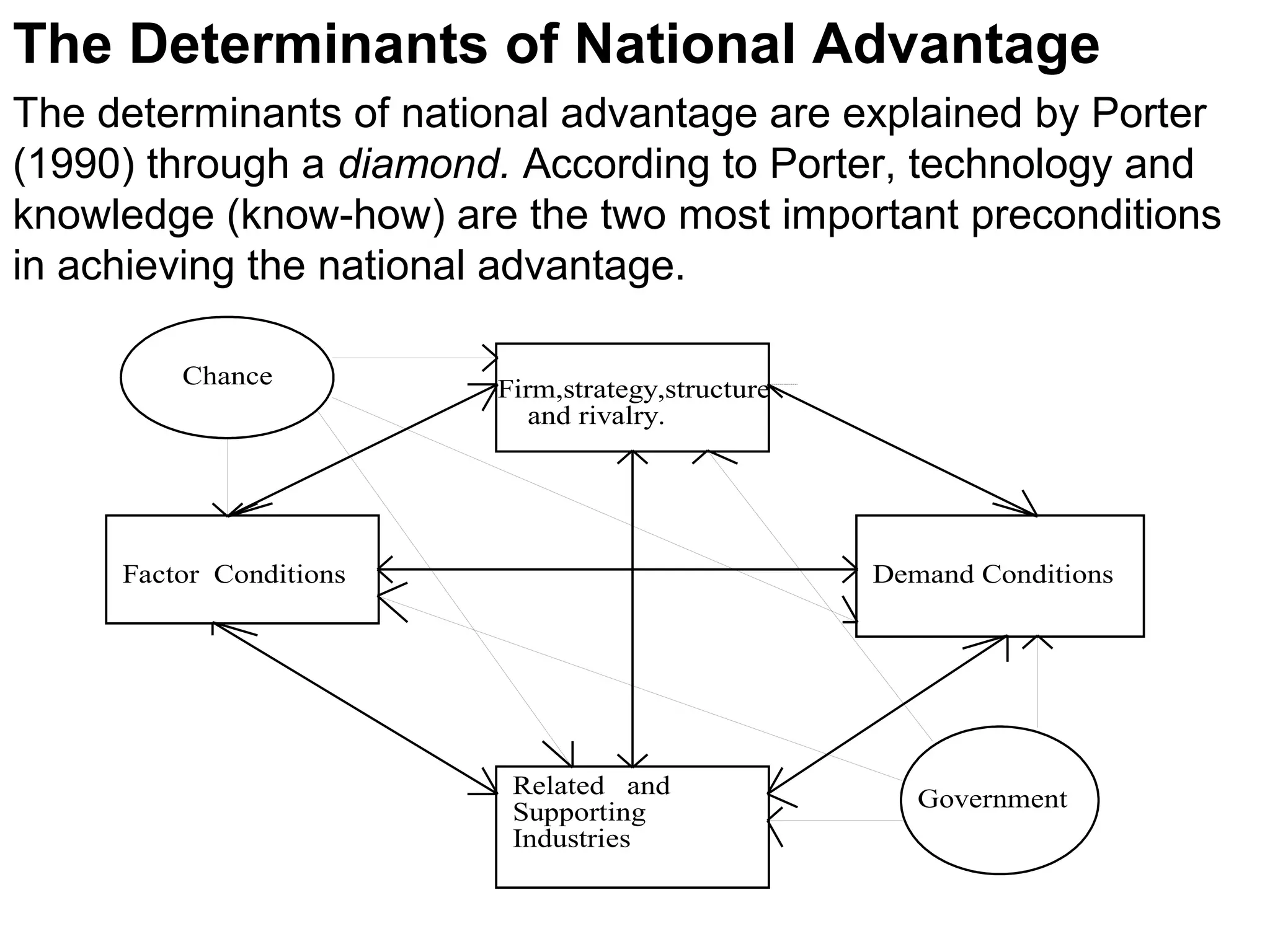
The determinants of national advantage are explained by Porter
(1990) through a diamond. According to Porter, technology and
knowledge (know-how) are the two most important preconditions
in achieving the national advantage.
Firm,strategy,structure
and rivalry.
Chance
Factor Conditions
Related and
Supporting
Government
Demand Conditions
Industries
Factor Conditions
• According to the theory, nations are endowed with differing stocks of
factors. A nation will export those goods which make intensive use of
factors with which it is relatively well endowed.
• Factors in the competitive advantage of a nation are important and can be
grouped into a number of broad categories such as: human resources,
physical resources, knowledge resources, capital resources and
infrastructure.
• The technology and know-how (knowledge skills) are the major elements
which play an important role in the success of the nation’s economy.
Choosing and applying the right technology will make the nations firms
achieve their objectives.
• The hierarchy among factors, factor creation, selective factor
disadvantages are important concepts which should be taken into
consideration when the factor conditions of Porter's diamond model are
explained.
The Demand Conditions
• In Porter's diamond, the home demand conditions for the industry's
product or service is another determinant of national competitive
advantage.
• The composition of home demand, the size and pattern of the growth of
home demand, and the mechanism by which a nation's domestic
preferences are transmitted to foreign markets, are important concepts.
• The size of home demand may be significant in some industries. Local
firms often enjoy some natural advantages in serving their home market,
compared with foreign firms: a result of proximity as well as language,
regulation and cultural affinities.
• Home demand is also transmitted via political alliances or historical ties.
This embeds in foreign nations such things as the legal system, product or
technical standards, and prefences in purchasing. Foreign aid and special
political relationships among nations are having less dramatic but similar
effects today.
The Related and Supporting Industries
• The presence of internationally competitive supplier industries in a
nation creates advantages in downstream industries in several
ways.
• Having a competitive domestic supplier industry is far preferable to
relying on well-qualified foreign suppliers. Proximity of managerial
and technical personnel, along with cultural similarity, tend to
facilitate a free and open information flow. Transaction costs are
reduced.
The Firm Strategy, Structure and Rivalry
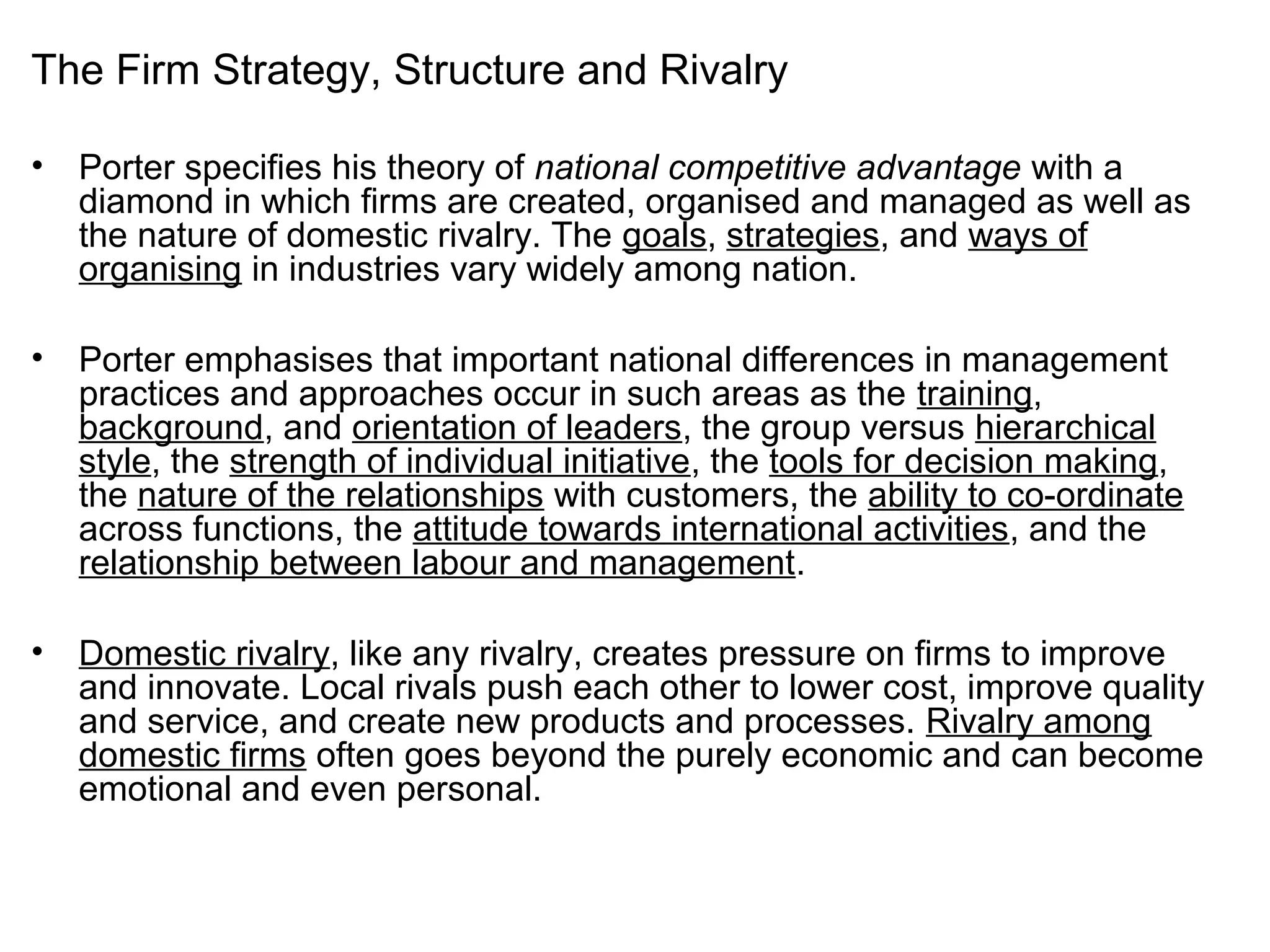
• Porter specifies his theory of national competitive advantage with a
diamond in which firms are created, organised and managed as well as
the nature of domestic rivalry. The goals, strategies, and ways of
organising in industries vary widely among nation.
• Porter emphasises that important national differences in management
practices and approaches occur in such areas as the training,
background, and orientation of leaders, the group versus hierarchical
style, the strength of individual initiative, the tools for decision making,
the nature of the relationships with customers, the ability to co-ordinate
across functions, the attitude towards international activities, and the
relationship between labour and management.
• Domestic rivalry, like any rivalry, creates pressure on firms to improve
and innovate. Local rivals push each other to lower cost, improve quality
and service, and create new products and processes. Rivalry among
domestic firms often goes beyond the purely economic and can become
emotional and even personal.
The Role of Government
• The government’s real role, in creating national competitive
advantage, is in influencing the factor determinants.
Government can influence (and be influenced by) each of the
four determinants either positively or negatively.
Governmental bodies establish local product standards or
regulations that mandate or influence buyer needs.
Government is also often a major buyer of many products in
a nation.
The Role of Government
• The government’s real role, in creating national competitive
advantage, is in influencing the factor determinants.
Government can influence (and be influenced by) each of the
four determinants either positively or negatively.
Governmental bodies establish local product standards or
regulations that mandate or influence buyer needs.
Government is also often a major buyer of many products in
a nation.

Porter comp-adv

  • 1.
    The Determinants ofNational Advantage The determinants of national advantage are explained by Porter (1990) through a diamond. According to Porter, technology and knowledge (know-how) are the two most important preconditions in achieving the national advantage. Firm,strategy,structure and rivalry. Chance Factor Conditions Related and Supporting Government Demand Conditions Industries
  • 2.
    Factor Conditions • Accordingto the theory, nations are endowed with differing stocks of factors. A nation will export those goods which make intensive use of factors with which it is relatively well endowed. • Factors in the competitive advantage of a nation are important and can be grouped into a number of broad categories such as: human resources, physical resources, knowledge resources, capital resources and infrastructure. • The technology and know-how (knowledge skills) are the major elements which play an important role in the success of the nation’s economy. Choosing and applying the right technology will make the nations firms achieve their objectives. • The hierarchy among factors, factor creation, selective factor disadvantages are important concepts which should be taken into consideration when the factor conditions of Porter's diamond model are explained.
  • 3.
    The Demand Conditions •In Porter's diamond, the home demand conditions for the industry's product or service is another determinant of national competitive advantage. • The composition of home demand, the size and pattern of the growth of home demand, and the mechanism by which a nation's domestic preferences are transmitted to foreign markets, are important concepts. • The size of home demand may be significant in some industries. Local firms often enjoy some natural advantages in serving their home market, compared with foreign firms: a result of proximity as well as language, regulation and cultural affinities. • Home demand is also transmitted via political alliances or historical ties. This embeds in foreign nations such things as the legal system, product or technical standards, and prefences in purchasing. Foreign aid and special political relationships among nations are having less dramatic but similar effects today.
  • 4.
    The Related andSupporting Industries • The presence of internationally competitive supplier industries in a nation creates advantages in downstream industries in several ways. • Having a competitive domestic supplier industry is far preferable to relying on well-qualified foreign suppliers. Proximity of managerial and technical personnel, along with cultural similarity, tend to facilitate a free and open information flow. Transaction costs are reduced.
  • 5.
    The Firm Strategy,Structure and Rivalry • Porter specifies his theory of national competitive advantage with a diamond in which firms are created, organised and managed as well as the nature of domestic rivalry. The goals, strategies, and ways of organising in industries vary widely among nation. • Porter emphasises that important national differences in management practices and approaches occur in such areas as the training, background, and orientation of leaders, the group versus hierarchical style, the strength of individual initiative, the tools for decision making, the nature of the relationships with customers, the ability to co-ordinate across functions, the attitude towards international activities, and the relationship between labour and management. • Domestic rivalry, like any rivalry, creates pressure on firms to improve and innovate. Local rivals push each other to lower cost, improve quality and service, and create new products and processes. Rivalry among domestic firms often goes beyond the purely economic and can become emotional and even personal.
  • 6.
    The Role ofGovernment • The government’s real role, in creating national competitive advantage, is in influencing the factor determinants. Government can influence (and be influenced by) each of the four determinants either positively or negatively. Governmental bodies establish local product standards or regulations that mandate or influence buyer needs. Government is also often a major buyer of many products in a nation.
  • 7.
    The Role ofGovernment • The government’s real role, in creating national competitive advantage, is in influencing the factor determinants. Government can influence (and be influenced by) each of the four determinants either positively or negatively. Governmental bodies establish local product standards or regulations that mandate or influence buyer needs. Government is also often a major buyer of many products in a nation.