Jeffrey A. Hart
                  Professor
                  Department of Political Science
                  Indiana University
                  http:mypage.iu.edu~hartj


The Rise and Fall of SOPA and PIPA

THE POLITICS OF FILE
SHARING IN THE UNITED
STATES
Sequence of Events
 PIPA (S. 969) introduced May 2011
 SOPA (H.R. 3261) introduced October 2011
 Copyright holders and their allies support the
  two bills
 Internet companies and their allies oppose
  them
 President Obama expresses opposition
 Bills are shelved (mid January 2012)
Purpose of the Research
 To explain the shelving of the bills given the
  initially strong bipartisan support for them
 To examine the role of financial contributions
  to Senators and Representative
 To analyze claims about the mobilization of
  opponents by Internet companies via the
  Internet (the Nerd Spring hypothesis)
 To place these events into a broader
  interpretive and theoretical context
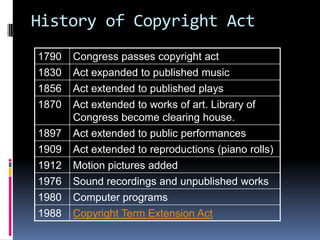
History of Copyright Act
1790   Congress passes copyright act
1830   Act expanded to published music
1856   Act extended to published plays
1870   Act extended to works of art. Library of
       Congress become clearing house.
1897   Act extended to public performances
1909   Act extended to reproductions (piano rolls)
1912   Motion pictures added
1976   Sound recordings and unpublished works
1980   Computer programs
1988   Copyright Term Extension Act
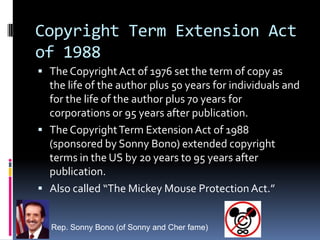
Copyright Term Extension Act
of 1988
 The Copyright Act of 1976 set the term of copy as
  the life of the author plus 50 years for individuals and
  for the life of the author plus 70 years for
  corporations or 95 years after publication.
 The Copyright Term Extension Act of 1988
  (sponsored by Sonny Bono) extended copyright
  terms in the US by 20 years to 95 years after
  publication.
 Also called “The Mickey Mouse Protection Act.”


   Rep. Sonny Bono (of Sonny and Cher fame)
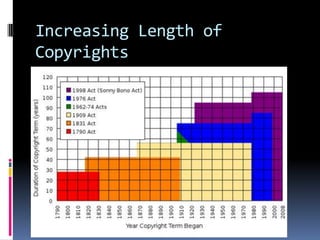
Increasing Length of
Copyrights
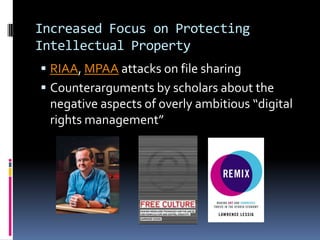
Increased Focus on Protecting
Intellectual Property
 RIAA, MPAA attacks on file sharing
 Counterarguments by scholars about the
  negative aspects of overly ambitious “digital
  rights management”
More Recent Intellectual
Property Rights Legislation
 Digital Millennium Copyright Act (DMCA) of
  1998 (safe harbor provisions connected with
  notice and takedown practices)
 Inducing Infringement of Copyrights Act of 2004
  reflects the U.S. Supreme Court Betamax
  decision establishing the criterion of “fair use”
  and the idea that technologies should not be
  banned if there are significant non-infringing
  uses (SNIU) – tightens previous laws
Napster shuts down
 In November 1999, the RIAA filed suit against Napster for
  copyright infringement.
 By 2001, Napster had 26.4 Million users.
 The RIAA’s suit was successful and Napster had to close
  down in July 2001.
 People interested in sharing copyrighted material turned
  to gnutella networks and then to BitTorrents
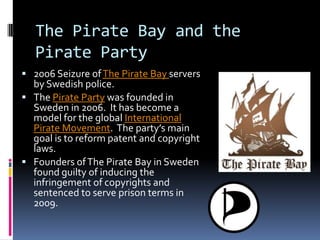
The Pirate Bay and the
   Pirate Party
 2006 Seizure of The Pirate Bay servers
  by Swedish police.
 The Pirate Party was founded in
  Sweden in 2006. It has become a
  model for the global International
  Pirate Movement. The party’s main
  goal is to reform patent and copyright
  laws.
 Founders of The Pirate Bay in Sweden
  found guilty of inducing the
  infringement of copyrights and
  sentenced to serve prison terms in
  2009.
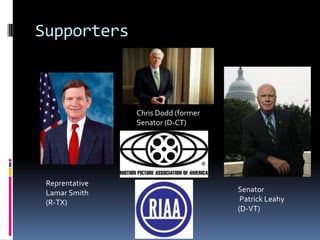
Supporters


                Chris Dodd (former
                Senator (D-CT)


 Reprentative
 Lamar Smith                         Senator
 (R-TX)                               Patrick Leahy
                                     (D-VT)
Arguments by Supporters
 File sharing of copyrighted content constitutes theft or
    piracy and is therefore illegal.
   Illegal file sharing (piracy) is extremely damaging not just to
    the copyright holders but to the economy as a whole.
   Current laws have reduced illegal file sharing in the United
    States but not in many foreign countries.
   There are still U.S.-based companies and organizations that
    facilitate illegal file sharing activities.
   Since the U.S. government does not have jurisdiction over
    foreign web operators, it must use its jurisdiction over U.S.
    web operators to stop illegal file sharing abroad.
   SOPA/PIPA have adequate safeguards to prevent the
    possible negative effects of the legislation on U.S. firms and
    the U.S. economy.
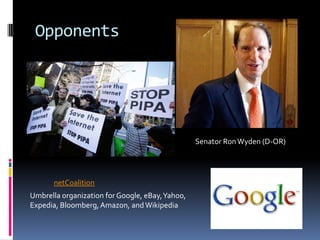
Opponents


                                                 Senator Ron Wyden (D-OR)


       netCoalition
Umbrella organization for Google, eBay, Yahoo,
Expedia, Bloomberg, Amazon, and Wikipedia
Arguments by Opponents
 Most agree that illegal file sharing is damaging to copyright holders but
  some opponents disagree strongly about the extent of the damage.
  They question the estimates provided by the MPAA and RIAA in
  particular.
 There are many legal uses of file sharing technologies and many users
  in the United States and abroad engage in legal file sharing.
  Thus, under the “fair use” criteria established in the Betamax decision
  of the U.S. Supreme Court, restrictions on technology which has
  substantial non-infringing uses (SNIU) should be avoided at all
  costs, especially when that technology may be used for creative and
  innovative purposes.
 The proposed legislation overturns current statutory “safe harbors” for
  U.S. Internet service providers established under the Digital Millennium
  Copyright Act of 1998.
 Monitoring requirements for U.S. web sites could potentially
  undermine free speech by forcing them to use “deep packet inspection”
  technologies commonly used in authoritarian political systems.
More Arguments of Opponents
  Restricting access to entire domains may damage the
   Domain Name System (DNS) and undermine the
   security of the entire Internet.
  SOPA and PIPA place too much of a burden on the
   Department of Justice to initiate actions against
   foreign infringing websites. The Department of
   Justice does not have enough expertise in intellectual
   property law to do the job adequately.
  Giving private firms (copyright holders and others) the
   power to initiate actions against foreign infringing
   websites that can financially harm U.S.-based search
   engines, advertising services, and/or payments web
   sites without adequate procedural safeguards is
   unwise and can hurt the overall economy.
Salman Khan explains why he
opposes SOPA/PIPA
 Khan Academy video on SOPA and PIPA
Internet-based Mobilization
of Opponents
 November 16, 2011:
  Tumblr, Mozilla, Techdirt, and the Center for
  Democracy and Technology put black barriers
  over their site logos for American Censorship
  Day
 January 18, 2012: the following companies
  “black out” their sites as an anti-SOPA/PIPA
  protest:
  Reddit, Wikipedia, Cheezburger, Mojang, and
  The Oatmeal.
 Google links to an online petition against the
  bills (7 million signatures)
The White House comes out
against SOPA and PIPA
 On January 14, 2012, the White House issued
  a formal statement saying they were
  concerned about the possible damage to an
  “Open Internet.”
 They focused on the need to protect
  intellectual property rights without damaging
  free speech and national security interests
  (the integrity of the DNS system was a
  particular concern).
The Bills are Shelved
 21 Senators who initially co-sponsored PIPA
  withdrew their support
 In the House, influential Representatives
  announced their opposition (e.g. Darrell Issa)
 Both SOPA and PIPA were withdrawn from
  the legislative docket
 Senator Ron Wyden (D-OR) and
  Representative Darrell Issa (R-CA) introduce
  an alternative bill called OPEN
What Happened and Why?
 The RIAA, the MPAA and their allies were lulled
  into a sense of complacency after a long series of
  legislative and judicial victories
 Smith, Leahy and Dodd were not sufficiently net
  savvy to predict the firestorm of protests over
  the proposed bills – the bills were poorly drafted
 Internet firms and their allies were able to rapidly
  mobilize opponents and convince members of
  Congress that their support of the bills would
  damage their electoral prospects

Isa12a

  • 1.
    Jeffrey A. Hart Professor Department of Political Science Indiana University http:mypage.iu.edu~hartj The Rise and Fall of SOPA and PIPA THE POLITICS OF FILE SHARING IN THE UNITED STATES
  • 2.
    Sequence of Events PIPA (S. 969) introduced May 2011  SOPA (H.R. 3261) introduced October 2011  Copyright holders and their allies support the two bills  Internet companies and their allies oppose them  President Obama expresses opposition  Bills are shelved (mid January 2012)
  • 3.
    Purpose of theResearch  To explain the shelving of the bills given the initially strong bipartisan support for them  To examine the role of financial contributions to Senators and Representative  To analyze claims about the mobilization of opponents by Internet companies via the Internet (the Nerd Spring hypothesis)  To place these events into a broader interpretive and theoretical context
  • 4.
    History of CopyrightAct 1790 Congress passes copyright act 1830 Act expanded to published music 1856 Act extended to published plays 1870 Act extended to works of art. Library of Congress become clearing house. 1897 Act extended to public performances 1909 Act extended to reproductions (piano rolls) 1912 Motion pictures added 1976 Sound recordings and unpublished works 1980 Computer programs 1988 Copyright Term Extension Act
  • 5.
    Copyright Term ExtensionAct of 1988  The Copyright Act of 1976 set the term of copy as the life of the author plus 50 years for individuals and for the life of the author plus 70 years for corporations or 95 years after publication.  The Copyright Term Extension Act of 1988 (sponsored by Sonny Bono) extended copyright terms in the US by 20 years to 95 years after publication.  Also called “The Mickey Mouse Protection Act.” Rep. Sonny Bono (of Sonny and Cher fame)
  • 6.
  • 7.
    Increased Focus onProtecting Intellectual Property  RIAA, MPAA attacks on file sharing  Counterarguments by scholars about the negative aspects of overly ambitious “digital rights management”
  • 8.
    More Recent Intellectual PropertyRights Legislation  Digital Millennium Copyright Act (DMCA) of 1998 (safe harbor provisions connected with notice and takedown practices)  Inducing Infringement of Copyrights Act of 2004 reflects the U.S. Supreme Court Betamax decision establishing the criterion of “fair use” and the idea that technologies should not be banned if there are significant non-infringing uses (SNIU) – tightens previous laws
  • 9.
    Napster shuts down In November 1999, the RIAA filed suit against Napster for copyright infringement.  By 2001, Napster had 26.4 Million users.  The RIAA’s suit was successful and Napster had to close down in July 2001.  People interested in sharing copyrighted material turned to gnutella networks and then to BitTorrents
  • 10.
    The Pirate Bayand the Pirate Party  2006 Seizure of The Pirate Bay servers by Swedish police.  The Pirate Party was founded in Sweden in 2006. It has become a model for the global International Pirate Movement. The party’s main goal is to reform patent and copyright laws.  Founders of The Pirate Bay in Sweden found guilty of inducing the infringement of copyrights and sentenced to serve prison terms in 2009.
  • 11.
    Supporters Chris Dodd (former Senator (D-CT) Reprentative Lamar Smith Senator (R-TX) Patrick Leahy (D-VT)
  • 12.
    Arguments by Supporters File sharing of copyrighted content constitutes theft or piracy and is therefore illegal.  Illegal file sharing (piracy) is extremely damaging not just to the copyright holders but to the economy as a whole.  Current laws have reduced illegal file sharing in the United States but not in many foreign countries.  There are still U.S.-based companies and organizations that facilitate illegal file sharing activities.  Since the U.S. government does not have jurisdiction over foreign web operators, it must use its jurisdiction over U.S. web operators to stop illegal file sharing abroad.  SOPA/PIPA have adequate safeguards to prevent the possible negative effects of the legislation on U.S. firms and the U.S. economy.
  • 13.
    Opponents Senator Ron Wyden (D-OR) netCoalition Umbrella organization for Google, eBay, Yahoo, Expedia, Bloomberg, Amazon, and Wikipedia
  • 14.
    Arguments by Opponents Most agree that illegal file sharing is damaging to copyright holders but some opponents disagree strongly about the extent of the damage. They question the estimates provided by the MPAA and RIAA in particular.  There are many legal uses of file sharing technologies and many users in the United States and abroad engage in legal file sharing. Thus, under the “fair use” criteria established in the Betamax decision of the U.S. Supreme Court, restrictions on technology which has substantial non-infringing uses (SNIU) should be avoided at all costs, especially when that technology may be used for creative and innovative purposes.  The proposed legislation overturns current statutory “safe harbors” for U.S. Internet service providers established under the Digital Millennium Copyright Act of 1998.  Monitoring requirements for U.S. web sites could potentially undermine free speech by forcing them to use “deep packet inspection” technologies commonly used in authoritarian political systems.
  • 15.
    More Arguments ofOpponents  Restricting access to entire domains may damage the Domain Name System (DNS) and undermine the security of the entire Internet.  SOPA and PIPA place too much of a burden on the Department of Justice to initiate actions against foreign infringing websites. The Department of Justice does not have enough expertise in intellectual property law to do the job adequately.  Giving private firms (copyright holders and others) the power to initiate actions against foreign infringing websites that can financially harm U.S.-based search engines, advertising services, and/or payments web sites without adequate procedural safeguards is unwise and can hurt the overall economy.
  • 16.
    Salman Khan explainswhy he opposes SOPA/PIPA  Khan Academy video on SOPA and PIPA
  • 17.
    Internet-based Mobilization of Opponents November 16, 2011: Tumblr, Mozilla, Techdirt, and the Center for Democracy and Technology put black barriers over their site logos for American Censorship Day  January 18, 2012: the following companies “black out” their sites as an anti-SOPA/PIPA protest: Reddit, Wikipedia, Cheezburger, Mojang, and The Oatmeal.  Google links to an online petition against the bills (7 million signatures)
  • 18.
    The White Housecomes out against SOPA and PIPA  On January 14, 2012, the White House issued a formal statement saying they were concerned about the possible damage to an “Open Internet.”  They focused on the need to protect intellectual property rights without damaging free speech and national security interests (the integrity of the DNS system was a particular concern).
  • 19.
    The Bills areShelved  21 Senators who initially co-sponsored PIPA withdrew their support  In the House, influential Representatives announced their opposition (e.g. Darrell Issa)  Both SOPA and PIPA were withdrawn from the legislative docket  Senator Ron Wyden (D-OR) and Representative Darrell Issa (R-CA) introduce an alternative bill called OPEN
  • 20.
    What Happened andWhy?  The RIAA, the MPAA and their allies were lulled into a sense of complacency after a long series of legislative and judicial victories  Smith, Leahy and Dodd were not sufficiently net savvy to predict the firestorm of protests over the proposed bills – the bills were poorly drafted  Internet firms and their allies were able to rapidly mobilize opponents and convince members of Congress that their support of the bills would damage their electoral prospects