Y669 International Political
Economy
September 14, 2010
Pioneers of Trade Theory
• Adam Smith, The Wealth of
Nations (1776) – first defense of
free market policies
• David Ricardo, Principals of
Political Economy and Taxation
(1817) - introduced theory of
comparative advantage
Graphical Version of Ricardian
Theory
Heckscher-Ohlin Model
• Basic model: two countries, two goods, two
factors of production (Ricardo only had one)
• Differences in factor endowments lead to “gains
from trade”
• Both countries will be better off if they specialize
in producing goods which require a relatively
abundant factor and then trade with another
country
• For maximum benefit, the other country should
have a very different factor endowment
Let’s Play the Trade Ruler
Game!
• http://nobelprize.org/educational_games/economi
History of U.S. Trade Policy
• Smoot-Hawley Tariff of 1930
• Depression High Tariffs
• FDR (espec. Cordell Hull) favors free trade
for post WW2 period
• 1947 -- Congress rejects
International Trade Organization treaty
proposed initially at Bretton Woods
• The GATT becomes the main trade regime
Overall Tariff Levels and
Trade/GNP, 1850-1990
Source: International Monetary Fund, Direction of Trade
Statistics Yearbook
(various years).
Figure 3-2. Growth in World Exports, 1958-2006,
in Billions of Current Dollars
Figure 3-3. Trade/GDP in the US, Britain, Germany,
France, and Japan, 1960-2006, in Percentages
Sources: World Bank, World Development Indicators 2001 CD-ROM (Washington,
D.C.: World Bank, 2001): OECD.Stat, http://stats.oecd.org/.
Main Rules of the GATT
• Nondiscrimination among members of the
GATT
– most favored nation (MFN) principle
– tariffs must be adjusted to reflect MFN levels
• Participation in multilateral trade
negotiations to lower tariffs and
nontariff barriers
A tariff is a tax that is charged on the
value of imported goods.
Multilateral Trade Negotiations
• 1947 Geneva
• 1949 Annecy
• 1950 Torquay
• 1956 Geneva
• 1960-61 Dillon
• 1962-67 Kennedy
• 1973-79 Tokyo
• 1986-93 Uruguay
• 2000- Doha
Biggest tariff reductions occurred in the Kennedy Round.
Tokyo Round began discussions of non-tariff barriers.
Uruguay Round established the basis for the World Trade
Organization.
Main Issues in the Tokyo Round
• Tariffs
• Conflict resolution; dispute settlement
• Nontariff barriers:
– subsidies
– government procurement
– standards
– custom valuation
– licensing
Example of a Subsidies Dispute:
Airbus vs. Boeing
This is
a Boeing
777
This is an Airbus 300
Latest WTO ruling (video)
Main Issues in the Uruguay
Round
• Agriculture (mainly subsidies)
• Trade in Services
• Trade-related Intellectual Property (TRIPs)
• Trade-related Investment Measures
(TRIMs)
French farmers
protesting the
Maastricht Treaty
inEurope.
Multilateral Trade Negotiations:
The Doha Round
• Begun in early 2000
• Major conferences so far:
– 2001 Doha (Qatar)
– 2003 Cancun
– 2004 Geneva
– 2005 Hong Kong
– 2006 Geneva
– 2007 Potsdam
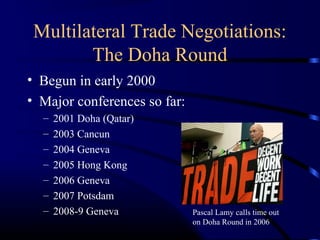
– 2008-9 Geneva Pascal Lamy calls time out
on Doha Round in 2006
Main Issues in the Doha Round
• Timing of implementation of Uruguay
Round agreements, espec. Agriculture,
services, regional agreements,
TRIPs/TRIMs
• Reductions in agricultural subsidies and
textile/apparel tariffs in the rich
industrialized countries

Gradipe03

  • 1.
  • 2.
    Pioneers of TradeTheory • Adam Smith, The Wealth of Nations (1776) – first defense of free market policies • David Ricardo, Principals of Political Economy and Taxation (1817) - introduced theory of comparative advantage
  • 3.
    Graphical Version ofRicardian Theory
  • 4.
    Heckscher-Ohlin Model • Basicmodel: two countries, two goods, two factors of production (Ricardo only had one) • Differences in factor endowments lead to “gains from trade” • Both countries will be better off if they specialize in producing goods which require a relatively abundant factor and then trade with another country • For maximum benefit, the other country should have a very different factor endowment
  • 5.
    Let’s Play theTrade Ruler Game! • http://nobelprize.org/educational_games/economi
  • 6.
    History of U.S.Trade Policy • Smoot-Hawley Tariff of 1930 • Depression High Tariffs • FDR (espec. Cordell Hull) favors free trade for post WW2 period • 1947 -- Congress rejects International Trade Organization treaty proposed initially at Bretton Woods • The GATT becomes the main trade regime
  • 7.
    Overall Tariff Levelsand Trade/GNP, 1850-1990
  • 8.
    Source: International MonetaryFund, Direction of Trade Statistics Yearbook (various years). Figure 3-2. Growth in World Exports, 1958-2006, in Billions of Current Dollars
  • 9.
    Figure 3-3. Trade/GDPin the US, Britain, Germany, France, and Japan, 1960-2006, in Percentages Sources: World Bank, World Development Indicators 2001 CD-ROM (Washington, D.C.: World Bank, 2001): OECD.Stat, http://stats.oecd.org/.
  • 10.
    Main Rules ofthe GATT • Nondiscrimination among members of the GATT – most favored nation (MFN) principle – tariffs must be adjusted to reflect MFN levels • Participation in multilateral trade negotiations to lower tariffs and nontariff barriers A tariff is a tax that is charged on the value of imported goods.
  • 11.
    Multilateral Trade Negotiations •1947 Geneva • 1949 Annecy • 1950 Torquay • 1956 Geneva • 1960-61 Dillon • 1962-67 Kennedy • 1973-79 Tokyo • 1986-93 Uruguay • 2000- Doha Biggest tariff reductions occurred in the Kennedy Round. Tokyo Round began discussions of non-tariff barriers. Uruguay Round established the basis for the World Trade Organization.
  • 12.
    Main Issues inthe Tokyo Round • Tariffs • Conflict resolution; dispute settlement • Nontariff barriers: – subsidies – government procurement – standards – custom valuation – licensing
  • 13.
    Example of aSubsidies Dispute: Airbus vs. Boeing This is a Boeing 777 This is an Airbus 300 Latest WTO ruling (video)
  • 14.
    Main Issues inthe Uruguay Round • Agriculture (mainly subsidies) • Trade in Services • Trade-related Intellectual Property (TRIPs) • Trade-related Investment Measures (TRIMs) French farmers protesting the Maastricht Treaty inEurope.
  • 15.
    Multilateral Trade Negotiations: TheDoha Round • Begun in early 2000 • Major conferences so far: – 2001 Doha (Qatar) – 2003 Cancun – 2004 Geneva – 2005 Hong Kong – 2006 Geneva – 2007 Potsdam – 2008-9 Geneva Pascal Lamy calls time out on Doha Round in 2006
  • 16.
    Main Issues inthe Doha Round • Timing of implementation of Uruguay Round agreements, espec. Agriculture, services, regional agreements, TRIPs/TRIMs • Reductions in agricultural subsidies and textile/apparel tariffs in the rich industrialized countries