Ryan Gillanders Curtis Goodman Will Kim Wade Tywoniuk Jeff Wilson
Overview & Background Global Shifts & Patterns of Consumption Production Costs & Technology Development The Role of the State Corporate Strategies Case of East Asia  Discussion Agenda
How many products can you think of that use semiconductors? What types of business are most impacted by the use of semiconductors? How would they operate without them?
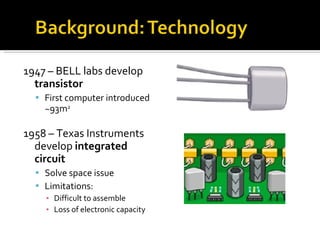
1947 – BELL labs develop  transistor  First computer introduced ~93m 2  1958 – Texas Instruments develop  integrated circuit Solve space issue Limitations: Difficult to assemble Loss of electronic capacity
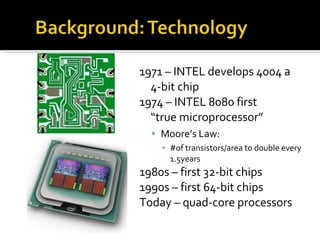
1971 – INTEL develops 4004 a  4-bit chip 1974 – INTEL 8080 first  “true microprocessor” Moore’s Law:  #of transistors/area to double every 1.5years 1980s – first 32-bit chips 1990s – first 64-bit chips Today – quad-core processors
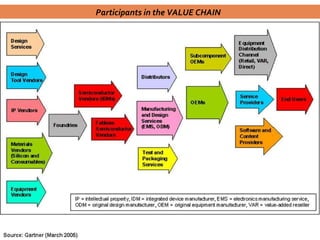
Participants in the VALUE CHAIN
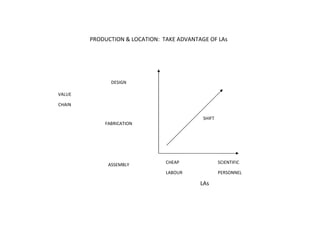
PRODUCTION & LOCATION:  TAKE ADVANTAGE OF LAs VALUE CHAIN DESIGN FABRICATION ASSEMBLY CHEAP LABOUR SCIENTIFIC PERSONNEL LAs SHIFT
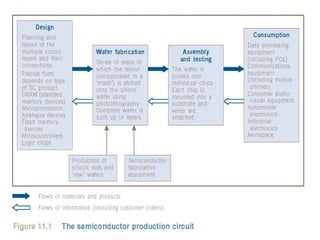
First industry to be called a  “Global Factory”  Clear geographical separation between stages of production process exist Capital and research intensive Increased miniaturization and performance Requires specialized labour-force
.
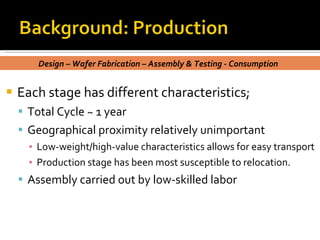
Each stage has different characteristics;  Total Cycle ~ 1 year Geographical proximity relatively unimportant Low-weight/high-value characteristics allows for easy transport Production stage has been most susceptible to relocation. Assembly carried out by low-skilled labor Design – Wafer Fabrication – Assembly & Testing - Consumption
Overview & Background Global Shifts & Patterns of Consumption Production Costs & Technology Development The Role of the State Corporate Strategies Case of East Asia  Discussion Agenda
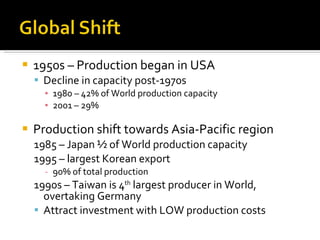
1950s – Production began in USA Decline in capacity post-1970s  1980 – 42% of World production capacity 2001 – 29% Production shift towards Asia-Pacific region 1985 – Japan ½ of World production capacity 1995 – largest Korean export  90% of total production 1990s – Taiwan is 4 th  largest producer in World, overtaking Germany Attract investment with LOW production costs
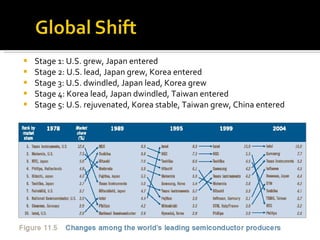
Stage 1: U.S. grew, Japan entered Stage 2: U.S. lead, Japan grew, Korea entered Stage 3: U.S. dwindled, Japan lead, Korea grew Stage 4: Korea lead, Japan dwindled, Taiwan entered Stage 5: U.S. rejuvenated, Korea stable, Taiwan grew, China entered
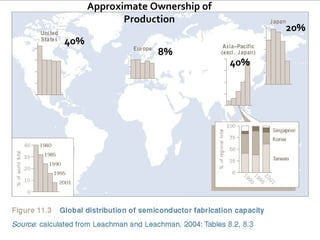
40% 8% 40% 20% Approximate Ownership of Production
Semiconductor market based on  derived demand Historically driven by government procurement USA defense and aerospace programs ‘ Invisible’ product Large corporations benefit from increased efficiencies Microprocessor spur PC market Specialized applications Communications Digital consumer goods
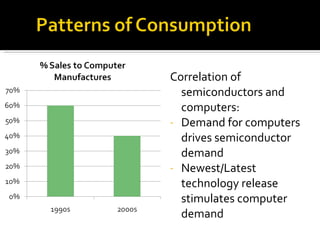
Correlation of semiconductors and computers: Demand for computers drives semiconductor demand Newest/Latest technology release stimulates computer demand
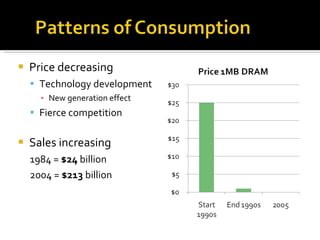
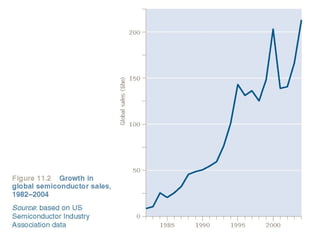
Price decreasing Technology development New generation effect Fierce competition Sales increasing 1984 =  $24  billion 2004 =  $213  billion
 
 
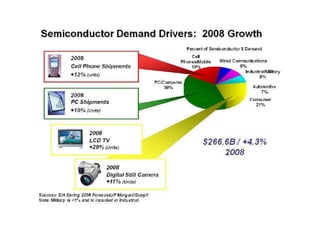
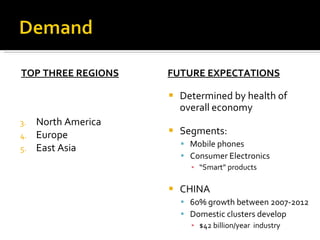
TOP THREE REGIONS North America Europe East Asia FUTURE EXPECTATIONS Determined by health of overall economy Segments: Mobile phones Consumer Electronics “ Smart” products CHINA  60% growth between 2007-2012 Domestic clusters develop $42 billion/year  industry
Overview & Background Global Shifts & Patterns of Consumption Production Costs & Technology Development The Role of the State Corporate Strategies Case of East Asia  Discussion Agenda
 
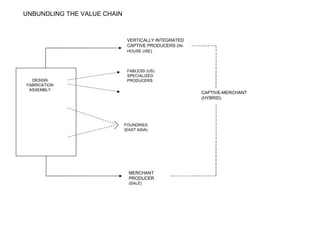
UNBUNDLING THE VALUE CHAIN DESIGN FABRICATION ASSEMBLY FABLESS (US) SPECIALIZED PRODUCERS FOUNDRIES (EAST ASIA) VERTICALLY INTEGRATED CAPTIVE PRODUCERS ( IN-HOUSE USE ) CAPTIVE-MERCHANT (HYBRID) MERCHANT PRODUCER  (SALE)
Overview & Background Global Shifts & Patterns of Consumption Production Costs & Technology Development The Role of the State Corporate Strategies Case of East Asia  Discussion Agenda
Government as stakeholder in development of local semiconductor industries Key technology used in most electronics Expensive and rapidly changing technology Three ways that government can help develop industry Indigenous production capacity Attracting foreign firms Purchasing from open market and developing for end use
Comparison of government involvement  United States Japan South Korea Taiwan Singapore Europe
Heavy government involvement to build indigenous capacity Initially developed in federal defence and aerospace sectors As US lost market share (1980s) the government sought trade agreements with Japan (Successfully) as well as Korea and China (Unsuccessful) Global competition encouraged privatization of US industry
Government stimulates local economy by protecting domestic producers Limiting direct foreign competition (up to 1970’s) and through a VLSI project (1976) VSLI project: Government subsidies up to 40% of total costs Encouraged collaboration of five major Japanese firms:  NEC, Toshiba, Hitatchi, Fujitsu and Mitsubishi
Strategy:  Emulate both USA and Japanese policies Government Investment in two major projects responsible for many factors of the industry: Korea Institute of Science and Technology (KIST) Korea Institute of Electronics Technology (KIET)
Government involvement with industry is very low All firms are privately owned and managed 1960’s Taiwanese government establishes the world’s first “export processing zone” Provided US firms with cheap assembly locations Established the  Industrial Technology Research Institute (ITRI)  to promote technological leverage Eventually evolved into  Electronics Research Service Organization (ERSO)
Heavy reliance on foreign firms to develop local industries  Government industrialization policies set strategy: Continuously upgrade sector through leveraging technologies and resources of foreign TNC’s
Most of Europe’s production capacity derived from US, Japanese, and Korean-owned plants Governments have supported collaborative ventures of information technologies Initiatives:  Accelerate innovation,  Protect European capacity of microelectronics, Encourage cross-border links between national electronics firms within Europe
Overview & Background Global Shifts & Patterns of Consumption Production Costs & Technology Development The Role of the State Corporate Strategies Case of East Asia  Discussion Agenda
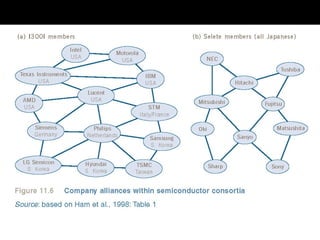
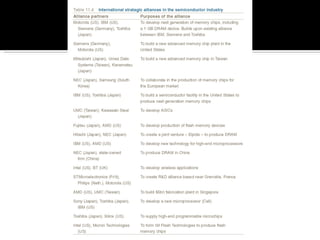
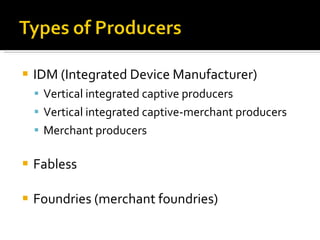
IDM (Integrated Device Manufacturer) Vertical integrated captive producers Vertical integrated captive-merchant producers Merchant producers Fabless Foundries (merchant foundries)
Comparison of industry strategy by country United States Japan South Korea Taiwan Singapore Europe
Market starters Overtaken by Japanese firms Wintelism- Intel Merchant producer system Offshore assembly plant- Fairchild, GI Change into fabless
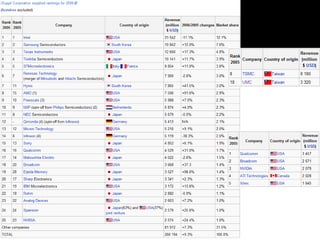
Concentration on DRAMs Production for in-house use Squeezed by reviving US firms and newly entering Korean firms Under-estimated the influence of Korean firms Solutions for stagnant market shares NAND flash memory Outsourcing  M&A and Joint ventures
From Imitator to Innovator Crisis from decrease in RAM price Solutions: NAND flash M&A Targeting non-memory semiconductors
Government driven industry Typical foundry companies TSMC UMC 70% of market occupancy Increasing competition with China
Orientated towards internal European market  European producers – Custom STMicroelectronics Infineon (spin-off from Siemens Semiconductors) NXP (spin-off from Philips Semiconductors) Qimonda (bankrupted)


Overview & Background Global Shifts & Patterns of Consumption Production Costs & Technology Development The Role of the State Corporate Strategies Case of East Asia  Discussion Agenda
East Asian production networks have been particularly critical in the development and resurgence of the US semiconductor industry
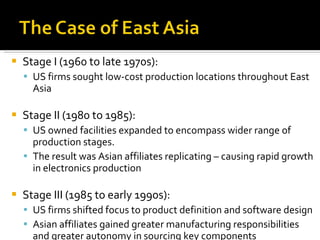
Stage I (1960 to late 1970s): US firms sought low-cost production locations throughout East Asia Stage II (1980 to 1985):  US owned facilities expanded to encompass wider range of production stages. The result was Asian affiliates replicating – causing rapid growth in electronics production Stage III (1985 to early 1990s):  US firms shifted focus to product definition and software design Asian affiliates gained greater manufacturing responsibilities and greater autonomy in sourcing key components
“ The strongest indigenous Asian producers began to control their own production networks…  the division of labor between the US and Asia, and within Asia… deepened significantly,  and US firms effectively exploited increased technical specialization in Asia.”  (pg. 344)
Overview & Background Global Shifts & Patterns of Consumption Production Costs & Technology Development The Role of the State Corporate Strategies Case of East Asia  Discussion Agenda
What type of cluster exists in the USA’s ? Generalized or specialized What are Intel’s FSA? Which are (non) location bound? How can the firm develop competitive advantage? How does distance impact firm strategy? Culture | Administrative | Geographic | Economic
Which of the three different strategies governments use to help out local industries is the best? Why? Does government involvement aid or hinder industry evolution?
Manufacturing has significant environmental impacts on host regions – how can government and private industry cooperate to mitigate destructive processes? Metals, acids, and solvents: Copper, lead, nickel, silicone, silver, zinc Trichloroethylene E-waste: cellphone, TVs, computers, etc. Responsibility?
Global shift in production location and organization Rise/fall and re-emergence of US firms Increasing importance of East-Asian firms Improved competition has resulted in: Increased degree of functional integration Diversification into new product lines and applications Relocation of production to ‘favorable’ locations Rationalizing operations on a global basis Government involvement differs across regions New opportunities Emergence of fabless design houses and foundries

Chips With Everything

  • 1.
    Ryan Gillanders CurtisGoodman Will Kim Wade Tywoniuk Jeff Wilson
  • 2.
    Overview & BackgroundGlobal Shifts & Patterns of Consumption Production Costs & Technology Development The Role of the State Corporate Strategies Case of East Asia Discussion Agenda
  • 3.
    How many productscan you think of that use semiconductors? What types of business are most impacted by the use of semiconductors? How would they operate without them?
  • 4.
    1947 – BELLlabs develop transistor First computer introduced ~93m 2 1958 – Texas Instruments develop integrated circuit Solve space issue Limitations: Difficult to assemble Loss of electronic capacity
  • 5.
    1971 – INTELdevelops 4004 a 4-bit chip 1974 – INTEL 8080 first “true microprocessor” Moore’s Law: #of transistors/area to double every 1.5years 1980s – first 32-bit chips 1990s – first 64-bit chips Today – quad-core processors
  • 6.
  • 7.
    PRODUCTION & LOCATION: TAKE ADVANTAGE OF LAs VALUE CHAIN DESIGN FABRICATION ASSEMBLY CHEAP LABOUR SCIENTIFIC PERSONNEL LAs SHIFT
  • 8.
    First industry tobe called a “Global Factory” Clear geographical separation between stages of production process exist Capital and research intensive Increased miniaturization and performance Requires specialized labour-force
  • 9.
  • 10.
    Each stage hasdifferent characteristics; Total Cycle ~ 1 year Geographical proximity relatively unimportant Low-weight/high-value characteristics allows for easy transport Production stage has been most susceptible to relocation. Assembly carried out by low-skilled labor Design – Wafer Fabrication – Assembly & Testing - Consumption
  • 11.
    Overview & BackgroundGlobal Shifts & Patterns of Consumption Production Costs & Technology Development The Role of the State Corporate Strategies Case of East Asia Discussion Agenda
  • 12.
    1950s – Productionbegan in USA Decline in capacity post-1970s 1980 – 42% of World production capacity 2001 – 29% Production shift towards Asia-Pacific region 1985 – Japan ½ of World production capacity 1995 – largest Korean export 90% of total production 1990s – Taiwan is 4 th largest producer in World, overtaking Germany Attract investment with LOW production costs
  • 13.
    Stage 1: U.S.grew, Japan entered Stage 2: U.S. lead, Japan grew, Korea entered Stage 3: U.S. dwindled, Japan lead, Korea grew Stage 4: Korea lead, Japan dwindled, Taiwan entered Stage 5: U.S. rejuvenated, Korea stable, Taiwan grew, China entered
  • 14.
    40% 8% 40%20% Approximate Ownership of Production
  • 15.
    Semiconductor market basedon derived demand Historically driven by government procurement USA defense and aerospace programs ‘ Invisible’ product Large corporations benefit from increased efficiencies Microprocessor spur PC market Specialized applications Communications Digital consumer goods
  • 16.
    Correlation of semiconductorsand computers: Demand for computers drives semiconductor demand Newest/Latest technology release stimulates computer demand
  • 17.
    Price decreasing Technologydevelopment New generation effect Fierce competition Sales increasing 1984 = $24 billion 2004 = $213 billion
  • 18.
  • 19.
  • 20.
    TOP THREE REGIONSNorth America Europe East Asia FUTURE EXPECTATIONS Determined by health of overall economy Segments: Mobile phones Consumer Electronics “ Smart” products CHINA 60% growth between 2007-2012 Domestic clusters develop $42 billion/year industry
  • 21.
    Overview & BackgroundGlobal Shifts & Patterns of Consumption Production Costs & Technology Development The Role of the State Corporate Strategies Case of East Asia Discussion Agenda
  • 22.
  • 23.
    UNBUNDLING THE VALUECHAIN DESIGN FABRICATION ASSEMBLY FABLESS (US) SPECIALIZED PRODUCERS FOUNDRIES (EAST ASIA) VERTICALLY INTEGRATED CAPTIVE PRODUCERS ( IN-HOUSE USE ) CAPTIVE-MERCHANT (HYBRID) MERCHANT PRODUCER (SALE)
  • 24.
    Overview & BackgroundGlobal Shifts & Patterns of Consumption Production Costs & Technology Development The Role of the State Corporate Strategies Case of East Asia Discussion Agenda
  • 25.
    Government as stakeholderin development of local semiconductor industries Key technology used in most electronics Expensive and rapidly changing technology Three ways that government can help develop industry Indigenous production capacity Attracting foreign firms Purchasing from open market and developing for end use
  • 26.
    Comparison of governmentinvolvement United States Japan South Korea Taiwan Singapore Europe
  • 27.
    Heavy government involvementto build indigenous capacity Initially developed in federal defence and aerospace sectors As US lost market share (1980s) the government sought trade agreements with Japan (Successfully) as well as Korea and China (Unsuccessful) Global competition encouraged privatization of US industry
  • 28.
    Government stimulates localeconomy by protecting domestic producers Limiting direct foreign competition (up to 1970’s) and through a VLSI project (1976) VSLI project: Government subsidies up to 40% of total costs Encouraged collaboration of five major Japanese firms: NEC, Toshiba, Hitatchi, Fujitsu and Mitsubishi
  • 29.
    Strategy: Emulateboth USA and Japanese policies Government Investment in two major projects responsible for many factors of the industry: Korea Institute of Science and Technology (KIST) Korea Institute of Electronics Technology (KIET)
  • 30.
    Government involvement withindustry is very low All firms are privately owned and managed 1960’s Taiwanese government establishes the world’s first “export processing zone” Provided US firms with cheap assembly locations Established the Industrial Technology Research Institute (ITRI) to promote technological leverage Eventually evolved into Electronics Research Service Organization (ERSO)
  • 31.
    Heavy reliance onforeign firms to develop local industries Government industrialization policies set strategy: Continuously upgrade sector through leveraging technologies and resources of foreign TNC’s
  • 32.
    Most of Europe’sproduction capacity derived from US, Japanese, and Korean-owned plants Governments have supported collaborative ventures of information technologies Initiatives: Accelerate innovation, Protect European capacity of microelectronics, Encourage cross-border links between national electronics firms within Europe
  • 33.
    Overview & BackgroundGlobal Shifts & Patterns of Consumption Production Costs & Technology Development The Role of the State Corporate Strategies Case of East Asia Discussion Agenda
  • 34.
    IDM (Integrated DeviceManufacturer) Vertical integrated captive producers Vertical integrated captive-merchant producers Merchant producers Fabless Foundries (merchant foundries)
  • 35.
    Comparison of industrystrategy by country United States Japan South Korea Taiwan Singapore Europe
  • 36.
    Market starters Overtakenby Japanese firms Wintelism- Intel Merchant producer system Offshore assembly plant- Fairchild, GI Change into fabless
  • 37.
    Concentration on DRAMsProduction for in-house use Squeezed by reviving US firms and newly entering Korean firms Under-estimated the influence of Korean firms Solutions for stagnant market shares NAND flash memory Outsourcing M&A and Joint ventures
  • 38.
    From Imitator toInnovator Crisis from decrease in RAM price Solutions: NAND flash M&A Targeting non-memory semiconductors
  • 39.
    Government driven industryTypical foundry companies TSMC UMC 70% of market occupancy Increasing competition with China
  • 40.
    Orientated towards internalEuropean market European producers – Custom STMicroelectronics Infineon (spin-off from Siemens Semiconductors) NXP (spin-off from Philips Semiconductors) Qimonda (bankrupted)
  • 41.
  • 42.
  • 43.
  • 44.
    Overview & BackgroundGlobal Shifts & Patterns of Consumption Production Costs & Technology Development The Role of the State Corporate Strategies Case of East Asia Discussion Agenda
  • 45.
    East Asian productionnetworks have been particularly critical in the development and resurgence of the US semiconductor industry
  • 46.
    Stage I (1960to late 1970s): US firms sought low-cost production locations throughout East Asia Stage II (1980 to 1985): US owned facilities expanded to encompass wider range of production stages. The result was Asian affiliates replicating – causing rapid growth in electronics production Stage III (1985 to early 1990s): US firms shifted focus to product definition and software design Asian affiliates gained greater manufacturing responsibilities and greater autonomy in sourcing key components
  • 47.
    “ The strongestindigenous Asian producers began to control their own production networks… the division of labor between the US and Asia, and within Asia… deepened significantly, and US firms effectively exploited increased technical specialization in Asia.” (pg. 344)
  • 48.
    Overview & BackgroundGlobal Shifts & Patterns of Consumption Production Costs & Technology Development The Role of the State Corporate Strategies Case of East Asia Discussion Agenda
  • 49.
    What type ofcluster exists in the USA’s ? Generalized or specialized What are Intel’s FSA? Which are (non) location bound? How can the firm develop competitive advantage? How does distance impact firm strategy? Culture | Administrative | Geographic | Economic
  • 50.
    Which of thethree different strategies governments use to help out local industries is the best? Why? Does government involvement aid or hinder industry evolution?
  • 51.
    Manufacturing has significantenvironmental impacts on host regions – how can government and private industry cooperate to mitigate destructive processes? Metals, acids, and solvents: Copper, lead, nickel, silicone, silver, zinc Trichloroethylene E-waste: cellphone, TVs, computers, etc. Responsibility?
  • 52.
    Global shift inproduction location and organization Rise/fall and re-emergence of US firms Increasing importance of East-Asian firms Improved competition has resulted in: Increased degree of functional integration Diversification into new product lines and applications Relocation of production to ‘favorable’ locations Rationalizing operations on a global basis Government involvement differs across regions New opportunities Emergence of fabless design houses and foundries

Editor's Notes

  • #5 In 1947, John Bardeen and Walter Brattain, working at Bell Telephone Laboratories, were trying to understand the nature of the electrons at the interface between a metal and a semiconductor three terminal character of the transistor is what allows us to make an amplifier for electrical signals, like the one in our radio. With the three-terminal transistor we can also make an electric switch, which can be controlled by another electrical switch. By cascading these switches (switches that control switches that control switches, etc.) we can build up very complicated logic circuits. These logic circuits can be built very compact on a silicon chip with 1,000,000 transistors per square centimeter. We can turn them on and off very rapidly by switching every 0.000000001 seconds. Such logic chips are at the heart of your personal computer and many other gadgets you use today. In the late 1940‘s, big computers were built with over 10,000 vacuum tubes and occupied over 93 square meters of space. In 1958 and 1959, Jack Kilby at Texas Instruments and Robert Noyce at Fairchild Camera, came up with a solution to the problem of large numbers of components, and the integrated circuit was developed. Instead of making transistors one-by-one, several transistors could be made at the same time, on the same piece of semiconductor. Not only transistors, but other electric components such as resistors, capacitors and diodes could be made by the same process with the same materials. .
  • #6 For more than 30 years, since the 1960's, the number of transistors per unit area has been doubling every 1.5 years. This fantastic progression of circuit fabrication is known as Moore's law, after Gordon Moore, one of the early integrated circuit pioneers and founders of Intel Corporation mostly the pure elements silicon (Si) and sometimes germanium (Ge) are being used Silicon is a grey colored element with crystalline structure. It is the second most abundant element in the earth's crust, after oxygen. Silicon is always found in combined form in nature, often with oxygen as quartz, and is found in rocks and silica sand http://nobelprize.org/educational_games/physics/transistor/history/
  • #13 Korea/Taiwan emerge through 1980s/90s,
  • #15 Much less widespread compared to other industries (ie: automobiles) TODAY approx. ownership of production: **overlap in manufacturing facilities Asia-Pacific – 40% USA – 40% Japan – 20% Europe – 8%
  • #16 INVISIBLE:: Most people don’t shop for them Importance of military stimulation to industry Japan and Europe, military is less important – demand stimulated by consumer segment new firms that had entered the personal computer market since the second half of the 1970s—Computer, Radio Shack, and Commodore first, and a stream of new start ups later—were all specialized computer firms. These firms preferred to buy advanced semiconductor devices from large capable and innovative microprocessor firms, rather than try to vertically integrate. Thus, Intel became the de-facto leader for the microprocessor market. Communications equipment Internet, mobile phones Digital consumer goods TV, Cameras, Music, PDAs, Video games, etc.
  • #17 Evident correlation between computer sales and semiconductor suppliers With greater sales to communications equipment suppliers – demand is also connected to NETWORK SERVICE PROVIDERS
  • #18 New generation effect = as new semi-conductors are produced that are faster and smaller which in turn drops demand for older generations More competitors, with differing operating environments
  • #19 1950 – Commercial introduction 1970s – Output doubles Since 1980s – grown 20-fold See fluctuations in demand – creating gluts and shortages Supply gluts = intensified price competition (lower prices) 1996, 1998, 2001 Supply shortage = increased prices 1994, 1997, 2000
  • #20 $200B semiconductor industry generates over $1,200B in electronics systems business and $5,000 billion in services, representing close to 10% of world GDP
  • #21 In 2005, the semiconductor industry made over 90 million transistors for every man, woman and child on Earth, and by 2010, this number should be 1 billion transistors. Global sales of semiconductors fell 2.8 per cent in 2008 compared with the previous year, the first year-on-year drop since 2001, the Semiconductor Industry Association (SIA) reported on Monday. China – 20%/year growth $42billion to be purchased from chinese designed manufacture
  • #22 Silverthorne" processor for ultramobile devices Intel's new chip is a tiny 25mm 2 . At only 47 million transistors (about 40 percent of that is a 512K, 8-way set associative L2 cache), it's also quite lean
  • #26 3 ways for gov’t to help develop industry: 1. Building indigenous production capacity based upon domestically owned firms 2. Attracting foreign semiconductor firms to establish production units 3. Purchasing semi conductors on the open market and contracting on developing the end uses Choice depends on government’s abilities and situation
  • #28 US-Japan Semiconductor Trade Agreement 1986: allowed American semiconductor manufacturers access to the Japanese market US attempts to solve issue of illegal subsidization of Hynix semiconductors out of Korea has been unsuccessful US attempts to gain fair access to Chinese market also unresolved
  • #29 VSLI = Very Large Scale Integration
  • #30 Planning and coordinating semiconductor R&D, import assimilating, disseminating foreign technologies, providing technical assistance to Korean firms and undertaking market research Invariably it was governments, rather than markets, that kick-started the move into chip-making. In some countries, such as Taiwan, the involvement was direct and temporary: both TSMC and UMC were spun off from government-funded research projects into publicly listed companies. In other cases, the involvement was indirect and open-ended: in South Korea, for instance, the government leaned--and continues to lean--on commercial banks to finance the move into chip making by the country's family-controlled conglomerates. The benefits for economic development seemed to justify this approach, and Singapore and Malaysia, too, accepted the idea without question. Source Citation: "The great chip glut; Semiconductor manufacturers."  The Economist (US)  (August 11, 2001): N/A.  Academic OneFile . Gale. University of Lethbridge. 6 Feb. 2009  <http://0-find.galegroup.com.darius.uleth.ca/itx/start.do?prodId=AONE>. Gale Document Number: A78563321
  • #31 Taiwanese government has instigated mainly joint-venture spin-off projects by combining local firms with foreign firms and investment Hsinchu Science-Based Industrial Park near Taipei, AKA “silicon valley of the east” Taiwan is now that world’s 3 rd largest semiconductor producer
  • #32 Almost all firms are foreign, their continued presence proves the kind of supportive environment provided by the government
  • #35 An integrated device manufacturer (IDM) is a semiconductor company which designs, manufactures, and sells integrated circuit (IC) products. Cypress Semiconductor, Fujitsu, Hitachi, IBM, IDT, Intel, LSI Corporation, Matsushita, Mitsubishi, Freescale, NEC, Philips, NXP, Samsung, STMicroelectronics, Infineon, Sony, National Semiconductor, Texas Instruments, and Toshiba. Vertical integrated captive producers manufacture for in-house use. Vertical integrated captive-merchant producers manufacture semiconductors partly for their own use and partly for sale. Merchant producers are companies making semiconductors only for sale. A fabless semiconductor company specializes in the design and sale of hardware devices implemented on semiconductor chips but do not manufacture them. Nvidia Today most major IDMs including Freescale, Infineon, Texas Instruments and Cypress Semiconductor have adopted the practice of outsourcing chip manufacturing as a significant manufacturing strategy. Foundries manufacture semiconductors to customer specifications but do not design them UMC (United Microelectronics Corporation) which was founded as Taiwan's first semiconductor company in 1980 Taiwan Semiconductor Manufacturing Company (TSMC)
  • #37 The commercial production of semiconductors began in the U.S. in the 1950s. US firms dominated world semiconductor market for almost three decades until Japanese firms entered to the market and overtaken US firms. Most semiconductor companies, especially IDMs, focused on producing DRAMs, because they could take advantages of mass production to dominate semiconductor market. US firms were overtaken by Japanese firms which entered market with low price and high quality. To recover their market dominance, they had to move our DRAM market into more sophisticated semiconductor devices. Wintelism helped intel positioned in the top semiconductor companies. From that point, U.S. firms settled downed as merchant producer selling semiconductor devices to end users. Although most of US plants are located within the US, they also moved their factories to abroad. Since the early 1960s, US firms have started built assembly plants in Asian country seeking low-labor cost. Fairchild was the first case. In 1962, they build the first plant in HK, and in 1964, General Instruments transferred assembly line to Taiwan. The model has been further validated by the conversion of major IDMs to a completely fabless model, including (for example) Conexant Systems, Semtech, and most recently, LSI Logic.
  • #38 VLSI project (Very Large Scale Integration) NEC, Fujitsu, Hitachi, Toshiba ,Mitsubishi Japanese government funded 40% of total cost between 1976 and 1979. As us firms did, Japanese firms concentrate on DRAM producing to take advantages of mass production. Japanese firms are typical vertical integrated captive producers, producing chips for in-house use. BUT, the lead of Japanese firms didn’t last long. b/c they were squeezed between reviving US firms targeting non memory semiconductors and Korean firms aiming DRAM industry Contrast to the US, Japanese firms tended to remain in the DRAM market. However, They under-estimated the influence Korean companies. Japan overtaken by a Korean company, Samsung. . To over come this trouble, Japanese firms find new strategies. In 1987, Toshiba invented NAND flash memory, and they diversified their production in flash memory sector. But, it also was overtaken by Samsung in a decade. second solution was increase of outsourcing to reduce the producing cost, which oppose Japanese strategy that keeping their production in-house to control quality Third one was massive merges and joint ventures. In 2002, Mitsubishi and Hitachi were spun off and merged to form a new separate legal entity named Renesas. In 2003, AMD and Fujitsu created a joint-venture company named Spansion.
  • #39 Like a Japanese semiconductor industry development, Korean government strive to establish a semiconductor industry. Korean government supported 3 major companies, Samsung, LG, and hyundai which are hynix today. Korea also targeted DRAM industry with cheap labor cost, but they invested a huge amount of money on R&D to takeover other developed companies. Korean firms were imitator at the first time. They depended on technology abandoned by US and Japanese firms But their R&D in silicon belly was impressive. Since Samsung invented 64MB DRAM at the first time in 1992, their technology in DRAM manufacturing was ahead of any other company To those firms who rely heavily on a DRAM industry, the rapid decrease of DRAM price is bid damage Due to the decreasing price, Korean firms had to find a breakthrough One was a new target in NAND flash field which was invented by a Japanese firm In 2006, Samsung occupied 48.7% of NAND flash market followed by Toshiba which was 24.6% Recently, Samsung is considering merging the Sandisk, if it happened, it is expected that Samsung solidify their top position in flash memory market The other was diversifying into non-memory market like Application possessors for mobile devices.
  • #40 Similar to Korea and Japan, there was a intervention of government. Two representative Taiwanese semiconductor companies are state owned companies, which are TSMC (Taiwan Semiconductor Manufacturing Company) and UMC (United Microelectronics Corporation) Joint ventured with qualcomm, solely running two runners In 2006, both companies occupied 70% of foundry market. People question that Chinese SMIC can overtake these two Taiwanese companies Taiwanese experts believe it is not possible Chinese companies could save money on R&D through joint venture with infineon, elpida, toshiba, fujitsu They have only technnique to make memory chips, not logic IC Even though they are willing to invest on R&D, I will be tremendous amount.
  • #41 STMicroelectronics is an Italian-French electronics and semiconductor manufacturer headquartered in Geneva, Switzerland. On May 1, 2006, Infineon's Memory Products division was carved out as a distinct company called Qimonda AG. In 2006, the semiconductor operations of the parent company, Philips were sold to a consortium of private equity firms through an LBO to form a new separate legal entity named NXP Semiconductors. On May 1, 2006, Infineon's Memory Products division was carved out as a distinct company called Qimonda AG. 2009,JAN,28 Qimonda was bankrupted and impact European silicon Valley
  • #48 the division of labor between the US and Asia, and within Asia between affiliates and local producers, deepened significantly Now designing and producing
  • #51 3 ways for gov’t to help develop industry: 1. Building indigenous production capacity based upon domestically owned firms 2. Attracting foreign semiconductor firms to establish production units 3. Purchasing semi conductors on the open market and contracting on developing the end uses