Institutional aspects of National Systems of
Innovation
Finance, financial institutions and governance
Olga Mikheeva, PhD
Marie Curie Research Fellow (public banking, finance and innovation, public policies and governance)
12 February 2021
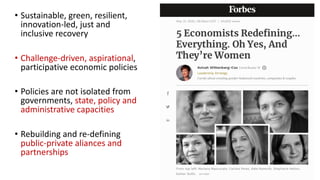
• Sustainable, green, resilient,
innovation-led, just and
inclusive recovery
• Challenge-driven, aspirational,
participative economic policies
• Policies are not isolated from
governments, state, policy and
administrative capacities
• Rebuilding and re-defining
public-private aliances and
partnerships
Institutional dimensions of innovation
! Innovation is uncertain, dynamic, collective and social process
! Institutional setups can either foster or hinder
innovation/development/growth
! Innovation is political
! Policies, bureaucracies, political economy of development
! Governance of innovation and development
! STI and knowledge creation
! Economic policies
! Financing policies (financial capitalism)
Financing aspects of innovation
! Typically, under-represented line of research in innovation studies (Neo-Schumpeterian
Manifesto by Hanusch and Pyka 2006)
! Interpretations of Perez, Callegari, Biondi, Burlamaqui
! Schumpeter: external credit (banker as an ephor of capitalism) " but also retained
earnings (corporation)
! Schumpeter-Minsky: financial firms also innovate, financial fragility hypothesis
! Schumpeter-Keynes-Minsky: increasing public investments (socialization of investments),
focused on long-term returns (Mazzucato and Wray 2015, Bellofiore 2014)
• Burlamaqui-Kregel (2005, 2006): financing of innovation and development is inherently
uncertain
• Dow (2014) Positive disposition to face uncertainty (e.g. Keynesian principles of effective
demand, socialisation of investments)
• Mazzucato (2013, 2018, 2021): finance is not neutral (types of activities supported) and
can set the direction to innovation (not only entrepreneurial discovery)
• Burlamaqui-Kattel (2015): financial governance and technological innovation define
economic development trajectories (leapfrogging)
Financial governance of innovation and
development
! Burlamaqui-Kattel (2015): financial governance and technological
innovation define economic development trajectories (leapfrogging)
! Financial policies as actualization of industrial and innovation policies
! Comparative history of financing of industrialization vs post-WWII
developmental states
! Financial systems differ (institutional setups) so do financial bureaucracies (CBs vs
MoF, central vs local levels) " different extent of importance of financing
policies/tools/institutions
! Increasing state’s control over credit allocation towards priority sectors
• Financial bureaucracies as an essential component of financing policies
! Globally mobile financial capital " global financial elites/decision-makers
! The role of financial policies in modern societies and respectively of key
financial agencies within governments (MoF, CB, supervisory authority)
! Institutional learning, learning from interaction between actors applies too
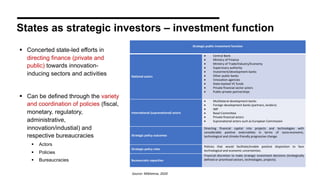
States as strategic investors – investment function
! Concerted state-led efforts in
directing finance (private and
public) towards innovation-
inducing sectors and activities
! Can be defined through the variety
and coordination of policies (fiscal,
monetary, regulatory,
administrative,
innovation/industial) and
respective bureaucracies
! Actors
! Policies
! Bureaucracies
Strategic public investment function
National actors
• Central Bank
• Ministry of Finance
• Ministry of Trade/Industry/Economy
• Supervisory authority
• Investment/development banks
• Other public banks
• Innovation agencies
• State-backed VC funds
• Private financial sector actors
• Public-private partnerships
International (supranational) actors
• Multilateral development banks
• Foreign development banks (partners, lenders)
• IMF
• Basel Committee
• Private financial actors
• Supranational actors such as European Commission
Strategic policy outcomes
Directing financial capital into projects and technologies with
considerable positive externalities in terms of socio-economic,
technological and climate-friendly progressive change.
Strategic policy roles
Policies that would facilitate/enable positive disposition to face
technological and economic uncertainties.
Bureaucratic capacities
Financial discretion to make strategic investment decisions (strategically
defined or prioritised sectors, technologies, projects).
Source: Mikheeva, 2020
Conclusions and implications for research
! Policies do not exist in isolation from implementing bodies
! Public policy and governance literature provides valuable conceptual
insights into policy actors, policy process and public bureaucracies
AND economics of innovation and monetary economics literatures
provide valuable insights about economic and financial systems
! More nuanced understanding of how innovation-oriented policies
and designed and implemented
! Further research
! Conceptualisation of state-led investment function(s)
! Understanding of financial bureaucracies and governance (multi-level)
! Comparative empirical studies
https://www.ucl.ac.uk/bartlett/public-purpose/people/olga-mikheeva
o.mikheeva@ucl.ac.uk
@oamikheeva
@IIPP_UCL
Thank you!

Lecture 6 (Part-2) Innovation Systems 101

  • 1.
    Institutional aspects ofNational Systems of Innovation Finance, financial institutions and governance Olga Mikheeva, PhD Marie Curie Research Fellow (public banking, finance and innovation, public policies and governance) 12 February 2021
  • 6.
    • Sustainable, green,resilient, innovation-led, just and inclusive recovery • Challenge-driven, aspirational, participative economic policies • Policies are not isolated from governments, state, policy and administrative capacities • Rebuilding and re-defining public-private aliances and partnerships
  • 7.
    Institutional dimensions ofinnovation ! Innovation is uncertain, dynamic, collective and social process ! Institutional setups can either foster or hinder innovation/development/growth ! Innovation is political ! Policies, bureaucracies, political economy of development ! Governance of innovation and development ! STI and knowledge creation ! Economic policies ! Financing policies (financial capitalism)
  • 8.
    Financing aspects ofinnovation ! Typically, under-represented line of research in innovation studies (Neo-Schumpeterian Manifesto by Hanusch and Pyka 2006) ! Interpretations of Perez, Callegari, Biondi, Burlamaqui ! Schumpeter: external credit (banker as an ephor of capitalism) " but also retained earnings (corporation) ! Schumpeter-Minsky: financial firms also innovate, financial fragility hypothesis ! Schumpeter-Keynes-Minsky: increasing public investments (socialization of investments), focused on long-term returns (Mazzucato and Wray 2015, Bellofiore 2014) • Burlamaqui-Kregel (2005, 2006): financing of innovation and development is inherently uncertain • Dow (2014) Positive disposition to face uncertainty (e.g. Keynesian principles of effective demand, socialisation of investments) • Mazzucato (2013, 2018, 2021): finance is not neutral (types of activities supported) and can set the direction to innovation (not only entrepreneurial discovery) • Burlamaqui-Kattel (2015): financial governance and technological innovation define economic development trajectories (leapfrogging)
  • 9.
    Financial governance ofinnovation and development ! Burlamaqui-Kattel (2015): financial governance and technological innovation define economic development trajectories (leapfrogging) ! Financial policies as actualization of industrial and innovation policies ! Comparative history of financing of industrialization vs post-WWII developmental states ! Financial systems differ (institutional setups) so do financial bureaucracies (CBs vs MoF, central vs local levels) " different extent of importance of financing policies/tools/institutions ! Increasing state’s control over credit allocation towards priority sectors • Financial bureaucracies as an essential component of financing policies ! Globally mobile financial capital " global financial elites/decision-makers ! The role of financial policies in modern societies and respectively of key financial agencies within governments (MoF, CB, supervisory authority) ! Institutional learning, learning from interaction between actors applies too
  • 10.
    States as strategicinvestors – investment function ! Concerted state-led efforts in directing finance (private and public) towards innovation- inducing sectors and activities ! Can be defined through the variety and coordination of policies (fiscal, monetary, regulatory, administrative, innovation/industial) and respective bureaucracies ! Actors ! Policies ! Bureaucracies Strategic public investment function National actors • Central Bank • Ministry of Finance • Ministry of Trade/Industry/Economy • Supervisory authority • Investment/development banks • Other public banks • Innovation agencies • State-backed VC funds • Private financial sector actors • Public-private partnerships International (supranational) actors • Multilateral development banks • Foreign development banks (partners, lenders) • IMF • Basel Committee • Private financial actors • Supranational actors such as European Commission Strategic policy outcomes Directing financial capital into projects and technologies with considerable positive externalities in terms of socio-economic, technological and climate-friendly progressive change. Strategic policy roles Policies that would facilitate/enable positive disposition to face technological and economic uncertainties. Bureaucratic capacities Financial discretion to make strategic investment decisions (strategically defined or prioritised sectors, technologies, projects). Source: Mikheeva, 2020
  • 11.
    Conclusions and implicationsfor research ! Policies do not exist in isolation from implementing bodies ! Public policy and governance literature provides valuable conceptual insights into policy actors, policy process and public bureaucracies AND economics of innovation and monetary economics literatures provide valuable insights about economic and financial systems ! More nuanced understanding of how innovation-oriented policies and designed and implemented ! Further research ! Conceptualisation of state-led investment function(s) ! Understanding of financial bureaucracies and governance (multi-level) ! Comparative empirical studies
  • 12.