Supporting Reshoring in
Communities:
Tools and Strategies for
Economic Developers
The scales have shifted in favor of the United
States, with more jobs being reshored than
offshored.
In 2014 alone, 60,000 manufacturing jobs
were reshored— previously offshored
manufacturing, IT, and service jobs returning
to their home soil—to the United States.
Roger Dupuis, “10 Things To Know About Reshoring, Manufacturing And Pennsylvania's Future” Central Pennsylvania Business
Journal. March 31, 2016. Http://Www.Cpbj.Com/Article/20160331/Cpbj01/160329811/10
Reshored Jobs are Catalysts for
Growth
• Boost employment
• Train the workforce
• Expand the tax base
• Companies that reshore create a multiplier
effect
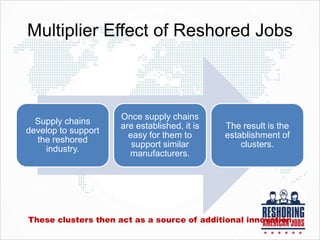
Multiplier Effect of Reshored Jobs
Supply chains
develop to support
the reshored
industry.
Once supply chains
are established, it is
easy for them to
support similar
manufacturers.
The result is the
establishment of
clusters.
These clusters then act as a source of additional innovation.
Why Companies Reshore
“In 2005, our labor costs in
China were only around 10
percent and by 2012 [labor
costs] was 37 percent.”
Marvin Cunningham, Long-
Stanton Manufacturing
Decline in
cost savings
Other Reasons Why Companies
Reshore
• U.S. laborers are, on average, significantly more
productive than those abroad.
• Any supply chain interruptions—both natural and
manmade—can increase the cost of producing a good
or providing a service.
– Faster speed to market is important to companies
considering reshoring.
• Protecting intellectual property, such as trademarks
and patents, overseas can be costly and exceedingly
difficult.
• Leaders of companies that reshored reported
experiencing inaccuracies or lower quality in
products manufactured overseas.
Are You Ready To Meet The
Workforce Needs Of Industry 4.0?
“Today, another workforce transformation is on the horizon as manufacturing
experiences a fourth wave of technological advancement: the rise of new digital
industrial technologies that are collectively known as Industry 4.0.” This change may
not be such a bad thing, if communities are prepared for it. Yes, much of the
traditional highly labor intensive jobs will be lost. The upside, however, is that these
jobs will be replaced with higher paying jobs.
The preplanning and economic assessment that goes into developing a strategic plan
not only helps communities forecast needs in terms of building educational and
workforce pipeline, it also help them address demand for additional workers.
Read the full BCG article - Man and Machine in Industry 4.0: How Will Technology
Transform the Industrial Workforce Through 2025? at
https://www.bcgperspectives.com/content/articles/technology-business-
transformation-engineered-products-infrastructure-man-machine-industry-4/
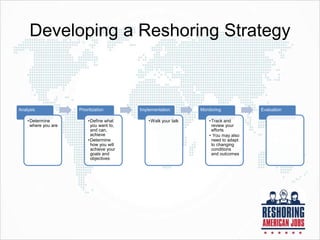
Developing a Reshoring Strategy
Analysis
•Determine
where you are
Prioritization
•Define what
you want to,
and can,
achieve
•Determine
how you will
achieve your
goals and
objectives
Implementation
•Walk your talk
Monitoring
•Track and
review your
efforts
• You may also
need to adapt
to changing
conditions
and outcomes
Evaluation
What Does a Sound Strategy Look
Like?
• Compatible with the community‘s vision;
• Feasible, given the community‘s strengths
and weaknesses;
• Implementable, given the community‘s
leadership and resources;
• Change-making - for addressing the
community‘s most urgent challenges; and
• Innovative - enabling the community to move
forward‖ on its most promising opportunities.
Joy Wilkins, Darrene Hackler, And Christopher Girdwood, “Economic Development Strategic Planning.” International Economic
Development Council. November 2011.
“Have a well-integrated economic development service
model. If a company has to put all these pieces together, like
training assistance and help locating their facility, it’s going
to be a big barrier.”
Chris Wilusz, Industrial Resource Center Network statewide coordinator (PA)
SETTING THE CONTEXT
FOR RESHORING: A PREVIEW
Many companies considering reshoring operations to a community often do not
contact an economic development organization during the preliminary research
stages, if at all. These companies will review subscription databases and public
information available to them to influence their decisions. The following section
summarizes a few approaches for communities to consider to make their
community appealing to companies consider reshoring their operations.
General Site Location Strategies
• Create and maintain an inventory of available buildings and
sites;
• Ensure that available building and sites are adequately served
by local infrastructures such as roads, highway interchanges,
high-voltage power, rail spurs, reliable water, and broadband;
• Maintain an understanding of relevant permitting processes,
building regulations, tax rates, and available incentives;
• Working with local planning officials to ensure that there is an
adequate supply of available land that can be easily
developed (i.e., land without legal encumbrances, tax arrears,
inappropriate zoning, natural hazards, or possible
contamination);
• Maintaining up-to-date, relevant economic and demographic
data.
Infrastructure Policies
• Evaluate the effects of various infrastructure
deficiencies on their local business;
• Raise awareness of the need for infrastructure
investment to support business prosperity;
• Participate more actively in the planning and
design of infrastructure assets; and
• Promote new financing mechanisms such as value
capture, congestion fees, infrastructure
exchanges, and public-private partnerships.
Broad-Based Policy for High-
Quality Workforce
• Encouraging research tax credits be awarded to projects that
entail cooperation between private industry and education
institutions;
• Creating training alliances for manufacturing that include
community colleges, government, and industry;
• Increasing science, engineering, and math education at all
levels, from pre-kindergarten to the postgraduate level;
• Fostering an integrated approach that advocates that students
gain not only relevant skills but comprehensive skillsets
appropriate for today’s industrial demands;
• Confronting biases and stigmas by promoting manufacturing
careers as high-skill, high-technology, and high-pay jobs
The approaches
covered in the previous
slides are just the tip of
the iceberg.
Download the full
toolkit, “Supporting
Reshoring in
Communities: Tools
and Strategies for
Economic Developers.”

Supporting Reshoring in Communities: Tools and Strategies for Economic Developers

  • 1.
    Supporting Reshoring in Communities: Toolsand Strategies for Economic Developers
  • 2.
    The scales haveshifted in favor of the United States, with more jobs being reshored than offshored. In 2014 alone, 60,000 manufacturing jobs were reshored— previously offshored manufacturing, IT, and service jobs returning to their home soil—to the United States. Roger Dupuis, “10 Things To Know About Reshoring, Manufacturing And Pennsylvania's Future” Central Pennsylvania Business Journal. March 31, 2016. Http://Www.Cpbj.Com/Article/20160331/Cpbj01/160329811/10
  • 3.
    Reshored Jobs areCatalysts for Growth • Boost employment • Train the workforce • Expand the tax base • Companies that reshore create a multiplier effect
  • 4.
    Multiplier Effect ofReshored Jobs Supply chains develop to support the reshored industry. Once supply chains are established, it is easy for them to support similar manufacturers. The result is the establishment of clusters. These clusters then act as a source of additional innovation.
  • 5.
    Why Companies Reshore “In2005, our labor costs in China were only around 10 percent and by 2012 [labor costs] was 37 percent.” Marvin Cunningham, Long- Stanton Manufacturing Decline in cost savings
  • 6.
    Other Reasons WhyCompanies Reshore • U.S. laborers are, on average, significantly more productive than those abroad. • Any supply chain interruptions—both natural and manmade—can increase the cost of producing a good or providing a service. – Faster speed to market is important to companies considering reshoring. • Protecting intellectual property, such as trademarks and patents, overseas can be costly and exceedingly difficult. • Leaders of companies that reshored reported experiencing inaccuracies or lower quality in products manufactured overseas.
  • 8.
    Are You ReadyTo Meet The Workforce Needs Of Industry 4.0? “Today, another workforce transformation is on the horizon as manufacturing experiences a fourth wave of technological advancement: the rise of new digital industrial technologies that are collectively known as Industry 4.0.” This change may not be such a bad thing, if communities are prepared for it. Yes, much of the traditional highly labor intensive jobs will be lost. The upside, however, is that these jobs will be replaced with higher paying jobs. The preplanning and economic assessment that goes into developing a strategic plan not only helps communities forecast needs in terms of building educational and workforce pipeline, it also help them address demand for additional workers. Read the full BCG article - Man and Machine in Industry 4.0: How Will Technology Transform the Industrial Workforce Through 2025? at https://www.bcgperspectives.com/content/articles/technology-business- transformation-engineered-products-infrastructure-man-machine-industry-4/
  • 9.
    Developing a ReshoringStrategy Analysis •Determine where you are Prioritization •Define what you want to, and can, achieve •Determine how you will achieve your goals and objectives Implementation •Walk your talk Monitoring •Track and review your efforts • You may also need to adapt to changing conditions and outcomes Evaluation
  • 10.
    What Does aSound Strategy Look Like? • Compatible with the community‘s vision; • Feasible, given the community‘s strengths and weaknesses; • Implementable, given the community‘s leadership and resources; • Change-making - for addressing the community‘s most urgent challenges; and • Innovative - enabling the community to move forward‖ on its most promising opportunities. Joy Wilkins, Darrene Hackler, And Christopher Girdwood, “Economic Development Strategic Planning.” International Economic Development Council. November 2011.
  • 11.
    “Have a well-integratedeconomic development service model. If a company has to put all these pieces together, like training assistance and help locating their facility, it’s going to be a big barrier.” Chris Wilusz, Industrial Resource Center Network statewide coordinator (PA)
  • 13.
    SETTING THE CONTEXT FORRESHORING: A PREVIEW Many companies considering reshoring operations to a community often do not contact an economic development organization during the preliminary research stages, if at all. These companies will review subscription databases and public information available to them to influence their decisions. The following section summarizes a few approaches for communities to consider to make their community appealing to companies consider reshoring their operations.
  • 14.
    General Site LocationStrategies • Create and maintain an inventory of available buildings and sites; • Ensure that available building and sites are adequately served by local infrastructures such as roads, highway interchanges, high-voltage power, rail spurs, reliable water, and broadband; • Maintain an understanding of relevant permitting processes, building regulations, tax rates, and available incentives; • Working with local planning officials to ensure that there is an adequate supply of available land that can be easily developed (i.e., land without legal encumbrances, tax arrears, inappropriate zoning, natural hazards, or possible contamination); • Maintaining up-to-date, relevant economic and demographic data.
  • 15.
    Infrastructure Policies • Evaluatethe effects of various infrastructure deficiencies on their local business; • Raise awareness of the need for infrastructure investment to support business prosperity; • Participate more actively in the planning and design of infrastructure assets; and • Promote new financing mechanisms such as value capture, congestion fees, infrastructure exchanges, and public-private partnerships.
  • 16.
    Broad-Based Policy forHigh- Quality Workforce • Encouraging research tax credits be awarded to projects that entail cooperation between private industry and education institutions; • Creating training alliances for manufacturing that include community colleges, government, and industry; • Increasing science, engineering, and math education at all levels, from pre-kindergarten to the postgraduate level; • Fostering an integrated approach that advocates that students gain not only relevant skills but comprehensive skillsets appropriate for today’s industrial demands; • Confronting biases and stigmas by promoting manufacturing careers as high-skill, high-technology, and high-pay jobs
  • 17.
    The approaches covered inthe previous slides are just the tip of the iceberg. Download the full toolkit, “Supporting Reshoring in Communities: Tools and Strategies for Economic Developers.”