Geopolitical Factors in International Competitiveness Jeffrey A. Hart Indiana University April 1, 2011
Contact information Department of Political Science Woodburn Hall 210 Bloomington, IN 47405 Email:  [email_address] Web:  http://mypage.iu.edu/~hartj
My books on this topic: Rival Capitalists  (1992) Globalization and Governance  (1999) Managing New Industry Creation  (2002) Technology, Television, and Competition  (2004) Competing for Knowledge  (in preparation)
What are Geopolitical Factors? Governmental policies adopted primarily as a response to inter-country and inter-regional rivalries They take three primary forms: Industrial policies Macroeconomic policies motivated by rivalries National security policies that have economic consequences
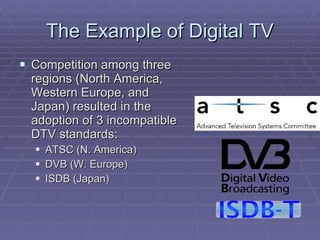
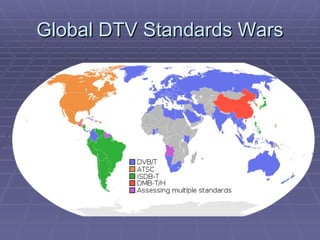
The Example of Digital TV Competition among three regions (North America, Western Europe, and Japan) resulted in the adoption of 3 incompatible DTV standards: ATSC (N. America) DVB (W. Europe) ISDB (Japan)
Global DTV Standards Wars
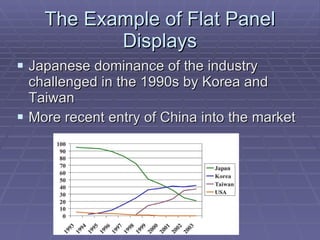
The Example of Flat Panel Displays Japanese dominance of the industry challenged in the 1990s by Korea and Taiwan More recent entry of China into the market
Tianma LCD Factory in Shanghai (formerly SVA-NEC)
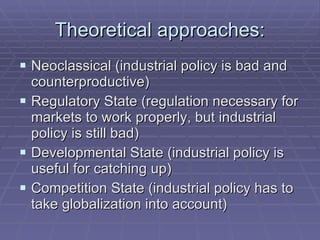
Theoretical approaches: Neoclassical (industrial policy is bad and counterproductive) Regulatory State (regulation necessary for markets to work properly, but industrial policy is still bad) Developmental State (industrial policy is useful for catching up) Competition State (industrial policy has to take globalization into account)
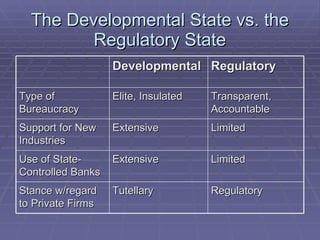
The Developmental State vs. the Regulatory State Developmental Regulatory Type of Bureaucracy Elite, Insulated Transparent, Accountable Support for New Industries Extensive Limited Use of State-Controlled Banks Extensive Limited Stance w/regard to Private Firms Tutellary Regulatory
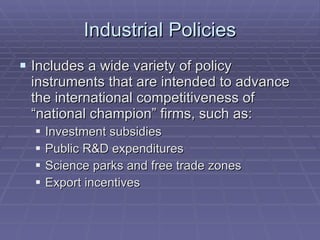
Industrial Policies Includes a wide variety of policy instruments that are intended to advance the international competitiveness of “national champion” firms, such as: Investment subsidies Public R&D expenditures Science parks and free trade zones Export incentives
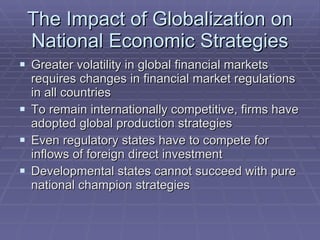
The Impact of Globalization on National Economic Strategies Greater volatility in global financial markets requires changes in financial market regulations in all countries To remain internationally competitive, firms have adopted global production strategies Even regulatory states have to compete for inflows of foreign direct investment Developmental states cannot succeed with pure national champion strategies
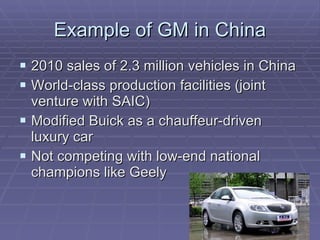
Example of GM in China 2010 sales of 2.3 million vehicles in China World-class production facilities (joint venture with SAIC) Modified Buick as a chauffeur-driven luxury car Not competing with low-end national champions like Geely
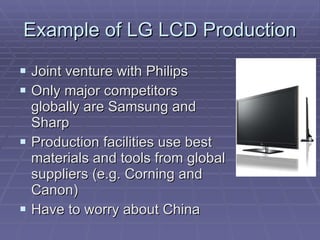
Example of LG LCD Production Joint venture with Philips Only major competitors globally are Samsung and Sharp Production facilities use best materials and tools from global suppliers (e.g. Corning and Canon) Have to worry about China
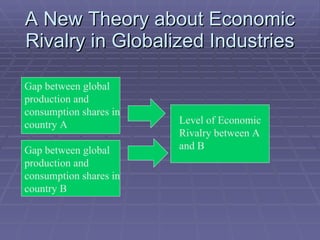
A New Theory about Economic Rivalry in Globalized Industries Gap between global production and consumption shares in country A Gap between global production and consumption shares in country B Level of Economic Rivalry between A and B

Casic 2011

  • 1.
    Geopolitical Factors inInternational Competitiveness Jeffrey A. Hart Indiana University April 1, 2011
  • 2.
    Contact information Departmentof Political Science Woodburn Hall 210 Bloomington, IN 47405 Email: [email_address] Web: http://mypage.iu.edu/~hartj
  • 3.
    My books onthis topic: Rival Capitalists (1992) Globalization and Governance (1999) Managing New Industry Creation (2002) Technology, Television, and Competition (2004) Competing for Knowledge (in preparation)
  • 4.
    What are GeopoliticalFactors? Governmental policies adopted primarily as a response to inter-country and inter-regional rivalries They take three primary forms: Industrial policies Macroeconomic policies motivated by rivalries National security policies that have economic consequences
  • 5.
    The Example ofDigital TV Competition among three regions (North America, Western Europe, and Japan) resulted in the adoption of 3 incompatible DTV standards: ATSC (N. America) DVB (W. Europe) ISDB (Japan)
  • 6.
  • 7.
    The Example ofFlat Panel Displays Japanese dominance of the industry challenged in the 1990s by Korea and Taiwan More recent entry of China into the market
  • 8.
    Tianma LCD Factoryin Shanghai (formerly SVA-NEC)
  • 9.
    Theoretical approaches: Neoclassical(industrial policy is bad and counterproductive) Regulatory State (regulation necessary for markets to work properly, but industrial policy is still bad) Developmental State (industrial policy is useful for catching up) Competition State (industrial policy has to take globalization into account)
  • 10.
    The Developmental Statevs. the Regulatory State Developmental Regulatory Type of Bureaucracy Elite, Insulated Transparent, Accountable Support for New Industries Extensive Limited Use of State-Controlled Banks Extensive Limited Stance w/regard to Private Firms Tutellary Regulatory
  • 11.
    Industrial Policies Includesa wide variety of policy instruments that are intended to advance the international competitiveness of “national champion” firms, such as: Investment subsidies Public R&D expenditures Science parks and free trade zones Export incentives
  • 12.
    The Impact ofGlobalization on National Economic Strategies Greater volatility in global financial markets requires changes in financial market regulations in all countries To remain internationally competitive, firms have adopted global production strategies Even regulatory states have to compete for inflows of foreign direct investment Developmental states cannot succeed with pure national champion strategies
  • 13.
    Example of GMin China 2010 sales of 2.3 million vehicles in China World-class production facilities (joint venture with SAIC) Modified Buick as a chauffeur-driven luxury car Not competing with low-end national champions like Geely
  • 14.
    Example of LGLCD Production Joint venture with Philips Only major competitors globally are Samsung and Sharp Production facilities use best materials and tools from global suppliers (e.g. Corning and Canon) Have to worry about China
  • 15.
    A New Theoryabout Economic Rivalry in Globalized Industries Gap between global production and consumption shares in country A Gap between global production and consumption shares in country B Level of Economic Rivalry between A and B