TECHNOLOGICAL INNOVATION IN
THE AGE OF THE INTERNET
Jeffrey A. Hart
Lecture prepared for delivery at theTransatlantic Policy
Consortium, Indiana University, Bloomington, June 24, 2014.
About me
 Professor Emeritus of Political Science
 Taught at IU from 1981 to 2013
 Specialist in International Relations and
International Political Economy
 Web site: http://mypage.iu.edu/~hartj
 You can access this lecture at:
http://www.slideshare.net/hartjeff12/
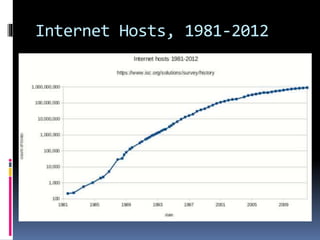
Internet Hosts, 1981-2012
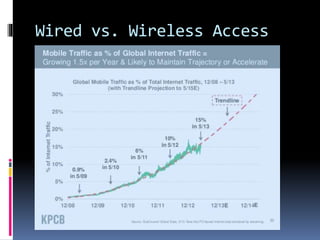
Wired vs. Wireless Access
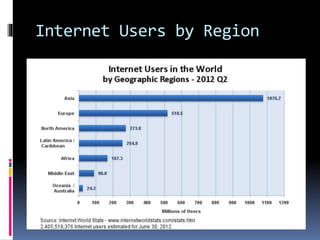
Internet Users by Region
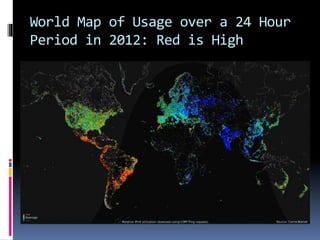
World Map of Usage over a 24 Hour
Period in 2012: Red is High
What has changed?
 Faster and cheaper communications that are
increasingly global in scope
 Much lower barriers to forming groups,
especially groups that connect geographically
dispersed people and institutions
 New forms of collaboration, e.g. crowd-sourcing
and crowd-funding; new forms of surveillance
 The migration of many human activities that
used to occur only in the physical world to
“Cyberspace”
Blurring of Regulatory
Boundaries
 Boundaries between previously separate
regulatory spaces are blurring
 Examples:
 Telephone networks vs. data networks
 Print media vs. online media
 Face to face vs. distance education
 New infrastructures must be built to
accommodate increasing demand for high-
speed (broadband) services
Big Players vs. Little
Players
 Big Players: Google, Baidu, eBay, Ali Baba,
Facebook,Twitter,Weibo, Apple,Amazon
 Big Internet Service Providers (ISPs): AT&T,
Verizon, Comcast, BT, FranceTelecom, etc.
 Little firms (often innovative and often
absorbed by the big players): e.g.Whatsapp,
Snapchat, Instagram,YouTube, Oculus, etc.
 Even smaller firms that can remain
independent if sufficiently nimble
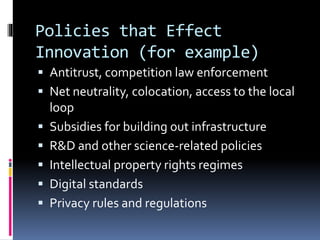
Policies that Effect
Innovation (for example)
 Antitrust, competition law enforcement
 Net neutrality, colocation, access to the local
loop
 Subsidies for building out infrastructure
 R&D and other science-related policies
 Intellectual property rights regimes
 Digital standards
 Privacy rules and regulations
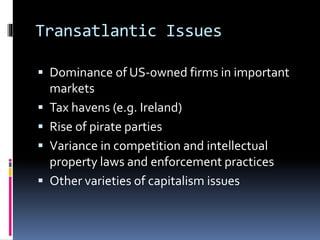
Transatlantic Issues
 Dominance of US-owned firms in important
markets
 Tax havens (e.g. Ireland)
 Rise of pirate parties
 Variance in competition and intellectual
property laws and enforcement practices
 Other varieties of capitalism issues

Techinnovation

  • 1.
    TECHNOLOGICAL INNOVATION IN THEAGE OF THE INTERNET Jeffrey A. Hart Lecture prepared for delivery at theTransatlantic Policy Consortium, Indiana University, Bloomington, June 24, 2014.
  • 2.
    About me  ProfessorEmeritus of Political Science  Taught at IU from 1981 to 2013  Specialist in International Relations and International Political Economy  Web site: http://mypage.iu.edu/~hartj  You can access this lecture at: http://www.slideshare.net/hartjeff12/
  • 3.
  • 4.
  • 5.
  • 6.
    World Map ofUsage over a 24 Hour Period in 2012: Red is High
  • 7.
    What has changed? Faster and cheaper communications that are increasingly global in scope  Much lower barriers to forming groups, especially groups that connect geographically dispersed people and institutions  New forms of collaboration, e.g. crowd-sourcing and crowd-funding; new forms of surveillance  The migration of many human activities that used to occur only in the physical world to “Cyberspace”
  • 8.
    Blurring of Regulatory Boundaries Boundaries between previously separate regulatory spaces are blurring  Examples:  Telephone networks vs. data networks  Print media vs. online media  Face to face vs. distance education  New infrastructures must be built to accommodate increasing demand for high- speed (broadband) services
  • 9.
    Big Players vs.Little Players  Big Players: Google, Baidu, eBay, Ali Baba, Facebook,Twitter,Weibo, Apple,Amazon  Big Internet Service Providers (ISPs): AT&T, Verizon, Comcast, BT, FranceTelecom, etc.  Little firms (often innovative and often absorbed by the big players): e.g.Whatsapp, Snapchat, Instagram,YouTube, Oculus, etc.  Even smaller firms that can remain independent if sufficiently nimble
  • 10.
    Policies that Effect Innovation(for example)  Antitrust, competition law enforcement  Net neutrality, colocation, access to the local loop  Subsidies for building out infrastructure  R&D and other science-related policies  Intellectual property rights regimes  Digital standards  Privacy rules and regulations
  • 11.
    Transatlantic Issues  Dominanceof US-owned firms in important markets  Tax havens (e.g. Ireland)  Rise of pirate parties  Variance in competition and intellectual property laws and enforcement practices  Other varieties of capitalism issues