2010 1.2 Topic One

ANATOMY
What is Anatomy?
 Anatomy is the study of the body
 Its structure (what its made up of)

 Its function (how it all works)

 Knowledge of human anatomy allows us to

have a better understanding of how our body
works at rest and during exercise and allows
us to apply this knowledge to our sporting
interests.
Body Systems
 There are many different systems in your

body e.g. Digestive system or reproductive
system.
 During this topic we will look at 5 of them
 Skeletal system

 Muscular system
 Nervous system
 Respiratory system
 Cardiovascular system
The Skeletal System
The Skeletal System
 Is the foundation on which the body

structured.
 The skeleton is made up from 206 individual
bones that when put together create our
shape and form the base for which other
tissues, organs and muscles attach to.
Functions of Bones
Function

Definition

Example

Support

Bones provide a framework
that supports the body and
cradles the soft organs

Spine supports the head and
trunk

Protection

Provides protection for the
vital organs in the body

Cranium protects the brain,
ribs support lungs and heart
Movement

Skeletal muscles, which
are attached to bones
by tendons, use the
bones as levers to move
the body and its parts

Bones move because of
joints and muscles
e.g. Elbow joint is
moved by biceps and
triceps

Storage

Bone serves as a
reservoir for minerals

Calcium and potassium

Supply

The bulk of blood cell
formation occurs within
the bone marrow.

Red and white blood cells
are formed in the bones.
Bone Classifications
 Bones come in many shapes and sizes. The

unique shape of each bone allows it to
perform its different function.
 Bones are classified by their shape as follows;
 Long

 Short
 Flat
 Irregular
 Long Bones
 Are longer than the are wide e.g. Humerus, femur.

They provide movement

 Short Bones
 Are small cube shaped bones e.g. Carpals and

Tarsals. Allows small and fine movements

 Flat Bones
 Are thin, flat and sometimes curved bones e.g.

Bones in the cranium. They provide protection.

 Irregular Bones
 Are bones that fit into none of the other

categories are considered irregular e.g. Vertebrae
or pelvis. Allows for fine movement.
The Skeleton
 The word skeleton comes from a Greek word
meaning ‘dried up body’ or ‘mummy’
 The skeleton is made up of 206 bones and can be

divided into two skeletons:
 The Axial Skeleton
 This is the bones that form the central column of the

body e.g cranium, vertebral column and rib cage

 The Appendicular Skeleton
 This is the bones of the upper and lower limbs and the

shoulder and hip girdles the attach limbs to the axial
skeleton
The Anatomical Position
 It is important that when discussing parts of

the body; movement that happens;
positioning of internal organs, bones and
muscles that you apply the standardized
anatomical position.
 This means that there is a standard way of
describing where one body part is in relation
another regardless of what position the body
is in.
4 Key Features of the
Anatomical Position
 Palms are facing forward
 Thumbs point away from the body
 Standing up straight
 Feet together
Terms of Reference
 When standing in the anatomical position

you can refer to body parts, bones or organs
in relation to each other by using the
different terms of reference.
 Usually we would say that ‘the ears are
located of each side of the head to the right
and left of the nose’. Using anatomical terms
of reference it would translate to ‘the ears are
lateral to the nose’
 Complete Terms of Reference worksheet
Joints
Joints and Movement
 Where two bones meet they form a Joint
 Movement can only happen where there is a
joint. The amount of movement that happens at
a joint is determined by what type of joint it is.
 There are 3 types of joints;
 Fibrous – immoveable, provide protection e.g. Skull

and Pelvis
 Cartilaginous – slightly moveable, shock absorption
e.g. Vertebrae, ribs
 Synovial – freely moveable, provides support and
stability e.g. Shoulder, knee
 Two key types of synovial joints are the

HINGE joint and the BALL AND SOCKET
joint.
 Hinge joints allow for movement in one

direction
 Ball and Socket joints allow for movement in
many directions
Movements of Synovial Joints
 Synovial joints are the freely moveable joints

we are only focusing on two of them – hinge
and ball and socket.
 The movements that occur at these joints
depends on the type of joint it is.
Movement

Definition

Example

Flexion

Is a bending action that
decreases the angle of the
joint and brings the bones
involved closer together.

Arm - Bending at the elbow
Hip – raising the thigh
towards the trunk
Knee – bending at the knee
Shoulder – moving the arm
forward

Extension

Is a straightening action
that increases the angle of
the joint.

Arm – straightening the
elbow
Hip – moving the leg
backward (or lowering the
thigh)
Knee – straightening the
knee
Shoulder – moving the arm
backward
Abduction

Moving a limb or part of a
limb away from the
midline of the body

Moving arms and legs out
wards when you do a star
jump

Adduction

Moving a limb or part of a
limb towards the midline of
the body

Bring arms and legs back
together when doing a star
jump

Supination

Movement of the hand into
a palm up position

Remember supination as in
a soup bowl.

Pronation

Movement of the hand into
a palm down position

The opposite of supination

Dorsiflexion

Pulling the toes up towards
the tibia

Toes come up like a dorsal
fin on a dolphin

Plantarflexion

Pointing toes downwards

Planting your foot on the
accelerator
Summary of Notes so far
 Skeleton consists of 206 bones
 Skeleton has 5 functions:






Protection
Storage
Supply
Support
Movement

 When describing body parts we always refer to them how they





are when in the Anatomical Position
Movement can only happen where there is a JOINT
The type of joint determines what kind of movement happens
Two key synovial joints are the HINGE and the BALL AND
SOCKET.
Flexion, Extension, Abduction, Adduction, Pronation, Supination,
Plantarflexion and Dorsiflexion are all ways of describing the
movement that is taking place at a joint.
The Muscular System
Functions of the Muscular
System
 Provide movement
 Circulation of Blood
 Posture and support

 Heat production
Muscle Categories
 Voluntary Muscles
 Are muscles we have control over and choose

when to use e.g. Biceps or Quadriceps

 Involuntary Muscles
 Are muscles that we do not have control over and

do not decide when to use them e.g. heart
Types of Muscles
 There are 3 types of muscles in your body
 Smooth Muscle – Involuntary
 Found in arteries, intestines and organs. The

contractions of these muscle fibres are slow and
sustained.

 Cardiac Muscle – Involuntary
 Only occurs in the Heart

 Skeletal Muscle - Voluntary





Attached directly to the bone via tendons
Contraction and Extension
Works in pairs
Muscle fibres
Skeletal Muscles
 Skeletal muscles make up over 1/3 of your body’s
mass – over 650 muscles

 Muscles are attached to the skeleton by tendons
 Muscles work in pairs to produce movement with
one muscle contracting and one muscle relaxing.
 Muscles can only pull – they can’t push.
 The contracting muscle is the agonist or prime
mover, the relaxing muscle is the antagonist.
 Skeletal muscles lie over joints in the body. When
a muscle contracts (shortens) the bones that the
muscle are attached to are pulled in the direction

of the contraction.

 In the picture the biceps muscle is
contracting (agonist). This muscle

lies over the elbow joint. When the
bicep contracts it shortens and pulls
the bones in the lower arm up in the
same direction, causing flexion of the
arm at the elbow
Muscle structure
Muscle actions
Muscle

Main Action(s)

Deltiod

Shoulder abduction, flexion and extension

Pectorals

Shoulder adduction and flexion

Latissimus dorsi

Shoulder adduction and extension

Triceps

Elbow extension

Biceps

Elbow flexion

Abdominals

Trunk flexion and rotation

Gluteals

Hip abduction and extension

Hamstring

Knee flexion and hip extension

Quadriceps

Knee extension and hip flexion
The Nervous System
What does the Nervous System
do?
 The nervous system is the master controlling

and communicating system in your body
 It is responsible for all behaviour, every
thought, action and emotion.
 Cells of the nervous system communicate by
means of electrical signals which are rapid
and specific and create a response.
Functions of the Nervous
System
 Sensory Input – your body has millions of

sensory receptors that monitor change both
in and outside of the body and collect
information.
 Integration – it processes and interprets all of
the information and makes decisions about
what to do about it.
 Motor Output – creates a response in either
muscles or organs in response to changes
Nervous System in Action
 When you are driving in your car and see a

red light (sensory input), your nervous system
integrates this information (red light means
‘stop’) and sends a message to the muscles in
your leg and foot to contract and relax to
move the foot onto the brake (motor output).
Body Types
 There are (basically) three different body

types that we’ve found in human beings.
 Ectomorph
 Mesomorph
 Endomorph
Ectomorph
•Typically have smaller bone structure.
•Small frames.
•They are usually very lean.
•Have difficulty putting on lots of muscle.
•Are usually very strong
•The fashion model body type.
•Famous Ectomorphs include:
•Brad Pitt
•Edward Norton
•Kate Moss
•Cameron Diaz
Endomorph


Smooth, round body



Medium to large bones and joints



Short limbs



High fat content



Gains muscle quickly



Loses weight slowly



Famous Endomorphs:






Jack Black
Danny Devito
Jennifer Lopez
Beyonce
Marilyn Monroe
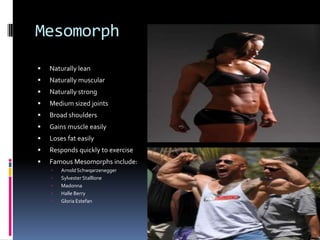
Mesomorph


Naturally lean



Naturally muscular



Naturally strong



Medium sized joints



Broad shoulders



Gains muscle easily



Loses fat easily



Responds quickly to exercise



Famous Mesomorphs include:






Arnold Schwqarzenegger
Sylvester Stalllone
Madonna
Halle Berry
Gloria Estefan
Find your body type
 Go to the following website:

 http://www.bodybuilding.com/fun/becke

r3.htm
 Take the quiz and find out what your body
type is.

 Research what exercises you should do for
your body type.
Finally…
 Gym day tomorrow.
 Bring your PROPER gym clothes. No gym

clothes, no exercise.
 Role Play Videos due on Wednesday. Make
sure they are finished!

再见

Anatomypowerpoint

  • 1.
    2010 1.2 TopicOne ANATOMY
  • 2.
    What is Anatomy? Anatomy is the study of the body  Its structure (what its made up of)  Its function (how it all works)  Knowledge of human anatomy allows us to have a better understanding of how our body works at rest and during exercise and allows us to apply this knowledge to our sporting interests.
  • 3.
    Body Systems  Thereare many different systems in your body e.g. Digestive system or reproductive system.  During this topic we will look at 5 of them  Skeletal system  Muscular system  Nervous system  Respiratory system  Cardiovascular system
  • 4.
  • 5.
    The Skeletal System Is the foundation on which the body structured.  The skeleton is made up from 206 individual bones that when put together create our shape and form the base for which other tissues, organs and muscles attach to.
  • 6.
    Functions of Bones Function Definition Example Support Bonesprovide a framework that supports the body and cradles the soft organs Spine supports the head and trunk Protection Provides protection for the vital organs in the body Cranium protects the brain, ribs support lungs and heart
  • 7.
    Movement Skeletal muscles, which areattached to bones by tendons, use the bones as levers to move the body and its parts Bones move because of joints and muscles e.g. Elbow joint is moved by biceps and triceps Storage Bone serves as a reservoir for minerals Calcium and potassium Supply The bulk of blood cell formation occurs within the bone marrow. Red and white blood cells are formed in the bones.
  • 8.
    Bone Classifications  Bonescome in many shapes and sizes. The unique shape of each bone allows it to perform its different function.  Bones are classified by their shape as follows;  Long  Short  Flat  Irregular
  • 9.
     Long Bones Are longer than the are wide e.g. Humerus, femur. They provide movement  Short Bones  Are small cube shaped bones e.g. Carpals and Tarsals. Allows small and fine movements  Flat Bones  Are thin, flat and sometimes curved bones e.g. Bones in the cranium. They provide protection.  Irregular Bones  Are bones that fit into none of the other categories are considered irregular e.g. Vertebrae or pelvis. Allows for fine movement.
  • 10.
    The Skeleton  Theword skeleton comes from a Greek word meaning ‘dried up body’ or ‘mummy’  The skeleton is made up of 206 bones and can be divided into two skeletons:  The Axial Skeleton  This is the bones that form the central column of the body e.g cranium, vertebral column and rib cage  The Appendicular Skeleton  This is the bones of the upper and lower limbs and the shoulder and hip girdles the attach limbs to the axial skeleton
  • 12.
    The Anatomical Position It is important that when discussing parts of the body; movement that happens; positioning of internal organs, bones and muscles that you apply the standardized anatomical position.  This means that there is a standard way of describing where one body part is in relation another regardless of what position the body is in.
  • 14.
    4 Key Featuresof the Anatomical Position  Palms are facing forward  Thumbs point away from the body  Standing up straight  Feet together
  • 15.
    Terms of Reference When standing in the anatomical position you can refer to body parts, bones or organs in relation to each other by using the different terms of reference.  Usually we would say that ‘the ears are located of each side of the head to the right and left of the nose’. Using anatomical terms of reference it would translate to ‘the ears are lateral to the nose’  Complete Terms of Reference worksheet
  • 16.
  • 17.
    Joints and Movement Where two bones meet they form a Joint  Movement can only happen where there is a joint. The amount of movement that happens at a joint is determined by what type of joint it is.  There are 3 types of joints;  Fibrous – immoveable, provide protection e.g. Skull and Pelvis  Cartilaginous – slightly moveable, shock absorption e.g. Vertebrae, ribs  Synovial – freely moveable, provides support and stability e.g. Shoulder, knee
  • 18.
     Two keytypes of synovial joints are the HINGE joint and the BALL AND SOCKET joint.  Hinge joints allow for movement in one direction  Ball and Socket joints allow for movement in many directions
  • 19.
    Movements of SynovialJoints  Synovial joints are the freely moveable joints we are only focusing on two of them – hinge and ball and socket.  The movements that occur at these joints depends on the type of joint it is.
  • 20.
    Movement Definition Example Flexion Is a bendingaction that decreases the angle of the joint and brings the bones involved closer together. Arm - Bending at the elbow Hip – raising the thigh towards the trunk Knee – bending at the knee Shoulder – moving the arm forward Extension Is a straightening action that increases the angle of the joint. Arm – straightening the elbow Hip – moving the leg backward (or lowering the thigh) Knee – straightening the knee Shoulder – moving the arm backward
  • 21.
    Abduction Moving a limbor part of a limb away from the midline of the body Moving arms and legs out wards when you do a star jump Adduction Moving a limb or part of a limb towards the midline of the body Bring arms and legs back together when doing a star jump Supination Movement of the hand into a palm up position Remember supination as in a soup bowl. Pronation Movement of the hand into a palm down position The opposite of supination Dorsiflexion Pulling the toes up towards the tibia Toes come up like a dorsal fin on a dolphin Plantarflexion Pointing toes downwards Planting your foot on the accelerator
  • 22.
    Summary of Notesso far  Skeleton consists of 206 bones  Skeleton has 5 functions:      Protection Storage Supply Support Movement  When describing body parts we always refer to them how they     are when in the Anatomical Position Movement can only happen where there is a JOINT The type of joint determines what kind of movement happens Two key synovial joints are the HINGE and the BALL AND SOCKET. Flexion, Extension, Abduction, Adduction, Pronation, Supination, Plantarflexion and Dorsiflexion are all ways of describing the movement that is taking place at a joint.
  • 23.
  • 24.
    Functions of theMuscular System  Provide movement  Circulation of Blood  Posture and support  Heat production
  • 25.
    Muscle Categories  VoluntaryMuscles  Are muscles we have control over and choose when to use e.g. Biceps or Quadriceps  Involuntary Muscles  Are muscles that we do not have control over and do not decide when to use them e.g. heart
  • 26.
    Types of Muscles There are 3 types of muscles in your body  Smooth Muscle – Involuntary  Found in arteries, intestines and organs. The contractions of these muscle fibres are slow and sustained.  Cardiac Muscle – Involuntary  Only occurs in the Heart  Skeletal Muscle - Voluntary     Attached directly to the bone via tendons Contraction and Extension Works in pairs Muscle fibres
  • 27.
    Skeletal Muscles  Skeletalmuscles make up over 1/3 of your body’s mass – over 650 muscles  Muscles are attached to the skeleton by tendons  Muscles work in pairs to produce movement with one muscle contracting and one muscle relaxing.  Muscles can only pull – they can’t push.  The contracting muscle is the agonist or prime mover, the relaxing muscle is the antagonist.
  • 28.
     Skeletal muscleslie over joints in the body. When a muscle contracts (shortens) the bones that the muscle are attached to are pulled in the direction of the contraction.  In the picture the biceps muscle is contracting (agonist). This muscle lies over the elbow joint. When the bicep contracts it shortens and pulls the bones in the lower arm up in the same direction, causing flexion of the arm at the elbow
  • 29.
  • 30.
    Muscle actions Muscle Main Action(s) Deltiod Shoulderabduction, flexion and extension Pectorals Shoulder adduction and flexion Latissimus dorsi Shoulder adduction and extension Triceps Elbow extension Biceps Elbow flexion Abdominals Trunk flexion and rotation Gluteals Hip abduction and extension Hamstring Knee flexion and hip extension Quadriceps Knee extension and hip flexion
  • 31.
  • 32.
    What does theNervous System do?  The nervous system is the master controlling and communicating system in your body  It is responsible for all behaviour, every thought, action and emotion.  Cells of the nervous system communicate by means of electrical signals which are rapid and specific and create a response.
  • 33.
    Functions of theNervous System  Sensory Input – your body has millions of sensory receptors that monitor change both in and outside of the body and collect information.  Integration – it processes and interprets all of the information and makes decisions about what to do about it.  Motor Output – creates a response in either muscles or organs in response to changes
  • 34.
    Nervous System inAction  When you are driving in your car and see a red light (sensory input), your nervous system integrates this information (red light means ‘stop’) and sends a message to the muscles in your leg and foot to contract and relax to move the foot onto the brake (motor output).
  • 35.
    Body Types  Thereare (basically) three different body types that we’ve found in human beings.  Ectomorph  Mesomorph  Endomorph
  • 36.
    Ectomorph •Typically have smallerbone structure. •Small frames. •They are usually very lean. •Have difficulty putting on lots of muscle. •Are usually very strong •The fashion model body type. •Famous Ectomorphs include: •Brad Pitt •Edward Norton •Kate Moss •Cameron Diaz
  • 37.
    Endomorph  Smooth, round body  Mediumto large bones and joints  Short limbs  High fat content  Gains muscle quickly  Loses weight slowly  Famous Endomorphs:      Jack Black Danny Devito Jennifer Lopez Beyonce Marilyn Monroe
  • 38.
    Mesomorph  Naturally lean  Naturally muscular  Naturallystrong  Medium sized joints  Broad shoulders  Gains muscle easily  Loses fat easily  Responds quickly to exercise  Famous Mesomorphs include:      Arnold Schwqarzenegger Sylvester Stalllone Madonna Halle Berry Gloria Estefan
  • 39.
    Find your bodytype  Go to the following website:  http://www.bodybuilding.com/fun/becke r3.htm  Take the quiz and find out what your body type is.  Research what exercises you should do for your body type.
  • 40.
    Finally…  Gym daytomorrow.  Bring your PROPER gym clothes. No gym clothes, no exercise.  Role Play Videos due on Wednesday. Make sure they are finished! 再见