J.A.R.
J.C.G.
T.R.G.B.
GPU: UNDERSTANDING CUDA
TALK STRUCTURE
• What is CUDA?
• History of GPU
• Hardware Presentation
• How does it work?
• Code Example
• Examples & Videos
• Results & Conclusion
WHAT IS CUDA
• Compute Unified Device Architecture
• Is a parallel computing platform and
programming model created by NVIDIA and
implemented by the graphics processing
units (GPUs) that they produce
• CUDA gives developers access to the
virtual instruction set and memory of the
parallel computational elements in CUDA GPUs
HISTORY
• 1981 – Monochrome Display Adapter
• 1988 – VGA Standard (VGA Controller) – VESA Founded
• 1989 – SVGA
• 1993 – PCI – NVidia Founded
• 1996 – AGP – Voodoo Graphics – Pentium
• 1999 – NVidia GeForce 256 – P3
• 2004 – PCI Express – GeForce6600 – P4
• 2006 – GeForce 8800
• 2008 – GeForce GTX280 / Core2
HISTORICAL PC
CPU
North Bridge Memory
South Bridge
VGA
Controller
Screen
Memory
Buffer
LAN UART
System Bus
PCI Bus
INTEL PC STRUCTURE
NEW INTEL PC STRUCTURE
VOODOO GRAPHICS SYSTEM ARCHITECTURE
Geom
Gather
Geom
Proc
Triangle
Proc
Pixel
Proc
Z / Blend
CPU
Core
Logic
FBI
FB
Memory
System
Memory
TMU
TEX
Memory
GPUCPU
GEFORCE GTX280 SYSTEM ARCHITECTURE
Geom
Gather
Geom
Proc
Triangle
Proc
Pixel
Proc
Z /
Blend
CPU
Core
Logic
GPU
GPU
Memory
System
Memory
GPUCPU
Physics
and AI
Scene
Mgmt
CUDA ARCHITECTURE ROADMAP
SOUL OF NVIDIA’S GPU ROADMAP
• Increase Performance / Watt
• Make Parallel Programming Easier
• Run more of the Application on the GPU
MYTHS ABOUT CUDA
• You have to port your entire application to the
GPU
• It is really hard to accelerate your application
• There is a PCI-e Bottleneck
CUDA MODELS
• Device Model
• Execution Model
DEVICE MODEL
Scalar
Processor
Many Scalar Processors + Register File + Shared Memory
DEVICE MODEL
Multiprocessor Device
DEVICE MODEL
Load/store
Global Memory
Thread Execution Manager
Input Assembler
Host
Texture Texture Texture Texture Texture Texture Texture TextureTexture
Parallel Data
Cache
Parallel Data
Cache
Parallel Data
Cache
Parallel Data
Cache
Parallel Data
Cache
Parallel Data
Cache
Parallel Data
Cache
Parallel Data
Cache
Load/store Load/store Load/store Load/store Load/store
HARDWARE PRESENTATION
Geforce GTS450
HARDWARE PRESENTATION
Geforce GTS450
HARDWARE PRESENTATION
Geforce GTS450 Especificaciones
HARDWARE PRESENTATION
Geforce GTX470
HARDWARE PRESENTATION
Geforce GTX470 Especificaciones
HARDWARE PRESENTATION
Geforce 8600 GT/GTS Especificaciones
EXECUTION MODEL
Vocabulary:
• Host: CPU.
• Device: GPU.
• Kernel: A piece of code executed on GPU. ( function, program.. )
• SIMT: Single Instruction Multiple Threads
• Warps: A set of 32 threads. Minimum size of the data processed in
SIMT.
EXECUTION MODEL
All threads execute same code.
Each thread have an
unique identifier (threadID (x,y,z))
A CUDA kernel is executed by
an array of threads
SIMT
EXECUTION MODEL - SOFTWARE
Grid: A set of Blocks
Thread: Smallest logict unit
Block: A set of Threads.
(Max 512)
• Private Shared Memory
• Barrier (Threads synchronization)
• Barrier ( Grid synchronization)
• Without synchronization between blocks
EXECUTION MODEL
Specified by the programmer at Runtime
- Number of blocks (gridDim)
- Block size (BlockDim)
CUDA kernel invocation
f <<<G, B>>>(a, b, c)
EXECUTION MODEL - MEMORY ARCHITECTURE
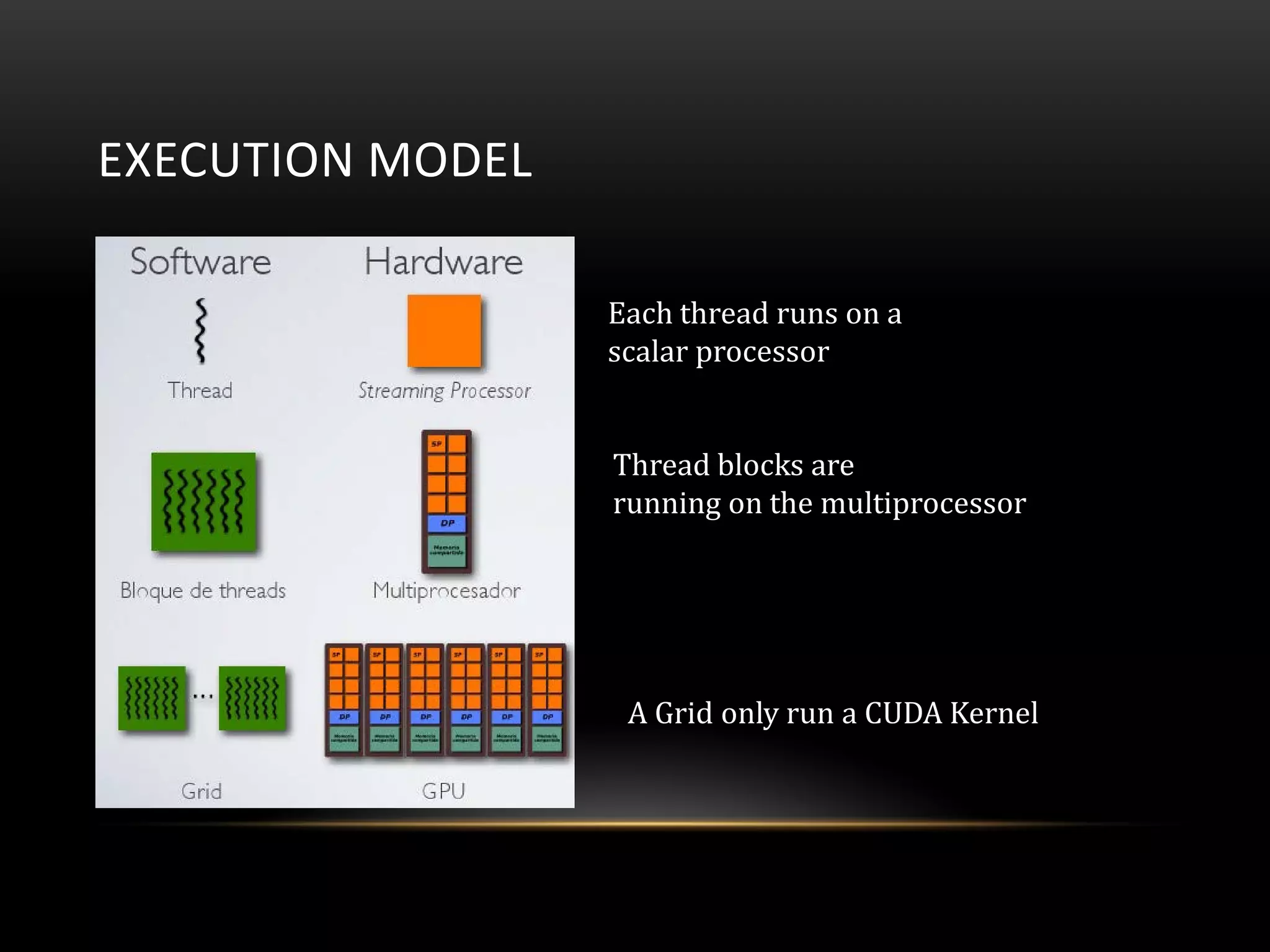
EXECUTION MODEL
Each thread runs on a
scalar processor
Thread blocks are
running on the multiprocessor
A Grid only run a CUDA Kernel
SCHEDULE
tiempo
warp 8 instrucción 11
warp 1 instrucción 42
warp 3 instrucción 95
warp 8 instrucción 12
.
.
.
warp 3 instrucción 96
Bloque 1 Bloque 2 Bloque n
warp 1
2
m
warp 2
2
m
warp 2
2
m
• Threads are grouped into blocks
• IDs are assigned to blocks and
threads
• Blocks threads are distributed
among the multiprocessors
• Threads of a block are grouped into
warps
• A warp is the smallest unit of
planning and consists of 32 threads
• Various warps on each
multiprocessor, but only one is
running
CODE EXAMPLE
The following program calculates and prints the square of first 100 integers.
// 1) Include header files
#include <stdio.h>
#include <conio.h>
#include <cuda.h>
// 2) Kernel that executes on the CUDA device
__global__ void square_array(float*a,int N) {
int idx=blockIdx.x*blockDim.x+threadIdx.x;
if (idx <N )
a[idx]=a[idx]*a[idx];
}
// 3) main( ) routine, the CPU must find
int main(void) {
CODE EXAMPLE
// 3.1:- Define pointer to host and device arrays
float*a_h,*a_d;
// 3.2:- Define other variables used in the program e.g. arrays etc.
const int N=100;
size_t size=N*sizeof(float);
// 3.3:- Allocate array on the host
a_h=(float*)malloc(size);
// 3.4:- Allocate array on device (DRAM of the GPU)
cudaMalloc((void**)&a_d,size);
for (int i=0;i<N;i ++)
a_h[i]=(float)i;
CODE EXAMPLE
// 3.5:- Copy the data from host array to device array.
cudaMemcpy(a_d,a_h,size,cudaMemcpyHostToDevice);
// 3.6:- Kernel Call, Execution Configuration
int block_size=4;
int n_blocks=N / block_size + ( N % block_size ==0);
square_array<<<n_blocks,block_size>>>(a_d,N);
// 3.7:- Retrieve result from device to host in the host memory
cudaMemcpy(a_h,a_d,sizeof(float)*N,cudaMemcpyDeviceToHost);
CODE EXAMPLE
// 3.8:- Print result
for(int i=0;i<N;i++)
printf("%dt%fn",i,a_h[i]);
// 3.9:- Free allocated memories on the device and host
free(a_h);
cudaFree(a_d);
getch(); } )
CUDA LIBRARIES
TESTING
TESTING
TESTING
EXAMPLES
• Video Example with a NVidia Tesla
• Development Environment
RADIX SORT RESULTS.
0
0,2
0,4
0,6
0,8
1
1,2
1,4
1,6
1.000.000 10.000.000 51.000.000 100.000.000
GTS 450
GTX 470
GeForce 8600
GTX 560M
CONCLUSION
• Easy to use and powerful so it is worth!
• GPU computing is the future. The Results
confirm our theory and the industry is giving
more and more importance.
• In the next years we will see more applications
that are using parallel computing
DOCUMENTATION & LINKS
• http://www.nvidia.es/object/cuda_home_new_es.html
• http://www.nvidia.com/docs/IO/113297/ISC-Briefing-Sumit-June11-Final.pdf
• http://cs.nyu.edu/courses/spring12/CSCI-GA.3033-012/lecture5.pdf
• http://www.hpca.ual.es/~jmartine/CUDA/SESION3_CUDA_GPU_EMG_JAM.pdf
• http://www.geforce.com/hardware/technology/cuda/supported-gpus
• http://en.wikipedia.org/wiki/GeForce_256
• http://en.wikipedia.org/wiki/CUDA
• https://developer.nvidia.com/technologies/Libraries
• https://www.udacity.com/wiki/cs344/troubleshoot_gcc47
• http://stackoverflow.com/questions/12986701/installing-cuda-5-samples-in-
ubuntu-12-10
QUESTIONS?

GPU: Understanding CUDA

  • 1.
  • 2.
    TALK STRUCTURE • Whatis CUDA? • History of GPU • Hardware Presentation • How does it work? • Code Example • Examples & Videos • Results & Conclusion
  • 3.
    WHAT IS CUDA •Compute Unified Device Architecture • Is a parallel computing platform and programming model created by NVIDIA and implemented by the graphics processing units (GPUs) that they produce • CUDA gives developers access to the virtual instruction set and memory of the parallel computational elements in CUDA GPUs
  • 4.
    HISTORY • 1981 –Monochrome Display Adapter • 1988 – VGA Standard (VGA Controller) – VESA Founded • 1989 – SVGA • 1993 – PCI – NVidia Founded • 1996 – AGP – Voodoo Graphics – Pentium • 1999 – NVidia GeForce 256 – P3 • 2004 – PCI Express – GeForce6600 – P4 • 2006 – GeForce 8800 • 2008 – GeForce GTX280 / Core2
  • 5.
    HISTORICAL PC CPU North BridgeMemory South Bridge VGA Controller Screen Memory Buffer LAN UART System Bus PCI Bus
  • 6.
  • 7.
    NEW INTEL PCSTRUCTURE
  • 8.
    VOODOO GRAPHICS SYSTEMARCHITECTURE Geom Gather Geom Proc Triangle Proc Pixel Proc Z / Blend CPU Core Logic FBI FB Memory System Memory TMU TEX Memory GPUCPU
  • 9.
    GEFORCE GTX280 SYSTEMARCHITECTURE Geom Gather Geom Proc Triangle Proc Pixel Proc Z / Blend CPU Core Logic GPU GPU Memory System Memory GPUCPU Physics and AI Scene Mgmt
  • 10.
  • 11.
    SOUL OF NVIDIA’SGPU ROADMAP • Increase Performance / Watt • Make Parallel Programming Easier • Run more of the Application on the GPU
  • 12.
    MYTHS ABOUT CUDA •You have to port your entire application to the GPU • It is really hard to accelerate your application • There is a PCI-e Bottleneck
  • 13.
    CUDA MODELS • DeviceModel • Execution Model
  • 14.
    DEVICE MODEL Scalar Processor Many ScalarProcessors + Register File + Shared Memory
  • 15.
  • 16.
    DEVICE MODEL Load/store Global Memory ThreadExecution Manager Input Assembler Host Texture Texture Texture Texture Texture Texture Texture TextureTexture Parallel Data Cache Parallel Data Cache Parallel Data Cache Parallel Data Cache Parallel Data Cache Parallel Data Cache Parallel Data Cache Parallel Data Cache Load/store Load/store Load/store Load/store Load/store
  • 17.
  • 18.
  • 19.
  • 20.
  • 21.
  • 22.
  • 23.
    HARDWARE PRESENTATION Geforce 8600GT/GTS Especificaciones
  • 24.
    EXECUTION MODEL Vocabulary: • Host:CPU. • Device: GPU. • Kernel: A piece of code executed on GPU. ( function, program.. ) • SIMT: Single Instruction Multiple Threads • Warps: A set of 32 threads. Minimum size of the data processed in SIMT.
  • 25.
    EXECUTION MODEL All threadsexecute same code. Each thread have an unique identifier (threadID (x,y,z)) A CUDA kernel is executed by an array of threads SIMT
  • 26.
    EXECUTION MODEL -SOFTWARE Grid: A set of Blocks Thread: Smallest logict unit Block: A set of Threads. (Max 512) • Private Shared Memory • Barrier (Threads synchronization) • Barrier ( Grid synchronization) • Without synchronization between blocks
  • 27.
    EXECUTION MODEL Specified bythe programmer at Runtime - Number of blocks (gridDim) - Block size (BlockDim) CUDA kernel invocation f <<<G, B>>>(a, b, c)
  • 28.
    EXECUTION MODEL -MEMORY ARCHITECTURE
  • 29.
    EXECUTION MODEL Each threadruns on a scalar processor Thread blocks are running on the multiprocessor A Grid only run a CUDA Kernel
  • 30.
    SCHEDULE tiempo warp 8 instrucción11 warp 1 instrucción 42 warp 3 instrucción 95 warp 8 instrucción 12 . . . warp 3 instrucción 96 Bloque 1 Bloque 2 Bloque n warp 1 2 m warp 2 2 m warp 2 2 m • Threads are grouped into blocks • IDs are assigned to blocks and threads • Blocks threads are distributed among the multiprocessors • Threads of a block are grouped into warps • A warp is the smallest unit of planning and consists of 32 threads • Various warps on each multiprocessor, but only one is running
  • 31.
    CODE EXAMPLE The followingprogram calculates and prints the square of first 100 integers. // 1) Include header files #include <stdio.h> #include <conio.h> #include <cuda.h> // 2) Kernel that executes on the CUDA device __global__ void square_array(float*a,int N) { int idx=blockIdx.x*blockDim.x+threadIdx.x; if (idx <N ) a[idx]=a[idx]*a[idx]; } // 3) main( ) routine, the CPU must find int main(void) {
  • 32.
    CODE EXAMPLE // 3.1:-Define pointer to host and device arrays float*a_h,*a_d; // 3.2:- Define other variables used in the program e.g. arrays etc. const int N=100; size_t size=N*sizeof(float); // 3.3:- Allocate array on the host a_h=(float*)malloc(size); // 3.4:- Allocate array on device (DRAM of the GPU) cudaMalloc((void**)&a_d,size); for (int i=0;i<N;i ++) a_h[i]=(float)i;
  • 33.
    CODE EXAMPLE // 3.5:-Copy the data from host array to device array. cudaMemcpy(a_d,a_h,size,cudaMemcpyHostToDevice); // 3.6:- Kernel Call, Execution Configuration int block_size=4; int n_blocks=N / block_size + ( N % block_size ==0); square_array<<<n_blocks,block_size>>>(a_d,N); // 3.7:- Retrieve result from device to host in the host memory cudaMemcpy(a_h,a_d,sizeof(float)*N,cudaMemcpyDeviceToHost);
  • 34.
    CODE EXAMPLE // 3.8:-Print result for(int i=0;i<N;i++) printf("%dt%fn",i,a_h[i]); // 3.9:- Free allocated memories on the device and host free(a_h); cudaFree(a_d); getch(); } )
  • 35.
  • 36.
  • 37.
  • 38.
  • 39.
    EXAMPLES • Video Examplewith a NVidia Tesla • Development Environment
  • 40.
    RADIX SORT RESULTS. 0 0,2 0,4 0,6 0,8 1 1,2 1,4 1,6 1.000.00010.000.000 51.000.000 100.000.000 GTS 450 GTX 470 GeForce 8600 GTX 560M
  • 41.
    CONCLUSION • Easy touse and powerful so it is worth! • GPU computing is the future. The Results confirm our theory and the industry is giving more and more importance. • In the next years we will see more applications that are using parallel computing
  • 42.
    DOCUMENTATION & LINKS •http://www.nvidia.es/object/cuda_home_new_es.html • http://www.nvidia.com/docs/IO/113297/ISC-Briefing-Sumit-June11-Final.pdf • http://cs.nyu.edu/courses/spring12/CSCI-GA.3033-012/lecture5.pdf • http://www.hpca.ual.es/~jmartine/CUDA/SESION3_CUDA_GPU_EMG_JAM.pdf • http://www.geforce.com/hardware/technology/cuda/supported-gpus • http://en.wikipedia.org/wiki/GeForce_256 • http://en.wikipedia.org/wiki/CUDA • https://developer.nvidia.com/technologies/Libraries • https://www.udacity.com/wiki/cs344/troubleshoot_gcc47 • http://stackoverflow.com/questions/12986701/installing-cuda-5-samples-in- ubuntu-12-10
  • 43.