Course Outline
ƒ GPU Architecture Overview (this module)
ƒ Tools of the Trade
ƒ Introduction to CUDA C
ƒ Patterns of Parallel Computing
ƒ Thread Cooperation and Synchronization
ƒ The Many Types of Memory
ƒ Atomic Operations
ƒ Events and Streams
ƒ CUDA in Advanced Scenarios
Note: to follow this course, you require a CUDA-capable GPU.urse, you require a CUDA cap
C
U
D
A
Teaching
C
enter,D
epartm
entofC
om
puterApplications,N
IT,Trichy
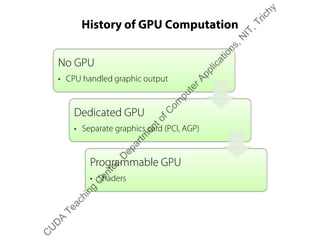
History of GPU Computation
No GPU
CPU handled graphic output
Dedicated GPU
Separate graphics card (PCI, AGP)
Programmable GPU
Shaders
C
U
D
A
Teaching
C
enter,D
epartm
entofC
om
puterApplications,N
IT,Trichy
Shaders
ƒ Small program that runs on the GPU
ƒ Types
† Vertex (used to calculate location of a vertex)
† Pixel (used to calculate the color components of a single pixel)
ƒ Shader languages
† High Level Shader Language (HLSL, Microsoft DirectX)
† OpenGL Shading Language (GLSL, OpenGL)
† Both are C-like
† Both are intended for graphics (i.e., not general-purpose)
ƒ Pixel shaders used for math
† Convert data to texture
† Run texture through pixel shader
† Get result texture and convert to data
C
U
D
A
Teaching
C
enter,D
epartm
entofC
om
puterApplications,N
IT,Trichy
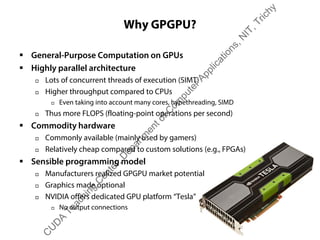
Why GPGPU?
ƒ General-Purpose Computation on GPUs
ƒ Highly parallel architecture
† Lots of concurrent threads of execution (SIMT)
† Higher throughput compared to CPUs
† Even taking into account many cores, hypethreading, SIMD
† Thus more FLOPS (floating-point operations per second)
ƒ Commodity hardware
† Commonly available (mainly used by gamers)
† Relatively cheap compared to custom solutions (e.g., FPGAs)
ƒ Sensible programming model
† Manufacturers realized GPGPU market potential
† Graphics made optional
† NVIDIA offers dedicated GPU platform “Tesla”
† No output connections
C
U
D
A
Teaching
C
enter,D
epartm
entofC
om
puterApplications,N
IT,Trichy
GPGPU Frameworks
ƒ Compute Unified Driver Architecture (CUDA)
† Developed by NVIDIA Corporation
† Extensions to programming languages (C/C++)
† Wrappers for other languages/platforms
(e.g., FORTRAN, PyCUDA, MATLAB)
ƒ Open Computing Language (OpenCL)
† Supported by many manufacturers (inc. NVIDIA)
† The high-level way to perform computation on ATI devices
ƒ C++ Accelerated Massive Programming (AMP)
† C++ superset
† A standard by Microsoft, part of MSVC++
† Supports both ATI and NVIDIA
ƒ Other frameworks and cross-compilers
† Alea, Aparapi, Brook, etc.
C
U
D
A
Teaching
C
enter,D
epartm
entofC
om
puterApplications,N
IT,Trichy
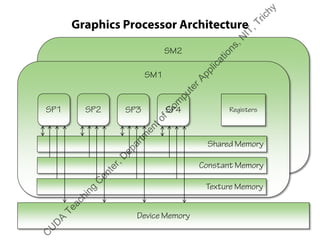
Graphics Processor Architecture
ƒ Warning: NVIDIA terminology ahead
ƒ Streaming Multiprocessor (SM)
† Contains several CUDA cores
† Can have >1 SM on card
ƒ CUDA Core (a.k.a. Streaming Processor, Shader Unit)
† # of cores per SM tied to compute capability
ƒ Different types of memory
† Means of access
† Performance characteristics
C
U
D
A
Teaching
C
enter,D
epartm
entofC
om
puterApplications,N
IT,Trichy
Graphics Processor Architecture
SM2
SM1
SP1 SP2 SP3
Device Memory
Registers
Shared Memory
SP4
Constant Memory
Texture Memory
C
U
D
A
Teaching
C
enter,D
epartm
entofC
om
puterApplications,N
IT,Trichy
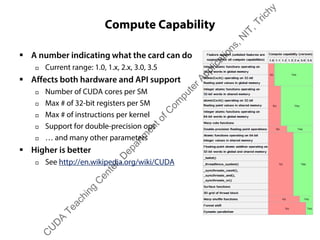
Compute Capability
ƒ A number indicating what the card can do
† Current range: 1.0, 1.x, 2.x, 3.0, 3.5
ƒ Affects both hardware and API support
† Number of CUDA cores per SM
† Max # of 32-bit registers per SM
† Max # of instructions per kernel
† Support for double-precision ops
† … and many other parameters
ƒ Higher is better
† See http://en.wikipedia.org/wiki/CUDA
C
U
D
A
Teaching
C
enter,D
epartm
entofC
om
puterApplications,N
IT,Trichy
Choosing a Graphics Card
ƒ Look at performance specs (peak flops)
† Pay attention to single vs. double
† E.g. http://www.nvidia.com/object/tesla-servers.html
ƒ Number of GPUs
ƒ Compute capability/architecture
† COTS cheaper than dedicated
ƒ Memory size
ƒ Ensure PSU/motherboard is good enough to handle the card(s)
ƒ Can have >1 graphics card
† YMMV (PCI saturation)
ƒ Can mix architectures (e.g. NVIDIA+ATI)
C
U
D
A
Teaching
C
enter,D
epartm
entofC
om
puterApplications,N
IT,Trichy
Overview
ƒ Windows, Mac OS, Linux
† This course uses Windows/Visual Studio
† This course focuses on desktop GPU development
ƒ CUDA Toolkit
† LLVM-based compiler
† Headers & libraries
† Documentation
† Samples
ƒ NSight
† Visual Studio: plugin that allows debugging
† Eclipse IDE
ƒ http://developer.nvidia.com/cuda
C
U
D
A
Teaching
C
enter,D
epartm
entofC
om
puterApplications,N
IT,Trichy
CUDA Tools
C
U
D
A
Teaching
C
enter,D
epartm
entofC
om
puterApplications,N
IT,Trichy
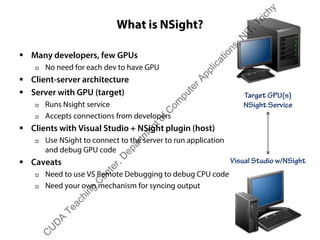
What is NSight?
ƒ Many developers, few GPUs
† No need for each dev to have GPU
ƒ Client-server architecture
ƒ Server with GPU (target)
† Runs Nsight service
† Accepts connections from developers
ƒ Clients with Visual Studio + NSight plugin (host)
† Use NSight to connect to the server to run application
and debug GPU code
ƒ Caveats
† Need to use VS Remote Debugging to debug CPU code
† Need your own mechanism for syncing output
Target GPU(s)
NSight Service
Visual Studio w/NSight
C
U
D
A
Teaching
C
enter,D
epartm
entofC
om
puterApplications,N
IT,Trichy
Overview
ƒ Compilation Process
ƒ Obligatory “Hello Cuda” demo
ƒ Location Qualifiers
ƒ Execution Model
ƒ Grid and Block Dimensions
ƒ Error Handling
ƒ Device Introspection
C
U
D
A
Teaching
C
enter,D
epartm
entofC
om
puterApplications,N
IT,Trichy
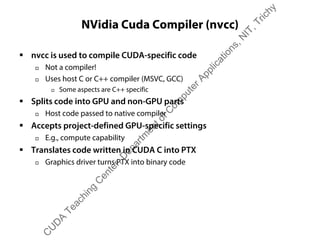
NVidia Cuda Compiler (nvcc)
ƒ nvcc is used to compile CUDA-specific code
† Not a compiler!
† Uses host C or C++ compiler (MSVC, GCC)
† Some aspects are C++ specific
ƒ Splits code into GPU and non-GPU parts
† Host code passed to native compiler
ƒ Accepts project-defined GPU-specific settings
† E.g., compute capability
ƒ Translates code written in CUDA C into PTX
† Graphics driver turns PTX into binary code
C
U
D
A
Teaching
C
enter,D
epartm
entofC
om
puterApplications,N
IT,Trichy
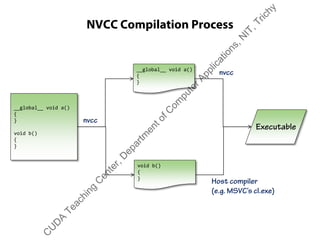
NVCC Compilation Process
__global__ void a()
{
}
void b()
{
}
__global__ void a()
{
}
nvcc
void b()
{
}
Executable
Host compiler
(e.g. MSVC’s cl.exe)
nvcc
C
U
D
A
Teaching
C
enter,D
epartm
entofC
om
puterApplications,N
IT,Trichy
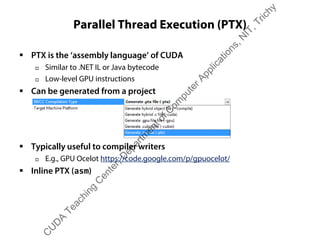
Parallel Thread Execution (PTX)
ƒ PTX is the ‘assembly language’ of CUDA
† Similar to .NET IL or Java bytecode
† Low-level GPU instructions
ƒ Can be generated from a project
ƒ Typically useful to compiler writers
† E.g., GPU Ocelot https://code.google.com/p/gpuocelot/
ƒ Inline PTX (asm)
C
U
D
A
Teaching
C
enter,D
epartm
entofC
om
puterApplications,N
IT,Trichy
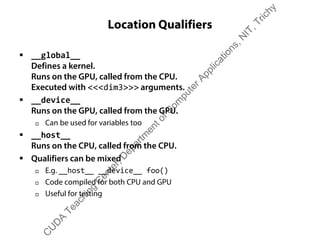
Location Qualifiers
ƒ __global__
Defines a kernel.
Runs on the GPU, called from the CPU.
Executed with <<<dim3>>> arguments.
ƒ __device__
Runs on the GPU, called from the GPU.
† Can be used for variables too
ƒ __host__
Runs on the CPU, called from the CPU.
ƒ Qualifiers can be mixed
† E.g. __host__ __device__ foo()
† Code compiled for both CPU and GPU
† Useful for testing
C
U
D
A
Teaching
C
enter,D
epartm
entofC
om
puterApplications,N
IT,Trichy
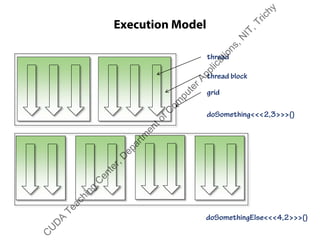
Execution Model
doSomething<<<2,3>>>()
doSomethingElse<<<4,2>>>()
thread
thread block
grid
C
U
D
A
Teaching
C
enter,D
epartm
entofC
om
puterApplications,N
IT,Trichy
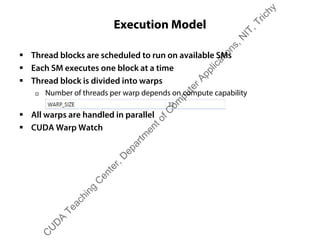
Execution Model
ƒ Thread blocks are scheduled to run on available SMs
ƒ Each SM executes one block at a time
ƒ Thread block is divided into warps
† Number of threads per warp depends on compute capability
ƒ All warps are handled in parallel
ƒ CUDA Warp Watch
C
U
D
A
Teaching
C
enter,D
epartm
entofC
om
puterApplications,N
IT,Trichy
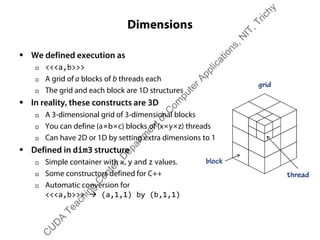
Dimensions
ƒ We defined execution as
† <<<a,b>>>
† A grid of a blocks of b threads each
† The grid and each block are 1D structures
ƒ In reality, these constructs are 3D
† A 3-dimensional grid of 3-dimensional blocks
† You can define (a×b×c) blocks of (x×y×z) threads
† Can have 2D or 1D by setting extra dimensions to 1
ƒ Defined in dim3 structure
† Simple container with x, y and z values.
† Some constructors defined for C++
† Automatic conversion for
<<<a,b>>> Æ (a,1,1) by (b,1,1)
grid
block
thread
C
U
D
A
Teaching
C
enter,D
epartm
entofC
om
puterApplications,N
IT,Trichy
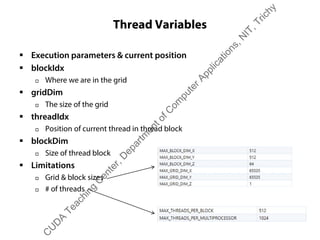
Thread Variables
ƒ Execution parameters & current position
ƒ blockIdx
† Where we are in the grid
ƒ gridDim
† The size of the grid
ƒ threadIdx
† Position of current thread in thread block
ƒ blockDim
† Size of thread block
ƒ Limitations
† Grid & block sizes
† # of threads
C
U
D
A
Teaching
C
enter,D
epartm
entofC
om
puterApplications,N
IT,Trichy
Error Handling
ƒ CUDA does not throw
† Silent failure
ƒ Core functions return cudaError_t
† Can check against cudaSuccess
† Get description with cudaGetErrorString()
ƒ Libraries may have different error types
† E.g. cuRAND has curandStatus_t
C
U
D
A
Teaching
C
enter,D
epartm
entofC
om
puterApplications,N
IT,Trichy
Rules of the Game
ƒ Different types of memory
† Shared vs. private
† Access speeds
ƒ Data is in arrays
† No parallel data structures
† No other data structures
† No auto-parallelization/vectorization compiler support
† No CPU-type SIMD equivalent
ƒ Compiler constraint
† No C++11 support
C
U
D
A
Teaching
C
enter,D
epartm
entofC
om
puterApplications,N
IT,Trichy
Overview
ƒ Data Access
ƒ Map
ƒ Gather
ƒ Reduce
ƒ Scan
C
U
D
A
Teaching
C
enter,D
epartm
entofC
om
puterApplications,N
IT,Trichy
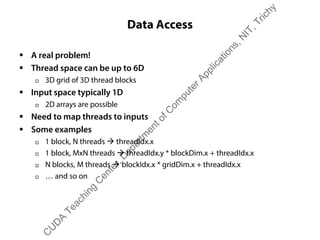
Data Access
ƒ A real problem!
ƒ Thread space can be up to 6D
† 3D grid of 3D thread blocks
ƒ Input space typically 1D
† 2D arrays are possible
ƒ Need to map threads to inputs
ƒ Some examples
† 1 block, N threads Æ threadIdx.x
† 1 block, MxN threads Æ threadIdx.y * blockDim.x + threadIdx.x
† N blocks, M threads Æ blockIdx.x * gridDim.x + threadIdx.x
† … and so on
C
U
D
A
Teaching
C
enter,D
epartm
entofC
om
puterApplications,N
IT,Trichy
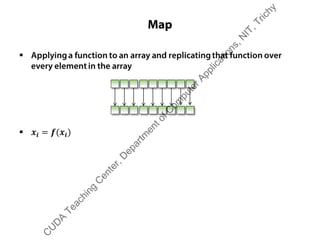
Map
C
U
D
A
Teaching
C
enter,D
epartm
entofC
om
puterApplications,N
IT,Trichy
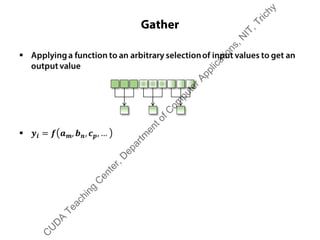
Gather
C
U
D
A
Teaching
C
enter,D
epartm
entofC
om
puterApplications,N
IT,Trichy
Black Scholes Formula
C
U
D
A
Teaching
C
enter,D
epartm
entofC
om
puterApplications,N
IT,Trichy
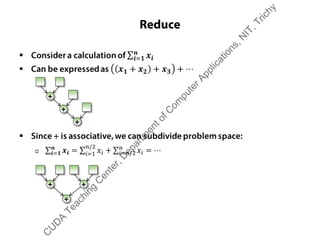
Reduce
+
+
+
+ +
+
C
U
D
A
Teaching
C
enter,D
epartm
entofC
om
puterApplications,N
IT,Trichy
Reduce in Practice
ƒ Adding up N data elements ƒ Adding up N data elements
ƒ Use 1 block of N/2 threads
ƒ Each thread does
x[i] += x[j];
ƒ At each step
† # of threads halved
† Distance (j-i) doubled
ƒ x[0] is the result
1 2 3 4 5 6 7 8
3 7 11 153
0
7
1
11
2
155
3
10 260100
0
62626
1
3663636
0
C
U
D
A
Teaching
C
enter,D
epartm
entofC
om
puterApplications,N
IT,Trichy
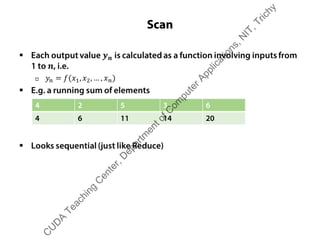
Scan
4 2 5 3 6
4 6 11 14 20
C
U
D
A
Teaching
C
enter,D
epartm
entofC
om
puterApplications,N
IT,Trichy
Scan in Practice
ƒ Similar to reduce
1 2 3 4
1 3 5 73
0
5
1
1 3 6 106
0
1 3 6 10
0
7
2
10
1
ƒ Require N-1 threads
ƒ Step size keeps doubling
ƒ Number of threads reduced
by step size
ƒ Each thread n does
x[n+step] += x[n];
5
3
9
2
000000 14
000 15
C
U
D
A
Teaching
C
enter,D
epartm
entofC
om
puterApplications,N
IT,Trichy
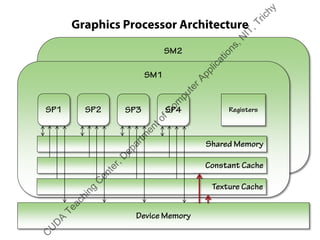
Graphics Processor Architecture
SM2
SM1
SP1 SP2 SP3
Device Memory
Registers
Shared Memory
SP4
Constant Cache
Texture CacheT
C
C
U
D
A
Teaching
C
enter,D
epartm
entofC
om
puterApplications,N
IT,Trichy
Device Memory
ƒ Grid scope (i.e., available to all threads in all blocks in the grid)
ƒ Application lifetime (exists until app exits or explicitly deallocated)
ƒ Dynamic
† cudaMalloc() to allocate
† Pass pointer to kernel
† cudaMemcpy() to copy to/from host memory
† cudaFree() to deallocate
ƒ Static
† Declare global variable as device
__device__ int sum = 0;
† Use freely within the kernel
† Use cudaMemcpy[To/From]Symbol() to copy to/from host memory
† No need to explicitly deallocate
ƒ Slowest and most inefficient
C
U
D
A
Teaching
C
enter,D
epartm
entofC
om
puterApplications,N
IT,Trichy
Constant & Texture Memory
ƒ Read-only: useful for lookup tables, model parameters, etc.
ƒ Grid scope, Application lifetime
ƒ Resides in device memory, but
ƒ Cached in a constant memory cache
ƒ Constrained by MAX_CONSTANT_MEMORY
† Expect 64kb
ƒ Similar operation to statically-defined device memory
† Declare as __constant__
† Use freely within the kernel
† Use cudaMemcpy[To/From]Symbol() to copy to/from host memory
ƒ Very fast provided all threads read from the same location
ƒ Used for kernel arguments
ƒ Texture memory: similar to Constant, optimized for 2D access
patterns
C
U
D
A
Teaching
C
enter,D
epartm
entofC
om
puterApplications,N
IT,Trichy
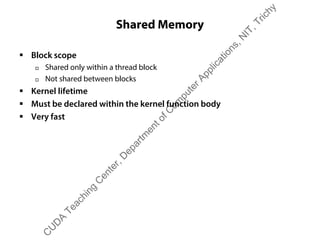
Shared Memory
ƒ Block scope
† Shared only within a thread block
† Not shared between blocks
ƒ Kernel lifetime
ƒ Must be declared within the kernel function body
ƒ Very fast
C
U
D
A
Teaching
C
enter,D
epartm
entofC
om
puterApplications,N
IT,Trichy
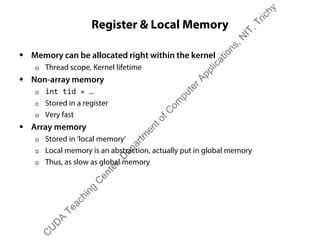
Register & Local Memory
ƒ Memory can be allocated right within the kernel
† Thread scope, Kernel lifetime
ƒ Non-array memory
† int tid = …
† Stored in a register
† Very fast
ƒ Array memory
† Stored in ‘local memory’
† Local memory is an abstraction, actually put in global memory
† Thus, as slow as global memory
C
U
D
A
Teaching
C
enter,D
epartm
entofC
om
puterApplications,N
IT,Trichy
Summary
Declaration Memory Scope Lifetime Slowdown
int foo; Register Thread Kernel 1x
int foo[10]; Local Thread Kernel 100x
__shared__ int foo; Shared Block Kernel 1x
__device__ int foo; Global Grid Application 100x
__constant__ int foo; Constant Grid Application 1x
C
U
D
A
Teaching
C
enter,D
epartm
entofC
om
puterApplications,N
IT,Trichy
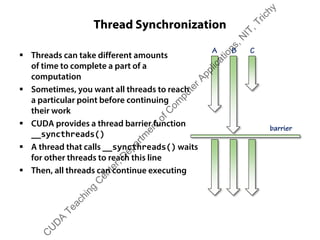
Thread Synchronization
ƒ Threads can take different amounts
of time to complete a part of a
computation
ƒ Sometimes, you want all threads to reach
a particular point before continuing
their work
ƒ CUDA provides a thread barrier function
__syncthreads()
ƒ A thread that calls __syncthreads() waits
for other threads to reach this line
ƒ Then, all threads can continue executing
barrier
A B C
C
U
D
A
Teaching
C
enter,D
epartm
entofC
om
puterApplications,N
IT,Trichy
Restrictions
ƒ __syncthreads() only synchronizes threads within a block
ƒ A thread that calls __syncthreads() waits for other threads to reach
this location
ƒ All threads must reach __syncthreads()
† if (x > 0.5)
{
__syncthreads(); // bad idea
}
ƒ Each call to __syncthreads() is unique
† if (x > 0.5)
{
__syncthreads();
} else {
__syncthreads(); // also a bad idea
}
C
U
D
A
Teaching
C
enter,D
epartm
entofC
om
puterApplications,N
IT,Trichy
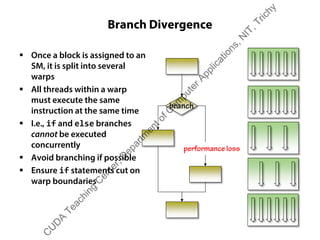
Branch Divergence
ƒ Once a block is assigned to an
SM, it is split into several
warps
ƒ All threads within a warp
must execute the same
instruction at the same time
ƒ I.e., if and else branches
cannot be executed
concurrently
ƒ Avoid branching if possible
ƒ Ensure if statements cut on
warp boundaries
branch
performance loss
C
U
D
A
Teaching
C
enter,D
epartm
entofC
om
puterApplications,N
IT,Trichy
Summary
ƒ Threads are synchronized with __syncthreads()
† Block scope
† All threads must reach the barrier
† Each __syncthreads() creates a unique barrier
ƒ A block is split into warps
† All threads in a warp execute same instruction
† Branching leads to warp divergence (performance loss)
† Avoid branching or ensure branch cases fall in different warps
C
U
D
A
Teaching
C
enter,D
epartm
entofC
om
puterApplications,N
IT,Trichy
Overview
ƒ Why atomics?
ƒ Atomic Functions
ƒ Atomic Sum
ƒ Monte Carlo Pi
C
U
D
A
Teaching
C
enter,D
epartm
entofC
om
puterApplications,N
IT,Trichy
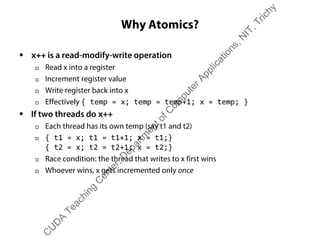
Why Atomics?
ƒ x++ is a read-modify-write operation
† Read x into a register
† Increment register value
† Write register back into x
† Effectively { temp = x; temp = temp+1; x = temp; }
ƒ If two threads do x++
† Each thread has its own temp (say t1 and t2)
† { t1 = x; t1 = t1+1; x = t1;}
{ t2 = x; t2 = t2+1; x = t2;}
† Race condition: the thread that writes to x first wins
† Whoever wins, x gets incremented only once
C
U
D
A
Teaching
C
enter,D
epartm
entofC
om
puterApplications,N
IT,Trichy
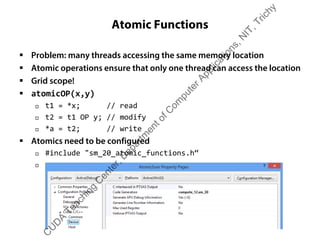
Atomic Functions
ƒ Problem: many threads accessing the same memory location
ƒ Atomic operations ensure that only one thread can access the location
ƒ Grid scope!
ƒ atomicOP(x,y)
† t1 = *x; // read
† t2 = t1 OP y; // modify
† *a = t2; // write
ƒ Atomics need to be configured
† #include "sm_20_atomic_functions.h“
†
C
U
D
A
Teaching
C
enter,D
epartm
entofC
om
puterApplications,N
IT,Trichy
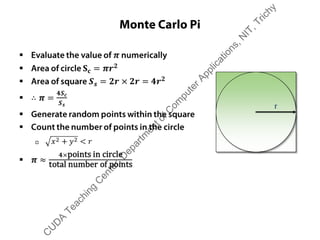
Monte Carlo Pi
r
C
U
D
A
Teaching
C
enter,D
epartm
entofC
om
puterApplications,N
IT,Trichy
Summary
ƒ Atomic operations ensure operations on a variable cannot be
interrupted by a different thread
ƒ CUDA supports several atomic operations
† atomicAdd()
† atomicOr()
† atomicMin()
† … and others
ƒ Atomics incur a heavy performance penalty
C
U
D
A
Teaching
C
enter,D
epartm
entofC
om
puterApplications,N
IT,Trichy
Overview
ƒ Events
ƒ Event API
ƒ Event example
ƒ Pinned memory
ƒ Streams
ƒ Stream API
ƒ Example (single stream)
ƒ Example (multiple streams)
C
U
D
A
Teaching
C
enter,D
epartm
entofC
om
puterApplications,N
IT,Trichy
Events
ƒ How to measure performance?
ƒ Use OS timers
† Too much noise
ƒ Use profiler
† Times only kernel duration + other invocations
ƒ CUDA Events
† Event = timestamp
† Timestamp recorded on the GPU
† Invoked from the CPU side
C
U
D
A
Teaching
C
enter,D
epartm
entofC
om
puterApplications,N
IT,Trichy
Event API
ƒ cudaEvent_t
† The event handle
ƒ cudaEventCreate(&e)
† Creates the event
ƒ cudaEventRecord(e, 0)
† Records the event, i.e. timestamp
† Second param is the stream to which to record
ƒ cudaEventSynchronize(e)
† CPU and GPU are async, can be doing things in parallel
† cudaEventSynchronize() blocks all instruction processing until the GPU
has reached the event
ƒ cudaEventElapsedTime(&f, start, stop)
† Computes elapsed time (msec) between start and stop, stored as float
C
U
D
A
Teaching
C
enter,D
epartm
entofC
om
puterApplications,N
IT,Trichy
Pinned Memory
ƒ CPU memory is pageable
† Can be swapped to disk
ƒ Pinned (page-locked) stays in place
ƒ Performance advantage when copying to/from GPU
ƒ Use cudaHostAlloc() instead of malloc() or new
ƒ Use cudaFreeHost() to deallocate
ƒ Cannot be swapped out
† Must have enough
† Proactively deallocate
C
U
D
A
Teaching
C
enter,D
epartm
entofC
om
puterApplications,N
IT,Trichy
Streams
ƒ Remember cudaEventRecord(event, stream)?
ƒ A CUDA stream is a queue of GPU operations
† Kernel launch
† Memory copy
ƒ Streams allow a form of task-based parallelism
† Performance improvement
ƒ To leverage streams you need device overlap support
† GPU_OVERLAP
C
U
D
A
Teaching
C
enter,D
epartm
entofC
om
puterApplications,N
IT,Trichy
Stream API
ƒ cudaStream_t
ƒ cudaStreamCreate(&stream)
ƒ kernel<<<blocks,threads,shared,stream>>>
ƒ cudaMemcpyAsync()
† Must use pinned memory!
ƒ stream parameter
ƒ cudaStreamSynchronize(stream)
C
U
D
A
Teaching
C
enter,D
epartm
entofC
om
puterApplications,N
IT,Trichy
Summary
ƒ CUDA events let you time your code on the GPU
ƒ Pinned memory speeds up data transfers to/from device
ƒ CUDA streams allow you to queue up operations asynchronously
† Lets you do different things in parallel on the GPU
† Use of pinned memory is required
C
U
D
A
Teaching
C
enter,D
epartm
entofC
om
puterApplications,N
IT,Trichy

Cuda materials

  • 1.
    Course Outline ƒ GPUArchitecture Overview (this module) ƒ Tools of the Trade ƒ Introduction to CUDA C ƒ Patterns of Parallel Computing ƒ Thread Cooperation and Synchronization ƒ The Many Types of Memory ƒ Atomic Operations ƒ Events and Streams ƒ CUDA in Advanced Scenarios Note: to follow this course, you require a CUDA-capable GPU.urse, you require a CUDA cap C U D A Teaching C enter,D epartm entofC om puterApplications,N IT,Trichy
  • 2.
    History of GPUComputation No GPU CPU handled graphic output Dedicated GPU Separate graphics card (PCI, AGP) Programmable GPU Shaders C U D A Teaching C enter,D epartm entofC om puterApplications,N IT,Trichy
  • 3.
    Shaders ƒ Small programthat runs on the GPU ƒ Types † Vertex (used to calculate location of a vertex) † Pixel (used to calculate the color components of a single pixel) ƒ Shader languages † High Level Shader Language (HLSL, Microsoft DirectX) † OpenGL Shading Language (GLSL, OpenGL) † Both are C-like † Both are intended for graphics (i.e., not general-purpose) ƒ Pixel shaders used for math † Convert data to texture † Run texture through pixel shader † Get result texture and convert to data C U D A Teaching C enter,D epartm entofC om puterApplications,N IT,Trichy
  • 4.
    Why GPGPU? ƒ General-PurposeComputation on GPUs ƒ Highly parallel architecture † Lots of concurrent threads of execution (SIMT) † Higher throughput compared to CPUs † Even taking into account many cores, hypethreading, SIMD † Thus more FLOPS (floating-point operations per second) ƒ Commodity hardware † Commonly available (mainly used by gamers) † Relatively cheap compared to custom solutions (e.g., FPGAs) ƒ Sensible programming model † Manufacturers realized GPGPU market potential † Graphics made optional † NVIDIA offers dedicated GPU platform “Tesla” † No output connections C U D A Teaching C enter,D epartm entofC om puterApplications,N IT,Trichy
  • 5.
    GPGPU Frameworks ƒ ComputeUnified Driver Architecture (CUDA) † Developed by NVIDIA Corporation † Extensions to programming languages (C/C++) † Wrappers for other languages/platforms (e.g., FORTRAN, PyCUDA, MATLAB) ƒ Open Computing Language (OpenCL) † Supported by many manufacturers (inc. NVIDIA) † The high-level way to perform computation on ATI devices ƒ C++ Accelerated Massive Programming (AMP) † C++ superset † A standard by Microsoft, part of MSVC++ † Supports both ATI and NVIDIA ƒ Other frameworks and cross-compilers † Alea, Aparapi, Brook, etc. C U D A Teaching C enter,D epartm entofC om puterApplications,N IT,Trichy
  • 6.
    Graphics Processor Architecture ƒWarning: NVIDIA terminology ahead ƒ Streaming Multiprocessor (SM) † Contains several CUDA cores † Can have >1 SM on card ƒ CUDA Core (a.k.a. Streaming Processor, Shader Unit) † # of cores per SM tied to compute capability ƒ Different types of memory † Means of access † Performance characteristics C U D A Teaching C enter,D epartm entofC om puterApplications,N IT,Trichy
  • 7.
    Graphics Processor Architecture SM2 SM1 SP1SP2 SP3 Device Memory Registers Shared Memory SP4 Constant Memory Texture Memory C U D A Teaching C enter,D epartm entofC om puterApplications,N IT,Trichy
  • 8.
    Compute Capability ƒ Anumber indicating what the card can do † Current range: 1.0, 1.x, 2.x, 3.0, 3.5 ƒ Affects both hardware and API support † Number of CUDA cores per SM † Max # of 32-bit registers per SM † Max # of instructions per kernel † Support for double-precision ops † … and many other parameters ƒ Higher is better † See http://en.wikipedia.org/wiki/CUDA C U D A Teaching C enter,D epartm entofC om puterApplications,N IT,Trichy
  • 9.
    Choosing a GraphicsCard ƒ Look at performance specs (peak flops) † Pay attention to single vs. double † E.g. http://www.nvidia.com/object/tesla-servers.html ƒ Number of GPUs ƒ Compute capability/architecture † COTS cheaper than dedicated ƒ Memory size ƒ Ensure PSU/motherboard is good enough to handle the card(s) ƒ Can have >1 graphics card † YMMV (PCI saturation) ƒ Can mix architectures (e.g. NVIDIA+ATI) C U D A Teaching C enter,D epartm entofC om puterApplications,N IT,Trichy
  • 10.
    Overview ƒ Windows, MacOS, Linux † This course uses Windows/Visual Studio † This course focuses on desktop GPU development ƒ CUDA Toolkit † LLVM-based compiler † Headers & libraries † Documentation † Samples ƒ NSight † Visual Studio: plugin that allows debugging † Eclipse IDE ƒ http://developer.nvidia.com/cuda C U D A Teaching C enter,D epartm entofC om puterApplications,N IT,Trichy
  • 11.
  • 12.
    What is NSight? ƒMany developers, few GPUs † No need for each dev to have GPU ƒ Client-server architecture ƒ Server with GPU (target) † Runs Nsight service † Accepts connections from developers ƒ Clients with Visual Studio + NSight plugin (host) † Use NSight to connect to the server to run application and debug GPU code ƒ Caveats † Need to use VS Remote Debugging to debug CPU code † Need your own mechanism for syncing output Target GPU(s) NSight Service Visual Studio w/NSight C U D A Teaching C enter,D epartm entofC om puterApplications,N IT,Trichy
  • 13.
    Overview ƒ Compilation Process ƒObligatory “Hello Cuda” demo ƒ Location Qualifiers ƒ Execution Model ƒ Grid and Block Dimensions ƒ Error Handling ƒ Device Introspection C U D A Teaching C enter,D epartm entofC om puterApplications,N IT,Trichy
  • 14.
    NVidia Cuda Compiler(nvcc) ƒ nvcc is used to compile CUDA-specific code † Not a compiler! † Uses host C or C++ compiler (MSVC, GCC) † Some aspects are C++ specific ƒ Splits code into GPU and non-GPU parts † Host code passed to native compiler ƒ Accepts project-defined GPU-specific settings † E.g., compute capability ƒ Translates code written in CUDA C into PTX † Graphics driver turns PTX into binary code C U D A Teaching C enter,D epartm entofC om puterApplications,N IT,Trichy
  • 15.
    NVCC Compilation Process __global__void a() { } void b() { } __global__ void a() { } nvcc void b() { } Executable Host compiler (e.g. MSVC’s cl.exe) nvcc C U D A Teaching C enter,D epartm entofC om puterApplications,N IT,Trichy
  • 16.
    Parallel Thread Execution(PTX) ƒ PTX is the ‘assembly language’ of CUDA † Similar to .NET IL or Java bytecode † Low-level GPU instructions ƒ Can be generated from a project ƒ Typically useful to compiler writers † E.g., GPU Ocelot https://code.google.com/p/gpuocelot/ ƒ Inline PTX (asm) C U D A Teaching C enter,D epartm entofC om puterApplications,N IT,Trichy
  • 17.
    Location Qualifiers ƒ __global__ Definesa kernel. Runs on the GPU, called from the CPU. Executed with <<<dim3>>> arguments. ƒ __device__ Runs on the GPU, called from the GPU. † Can be used for variables too ƒ __host__ Runs on the CPU, called from the CPU. ƒ Qualifiers can be mixed † E.g. __host__ __device__ foo() † Code compiled for both CPU and GPU † Useful for testing C U D A Teaching C enter,D epartm entofC om puterApplications,N IT,Trichy
  • 18.
  • 19.
    Execution Model ƒ Threadblocks are scheduled to run on available SMs ƒ Each SM executes one block at a time ƒ Thread block is divided into warps † Number of threads per warp depends on compute capability ƒ All warps are handled in parallel ƒ CUDA Warp Watch C U D A Teaching C enter,D epartm entofC om puterApplications,N IT,Trichy
  • 20.
    Dimensions ƒ We definedexecution as † <<<a,b>>> † A grid of a blocks of b threads each † The grid and each block are 1D structures ƒ In reality, these constructs are 3D † A 3-dimensional grid of 3-dimensional blocks † You can define (a×b×c) blocks of (x×y×z) threads † Can have 2D or 1D by setting extra dimensions to 1 ƒ Defined in dim3 structure † Simple container with x, y and z values. † Some constructors defined for C++ † Automatic conversion for <<<a,b>>> Æ (a,1,1) by (b,1,1) grid block thread C U D A Teaching C enter,D epartm entofC om puterApplications,N IT,Trichy
  • 21.
    Thread Variables ƒ Executionparameters & current position ƒ blockIdx † Where we are in the grid ƒ gridDim † The size of the grid ƒ threadIdx † Position of current thread in thread block ƒ blockDim † Size of thread block ƒ Limitations † Grid & block sizes † # of threads C U D A Teaching C enter,D epartm entofC om puterApplications,N IT,Trichy
  • 22.
    Error Handling ƒ CUDAdoes not throw † Silent failure ƒ Core functions return cudaError_t † Can check against cudaSuccess † Get description with cudaGetErrorString() ƒ Libraries may have different error types † E.g. cuRAND has curandStatus_t C U D A Teaching C enter,D epartm entofC om puterApplications,N IT,Trichy
  • 23.
    Rules of theGame ƒ Different types of memory † Shared vs. private † Access speeds ƒ Data is in arrays † No parallel data structures † No other data structures † No auto-parallelization/vectorization compiler support † No CPU-type SIMD equivalent ƒ Compiler constraint † No C++11 support C U D A Teaching C enter,D epartm entofC om puterApplications,N IT,Trichy
  • 24.
    Overview ƒ Data Access ƒMap ƒ Gather ƒ Reduce ƒ Scan C U D A Teaching C enter,D epartm entofC om puterApplications,N IT,Trichy
  • 25.
    Data Access ƒ Areal problem! ƒ Thread space can be up to 6D † 3D grid of 3D thread blocks ƒ Input space typically 1D † 2D arrays are possible ƒ Need to map threads to inputs ƒ Some examples † 1 block, N threads Æ threadIdx.x † 1 block, MxN threads Æ threadIdx.y * blockDim.x + threadIdx.x † N blocks, M threads Æ blockIdx.x * gridDim.x + threadIdx.x † … and so on C U D A Teaching C enter,D epartm entofC om puterApplications,N IT,Trichy
  • 26.
  • 27.
  • 28.
  • 29.
  • 30.
    Reduce in Practice ƒAdding up N data elements ƒ Adding up N data elements ƒ Use 1 block of N/2 threads ƒ Each thread does x[i] += x[j]; ƒ At each step † # of threads halved † Distance (j-i) doubled ƒ x[0] is the result 1 2 3 4 5 6 7 8 3 7 11 153 0 7 1 11 2 155 3 10 260100 0 62626 1 3663636 0 C U D A Teaching C enter,D epartm entofC om puterApplications,N IT,Trichy
  • 31.
    Scan 4 2 53 6 4 6 11 14 20 C U D A Teaching C enter,D epartm entofC om puterApplications,N IT,Trichy
  • 32.
    Scan in Practice ƒSimilar to reduce 1 2 3 4 1 3 5 73 0 5 1 1 3 6 106 0 1 3 6 10 0 7 2 10 1 ƒ Require N-1 threads ƒ Step size keeps doubling ƒ Number of threads reduced by step size ƒ Each thread n does x[n+step] += x[n]; 5 3 9 2 000000 14 000 15 C U D A Teaching C enter,D epartm entofC om puterApplications,N IT,Trichy
  • 33.
    Graphics Processor Architecture SM2 SM1 SP1SP2 SP3 Device Memory Registers Shared Memory SP4 Constant Cache Texture CacheT C C U D A Teaching C enter,D epartm entofC om puterApplications,N IT,Trichy
  • 34.
    Device Memory ƒ Gridscope (i.e., available to all threads in all blocks in the grid) ƒ Application lifetime (exists until app exits or explicitly deallocated) ƒ Dynamic † cudaMalloc() to allocate † Pass pointer to kernel † cudaMemcpy() to copy to/from host memory † cudaFree() to deallocate ƒ Static † Declare global variable as device __device__ int sum = 0; † Use freely within the kernel † Use cudaMemcpy[To/From]Symbol() to copy to/from host memory † No need to explicitly deallocate ƒ Slowest and most inefficient C U D A Teaching C enter,D epartm entofC om puterApplications,N IT,Trichy
  • 35.
    Constant & TextureMemory ƒ Read-only: useful for lookup tables, model parameters, etc. ƒ Grid scope, Application lifetime ƒ Resides in device memory, but ƒ Cached in a constant memory cache ƒ Constrained by MAX_CONSTANT_MEMORY † Expect 64kb ƒ Similar operation to statically-defined device memory † Declare as __constant__ † Use freely within the kernel † Use cudaMemcpy[To/From]Symbol() to copy to/from host memory ƒ Very fast provided all threads read from the same location ƒ Used for kernel arguments ƒ Texture memory: similar to Constant, optimized for 2D access patterns C U D A Teaching C enter,D epartm entofC om puterApplications,N IT,Trichy
  • 36.
    Shared Memory ƒ Blockscope † Shared only within a thread block † Not shared between blocks ƒ Kernel lifetime ƒ Must be declared within the kernel function body ƒ Very fast C U D A Teaching C enter,D epartm entofC om puterApplications,N IT,Trichy
  • 37.
    Register & LocalMemory ƒ Memory can be allocated right within the kernel † Thread scope, Kernel lifetime ƒ Non-array memory † int tid = … † Stored in a register † Very fast ƒ Array memory † Stored in ‘local memory’ † Local memory is an abstraction, actually put in global memory † Thus, as slow as global memory C U D A Teaching C enter,D epartm entofC om puterApplications,N IT,Trichy
  • 38.
    Summary Declaration Memory ScopeLifetime Slowdown int foo; Register Thread Kernel 1x int foo[10]; Local Thread Kernel 100x __shared__ int foo; Shared Block Kernel 1x __device__ int foo; Global Grid Application 100x __constant__ int foo; Constant Grid Application 1x C U D A Teaching C enter,D epartm entofC om puterApplications,N IT,Trichy
  • 39.
    Thread Synchronization ƒ Threadscan take different amounts of time to complete a part of a computation ƒ Sometimes, you want all threads to reach a particular point before continuing their work ƒ CUDA provides a thread barrier function __syncthreads() ƒ A thread that calls __syncthreads() waits for other threads to reach this line ƒ Then, all threads can continue executing barrier A B C C U D A Teaching C enter,D epartm entofC om puterApplications,N IT,Trichy
  • 40.
    Restrictions ƒ __syncthreads() onlysynchronizes threads within a block ƒ A thread that calls __syncthreads() waits for other threads to reach this location ƒ All threads must reach __syncthreads() † if (x > 0.5) { __syncthreads(); // bad idea } ƒ Each call to __syncthreads() is unique † if (x > 0.5) { __syncthreads(); } else { __syncthreads(); // also a bad idea } C U D A Teaching C enter,D epartm entofC om puterApplications,N IT,Trichy
  • 41.
    Branch Divergence ƒ Oncea block is assigned to an SM, it is split into several warps ƒ All threads within a warp must execute the same instruction at the same time ƒ I.e., if and else branches cannot be executed concurrently ƒ Avoid branching if possible ƒ Ensure if statements cut on warp boundaries branch performance loss C U D A Teaching C enter,D epartm entofC om puterApplications,N IT,Trichy
  • 42.
    Summary ƒ Threads aresynchronized with __syncthreads() † Block scope † All threads must reach the barrier † Each __syncthreads() creates a unique barrier ƒ A block is split into warps † All threads in a warp execute same instruction † Branching leads to warp divergence (performance loss) † Avoid branching or ensure branch cases fall in different warps C U D A Teaching C enter,D epartm entofC om puterApplications,N IT,Trichy
  • 43.
    Overview ƒ Why atomics? ƒAtomic Functions ƒ Atomic Sum ƒ Monte Carlo Pi C U D A Teaching C enter,D epartm entofC om puterApplications,N IT,Trichy
  • 44.
    Why Atomics? ƒ x++is a read-modify-write operation † Read x into a register † Increment register value † Write register back into x † Effectively { temp = x; temp = temp+1; x = temp; } ƒ If two threads do x++ † Each thread has its own temp (say t1 and t2) † { t1 = x; t1 = t1+1; x = t1;} { t2 = x; t2 = t2+1; x = t2;} † Race condition: the thread that writes to x first wins † Whoever wins, x gets incremented only once C U D A Teaching C enter,D epartm entofC om puterApplications,N IT,Trichy
  • 45.
    Atomic Functions ƒ Problem:many threads accessing the same memory location ƒ Atomic operations ensure that only one thread can access the location ƒ Grid scope! ƒ atomicOP(x,y) † t1 = *x; // read † t2 = t1 OP y; // modify † *a = t2; // write ƒ Atomics need to be configured † #include "sm_20_atomic_functions.h“ † C U D A Teaching C enter,D epartm entofC om puterApplications,N IT,Trichy
  • 46.
  • 47.
    Summary ƒ Atomic operationsensure operations on a variable cannot be interrupted by a different thread ƒ CUDA supports several atomic operations † atomicAdd() † atomicOr() † atomicMin() † … and others ƒ Atomics incur a heavy performance penalty C U D A Teaching C enter,D epartm entofC om puterApplications,N IT,Trichy
  • 48.
    Overview ƒ Events ƒ EventAPI ƒ Event example ƒ Pinned memory ƒ Streams ƒ Stream API ƒ Example (single stream) ƒ Example (multiple streams) C U D A Teaching C enter,D epartm entofC om puterApplications,N IT,Trichy
  • 49.
    Events ƒ How tomeasure performance? ƒ Use OS timers † Too much noise ƒ Use profiler † Times only kernel duration + other invocations ƒ CUDA Events † Event = timestamp † Timestamp recorded on the GPU † Invoked from the CPU side C U D A Teaching C enter,D epartm entofC om puterApplications,N IT,Trichy
  • 50.
    Event API ƒ cudaEvent_t †The event handle ƒ cudaEventCreate(&e) † Creates the event ƒ cudaEventRecord(e, 0) † Records the event, i.e. timestamp † Second param is the stream to which to record ƒ cudaEventSynchronize(e) † CPU and GPU are async, can be doing things in parallel † cudaEventSynchronize() blocks all instruction processing until the GPU has reached the event ƒ cudaEventElapsedTime(&f, start, stop) † Computes elapsed time (msec) between start and stop, stored as float C U D A Teaching C enter,D epartm entofC om puterApplications,N IT,Trichy
  • 51.
    Pinned Memory ƒ CPUmemory is pageable † Can be swapped to disk ƒ Pinned (page-locked) stays in place ƒ Performance advantage when copying to/from GPU ƒ Use cudaHostAlloc() instead of malloc() or new ƒ Use cudaFreeHost() to deallocate ƒ Cannot be swapped out † Must have enough † Proactively deallocate C U D A Teaching C enter,D epartm entofC om puterApplications,N IT,Trichy
  • 52.
    Streams ƒ Remember cudaEventRecord(event,stream)? ƒ A CUDA stream is a queue of GPU operations † Kernel launch † Memory copy ƒ Streams allow a form of task-based parallelism † Performance improvement ƒ To leverage streams you need device overlap support † GPU_OVERLAP C U D A Teaching C enter,D epartm entofC om puterApplications,N IT,Trichy
  • 53.
    Stream API ƒ cudaStream_t ƒcudaStreamCreate(&stream) ƒ kernel<<<blocks,threads,shared,stream>>> ƒ cudaMemcpyAsync() † Must use pinned memory! ƒ stream parameter ƒ cudaStreamSynchronize(stream) C U D A Teaching C enter,D epartm entofC om puterApplications,N IT,Trichy
  • 54.
    Summary ƒ CUDA eventslet you time your code on the GPU ƒ Pinned memory speeds up data transfers to/from device ƒ CUDA streams allow you to queue up operations asynchronously † Lets you do different things in parallel on the GPU † Use of pinned memory is required C U D A Teaching C enter,D epartm entofC om puterApplications,N IT,Trichy