Seminar „11                             CUDA

Contents


              1   WHAT IS CUDA ??????

              2   EXECUTION MODEL


              3   IMPLEMENTATION


              4   APPLICATION


3/17/2012                                      2
Seminar „11                                              CUDA


What is CUDA ??????
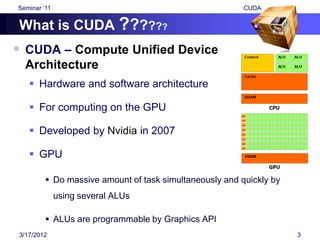
 CUDA – Compute Unified Device
  Architecture
    Hardware and software architecture

    For computing on the GPU

    Developed by Nvidia in 2007

    GPU

          Do massive amount of task simultaneously and quickly by
              using several ALUs

          ALUs are programmable by Graphics API
3/17/2012                                                            3
Seminar „11                                     CUDA


What is CUDA ??????
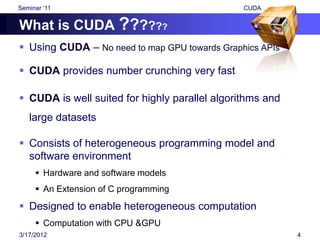
 Using CUDA – No need to map GPU towards Graphics APIs

 CUDA provides number crunching very fast

 CUDA is well suited for highly parallel algorithms and
   large datasets

 Consists of heterogeneous programming model and
  software environment
      Hardware and software models
      An Extension of C programming
 Designed to enable heterogeneous computation
      Computation with CPU &GPU
3/17/2012                                                  4
Seminar „11                                        CUDA

  CUDA kernels & threads
 Device = GPU
     Executes parallel portions of an application
      as kernels

 Host = CPU
     Executes serial portions of an application

 Kernel = Functions that runs on device
     One kernel at one time
     Many threads execute each kernel
 Posses host and device memory
 Host and device connected by PCI
  EXPRESS X16
  3/17/2012                                                 5
Seminar „11                                         CUDA

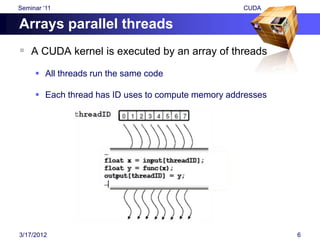
Arrays parallel threads
 A CUDA kernel is executed by an array of threads
      All threads run the same code

      Each thread has ID uses to compute memory addresses


3/17/2012                                                    6
Seminar „11                                          CUDA

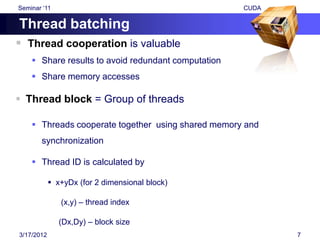
Thread batching
 Thread cooperation is valuable
     Share results to avoid redundant computation
     Share memory accesses

 Thread block = Group of threads

     Threads cooperate together using shared memory and
       synchronization

     Thread ID is calculated by

             x+yDx (for 2 dimensional block)

               (x,y) – thread index

               (Dx,Dy) – block size
3/17/2012                                                   7
Seminar „11                                               CUDA

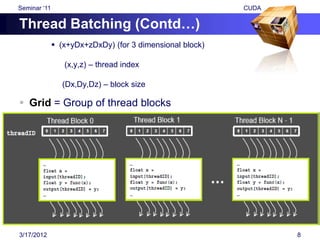
Thread Batching (Contd…)
               (x+yDx+zDxDy) (for 3 dimensional block)

                 (x,y,z) – thread index

                (Dx,Dy,Dz) – block size

 Grid = Group of thread blocks


3/17/2012                                                        8
Seminar „11                                       CUDA

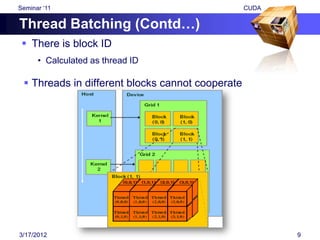
Thread Batching (Contd…)
  There is block ID
      • Calculated as thread ID

  Threads in different blocks cannot cooperate


3/17/2012                                                9
Seminar „11                                              CUDA

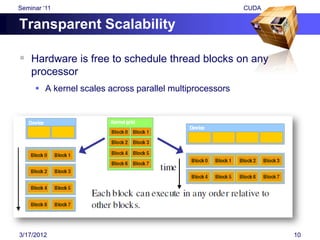
Transparent Scalability

 Hardware is free to schedule thread blocks on any
    processor
      A kernel scales across parallel multiprocessors


3/17/2012                                                       10
Seminar „11                                                   CUDA

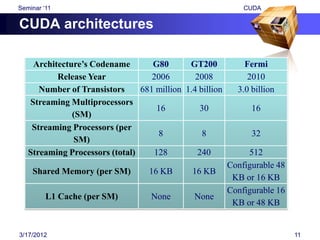
CUDA architectures

    Architecture’s Codename        G80       GT200            Fermi
          Release Year             2006        2008            2010
      Number of Transistors     681 million 1.4 billion     3.0 billion
   Streaming Multiprocessors
                                    16           30             16
              (SM)
    Streaming Processors (per
                                     8           8              32
               SM)
   Streaming Processors (total)     128         240            512
                                                          Configurable 48
    Shared Memory (per SM)         16 KB      16 KB
                                                           KB or 16 KB
                                                          Configurable 16
         L1 Cache (per SM)         None        None
                                                           KB or 48 KB


3/17/2012                                                                   11
Seminar „11                  CUDA

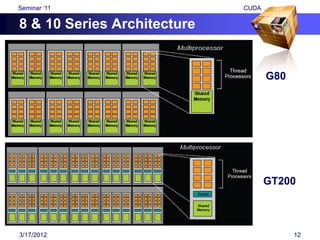
8 & 10 Series Architecture


                                    G80


                                    GT200


3/17/2012                                 12
Seminar „11              CUDA

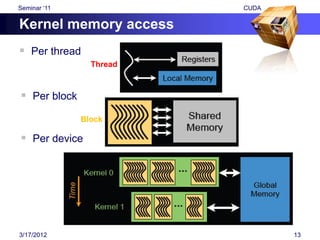
Kernel memory access
 Per thread
                Thread


 Per block
              Block

 Per device


3/17/2012                       13
Seminar „11                                           CUDA

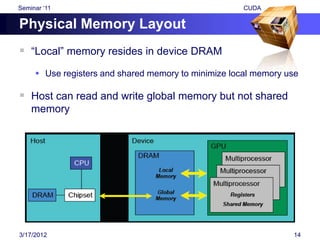
Physical Memory Layout
 “Local” memory resides in device DRAM
      Use registers and shared memory to minimize local memory use

 Host can read and write global memory but not shared
    memory


3/17/2012                                                        14
Seminar „11                    CUDA

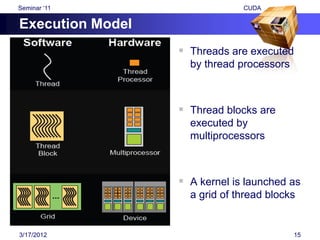
Execution Model
                   Threads are executed
                    by thread processors


                   Thread blocks are
                    executed by
                    multiprocessors


                   A kernel is launched as
                    a grid of thread blocks


3/17/2012                                  15
Seminar „11                 CUDA

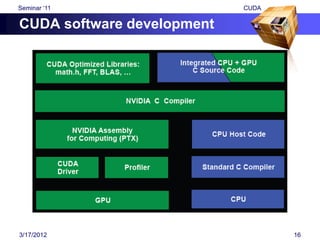
CUDA software development


3/17/2012                          16
Seminar „11                       CUDA

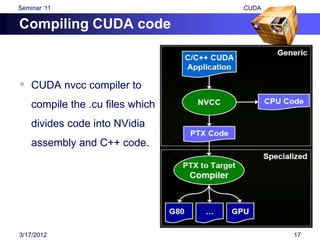
Compiling CUDA code


 CUDA nvcc compiler to
    compile the .cu files which
    divides code into NVidia
    assembly and C++ code.


3/17/2012                                17
Seminar „11                                                 CUDA


    Example
int main(void){
         float *a_h, *b_h;          //host data
         float *a_d, *b_d;          //device data        Host      Device
         int N = 15, nBytes, i;
         nBytes = N*sizeof(float);                       a_h           a_d
         a_h = (float*)malloc(nBytes);
         b_h = (float*)malloc(nBytes);
                                                         b_h           b_d
         cudaMalloc((void**)&a_d,nBytes);
         cudaMalloc((void**)&b_d,nBytes);
         for(i=0; i<N; i++) a_h[i]=100.f +i;
         cudaMemcpy(a_d, a_h, nBytes, cudaMemcpyHostToDevice);
         cudaMemcpy(b_d, a_d, nBytes, cudaMemcpyDeviceToDevice);
         cudaMemcpy(b_h, b_d, nByyes, cudaMemcpyDeviceToHost);
         for(i=0; i<N; i++) assert(a_h[i] == b_h[i]);
         free(a_h); free(b_h); cudaFree(a_d); cudaFree(b_d);
         return 0;}
    3/17/2012                                                                18
Seminar „11                                  CUDA

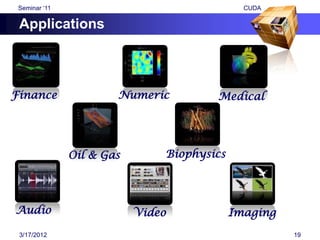
 Applications


Finance                Numeric         Medical


               Oil & Gas       Biophysics


Audio                      Video            Imaging
 3/17/2012                                            19
Seminar „11                                    CUDA

Advantages

 Provides shared memory

 Cost effective

 The gaming industries demand on Graphics cards has
    forced a lot of research and money into the improvement
    of the GPUs

 Transparent Scalability


3/17/2012                                                 20
Seminar „11                                  CUDA

Drawbacks


 Despite having hundreds of “cores” CUDA is not as
    flexible as CPU‟s

 Not as effective for personal computers


3/17/2012                                             21
Seminar „11                                  CUDA

Future Scope


 Implementation of CUDA in several other group of
    companies‟ GPUs.

 More and more streaming processors can be included

 CUDA in wide variety of programming languages.


3/17/2012                                              22
Seminar „11                                        CUDA

Conclusion

 Brought significant innovations to the High Performance
    Computing world.

 CUDA simplified process of development of general
    purpose parallel applications.

 These applications have now enough computational
    power to get proper results in a short time.


3/17/2012                                                 23
Seminar „11                                                       CUDA

  References
1. “CUDA by Example: An Introduction to General-Purpose GPU
    Programming” by Edward kandrot
2. “Programming Massively Parallel Processors: A Hands-on Approach
    (Applications of GPU Computing Series)” By David B kirk & Wen Mei W.
    Hwu.
3. “GPU Computing Gems Emerald Edition (Applications of GPU Computing
    Series)” By Wen-mei W. Hwu .
4. “The Cost To Play: CUDA Programming” , By Douglas Eadline, Ph.D. ,on
    Linux Magazine Wednesday, February 17th, 2010
5. “Nvidia Announces CUDA x86” Written by Cristian, On Tech Connect
    Magazine 21 September 2010
6. CUDA Programming Guide. ver. 1.1,
    http://www.nvidia.com/object/cuda_develop.html
7. TESLA GPU Computing Technical Brief,
    http://www.nvidia.com/object/tesla_product_literature.html
8. G80 architecture reviews and specification,
    http://www.nvidia.com/page/8800_reviews.html,
    http://www.nvidia.com/page/8800_tech_specs.html
9. Beyond3D G80: Architecture and GPU Analysis,
    http://www.beyond3d.com/content/reviews/1
10. Graphics adapters supporting CUDA,
    http://www.nvidia.com/object/cuda_learn_products.html
  3/17/2012                                                                24
Seminar „11                    CUDA


              Questions?????


3/17/2012                             26

Cuda

  • 2.
    Seminar „11 CUDA Contents 1 WHAT IS CUDA ?????? 2 EXECUTION MODEL 3 IMPLEMENTATION 4 APPLICATION 3/17/2012 2
  • 3.
    Seminar „11 CUDA What is CUDA ??????  CUDA – Compute Unified Device Architecture  Hardware and software architecture  For computing on the GPU  Developed by Nvidia in 2007  GPU  Do massive amount of task simultaneously and quickly by using several ALUs  ALUs are programmable by Graphics API 3/17/2012 3
  • 4.
    Seminar „11 CUDA What is CUDA ??????  Using CUDA – No need to map GPU towards Graphics APIs  CUDA provides number crunching very fast  CUDA is well suited for highly parallel algorithms and large datasets  Consists of heterogeneous programming model and software environment  Hardware and software models  An Extension of C programming  Designed to enable heterogeneous computation  Computation with CPU &GPU 3/17/2012 4
  • 5.
    Seminar „11 CUDA CUDA kernels & threads  Device = GPU  Executes parallel portions of an application as kernels  Host = CPU  Executes serial portions of an application  Kernel = Functions that runs on device  One kernel at one time  Many threads execute each kernel  Posses host and device memory  Host and device connected by PCI EXPRESS X16 3/17/2012 5
  • 6.
    Seminar „11 CUDA Arrays parallel threads  A CUDA kernel is executed by an array of threads  All threads run the same code  Each thread has ID uses to compute memory addresses 3/17/2012 6
  • 7.
    Seminar „11 CUDA Thread batching  Thread cooperation is valuable  Share results to avoid redundant computation  Share memory accesses  Thread block = Group of threads  Threads cooperate together using shared memory and synchronization  Thread ID is calculated by  x+yDx (for 2 dimensional block) (x,y) – thread index (Dx,Dy) – block size 3/17/2012 7
  • 8.
    Seminar „11 CUDA Thread Batching (Contd…)  (x+yDx+zDxDy) (for 3 dimensional block) (x,y,z) – thread index (Dx,Dy,Dz) – block size  Grid = Group of thread blocks 3/17/2012 8
  • 9.
    Seminar „11 CUDA Thread Batching (Contd…)  There is block ID • Calculated as thread ID  Threads in different blocks cannot cooperate 3/17/2012 9
  • 10.
    Seminar „11 CUDA Transparent Scalability  Hardware is free to schedule thread blocks on any processor  A kernel scales across parallel multiprocessors 3/17/2012 10
  • 11.
    Seminar „11 CUDA CUDA architectures Architecture’s Codename G80 GT200 Fermi Release Year 2006 2008 2010 Number of Transistors 681 million 1.4 billion 3.0 billion Streaming Multiprocessors 16 30 16 (SM) Streaming Processors (per 8 8 32 SM) Streaming Processors (total) 128 240 512 Configurable 48 Shared Memory (per SM) 16 KB 16 KB KB or 16 KB Configurable 16 L1 Cache (per SM) None None KB or 48 KB 3/17/2012 11
  • 12.
    Seminar „11 CUDA 8 & 10 Series Architecture G80 GT200 3/17/2012 12
  • 13.
    Seminar „11 CUDA Kernel memory access  Per thread Thread  Per block Block  Per device 3/17/2012 13
  • 14.
    Seminar „11 CUDA Physical Memory Layout  “Local” memory resides in device DRAM  Use registers and shared memory to minimize local memory use  Host can read and write global memory but not shared memory 3/17/2012 14
  • 15.
    Seminar „11 CUDA Execution Model  Threads are executed by thread processors  Thread blocks are executed by multiprocessors  A kernel is launched as a grid of thread blocks 3/17/2012 15
  • 16.
    Seminar „11 CUDA CUDA software development 3/17/2012 16
  • 17.
    Seminar „11 CUDA Compiling CUDA code  CUDA nvcc compiler to compile the .cu files which divides code into NVidia assembly and C++ code. 3/17/2012 17
  • 18.
    Seminar „11 CUDA Example int main(void){ float *a_h, *b_h; //host data float *a_d, *b_d; //device data Host Device int N = 15, nBytes, i; nBytes = N*sizeof(float); a_h a_d a_h = (float*)malloc(nBytes); b_h = (float*)malloc(nBytes); b_h b_d cudaMalloc((void**)&a_d,nBytes); cudaMalloc((void**)&b_d,nBytes); for(i=0; i<N; i++) a_h[i]=100.f +i; cudaMemcpy(a_d, a_h, nBytes, cudaMemcpyHostToDevice); cudaMemcpy(b_d, a_d, nBytes, cudaMemcpyDeviceToDevice); cudaMemcpy(b_h, b_d, nByyes, cudaMemcpyDeviceToHost); for(i=0; i<N; i++) assert(a_h[i] == b_h[i]); free(a_h); free(b_h); cudaFree(a_d); cudaFree(b_d); return 0;} 3/17/2012 18
  • 19.
    Seminar „11 CUDA Applications Finance Numeric Medical Oil & Gas Biophysics Audio Video Imaging 3/17/2012 19
  • 20.
    Seminar „11 CUDA Advantages  Provides shared memory  Cost effective  The gaming industries demand on Graphics cards has forced a lot of research and money into the improvement of the GPUs  Transparent Scalability 3/17/2012 20
  • 21.
    Seminar „11 CUDA Drawbacks  Despite having hundreds of “cores” CUDA is not as flexible as CPU‟s  Not as effective for personal computers 3/17/2012 21
  • 22.
    Seminar „11 CUDA Future Scope  Implementation of CUDA in several other group of companies‟ GPUs.  More and more streaming processors can be included  CUDA in wide variety of programming languages. 3/17/2012 22
  • 23.
    Seminar „11 CUDA Conclusion  Brought significant innovations to the High Performance Computing world.  CUDA simplified process of development of general purpose parallel applications.  These applications have now enough computational power to get proper results in a short time. 3/17/2012 23
  • 24.
    Seminar „11 CUDA References 1. “CUDA by Example: An Introduction to General-Purpose GPU Programming” by Edward kandrot 2. “Programming Massively Parallel Processors: A Hands-on Approach (Applications of GPU Computing Series)” By David B kirk & Wen Mei W. Hwu. 3. “GPU Computing Gems Emerald Edition (Applications of GPU Computing Series)” By Wen-mei W. Hwu . 4. “The Cost To Play: CUDA Programming” , By Douglas Eadline, Ph.D. ,on Linux Magazine Wednesday, February 17th, 2010 5. “Nvidia Announces CUDA x86” Written by Cristian, On Tech Connect Magazine 21 September 2010 6. CUDA Programming Guide. ver. 1.1, http://www.nvidia.com/object/cuda_develop.html 7. TESLA GPU Computing Technical Brief, http://www.nvidia.com/object/tesla_product_literature.html 8. G80 architecture reviews and specification, http://www.nvidia.com/page/8800_reviews.html, http://www.nvidia.com/page/8800_tech_specs.html 9. Beyond3D G80: Architecture and GPU Analysis, http://www.beyond3d.com/content/reviews/1 10. Graphics adapters supporting CUDA, http://www.nvidia.com/object/cuda_learn_products.html 3/17/2012 24
  • 26.
    Seminar „11 CUDA Questions????? 3/17/2012 26

Editor's Notes