ACKNOWLEDGEMENT
The satisfaction that accompanies the successful completion of any task
would be incomplete without acknowledging the people whose constant
guidance and encouragement has crowned all the efforts with success.
I express my deep gratitude to Prof. Dr.N.R.Samal, Head of the
Department of Electrical Engineering for his support and inspiration and
to my guide Er. Debasish Mishra (Asst. Professor), Department of
Electrical Engineering for permitting me to present the seminar on “GPS
INTERFACE IN GSM NETWORK”.
I would also like to extend my deep regards to the lecturers of Electrical
Department for their guidance and help. I am also very grateful to my
friends without whose support and help this would not have been a
success.
ANUP KUMAR
REG.NO: 1201211212
ROLL.NO: 125120
DEPARTMENT OF ELECTRICAL ENGINEERING
ORISSA ENGINEERING COLLEGE BHUBANESWAR
CERTIFICATE
This is to certify that ANUP KUMAR, bearing Roll No: 125120
and University Registration No-1201211212, a student of 7th
semester has submitted the seminar report entitled “GPS interface
in GSM Network” as per the requirement of the Biju Patnaik
University Of Technology in partial fulfilment of Degree of
Bachelor of technology (Electrical Engineering Department) for the
academic year 2012-2016.
Guided By:-Dr. N.R. Samal
Professor& HOD
Dean Academics
Department of Electrical Engineering
Er. DebasishMishra.
Assistant Professor
Department of Electrical Engineering
DECLARATION
I, Anup Kumar, hereby declare that the seminar report
Entitled “GPS interface in GSM network” submitted to the OEC
Bhubaneswar is a record of an original work done by me under
the guidance of Er. Debasish Mishra, Assistant Professor in
Electrical Engineering, O r i s s a E n g i n e e r i n g C o l l e g e ,
B H U B A N E S W A R .
This report is submitted in the
partial fulfilment of the requirements for the award of
the degree of Bachelor of Technology in Electrical Engineering.
The results embodied in this thesis have not been submitted to
any other University or Institute for the award of any degree or
diploma.
INDEX
 ABSTRACT
 INTRODUCTION
 WHAT IS GSM
 WHAT IS GPS
 SYSTEM ARCHITECTURE
 VEHICLE TRACKING SYSTEM
 GSM AND GPS BASED VECHICLE LOCATION AND
TRACKING SYSTEM
 APPLICATIONS AND ADVANTAGES
 CONCLUSION
 FUTURE SCOPE
 References
ABSTRACT
GPS is one of the technologies that are used in a huge number of
applications today. One of the applications is tracking your vehicle and
keeps regular monitoring on them. This tracking system can
Inform you the location and route travelled by vehicle, and that
information can be observed from any other remote location. It also
includes the web application that provides you exact location of target.
This system enables us to track target in any weather conditions. This
system uses GPS and GSM technologies.
The paper includes the hardware part which comprises of GPS, GSM,
16x2 LCD and monitoring unit part is used for interfacing all the
required modules and a web application is also developed at the client
side.
Main objective is to design a system that can be easily installed and to
provide platform for further enhancement.
INTRODUCTION
GLOBAL POSITIONING SATELLITES (GPS) ENABLE THE TRACKING OF ALL KINDS OF MOBILE ASSETS
ACCURATELY AND PROVIDE THEIR REAL TIME POSITIONS TO THE OWNERS ON A 24 BY 7 BASIS
OVER THE GPRS/GSM LINK. WHILE THE GPS PROVIDES THE LATITUDE/LONGITUDE
INFORMATION OF THE MOBILE ASSET A GIVEN TIME, THIS INFORMATION CAN BE TRANSMITTED
TO ANY PLACE USING THE GPRS RADIO LINK. IN FACT, THE ASSET CAN EVEN HAVE ENOUGH
INTELLIGENCE BUILT INTO IT TO INITIATE CALLS USING THE GSM PHONE LINKS. THE TECHNOLOGY
AND THE COST OF IMPLEMENTING THIS TECHNOLOGY HAS COME DOWN DRASTICALLY OVER THE
LAST FEW YEARS MAKING THEM VERY AFFORDABLE TO THE GENERAL PUBLIC.
THIS GPS/GSM/GPRS TRACKING TECHNOLOGY CAN BE USED IN THE FOLLOWING AREAS, JUST
TO NAME A FEW:
VEHICLE TRACKING TO ACCOMPLISH
MONITORING OF SPEED AND LOCATION OF THE MOBILE ASSET
MONITORING OF VARIOUS COMPLIANCES RELATED TO SAFETY, DRIVER BEHAVIOR, ETC.
EMERGENCY SERVICES: CRASH REPORTING, ENGINE STALL, ETC.
FLEET MANAGEMENT;
DRIVING PATTERN, BEHAVIOR AND UNDERSTANDING
HIGH VALUE ASSET TRACKING:
HIGH VALUE ASSET/CONSIGNMENT TRACKING
THIS COULD BE INTERNATIONAL BULK CONTAINERS, HIGH VALUE CONTAINERS (AIRLINES, ETC.)
AND SEVERAL OTHER SUCH ASSETS. THIS APPROACH PAPER IS LIMITED TO VEHICLE TRACKING
ONLY WHILE THE SAME TECHNOLOGY COULD BE USED WITH SOME MODIFICATIONS IN
GUI/SOFTWARE FOR VARIOUS OTHER APPLICATIONS AS INDICATED ABOVE.
VEHICLE AND FLEET MANAGEMENT SERVICES WILL CONSIST OF A TRACKING / RECORDING DEVICE
(ASSET TRACK), WHICH WILL BE INSTALLED IN THE VEHICLE THAT IS TO BE TRACKED. THIS WILL
THEN TRANSMIT DATA ABOUT SPEED, POSITION (THROUGH GPS)
WHAT IS GSM
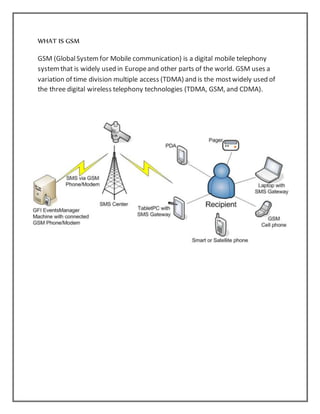
GSM (GlobalSystemfor Mobile communication) is a digital mobile telephony
systemthat is widely used in Europeand other parts of the world. GSM uses a
variation of time division multiple access (TDMA) and is the mostwidely used of
the three digital wireless telephony technologies (TDMA, GSM, and CDMA).
WHAT IS GPS
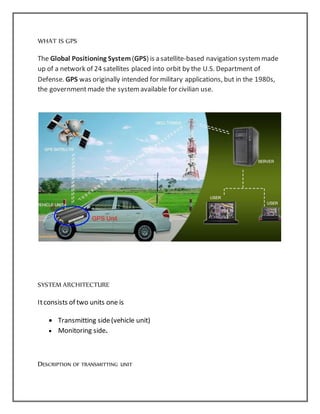
The Global Positioning System(GPS) is a satellite-based navigation systemmade
up of a network of 24 satellites placed into orbit by the U.S. Department of
Defense. GPS was originally intended for military applications, but in the 1980s,
the governmentmade the systemavailable for civilian use.
SYSTEM ARCHITECTURE
Itconsists of two units one is
 Transmitting side(vehicle unit)
 Monitoring side.
DESCRIPTION OF TRANSMITTING UNIT
GPS
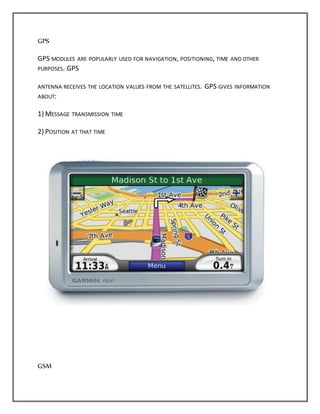
GPS MODULES ARE POPULARLY USED FOR NAVIGATION, POSITIONING, TIME AND OTHER
PURPOSES. GPS
ANTENNA RECEIVES THE LOCATION VALUES FROM THE SATELLITES. GPS GIVES INFORMATION
ABOUT:
1) MESSAGE TRANSMISSION TIME
2) POSITION AT THAT TIME
GSM
GSM MODEM IS USED FOR TRANSMITTING AND RECEIVING THE DATA.
SIM300 IS A TRI- BAND GSM/GPRS ENGINE.
IT WORKS ON VARIOUS FREQUENCIES I.E. EGSM 900MHZ, DCS 1800MHZ AND PCS
1900MHZ.
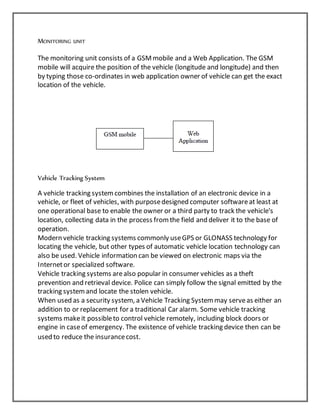
16X2 LCD
A 16X2 LCD IS USED FOR DISPLAYING LOCATION VALUES.
A 9V BATTERY IS USED TO POWER UP THE CIRCUIT.
MONITORING UNIT
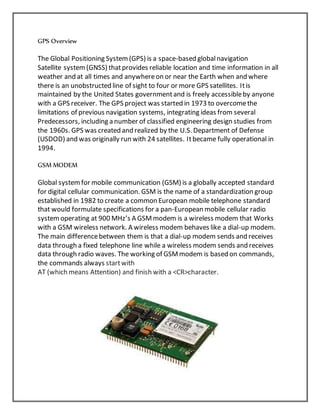
The monitoring unit consists of a GSMmobile and a Web Application. The GSM
mobile will acquire the position of the vehicle (longitude and longitude) and then
by typing those co-ordinates in web application owner of vehicle can get the exact
location of the vehicle.
Vehicle Tracking System
A vehicle tracking systemcombines the installation of an electronic device in a
vehicle, or fleet of vehicles, with purposedesigned computer softwareat least at
one operational base to enable the owner or a third party to track the vehicle's
location, collecting data in the process fromthe field and deliver it to the base of
operation.
Modern vehicle tracking systems commonly useGPS or GLONASS technology for
locating the vehicle, but other types of automatic vehicle location technology can
also be used. Vehicle information can be viewed on electronic maps via the
Internetor specialized software.
Vehicle tracking systems arealso popular in consumer vehicles as a theft
prevention and retrieval device. Police can simply follow the signal emitted by the
tracking systemand locate the stolen vehicle.
When used as a security system, a Vehicle Tracking Systemmay serveas either an
addition to or replacement for a traditional Car alarm. Some vehicle tracking
systems makeit possibleto control vehicle remotely, including block doors or
engine in caseof emergency. The existence of vehicle tracking device then can be
used to reduce the insurancecost.
GSM Overview
Global Systemfor Mobile Communications or GSMis the world's mostpopular
standard for mobile telephone systems. The GSMAssociation estimates that 80%
of the global mobile market uses the standard.
[1] GSM is used by over 1.5 billion people
[2] Across morethan 212 countries and territories.
[3] This ubiquity means that subscribers can usetheir phones throughoutthe
world, enabled by Internationalroaming arrangements between mobile network
operators.
GSM differs fromits predecessor technologies in that both signaling and speech
channels are digital, and thus GSM is considered a second generation (2G) mobile
phone system. The GSMstandard has been an advantageto both consumers, who
may benefit fromthe ability to Roam and switch carriers withoutreplacing
phones, and also to network operators, who can chooseequipment from many
GSM equipment vendors.
GPS Overview
The Global Positioning System(GPS) is a space-based globalnavigation
Satellite system(GNSS) thatprovides reliable location and time information in all
weather and at all times and anywhereon or near the Earth when and where
there is an unobstructed line of sight to four or more GPS satellites. Itis
maintained by the United States governmentand is freely accessibleby anyone
with a GPS receiver. The GPS project was started in 1973 to overcomethe
limitations of previous navigation systems, integrating ideas from several
Predecessors, including a number of classified engineering design studies from
the 1960s. GPS was created and realized by the U.S. Department of Defense
(USDOD) and was originally run with 24 satellites. Itbecame fully operational in
1994.
GSM MODEM
Global systemfor mobile communication (GSM) is a globally accepted standard
for digital cellular communication. GSM is the name of a standardization group
established in 1982 to create a common European mobile telephone standard
that would formulate specifications for a pan-European mobile cellular radio
systemoperating at 900 MHz’s A GSMmodem is a wireless modem that Works
with a GSM wireless network. A wireless modem behaves like a dial-up modem.
The main differencebetween them is that a dial-up modem sends and receives
data through a fixed telephone line while a wireless modem sends and receives
data through radio waves. The working of GSMmodem is based on commands,
the commands always startwith
AT (which means Attention) and finish with a <CR>character.
THE GSM NETWORK
GSM provides recommendations, notrequirements. The GSM specifications
define the functions and interface requirements in detail but do not address the
hardware. The reason for this is to limit the designers as little as possiblebut still
to make it possiblefor the operators to buy equipment fromdifferent suppliers.
The GSM network is divided into three major systems:
 The switching system(SS),
 The base station system(BSS),
 The operation and supportsystem(OSS).
The operations and maintenance center (OMC) is connected to all equipment in
the switching systemand to the BSC. The implementation of OMC is called the
operation and supportsystem(OSS). TheOSS is the functional entity fromwhich
the network operator monitors and controls the system. The purposeof OSS is to
offer the customer cost-effectivesupportfor centralized, regional and local
operational and maintenance activities that are required for a GSM
Network. An importantfunction of OSS is to providea network overview and
supportthe maintenance activities of different operation and maintenance
organizations.
SPECIFICATIONS AND CHARACTERISTICS FOR GSM
The specifications and characteristics for GSM
 Frequency band- The frequency range specified for GSM is 1,850 to 1,990
MHz (mobile station to base station).
 Duplex distance- The duplex distance is 80 MHz Duplex distance is the
distance between the uplink and downlink frequencies. A channel has two
frequencies, 80 MHz apart.
 Channel separation- The separation between adjacent carrier frequencies.
In GSM, this is 200 kHz.
 Modulation- Modulation is the process of sending a signalby changing the
characteristics of a carrier frequency. This is done in GSM via Gaussian
minimum shift keying (GMSK).
 Transmission rate- GSMis a digital systemwith an over-the-air bit rate of
270 kbps.
GSM AND GPS BASED VECHICLE LOCATION AND TRACKING SYSTEM
 Description
Presentproject is designed using 8051 microcontroller in this Projectit is
proposed to design
an embedded systemwhich is used for tracking and positioning of any vehicle by
using Global Positioning System(GPS) and Global systemfor mobile
communication (GSM).
In this projectAT89S52 microcontroller is used for interfacing to various hardware
peripherals.
The current design is an embedded application, which will continuously monitor a
moving Vehicle and reportthe status of the Vehicle on demand. For doing so an
AT89S52 microcontroller is interfaced serially to a GSMModem and GPS Receiver.
A GSM modem is used to send the position (Latitude and Longitude) of the
vehicle froma remote place. The GPS modem will continuously givethe data i.e.
the latitude and longitude indicating the position of the vehicle. The GPS modem
gives many parameters as the output, but only the NMEA data coming out is read
and displayed on to the LCD. The same data is sent to the mobile at the other end
fromwhere the position of the vehicle is demanded. An EEPROM is used to store
the mobile number. The hardwareinterfaces to microcontroller are LCD display,
GSM modem and GPS Receiver. The design uses RS-232 protocolfor serial
communication between the modems and the microcontroller. A serial driver ICis
used for converting TTL voltage levels to RS-232 voltagelevels. INthe main they
are easy to steal, and the averagemotorist has very little knowledgeof whatit is
all about. To avoid this kind of steal we aregoing to implement this projectwhich
provides moresecurity to the vehicle. When the requestby user is sent to the
number at the modem, the systemautomatically sends a return reply to that
mobile indicating the position of the vehicle in terms of latitude and longitude
fromthis information wecan track our vehicles.
APPLICATIONS AND ADVANTAGES
APPLICATIONS
 Stolen vehicle recovery.
 Field service management.
 Itis used for food delivery and car rental companies.
ADVANTAGES:
 Itprovides moresecurity than other system.
 Fromthe remote place we can access the system.
 By this we can position the vehicle in exact place.
CONCLUSION
The project is all about controlling theft of a vehicle. The systemis about making
vehicle moreSecure by the use of GPS, GSM technology and a web application.
SCOPE IN FUTURE
 If anybody steals our car wecan easily find our car around the globe and
the vehicle can be turned off by only with a simple SMS.
 To track animals in jungles.
 Delivery services.
Itcan also be beneficial for:-
1. Parents to look after their children.
2. To track animals in jungles
3. Delivery services
4. Cops department and fire services
References
 http://en.wikipedia.org/wiki/Sevensegment_Display
 http://www.gsm-modem.de/
 http://www.datasheetsite.com/datasheet/MAX232
 http://www.rentron.com/rf_remote_control.htm

Gps interface in gsm network

  • 1.
    ACKNOWLEDGEMENT The satisfaction thataccompanies the successful completion of any task would be incomplete without acknowledging the people whose constant guidance and encouragement has crowned all the efforts with success. I express my deep gratitude to Prof. Dr.N.R.Samal, Head of the Department of Electrical Engineering for his support and inspiration and to my guide Er. Debasish Mishra (Asst. Professor), Department of Electrical Engineering for permitting me to present the seminar on “GPS INTERFACE IN GSM NETWORK”. I would also like to extend my deep regards to the lecturers of Electrical Department for their guidance and help. I am also very grateful to my friends without whose support and help this would not have been a success. ANUP KUMAR REG.NO: 1201211212 ROLL.NO: 125120 DEPARTMENT OF ELECTRICAL ENGINEERING
  • 2.
    ORISSA ENGINEERING COLLEGEBHUBANESWAR CERTIFICATE This is to certify that ANUP KUMAR, bearing Roll No: 125120 and University Registration No-1201211212, a student of 7th semester has submitted the seminar report entitled “GPS interface in GSM Network” as per the requirement of the Biju Patnaik University Of Technology in partial fulfilment of Degree of Bachelor of technology (Electrical Engineering Department) for the academic year 2012-2016. Guided By:-Dr. N.R. Samal Professor& HOD Dean Academics Department of Electrical Engineering Er. DebasishMishra. Assistant Professor Department of Electrical Engineering
  • 3.
    DECLARATION I, Anup Kumar,hereby declare that the seminar report Entitled “GPS interface in GSM network” submitted to the OEC Bhubaneswar is a record of an original work done by me under the guidance of Er. Debasish Mishra, Assistant Professor in Electrical Engineering, O r i s s a E n g i n e e r i n g C o l l e g e , B H U B A N E S W A R . This report is submitted in the partial fulfilment of the requirements for the award of the degree of Bachelor of Technology in Electrical Engineering. The results embodied in this thesis have not been submitted to any other University or Institute for the award of any degree or diploma.
  • 4.
    INDEX  ABSTRACT  INTRODUCTION WHAT IS GSM  WHAT IS GPS  SYSTEM ARCHITECTURE  VEHICLE TRACKING SYSTEM  GSM AND GPS BASED VECHICLE LOCATION AND TRACKING SYSTEM  APPLICATIONS AND ADVANTAGES  CONCLUSION  FUTURE SCOPE  References ABSTRACT
  • 5.
    GPS is oneof the technologies that are used in a huge number of applications today. One of the applications is tracking your vehicle and keeps regular monitoring on them. This tracking system can Inform you the location and route travelled by vehicle, and that information can be observed from any other remote location. It also includes the web application that provides you exact location of target. This system enables us to track target in any weather conditions. This system uses GPS and GSM technologies. The paper includes the hardware part which comprises of GPS, GSM, 16x2 LCD and monitoring unit part is used for interfacing all the required modules and a web application is also developed at the client side. Main objective is to design a system that can be easily installed and to provide platform for further enhancement. INTRODUCTION
  • 6.
    GLOBAL POSITIONING SATELLITES(GPS) ENABLE THE TRACKING OF ALL KINDS OF MOBILE ASSETS ACCURATELY AND PROVIDE THEIR REAL TIME POSITIONS TO THE OWNERS ON A 24 BY 7 BASIS OVER THE GPRS/GSM LINK. WHILE THE GPS PROVIDES THE LATITUDE/LONGITUDE INFORMATION OF THE MOBILE ASSET A GIVEN TIME, THIS INFORMATION CAN BE TRANSMITTED TO ANY PLACE USING THE GPRS RADIO LINK. IN FACT, THE ASSET CAN EVEN HAVE ENOUGH INTELLIGENCE BUILT INTO IT TO INITIATE CALLS USING THE GSM PHONE LINKS. THE TECHNOLOGY AND THE COST OF IMPLEMENTING THIS TECHNOLOGY HAS COME DOWN DRASTICALLY OVER THE LAST FEW YEARS MAKING THEM VERY AFFORDABLE TO THE GENERAL PUBLIC. THIS GPS/GSM/GPRS TRACKING TECHNOLOGY CAN BE USED IN THE FOLLOWING AREAS, JUST TO NAME A FEW: VEHICLE TRACKING TO ACCOMPLISH MONITORING OF SPEED AND LOCATION OF THE MOBILE ASSET MONITORING OF VARIOUS COMPLIANCES RELATED TO SAFETY, DRIVER BEHAVIOR, ETC. EMERGENCY SERVICES: CRASH REPORTING, ENGINE STALL, ETC. FLEET MANAGEMENT; DRIVING PATTERN, BEHAVIOR AND UNDERSTANDING HIGH VALUE ASSET TRACKING: HIGH VALUE ASSET/CONSIGNMENT TRACKING THIS COULD BE INTERNATIONAL BULK CONTAINERS, HIGH VALUE CONTAINERS (AIRLINES, ETC.) AND SEVERAL OTHER SUCH ASSETS. THIS APPROACH PAPER IS LIMITED TO VEHICLE TRACKING ONLY WHILE THE SAME TECHNOLOGY COULD BE USED WITH SOME MODIFICATIONS IN GUI/SOFTWARE FOR VARIOUS OTHER APPLICATIONS AS INDICATED ABOVE. VEHICLE AND FLEET MANAGEMENT SERVICES WILL CONSIST OF A TRACKING / RECORDING DEVICE (ASSET TRACK), WHICH WILL BE INSTALLED IN THE VEHICLE THAT IS TO BE TRACKED. THIS WILL THEN TRANSMIT DATA ABOUT SPEED, POSITION (THROUGH GPS)
  • 7.
    WHAT IS GSM GSM(GlobalSystemfor Mobile communication) is a digital mobile telephony systemthat is widely used in Europeand other parts of the world. GSM uses a variation of time division multiple access (TDMA) and is the mostwidely used of the three digital wireless telephony technologies (TDMA, GSM, and CDMA).
  • 8.
    WHAT IS GPS TheGlobal Positioning System(GPS) is a satellite-based navigation systemmade up of a network of 24 satellites placed into orbit by the U.S. Department of Defense. GPS was originally intended for military applications, but in the 1980s, the governmentmade the systemavailable for civilian use. SYSTEM ARCHITECTURE Itconsists of two units one is  Transmitting side(vehicle unit)  Monitoring side. DESCRIPTION OF TRANSMITTING UNIT
  • 9.
    GPS GPS MODULES AREPOPULARLY USED FOR NAVIGATION, POSITIONING, TIME AND OTHER PURPOSES. GPS ANTENNA RECEIVES THE LOCATION VALUES FROM THE SATELLITES. GPS GIVES INFORMATION ABOUT: 1) MESSAGE TRANSMISSION TIME 2) POSITION AT THAT TIME GSM
  • 10.
    GSM MODEM ISUSED FOR TRANSMITTING AND RECEIVING THE DATA. SIM300 IS A TRI- BAND GSM/GPRS ENGINE. IT WORKS ON VARIOUS FREQUENCIES I.E. EGSM 900MHZ, DCS 1800MHZ AND PCS 1900MHZ. 16X2 LCD A 16X2 LCD IS USED FOR DISPLAYING LOCATION VALUES. A 9V BATTERY IS USED TO POWER UP THE CIRCUIT.
  • 11.
    MONITORING UNIT The monitoringunit consists of a GSMmobile and a Web Application. The GSM mobile will acquire the position of the vehicle (longitude and longitude) and then by typing those co-ordinates in web application owner of vehicle can get the exact location of the vehicle. Vehicle Tracking System A vehicle tracking systemcombines the installation of an electronic device in a vehicle, or fleet of vehicles, with purposedesigned computer softwareat least at one operational base to enable the owner or a third party to track the vehicle's location, collecting data in the process fromthe field and deliver it to the base of operation. Modern vehicle tracking systems commonly useGPS or GLONASS technology for locating the vehicle, but other types of automatic vehicle location technology can also be used. Vehicle information can be viewed on electronic maps via the Internetor specialized software. Vehicle tracking systems arealso popular in consumer vehicles as a theft prevention and retrieval device. Police can simply follow the signal emitted by the tracking systemand locate the stolen vehicle. When used as a security system, a Vehicle Tracking Systemmay serveas either an addition to or replacement for a traditional Car alarm. Some vehicle tracking systems makeit possibleto control vehicle remotely, including block doors or engine in caseof emergency. The existence of vehicle tracking device then can be used to reduce the insurancecost.
  • 12.
    GSM Overview Global SystemforMobile Communications or GSMis the world's mostpopular standard for mobile telephone systems. The GSMAssociation estimates that 80% of the global mobile market uses the standard. [1] GSM is used by over 1.5 billion people [2] Across morethan 212 countries and territories. [3] This ubiquity means that subscribers can usetheir phones throughoutthe world, enabled by Internationalroaming arrangements between mobile network operators. GSM differs fromits predecessor technologies in that both signaling and speech channels are digital, and thus GSM is considered a second generation (2G) mobile phone system. The GSMstandard has been an advantageto both consumers, who may benefit fromthe ability to Roam and switch carriers withoutreplacing phones, and also to network operators, who can chooseequipment from many GSM equipment vendors.
  • 13.
    GPS Overview The GlobalPositioning System(GPS) is a space-based globalnavigation Satellite system(GNSS) thatprovides reliable location and time information in all weather and at all times and anywhereon or near the Earth when and where there is an unobstructed line of sight to four or more GPS satellites. Itis maintained by the United States governmentand is freely accessibleby anyone with a GPS receiver. The GPS project was started in 1973 to overcomethe limitations of previous navigation systems, integrating ideas from several Predecessors, including a number of classified engineering design studies from the 1960s. GPS was created and realized by the U.S. Department of Defense (USDOD) and was originally run with 24 satellites. Itbecame fully operational in 1994. GSM MODEM Global systemfor mobile communication (GSM) is a globally accepted standard for digital cellular communication. GSM is the name of a standardization group established in 1982 to create a common European mobile telephone standard that would formulate specifications for a pan-European mobile cellular radio systemoperating at 900 MHz’s A GSMmodem is a wireless modem that Works with a GSM wireless network. A wireless modem behaves like a dial-up modem. The main differencebetween them is that a dial-up modem sends and receives data through a fixed telephone line while a wireless modem sends and receives data through radio waves. The working of GSMmodem is based on commands, the commands always startwith AT (which means Attention) and finish with a <CR>character.
  • 14.
    THE GSM NETWORK GSMprovides recommendations, notrequirements. The GSM specifications define the functions and interface requirements in detail but do not address the hardware. The reason for this is to limit the designers as little as possiblebut still to make it possiblefor the operators to buy equipment fromdifferent suppliers. The GSM network is divided into three major systems:  The switching system(SS),  The base station system(BSS),  The operation and supportsystem(OSS). The operations and maintenance center (OMC) is connected to all equipment in the switching systemand to the BSC. The implementation of OMC is called the operation and supportsystem(OSS). TheOSS is the functional entity fromwhich the network operator monitors and controls the system. The purposeof OSS is to offer the customer cost-effectivesupportfor centralized, regional and local operational and maintenance activities that are required for a GSM Network. An importantfunction of OSS is to providea network overview and supportthe maintenance activities of different operation and maintenance organizations. SPECIFICATIONS AND CHARACTERISTICS FOR GSM The specifications and characteristics for GSM  Frequency band- The frequency range specified for GSM is 1,850 to 1,990 MHz (mobile station to base station).  Duplex distance- The duplex distance is 80 MHz Duplex distance is the distance between the uplink and downlink frequencies. A channel has two frequencies, 80 MHz apart.  Channel separation- The separation between adjacent carrier frequencies. In GSM, this is 200 kHz.
  • 15.
     Modulation- Modulationis the process of sending a signalby changing the characteristics of a carrier frequency. This is done in GSM via Gaussian minimum shift keying (GMSK).  Transmission rate- GSMis a digital systemwith an over-the-air bit rate of 270 kbps. GSM AND GPS BASED VECHICLE LOCATION AND TRACKING SYSTEM  Description Presentproject is designed using 8051 microcontroller in this Projectit is proposed to design an embedded systemwhich is used for tracking and positioning of any vehicle by using Global Positioning System(GPS) and Global systemfor mobile communication (GSM). In this projectAT89S52 microcontroller is used for interfacing to various hardware peripherals. The current design is an embedded application, which will continuously monitor a moving Vehicle and reportthe status of the Vehicle on demand. For doing so an AT89S52 microcontroller is interfaced serially to a GSMModem and GPS Receiver. A GSM modem is used to send the position (Latitude and Longitude) of the vehicle froma remote place. The GPS modem will continuously givethe data i.e. the latitude and longitude indicating the position of the vehicle. The GPS modem gives many parameters as the output, but only the NMEA data coming out is read and displayed on to the LCD. The same data is sent to the mobile at the other end fromwhere the position of the vehicle is demanded. An EEPROM is used to store the mobile number. The hardwareinterfaces to microcontroller are LCD display, GSM modem and GPS Receiver. The design uses RS-232 protocolfor serial communication between the modems and the microcontroller. A serial driver ICis used for converting TTL voltage levels to RS-232 voltagelevels. INthe main they are easy to steal, and the averagemotorist has very little knowledgeof whatit is all about. To avoid this kind of steal we aregoing to implement this projectwhich provides moresecurity to the vehicle. When the requestby user is sent to the number at the modem, the systemautomatically sends a return reply to that mobile indicating the position of the vehicle in terms of latitude and longitude fromthis information wecan track our vehicles.
  • 16.
    APPLICATIONS AND ADVANTAGES APPLICATIONS Stolen vehicle recovery.  Field service management.  Itis used for food delivery and car rental companies. ADVANTAGES:  Itprovides moresecurity than other system.  Fromthe remote place we can access the system.  By this we can position the vehicle in exact place. CONCLUSION The project is all about controlling theft of a vehicle. The systemis about making vehicle moreSecure by the use of GPS, GSM technology and a web application. SCOPE IN FUTURE
  • 17.
     If anybodysteals our car wecan easily find our car around the globe and the vehicle can be turned off by only with a simple SMS.  To track animals in jungles.  Delivery services. Itcan also be beneficial for:- 1. Parents to look after their children. 2. To track animals in jungles 3. Delivery services 4. Cops department and fire services References  http://en.wikipedia.org/wiki/Sevensegment_Display  http://www.gsm-modem.de/  http://www.datasheetsite.com/datasheet/MAX232  http://www.rentron.com/rf_remote_control.htm