GPS Tracking System
Submitted by
RAKESH GUPTA
GPS Tracking System
A PROJECT REPORT
Submitted by
RAKESH GUPTA
Under the guidance of
Prof. BIJAY KUSHWAHA
in partial fulfillment for the award of
the degree of
Bachelor of Computer Science
In
Information Technology
INDEX
1. INTRODUCTION…………………..
I. PURPOSE
II. SCOPE
III. OBJECTIVE
IV. LITERATIVE STUDY
V. COMPONENTS
VI. POSITIONING
VII.NAVIGATION
VIII.TIMING
IX. APPLICATION
1. SYSTEM ANALYSIS………………….
I. SPECIFICATION REQUIREMENT
II. HARDWARE DESCRIPTION
III. SOFTWARE
I. DEVELOPMENT ENVIRONMENT
1. DESIGN…………………………
I. PURPOSE
II. SCOPE
III. SYSTEM FEATURE
IV. FUNCTIONAL REQUIREMENT
i. Parse location
ii. Send location
iii. Show loaction
1. OBJECT RELATIONAL MODEL
2. ANALYSIS CLASS DIAGRAM
3. ACTIVITY DIAGRAM
4. SYSTEM TESTING…………..
I. SCREENSHOOT 1
I. SCREENSHOOT 2
II. SCREENSHOOT 3
1. OUTPUT AND REPORT
2. CONCLUSION & FUTURE ENHANCEMENT…………..
. INTRODUCTION:
A GPS tracking unit is a device that uses the Global
Positioning System (GPS) to determine the precise
location of a vehicle, person, or other asset to which it is
attached and to record the position of the asset at regular
intervals. The recorded location data can be stored
within the tracking unit, or it may be transmitted to a
central location data base, or internet-connected
computer, using a cellular (GPRS or SMS), radio, or
satellite modem embedded in the unit. This allows the
asset's location to be displayed against a map backdrop
either in real time or when analysing the track later,
using GPS tracking software.
I. Purpose:
A wide range of tracking systems has been
developed so far tracking vehicles and displaying their
position on a map, we can also use the system that has
been developed to tracks the mobility of a human being.
Now a day's tracking a person's mobility has become a
crucial issue these days be it tracking a criminal came on
payroll or a detective going to detect a case or any other
utility.
I. Scope:
Global Positioning System has numerous
applications. The earliest application was military.
Boaters were the first civilians to use GPS extensively
for navigation, as dead reckoning is prone to error.
Many high-end cars have a GPS navigation system
which serves much the same purpose as a marine GPS.
Some athletes are turning to GPS to track speed and
distance. A few digital cameras have a GPS receiver
which records the location where the picture was taken. So far,
I've listed only one-way applications. Two-way applications
include cell phones when calling the emergency number and
vehicle tracking.
I. Objective:
The global positioning system, more commonly referred
to as GPS, is a radio frequency navigation system
operated by the U.S. Department of Defense. GPS was
originally developed for military purposes, but has since
become available to nonmilitary personnel worldwide as
well. According to the National Executive Committee
for Space-Based Positioning, Navigation and Timing,
the objectives of GPS are to provide accurate
positioning, navigation and atomic timing services on a
continuous and free basis.
I. Literature Survey:
I. Components :
GPS is comprised of three main segments: space,
control and users. The space segment consists of a
constellation of U.S. satellites, placed so that at least
three satellites are positioned above the horizon from
any point on earth. PNT states that as of October 2009,
35 GPS satellites were in use. The control segment
includes monitoring stations located worldwide charged
with monitoring the GPS system. The user segment is
made up of GPS receivers.
I. Positioning :
GPS provides the user with a precise location by
utilizing radio frequencies. The GPS receiver translates
the information from at least three GPS satellites to
provide the user with a two-dimensional location of
latitudinal and longitudinal position on earth. If a fourth
satellite is available, then the receiver can provide the
user with three-dimensional location information, which
includes altitude in addition to latitude and longitude.
I. Navigation :
Navigation enables a user to process his current
location based on GPS data and travel to his desired
location, also based on accurate GPS data. Any user
with a working GPS receiver can navigate to a particular
destination, whether traveling on foot, by automobile, by
airplane or by ship. GPS navigation is even accurate
underground.
I. Timing :
Time is the fourth dimension that GPS is set up
to provide, by synchronizing each GPS receiver to the
GPS satellites to provide accurate time to the user. The
time is accurate to one hundred-billionth of a second.
GPS receivers are able to perform this function because
each GPS satellite includes several atomic clocks.
I. .
I. Applications :
In addition to military use, GPS has multiple
civilian applications. GPS has enabled many businesses
to operate more efficiently and effectively by providing
accurate time. Commercial and public transportation
companies can save time and money by routing their
carriers to less-congested areas. The average traveller
can use GPS to find the nearest coffee shop, book store
or gas station. GPS also can be used to enhance survival
rates in search-and-rescue missions. The possibilities are
endless, and as the use of GPS technology increases, so
will the potential applications.
2. SYSTEM ANALYSIS:
OBJECTIVE:
The objective of this chapter is to study the specific requirement hardware , software
design and its function.
I. SPECIFIC REQUIREMENT:
Arduino can sense the environment by receiving input from a variety of sensors
and can affect its surroundings by controlling lights, motors, and other actuators. The
microcontroller on the board is programmed using the Arduino programming language
(based on Wiring) and the Arduino development environment (based on Processing).
Arduino projects can be stand-alone or they can communicate with software running on
a computer (e.g. Flash, Processing, MaxMSP).
The boards can be built by hand or purchased preassembled; the software can be
downloaded for free. The hardware reference designs (CAD files) are available under
an open-source license, you are free to adapt them as per yours project requirement.
I. HARDWARE DESCRIPTION:
For the GPS tracking system we have three module that will be attached to each other . This
module together will perform as a GPS tracking system.
• A9G CONTROLLER BOARD
i. This A9G board made up of combining of GSM /GPRS module
ii. GPS MODULE AND
iii. ESP 32 CONTROLLER BOARD
 A9G BOARD :
The A9G development board is a multifunctional development board based on EMC’s
A9G GPRS/ GSM + GPS/ BDS module, you can use it to verify the basic
communication and peripheral functions of A9G module. It has the basic phone/
SMS, GPRS networking communications and GPG/ BDS dual mode positioning
function. There are lithium battery charge management, microphone, speaker
interface, USB communication interface, multiple user keys/ led, TF card slot,
acceleration sensor, SPI interface, I2C2 interface, ADC interface on the boards, so
you can develop different functions with this board.
FEATURES OF THIS BOARD :
 Supports voice call and SMS message
 Supports GSM/ GPRS frequency: 850/ 900/ 1800/ 1900 MHz
 Supports GPRS data service, the maximum download data rate is
85.6 Kbps, upload data is 42.8 Kbps
 Supports GSM07.07, 07. 05 AT commands and Ai-Thinker
explosion command
 Supports 3 serial ports, one download serial port, one AT
command port
Figure -2
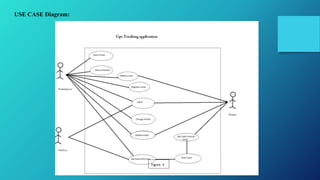
USE CASE Diagram:
IV.Functional Requirement
i. Parse Locations
Description: This function will run on
the device at every fixed interval of time
to read the input from GPS receiver and
get the location data.
Input: NMEA String
from the GPS receiver.
Output: Location data and
time stamp.
i. Send Location
Description: This function runs on the
device to send the location data and time
stamp to the server. On receiving the
time stamp from the server it knows that
the location data has been logged for the
said time
Input: Location data and time stamp.
Output: Time stamp.
i. Show Location
Description : Allows user to get current
location of the device or the location at a
given time.
Input: Time stamp
Output : Location at the given time .
Non Functional Requirement
SIM Card support
The user can track the device using the SMS Service By
sending SEND LOCATION CODE to GPS No. for getting
Exact location.
GPS Tracking System.pptx

GPS Tracking System.pptx

  • 1.
  • 2.
    GPS Tracking System APROJECT REPORT Submitted by RAKESH GUPTA Under the guidance of Prof. BIJAY KUSHWAHA in partial fulfillment for the award of the degree of Bachelor of Computer Science In Information Technology
  • 3.
    INDEX 1. INTRODUCTION………………….. I. PURPOSE II.SCOPE III. OBJECTIVE IV. LITERATIVE STUDY V. COMPONENTS VI. POSITIONING VII.NAVIGATION VIII.TIMING IX. APPLICATION 1. SYSTEM ANALYSIS…………………. I. SPECIFICATION REQUIREMENT II. HARDWARE DESCRIPTION III. SOFTWARE
  • 4.
    I. DEVELOPMENT ENVIRONMENT 1.DESIGN………………………… I. PURPOSE II. SCOPE III. SYSTEM FEATURE IV. FUNCTIONAL REQUIREMENT i. Parse location ii. Send location iii. Show loaction 1. OBJECT RELATIONAL MODEL 2. ANALYSIS CLASS DIAGRAM 3. ACTIVITY DIAGRAM 4. SYSTEM TESTING………….. I. SCREENSHOOT 1
  • 5.
    I. SCREENSHOOT 2 II.SCREENSHOOT 3 1. OUTPUT AND REPORT 2. CONCLUSION & FUTURE ENHANCEMENT…………..
  • 6.
    . INTRODUCTION: A GPStracking unit is a device that uses the Global Positioning System (GPS) to determine the precise location of a vehicle, person, or other asset to which it is attached and to record the position of the asset at regular intervals. The recorded location data can be stored within the tracking unit, or it may be transmitted to a central location data base, or internet-connected computer, using a cellular (GPRS or SMS), radio, or satellite modem embedded in the unit. This allows the asset's location to be displayed against a map backdrop either in real time or when analysing the track later, using GPS tracking software.
  • 7.
    I. Purpose: A widerange of tracking systems has been developed so far tracking vehicles and displaying their position on a map, we can also use the system that has been developed to tracks the mobility of a human being. Now a day's tracking a person's mobility has become a crucial issue these days be it tracking a criminal came on payroll or a detective going to detect a case or any other utility. I. Scope: Global Positioning System has numerous applications. The earliest application was military. Boaters were the first civilians to use GPS extensively for navigation, as dead reckoning is prone to error. Many high-end cars have a GPS navigation system which serves much the same purpose as a marine GPS. Some athletes are turning to GPS to track speed and distance. A few digital cameras have a GPS receiver
  • 8.
    which records thelocation where the picture was taken. So far, I've listed only one-way applications. Two-way applications include cell phones when calling the emergency number and vehicle tracking. I. Objective: The global positioning system, more commonly referred to as GPS, is a radio frequency navigation system operated by the U.S. Department of Defense. GPS was originally developed for military purposes, but has since become available to nonmilitary personnel worldwide as well. According to the National Executive Committee for Space-Based Positioning, Navigation and Timing, the objectives of GPS are to provide accurate positioning, navigation and atomic timing services on a continuous and free basis.
  • 9.
    I. Literature Survey: I.Components : GPS is comprised of three main segments: space, control and users. The space segment consists of a constellation of U.S. satellites, placed so that at least three satellites are positioned above the horizon from any point on earth. PNT states that as of October 2009, 35 GPS satellites were in use. The control segment includes monitoring stations located worldwide charged with monitoring the GPS system. The user segment is made up of GPS receivers. I. Positioning : GPS provides the user with a precise location by utilizing radio frequencies. The GPS receiver translates the information from at least three GPS satellites to provide the user with a two-dimensional location of latitudinal and longitudinal position on earth. If a fourth satellite is available, then the receiver can provide the user with three-dimensional location information, which includes altitude in addition to latitude and longitude.
  • 10.
    I. Navigation : Navigationenables a user to process his current location based on GPS data and travel to his desired location, also based on accurate GPS data. Any user with a working GPS receiver can navigate to a particular destination, whether traveling on foot, by automobile, by airplane or by ship. GPS navigation is even accurate underground. I. Timing : Time is the fourth dimension that GPS is set up to provide, by synchronizing each GPS receiver to the GPS satellites to provide accurate time to the user. The time is accurate to one hundred-billionth of a second. GPS receivers are able to perform this function because each GPS satellite includes several atomic clocks. I. .
  • 11.
    I. Applications : Inaddition to military use, GPS has multiple civilian applications. GPS has enabled many businesses to operate more efficiently and effectively by providing accurate time. Commercial and public transportation companies can save time and money by routing their carriers to less-congested areas. The average traveller can use GPS to find the nearest coffee shop, book store or gas station. GPS also can be used to enhance survival rates in search-and-rescue missions. The possibilities are endless, and as the use of GPS technology increases, so will the potential applications.
  • 12.
    2. SYSTEM ANALYSIS: OBJECTIVE: Theobjective of this chapter is to study the specific requirement hardware , software design and its function. I. SPECIFIC REQUIREMENT: Arduino can sense the environment by receiving input from a variety of sensors and can affect its surroundings by controlling lights, motors, and other actuators. The microcontroller on the board is programmed using the Arduino programming language (based on Wiring) and the Arduino development environment (based on Processing). Arduino projects can be stand-alone or they can communicate with software running on a computer (e.g. Flash, Processing, MaxMSP). The boards can be built by hand or purchased preassembled; the software can be downloaded for free. The hardware reference designs (CAD files) are available under an open-source license, you are free to adapt them as per yours project requirement.
  • 13.
    I. HARDWARE DESCRIPTION: Forthe GPS tracking system we have three module that will be attached to each other . This module together will perform as a GPS tracking system. • A9G CONTROLLER BOARD i. This A9G board made up of combining of GSM /GPRS module ii. GPS MODULE AND iii. ESP 32 CONTROLLER BOARD  A9G BOARD : The A9G development board is a multifunctional development board based on EMC’s A9G GPRS/ GSM + GPS/ BDS module, you can use it to verify the basic communication and peripheral functions of A9G module. It has the basic phone/ SMS, GPRS networking communications and GPG/ BDS dual mode positioning function. There are lithium battery charge management, microphone, speaker interface, USB communication interface, multiple user keys/ led, TF card slot, acceleration sensor, SPI interface, I2C2 interface, ADC interface on the boards, so you can develop different functions with this board.
  • 14.
    FEATURES OF THISBOARD :  Supports voice call and SMS message  Supports GSM/ GPRS frequency: 850/ 900/ 1800/ 1900 MHz  Supports GPRS data service, the maximum download data rate is 85.6 Kbps, upload data is 42.8 Kbps  Supports GSM07.07, 07. 05 AT commands and Ai-Thinker explosion command  Supports 3 serial ports, one download serial port, one AT command port
  • 16.
  • 17.
    IV.Functional Requirement i. ParseLocations Description: This function will run on the device at every fixed interval of time to read the input from GPS receiver and get the location data. Input: NMEA String from the GPS receiver. Output: Location data and time stamp. i. Send Location Description: This function runs on the device to send the location data and time stamp to the server. On receiving the time stamp from the server it knows that the location data has been logged for the said time Input: Location data and time stamp. Output: Time stamp. i. Show Location Description : Allows user to get current location of the device or the location at a given time. Input: Time stamp Output : Location at the given time . Non Functional Requirement SIM Card support The user can track the device using the SMS Service By sending SEND LOCATION CODE to GPS No. for getting Exact location.