GPRS
(General Packet
Radio Service)
By Ekansh Agarwal
1
Table of contents
01
About GPRS
• What is GPRS?
• Key features of GPRS
References
04
Characterisitcs of
GPRS
• Characteristics of GPRS
• Applications of GPRS
02
GPRS Architecture
• Network elements
• Support Nodes
• Databases in GPRS
• Protocol Stack
• Mobile station classes
• Packet data Protocol
03
2
About GPRS
● General Packet Radio System is also known as GPRS is a third-generation step toward
internet access. GPRS is also known as GSM-IP that is a Global-System Mobile
Communications Internet Protocol as it keeps the users of this system online, allows to
make voice calls, and access internet on-the-go.
● The GPRS specifications are written by the European Telecommunications Standard
Institute (ETSI), the European counterpart of the American National Standard Institute
(ANSI).
● In the current versions of GPRS, networks based on the Internet Protocol (IP) like the
global internet or private/corporate intranets and X.25 networks are supported
● In the current versions of GPRS, networks based on the Internet Protocol (IP) like the
global internet or private/corporate intranets and X.25 networks are supported
3
GPRS
(General Packet Radio
Services)
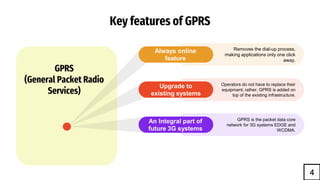
Key features of GPRS
Removes the dial-up process,
making applications only one click
away.
Always online
feature
GPRS is the packet data core
network for 3G systems EDGE and
WCDMA.
An Integral part of
future 3G systems
Operators do not have to replace their
equipment; rather, GPRS is added on
top of the existing infrastructure.
Upgrade to
existing systems
4
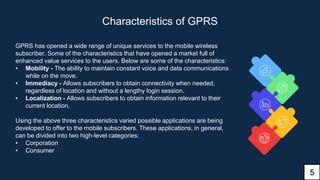
Characteristics of GPRS
GPRS has opened a wide range of unique services to the mobile wireless
subscriber. Some of the characteristics that have opened a market full of
enhanced value services to the users. Below are some of the characteristics:
• Mobility - The ability to maintain constant voice and data communications
while on the move.
• Immediacy - Allows subscribers to obtain connectivity when needed,
regardless of location and without a lengthy login session.
• Localization - Allows subscribers to obtain information relevant to their
current location.
Using the above three characteristics varied possible applications are being
developed to offer to the mobile subscribers. These applications, in general,
can be divided into two high-level categories:
• Corporation
• Consumer
5
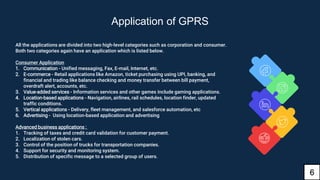
Application of GPRS
All the applications are divided into two high-level categories such as corporation and consumer.
Both two categories again have an application which is listed below.
Consumer Application
1. Communication - Unified messaging, Fax, E-mail, Internet, etc.
2. E-commerce - Retail applications like Amazon, ticket purchasing using UPI, banking, and
financial and trading like balance checking and money transfer between bill payment,
overdraft alert, accounts, etc.
3. Value-added services - Information services and other games include gaming applications.
4. Location-based applications - Navigation, airlines, rail schedules, location finder, updated
traffic conditions.
5. Vertical applications - Delivery, fleet management, and salesforce automation, etc
6. Advertising - Using location-based application and advertising
Advanced business applications :
1. Tracking of taxes and credit card validation for customer payment.
2. Localization of stolen cars.
3. Control of the position of trucks for transportation companies.
4. Support for security and monitoring system.
5. Distribution of specific message to a selected group of users.
6
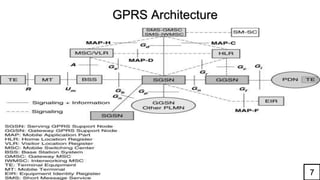
GPRS Architecture
7
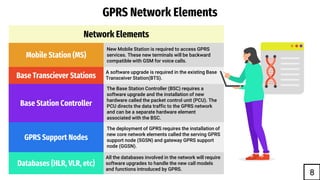
GPRS Network Elements
Network Elements
Mobile Station (MS)
New Mobile Station is required to access GPRS
services. These new terminals will be backward
compatible with GSM for voice calls.
Base Transciever Stations
A software upgrade is required in the existing Base
Transceiver Station(BTS).
Base Station Controller
The Base Station Controller (BSC) requires a
software upgrade and the installation of new
hardware called the packet control unit (PCU). The
PCU directs the data traffic to the GPRS network
and can be a separate hardware element
associated with the BSC.
GPRS Support Nodes
The deployment of GPRS requires the installation of
new core network elements called the serving GPRS
support node (SGSN) and gateway GPRS support
node (GGSN).
Databases (HLR, VLR, etc)
All the databases involved in the network will require
software upgrades to handle the new call models
and functions introduced by GPRS.
8
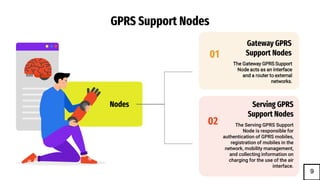
GPRS Support Nodes
Nodes
The Gateway GPRS Support
Node acts as an interface
and a router to external
networks.
Gateway GPRS
Support Nodes
01
The Serving GPRS Support
Node is responsible for
authentication of GPRS mobiles,
registration of mobiles in the
network, mobility management,
and collecting information on
charging for the use of the air
interface.
Serving GPRS
Support Nodes
02
9
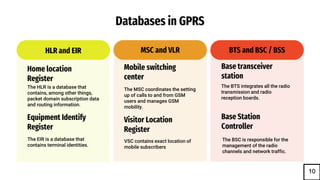
Databases in GPRS
HLR and EIR
Home location
Register
The HLR is a database that
contains, among other things,
packet domain subscription data
and routing information.
Equipment Identify
Register
The EIR is a database that
contains terminal identities.
MSC and VLR
Mobile switching
center
The MSC coordinates the setting
up of calls to and from GSM
users and manages GSM
mobility.
Base transceiver
station
The BTS integrates all the radio
transmission and radio
reception boards.
Visitor Location
Register
VSC contains exact location of
mobile subscribers
Base Station
Controller
The BSC is responsible for the
management of the radio
channels and network traffic.
BTS and BSC / BSS
10
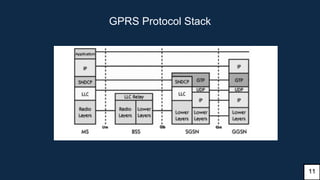
GPRS Protocol Stack
11
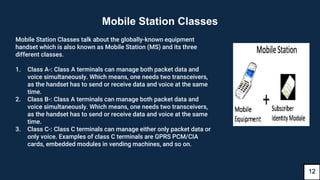
Mobile Station Classes
Mobile Station Classes talk about the globally-known equipment
handset which is also known as Mobile Station (MS) and its three
different classes.
1. Class A-: Class A terminals can manage both packet data and
voice simultaneously. Which means, one needs two transceivers,
as the handset has to send or receive data and voice at the same
time.
2. Class B-: Class A terminals can manage both packet data and
voice simultaneously. Which means, one needs two transceivers,
as the handset has to send or receive data and voice at the same
time.
3. Class C-: Class C terminals can manage either only packet data or
only voice. Examples of class C terminals are GPRS PCM/CIA
cards, embedded modules in vending machines, and so on.
12
Packet Data Protocol
• The PDP addresses are network layer addresses (Open Standards
Interconnect [OSI] model Layer 3). GPRS systems support both X.25
and IP network layer protocols. Therefore, PDP addresses can be
X.25, IP, or both.
• All packet data traffic sent from the public packet data network for
the PDP address goes through the gateway (GGSN).
• The public packet data network is only concerned that the address
belongs to a specific GGSN.
• When a MS is already attached to a SGSN and it is about to transfer
data, it must activate a PDP address. Activating a PDP address
establishes an association between the current SGSN of mobile
device and the GGSN that anchors the PDP address.
• The record kept by the SGSN and the GGSN regarding this
association is called the PDP context.
13
References
1. Tutorials point GPRS - Architecture (tutorialspoint.com)
2. General Packet Radio Service (GPRS): Architecture, interfaces, and deployment
3. Wireless Internet access based on GPRS
14

GPRS architecture

  • 1.
  • 2.
    Table of contents 01 AboutGPRS • What is GPRS? • Key features of GPRS References 04 Characterisitcs of GPRS • Characteristics of GPRS • Applications of GPRS 02 GPRS Architecture • Network elements • Support Nodes • Databases in GPRS • Protocol Stack • Mobile station classes • Packet data Protocol 03 2
  • 3.
    About GPRS ● GeneralPacket Radio System is also known as GPRS is a third-generation step toward internet access. GPRS is also known as GSM-IP that is a Global-System Mobile Communications Internet Protocol as it keeps the users of this system online, allows to make voice calls, and access internet on-the-go. ● The GPRS specifications are written by the European Telecommunications Standard Institute (ETSI), the European counterpart of the American National Standard Institute (ANSI). ● In the current versions of GPRS, networks based on the Internet Protocol (IP) like the global internet or private/corporate intranets and X.25 networks are supported ● In the current versions of GPRS, networks based on the Internet Protocol (IP) like the global internet or private/corporate intranets and X.25 networks are supported 3
  • 4.
    GPRS (General Packet Radio Services) Keyfeatures of GPRS Removes the dial-up process, making applications only one click away. Always online feature GPRS is the packet data core network for 3G systems EDGE and WCDMA. An Integral part of future 3G systems Operators do not have to replace their equipment; rather, GPRS is added on top of the existing infrastructure. Upgrade to existing systems 4
  • 5.
    Characteristics of GPRS GPRShas opened a wide range of unique services to the mobile wireless subscriber. Some of the characteristics that have opened a market full of enhanced value services to the users. Below are some of the characteristics: • Mobility - The ability to maintain constant voice and data communications while on the move. • Immediacy - Allows subscribers to obtain connectivity when needed, regardless of location and without a lengthy login session. • Localization - Allows subscribers to obtain information relevant to their current location. Using the above three characteristics varied possible applications are being developed to offer to the mobile subscribers. These applications, in general, can be divided into two high-level categories: • Corporation • Consumer 5
  • 6.
    Application of GPRS Allthe applications are divided into two high-level categories such as corporation and consumer. Both two categories again have an application which is listed below. Consumer Application 1. Communication - Unified messaging, Fax, E-mail, Internet, etc. 2. E-commerce - Retail applications like Amazon, ticket purchasing using UPI, banking, and financial and trading like balance checking and money transfer between bill payment, overdraft alert, accounts, etc. 3. Value-added services - Information services and other games include gaming applications. 4. Location-based applications - Navigation, airlines, rail schedules, location finder, updated traffic conditions. 5. Vertical applications - Delivery, fleet management, and salesforce automation, etc 6. Advertising - Using location-based application and advertising Advanced business applications : 1. Tracking of taxes and credit card validation for customer payment. 2. Localization of stolen cars. 3. Control of the position of trucks for transportation companies. 4. Support for security and monitoring system. 5. Distribution of specific message to a selected group of users. 6
  • 7.
  • 8.
    GPRS Network Elements NetworkElements Mobile Station (MS) New Mobile Station is required to access GPRS services. These new terminals will be backward compatible with GSM for voice calls. Base Transciever Stations A software upgrade is required in the existing Base Transceiver Station(BTS). Base Station Controller The Base Station Controller (BSC) requires a software upgrade and the installation of new hardware called the packet control unit (PCU). The PCU directs the data traffic to the GPRS network and can be a separate hardware element associated with the BSC. GPRS Support Nodes The deployment of GPRS requires the installation of new core network elements called the serving GPRS support node (SGSN) and gateway GPRS support node (GGSN). Databases (HLR, VLR, etc) All the databases involved in the network will require software upgrades to handle the new call models and functions introduced by GPRS. 8
  • 9.
    GPRS Support Nodes Nodes TheGateway GPRS Support Node acts as an interface and a router to external networks. Gateway GPRS Support Nodes 01 The Serving GPRS Support Node is responsible for authentication of GPRS mobiles, registration of mobiles in the network, mobility management, and collecting information on charging for the use of the air interface. Serving GPRS Support Nodes 02 9
  • 10.
    Databases in GPRS HLRand EIR Home location Register The HLR is a database that contains, among other things, packet domain subscription data and routing information. Equipment Identify Register The EIR is a database that contains terminal identities. MSC and VLR Mobile switching center The MSC coordinates the setting up of calls to and from GSM users and manages GSM mobility. Base transceiver station The BTS integrates all the radio transmission and radio reception boards. Visitor Location Register VSC contains exact location of mobile subscribers Base Station Controller The BSC is responsible for the management of the radio channels and network traffic. BTS and BSC / BSS 10
  • 11.
  • 12.
    Mobile Station Classes MobileStation Classes talk about the globally-known equipment handset which is also known as Mobile Station (MS) and its three different classes. 1. Class A-: Class A terminals can manage both packet data and voice simultaneously. Which means, one needs two transceivers, as the handset has to send or receive data and voice at the same time. 2. Class B-: Class A terminals can manage both packet data and voice simultaneously. Which means, one needs two transceivers, as the handset has to send or receive data and voice at the same time. 3. Class C-: Class C terminals can manage either only packet data or only voice. Examples of class C terminals are GPRS PCM/CIA cards, embedded modules in vending machines, and so on. 12
  • 13.
    Packet Data Protocol •The PDP addresses are network layer addresses (Open Standards Interconnect [OSI] model Layer 3). GPRS systems support both X.25 and IP network layer protocols. Therefore, PDP addresses can be X.25, IP, or both. • All packet data traffic sent from the public packet data network for the PDP address goes through the gateway (GGSN). • The public packet data network is only concerned that the address belongs to a specific GGSN. • When a MS is already attached to a SGSN and it is about to transfer data, it must activate a PDP address. Activating a PDP address establishes an association between the current SGSN of mobile device and the GGSN that anchors the PDP address. • The record kept by the SGSN and the GGSN regarding this association is called the PDP context. 13
  • 14.
    References 1. Tutorials pointGPRS - Architecture (tutorialspoint.com) 2. General Packet Radio Service (GPRS): Architecture, interfaces, and deployment 3. Wireless Internet access based on GPRS 14

Editor's Notes

  • #10 A Gateway GPRS Support Node (GGSN) is part of the core network that connects GSM-based 3G networks to the Internet. The GGSN, sometimes known as a wireless router, works in tandem with the Serving GPRS Support Node (SGSN) to keep mobile users connected to the Internet and IP-based applications. The GGSN converts incoming data traffic from mobile users (via the SGSN) and forwards it to the relevant network, and vice versa. So, for instance, a Google query from a smartphone would be routed via the SGSN to the GGSN and sent on as a query to the Internet search engine, then the process would be reversed for the reply to the phone user. The GGSN and the SGSN together form the GPRS support nodes (GSN). The GGSN is also linked into hosted services (such as voice and video) and to the billing, policy control, and user verification elements of the core network. GGSN vendors include Alcatel-Lucent (NYSE: ALU), Cisco Systems Inc. (Nasdaq: CSCO), Ericsson AB (Nasdaq: ERIC), and Nokia Networks .