1
GPRS
i
AbouttheTutorial
General Packet Radio Service (GPRS) is a Mobile Data Service accessible to GSM and IS-
136 mobile phones users. This service is packet-switched where several number of users
can divide the same transmission channel for transmitting the data. This tutorial will help
you understand the basics of GPRS.
Audience
This tutorial is prepared for beginners to help them understand the basic-to-advanced
concepts related to GPRS.
Prerequisites
Before starting your practice with varied examples given in this reference, we assume that
you are already aware of the basic terminologies used in Telecom domain.
Disclaimer&Copyright
 Copyright 2015 by Tutorials Point (I) Pvt. Ltd.
All the content and graphics published in this e-book are the property of Tutorials Point (I)
Pvt. Ltd. The user of this e-book is prohibited to reuse, retain, copy, distribute, or republish
any contents or a part of contents of this e-book in any manner without written consent
of the publisher.
We strive to update the contents of our website and tutorials as timely and as precisely as
possible, however, the contents may contain inaccuracies or errors. Tutorials Point (I) Pvt.
Ltd. provides no guarantee regarding the accuracy, timeliness, or completeness of our
website or its contents including this tutorial. If you discover any errors on our website or
in this tutorial, please notify us at contact@tutorialspoint.com
GPRS
ii
TableofContents
About the Tutorial..................................................................................................................................i
Audience ................................................................................................................................................i
Prerequisites ..........................................................................................................................................i
Disclaimer & Copyright...........................................................................................................................i
Table of Contents ..................................................................................................................................ii
1. GPRS – OVERVIEW.............................................................................................................1
Who Owns GPRS?..................................................................................................................................1
Key Features..........................................................................................................................................1
Goals of GPRS........................................................................................................................................1
Benefits of GPRS....................................................................................................................................2
2. GPRS – APPLICATIONS........................................................................................................3
Characteristics of GPRS..........................................................................................................................3
3. GPRS – ARCHITECTURE ......................................................................................................5
GPRS Architecture Diagram ...................................................................................................................5
GPRS Mobile Stations ............................................................................................................................6
GPRS Base Station Subsystem ...............................................................................................................6
GPRS Support Nodes .............................................................................................................................7
Internal Backbone .................................................................................................................................7
Routing Area .........................................................................................................................................7
4. GPRS – PROTOCOL STACK..................................................................................................8
5. GPRS – QUALITY OF SERVICE..............................................................................................9
Service Precedence................................................................................................................................9
Reliability ............................................................................................................................................10
Delay ...................................................................................................................................................10
Throughput .........................................................................................................................................10
GPRS
iii
6. GPRS – MOBILE STATION CLASSES...................................................................................11
Class A.................................................................................................................................................11
Class B .................................................................................................................................................11
Class C .................................................................................................................................................12
7. GPRS – PDP CONTEXT ......................................................................................................13
PDP Structure ......................................................................................................................................13
8. GPRS – DATA ROUTING....................................................................................................15
Data Packet Routing ............................................................................................................................15
Mobility Management.........................................................................................................................15
Routing Updates..................................................................................................................................16
9. GPRS – ACCESS MODES & ACCESS POINT NAMES............................................................17
Transparent Mode...............................................................................................................................17
Non-Transparent Mode.......................................................................................................................17
GPRS Access Point Name.....................................................................................................................17
10. GPRS – NETWORK PROCESSES .........................................................................................18
Types of Process..................................................................................................................................18
11. GPRS – BILLING TECHNIQUES...........................................................................................20
12. GPRS – MOBILE PHONES..................................................................................................21
13. GPRS – SUMMARY ...........................................................................................................23
What is Next?......................................................................................................................................23
1
General Packet Radio System is also known as GPRS is a third-generation step toward
internet access. GPRS is also known as GSM-IP that is a Global-System Mobile
Communications Internet Protocol as it keeps the users of this system online, allows to
make voice calls, and access internet on-the-go. Even Time-Division Multiple Access
(TDMA) users get benefit from this system, as it provides packet radio access.
GPRS also permits the network operators to execute an Internet Protocol (IP) based core
architecture for integrated voice and data applications, which continues to be used and
expanded for 3G services.
GPRS supersedes the wired connections, as this system has simplified access to the packet
data networks like the internet. The packet radio principle is employed by GPRS to
transport user data packets in a structural way between GSM mobile stations and external
packet data networks. These packets can be directly routed to the packet switched
networks from the GPRS mobile stations.
In the current versions of GPRS, networks based on the Internet Protocol (IP) like the
global internet or private/corporate intranets and X.25 networks are supported.
WhoOwnsGPRS?
The GPRS specifications are written by the European Telecommunications Standard
Institute (ETSI), the European counterpart of the American National Standard Institute
(ANSI).
KeyFeatures
Following three key features describe wireless packet data:
 Always online feature - Removes the dial-up process, making applications only
one click away.
 Upgrade to existing systems - Operators do not need to replace their
equipment; rather, GPRS is added on top of the existing infrastructure.
 An integral part of future 3G systems - GPRS is the packet data core network
for 3G systems EDGE and WCDMA.
GoalsofGPRS
GPRS is the first step toward an end-to-end wireless infrastructure and has the following
goals:
 Open architecture
 Consistent IP services
 Same infrastructure for different air interfaces
1. GPRS – OVERVIEW
GPRS
2
 Integrated telephony and Internet infrastructure
 Leverage industry investment in IP
 Service innovation independent of infrastructure
BenefitsofGPRS
Higher Data Rate
GPRS benefits the users in many ways, one of which is higher data rates in turn of shorter
access times. In the typical GSM mobile, setup alone is a lengthy process, and equally
rates for data permission are restrained to 9.6 kbps. The session establishment time
offered while GPRS is in practice is lower than one second and ISDN-line data rates are up
to many 10 kbps.
Easy Billing
GPRS packet transmission offers a more user-friendly billing than that of circuit switched
services. In circuit switched services, billing is based on the duration of the connection.
This is unsuitable for applications with bursty traffic. The user must pay for the entire
airtime, even for the idle periods when no packet has been sent (e.g., when the user reads
a Web page).
In contrast to this, with packet switched services, billing can be based on the amount of
transmitted data. The advantage for the user is that he or she can be "online" over a long
period of time but will be billed based on the transmitted data volume only.
GPRS
3
GPRS has opened a wide range of unique services to the mobile wireless subscribers.
CharacteristicsofGPRS
Following are some of the characteristics that have opened a market full of enhanced value
services to the users:
 Mobility - The ability to maintain constant voice and data communications while
on the move.
 Immediacy - Allows subscribers to obtain connectivity when needed, regardless
of location and without a lengthy login session.
 Localization - Allows subscribers to obtain information relevant to their current
location.
Using the above three characteristics, varied possible applications are being developed for
the mobile subscribers. These applications, in general, can be divided into two high-level
categories:
 Corporation
 Consumer
Characteristics
Mobility
ImmediacyLocalization
2. GPRS – APPLICATIONS
GPRS
4
These two levels further include:
 Communications - E-mail, fax, unified messaging, and intranet/internet access,
etc.
 Value-added services - Information services, games, etc.
 E-commerce - Retail, ticket purchasing, banking and financial trading, etc.
 Location-based applications - Navigation, traffic conditions, airline/rail
schedules, location finder, etc.
 Vertical applications - Freight delivery, fleet management, and sales-force
automation.
 Advertising - Advertising may be location sensitive. For example, a user entering
a mall can receive advertisements specific to the stores in that mall.
Along with the above applications, non-voice services such as SMS, MMS, and voice calls
are also possible with GPRS. Closed User Group (CUG) is a common term used after GPRS
is in the market. In addition, it is planned to implement supplementary services, such as
Call Forwarding Unconditional (CFU), and Call Forwarding on Mobile subscriber Not
Reachable (CFNRc), and Closed User Group (CUG).
GPRS
5
GPRS architecture works on the same procedure like GSM network, but it has some
additional entities that allow packet data transmission. This data network overlaps a
second-generation GSM network providing packet data transport at the rates of 9.6 to 171
kbps. Along with the packet data transport, the GSM network accommodates multiple
users to share the same air interface resources concurrently.
GPRSArchitectureDiagram
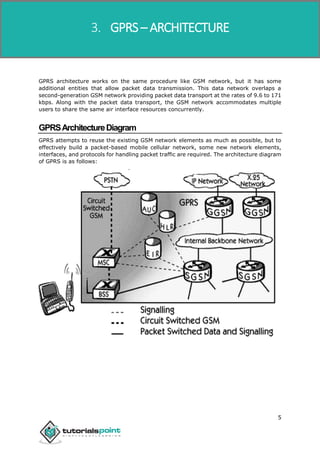
GPRS attempts to reuse the existing GSM network elements as much as possible, but to
effectively build a packet-based mobile cellular network, some new network elements,
interfaces, and protocols for handling packet traffic are required. The architecture diagram
of GPRS is as follows:
3. GPRS – ARCHITECTURE
GPRS
6
GPRS requires modifications to numerous GSM network elements as summarized below:
GSM Network Element Modification or Upgrade Required for GPRS
Mobile Station (MS)
New Mobile Station is required to access GPRS services.
These new terminals will be backward compatible with
GSM for voice calls.
BTS
A software upgrade is required in the existing Base
Transceiver Station (BTS).
BSC
The Base Station Controller (BSC) requires a software
upgrade and the installation of a new hardware called
the ‘packet control unit (PCU).’ The PCU directs the
data traffic to the GPRS network and can be a separate
hardware element associated with the BSC.
GPRS Support Nodes (GSNs)
The deployment of GPRS requires the installation of
new core network elements called the ‘serving GPRS
support node (SGSN)’ and ‘gateway GPRS support node
(GGSN).’
Databases (HLR, VLR, etc.)
All the databases involved in the network will require
software upgrades to handle the new call models and
functions introduced by GPRS.
GPRSMobileStations
New Mobile Stations (MS) are required to use GPRS services because existing GSM phones
do not handle the enhanced air interface or packet data. A variety of MS can exist,
including a high-speed version of current phones to support high-speed data access, a
new PDA device with an embedded GSM phone, and PC cards for laptop computers. These
mobile stations are backward compatible for making voice calls using GSM.
GPRSBaseStationSubsystem
Each BSC requires the installation of one or more Packet Control Units (PCUs) and a
software upgrade. The PCU provides a physical and logical data interface to the Base
Station Subsystem (BSS) for packet data traffic. The BTS can also require a software
upgrade, but typically does not require hardware enhancements.
When either voice or data traffic is originated at the subscriber mobile, it is transported
over the air interface to the BTS, and from the BTS to the BSC in the same way as a
standard GSM call. However, at the output of the BSC, the traffic is separated; voice is
sent to the Mobile Switching Center (MSC) per standard GSM, and data is sent to a new
device called the SGSN via the PCU over a Frame Relay interface.
GPRS
7
GPRSSupportNodes
Further, the following two new components, called Gateway GPRS Support Nodes (GSNs)
and, Serving GPRS Support Node (SGSN) are added:
Gateway GPRS Support Node (GGSN)
The Gateway GPRS Support Node acts as an interface and a router to external networks.
It contains routing information for GPRS mobiles, which is used to tunnel packets through
the IP based internal backbone to the correct Serving GPRS Support Node. The GGSN also
collects charging information connected to the use of the external data networks and can
act as a packet filter for incoming traffic.
Serving GPRS Support Node (SGSN)
The Serving GPRS Support Node is responsible for authentication of GPRS mobiles,
registration of mobiles in the network, mobility management, and collecting information
on charging for the use of the air interface.
InternalBackbone
The internal backbone is an IP based network used to carry packets between different
GSNs. Tunneling is used between SGSNs and GGSNs, so the internal backbone does not
need any information about domains outside the GPRS network. Signaling from a GSN to
a MSC, HLR, or EIR is done using SS7.
RoutingArea
GPRS introduces the concept of a Routing Area. This concept is similar to Location Area in
GSM, except that it generally contains fewer cells. Because routing areas are smaller than
location areas, less radio resources are used while broadcasting a page message.
GPRS
8
The flow of GPRS protocol stack and end-to-end message from the MS to the GGSN is
displayed in the below diagram. GTP is the protocol used between SGSN and GGSN using
the Gn interface. This is a Layer 3 tunneling protocol.
The process that takes place in the application looks like a normal IP sub-network for the
users, both inside and outside the network. The vital thing that needs attention is, the
application communicates via standard IP, that is carried through the GPRS network and
out through the gateway GPRS. The packets that are mobile between the GGSN and the
SGSN use the GPRS tunneling protocol, this way the IP addresses located on the external
side of the GPRS network do not have deal with the internal backbone. GTP runs UDP and
IP.
Sub-Network Dependent Convergence Protocol (SNDCP) and Logical Link Control (LLC)
combination used between the SGSN and the MS. The SNDCP flattens data to reduce the
load on the radio channel. A safe logical link by encrypting packets is provided by LLC and
the same LLC link is used as long as a mobile is under a single SGSN.
In case, the mobile moves to a new routing area that lies under a different SGSN; then,
the old LLC link is removed and a new link is established with the new Serving GSN X.25.
Services are provided by running X.25 on top of TCP/IP in the internal backbone.
4. GPRS – PROTOCOL STACK
GPRS
9
Quality of Service (QoS) requirements for the conventional mobile packet data applications
are in assorted forms. QoS is a vital feature of GPRS services, as there are different QoS
support requirements for assorted GPRS applications such as real-time multimedia, web
browsing, and e-mail transfer.
GPRS allows to define QoS profiles using the following parameters:
Figure: QoS Parameters
ServicePrecedence
The preference given to a service when compared to another service is known as Service
Precedence. This level of priority is classified into three levels called as:
 High
 Normal
 Low
QoS
parameters
Service
Precedence
Reliability
Delay
Throughput
5. GPRS – QUALITY OF SERVICE
GPRS
10
When there is a network congestion, the packets of low priority are discarded as compared
to high or normal priority packets.
Reliability
This parameter signifies the transmission characteristics required for an application. The
reliability classes are defined, which guarantee certain maximum values for the probability
of loss, duplication, miss-sequencing, and corruption of packets.
Delay
The delay is defined as the end-to-end transfer time between two communicating mobile
stations or between a mobile station and the GI interface to an external packet data
network.
This includes all delays within the GPRS network, e.g., the delay for request and
assignment of radio resources and the transit delay in the GPRS backbone network.
Transfer delays outside the GPRS network, e.g., in external transit networks, are not taken
into account.
Throughput
The throughput specifies the maximum/peak bit rate and the mean bit rate.
Using these QoS classes, QoS profiles can be negotiated between the mobile user and the
network for each session, depending on the QoS demand and the available resources.
The billing of the service is then based on the transmitted data volume, the type of service,
and the chosen QoS profile.
GPRS
11
Mobile Station Classes talk about the globally-known equipment handset, which is also
known as Mobile Station (MS) and its three different classes. This equipment, more popular
as handset, is used to make phone calls and access data services. The MS comprises of
Terminal Equipment (TE) and Mobile Terminal (MT).
TE is the equipment that accommodates the applications and the user interaction, while
the MT is the part that connects to the network.
In the following example, Palm Pilot is TE and Mobile phone is MT.
In order to take advantage of the new GPRS services, we need new GPRS enabled
handsets.
Following are the different classes of GPRS terminal equipment:
ClassA
Class A terminals can manage both packet data and voice simultaneously. It means, one
needs two transceivers, as the handset has to send or receive data and voice at the same
time. This is the main reason why class A terminals are high-priced to manufacture than
Class B and C terminals.
ClassB
Class B terminals do not play the same role as Class A. These terminals can manage either
packet data or voice at a time. One can use a single transceiver for both, resulting in the
low cost of terminals.
6. GPRS – MOBILE STATIONCLASSES
GPRS
12
For example, if a user is using the GPRS session (like WAP browsing, file transfer, etc.)
then this session is halted if he or she receives a call. This terminal does not allow both
the sessions active in one go. This backlog needs rectification, thereby giving the user a
facility of both receiving a call and maintaining the data session.
ClassC
Class C terminals can manage either only packet data or only voice. Examples of Class C
terminals are GPRS PCM/CIA cards, embedded modules in vending machines, and so on.
Due to the high cost of Class A handsets, most handset manufacturers have announced
that their first handsets will be Class B. Currently, work is going on in 3GPP to standardize
a lightweight Class A in order to make handsets with simultaneous voice and data available
at a reasonable cost.
GPRS
13
PDP stands for Packet Data Protocol. The PDP addresses are the network layer addresses
(Open Standards Interconnect [OSI] model Layer 3). GPRS systems support both X.25
and IP network layer protocols. Therefore, PDP addresses can be X.25, IP, or both.
PDPStructure
Each PDP address is anchored at a Gateway GPRS Support Node (GGSN), as shown in the
figure below. All packet data traffic sent from the public packet data network for the PDP
address goes through the gateway (GGSN).
The public packet data network is only concern that the address belongs to a specific
GGSN. The GGSN hides the mobility of the station from the rest of the packet data network
and from computers connected to the public packet data network.
Statically assigned PDP addresses are usually anchored at a GGSN in the subscriber's home
network. Conversely, dynamically assigned PDP addresses can be anchored either in the
subscriber's home network or the network where the user is visiting.
When a MS is already attached to a SGSN and it is about to transfer data, it must activate
a PDP address. Activating a PDP address establishes an association between the current
SGSN of mobile device and the GGSN that anchors the PDP address.
The record kept by the SGSN and the GGSN regarding this association is called
the PDP context.
7. GPRS – PDP CONTEXT
GPRS
14
It is important to understand the difference between a MS attaching to a SGSN and a MS
activating a PDP address. A single MS attaches to only one SGSN, however, it may have
multiple PDP addresses that are all active at the same time.
Each of the addresses may be anchored to a different GGSN. If packets arrive from the
public packet data network at a GGSN for a specific PDP address and the GGSN does not
have an active PDP context corresponding to that address, it may simply discard the
packets. Conversely, the GGSN may attempt to activate a PDP context with an MS if the
address is statically assigned to a particular mobile device.
GPRS
15
Data routing or routing of data packets to and fro from a mobile user, is one of the pivot
requisites in the GPRS network. The requirement can be divided into the following two
areas:
 Data Packet Routing
 Mobility Management
DataPacketRouting
The important roles of GGSN involve synergy with the external data network. The GGSN
updates the location directory using routing information supplied by the SGSNs about the
location of an MS. It routes the external data network protocol packet encapsulated over
the GPRS backbone to the SGSN currently serving the MS. It also decapsulates and
forwards external data network packets to the appropriate data network and collects
charging data that is forwarded to a charging gateway (CG).
Following are the three important routing schemes:
 Mobile-originated message - This path begins at the GPRS mobile device and
ends at the host.
 Network-initiated message when the MS is in its home network - This path
begins at the host and ends at the GPRS mobile device.
 Network-initiated message when the MS roams to another GPRS network
-This path begins at the host of visited network and ends at the GPRS mobile
device.
The GPRS network encapsulates all data network protocols into its own encapsulation
protocol called the GPRS Tunneling Protocol (GTP). The GTP ensures security in the
backbone network and simplifies the routing mechanism and the delivery of data over the
GPRS network.
MobilityManagement
The operation of the GPRS is partly independent of the GSM network. However, some
procedures share the network elements with the current GSM functions to increase
efficiency and to make optimum use of free GSM resources (such as unallocated time
slots).
An MS can be in any of the following three states in the GPRS system. The three-state
model is unique to packet radio. GSM uses a two-state model either Idle or Active.
Active State
When the MS is in the active state, data is transmitted between an MS and the GPRS
network only. In the active state, the SGSN knows the cell location of the MS.
8. GPRS – DATA ROUTING
GPRS
16
Packet transmission to an active MS is initiated by packet paging to notify the MS of an
incoming data packet. The data transmission proceeds immediately after packet paging
through the channel indicated by the paging message. The purpose of the paging message
is to simplify the process of receiving packets. The MS listens to only the paging messages
instead of to all the data packets in the downlink channels. This reduces battery usage
significantly.
When an MS has a packet to transmit, it must access the uplink channel (i.e., the channel
to the packet data network where services reside). The uplink channel is shared by a
number of MSs, and its use is allocated by a BSS. The MS requests use of the channel in
a random access message. The BSS allocates an unused channel to the MS and sends an
access grant message in reply to the random access message.
Standby State
In the standby state, only the routing area of the MS is known. (The routing area can
consist of one or more cells within a GSM location area).
When the SGSN sends a packet to an MS that is in the standby state, the MS must be
paged. Because the SGSN knows the routing area of the MS, a packet paging message is
sent to the routing area. On receiving the packet paging message, the MS relays its cell
location to the SGSN to establish the active state.
Idle State
In the idle state, the MS does not have a logical GPRS context activated or any Packet-
Switched Public Data Network (PSPDN) addresses allocated. In this state, the MS can
receive only those multicast messages, which can be received by any GPRS MS. Because
the GPRS network infrastructure does not know the location of the MS, it is not possible
to send messages to the MS from the external data networks.
RoutingUpdates
When an MS that is in an active or a standby state, moves from one routing area to another
within the service area of one SGSN, it must perform a routing update. The routing area
information in the SGSN is updated, and the success of the procedure is indicated in the
response message.
A cell-based routing update procedure is invoked when an active MS enters a new cell.
The MS sends a short message containing the identity of the MS and its new location
through GPRS channels to its current SGSN. This procedure is used only when the MS is
in the active state.
The inter-SGSN routing update is the most complicated routing update. The MS changes
from one SGSN area to another, and it must establish a new connection to a new SGSN.
This means, creating a new logical link context between the MS and the new SGSN and
informing the GGSN about the new location of the MS.
GPRS
17
The GPRS access modes specify whether or not the GGSN requests user authentication at
the access point to a Public Data Network (PDN). The available options are:
 Transparent - No security authorization/authentication is requested by the GGSN.
 Non-transparent - In this case, GGSN acts as a proxy for authentication.
The GPRS transparent and non-transparent modes relate only to PDP type IPv4.
TransparentMode
Transparent access pertains to a GPRS PLMN that is not involved in subscriber access
authorization and authentication. Access to PDN-related security procedures are
transparent to GSNs.
In transparent access mode, the MS is given an address belonging to the operator or any
other addressing space of domain. The address is given either at subscription as a static
address or at PDP context activation, as a dynamic address. The dynamic address is
allocated from a Dynamic Host Configuration Protocol (DHCP) server in the GPRS
network. Any user authentication is done within the GPRS network. No RADIUS
authentication is performed; only IMSI-based authentication (from the subscriber identity
module in the handset) is done.
Non-TransparentMode
Non-transparent access to an intranet/ISP means, the PLMN plays a role in the
intranet/ISP authentication of the MS. Non-transparent access uses the Password
Authentication Protocol (PAP) or Challenge Handshake Authentication Protocol (CHAP)
message issued by the mobile terminal and piggybacked in the GTP PDP context activation
message. This message is used to build a RADIUS request toward the RADIUS server
associated with the access point name (APN).
GPRSAccessPointName
The GPRS standards define a network identity called an Access Point Name (APN). An APN
identifies a PDN that is accessible from a GGSN node in a GPRS network. In GPRS, only
the APN is used to select the target network. To configure an APN, the operator configures
the following three elements on the GSN node:
 Access Point - Defines an APN and its associated access characteristics, including
security (RADIUS), dynamic address allocation (DHCP), and DNS services.
 Access Point List - Defines a logical interface that is associated with the virtual
template.
 Access Group - Defines whether access is permitted between the PDN and the
MS.
9. GPRS – ACCESS MODES & ACCESS POINT NAMES
GPRS
18
This chapter gives a brief description of the basic processes used in GPRS networks.
TypesofProcess
Following are the important types of process:
 Attach process - Process by which the MS attaches (i.e., connects) to the SGSN
in a GPRS network.
 Authentication process - Process by which the SGSN authenticates the mobile
subscriber.
 PDP activation process - Process by which a user session is established between
the MS and the destination network.
Figure: Network Process
 Detach process - Process by which the MS detaches (i.e., disconnects) from the
SGSN in the GPRS network.
 Network-initiated PDP request for static IP address - Process by which a call
from the packet data network reaches to the MS using a static IP address.
Network
Processes
Attach
Authentica-
tion
PDP
Activation
Detach
Static IP
Address
Dynamic IP
Address
10. GPRS – NETWORK PROCESSES
GPRS
19
 Network-initiated PDP request for dynamic IP address - Process by which a
call from the packet data network reaches to the MS using a dynamic IP address.
GPRS
20
As packet data is introduced into mobile systems, the question of how to bill for the
services arises. Always online and paying by the minute does not sound all that appealing.
Here, we describe the possibilities, but it totally depends on different service providers,
how they want to charge their customers.
The SGSN and GGSN register all possible aspects of a GPRS user's behavior and generate
billing information accordingly. This information is gathered in so-called Charging Data
Records (CDR) and is delivered to a billing gateway.
The GPRS service charging can be based on the following parameters:
 Volume - The amount of bytes transferred, i.e., downloaded and uploaded.
 Duration - The duration of a PDP context session.
 Time - Date, time of day, and day of the week (enabling lower tariffs at off-peak
hours).
 Final destination - A subscriber could be charged for access to the specific
network, such as through a proxy server.
 Location - The current location of the subscriber.
 Quality of Service - Pay more for higher network priority.
 SMS - The SGSN will produce specific CDRs for SMS.
 Served IMSI/subscriber - Different subscriber classes (different tariffs for
frequent users, businesses, or private users).
 Reverse charging - The receiving subscriber is not charged for the received data;
instead, the sending party is charged.
 Free of charge - Specified data to be free of charge.
 Flat rate - A fixed monthly fee.
 Bearer service - Charging based on different bearer services (for an operator who
has several networks, such as GSM900 and GSM1800, and who wants to promote
usage of one of the networks). Or, perhaps the bearer service would be good for
areas where it would be cheaper for the operator to offer services through a
wireless LAN rather than through the GSM network.
11. GPRS – BILLING TECHNIQUES
GPRS
21
GPRS has almost become a default or a mandatory feature of the latest GSM phones. In
case you have plan to buy a GPRS enabled mobile phone, then; GSM mobile phone should
be opted instead of going for a CDMA technology.
12. GPRS – MOBILE PHONES
GPRS
22
At present, numerous noted mobile device manufacturers provide state–of-the-art mobile
handsets, important of them are:
Alcatel Amoi
Apple Asus
Benefon BenQ
BenQ-Siemens Bird
BlackBerry Bosch
Chea Ericsson
Eten Fujitsu Siemens
Gigabyte Haier
HP HTC
i-mate Innostream
Kyocera LG
Maxon Mitac
Mitsubishi Motorola
NEC Neonode
Nokia O2
Palm Panasonic
Pantech Philips
Qtek Sagem
Samsung Sendo
Sewon Sharp
Siemens Sony
Sony Ericsson Tel.Me.
Telit Thuraya
Toshiba Vertu
VK Mobile WND
XCute
GPRS
23
In this tutorial, we have discussed all the basic concepts related to GPRS technology. Hope,
now you have basic understanding of GPRS Technology.
You have learnt about GPRS basic overview, its architecture, a short description of GSM
protocol stack and available GPRS applications. We also explained you how you can charge
GPRS services.
A list of all the important GPRS Acronyms has been given for your quick reference. So,
you can book mark this page for future reference.
WhatisNext?
We have now seen that GPRS is a crucial step in the mobile evolution, and it opens endless
possibilities for the application developers and the users. The next step after GPRS can be
either EDGE or UMTS (or both).
 Enhanced Data rate for GSM Evolution (EDGE): Using a new modulation
scheme to provide up to three times higher throughput (for HSCSD and GPRS)
 Universal Mobile Telecommunication System (UMTS): A new wireless
technology using new infrastructure deployment.
If you are not aware of GSM technology, then our simple GSM tutorial will give you a very
good start up.
Now, if you need more detail about GPRS technology, then I would recommend you to go
through other GSM resources listed in GPRS Useful Resources chapter.
Please send me your feedback and suggestion at webmaster@tutorialspoint.com.
13. GPRS – SUMMARY

Gprs tutorial

  • 1.
  • 2.
    GPRS i AbouttheTutorial General Packet RadioService (GPRS) is a Mobile Data Service accessible to GSM and IS- 136 mobile phones users. This service is packet-switched where several number of users can divide the same transmission channel for transmitting the data. This tutorial will help you understand the basics of GPRS. Audience This tutorial is prepared for beginners to help them understand the basic-to-advanced concepts related to GPRS. Prerequisites Before starting your practice with varied examples given in this reference, we assume that you are already aware of the basic terminologies used in Telecom domain. Disclaimer&Copyright  Copyright 2015 by Tutorials Point (I) Pvt. Ltd. All the content and graphics published in this e-book are the property of Tutorials Point (I) Pvt. Ltd. The user of this e-book is prohibited to reuse, retain, copy, distribute, or republish any contents or a part of contents of this e-book in any manner without written consent of the publisher. We strive to update the contents of our website and tutorials as timely and as precisely as possible, however, the contents may contain inaccuracies or errors. Tutorials Point (I) Pvt. Ltd. provides no guarantee regarding the accuracy, timeliness, or completeness of our website or its contents including this tutorial. If you discover any errors on our website or in this tutorial, please notify us at contact@tutorialspoint.com
  • 3.
    GPRS ii TableofContents About the Tutorial..................................................................................................................................i Audience................................................................................................................................................i Prerequisites ..........................................................................................................................................i Disclaimer & Copyright...........................................................................................................................i Table of Contents ..................................................................................................................................ii 1. GPRS – OVERVIEW.............................................................................................................1 Who Owns GPRS?..................................................................................................................................1 Key Features..........................................................................................................................................1 Goals of GPRS........................................................................................................................................1 Benefits of GPRS....................................................................................................................................2 2. GPRS – APPLICATIONS........................................................................................................3 Characteristics of GPRS..........................................................................................................................3 3. GPRS – ARCHITECTURE ......................................................................................................5 GPRS Architecture Diagram ...................................................................................................................5 GPRS Mobile Stations ............................................................................................................................6 GPRS Base Station Subsystem ...............................................................................................................6 GPRS Support Nodes .............................................................................................................................7 Internal Backbone .................................................................................................................................7 Routing Area .........................................................................................................................................7 4. GPRS – PROTOCOL STACK..................................................................................................8 5. GPRS – QUALITY OF SERVICE..............................................................................................9 Service Precedence................................................................................................................................9 Reliability ............................................................................................................................................10 Delay ...................................................................................................................................................10 Throughput .........................................................................................................................................10
  • 4.
    GPRS iii 6. GPRS –MOBILE STATION CLASSES...................................................................................11 Class A.................................................................................................................................................11 Class B .................................................................................................................................................11 Class C .................................................................................................................................................12 7. GPRS – PDP CONTEXT ......................................................................................................13 PDP Structure ......................................................................................................................................13 8. GPRS – DATA ROUTING....................................................................................................15 Data Packet Routing ............................................................................................................................15 Mobility Management.........................................................................................................................15 Routing Updates..................................................................................................................................16 9. GPRS – ACCESS MODES & ACCESS POINT NAMES............................................................17 Transparent Mode...............................................................................................................................17 Non-Transparent Mode.......................................................................................................................17 GPRS Access Point Name.....................................................................................................................17 10. GPRS – NETWORK PROCESSES .........................................................................................18 Types of Process..................................................................................................................................18 11. GPRS – BILLING TECHNIQUES...........................................................................................20 12. GPRS – MOBILE PHONES..................................................................................................21 13. GPRS – SUMMARY ...........................................................................................................23 What is Next?......................................................................................................................................23
  • 5.
    1 General Packet RadioSystem is also known as GPRS is a third-generation step toward internet access. GPRS is also known as GSM-IP that is a Global-System Mobile Communications Internet Protocol as it keeps the users of this system online, allows to make voice calls, and access internet on-the-go. Even Time-Division Multiple Access (TDMA) users get benefit from this system, as it provides packet radio access. GPRS also permits the network operators to execute an Internet Protocol (IP) based core architecture for integrated voice and data applications, which continues to be used and expanded for 3G services. GPRS supersedes the wired connections, as this system has simplified access to the packet data networks like the internet. The packet radio principle is employed by GPRS to transport user data packets in a structural way between GSM mobile stations and external packet data networks. These packets can be directly routed to the packet switched networks from the GPRS mobile stations. In the current versions of GPRS, networks based on the Internet Protocol (IP) like the global internet or private/corporate intranets and X.25 networks are supported. WhoOwnsGPRS? The GPRS specifications are written by the European Telecommunications Standard Institute (ETSI), the European counterpart of the American National Standard Institute (ANSI). KeyFeatures Following three key features describe wireless packet data:  Always online feature - Removes the dial-up process, making applications only one click away.  Upgrade to existing systems - Operators do not need to replace their equipment; rather, GPRS is added on top of the existing infrastructure.  An integral part of future 3G systems - GPRS is the packet data core network for 3G systems EDGE and WCDMA. GoalsofGPRS GPRS is the first step toward an end-to-end wireless infrastructure and has the following goals:  Open architecture  Consistent IP services  Same infrastructure for different air interfaces 1. GPRS – OVERVIEW
  • 6.
    GPRS 2  Integrated telephonyand Internet infrastructure  Leverage industry investment in IP  Service innovation independent of infrastructure BenefitsofGPRS Higher Data Rate GPRS benefits the users in many ways, one of which is higher data rates in turn of shorter access times. In the typical GSM mobile, setup alone is a lengthy process, and equally rates for data permission are restrained to 9.6 kbps. The session establishment time offered while GPRS is in practice is lower than one second and ISDN-line data rates are up to many 10 kbps. Easy Billing GPRS packet transmission offers a more user-friendly billing than that of circuit switched services. In circuit switched services, billing is based on the duration of the connection. This is unsuitable for applications with bursty traffic. The user must pay for the entire airtime, even for the idle periods when no packet has been sent (e.g., when the user reads a Web page). In contrast to this, with packet switched services, billing can be based on the amount of transmitted data. The advantage for the user is that he or she can be "online" over a long period of time but will be billed based on the transmitted data volume only.
  • 7.
    GPRS 3 GPRS has openeda wide range of unique services to the mobile wireless subscribers. CharacteristicsofGPRS Following are some of the characteristics that have opened a market full of enhanced value services to the users:  Mobility - The ability to maintain constant voice and data communications while on the move.  Immediacy - Allows subscribers to obtain connectivity when needed, regardless of location and without a lengthy login session.  Localization - Allows subscribers to obtain information relevant to their current location. Using the above three characteristics, varied possible applications are being developed for the mobile subscribers. These applications, in general, can be divided into two high-level categories:  Corporation  Consumer Characteristics Mobility ImmediacyLocalization 2. GPRS – APPLICATIONS
  • 8.
    GPRS 4 These two levelsfurther include:  Communications - E-mail, fax, unified messaging, and intranet/internet access, etc.  Value-added services - Information services, games, etc.  E-commerce - Retail, ticket purchasing, banking and financial trading, etc.  Location-based applications - Navigation, traffic conditions, airline/rail schedules, location finder, etc.  Vertical applications - Freight delivery, fleet management, and sales-force automation.  Advertising - Advertising may be location sensitive. For example, a user entering a mall can receive advertisements specific to the stores in that mall. Along with the above applications, non-voice services such as SMS, MMS, and voice calls are also possible with GPRS. Closed User Group (CUG) is a common term used after GPRS is in the market. In addition, it is planned to implement supplementary services, such as Call Forwarding Unconditional (CFU), and Call Forwarding on Mobile subscriber Not Reachable (CFNRc), and Closed User Group (CUG).
  • 9.
    GPRS 5 GPRS architecture workson the same procedure like GSM network, but it has some additional entities that allow packet data transmission. This data network overlaps a second-generation GSM network providing packet data transport at the rates of 9.6 to 171 kbps. Along with the packet data transport, the GSM network accommodates multiple users to share the same air interface resources concurrently. GPRSArchitectureDiagram GPRS attempts to reuse the existing GSM network elements as much as possible, but to effectively build a packet-based mobile cellular network, some new network elements, interfaces, and protocols for handling packet traffic are required. The architecture diagram of GPRS is as follows: 3. GPRS – ARCHITECTURE
  • 10.
    GPRS 6 GPRS requires modificationsto numerous GSM network elements as summarized below: GSM Network Element Modification or Upgrade Required for GPRS Mobile Station (MS) New Mobile Station is required to access GPRS services. These new terminals will be backward compatible with GSM for voice calls. BTS A software upgrade is required in the existing Base Transceiver Station (BTS). BSC The Base Station Controller (BSC) requires a software upgrade and the installation of a new hardware called the ‘packet control unit (PCU).’ The PCU directs the data traffic to the GPRS network and can be a separate hardware element associated with the BSC. GPRS Support Nodes (GSNs) The deployment of GPRS requires the installation of new core network elements called the ‘serving GPRS support node (SGSN)’ and ‘gateway GPRS support node (GGSN).’ Databases (HLR, VLR, etc.) All the databases involved in the network will require software upgrades to handle the new call models and functions introduced by GPRS. GPRSMobileStations New Mobile Stations (MS) are required to use GPRS services because existing GSM phones do not handle the enhanced air interface or packet data. A variety of MS can exist, including a high-speed version of current phones to support high-speed data access, a new PDA device with an embedded GSM phone, and PC cards for laptop computers. These mobile stations are backward compatible for making voice calls using GSM. GPRSBaseStationSubsystem Each BSC requires the installation of one or more Packet Control Units (PCUs) and a software upgrade. The PCU provides a physical and logical data interface to the Base Station Subsystem (BSS) for packet data traffic. The BTS can also require a software upgrade, but typically does not require hardware enhancements. When either voice or data traffic is originated at the subscriber mobile, it is transported over the air interface to the BTS, and from the BTS to the BSC in the same way as a standard GSM call. However, at the output of the BSC, the traffic is separated; voice is sent to the Mobile Switching Center (MSC) per standard GSM, and data is sent to a new device called the SGSN via the PCU over a Frame Relay interface.
  • 11.
    GPRS 7 GPRSSupportNodes Further, the followingtwo new components, called Gateway GPRS Support Nodes (GSNs) and, Serving GPRS Support Node (SGSN) are added: Gateway GPRS Support Node (GGSN) The Gateway GPRS Support Node acts as an interface and a router to external networks. It contains routing information for GPRS mobiles, which is used to tunnel packets through the IP based internal backbone to the correct Serving GPRS Support Node. The GGSN also collects charging information connected to the use of the external data networks and can act as a packet filter for incoming traffic. Serving GPRS Support Node (SGSN) The Serving GPRS Support Node is responsible for authentication of GPRS mobiles, registration of mobiles in the network, mobility management, and collecting information on charging for the use of the air interface. InternalBackbone The internal backbone is an IP based network used to carry packets between different GSNs. Tunneling is used between SGSNs and GGSNs, so the internal backbone does not need any information about domains outside the GPRS network. Signaling from a GSN to a MSC, HLR, or EIR is done using SS7. RoutingArea GPRS introduces the concept of a Routing Area. This concept is similar to Location Area in GSM, except that it generally contains fewer cells. Because routing areas are smaller than location areas, less radio resources are used while broadcasting a page message.
  • 12.
    GPRS 8 The flow ofGPRS protocol stack and end-to-end message from the MS to the GGSN is displayed in the below diagram. GTP is the protocol used between SGSN and GGSN using the Gn interface. This is a Layer 3 tunneling protocol. The process that takes place in the application looks like a normal IP sub-network for the users, both inside and outside the network. The vital thing that needs attention is, the application communicates via standard IP, that is carried through the GPRS network and out through the gateway GPRS. The packets that are mobile between the GGSN and the SGSN use the GPRS tunneling protocol, this way the IP addresses located on the external side of the GPRS network do not have deal with the internal backbone. GTP runs UDP and IP. Sub-Network Dependent Convergence Protocol (SNDCP) and Logical Link Control (LLC) combination used between the SGSN and the MS. The SNDCP flattens data to reduce the load on the radio channel. A safe logical link by encrypting packets is provided by LLC and the same LLC link is used as long as a mobile is under a single SGSN. In case, the mobile moves to a new routing area that lies under a different SGSN; then, the old LLC link is removed and a new link is established with the new Serving GSN X.25. Services are provided by running X.25 on top of TCP/IP in the internal backbone. 4. GPRS – PROTOCOL STACK
  • 13.
    GPRS 9 Quality of Service(QoS) requirements for the conventional mobile packet data applications are in assorted forms. QoS is a vital feature of GPRS services, as there are different QoS support requirements for assorted GPRS applications such as real-time multimedia, web browsing, and e-mail transfer. GPRS allows to define QoS profiles using the following parameters: Figure: QoS Parameters ServicePrecedence The preference given to a service when compared to another service is known as Service Precedence. This level of priority is classified into three levels called as:  High  Normal  Low QoS parameters Service Precedence Reliability Delay Throughput 5. GPRS – QUALITY OF SERVICE
  • 14.
    GPRS 10 When there isa network congestion, the packets of low priority are discarded as compared to high or normal priority packets. Reliability This parameter signifies the transmission characteristics required for an application. The reliability classes are defined, which guarantee certain maximum values for the probability of loss, duplication, miss-sequencing, and corruption of packets. Delay The delay is defined as the end-to-end transfer time between two communicating mobile stations or between a mobile station and the GI interface to an external packet data network. This includes all delays within the GPRS network, e.g., the delay for request and assignment of radio resources and the transit delay in the GPRS backbone network. Transfer delays outside the GPRS network, e.g., in external transit networks, are not taken into account. Throughput The throughput specifies the maximum/peak bit rate and the mean bit rate. Using these QoS classes, QoS profiles can be negotiated between the mobile user and the network for each session, depending on the QoS demand and the available resources. The billing of the service is then based on the transmitted data volume, the type of service, and the chosen QoS profile.
  • 15.
    GPRS 11 Mobile Station Classestalk about the globally-known equipment handset, which is also known as Mobile Station (MS) and its three different classes. This equipment, more popular as handset, is used to make phone calls and access data services. The MS comprises of Terminal Equipment (TE) and Mobile Terminal (MT). TE is the equipment that accommodates the applications and the user interaction, while the MT is the part that connects to the network. In the following example, Palm Pilot is TE and Mobile phone is MT. In order to take advantage of the new GPRS services, we need new GPRS enabled handsets. Following are the different classes of GPRS terminal equipment: ClassA Class A terminals can manage both packet data and voice simultaneously. It means, one needs two transceivers, as the handset has to send or receive data and voice at the same time. This is the main reason why class A terminals are high-priced to manufacture than Class B and C terminals. ClassB Class B terminals do not play the same role as Class A. These terminals can manage either packet data or voice at a time. One can use a single transceiver for both, resulting in the low cost of terminals. 6. GPRS – MOBILE STATIONCLASSES
  • 16.
    GPRS 12 For example, ifa user is using the GPRS session (like WAP browsing, file transfer, etc.) then this session is halted if he or she receives a call. This terminal does not allow both the sessions active in one go. This backlog needs rectification, thereby giving the user a facility of both receiving a call and maintaining the data session. ClassC Class C terminals can manage either only packet data or only voice. Examples of Class C terminals are GPRS PCM/CIA cards, embedded modules in vending machines, and so on. Due to the high cost of Class A handsets, most handset manufacturers have announced that their first handsets will be Class B. Currently, work is going on in 3GPP to standardize a lightweight Class A in order to make handsets with simultaneous voice and data available at a reasonable cost.
  • 17.
    GPRS 13 PDP stands forPacket Data Protocol. The PDP addresses are the network layer addresses (Open Standards Interconnect [OSI] model Layer 3). GPRS systems support both X.25 and IP network layer protocols. Therefore, PDP addresses can be X.25, IP, or both. PDPStructure Each PDP address is anchored at a Gateway GPRS Support Node (GGSN), as shown in the figure below. All packet data traffic sent from the public packet data network for the PDP address goes through the gateway (GGSN). The public packet data network is only concern that the address belongs to a specific GGSN. The GGSN hides the mobility of the station from the rest of the packet data network and from computers connected to the public packet data network. Statically assigned PDP addresses are usually anchored at a GGSN in the subscriber's home network. Conversely, dynamically assigned PDP addresses can be anchored either in the subscriber's home network or the network where the user is visiting. When a MS is already attached to a SGSN and it is about to transfer data, it must activate a PDP address. Activating a PDP address establishes an association between the current SGSN of mobile device and the GGSN that anchors the PDP address. The record kept by the SGSN and the GGSN regarding this association is called the PDP context. 7. GPRS – PDP CONTEXT
  • 18.
    GPRS 14 It is importantto understand the difference between a MS attaching to a SGSN and a MS activating a PDP address. A single MS attaches to only one SGSN, however, it may have multiple PDP addresses that are all active at the same time. Each of the addresses may be anchored to a different GGSN. If packets arrive from the public packet data network at a GGSN for a specific PDP address and the GGSN does not have an active PDP context corresponding to that address, it may simply discard the packets. Conversely, the GGSN may attempt to activate a PDP context with an MS if the address is statically assigned to a particular mobile device.
  • 19.
    GPRS 15 Data routing orrouting of data packets to and fro from a mobile user, is one of the pivot requisites in the GPRS network. The requirement can be divided into the following two areas:  Data Packet Routing  Mobility Management DataPacketRouting The important roles of GGSN involve synergy with the external data network. The GGSN updates the location directory using routing information supplied by the SGSNs about the location of an MS. It routes the external data network protocol packet encapsulated over the GPRS backbone to the SGSN currently serving the MS. It also decapsulates and forwards external data network packets to the appropriate data network and collects charging data that is forwarded to a charging gateway (CG). Following are the three important routing schemes:  Mobile-originated message - This path begins at the GPRS mobile device and ends at the host.  Network-initiated message when the MS is in its home network - This path begins at the host and ends at the GPRS mobile device.  Network-initiated message when the MS roams to another GPRS network -This path begins at the host of visited network and ends at the GPRS mobile device. The GPRS network encapsulates all data network protocols into its own encapsulation protocol called the GPRS Tunneling Protocol (GTP). The GTP ensures security in the backbone network and simplifies the routing mechanism and the delivery of data over the GPRS network. MobilityManagement The operation of the GPRS is partly independent of the GSM network. However, some procedures share the network elements with the current GSM functions to increase efficiency and to make optimum use of free GSM resources (such as unallocated time slots). An MS can be in any of the following three states in the GPRS system. The three-state model is unique to packet radio. GSM uses a two-state model either Idle or Active. Active State When the MS is in the active state, data is transmitted between an MS and the GPRS network only. In the active state, the SGSN knows the cell location of the MS. 8. GPRS – DATA ROUTING
  • 20.
    GPRS 16 Packet transmission toan active MS is initiated by packet paging to notify the MS of an incoming data packet. The data transmission proceeds immediately after packet paging through the channel indicated by the paging message. The purpose of the paging message is to simplify the process of receiving packets. The MS listens to only the paging messages instead of to all the data packets in the downlink channels. This reduces battery usage significantly. When an MS has a packet to transmit, it must access the uplink channel (i.e., the channel to the packet data network where services reside). The uplink channel is shared by a number of MSs, and its use is allocated by a BSS. The MS requests use of the channel in a random access message. The BSS allocates an unused channel to the MS and sends an access grant message in reply to the random access message. Standby State In the standby state, only the routing area of the MS is known. (The routing area can consist of one or more cells within a GSM location area). When the SGSN sends a packet to an MS that is in the standby state, the MS must be paged. Because the SGSN knows the routing area of the MS, a packet paging message is sent to the routing area. On receiving the packet paging message, the MS relays its cell location to the SGSN to establish the active state. Idle State In the idle state, the MS does not have a logical GPRS context activated or any Packet- Switched Public Data Network (PSPDN) addresses allocated. In this state, the MS can receive only those multicast messages, which can be received by any GPRS MS. Because the GPRS network infrastructure does not know the location of the MS, it is not possible to send messages to the MS from the external data networks. RoutingUpdates When an MS that is in an active or a standby state, moves from one routing area to another within the service area of one SGSN, it must perform a routing update. The routing area information in the SGSN is updated, and the success of the procedure is indicated in the response message. A cell-based routing update procedure is invoked when an active MS enters a new cell. The MS sends a short message containing the identity of the MS and its new location through GPRS channels to its current SGSN. This procedure is used only when the MS is in the active state. The inter-SGSN routing update is the most complicated routing update. The MS changes from one SGSN area to another, and it must establish a new connection to a new SGSN. This means, creating a new logical link context between the MS and the new SGSN and informing the GGSN about the new location of the MS.
  • 21.
    GPRS 17 The GPRS accessmodes specify whether or not the GGSN requests user authentication at the access point to a Public Data Network (PDN). The available options are:  Transparent - No security authorization/authentication is requested by the GGSN.  Non-transparent - In this case, GGSN acts as a proxy for authentication. The GPRS transparent and non-transparent modes relate only to PDP type IPv4. TransparentMode Transparent access pertains to a GPRS PLMN that is not involved in subscriber access authorization and authentication. Access to PDN-related security procedures are transparent to GSNs. In transparent access mode, the MS is given an address belonging to the operator or any other addressing space of domain. The address is given either at subscription as a static address or at PDP context activation, as a dynamic address. The dynamic address is allocated from a Dynamic Host Configuration Protocol (DHCP) server in the GPRS network. Any user authentication is done within the GPRS network. No RADIUS authentication is performed; only IMSI-based authentication (from the subscriber identity module in the handset) is done. Non-TransparentMode Non-transparent access to an intranet/ISP means, the PLMN plays a role in the intranet/ISP authentication of the MS. Non-transparent access uses the Password Authentication Protocol (PAP) or Challenge Handshake Authentication Protocol (CHAP) message issued by the mobile terminal and piggybacked in the GTP PDP context activation message. This message is used to build a RADIUS request toward the RADIUS server associated with the access point name (APN). GPRSAccessPointName The GPRS standards define a network identity called an Access Point Name (APN). An APN identifies a PDN that is accessible from a GGSN node in a GPRS network. In GPRS, only the APN is used to select the target network. To configure an APN, the operator configures the following three elements on the GSN node:  Access Point - Defines an APN and its associated access characteristics, including security (RADIUS), dynamic address allocation (DHCP), and DNS services.  Access Point List - Defines a logical interface that is associated with the virtual template.  Access Group - Defines whether access is permitted between the PDN and the MS. 9. GPRS – ACCESS MODES & ACCESS POINT NAMES
  • 22.
    GPRS 18 This chapter givesa brief description of the basic processes used in GPRS networks. TypesofProcess Following are the important types of process:  Attach process - Process by which the MS attaches (i.e., connects) to the SGSN in a GPRS network.  Authentication process - Process by which the SGSN authenticates the mobile subscriber.  PDP activation process - Process by which a user session is established between the MS and the destination network. Figure: Network Process  Detach process - Process by which the MS detaches (i.e., disconnects) from the SGSN in the GPRS network.  Network-initiated PDP request for static IP address - Process by which a call from the packet data network reaches to the MS using a static IP address. Network Processes Attach Authentica- tion PDP Activation Detach Static IP Address Dynamic IP Address 10. GPRS – NETWORK PROCESSES
  • 23.
    GPRS 19  Network-initiated PDPrequest for dynamic IP address - Process by which a call from the packet data network reaches to the MS using a dynamic IP address.
  • 24.
    GPRS 20 As packet datais introduced into mobile systems, the question of how to bill for the services arises. Always online and paying by the minute does not sound all that appealing. Here, we describe the possibilities, but it totally depends on different service providers, how they want to charge their customers. The SGSN and GGSN register all possible aspects of a GPRS user's behavior and generate billing information accordingly. This information is gathered in so-called Charging Data Records (CDR) and is delivered to a billing gateway. The GPRS service charging can be based on the following parameters:  Volume - The amount of bytes transferred, i.e., downloaded and uploaded.  Duration - The duration of a PDP context session.  Time - Date, time of day, and day of the week (enabling lower tariffs at off-peak hours).  Final destination - A subscriber could be charged for access to the specific network, such as through a proxy server.  Location - The current location of the subscriber.  Quality of Service - Pay more for higher network priority.  SMS - The SGSN will produce specific CDRs for SMS.  Served IMSI/subscriber - Different subscriber classes (different tariffs for frequent users, businesses, or private users).  Reverse charging - The receiving subscriber is not charged for the received data; instead, the sending party is charged.  Free of charge - Specified data to be free of charge.  Flat rate - A fixed monthly fee.  Bearer service - Charging based on different bearer services (for an operator who has several networks, such as GSM900 and GSM1800, and who wants to promote usage of one of the networks). Or, perhaps the bearer service would be good for areas where it would be cheaper for the operator to offer services through a wireless LAN rather than through the GSM network. 11. GPRS – BILLING TECHNIQUES
  • 25.
    GPRS 21 GPRS has almostbecome a default or a mandatory feature of the latest GSM phones. In case you have plan to buy a GPRS enabled mobile phone, then; GSM mobile phone should be opted instead of going for a CDMA technology. 12. GPRS – MOBILE PHONES
  • 26.
    GPRS 22 At present, numerousnoted mobile device manufacturers provide state–of-the-art mobile handsets, important of them are: Alcatel Amoi Apple Asus Benefon BenQ BenQ-Siemens Bird BlackBerry Bosch Chea Ericsson Eten Fujitsu Siemens Gigabyte Haier HP HTC i-mate Innostream Kyocera LG Maxon Mitac Mitsubishi Motorola NEC Neonode Nokia O2 Palm Panasonic Pantech Philips Qtek Sagem Samsung Sendo Sewon Sharp Siemens Sony Sony Ericsson Tel.Me. Telit Thuraya Toshiba Vertu VK Mobile WND XCute
  • 27.
    GPRS 23 In this tutorial,we have discussed all the basic concepts related to GPRS technology. Hope, now you have basic understanding of GPRS Technology. You have learnt about GPRS basic overview, its architecture, a short description of GSM protocol stack and available GPRS applications. We also explained you how you can charge GPRS services. A list of all the important GPRS Acronyms has been given for your quick reference. So, you can book mark this page for future reference. WhatisNext? We have now seen that GPRS is a crucial step in the mobile evolution, and it opens endless possibilities for the application developers and the users. The next step after GPRS can be either EDGE or UMTS (or both).  Enhanced Data rate for GSM Evolution (EDGE): Using a new modulation scheme to provide up to three times higher throughput (for HSCSD and GPRS)  Universal Mobile Telecommunication System (UMTS): A new wireless technology using new infrastructure deployment. If you are not aware of GSM technology, then our simple GSM tutorial will give you a very good start up. Now, if you need more detail about GPRS technology, then I would recommend you to go through other GSM resources listed in GPRS Useful Resources chapter. Please send me your feedback and suggestion at webmaster@tutorialspoint.com. 13. GPRS – SUMMARY