BABA GHULAM SHAH BADSHAH
UNIVERSITY- RAJOURI (J&K).
DEPARTMENT OF COMPUTER
SCIENCES
PRESENTATION TOPIC:-
PRESENTED BY:-
Ajeela Mushtaq Roll NO:-13-Mcs-15
PRESENTED TO:-
MR.SYED FAYEQ JEELANI
GPRS ARCHITECTURE
OUTLINE :
• GPRS
• SERVICES OFFERED
• GPRS ARCHITECTURE
GPRS
GPRS stands for General Packet Radio Service
and is a second generation (2G) and third
generation (3G)--or sometimes referred to as in-
between both generations, 2.5G--wireless data
service that extends GSM data capabilities for
Internet access, multimedia messaging services,
and early mobile Internet applications via the
wireless application protocol (WAP), as well as
other wireless data services.
Cont…
•  GPRS was originally standardized by European
Telecommunications Standards Institute (ETSI).
• GPRS usage is typically charged based on volume of
data transferred, contrasting with circuit
switched data, which is usually billed per minute of
connection time. 
•  GPRS data may be sold either as part of a bundle
(e.g., up to 5 GB per month for a fixed fee) or on a
pay-as-you-use basis. 
• GPRS provides data rates of 56–114 kbit/second.
Services offered:
• GPRS extends the GSM Packet circuit switched data
capabilities and makes the following services
possible:
• SMS messaging and broadcasting.
• Multimedia messaging service (MMS).
• Push to talk over cellular (PoC).
• Instant messaging and presence.
• Internet applications for smart devices
through wireless application protocol.
GPRS Architecture:
• GPRS is a data network that overlays a second-
generation GSM network.
• GPRS attempts to reuse the existing GSM network
elements as much as possible, but to effectively
build a packet-based mobile cellular network, some
new network elements, interfaces, and protocols for
handling packet traffic are required.
GPRS requires modifications to numerous
GSM network elements as summarized
below:
Mobile Station (MS):
New Mobile Station is required to access GPRS services. These
new terminals will be backward compatible with GSM for voice
calls.
BTS:
A software upgrade is required in the existing base transceiver
site.
BSC:
The base station controller (BSC) requires a software upgrade
and the installation of new hardware called the packet control
unit (PCU). The PCU directs the data traffic to the GPRS network
and can be a separate hardware element associated with the
GPRS Support Nodes (GSNs):
The deployment of GPRS requires the installation of new
core network elements called the serving GPRS support
node (SGSN) and gateway GPRS support node (GGSN).
Databases (HLR, VLR, etc.):
All the databases involved in the network will require
software upgrades to handle the new call models and
functions introduced by GPRS.
GPRS Mobile Stations:
New Mobile Station are required to use GPRS
services because existing GSM phones do not
handle the enhanced air interface or packet data. A
variety of MS can exist, including a high-speed
version of current phones to support high-speed
data access, a new PDA device with an embedded
GSM phone, and PC cards for laptop computers.
These mobile stations are backward compatible for
making voice calls using GSM.
GPRS Base Station Subsystem:
• Each BSC requires the installation of one or more Packet
Control Units (PCUs) and a software upgrade. The PCU
provides a physical and logical data interface to the base
station subsystem (BSS) for packet data traffic. The BTS
can also require a software upgrade but typically does
not require hardware enhancements.
• When either voice or data traffic is originated at the
subscriber mobile, it is transported over the air interface
to the BTS, and from the BTS to the BSC in the same way
as a standard GSM call. However, at the output of the
BSC, the traffic is separated; voice is sent to the mobile
switching center (MSC) per standard GSM, and data is
sent to a new device called the SGSN via the PCU over a
Frame Relay interface.
GPRS Support Nodes:
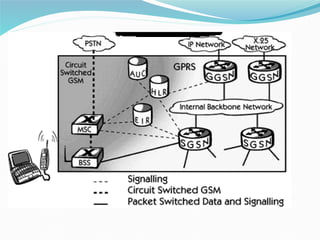
Following two new components, called GPRS support nodes
(GSNs), are added:
• Gateway GPRS support node (GGSN):
The Gateway GPRS Support Node acts as an interface and a
router to external networks. The GGSN contains routing
information for GPRS mobiles, which is used to tunnel packets
through the IP based internal backbone to the correct Serving
GPRS Support Node. The GGSN also collects charging
information connected to the use of the external data
networks and can act as a packet filter for incoming traffic.
• Serving GPRS support node (SGSN):
The Serving GPRS Support Node is responsible for
authentication of GPRS mobiles, registration of mobiles in the
network, mobility management, and collecting information for
charging for the use of the air interface.
Internal Backbone:
The internal backbone is an IP based network used
to carry packets between different GSNs. Tunneling
is used between SGSNs and GGSNs, so the internal
backbone does not need any information about
domains outside the GPRS network. Signaling from
a GSN to a MSC, HLR or EIR is done using SS7.
Routing Area:
GPRS introduces the concept of a routing area. This
is much the same as a Location Area in GSM, except
that it will generally contain fewer cells. Because
routing areas are smaller than Location Areas, less
radio resources are used when a paging message is
broadcast.
Thanks…!!!

Gprs

  • 1.
    BABA GHULAM SHAHBADSHAH UNIVERSITY- RAJOURI (J&K). DEPARTMENT OF COMPUTER SCIENCES PRESENTATION TOPIC:- PRESENTED BY:- Ajeela Mushtaq Roll NO:-13-Mcs-15 PRESENTED TO:- MR.SYED FAYEQ JEELANI GPRS ARCHITECTURE
  • 2.
    OUTLINE : • GPRS •SERVICES OFFERED • GPRS ARCHITECTURE
  • 3.
    GPRS GPRS stands forGeneral Packet Radio Service and is a second generation (2G) and third generation (3G)--or sometimes referred to as in- between both generations, 2.5G--wireless data service that extends GSM data capabilities for Internet access, multimedia messaging services, and early mobile Internet applications via the wireless application protocol (WAP), as well as other wireless data services.
  • 4.
    Cont… •  GPRS wasoriginally standardized by European Telecommunications Standards Institute (ETSI). • GPRS usage is typically charged based on volume of data transferred, contrasting with circuit switched data, which is usually billed per minute of connection time.  •  GPRS data may be sold either as part of a bundle (e.g., up to 5 GB per month for a fixed fee) or on a pay-as-you-use basis.  • GPRS provides data rates of 56–114 kbit/second.
  • 5.
    Services offered: • GPRSextends the GSM Packet circuit switched data capabilities and makes the following services possible: • SMS messaging and broadcasting. • Multimedia messaging service (MMS). • Push to talk over cellular (PoC). • Instant messaging and presence. • Internet applications for smart devices through wireless application protocol.
  • 6.
    GPRS Architecture: • GPRSis a data network that overlays a second- generation GSM network. • GPRS attempts to reuse the existing GSM network elements as much as possible, but to effectively build a packet-based mobile cellular network, some new network elements, interfaces, and protocols for handling packet traffic are required.
  • 8.
    GPRS requires modificationsto numerous GSM network elements as summarized below: Mobile Station (MS): New Mobile Station is required to access GPRS services. These new terminals will be backward compatible with GSM for voice calls. BTS: A software upgrade is required in the existing base transceiver site. BSC: The base station controller (BSC) requires a software upgrade and the installation of new hardware called the packet control unit (PCU). The PCU directs the data traffic to the GPRS network and can be a separate hardware element associated with the
  • 9.
    GPRS Support Nodes(GSNs): The deployment of GPRS requires the installation of new core network elements called the serving GPRS support node (SGSN) and gateway GPRS support node (GGSN). Databases (HLR, VLR, etc.): All the databases involved in the network will require software upgrades to handle the new call models and functions introduced by GPRS.
  • 10.
    GPRS Mobile Stations: NewMobile Station are required to use GPRS services because existing GSM phones do not handle the enhanced air interface or packet data. A variety of MS can exist, including a high-speed version of current phones to support high-speed data access, a new PDA device with an embedded GSM phone, and PC cards for laptop computers. These mobile stations are backward compatible for making voice calls using GSM.
  • 11.
    GPRS Base StationSubsystem: • Each BSC requires the installation of one or more Packet Control Units (PCUs) and a software upgrade. The PCU provides a physical and logical data interface to the base station subsystem (BSS) for packet data traffic. The BTS can also require a software upgrade but typically does not require hardware enhancements. • When either voice or data traffic is originated at the subscriber mobile, it is transported over the air interface to the BTS, and from the BTS to the BSC in the same way as a standard GSM call. However, at the output of the BSC, the traffic is separated; voice is sent to the mobile switching center (MSC) per standard GSM, and data is sent to a new device called the SGSN via the PCU over a Frame Relay interface.
  • 12.
    GPRS Support Nodes: Followingtwo new components, called GPRS support nodes (GSNs), are added: • Gateway GPRS support node (GGSN): The Gateway GPRS Support Node acts as an interface and a router to external networks. The GGSN contains routing information for GPRS mobiles, which is used to tunnel packets through the IP based internal backbone to the correct Serving GPRS Support Node. The GGSN also collects charging information connected to the use of the external data networks and can act as a packet filter for incoming traffic. • Serving GPRS support node (SGSN): The Serving GPRS Support Node is responsible for authentication of GPRS mobiles, registration of mobiles in the network, mobility management, and collecting information for charging for the use of the air interface.
  • 13.
    Internal Backbone: The internalbackbone is an IP based network used to carry packets between different GSNs. Tunneling is used between SGSNs and GGSNs, so the internal backbone does not need any information about domains outside the GPRS network. Signaling from a GSN to a MSC, HLR or EIR is done using SS7.
  • 14.
    Routing Area: GPRS introducesthe concept of a routing area. This is much the same as a Location Area in GSM, except that it will generally contain fewer cells. Because routing areas are smaller than Location Areas, less radio resources are used when a paging message is broadcast.
  • 15.