GPRS:
General Packet Radio Service
Contents
1. Introduction to GPRS
What is GPRS ?
Short comings of GSM
GPRS characteristics
2. GPRS architecture
Acronyms
Network elements
3. GPRS View
Benefits of GPRS
Shortcomings
Applications of GPRS
4. Conclusion
5. References
What is GPRS?
GPRS stands for General Packet Radio Service
• General -> not restricted to GSM
• Packet Radio -> enables packet mode communication over air
• Service, not System -> existing BSS (partially also NSS) infrastructure is used
Reuse the existing GSM infrastructure
• is the major GSM Phase 2+ enhancement and an important step to 3G
Introduce packet-switched routing
Requires many new network elements into NSS
Functionality
Better data transfer rates
Low cost and connectivity-oriented
Aims at providing data services to mobile users with high bandwidth
efficiency and “always on” connectivity
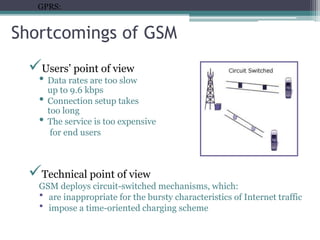
Shortcomings of GSM
Users’ point of view
• Data rates are too slow
up to 9.6 kbps
• Connection setup takes
too long
• The service is too expensive
for end users
Technical point of view
GSM deploys circuit-switched mechanisms, which:
 are inappropriate for the bursty characteristics of Internet traffic
 impose a time-oriented charging scheme
GPRS:
GPRS Characteristics..
GPRS uses packet switched resource allocation
• resources allocated only when data is to be sent/received
Flexible channel allocation
• one to eight time slots
• available resources shared by active users
• GPRS and circuit switched GSM services can use same time slots
alternatively
Traffic characteristics suitable for GPRS
• Intermittent, bursty data transmissions
• Frequent transmissions of small volumes of data
• Infrequent transmission of larger volumes of data
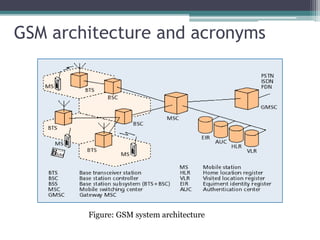
GSM architecture and acronyms
Figure: GSM system architecture
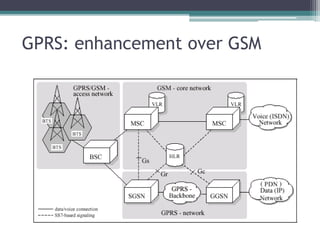
GPRS: enhancement over GSM
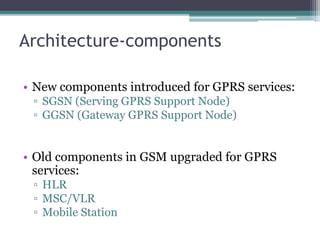
Architecture-components
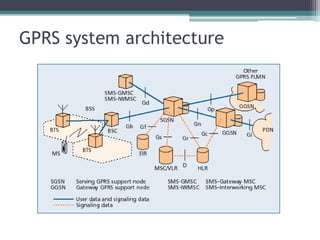
• New components introduced for GPRS services:
▫ SGSN (Serving GPRS Support Node)
▫ GGSN (Gateway GPRS Support Node)
• Old components in GSM upgraded for GPRS
services:
▫ HLR
▫ MSC/VLR
▫ Mobile Station
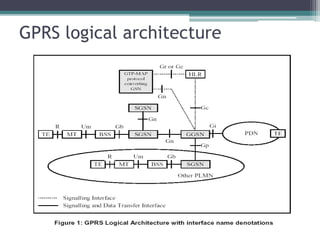
GPRS system architecture
Architecture
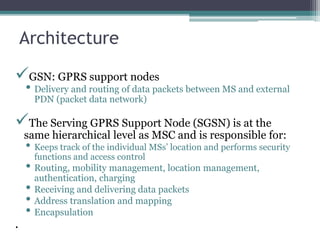
GSN: GPRS support nodes
• Delivery and routing of data packets between MS and external
PDN (packet data network)
The Serving GPRS Support Node (SGSN) is at the
same hierarchical level as MSC and is responsible for:
• Keeps track of the individual MSs’ location and performs security
functions and access control
• Routing, mobility management, location management,
authentication, charging
• Receiving and delivering data packets
• Address translation and mapping
• Encapsulation
.
Architecture contd..
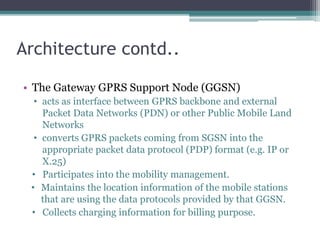
• The Gateway GPRS Support Node (GGSN)
• acts as interface between GPRS backbone and external
Packet Data Networks (PDN) or other Public Mobile Land
Networks
• converts GPRS packets coming from SGSN into the
appropriate packet data protocol (PDP) format (e.g. IP or
X.25)
• Participates into the mobility management.
• Maintains the location information of the mobile stations
that are using the data protocols provided by that GGSN.
• Collects charging information for billing purpose.
HLR
• Enhanced with GPRS subscription data and routing
information.
• Accessible from the SGSN via the Gr interface and from the
GGSN via the Gc interface.
MSC/VLR
• Not needed for routing of GPRS data.
• Needed for the co-operation between GPRS and the other
GSM services. e.g.,
▫ Paging for circuit-switched calls that can be performed
more efficiently via the SGSN
▫ Combining GPRS and non-GPRS location updates
• Receives location information from SGSN or sends paging
requests to SGSN via the Gs interface.
Mobile Station
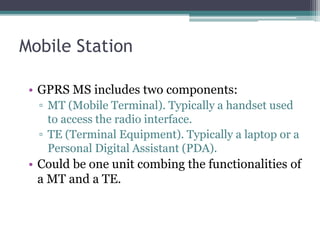
• GPRS MS includes two components:
▫ MT (Mobile Terminal). Typically a handset used
to access the radio interface.
▫ TE (Terminal Equipment). Typically a laptop or a
Personal Digital Assistant (PDA).
• Could be one unit combing the functionalities of
a MT and a TE.
GPRS Mobile types..
Class A:
Simultaneous GPRS and conventional GSM operation
Supports simultaneous circuit switched and GPRS data transfer
Class B:
Can be attached to both GPRS and conventional GSM services
simultaneously
Can listen circuit switched and GPRS pages (via GPRS)
Supports either circuit switched calls or GPRS data transfer but not
simultaneous communication
Class C:
Alternatively attached in GPRS or conventional GSM
No simultaneous operation
‘GPRS only’ mobiles also possible (e.g. for telemetric applications
GPRS logical architecture
Benefits of GPRS
Efficient
GPRS mobile devices only use the GSM network when data is
transferred. The GSM connection is not dedicated to each user,
therefore it can be shared with many users resulting in efficient use
of the network.
Fast
• GPRS gives speeds of up to 5 time faster than GSM.
• Connection setup times are reduced
Payment based on data usage
Billing is not based on time, but on the amount of data actually
transferred.
Enables new service opportunities
Shortcomings..
• Limited Cell Capacity for All Users
• Speeds Much Lower in Reality
• Transit Delays
• No Store and Forward
Applications of GPRS
• Information services as text or graphics
• m-commerce
▫ web shopping
▫ tickets for transport (eg trains)
▫ gaming
▫ Banking
• Location Based Services
• Corporate email, Internet email
• LAN applications
• Mobile Office
• Web browsing
• File transfer
Conclusion..
•GPRS is classified as a 2.5G (or 2G Plus) technology
because it builds upon existing network infrastructure.
•E- Commerce, Banking , Unified Messaging are the fields
where GPRS is very much advantageous.
•But the areas like limited cell capacity, lower speed, and
other certain limitations are the areas where it needs to
improve.
References
• Schiller J, Mobile Communications, 2/e-Addison
Weslay,2003.
• Raj Kamal, Mobile Computing, Oxford University Press,
2007
• Asoke Talukder,Roopa Yavagal, Mobile
Computing,McGrawhill,2006
• en.wikipedia.org/wiki/General_Packet_Radio_Service

9 gprs

  • 1.
  • 2.
    Contents 1. Introduction toGPRS What is GPRS ? Short comings of GSM GPRS characteristics 2. GPRS architecture Acronyms Network elements 3. GPRS View Benefits of GPRS Shortcomings Applications of GPRS 4. Conclusion 5. References
  • 3.
    What is GPRS? GPRSstands for General Packet Radio Service • General -> not restricted to GSM • Packet Radio -> enables packet mode communication over air • Service, not System -> existing BSS (partially also NSS) infrastructure is used Reuse the existing GSM infrastructure • is the major GSM Phase 2+ enhancement and an important step to 3G Introduce packet-switched routing Requires many new network elements into NSS Functionality Better data transfer rates Low cost and connectivity-oriented Aims at providing data services to mobile users with high bandwidth efficiency and “always on” connectivity
  • 4.
    Shortcomings of GSM Users’point of view • Data rates are too slow up to 9.6 kbps • Connection setup takes too long • The service is too expensive for end users Technical point of view GSM deploys circuit-switched mechanisms, which:  are inappropriate for the bursty characteristics of Internet traffic  impose a time-oriented charging scheme GPRS:
  • 5.
    GPRS Characteristics.. GPRS usespacket switched resource allocation • resources allocated only when data is to be sent/received Flexible channel allocation • one to eight time slots • available resources shared by active users • GPRS and circuit switched GSM services can use same time slots alternatively Traffic characteristics suitable for GPRS • Intermittent, bursty data transmissions • Frequent transmissions of small volumes of data • Infrequent transmission of larger volumes of data
  • 6.
    GSM architecture andacronyms Figure: GSM system architecture
  • 7.
  • 8.
    Architecture-components • New componentsintroduced for GPRS services: ▫ SGSN (Serving GPRS Support Node) ▫ GGSN (Gateway GPRS Support Node) • Old components in GSM upgraded for GPRS services: ▫ HLR ▫ MSC/VLR ▫ Mobile Station
  • 9.
  • 10.
    Architecture GSN: GPRS supportnodes • Delivery and routing of data packets between MS and external PDN (packet data network) The Serving GPRS Support Node (SGSN) is at the same hierarchical level as MSC and is responsible for: • Keeps track of the individual MSs’ location and performs security functions and access control • Routing, mobility management, location management, authentication, charging • Receiving and delivering data packets • Address translation and mapping • Encapsulation .
  • 11.
    Architecture contd.. • TheGateway GPRS Support Node (GGSN) • acts as interface between GPRS backbone and external Packet Data Networks (PDN) or other Public Mobile Land Networks • converts GPRS packets coming from SGSN into the appropriate packet data protocol (PDP) format (e.g. IP or X.25) • Participates into the mobility management. • Maintains the location information of the mobile stations that are using the data protocols provided by that GGSN. • Collects charging information for billing purpose.
  • 12.
    HLR • Enhanced withGPRS subscription data and routing information. • Accessible from the SGSN via the Gr interface and from the GGSN via the Gc interface. MSC/VLR • Not needed for routing of GPRS data. • Needed for the co-operation between GPRS and the other GSM services. e.g., ▫ Paging for circuit-switched calls that can be performed more efficiently via the SGSN ▫ Combining GPRS and non-GPRS location updates • Receives location information from SGSN or sends paging requests to SGSN via the Gs interface.
  • 13.
    Mobile Station • GPRSMS includes two components: ▫ MT (Mobile Terminal). Typically a handset used to access the radio interface. ▫ TE (Terminal Equipment). Typically a laptop or a Personal Digital Assistant (PDA). • Could be one unit combing the functionalities of a MT and a TE.
  • 14.
    GPRS Mobile types.. ClassA: Simultaneous GPRS and conventional GSM operation Supports simultaneous circuit switched and GPRS data transfer Class B: Can be attached to both GPRS and conventional GSM services simultaneously Can listen circuit switched and GPRS pages (via GPRS) Supports either circuit switched calls or GPRS data transfer but not simultaneous communication Class C: Alternatively attached in GPRS or conventional GSM No simultaneous operation ‘GPRS only’ mobiles also possible (e.g. for telemetric applications
  • 15.
  • 16.
    Benefits of GPRS Efficient GPRSmobile devices only use the GSM network when data is transferred. The GSM connection is not dedicated to each user, therefore it can be shared with many users resulting in efficient use of the network. Fast • GPRS gives speeds of up to 5 time faster than GSM. • Connection setup times are reduced Payment based on data usage Billing is not based on time, but on the amount of data actually transferred. Enables new service opportunities
  • 17.
    Shortcomings.. • Limited CellCapacity for All Users • Speeds Much Lower in Reality • Transit Delays • No Store and Forward
  • 18.
    Applications of GPRS •Information services as text or graphics • m-commerce ▫ web shopping ▫ tickets for transport (eg trains) ▫ gaming ▫ Banking • Location Based Services • Corporate email, Internet email • LAN applications • Mobile Office • Web browsing • File transfer
  • 19.
    Conclusion.. •GPRS is classifiedas a 2.5G (or 2G Plus) technology because it builds upon existing network infrastructure. •E- Commerce, Banking , Unified Messaging are the fields where GPRS is very much advantageous. •But the areas like limited cell capacity, lower speed, and other certain limitations are the areas where it needs to improve.
  • 20.
    References • Schiller J,Mobile Communications, 2/e-Addison Weslay,2003. • Raj Kamal, Mobile Computing, Oxford University Press, 2007 • Asoke Talukder,Roopa Yavagal, Mobile Computing,McGrawhill,2006 • en.wikipedia.org/wiki/General_Packet_Radio_Service