General Packet Radio Service
(GPRS)
What is GPRS?
• GPRS (General Packet Radio Service)
✓ a packet oriented data service for IP and X.25 over GSM networks
✓ enables packet-switched services on the resources of the already
existing GSM network infrastructure
✓ deploying new channel coding schemes and timeslot bundling,
GPRS is capable of providing single user throughput rates of up to
160 kbps (in theory)
✓ provides an “always on” functionality, without continuous
consumption of resources
✓ requires a major hardware upgrade in the GSM network and it
requires new mobile stations
✓ a step toward 3G networks (2.5G)
From GSM to GPRS
Um
MAP
ISUP
MAP
MAP
ISUP
GSM
A
A-bis
BSS
PSTN/ISDN
R
Gi
Gp
Gb Gs
Gf
Gr
PDN
Private
Backbone
Gn
Gn
GPRS
Gc
PDN
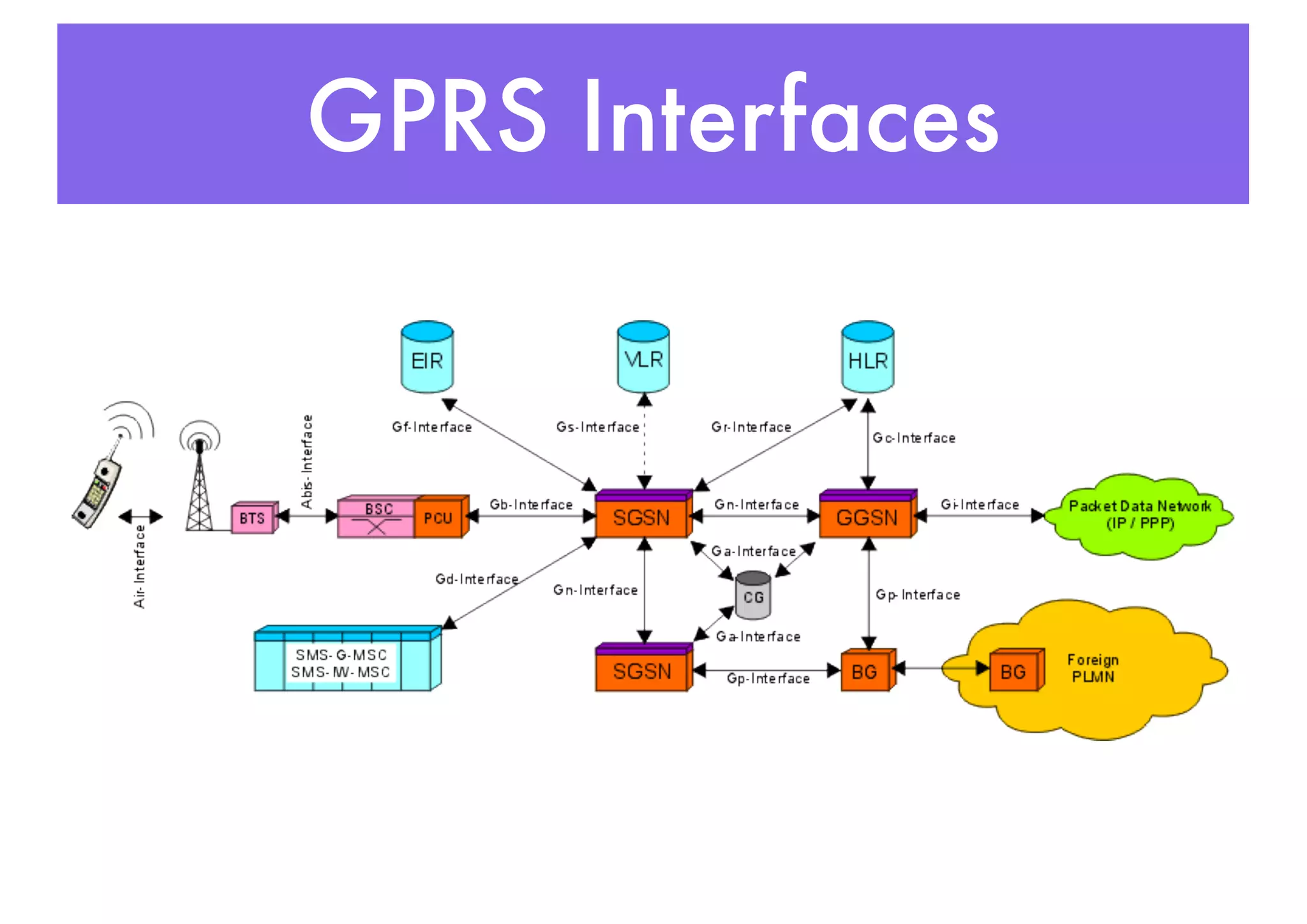
GPRS Interfaces
Service GPRS Support Node
(SGSN)
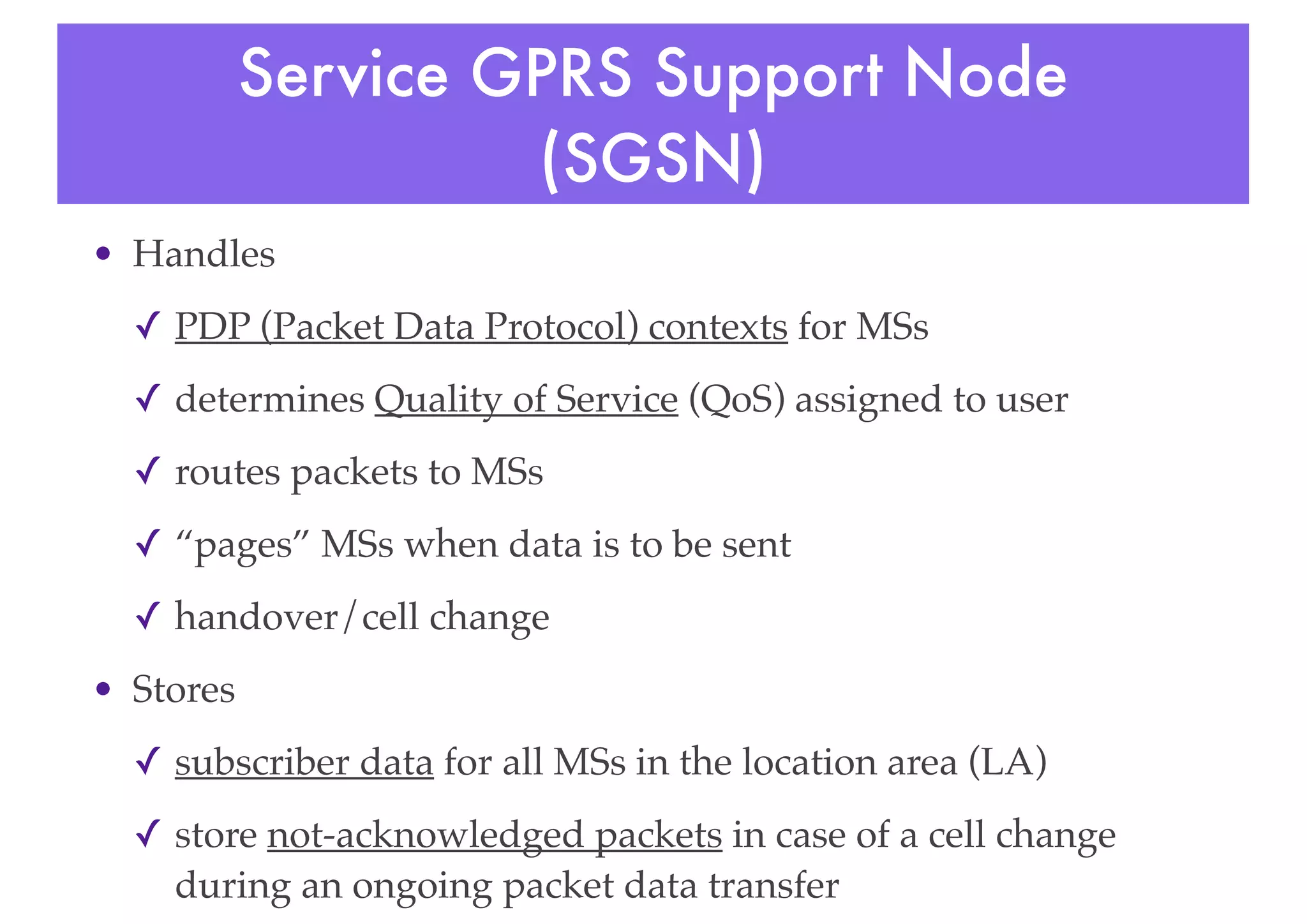
• Handles
✓ PDP (Packet Data Protocol) contexts for MSs
✓ determines Quality of Service (QoS) assigned to user
✓ routes packets to MSs
✓ “pages” MSs when data is to be sent
✓ handover/cell change
• Stores
✓ subscriber data for all MSs in the location area (LA)
✓ store not-acknowledged packets in case of a cell change
during an ongoing packet data transfer
• Security
✓ authentication, by means of identity or equipment
check
✓ P-TMSI is allocated by SGSN
✓ ciphering
• Charging
✓ together with the GGSN, the SGSN collects CDR's
(Call Data Records)
✓ opposed to the GGSN, the SGSN collects CDR's for
the use of the own network resources
✓ these CDR's are forwarded to the Charging Gateway
(CG) via the IP-based intra-PLMN backbone
Gateway GPRS Support Node
(GGSN)
• Handles
✓ interconnects a PLMN to the external world (Internet)
✓ routes IP packets to the appropriate SGSN
- if the MS changes the SGSN during ready mode,
the GGSN is used as data packet buffer
✓ activation and deactivation of PDP-contexts / session
management
• Stores
✓ subscriber data for active MSs
• Security
✓ firewall
✓ screening
• Charging
✓ the GGSN will, in addition to the SGSN, collect CDRs
and forward them to the charging gateway (CG)
✓ opposed to the SGSN, the GGSN will collect call data
records based on the usage of external network
resources
✓ in other words, charges that arise from other packet
data or mobile network operators are collected by the
GGSN
Home Location Register
(HLR)
• New fields has been added to the HLR in order to serve the GPRS
Network
✓ IMSI is still the reference key
✓ SGSN number
- the SS7 address of SGSN currently serving the MS
✓ SGSN address
- the IP address of SGSN currently serving the MS
✓ GGSN list
- the GGSN number and optional IP address are related to the
GGSN which will be contacted when activity from the MS is
detected
✓ For each PDP context
- PDP type (e.g. X25 or IP)
- PDP address (note: this field will be empty if
dynamic IP address is used)
- QoS profile (QoS profile for this PDP context)
- VPLMN address allowed
- Access Point Name (APN)
Base Station Subsystem
(BSS)
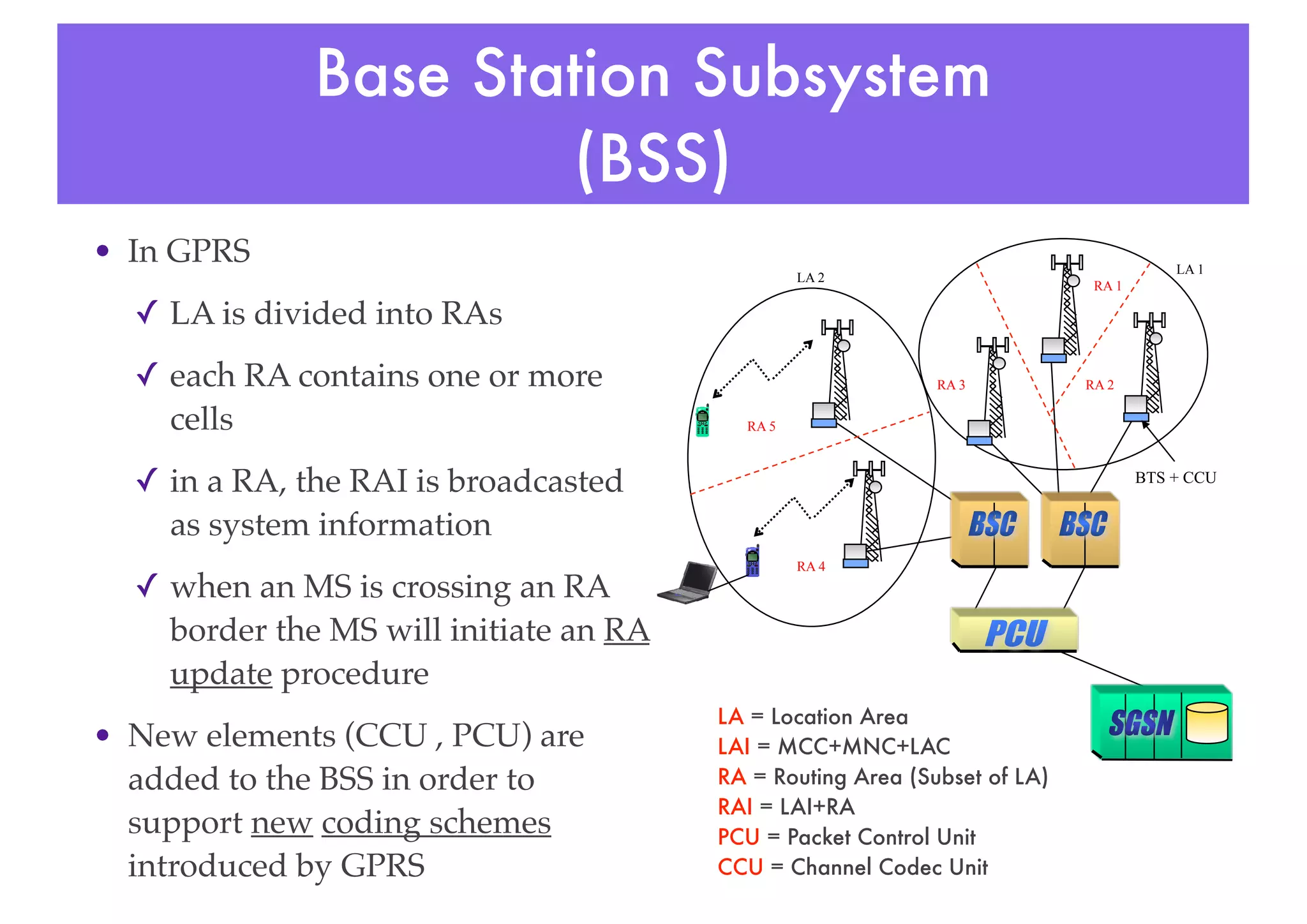
• In GPRS
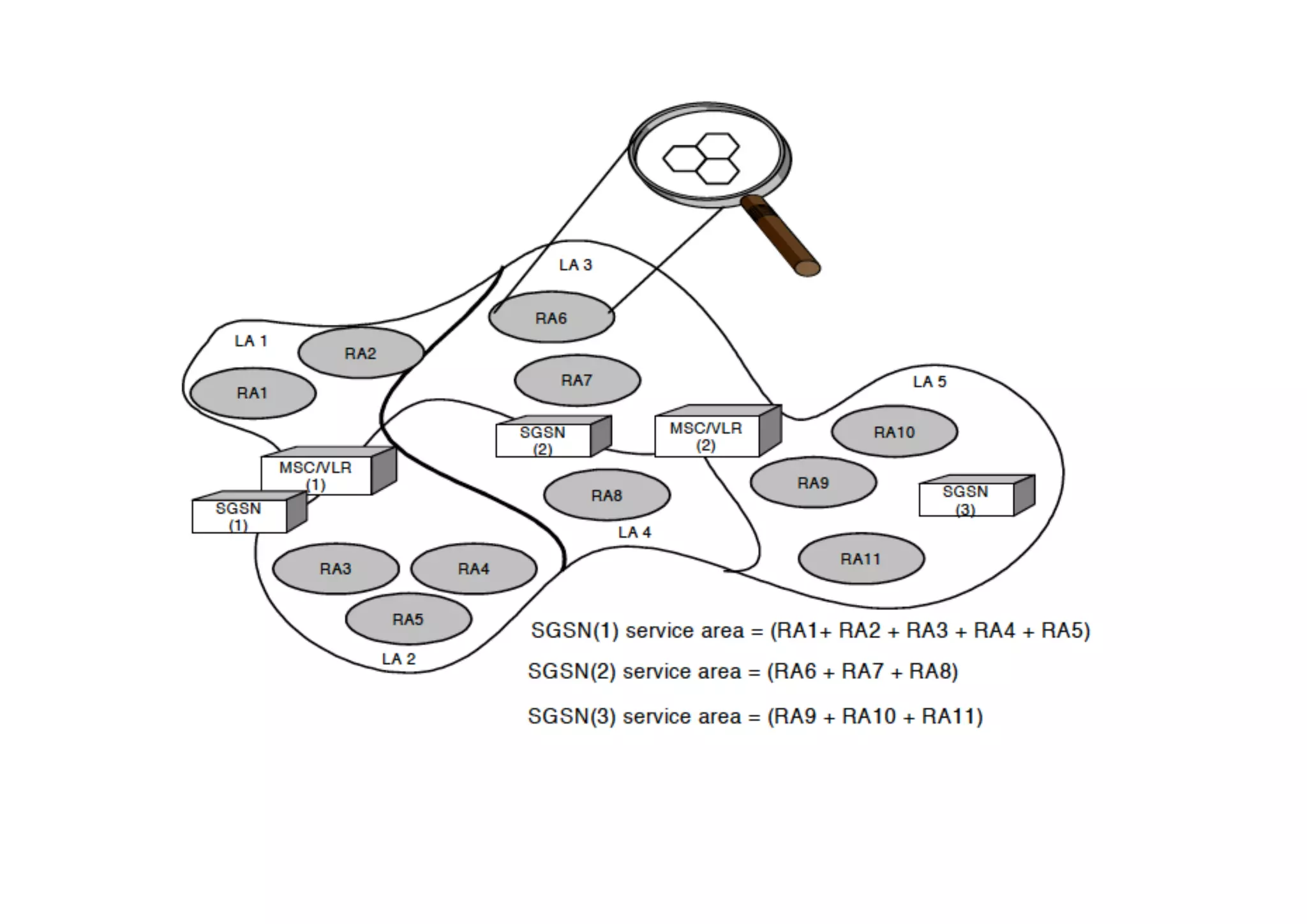
✓ LA is divided into RAs
✓ each RA contains one or more
cells
✓ in a RA, the RAI is broadcasted
as system information
✓ when an MS is crossing an RA
border the MS will initiate an RA
update procedure
• New elements (CCU , PCU) are
added to the BSS in order to
support new coding schemes
introduced by GPRS
LA 1
LA 2
RA 1
RA 3
RA 5
RA 2
RA 4
BTS + CCU
LA = Location Area
LAI = MCC+MNC+LAC
RA = Routing Area (Subset of LA)
RAI = LAI+RA
PCU = Packet Control Unit
CCU = Channel Codec Unit
Packet Control Unit
(PCU)
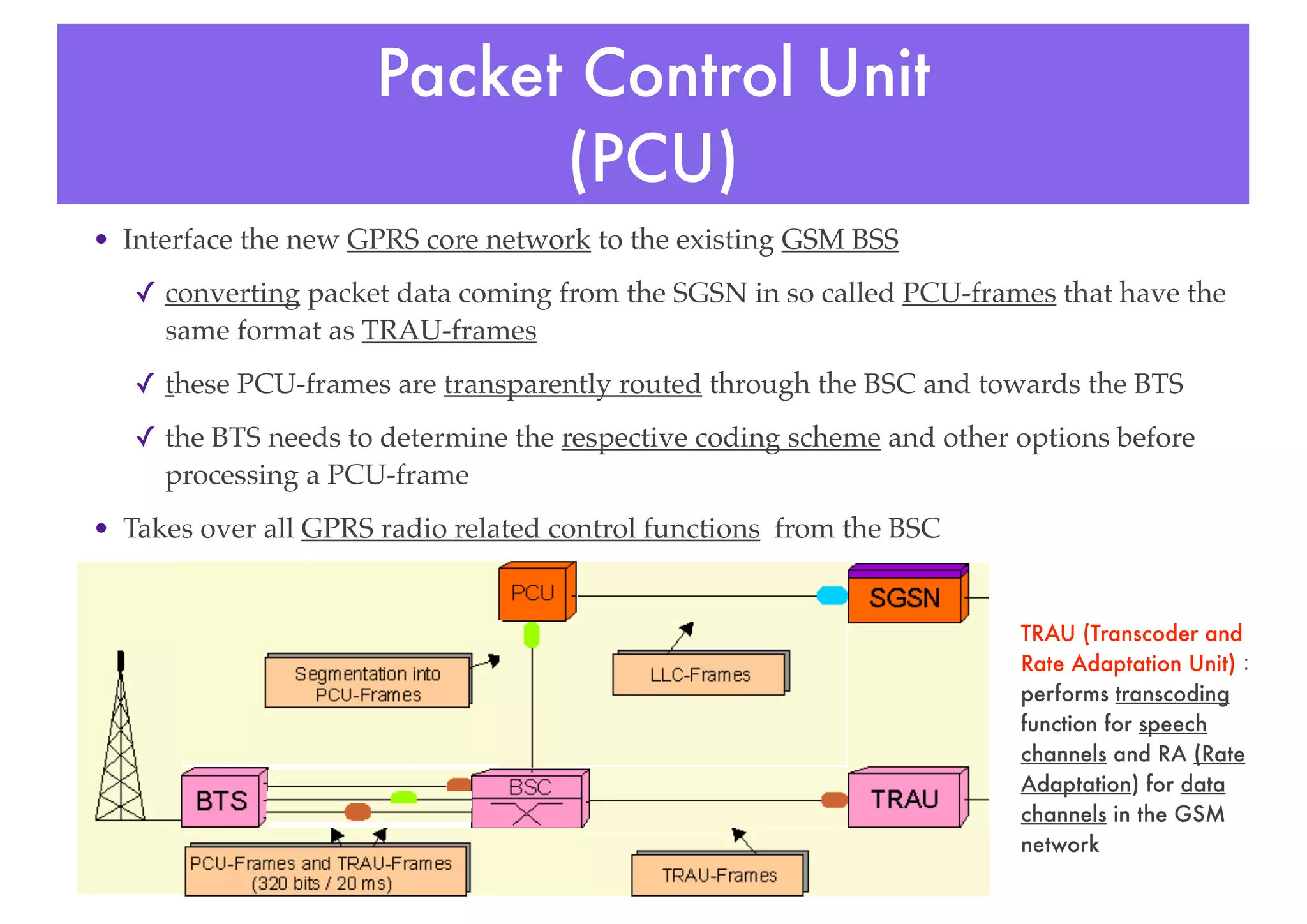
• Interface the new GPRS core network to the existing GSM BSS
✓ converting packet data coming from the SGSN in so called PCU-frames that have the
same format as TRAU-frames
✓ these PCU-frames are transparently routed through the BSC and towards the BTS
✓ the BTS needs to determine the respective coding scheme and other options before
processing a PCU-frame
• Takes over all GPRS radio related control functions from the BSC
TRAU (Transcoder and
Rate Adaptation Unit):
performs transcoding
function for speech
channels and RA (Rate
Adaptation) for data
channels in the GSM
network
Mobile Station
(MS)
• Three different classes of MSs have been defined
✓ Class A
- supports simultaneous monitoring and operation of
packet-switched and circuit-switched services
✓ Class B
- supports simultaneous monitoring but not simultaneous
operation of circuit-switched and packet-switched services
✓ Class C
- supports either circuit-switched or packet-switched
monitoring and operation at a given time
GPRS Mobility Management
(GMM)
• GMM are used to keep track of the current
location of an MS and to initiate security
procedures
• GMM is a function that is mainly handled
between MS and SGSN (the HLR is also
involved)
• There are various scenarios defined in GPRS to
update a subscriber's location within the network
✓ Routing Area Update (Intra-SGSN and Inter-
SGSN)
✓ GPRS attach and detach
✓ cell update (only while in GMM-Ready State)
• The GMM cell update procedure replaces in
GPRS what is known as handover procedure in
circuit-switched GSM
GPRS Attach
GSM and GPRS Functional State Models
• Due to the fact that a GPRS MS is not constantly
“connected” to the network, the GMM has introduced a
new state, called “Ready State”
GMM States
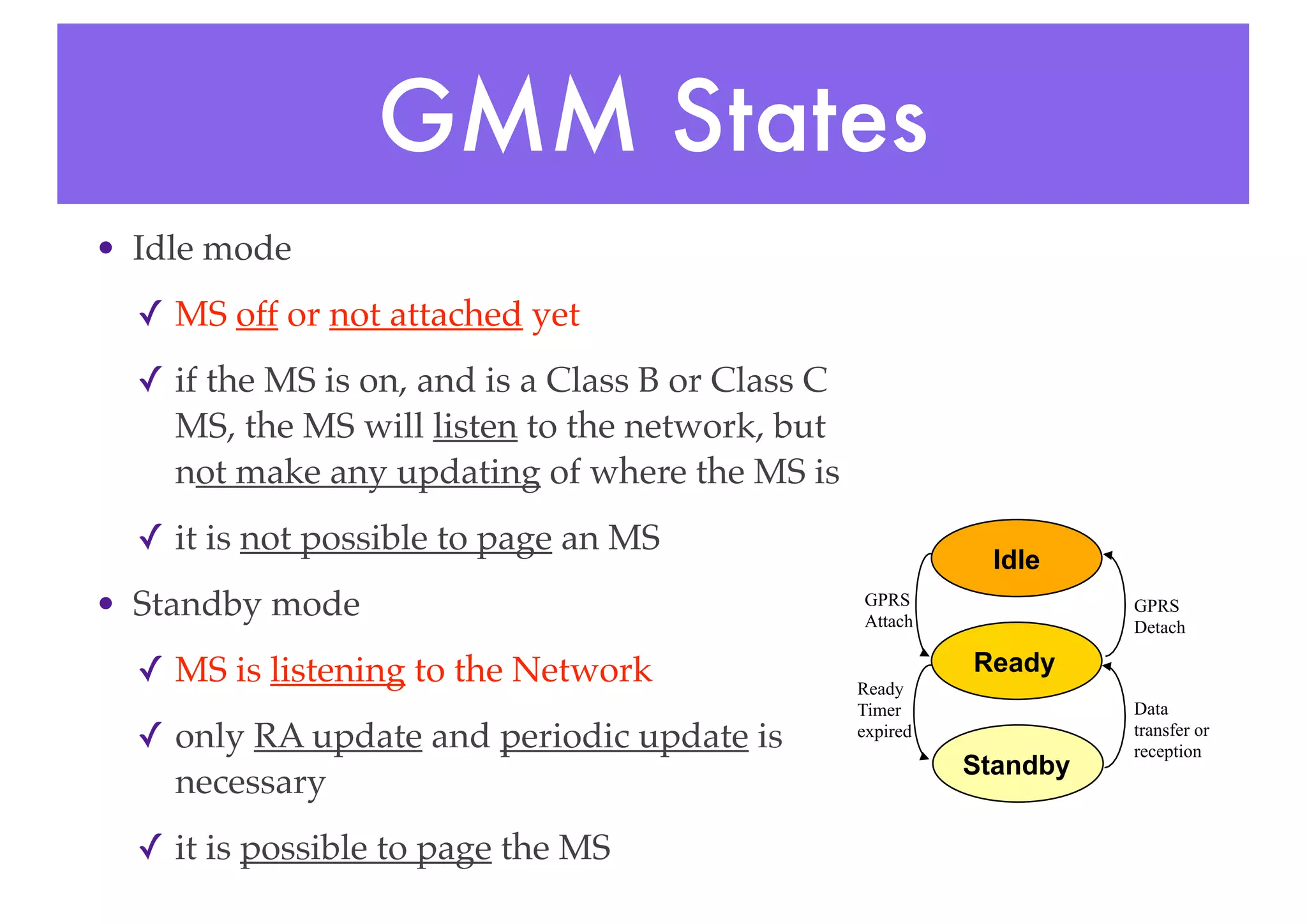
• Idle mode
✓ MS off or not attached yet
✓ if the MS is on, and is a Class B or Class C
MS, the MS will listen to the network, but
not make any updating of where the MS is
✓ it is not possible to page an MS
• Standby mode
✓ MS is listening to the Network
✓ only RA update and periodic update is
necessary
✓ it is possible to page the MS
Idle
Ready
Standby
GPRS
Attach
GPRS
Detach
Ready
Timer
expired
Data
transfer or
reception
• Ready mode
✓ MS is able to send and receive data
✓ cell updating is necessary
✓ if no activity within the timer
(default = 44s) the MS will fall
back to a stand-by state
✓ note: an MS can be forced back to
standby mode due to lack of
recourses
Idle
Ready
Standby
GPRS
Attach
GPRS
Detach
Ready
Timer
expired
Data
transfer or
reception
GMM Procedures
• GPRS attach / detach
✓ made towards the SGSN
✓ the MS must provide its identity (P-TMSI/IMSI) and an
indication of which type of attach that is to be executed
(GPRS or combined GPRS/IMSI)
✓ after GPRS attach the MS is in ”Ready” state and MM
contexts are established in the MS and the SGSN
• Routing Area update
✓ when a GPRS-attached MS detects a new RA (Routing Area)
✓ when the periodic RA update counter has expired
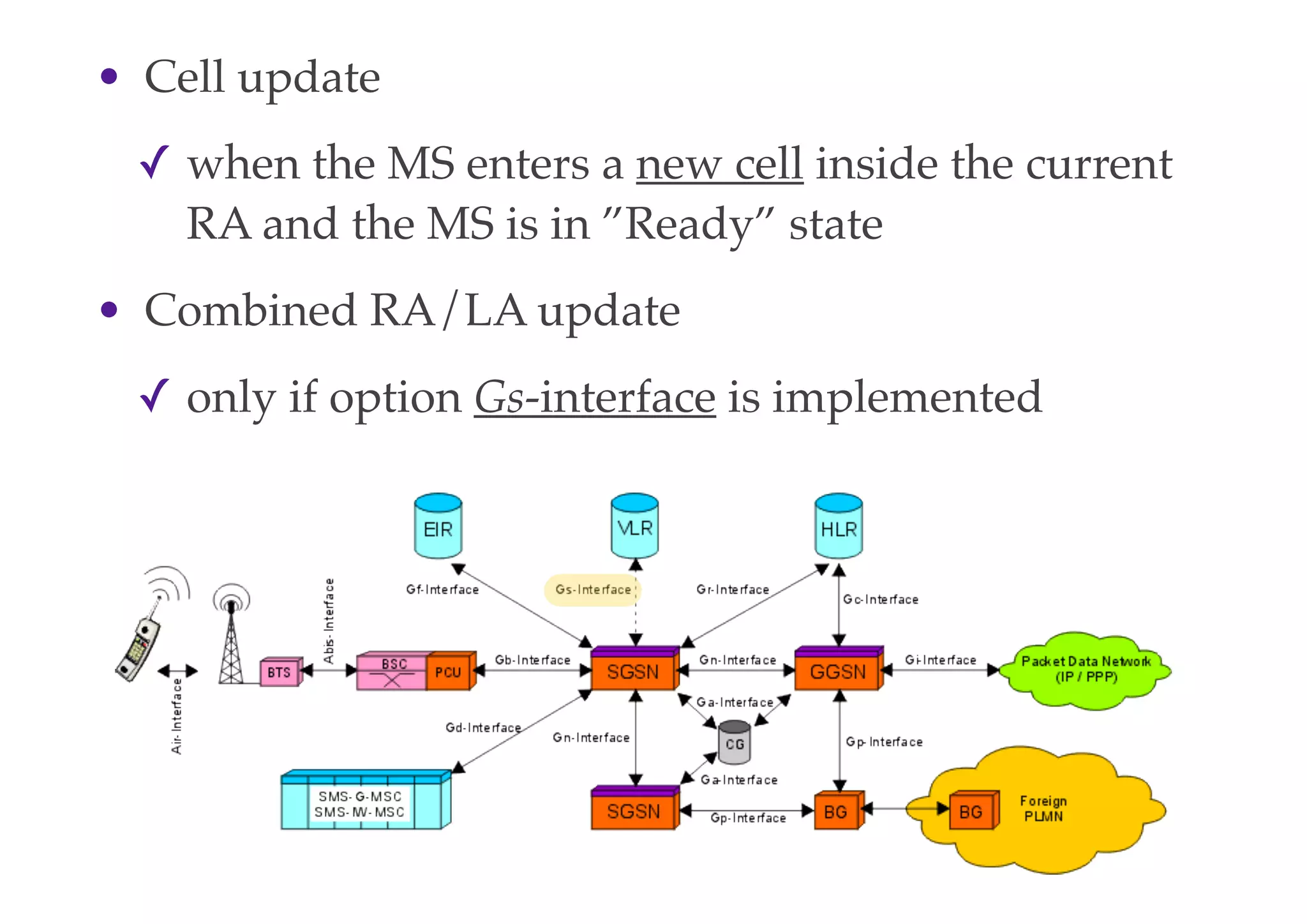
• Cell update
✓ when the MS enters a new cell inside the current
RA and the MS is in ”Ready” state
• Combined RA/LA update
✓ only if option Gs-interface is implemented
Session Management
(SM)
• Allow transfer of user data packets between the
MS and some external packet data network
• Before data transmission start, SM involves a
handshaking procedure between MS, SGSN and
GGSN
• Establish a PDP context between MS and GGSN
(includes the negotiated QoS profile)
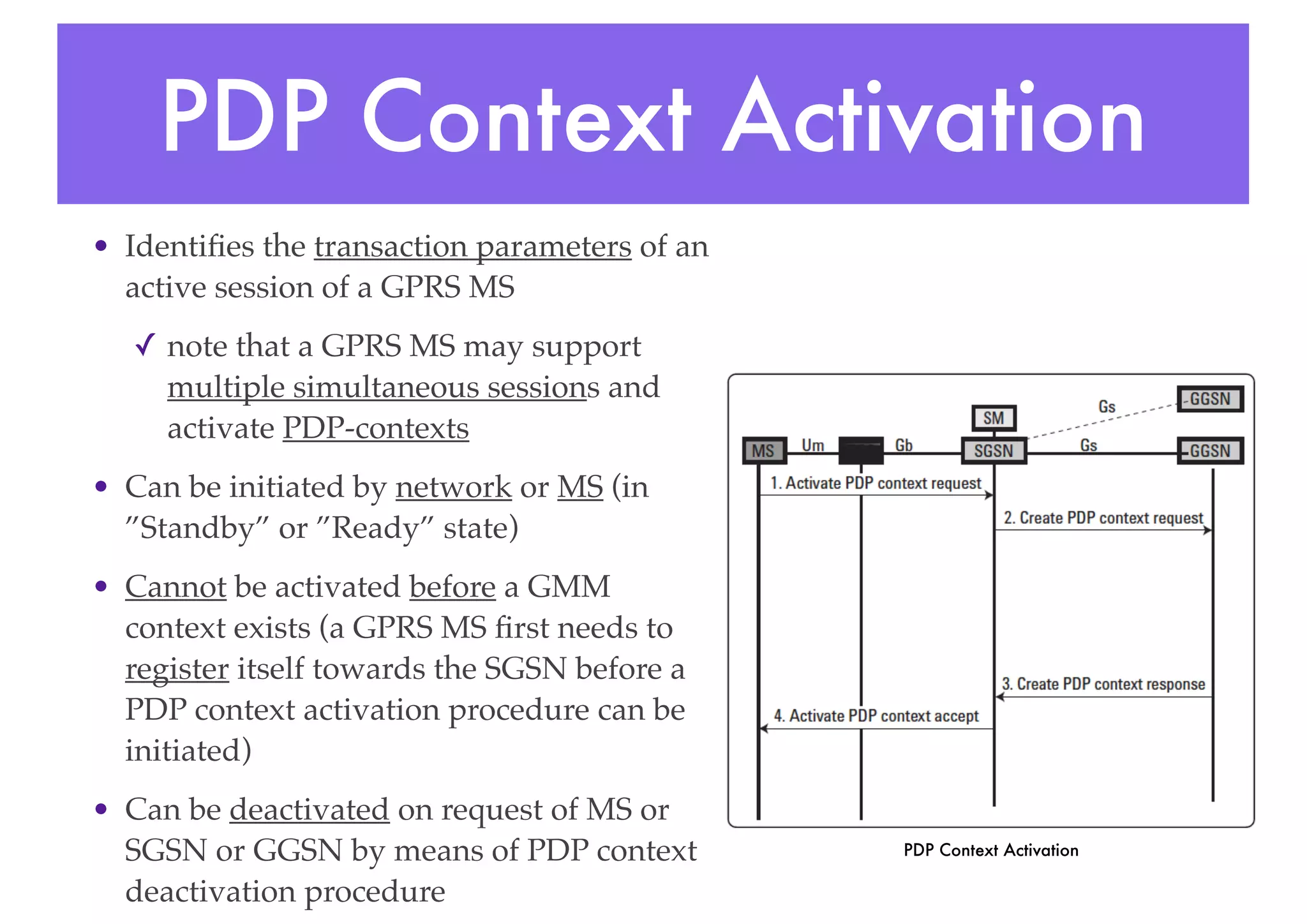
PDP Context Activation
• Identifies the transaction parameters of an
active session of a GPRS MS
✓ note that a GPRS MS may support
multiple simultaneous sessions and
activate PDP-contexts
• Can be initiated by network or MS (in
”Standby” or ”Ready” state)
• Cannot be activated before a GMM
context exists (a GPRS MS first needs to
register itself towards the SGSN before a
PDP context activation procedure can be
initiated)
• Can be deactivated on request of MS or
SGSN or GGSN by means of PDP context
deactivation procedure
PDP Context Activation
A MS with two PDP Contexts Active
Radio Resource (RR) Management
Procedures
• Takes care of the allocation and maintenance of radio
communication paths
• Paging procedure
✓ moves the MM state to ”Ready” to allow SGSN to forward
downlink data to BSS
• TBF (Temporary Block Flow) establishment/release
✓ a TBF is a physical connection (allocated radio resource)
used by two RR entities to support unidirectional transfer of
user data or signaling
✓ a TBF is temporary and is maintained only for the duration
of the data transfer
GPRS Protocols
Um
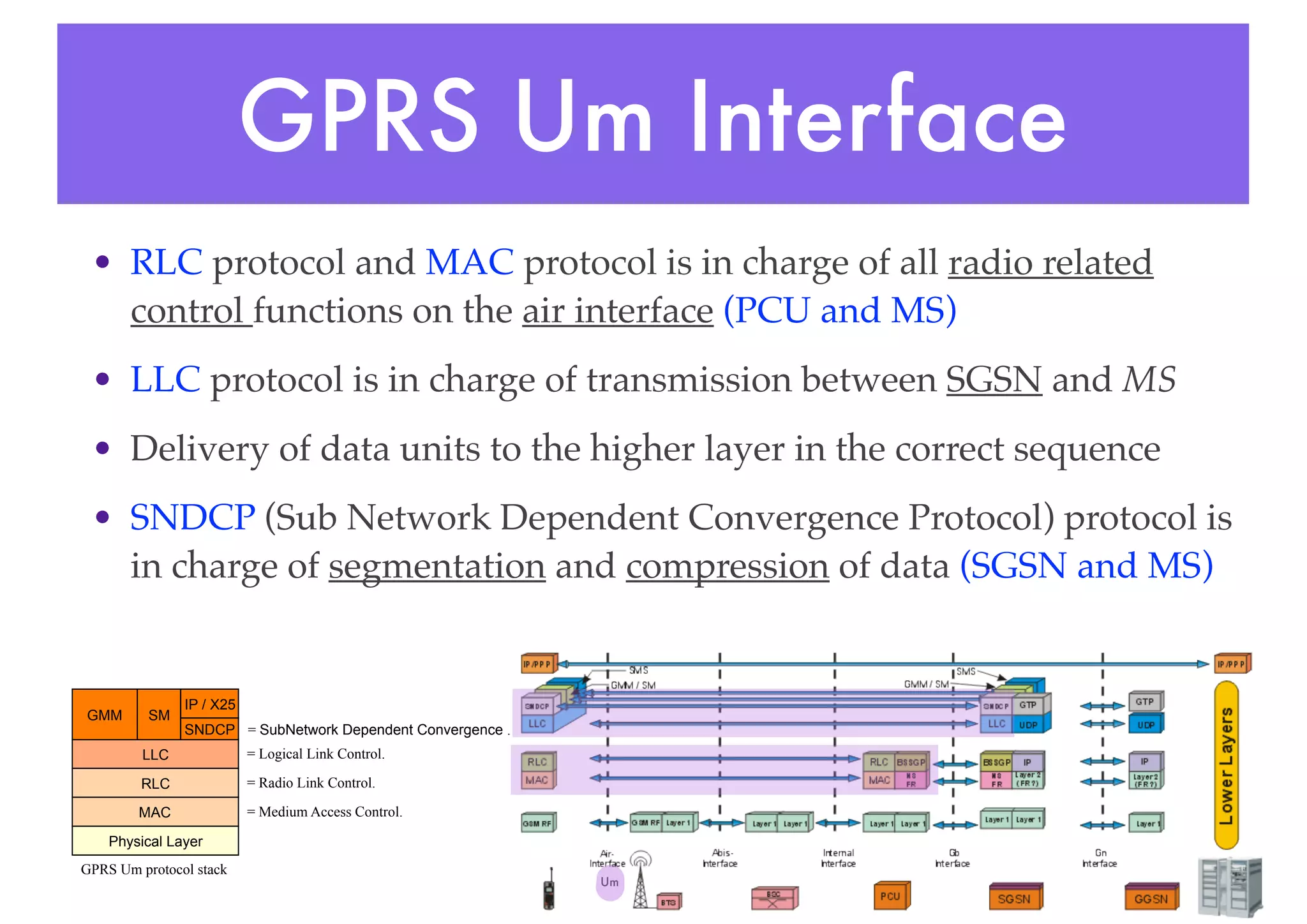
GPRS Um Interface
• RLC protocol and MAC protocol is in charge of all radio related
control functions on the air interface (PCU and MS)
• LLC protocol is in charge of transmission between SGSN and MS
• Delivery of data units to the higher layer in the correct sequence
• SNDCP (Sub Network Dependent Convergence Protocol) protocol is
in charge of segmentation and compression of data (SGSN and MS)
Um
Physical Layer
MAC
LLC
GMM
RLC
SM
IP / X25
SNDCP
GPRS Um protocol stack
= Radio Link Control.
= Medium Access Control.
= Logical Link Control.
= SubNetwork Dependent Convergence .
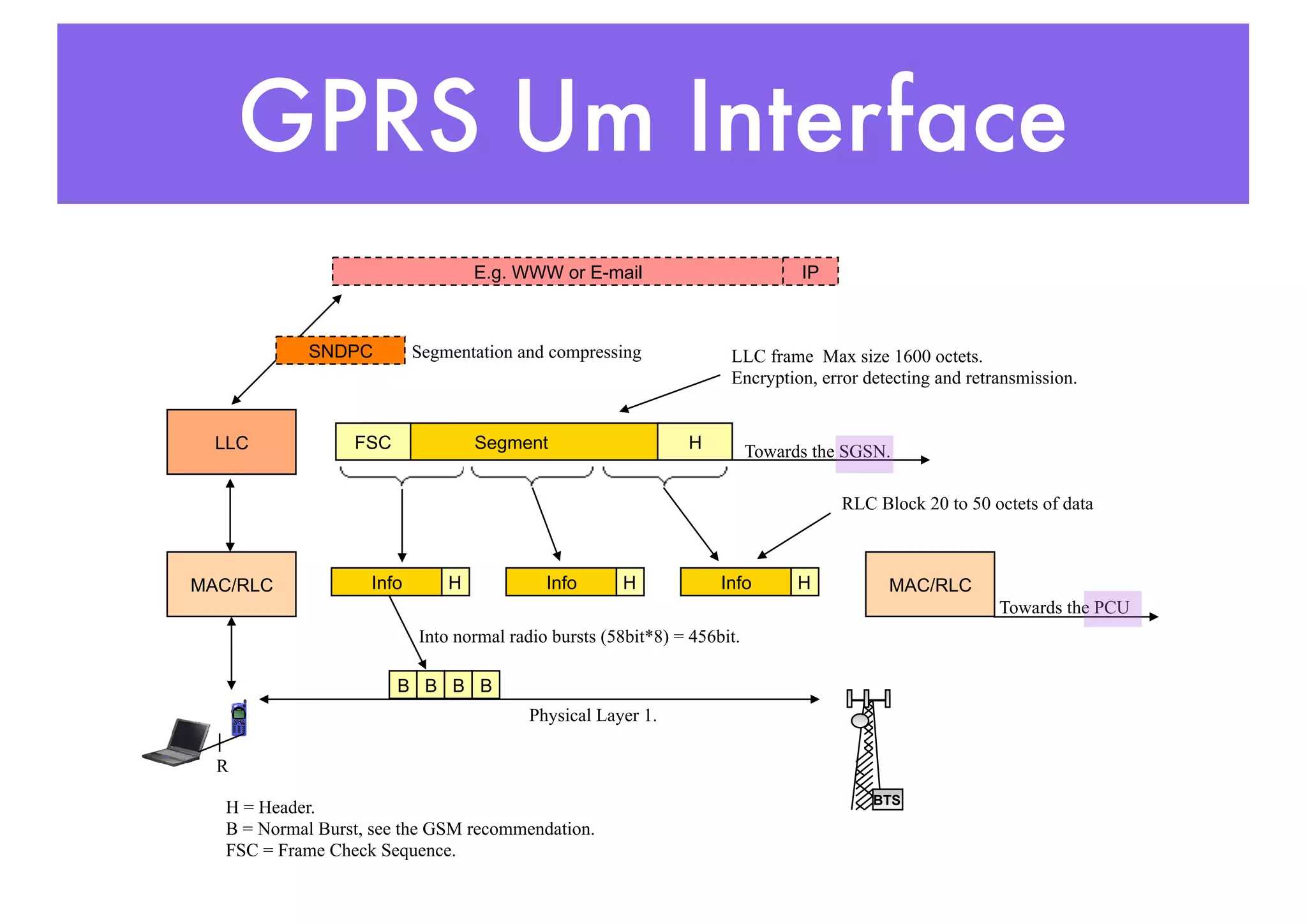
GPRS Um Interface
R
BTS
SNDPC
LLC
MAC/RLC MAC/RLC
Info H Info H Info H
Segment H
FSC Towards the SGSN.
E.g. WWW or E-mail IP
Segmentation and compressing
H = Header.
B = Normal Burst, see the GSM recommendation.
FSC = Frame Check Sequence.
Towards the PCU
Physical Layer 1.
B B B
B
LLC frame Max size 1600 octets.
Encryption, error detecting and retransmission.
RLC Block 20 to 50 octets of data
Into normal radio bursts (58bit*8) = 456bit.
GPRS A-bis Interface
• In GPRS each vendor is making his own version of the A-
bis protocol (not specified)
• The BTMS (BTS Management Protocol for GSM) has been
changed to BSSGP (Base Station System GPRS Protocol)
= BSS GPRS.
= Frame Relay
Layer1
Network
Service
Relay
A-bis protocol stack
BSSGP
Layer1
RLC
MAC
LLC
GMM/SM
Gb protocol stack
Um
GPRS Logical Channels
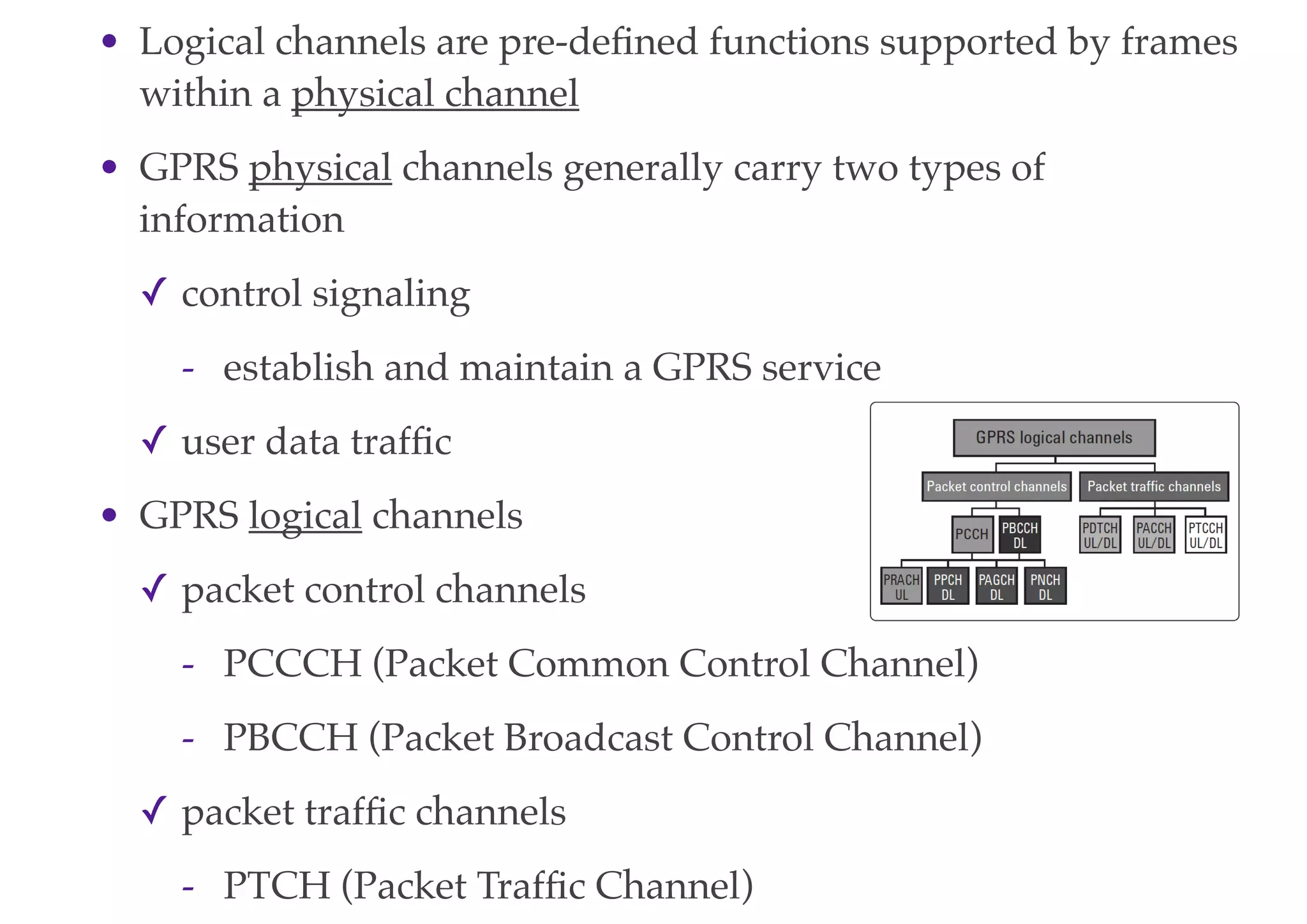
• Logical channels are pre-defined functions supported by frames
within a physical channel
• GPRS physical channels generally carry two types of
information
✓ control signaling
- establish and maintain a GPRS service
✓ user data traffic
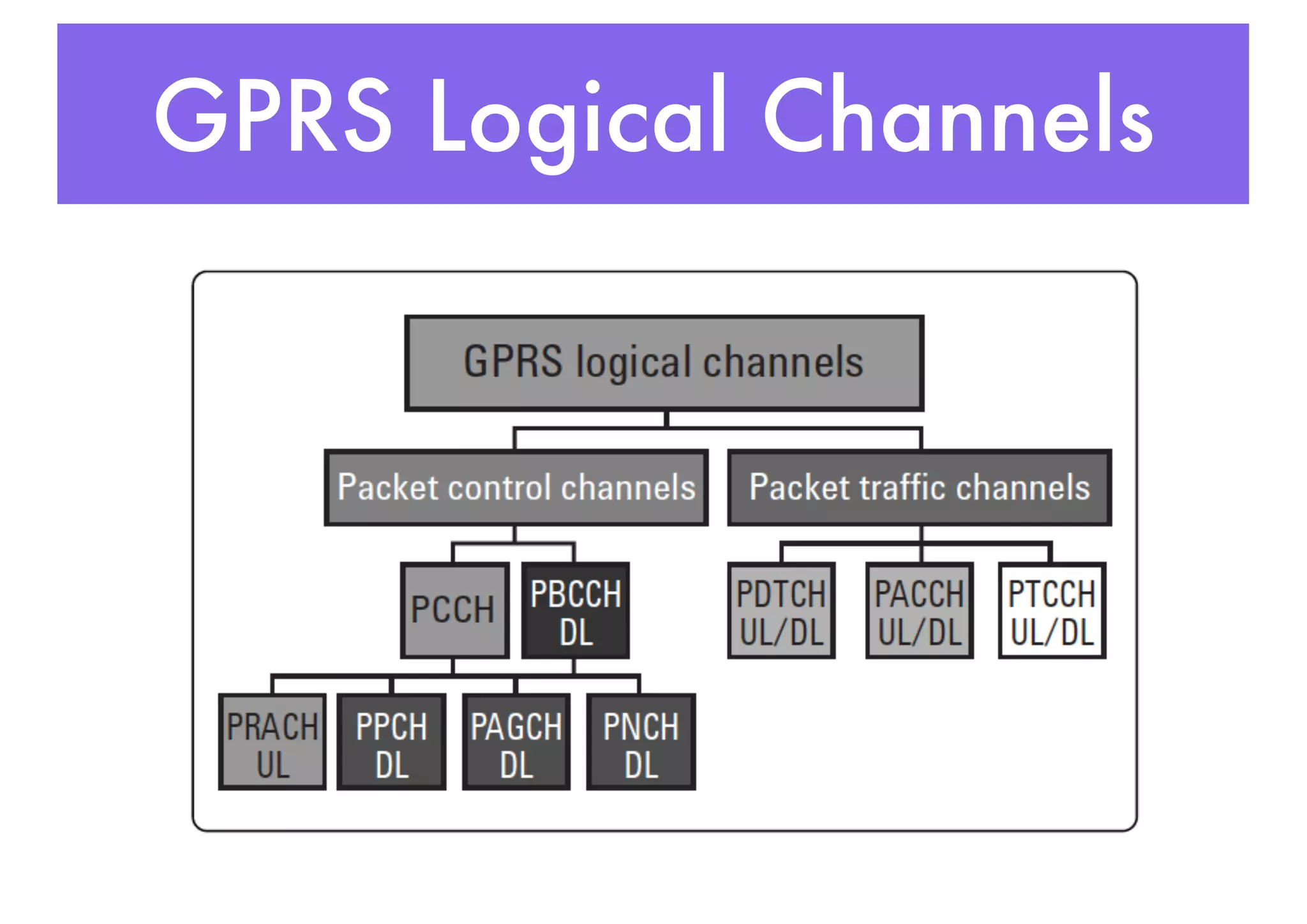
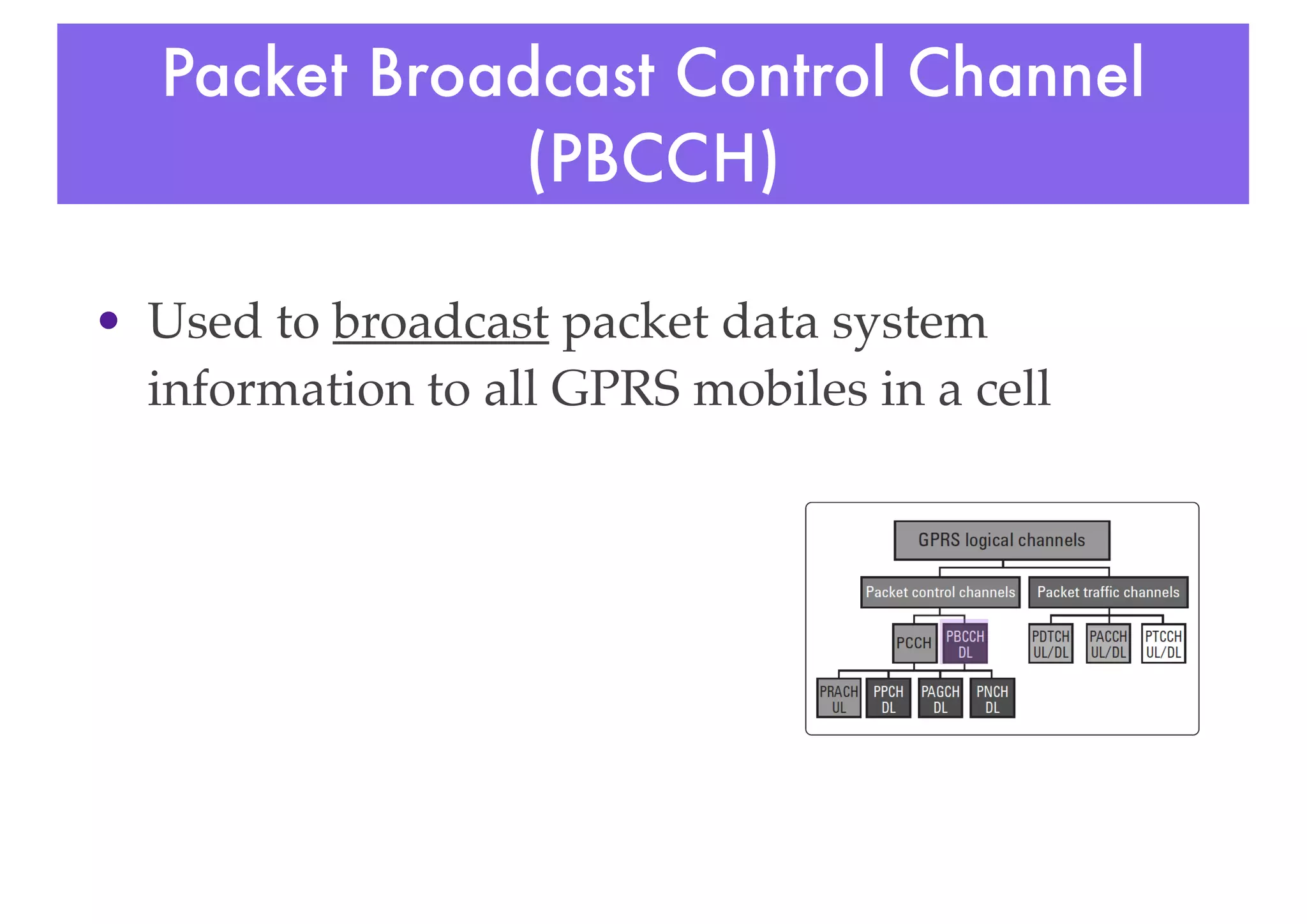
• GPRS logical channels
✓ packet control channels
- PCCCH (Packet Common Control Channel)
- PBCCH (Packet Broadcast Control Channel)
✓ packet traffic channels
- PTCH (Packet Traffic Channel)
Packet Common Control Channel
(PCCCH)
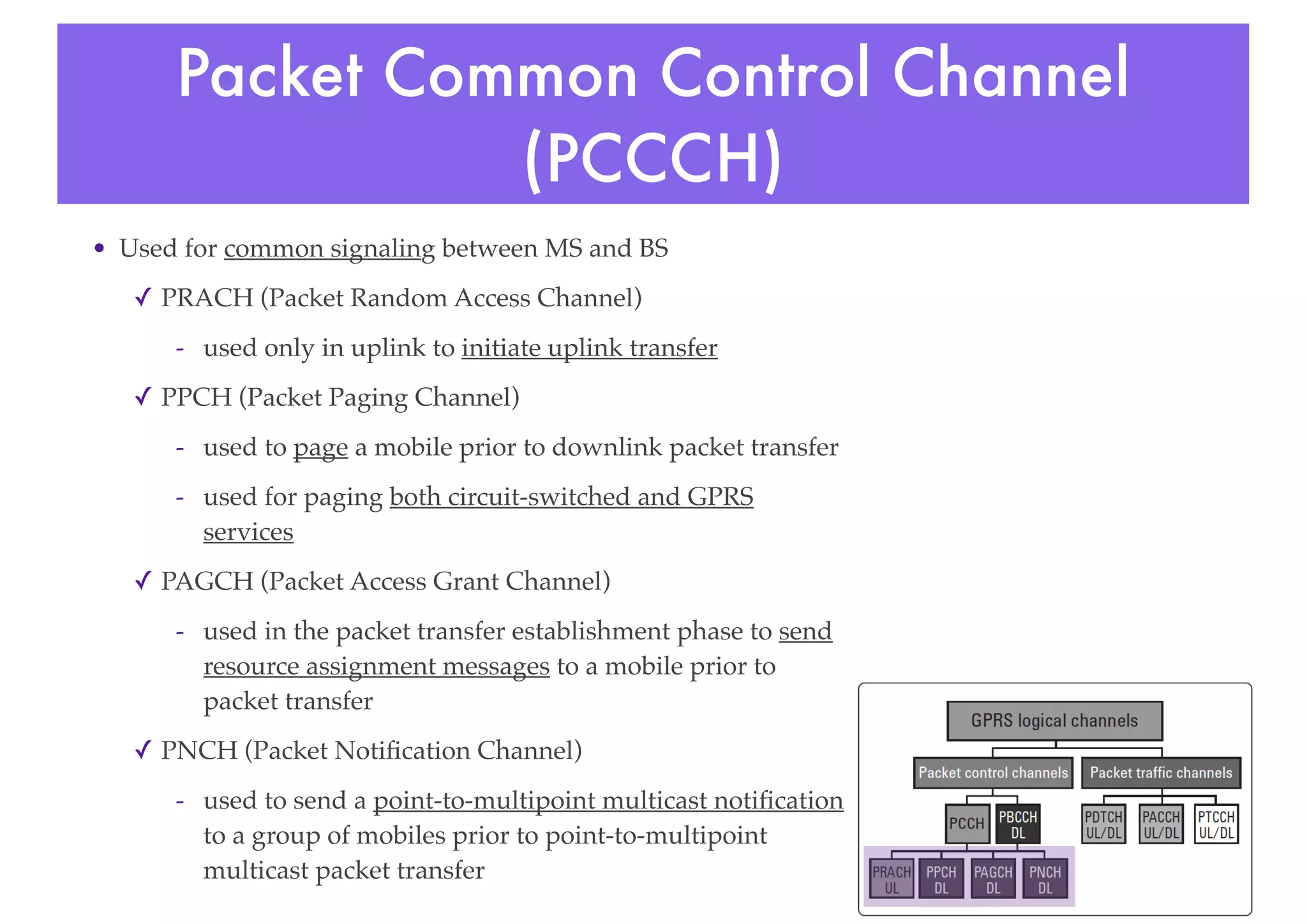
• Used for common signaling between MS and BS
✓ PRACH (Packet Random Access Channel)
- used only in uplink to initiate uplink transfer
✓ PPCH (Packet Paging Channel)
- used to page a mobile prior to downlink packet transfer
- used for paging both circuit-switched and GPRS
services
✓ PAGCH (Packet Access Grant Channel)
- used in the packet transfer establishment phase to send
resource assignment messages to a mobile prior to
packet transfer
✓ PNCH (Packet Notification Channel)
- used to send a point-to-multipoint multicast notification
to a group of mobiles prior to point-to-multipoint
multicast packet transfer
Packet Broadcast Control Channel
(PBCCH)
• Used to broadcast packet data system
information to all GPRS mobiles in a cell
Packet Traffic Channel
(PTCH)
• PTCH consists of the following sub-channels associated with traffic
✓ PDTCH (Packet Data Traffic Channel)
- allocated for data transfer
- it is dedicated temporarily to one or a group of mobiles for multicast
applications
- one mobile may use multiple PDTCHs in parallel for packet data
transfer during multislot operation
✓ PACCH (Packet Associated Control Channel)
- used to convey signaling information related to a given mobile, e.g.,
power control, packet acknowledgments, or resource reassignments
- one PACCH is associated with one or several PDTCHs concurrently
assigned to a mobile
✓ PTCCH (Packet Timing Advance Control Channel)
- used in the uplink for transmission of random access burst
- it allows the timing advance required by the mobile in the packet
transfer mode to be estimated
- in the downlink, the PTCCH can be used to update the timing
advance to multiple mobiles
Group Channel Function Direction
Packet data
Traffic channel
PDTCH Data Traffic MS BSS
Packet broadcast
control channel
PBCCH Broadcast Control MS BSS
Packet common
Control Channel
(PCCCH)
PRACH
PAGCH
PPCH
PNCH
Random Access
Access Grant
Paging
Notification
MS BSS
MS BSS
MS BSS
MS BSS
Packet Dedicated
Control Channels
PACCH
PTCCH
Associated Control
Timing Advance Control
MS BSS
MS BSS
Uplink Data Transfer
MS BSS
PRACH or RACH
PAGCH or AGCH
Random Access
Transmission
Packet channel Request
PACCH
PACCH
PDTCH
PACCH
PDTCH
PACCH
Packet Immediate assignment
Packet resource Request
Packet resource assignment
Frame Transmission
Negative Acknowledgement
Retransmission of blocks in error
Acknowledgement
Downlink Data Transfer
Paging
Transmission
Packet channel Request
PACCH
PDTCH
PACCH
PDTCH
PACCH
Packet Immediate assignment
Packet paging response
Packet resource assignment
Frame Transmission
Negative Acknowledgement
Retransmission of blocks in error
Acknowledgement
Packet paging request
PPCH or PCH
MS BSS
Physical Layer (GSM RF)
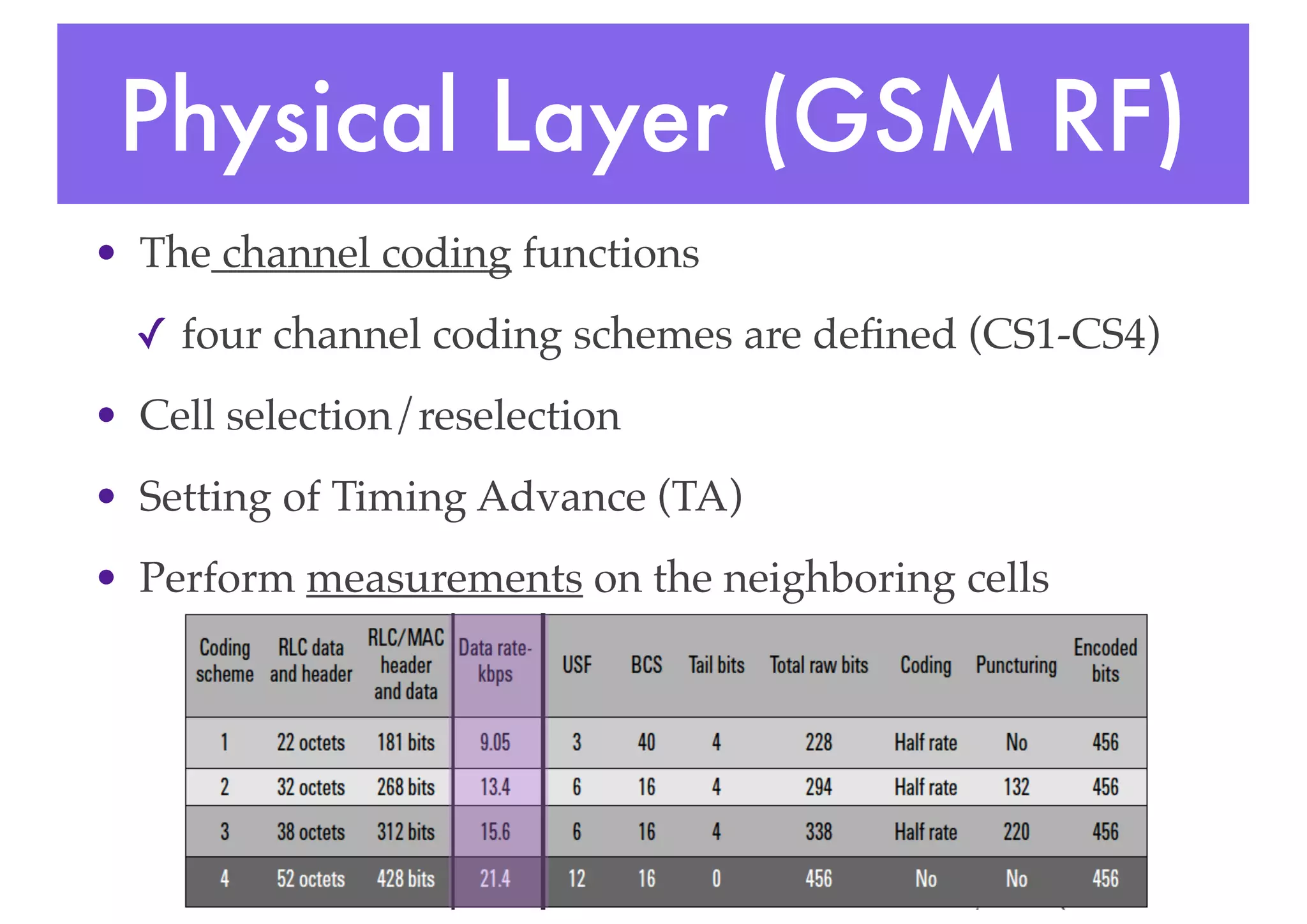
• The channel coding functions
✓ four channel coding schemes are defined (CS1-CS4)
• Cell selection/reselection
• Setting of Timing Advance (TA)
• Perform measurements on the neighboring cells
Radio Link Control / Medium Access Control
(RLC / MAC)
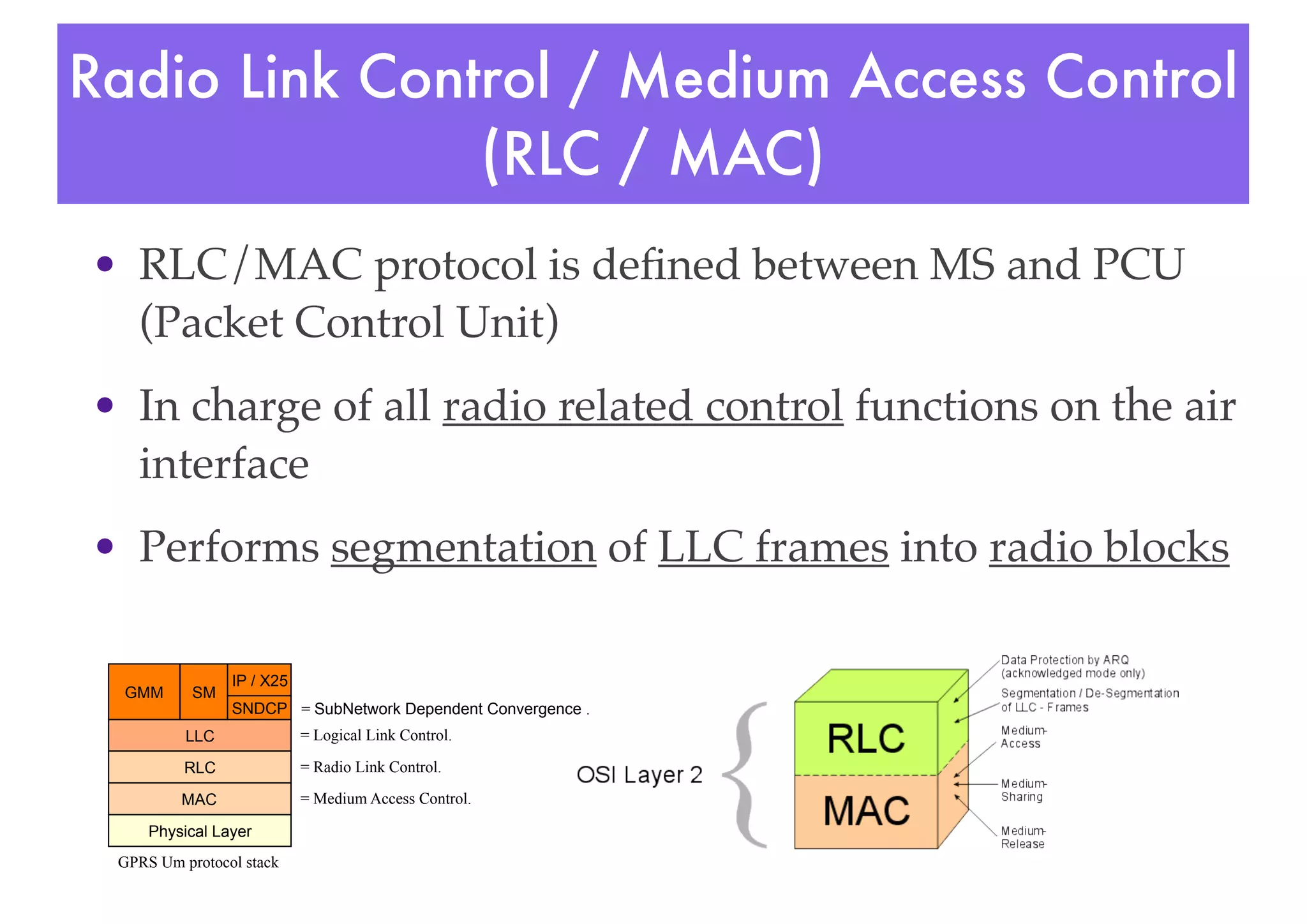
• RLC/MAC protocol is defined between MS and PCU
(Packet Control Unit)
• In charge of all radio related control functions on the air
interface
• Performs segmentation of LLC frames into radio blocks
Physical Layer
MAC
LLC
GMM
RLC
SM
IP / X25
SNDCP
GPRS Um protocol stack
= Radio Link Control.
= Medium Access Control.
= Logical Link Control.
= SubNetwork Dependent Convergence .
Logical Link Control
(LLC)
• LLC provides different types of services to different upper layer
applications, namely SNDCP GMM/SM and SMS
• Provides the transport frames for the data transfer between MS and
SGSN
• Encapsulation of higher layer protocol data units into LLC data units
• Delivery of data units to the higher layer in correct sequence
• Ciphering and deciphering (if enabled)
Physical Layer
MAC
LLC
GMM
RLC
SM
IP / X25
SNDCP
GPRS Um protocol stack
= Radio Link Control.
= Medium Access Control.
= Logical Link Control.
= SubNetwork Dependent Convergence .
Sub-Network Dependent Convergence Protocol
(SNDCP)
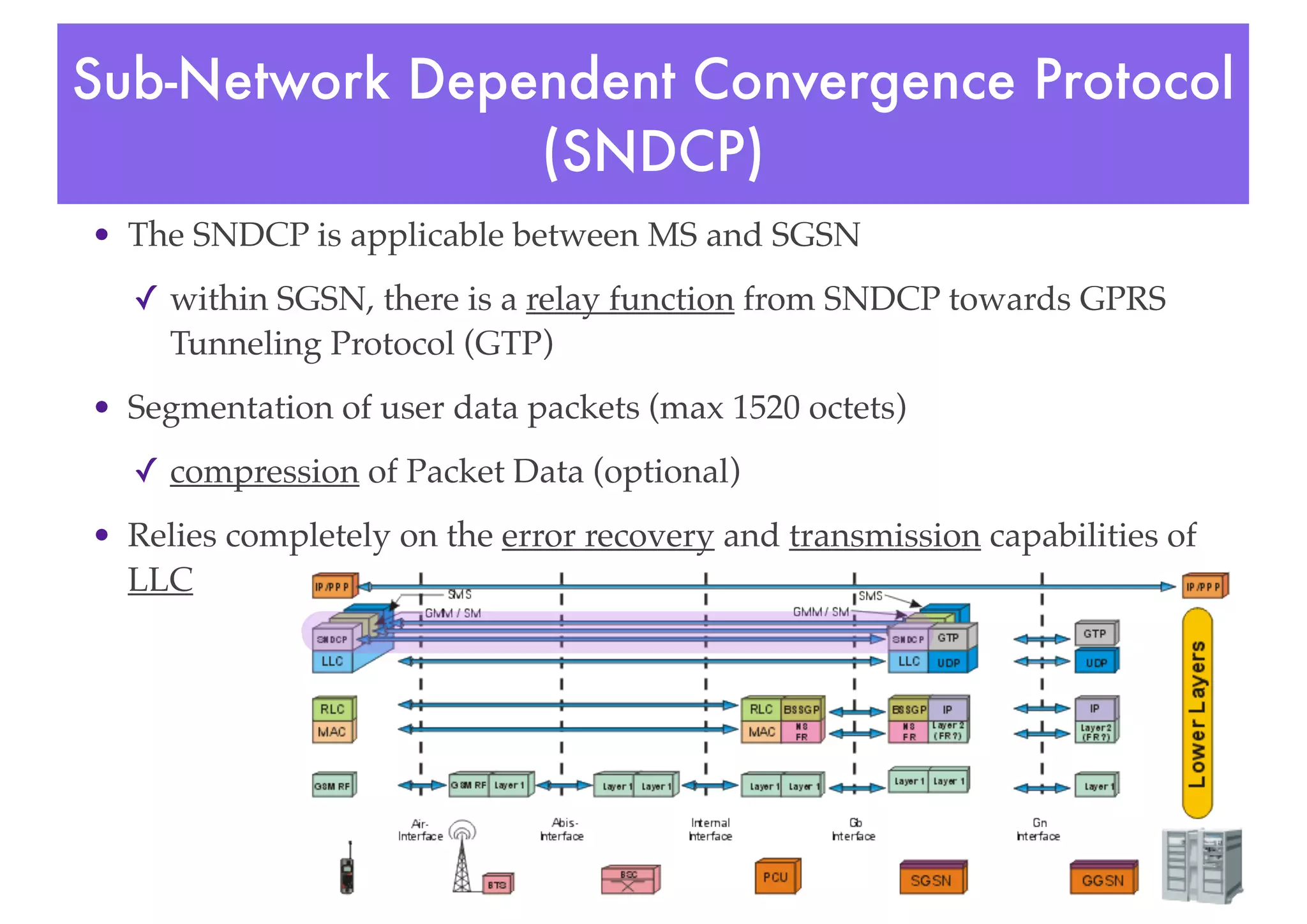
• The SNDCP is applicable between MS and SGSN
✓ within SGSN, there is a relay function from SNDCP towards GPRS
Tunneling Protocol (GTP)
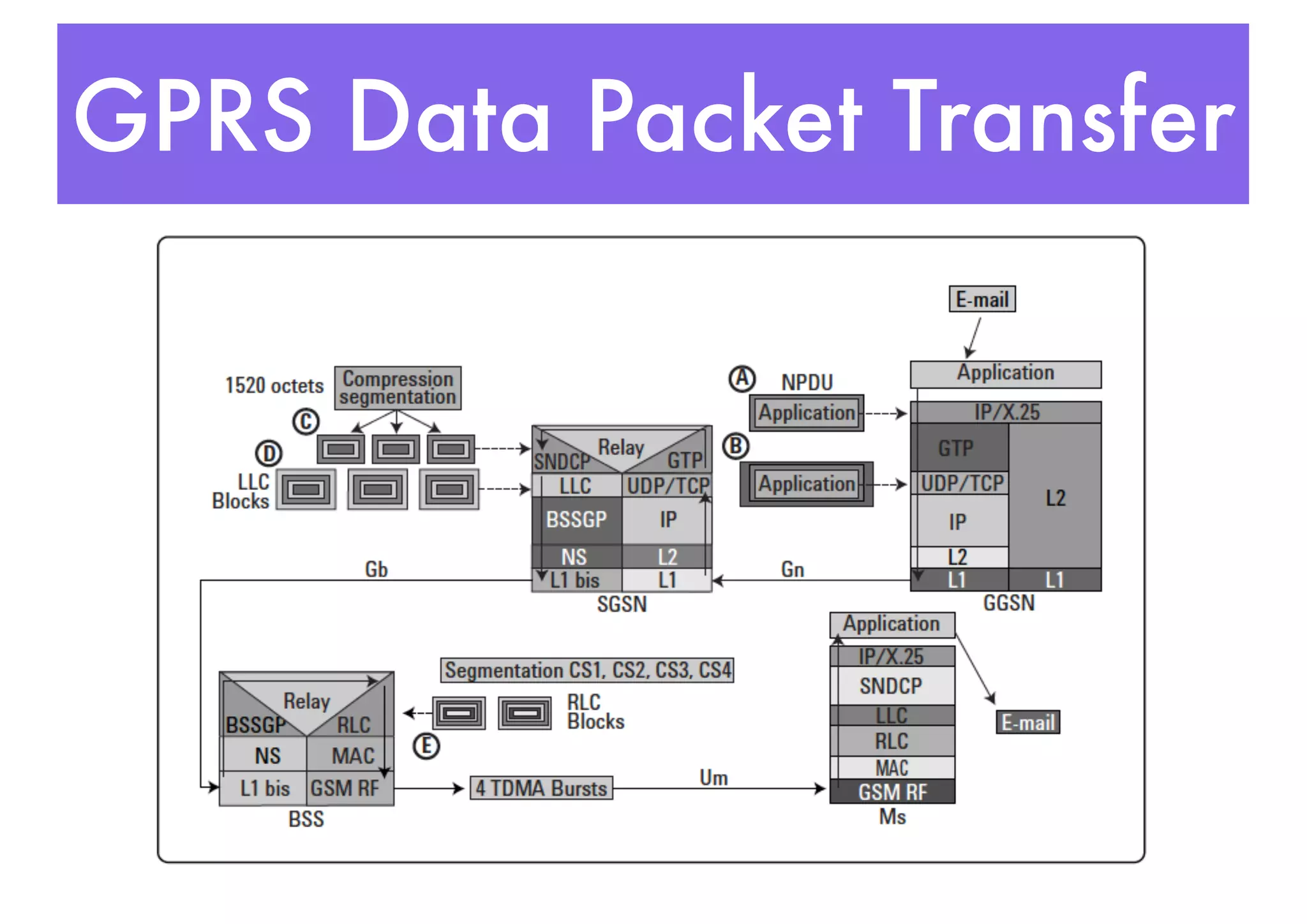
• Segmentation of user data packets (max 1520 octets)
✓ compression of Packet Data (optional)
• Relies completely on the error recovery and transmission capabilities of
LLC
Coding Schemes (CS) in GPRS
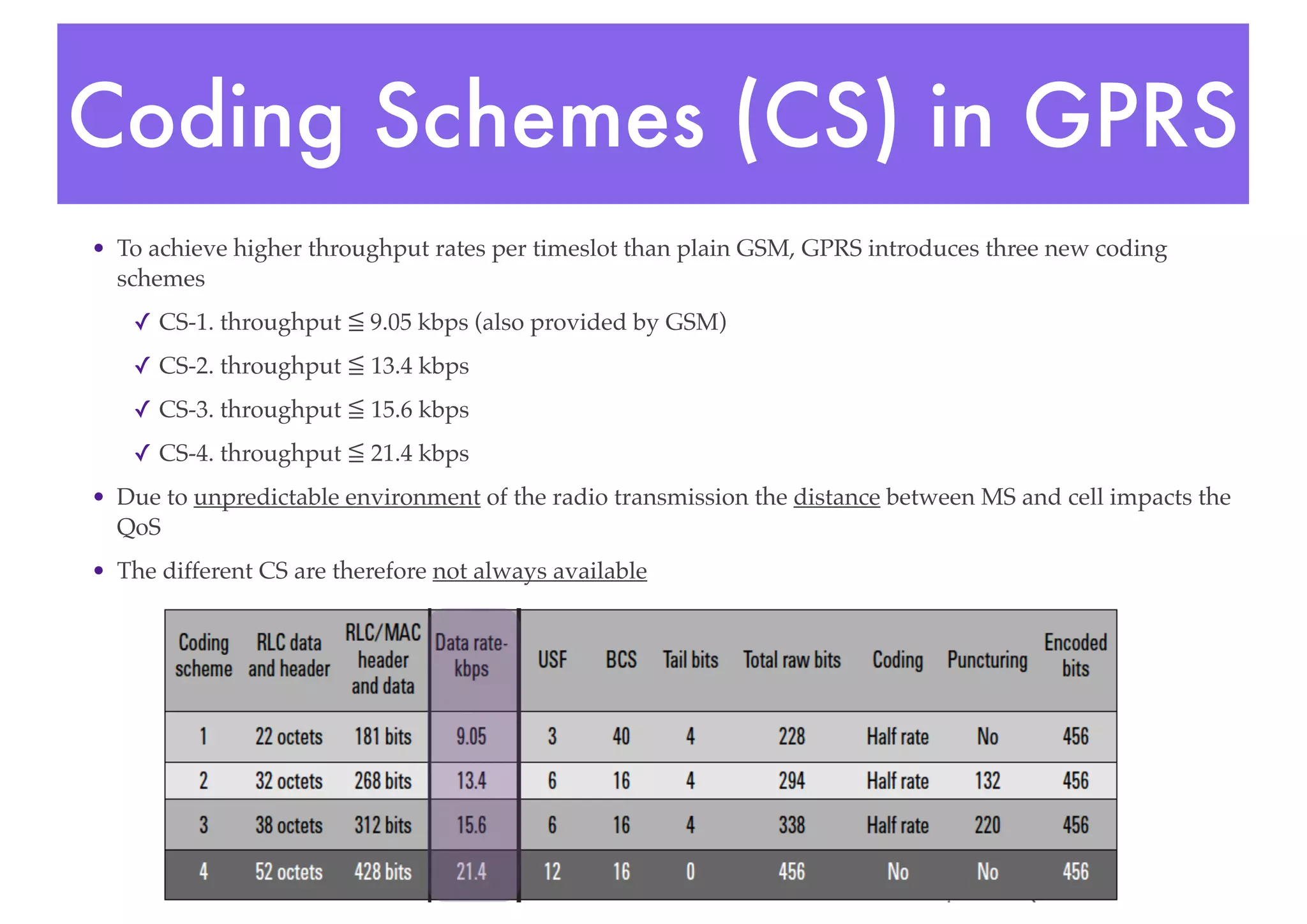
• To achieve higher throughput rates per timeslot than plain GSM, GPRS introduces three new coding
schemes
✓ CS-1. throughput ≦  9.05 kbps (also provided by GSM)
✓ CS-2. throughput ≦ 13.4 kbps
✓ CS-3. throughput ≦ 15.6 kbps
✓ CS-4. throughput ≦ 21.4 kbps
• Due to unpredictable environment of the radio transmission the distance between MS and cell impacts the
QoS
• The different CS are therefore not always available
GPRS Gb Interface
L1bis (WAN) L1 (LAN)
L1bis (WAN)
MAC
RLC
NS
BSSGP
NS
BSSGP
SNDCP
L2 (PPP)
IP
UDP/TCP
GTP
BSS SGSN
Gb
RELAY
RELAY
LLC
LAPG
PLL
RFL
Gb
Gb Protocol Layers
• BSSGP (BSS GPRS Protocol)
✓ transparent transfer of signaling and data PDUs between SGSN and PCU
✓ administration of the packet-switched link resources between SGSN and PCU
✓ initiation of packet-switched paging for a particular MS if requested by SGSN
• NS (Network Service) - consists of two sublayers
✓ Network Service Control Protocol
- provides virtual connections (NS-VC) between the SGSN and the PCU
- these VCs need to be administrated by the NS protocol
✓ Frame Relay Protocol
- NS is a packet-switched protocol: a single virtual connection may use resources from 0 kbps up to entire
bandwidth of the transmission link
- transports BSSGP PDUs between BSS and SGSN
L1bis (WAN) L1 (LAN)
L1bis (WAN)
MAC
RLC
NS
BSSGP
NS
BSSGP
SNDCP
L2 (PPP)
IP
UDP/TCP
GTP
BSS SGSN
Gb
RELAY
RELAY
LLC
LAPG
PLL
RFL
GPRS Interfaces
Other GPRS Interfaces
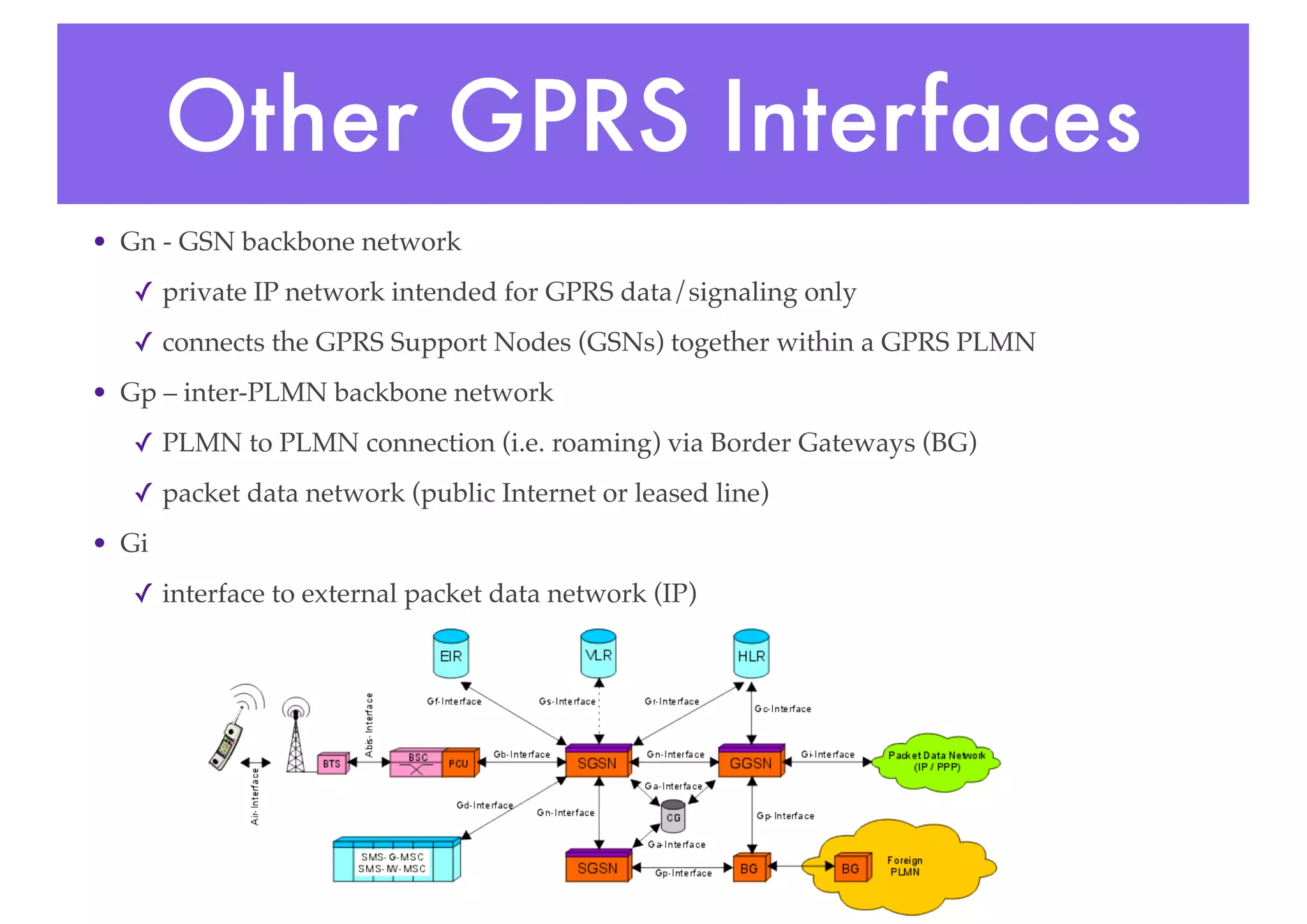
• Gn - GSN backbone network
✓ private IP network intended for GPRS data/signaling only
✓ connects the GPRS Support Nodes (GSNs) together within a GPRS PLMN
• Gp – inter-PLMN backbone network
✓ PLMN to PLMN connection (i.e. roaming) via Border Gateways (BG)
✓ packet data network (public Internet or leased line)
• Gi
✓ interface to external packet data network (IP)
• Gs – SGSN to MSC/VLR
✓ used to perform IMSI attach and GPRS attach
simultaneously
✓ combined paging procedures, where all paging is done
form SGSN
• Gr – SGSN to HLR
✓ SGSN must contact the HLR whenever a new subscriber
enters one of its Routing Areas
• Gd – SGSN to SMS
✓ used if SMS is forwarded over GPRS channels
• Gf – SGSN to EIR
✓ used to check the IMEI number
GPRS Tunnel Protocol
(GTP)
• Allows multi-protocol packets to be
tunneled through GPRS backbone
between GPRS Support Nodes
(GSNs)
• Responsible for the transmission of
both signaling information and
application data
• Based on an IP-protocol stack and
uses UDP as transport layer (OSI
layer 4)
• Also takes care of the transfer of
charging information
L1 (LAN)
L1bis (WAN) L1 (LAN)
Frame Relay
BSSGP
SNDCP
L2 (PPP)
IP
UDP/TCP
GTP
L2 (PPP)
IP
UDP/TCP
GTP
IP/X.25
SGSN GGSN
Gn
RELAY
LLC
LAPG
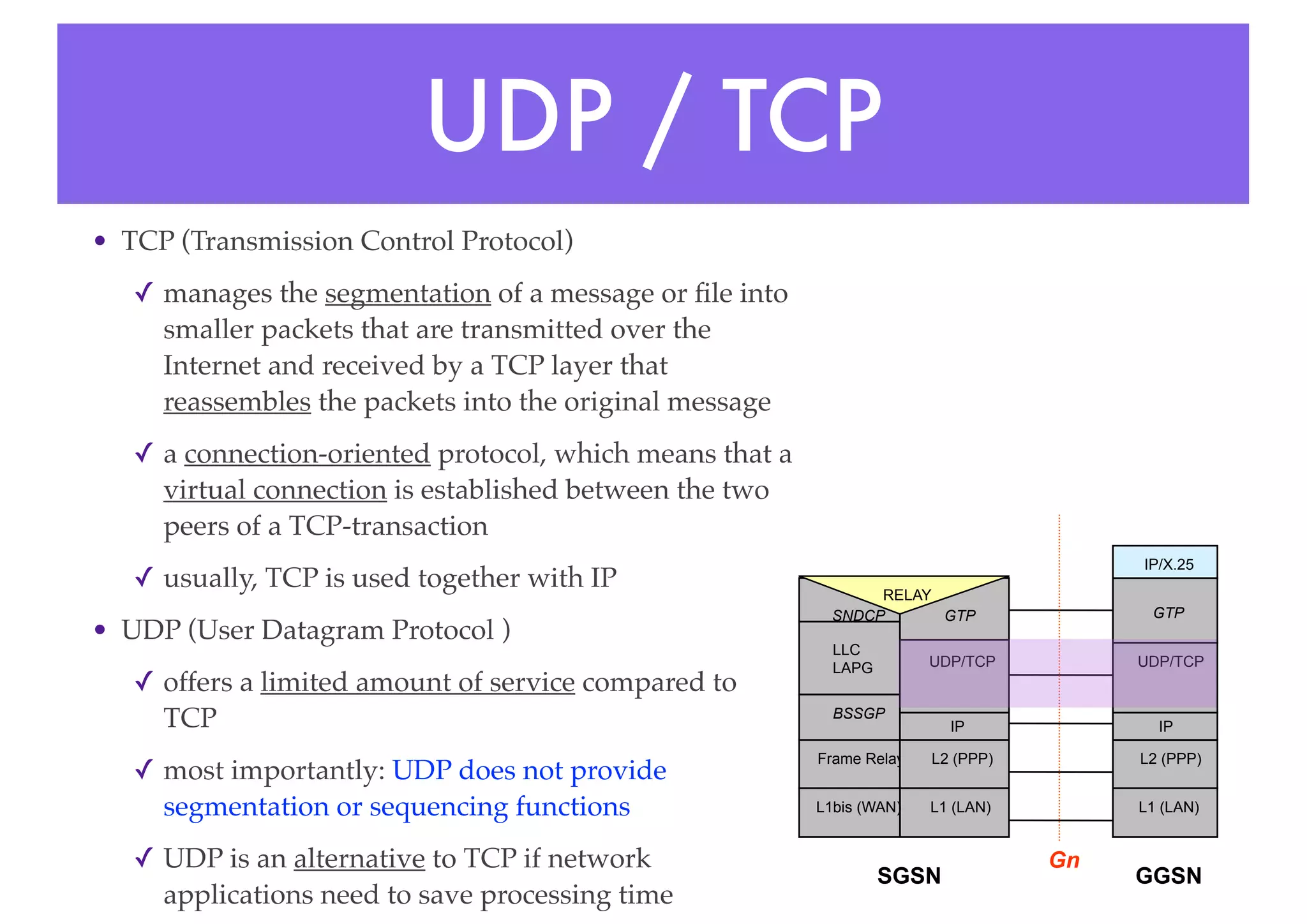
UDP / TCP
• TCP (Transmission Control Protocol)
✓ manages the segmentation of a message or file into
smaller packets that are transmitted over the
Internet and received by a TCP layer that
reassembles the packets into the original message
✓ a connection-oriented protocol, which means that a
virtual connection is established between the two
peers of a TCP-transaction
✓ usually, TCP is used together with IP
• UDP (User Datagram Protocol )
✓ offers a limited amount of service compared to
TCP
✓ most importantly: UDP does not provide
segmentation or sequencing functions
✓ UDP is an alternative to TCP if network
applications need to save processing time
L1 (LAN)
L1bis (WAN) L1 (LAN)
Frame Relay
BSSGP
SNDCP
L2 (PPP)
IP
UDP/TCP
GTP
L2 (PPP)
IP
UDP/TCP
GTP
IP/X.25
SGSN GGSN
Gn
RELAY
LLC
LAPG
GPRS Data Packet Transfer

General Packet Radio Service (GPRS).pdf

  • 1.
    General Packet RadioService (GPRS)
  • 2.
    What is GPRS? •GPRS (General Packet Radio Service) ✓ a packet oriented data service for IP and X.25 over GSM networks ✓ enables packet-switched services on the resources of the already existing GSM network infrastructure ✓ deploying new channel coding schemes and timeslot bundling, GPRS is capable of providing single user throughput rates of up to 160 kbps (in theory) ✓ provides an “always on” functionality, without continuous consumption of resources ✓ requires a major hardware upgrade in the GSM network and it requires new mobile stations ✓ a step toward 3G networks (2.5G)
  • 3.
    From GSM toGPRS Um MAP ISUP MAP MAP ISUP GSM A A-bis BSS PSTN/ISDN R Gi Gp Gb Gs Gf Gr PDN Private Backbone Gn Gn GPRS Gc PDN
  • 4.
  • 5.
    Service GPRS SupportNode (SGSN) • Handles ✓ PDP (Packet Data Protocol) contexts for MSs ✓ determines Quality of Service (QoS) assigned to user ✓ routes packets to MSs ✓ “pages” MSs when data is to be sent ✓ handover/cell change • Stores ✓ subscriber data for all MSs in the location area (LA) ✓ store not-acknowledged packets in case of a cell change during an ongoing packet data transfer
  • 6.
    • Security ✓ authentication,by means of identity or equipment check ✓ P-TMSI is allocated by SGSN ✓ ciphering • Charging ✓ together with the GGSN, the SGSN collects CDR's (Call Data Records) ✓ opposed to the GGSN, the SGSN collects CDR's for the use of the own network resources ✓ these CDR's are forwarded to the Charging Gateway (CG) via the IP-based intra-PLMN backbone
  • 7.
    Gateway GPRS SupportNode (GGSN) • Handles ✓ interconnects a PLMN to the external world (Internet) ✓ routes IP packets to the appropriate SGSN - if the MS changes the SGSN during ready mode, the GGSN is used as data packet buffer ✓ activation and deactivation of PDP-contexts / session management • Stores ✓ subscriber data for active MSs
  • 8.
    • Security ✓ firewall ✓screening • Charging ✓ the GGSN will, in addition to the SGSN, collect CDRs and forward them to the charging gateway (CG) ✓ opposed to the SGSN, the GGSN will collect call data records based on the usage of external network resources ✓ in other words, charges that arise from other packet data or mobile network operators are collected by the GGSN
  • 9.
    Home Location Register (HLR) •New fields has been added to the HLR in order to serve the GPRS Network ✓ IMSI is still the reference key ✓ SGSN number - the SS7 address of SGSN currently serving the MS ✓ SGSN address - the IP address of SGSN currently serving the MS ✓ GGSN list - the GGSN number and optional IP address are related to the GGSN which will be contacted when activity from the MS is detected
  • 10.
    ✓ For eachPDP context - PDP type (e.g. X25 or IP) - PDP address (note: this field will be empty if dynamic IP address is used) - QoS profile (QoS profile for this PDP context) - VPLMN address allowed - Access Point Name (APN)
  • 11.
    Base Station Subsystem (BSS) •In GPRS ✓ LA is divided into RAs ✓ each RA contains one or more cells ✓ in a RA, the RAI is broadcasted as system information ✓ when an MS is crossing an RA border the MS will initiate an RA update procedure • New elements (CCU , PCU) are added to the BSS in order to support new coding schemes introduced by GPRS LA 1 LA 2 RA 1 RA 3 RA 5 RA 2 RA 4 BTS + CCU LA = Location Area LAI = MCC+MNC+LAC RA = Routing Area (Subset of LA) RAI = LAI+RA PCU = Packet Control Unit CCU = Channel Codec Unit
  • 13.
    Packet Control Unit (PCU) •Interface the new GPRS core network to the existing GSM BSS ✓ converting packet data coming from the SGSN in so called PCU-frames that have the same format as TRAU-frames ✓ these PCU-frames are transparently routed through the BSC and towards the BTS ✓ the BTS needs to determine the respective coding scheme and other options before processing a PCU-frame • Takes over all GPRS radio related control functions from the BSC TRAU (Transcoder and Rate Adaptation Unit): performs transcoding function for speech channels and RA (Rate Adaptation) for data channels in the GSM network
  • 14.
    Mobile Station (MS) • Threedifferent classes of MSs have been defined ✓ Class A - supports simultaneous monitoring and operation of packet-switched and circuit-switched services ✓ Class B - supports simultaneous monitoring but not simultaneous operation of circuit-switched and packet-switched services ✓ Class C - supports either circuit-switched or packet-switched monitoring and operation at a given time
  • 15.
    GPRS Mobility Management (GMM) •GMM are used to keep track of the current location of an MS and to initiate security procedures • GMM is a function that is mainly handled between MS and SGSN (the HLR is also involved) • There are various scenarios defined in GPRS to update a subscriber's location within the network ✓ Routing Area Update (Intra-SGSN and Inter- SGSN) ✓ GPRS attach and detach ✓ cell update (only while in GMM-Ready State) • The GMM cell update procedure replaces in GPRS what is known as handover procedure in circuit-switched GSM GPRS Attach
  • 16.
    GSM and GPRSFunctional State Models • Due to the fact that a GPRS MS is not constantly “connected” to the network, the GMM has introduced a new state, called “Ready State”
  • 17.
    GMM States • Idlemode ✓ MS off or not attached yet ✓ if the MS is on, and is a Class B or Class C MS, the MS will listen to the network, but not make any updating of where the MS is ✓ it is not possible to page an MS • Standby mode ✓ MS is listening to the Network ✓ only RA update and periodic update is necessary ✓ it is possible to page the MS Idle Ready Standby GPRS Attach GPRS Detach Ready Timer expired Data transfer or reception
  • 18.
    • Ready mode ✓MS is able to send and receive data ✓ cell updating is necessary ✓ if no activity within the timer (default = 44s) the MS will fall back to a stand-by state ✓ note: an MS can be forced back to standby mode due to lack of recourses Idle Ready Standby GPRS Attach GPRS Detach Ready Timer expired Data transfer or reception
  • 19.
    GMM Procedures • GPRSattach / detach ✓ made towards the SGSN ✓ the MS must provide its identity (P-TMSI/IMSI) and an indication of which type of attach that is to be executed (GPRS or combined GPRS/IMSI) ✓ after GPRS attach the MS is in ”Ready” state and MM contexts are established in the MS and the SGSN • Routing Area update ✓ when a GPRS-attached MS detects a new RA (Routing Area) ✓ when the periodic RA update counter has expired
  • 20.
    • Cell update ✓when the MS enters a new cell inside the current RA and the MS is in ”Ready” state • Combined RA/LA update ✓ only if option Gs-interface is implemented
  • 21.
    Session Management (SM) • Allowtransfer of user data packets between the MS and some external packet data network • Before data transmission start, SM involves a handshaking procedure between MS, SGSN and GGSN • Establish a PDP context between MS and GGSN (includes the negotiated QoS profile)
  • 22.
    PDP Context Activation •Identifies the transaction parameters of an active session of a GPRS MS ✓ note that a GPRS MS may support multiple simultaneous sessions and activate PDP-contexts • Can be initiated by network or MS (in ”Standby” or ”Ready” state) • Cannot be activated before a GMM context exists (a GPRS MS first needs to register itself towards the SGSN before a PDP context activation procedure can be initiated) • Can be deactivated on request of MS or SGSN or GGSN by means of PDP context deactivation procedure PDP Context Activation
  • 23.
    A MS withtwo PDP Contexts Active
  • 24.
    Radio Resource (RR)Management Procedures • Takes care of the allocation and maintenance of radio communication paths • Paging procedure ✓ moves the MM state to ”Ready” to allow SGSN to forward downlink data to BSS • TBF (Temporary Block Flow) establishment/release ✓ a TBF is a physical connection (allocated radio resource) used by two RR entities to support unidirectional transfer of user data or signaling ✓ a TBF is temporary and is maintained only for the duration of the data transfer
  • 25.
  • 26.
    GPRS Um Interface •RLC protocol and MAC protocol is in charge of all radio related control functions on the air interface (PCU and MS) • LLC protocol is in charge of transmission between SGSN and MS • Delivery of data units to the higher layer in the correct sequence • SNDCP (Sub Network Dependent Convergence Protocol) protocol is in charge of segmentation and compression of data (SGSN and MS) Um Physical Layer MAC LLC GMM RLC SM IP / X25 SNDCP GPRS Um protocol stack = Radio Link Control. = Medium Access Control. = Logical Link Control. = SubNetwork Dependent Convergence .
  • 27.
    GPRS Um Interface R BTS SNDPC LLC MAC/RLCMAC/RLC Info H Info H Info H Segment H FSC Towards the SGSN. E.g. WWW or E-mail IP Segmentation and compressing H = Header. B = Normal Burst, see the GSM recommendation. FSC = Frame Check Sequence. Towards the PCU Physical Layer 1. B B B B LLC frame Max size 1600 octets. Encryption, error detecting and retransmission. RLC Block 20 to 50 octets of data Into normal radio bursts (58bit*8) = 456bit.
  • 28.
    GPRS A-bis Interface •In GPRS each vendor is making his own version of the A- bis protocol (not specified) • The BTMS (BTS Management Protocol for GSM) has been changed to BSSGP (Base Station System GPRS Protocol) = BSS GPRS. = Frame Relay Layer1 Network Service Relay A-bis protocol stack BSSGP Layer1 RLC MAC LLC GMM/SM Gb protocol stack Um
  • 29.
  • 30.
    • Logical channelsare pre-defined functions supported by frames within a physical channel • GPRS physical channels generally carry two types of information ✓ control signaling - establish and maintain a GPRS service ✓ user data traffic • GPRS logical channels ✓ packet control channels - PCCCH (Packet Common Control Channel) - PBCCH (Packet Broadcast Control Channel) ✓ packet traffic channels - PTCH (Packet Traffic Channel)
  • 31.
    Packet Common ControlChannel (PCCCH) • Used for common signaling between MS and BS ✓ PRACH (Packet Random Access Channel) - used only in uplink to initiate uplink transfer ✓ PPCH (Packet Paging Channel) - used to page a mobile prior to downlink packet transfer - used for paging both circuit-switched and GPRS services ✓ PAGCH (Packet Access Grant Channel) - used in the packet transfer establishment phase to send resource assignment messages to a mobile prior to packet transfer ✓ PNCH (Packet Notification Channel) - used to send a point-to-multipoint multicast notification to a group of mobiles prior to point-to-multipoint multicast packet transfer
  • 32.
    Packet Broadcast ControlChannel (PBCCH) • Used to broadcast packet data system information to all GPRS mobiles in a cell
  • 33.
    Packet Traffic Channel (PTCH) •PTCH consists of the following sub-channels associated with traffic ✓ PDTCH (Packet Data Traffic Channel) - allocated for data transfer - it is dedicated temporarily to one or a group of mobiles for multicast applications - one mobile may use multiple PDTCHs in parallel for packet data transfer during multislot operation ✓ PACCH (Packet Associated Control Channel) - used to convey signaling information related to a given mobile, e.g., power control, packet acknowledgments, or resource reassignments - one PACCH is associated with one or several PDTCHs concurrently assigned to a mobile ✓ PTCCH (Packet Timing Advance Control Channel) - used in the uplink for transmission of random access burst - it allows the timing advance required by the mobile in the packet transfer mode to be estimated - in the downlink, the PTCCH can be used to update the timing advance to multiple mobiles
  • 34.
    Group Channel FunctionDirection Packet data Traffic channel PDTCH Data Traffic MS BSS Packet broadcast control channel PBCCH Broadcast Control MS BSS Packet common Control Channel (PCCCH) PRACH PAGCH PPCH PNCH Random Access Access Grant Paging Notification MS BSS MS BSS MS BSS MS BSS Packet Dedicated Control Channels PACCH PTCCH Associated Control Timing Advance Control MS BSS MS BSS
  • 35.
    Uplink Data Transfer MSBSS PRACH or RACH PAGCH or AGCH Random Access Transmission Packet channel Request PACCH PACCH PDTCH PACCH PDTCH PACCH Packet Immediate assignment Packet resource Request Packet resource assignment Frame Transmission Negative Acknowledgement Retransmission of blocks in error Acknowledgement
  • 36.
    Downlink Data Transfer Paging Transmission Packetchannel Request PACCH PDTCH PACCH PDTCH PACCH Packet Immediate assignment Packet paging response Packet resource assignment Frame Transmission Negative Acknowledgement Retransmission of blocks in error Acknowledgement Packet paging request PPCH or PCH MS BSS
  • 37.
    Physical Layer (GSMRF) • The channel coding functions ✓ four channel coding schemes are defined (CS1-CS4) • Cell selection/reselection • Setting of Timing Advance (TA) • Perform measurements on the neighboring cells
  • 38.
    Radio Link Control/ Medium Access Control (RLC / MAC) • RLC/MAC protocol is defined between MS and PCU (Packet Control Unit) • In charge of all radio related control functions on the air interface • Performs segmentation of LLC frames into radio blocks Physical Layer MAC LLC GMM RLC SM IP / X25 SNDCP GPRS Um protocol stack = Radio Link Control. = Medium Access Control. = Logical Link Control. = SubNetwork Dependent Convergence .
  • 39.
    Logical Link Control (LLC) •LLC provides different types of services to different upper layer applications, namely SNDCP GMM/SM and SMS • Provides the transport frames for the data transfer between MS and SGSN • Encapsulation of higher layer protocol data units into LLC data units • Delivery of data units to the higher layer in correct sequence • Ciphering and deciphering (if enabled) Physical Layer MAC LLC GMM RLC SM IP / X25 SNDCP GPRS Um protocol stack = Radio Link Control. = Medium Access Control. = Logical Link Control. = SubNetwork Dependent Convergence .
  • 40.
    Sub-Network Dependent ConvergenceProtocol (SNDCP) • The SNDCP is applicable between MS and SGSN ✓ within SGSN, there is a relay function from SNDCP towards GPRS Tunneling Protocol (GTP) • Segmentation of user data packets (max 1520 octets) ✓ compression of Packet Data (optional) • Relies completely on the error recovery and transmission capabilities of LLC
  • 41.
    Coding Schemes (CS)in GPRS • To achieve higher throughput rates per timeslot than plain GSM, GPRS introduces three new coding schemes ✓ CS-1. throughput ≦  9.05 kbps (also provided by GSM) ✓ CS-2. throughput ≦ 13.4 kbps ✓ CS-3. throughput ≦ 15.6 kbps ✓ CS-4. throughput ≦ 21.4 kbps • Due to unpredictable environment of the radio transmission the distance between MS and cell impacts the QoS • The different CS are therefore not always available
  • 42.
    GPRS Gb Interface L1bis(WAN) L1 (LAN) L1bis (WAN) MAC RLC NS BSSGP NS BSSGP SNDCP L2 (PPP) IP UDP/TCP GTP BSS SGSN Gb RELAY RELAY LLC LAPG PLL RFL Gb
  • 43.
    Gb Protocol Layers •BSSGP (BSS GPRS Protocol) ✓ transparent transfer of signaling and data PDUs between SGSN and PCU ✓ administration of the packet-switched link resources between SGSN and PCU ✓ initiation of packet-switched paging for a particular MS if requested by SGSN • NS (Network Service) - consists of two sublayers ✓ Network Service Control Protocol - provides virtual connections (NS-VC) between the SGSN and the PCU - these VCs need to be administrated by the NS protocol ✓ Frame Relay Protocol - NS is a packet-switched protocol: a single virtual connection may use resources from 0 kbps up to entire bandwidth of the transmission link - transports BSSGP PDUs between BSS and SGSN L1bis (WAN) L1 (LAN) L1bis (WAN) MAC RLC NS BSSGP NS BSSGP SNDCP L2 (PPP) IP UDP/TCP GTP BSS SGSN Gb RELAY RELAY LLC LAPG PLL RFL
  • 44.
  • 45.
    Other GPRS Interfaces •Gn - GSN backbone network ✓ private IP network intended for GPRS data/signaling only ✓ connects the GPRS Support Nodes (GSNs) together within a GPRS PLMN • Gp – inter-PLMN backbone network ✓ PLMN to PLMN connection (i.e. roaming) via Border Gateways (BG) ✓ packet data network (public Internet or leased line) • Gi ✓ interface to external packet data network (IP)
  • 46.
    • Gs –SGSN to MSC/VLR ✓ used to perform IMSI attach and GPRS attach simultaneously ✓ combined paging procedures, where all paging is done form SGSN • Gr – SGSN to HLR ✓ SGSN must contact the HLR whenever a new subscriber enters one of its Routing Areas • Gd – SGSN to SMS ✓ used if SMS is forwarded over GPRS channels • Gf – SGSN to EIR ✓ used to check the IMEI number
  • 47.
    GPRS Tunnel Protocol (GTP) •Allows multi-protocol packets to be tunneled through GPRS backbone between GPRS Support Nodes (GSNs) • Responsible for the transmission of both signaling information and application data • Based on an IP-protocol stack and uses UDP as transport layer (OSI layer 4) • Also takes care of the transfer of charging information L1 (LAN) L1bis (WAN) L1 (LAN) Frame Relay BSSGP SNDCP L2 (PPP) IP UDP/TCP GTP L2 (PPP) IP UDP/TCP GTP IP/X.25 SGSN GGSN Gn RELAY LLC LAPG
  • 48.
    UDP / TCP •TCP (Transmission Control Protocol) ✓ manages the segmentation of a message or file into smaller packets that are transmitted over the Internet and received by a TCP layer that reassembles the packets into the original message ✓ a connection-oriented protocol, which means that a virtual connection is established between the two peers of a TCP-transaction ✓ usually, TCP is used together with IP • UDP (User Datagram Protocol ) ✓ offers a limited amount of service compared to TCP ✓ most importantly: UDP does not provide segmentation or sequencing functions ✓ UDP is an alternative to TCP if network applications need to save processing time L1 (LAN) L1bis (WAN) L1 (LAN) Frame Relay BSSGP SNDCP L2 (PPP) IP UDP/TCP GTP L2 (PPP) IP UDP/TCP GTP IP/X.25 SGSN GGSN Gn RELAY LLC LAPG
  • 49.